

★★★★★ 4.5/5 — A case for working with your energy cycles instead of a flat, linear schedule.
Best for: Women who feel like standard productivity advice was never built with their bodies in mind.
Reading time: ~4 hrs to read · guide: 18 min to skim this summary.
Difficulty to apply: Moderate — requires tracking your own patterns before the framework can be personalized.
Do Less in one minute
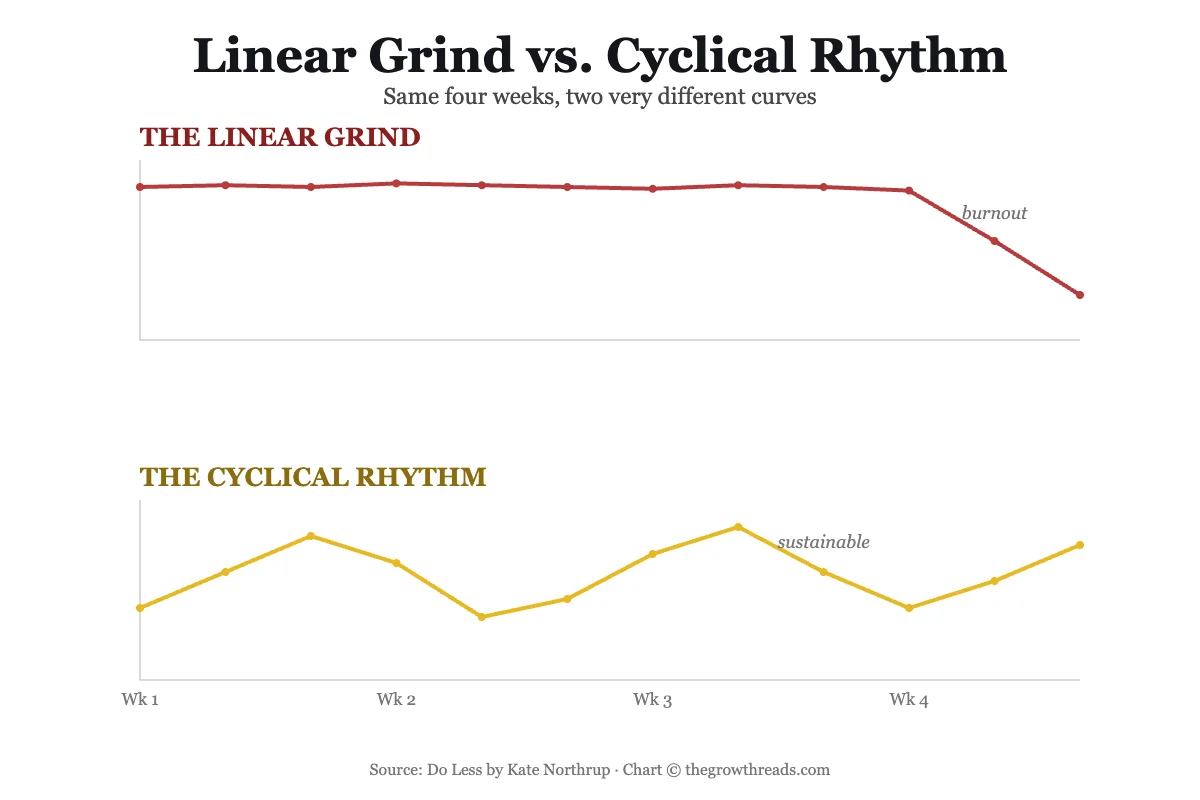
Most productivity advice assumes a flat, linear output curve — the same energy and focus every day, five days a week — and that assumption doesn’t match how many women’s bodies actually work. Kate Northrup’s Do Less argues for replacing that grind-culture model with cycle-aware planning: tracking your own energy rhythms (tied to the menstrual cycle, or lunar phases for those without one) and matching the type of work you take on to where you are in that cycle, rather than forcing every day into the same mold. The book also pushes back on busyness as an identity, arguing that self-worth doesn’t need to be earned through constant output.
Key takeaways
- Linear scheduling isn’t neutral: a fixed, identical-every-day schedule assumes flat energy output that doesn’t match how many people’s bodies actually work.
- Energy has a cycle, not just a level: the book frames capacity as moving through phases rather than being simply “high” or “low.”
- Match tasks to phase: higher-output phases suit demanding, outward-facing work; lower-output phases suit reflection, planning, and rest.
- Moon phases as an alternative: the book offers lunar cycles as a substitute framework for readers without a menstrual cycle to track.
- Rest is part of the system, not a break from it: recovery phases are framed as what makes the higher-output phases sustainable.
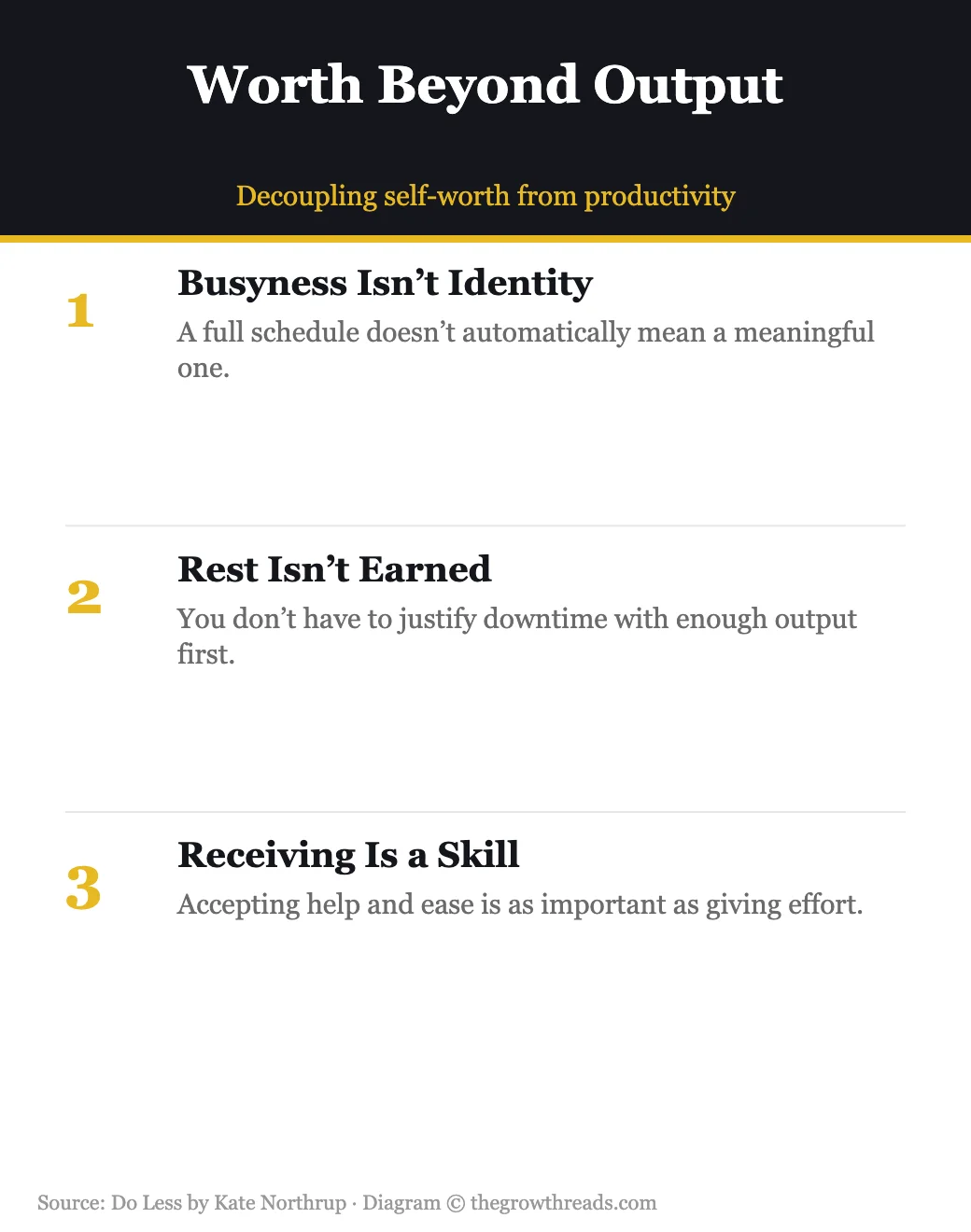
- Busyness isn’t the same as worth: the book argues against tying self-worth to how full your calendar looks.
- Receiving is a practice: accepting help, ease, and support is treated as a skill worth building, not a weakness.
- Sustainability beats a sprint: a cyclical rhythm, even with lower peaks, is framed as more durable than a flat grind that eventually crashes.
What is Do Less about?
Do Less is Kate Northrup’s case for replacing linear, grind-based productivity with cycle-aware planning that matches your workload to your natural energy rhythms rather than a fixed daily schedule. The book pairs this practical framework with a broader argument against tying self-worth to busyness, encouraging readers to treat rest and receiving help as legitimate parts of getting things done, not exceptions to it.
About the author
Kate Northrup is the daughter of Dr. Christiane Northrup, a well-known physician and author on women’s health, and has built her own career and platform around reframing money, energy, and time for women, following an earlier book, Money: A Love Story. She runs a podcast and a paid community for women applying these ideas, and Do Less extends her earlier work on scarcity and worth into the specific territory of time and energy management. Explore all Kate Northrup book summaries →
That throughline from Money: A Love Story to Do Less is worth noting for readers familiar with her earlier work — both books share a core move of taking a resource most people manage through willpower and grind (money, then time and energy) and reframing scarcity around it as partly a mindset problem rather than purely a logistics one.
Key concepts at a glance
| Concept | What it means | Use it when |
| Cycle syncing | Matching task type to where you are in your energy cycle. | You want to plan a week or month around your own rhythm. |
| Four cycle phases | Rest & reflect, build & initiate, peak & deliver, wind down. | You’re deciding what kind of work to schedule for a given week. |
| Lunar alternative | Moon phases as a substitute cycle for readers without a menstrual cycle. | You want a rhythm-based framework without tracking a cycle. |
| Worth beyond output | Self-worth decoupled from how busy or productive you look. | You notice guilt creeping in during lower-output periods. |
| Receiving as a skill | Actively accepting help and ease rather than only giving effort. | You default to doing everything yourself even when support is offered. |
Part 1: Why linear scheduling doesn’t fit everyone
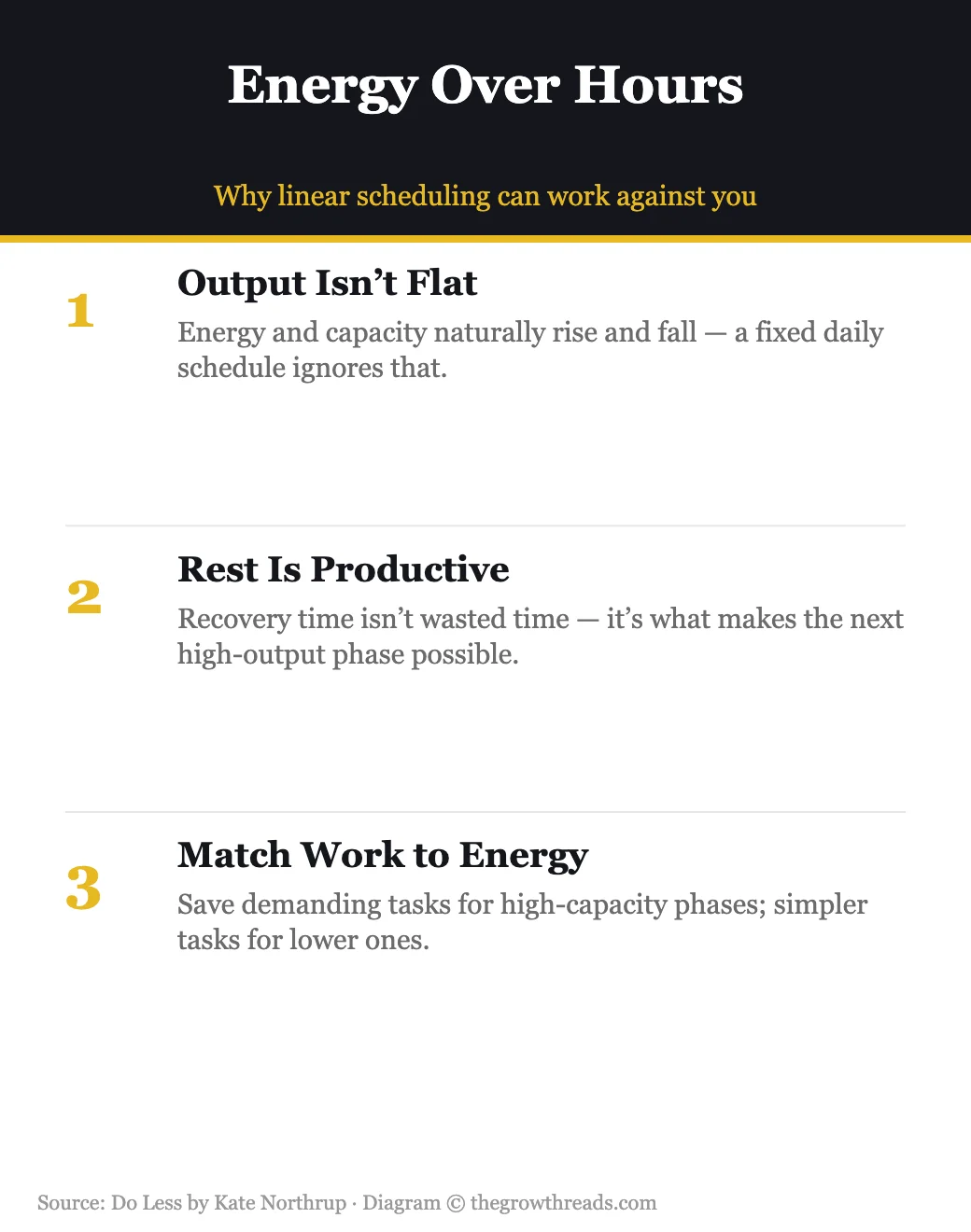
Northrup opens by naming an assumption baked into most mainstream productivity advice: that output should be roughly flat, day after day, week after week. She argues this model was built around a default that doesn’t match how many women’s bodies and energy levels actually move through a month, and that trying to force a cyclical body into a linear schedule produces avoidable friction and, over time, burnout.
The book frames this not as an excuse to do less overall, but as a redesign of when different kinds of effort happen — matching the type of task to the phase of energy available, rather than treating every workday as functionally identical.
She’s careful to frame this as a redesign rather than a reduction in ambition — the goal isn’t to accomplish less overall, but to stop fighting a body that doesn’t run on a flat line. A demanding task attempted during a low-capacity window often takes longer and produces worse results than the same task tackled during a higher-capacity one, so the “linear” schedule can end up less efficient than it looks on paper, not more.
Part 2: The four-phase framework
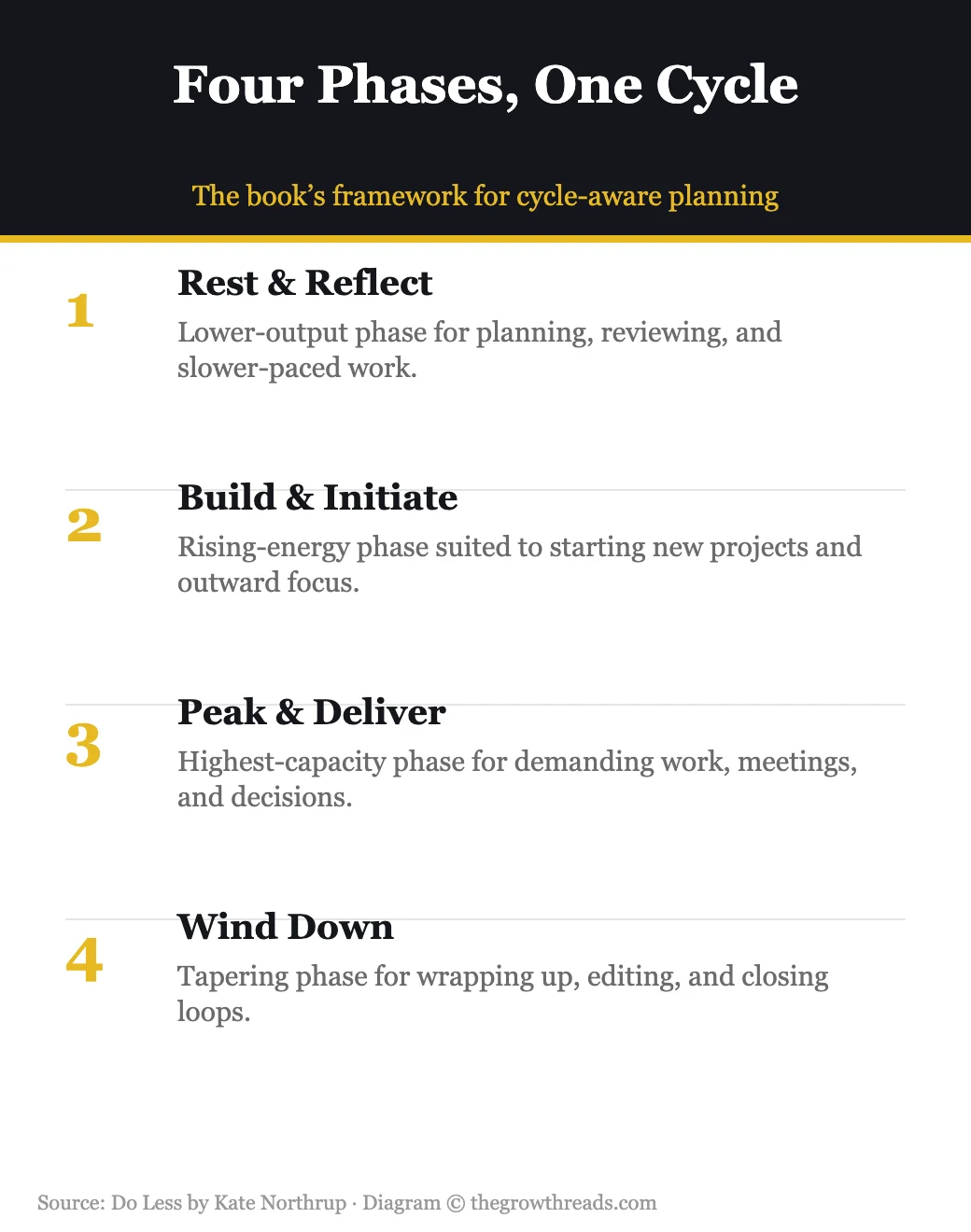
The book’s practical core is a four-phase model readers can use to plan around: a rest-and-reflect phase suited to lower-output planning and review; a build-and-initiate phase for starting new projects; a peak-and-deliver phase for the most demanding work, meetings, and decisions; and a wind-down phase for closing loops and finishing what’s in progress. For readers tracking a menstrual cycle, these phases are tied to that cycle; for readers without one — due to menopause, medication, or simply not having a cycle to track — Northrup offers lunar phases as an alternative rhythm to plan around.
The framework is presented as a starting template to personalize through observation, not a rigid formula — Northrup encourages readers to track their own actual energy patterns for a cycle or two before assuming the phases land exactly where a generic template predicts.
This tracking-first approach matters because the book is explicit that everyone’s pattern differs — two readers using the same four-phase template might find their personal peak-and-deliver window falls at very different points relative to a generic calendar. The template gives readers a vocabulary and structure to notice their own pattern, rather than a fixed schedule to adopt without checking it against their own experience.
Part 3: Worth beyond output
Alongside the scheduling framework, Northrup makes a broader argument: that busyness has become a stand-in for worthiness, and that a full calendar doesn’t automatically mean a meaningful or well-spent one. She traces this back to cultural messaging that ties a person’s value to visible output and constant availability, and argues that untangling the two is necessary before cyclical planning can actually stick — otherwise, guilt during lower-output phases quietly pulls readers back to the flat grind schedule they were trying to leave.
This is arguably the book’s most useful practical warning: a cyclical planning framework adopted purely as a scheduling technique, without addressing the underlying belief that rest must be earned, tends to collapse the first time a lower-output week coincides with a busy period at work. The worth-and-busyness argument isn’t a separate self-help tangent from the time-management content — it’s presented as the load-bearing belief the whole system depends on.
“Receiving” gets specific treatment as a practice to build, not just a nice idea — actively accepting help, delegating, and allowing ease are framed as skills many high-achieving readers haven’t developed, having spent far more time practicing giving and doing than accepting support.
Northrup connects this directly back to the busyness-as-identity theme: someone who equates their worth with visible effort will tend to resist help almost reflexively, since accepting it can feel like admitting they didn’t need to do everything themselves after all. Building the practice of receiving, in her framing, is partly a scheduling skill and partly an identity shift — both need to move together for the cyclical approach to actually stick over time.
Who is Do Less best for — and who should read something else first?
This book is best for women who’ve tried standard, gender-neutral productivity systems and found them consistently out of step with how their own energy actually moves through a month. Its combination of a practical planning framework and a broader worth/busyness argument makes it useful both for scheduling and for the guilt that often comes with resting.
If you don’t relate to the cycle-based framing — because of menopause, gender, or simply preferring a different lens — the underlying “match your work to your energy, not the clock” idea is shared with Two Awesome Hours, which reaches a similar conclusion through a single-day energy curve instead of a monthly cycle. If your main challenge is sustaining daily effort rather than planning around energy phases, The Miracle Equation may be a better fit.
Questions to reflect on
- Does your current schedule assume the same energy and focus every single day, regardless of how you actually feel?
- When was the last time you rested without first feeling like you’d “earned” it through enough output?
- What’s one task on your plate right now that would go better in a different week than the one it’s scheduled for?
- Is your calendar full of things that matter, or full of things that just look productive?
- What’s one piece of help you’ve been declining that you could actually accept this week?
🔥 Ready to work with your energy, not against it?
Grab a copy and start planning around your own natural rhythm.
How to apply Do Less (7-day plan)
- Day 1 — Start tracking: Begin logging your energy level each day, whether by cycle phase, moon phase, or simple daily notes.
- Day 2 — Audit your calendar: Review the next two weeks and flag anything scheduled without regard to your likely energy that day.
- Day 3 — Identify your phases: Based on your tracking so far, sketch a rough map of your own higher- and lower-output periods.
- Day 4 — Move one task: Reschedule one demanding task into a higher-energy window and one lighter task into a lower one.
- Day 5 — Practice receiving: Accept one offer of help or delegate one task you’d normally handle alone.
- Day 6 — Protect a rest phase: Block time for a lower-output period without filling it with “productive” busywork.
- Day 7 — Review without guilt: Look back at the week and separate what actually mattered from what just felt busy.
Frequently asked questions
What does “cycle syncing” mean in this book?
It refers to matching the type of work you take on to where you are in your menstrual cycle — for example, scheduling demanding or outward-facing work during higher-energy phases and reflective or lower-key work during lower-energy phases. The book also offers lunar phases as an alternative cycle for readers without a menstrual cycle to track.
Is cycle syncing for productivity scientifically proven?
This is an honest open question. The general idea that energy and mood can fluctuate across a menstrual cycle has some research support, but using cycle phase to optimize specific work-task scheduling is a newer, less settled area, and some published commentary has questioned how strong the evidence base currently is for that specific application. It’s fair to treat the framework as the book’s proposed approach rather than settled science, while still finding the practice of tracking your own energy honestly useful regardless of the underlying mechanism.
Does this book apply to postmenopausal women, or people without a menstrual cycle?
The book offers lunar cycles as an explicit alternative framework for readers in this situation, though the menstrual-cycle version is the more central and detailed system presented. Readers without a cycle to track may find the broader ideas — rest as productive, busyness isn’t worth, matching work to energy — more directly transferable than the specific cycle-phase mechanics.
Is this book only for women, or can men apply the ideas too?
The book is explicitly written for and marketed to women, and its central cycle-syncing framework is built around the menstrual cycle specifically. That said, the broader arguments — that linear scheduling ignores natural energy fluctuation, and that busyness isn’t the same as worth — aren’t inherently gender-specific, even though the book’s primary audience and examples are women.
Does the book require you to have a flexible schedule to apply it?
Much of the framework assumes some ability to choose which tasks happen when, which is easier for readers with schedule flexibility than for those in rigid shift work or highly reactive roles. Readers with less control over their calendar may need to apply the ideas more modestly — for instance, protecting small pockets of rest or choosing which of their own discretionary tasks to move, rather than restructuring an entire week.
How is this different from general “listen to your body” advice?
The book goes further than a general wellness suggestion by offering a specific four-phase structure to plan around and pairing it with a broader argument about self-worth and busyness. That structure is what distinguishes it from vaguer advice to simply “rest when tired,” giving readers a framework to test against their own actual patterns rather than an open-ended suggestion.
What’s the book’s stance on ambition — is “doing less” about giving up on big goals?
No — the book frames doing less as a route to sustaining ambition longer, not abandoning it. The argument is that a flat, linear grind eventually produces burnout and diminishing returns, while a cyclical rhythm, even with lower peaks at times, is presented as more durable for pursuing ambitious goals over years rather than burning out within one.
Related summaries
- Two Awesome Hours Summary & Review
- Willpower Doesn’t Work Summary & Review
- Your Best Year Ever Summary & Review
- The Miracle Equation Summary & Review
- Best Productivity Books