

★★★★★ 4.7/5 — A short, blunt formula for treating faith and effort as daily decisions instead of feelings you wait to have.
Best for: Anyone chasing one specific, high-stakes goal who keeps waiting to “feel ready” before committing fully to it.
Reading time: ~3 hrs to read · guide: 18 min to skim this summary.
Difficulty to apply: Easy to start, hard to sustain — the two decisions are simple, the daily consistency is the real work.
The Miracle Equation in one minute
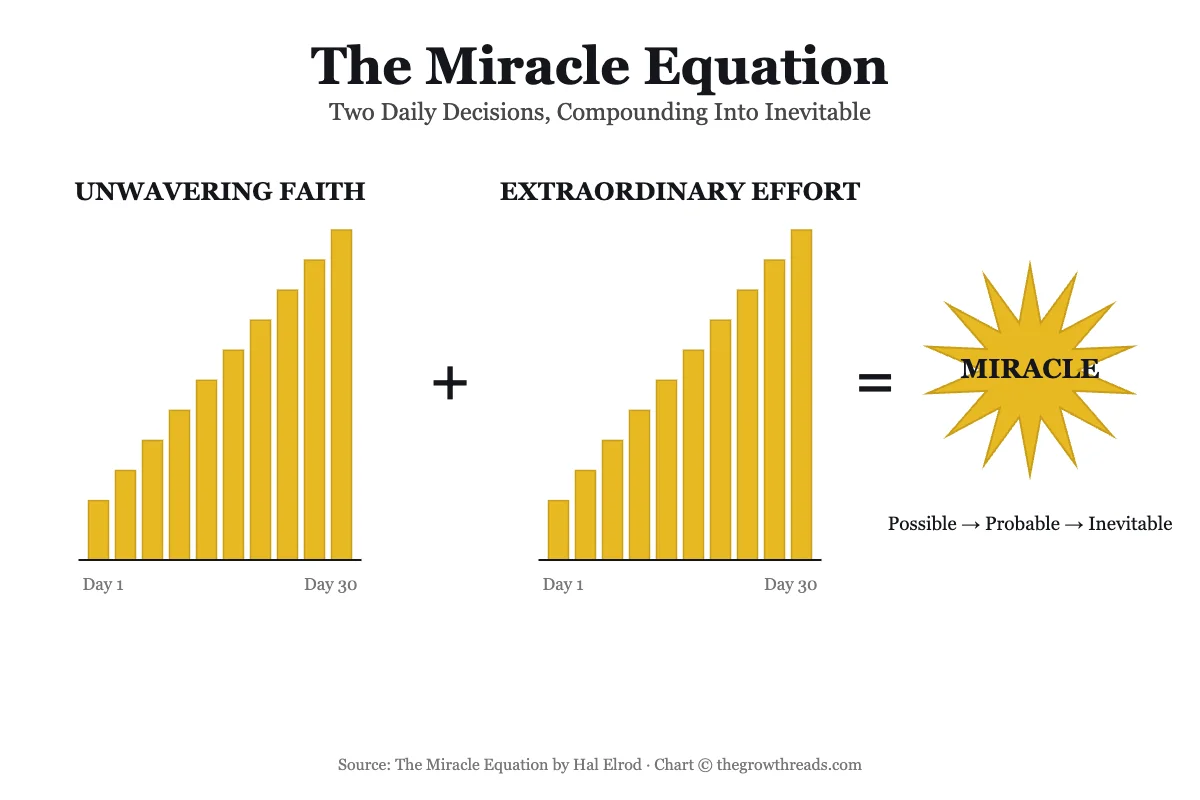
Most goals don’t die from a lack of ability — they die because effort and belief are conditional on results that haven’t shown up yet. Hal Elrod’s The Miracle Equation reduces goal achievement to one formula: Unwavering Faith + Extraordinary Effort = Miracles. Rather than waiting for evidence before committing fully, the book argues you decide to believe and decide to act every single day, regardless of how things look so far — and that this daily, unconditional combination is what eventually turns a “possible” goal into a “probable” one, and then an “inevitable” one.
Key takeaways
- Faith and effort are decisions, not feelings: you don’t wait to feel confident or motivated — you decide to act as if the outcome is certain.
- Unconditional beats conditional: most people’s faith rises and falls with recent results; the book asks for faith that holds steady regardless of results.
- Extraordinary effort is relative to you, not a fixed bar: it means effort disproportionate to what feels comfortable for your current standard, not a universal maximum.
- A single day proves nothing: one good day of faith and effort is meaningless in isolation — the compounding across many days is the actual mechanism.
- Results are only partly in your control: the equation deliberately measures faith and effort, which you control, instead of outcomes, which you don’t.
- Doubt is normal, not disqualifying: Elrod frames faith as a practice you return to daily, not a permanent state you either have or lack.
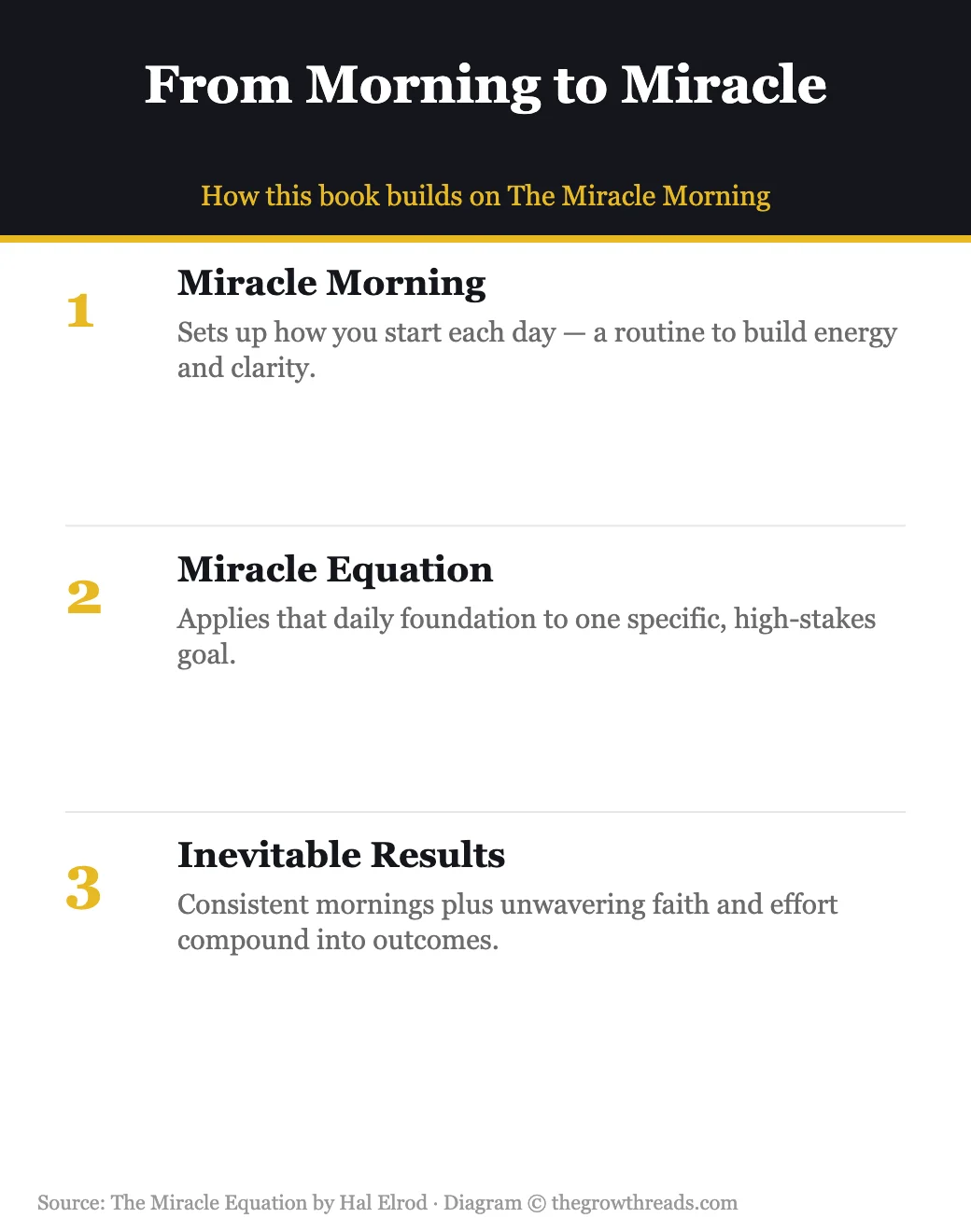
- The book builds on The Miracle Morning: a consistent morning routine is treated as the foundation that makes daily faith and effort sustainable.
- Effort needs a container: the book recommends a dedicated daily block of focused effort toward the goal, not effort scattered across a busy day.
- Setbacks are data, not verdicts: a bad day doesn’t break the equation — it’s a signal to recommit the next morning, not evidence to quit.
What is The Miracle Equation about?
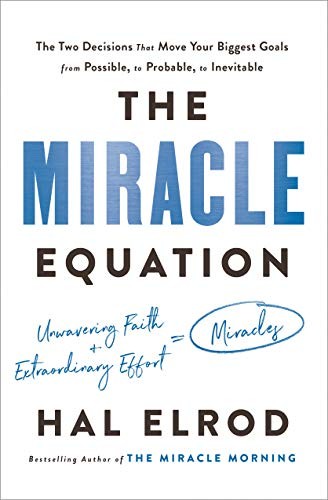
The Miracle Equation is Hal Elrod’s framework for treating any big goal as inevitable through two daily decisions: unwavering faith and extraordinary effort. Rather than a general productivity system, it’s a narrow, repeatable formula meant to be applied to one specific, high-stakes goal at a time, sustained through daily practice rather than a single burst of motivation.
About the author
Hal Elrod’s public story centers on a car accident in 1999, when he was hit head-on by a drunk driver, sustained multiple serious injuries, and was told by doctors he might never walk again — an account he has repeated across many interviews and that forms the origin story of his brand, though the precise medical specifics are drawn from his own retelling rather than independently published medical records. He later faced a rare, aggressive form of leukemia, which he also wrote and spoke about publicly. His health story ran alongside his productivity career rather than replacing it, and he has said publicly that the same faith-and-effort framing he taught others helped structure how he approached treatment and recovery. Elrod is best known for The Miracle Morning, a bestselling morning-routine book that spawned numerous niche spin-off editions, and he hosts the podcast Achieve Your Goals. The Miracle Equation is positioned as the natural follow-up: where The Miracle Morning shapes how you start your day, this book applies that same daily discipline to one specific goal. Explore all Hal Elrod book summaries →
Key concepts at a glance
| Concept | What it means | Use it when |
| The Miracle Equation | Unwavering Faith + Extraordinary Effort = Miracles. | You want one core formula to return to when a goal feels stalled. |
| Unwavering Faith | Deciding to believe in the goal daily, independent of current results. | Doubt creeps in after a slow week or a setback. |
| Extraordinary Effort | Effort disproportionate to what feels comfortable, sustained daily. | Your current effort level hasn’t moved the goal in weeks. |
| Daily effort block | A dedicated, protected block of focused time for the goal each day. | Effort toward the goal keeps getting squeezed out by other tasks. |
| Miracle Morning tie-in | A consistent morning routine as the foundation for daily faith and effort. | You want a sustainable base before applying the equation to a specific goal. |
| Possible → Probable → Inevitable | The three-stage shift Elrod says goals move through under the equation. | You need language for tracking progress that isn’t just “done or not done.” |
Part 1: The formula itself
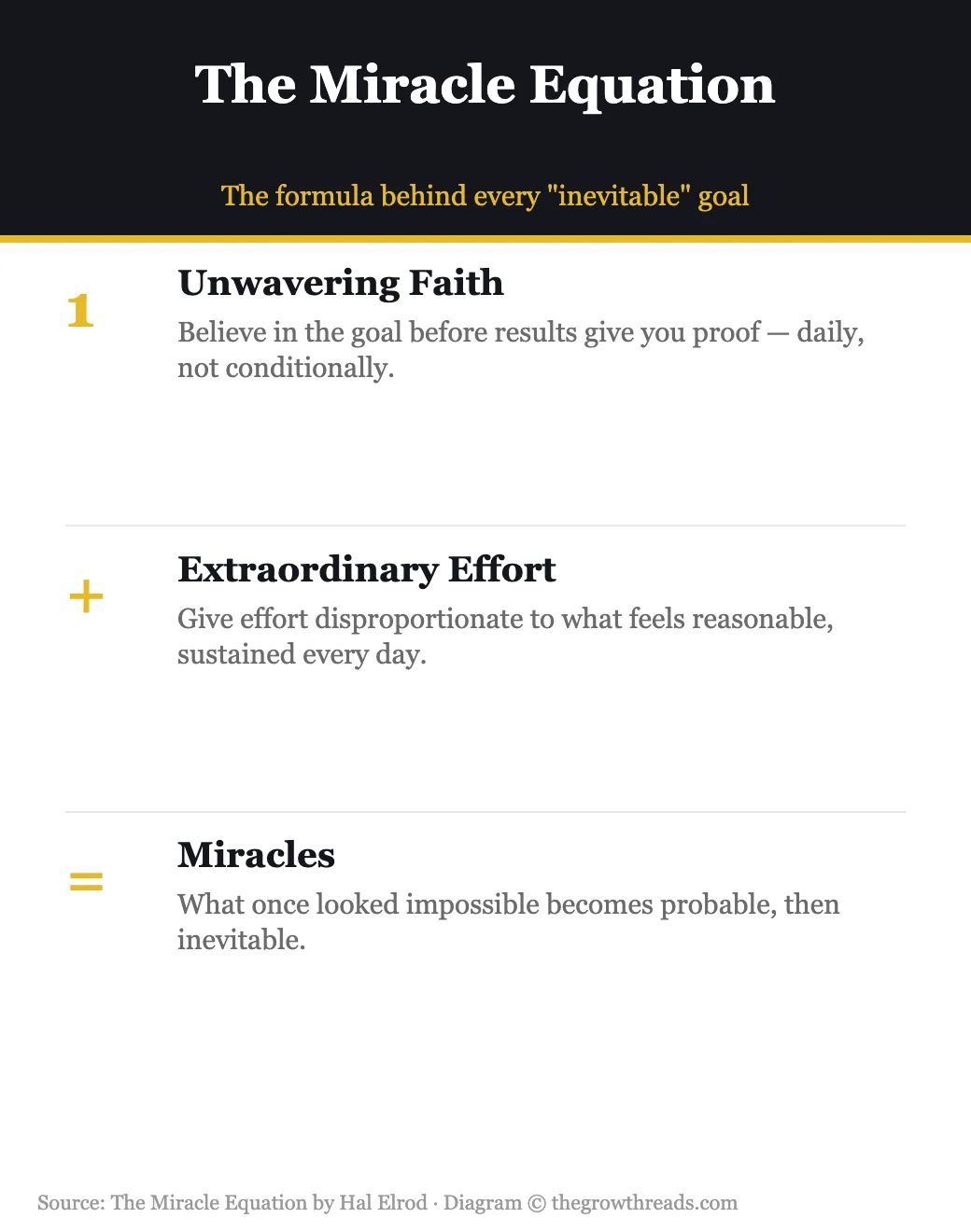
Elrod opens by naming the actual reason he believes most goals fail: people let their faith and effort be conditional on results. Early progress fuels belief and effort; early setbacks drain both. The Miracle Equation asks readers to flip that order — commit to unwavering faith and extraordinary effort first, unconditionally, and let the results follow rather than lead. The formula itself is deliberately simple to state and repeat: Unwavering Faith + Extraordinary Effort = Miracles.
The word “miracle” is doing specific work here — Elrod isn’t claiming anything supernatural, but rather that from the outside, a goal achieved through sustained faith and effort over enough days can look inevitable in hindsight even though it looked improbable at the start. The book’s job is to make that shift in probability feel like a repeatable process rather than luck.
Elrod is careful to note that “miracle” in the title isn’t a claim about outcomes defying reality — it’s a claim about how consistent, unconditional faith and effort change what’s statistically likely over time. A goal that looked like a long shot in month one can look nearly guaranteed by month six, not because the odds changed on their own, but because daily compounding effort quietly shifted them.
Part 2: Deciding to believe
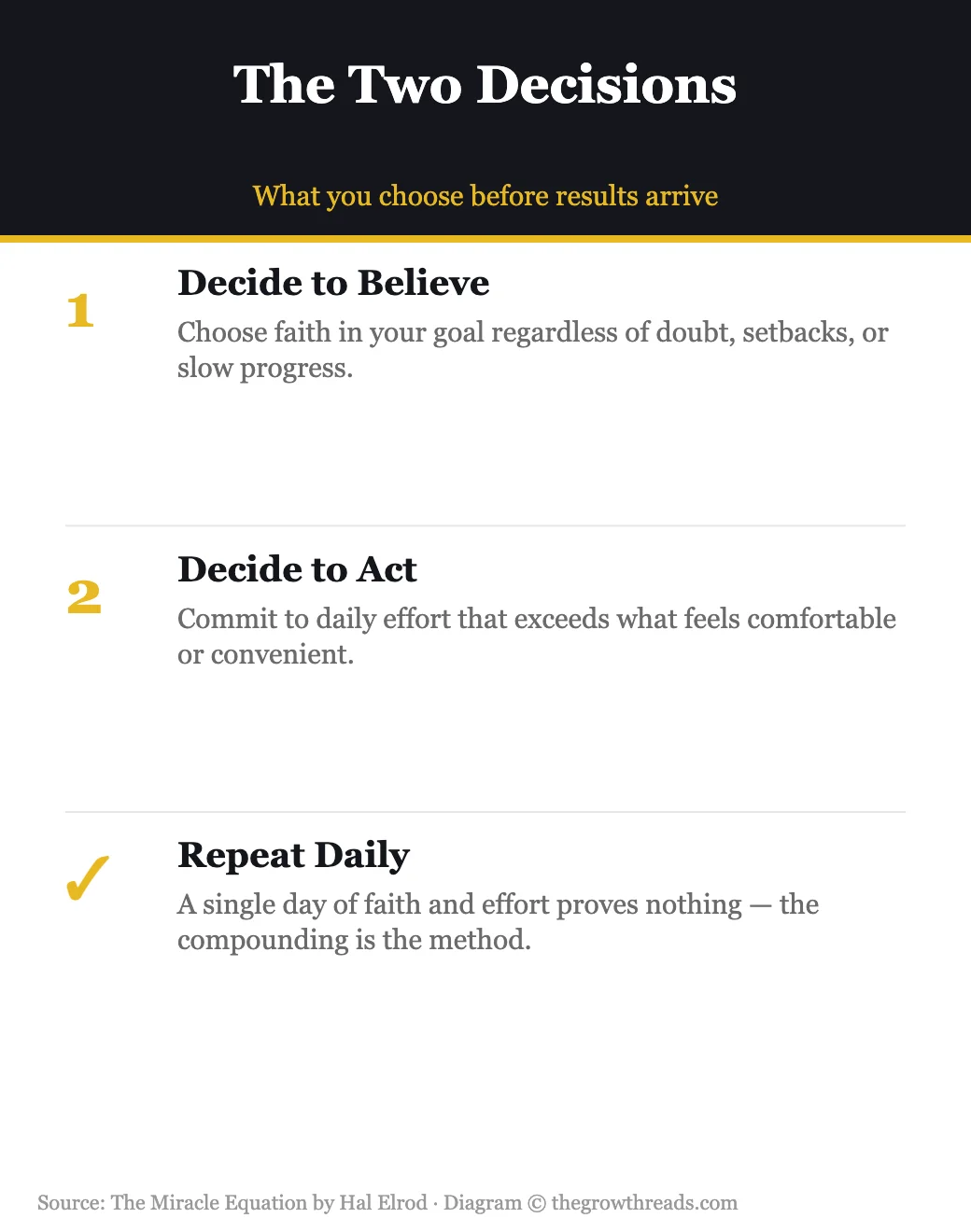
The first decision — unwavering faith — is framed explicitly as a decision, not a feeling you either have or don’t. Elrod’s argument is that waiting to feel fully confident before committing to a goal gets the order backwards; the confidence tends to arrive after weeks of consistent action, not before. So faith becomes something you choose each morning, deliberately, especially on the days it feels least justified by recent results.
Practically, this shows up as short daily affirmations or reminders tied to the goal, plus a conscious refusal to let a bad week become “proof” that the goal is unrealistic. The book is candid that doubt doesn’t disappear — it’s simply not allowed to be the deciding vote on whether you show up for the goal that day.
Part 3: Deciding to act
The second decision — extraordinary effort — is the harder one to sustain. Elrod’s definition is relative rather than absolute: it means effort that’s disproportionate to what’s comfortable for you right now, not some universal maximum-effort standard. The book recommends anchoring this in a dedicated daily block of focused time protected specifically for the goal, since effort left to “whenever there’s time” reliably gets crowded out by everything else on a given day.
The exact structure of that daily effort block is described in the book in more specific terms than we can fully verify secondhand, so treat any single named format as approximate rather than a precise quote — the core, well-supported idea is simply that effort needs a protected, recurring container rather than being left to spontaneous motivation.
What’s less ambiguous is the underlying failure mode the book is targeting: effort that only happens “if there’s time left over” almost never happens at all, because there’s rarely time left over. Blocking the time in advance — treating it as a fixed appointment rather than a flexible intention — is the mechanism doing the real work here, regardless of exactly how long the block runs.
Part 4: Building it on a Miracle Morning foundation
Elrod is explicit that The Miracle Equation works best layered on top of a consistent morning routine — the SAVERS practice from The Miracle Morning (Silence, Affirmations, Visualization, Exercise, Reading, Scribing) — rather than standing alone. The morning routine builds the general energy and clarity; the equation then applies that daily foundation to one specific, chosen goal.
This layering matters practically: readers who try to adopt unwavering faith and extraordinary effort without any stable daily structure underneath them tend to burn out faster, since there’s no consistent anchor point for the two decisions to attach to each day. The book positions itself as a specialization of an already-running habit, not a brand-new system to build from zero.
This also explains why readers who try The Miracle Equation in isolation, without any existing morning practice, sometimes report it feeling harder than expected: the book was written assuming a baseline of daily structure most readers of The Miracle Morning already had in place. Building that baseline first — even a scaled-down five or ten minute version of SAVERS — tends to make the two decisions easier to sustain than attempting them cold.
Who is The Miracle Equation best for — and who should read something else first?
This book is best for people chasing one specific, high-stakes goal — a business target, a race, a creative project — who keep waiting to feel fully ready or confident before committing everything to it. Its narrow focus is a feature: it’s not trying to reorganize your whole life, just to give you a formula for one goal at a time.
If you don’t yet have a stable morning routine to anchor daily faith and effort to, start with What the Most Successful People Do Before Breakfast or build out your own routine before layering this on top. If your bigger challenge is deciding which goal deserves this level of commitment in the first place, Your Best Year Ever is the better starting point. And if extraordinary effort keeps collapsing under willpower fatigue, pair this with Willpower Doesn’t Work.
Questions to reflect on
- Is your current level of faith in your top goal conditional on this week’s results, or genuinely unwavering?
- What would “extraordinary effort” — relative to your own comfortable baseline — actually look like this week?
- Do you have a protected daily block of time for your most important goal, or does effort toward it only happen “when there’s time”?
- What’s one recent setback you’ve treated as proof the goal is unrealistic, rather than as one data point?
- Is your morning routine stable enough to support daily faith and effort, or does it need to come first?
🔥 Ready to make your goal inevitable?
Grab a copy and start applying the equation to your one biggest goal today.
How to apply The Miracle Equation (7-day plan)
- Day 1 — Pick one goal: Choose a single, specific, high-stakes goal to apply the equation to — not your whole life at once.
- Day 2 — Write your faith statement: Write one sentence affirming unwavering belief in the goal, to read each morning regardless of results.
- Day 3 — Define extraordinary effort: Write down what effort disproportionate to your current comfortable baseline actually looks like for this goal.
- Day 4 — Schedule your daily effort block: Put a protected, recurring block of time on your calendar dedicated only to this goal.
- Day 5 — Run the block: Show up for your first full effort block, regardless of motivation level that day.
- Day 6 — Recommit after a rough day: If day 5 or 6 felt weak, practice treating it as data, not a verdict, and recommit the next morning.
- Day 7 — Review the week: Check whether faith and effort were unconditional this week, and adjust the plan — not the goal — for week two.
Frequently asked questions
What exactly is “the Miracle Equation”?
It’s Hal Elrod’s formula: Unwavering Faith + Extraordinary Effort = Miracles. The idea is that consistently choosing to believe in a goal and to act on it with disproportionate effort, every day and regardless of current results, is what eventually makes an unlikely goal look inevitable in hindsight.
Is this book only for people who already read The Miracle Morning?
No, it can be read on its own, but Elrod explicitly frames it as building on that earlier book’s morning routine (SAVERS). Readers without an existing morning routine may get more value pairing this with The Miracle Morning or another routine-focused book first, since the equation assumes a stable daily foundation underneath it.
What does “extraordinary effort” actually mean in practice?
Elrod defines it as relative to your own current comfortable baseline, not a fixed universal standard — effort that’s disproportionate to what feels easy or convenient for you specifically. The book recommends anchoring it in a dedicated, protected daily time block for the goal rather than treating it as a vague intensity level.
Does the book cite specific scientific studies for the equation?
The book is written in an accessible, story-driven style typical of the genre; we were not able to independently verify specific named studies or statistics behind the formula itself. Readers looking for a heavily citation-backed argument may find the evidentiary basis lighter than the confident tone suggests — the practical exercises stand on their own regardless.
How is this different from just being a “positive thinking” book?
The equation pairs faith with extraordinary effort as an equal, non-negotiable second term — belief alone isn’t presented as sufficient. Elrod’s framing is that faith without effort is just wishful thinking, and effort without faith tends to collapse the first time results are slow, so the book insists on both together rather than treating mindset as the whole solution.
Can the Miracle Equation be applied to more than one goal at a time?
The book’s guidance leans toward applying it to one specific, high-stakes goal at a time rather than spreading unwavering faith and extraordinary effort across many goals simultaneously, since both are hard to sustain daily even for a single goal. Readers with multiple priorities are generally better served picking the one goal that matters most right now.
What happens when a day of effort just doesn’t happen?
Elrod treats a missed day as information rather than a failure of the whole system — the guidance is to recommit the next morning rather than treating one broken streak as proof the goal or the method doesn’t work. The emphasis throughout the book is on the compounding of many days, not the perfection of any single one.
Related summaries
- Your Best Year Ever Summary & Review
- Willpower Doesn’t Work Summary & Review
- What the Most Successful People Do Before Breakfast Summary & Review
- Atomic Habits Summary & Review
- Best Productivity Books