

★★★★☆ 4.0/5 — A science-grounded case for chasing effectiveness over raw hours logged.
Best for: Knowledge workers who assume more hours means more output and haven’t questioned that math.
Reading time: ~3.5 hrs to read · guide: 17 min to skim this summary.
Difficulty to apply: Easy — most strategies are small daily adjustments, not a system overhaul.
Two Awesome Hours in one minute
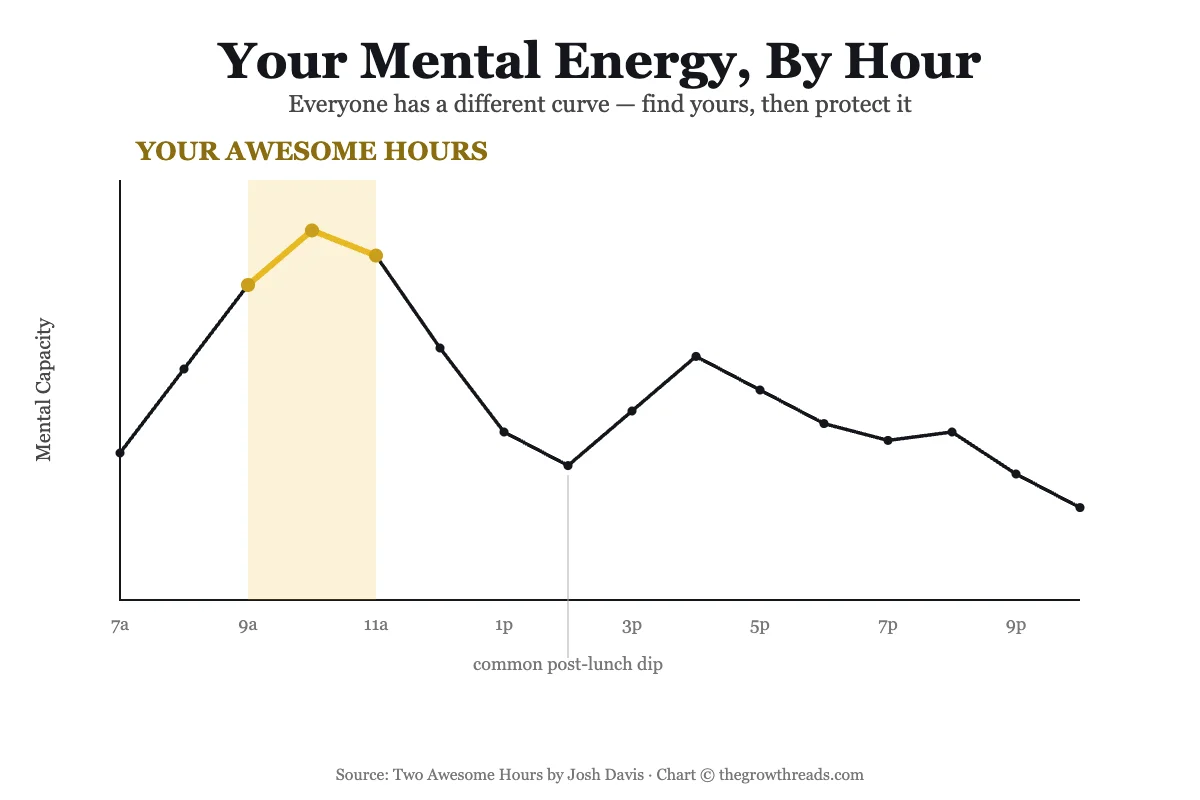
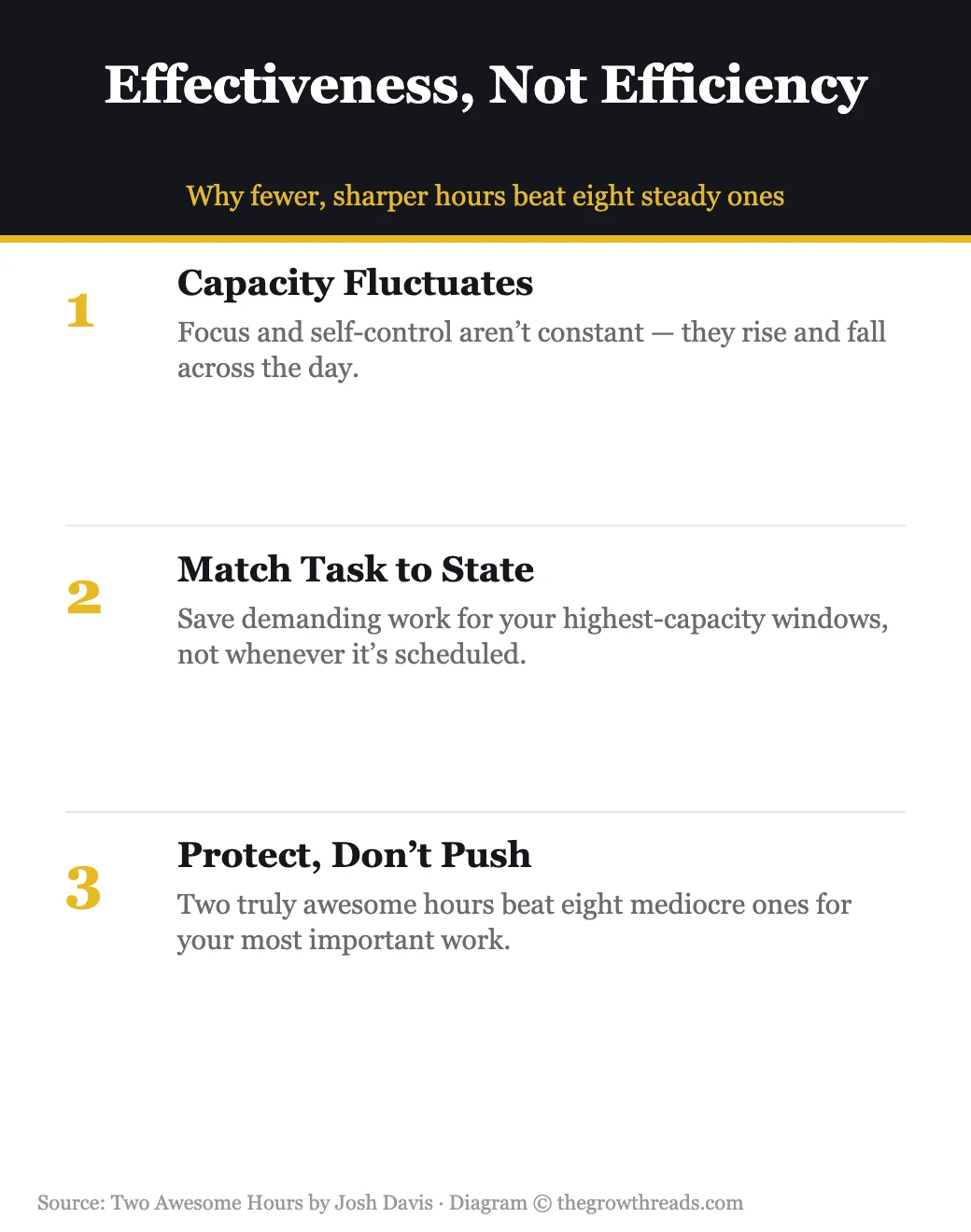
You are not a machine that produces steady output for eight straight hours — and trying to act like one is why so much of the workday feels wasted. Josh Davis, PhD, argues in Two Awesome Hours that the right measure of a workday isn’t efficiency (hours logged) but effectiveness (what actually got accomplished). Mental capacity for focus, self-control, and good decisions fluctuates across the day for biological reasons, so the goal is to identify your highest-capacity windows — your “awesome hours” — and protect them fiercely for your most important work, while routing lower-stakes tasks to your lower-capacity hours.
Key takeaways
- Effectiveness beats efficiency: what you accomplish matters more than how many hours you’re technically working.
- Mental capacity fluctuates: focus and self-control aren’t constant resources — they rise and fall across the day for each individual.
- Your “awesome hours” are personal: your best window might be 9-11am or 8-10pm — the book asks you to find your own, not copy someone else’s.
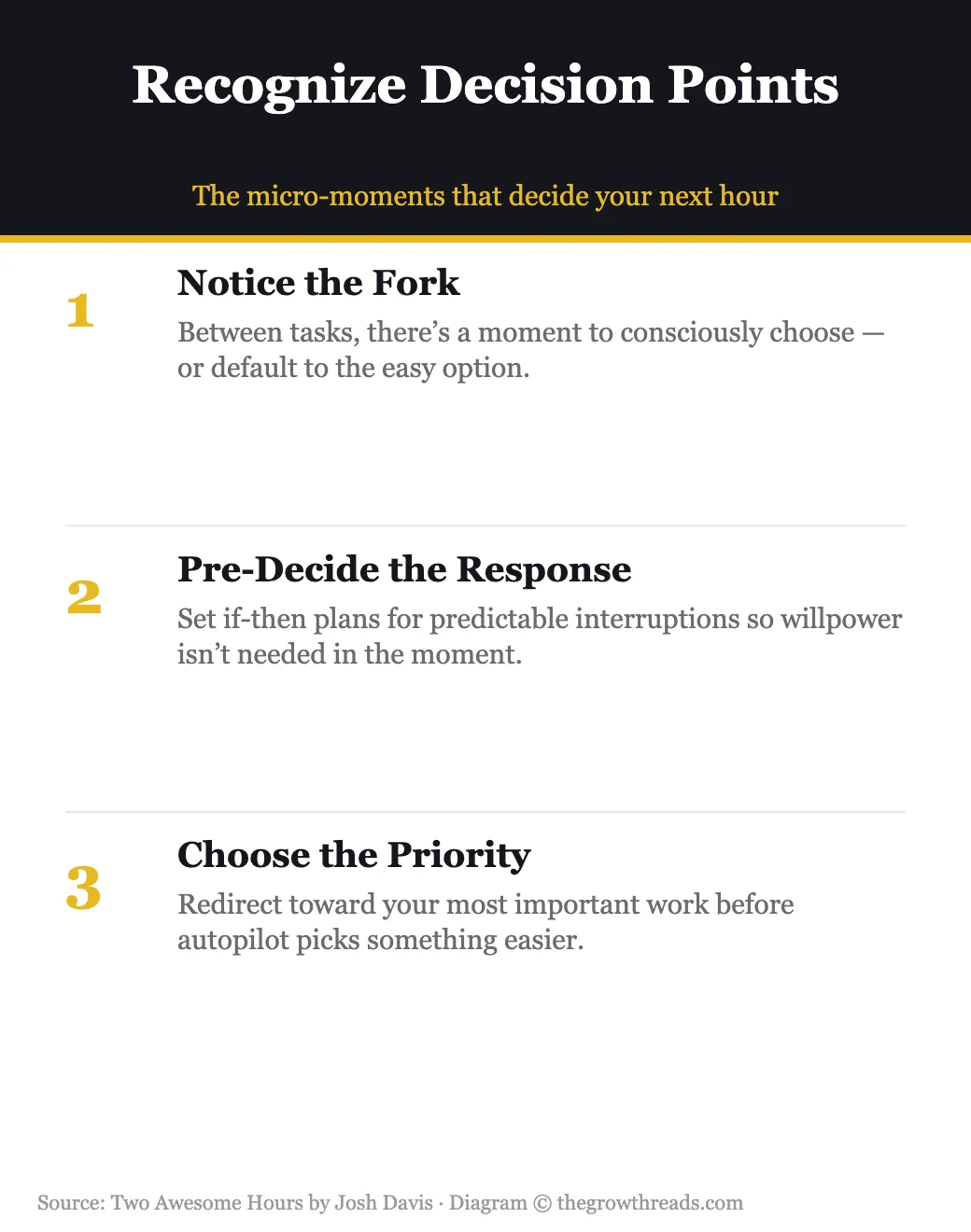
- Recognize decision points: the small moments between tasks are where you either redirect toward priorities or default to the easy option.
- Pre-decide predictable interruptions: if-then plans for notifications and requests reduce how much in-the-moment willpower you need.
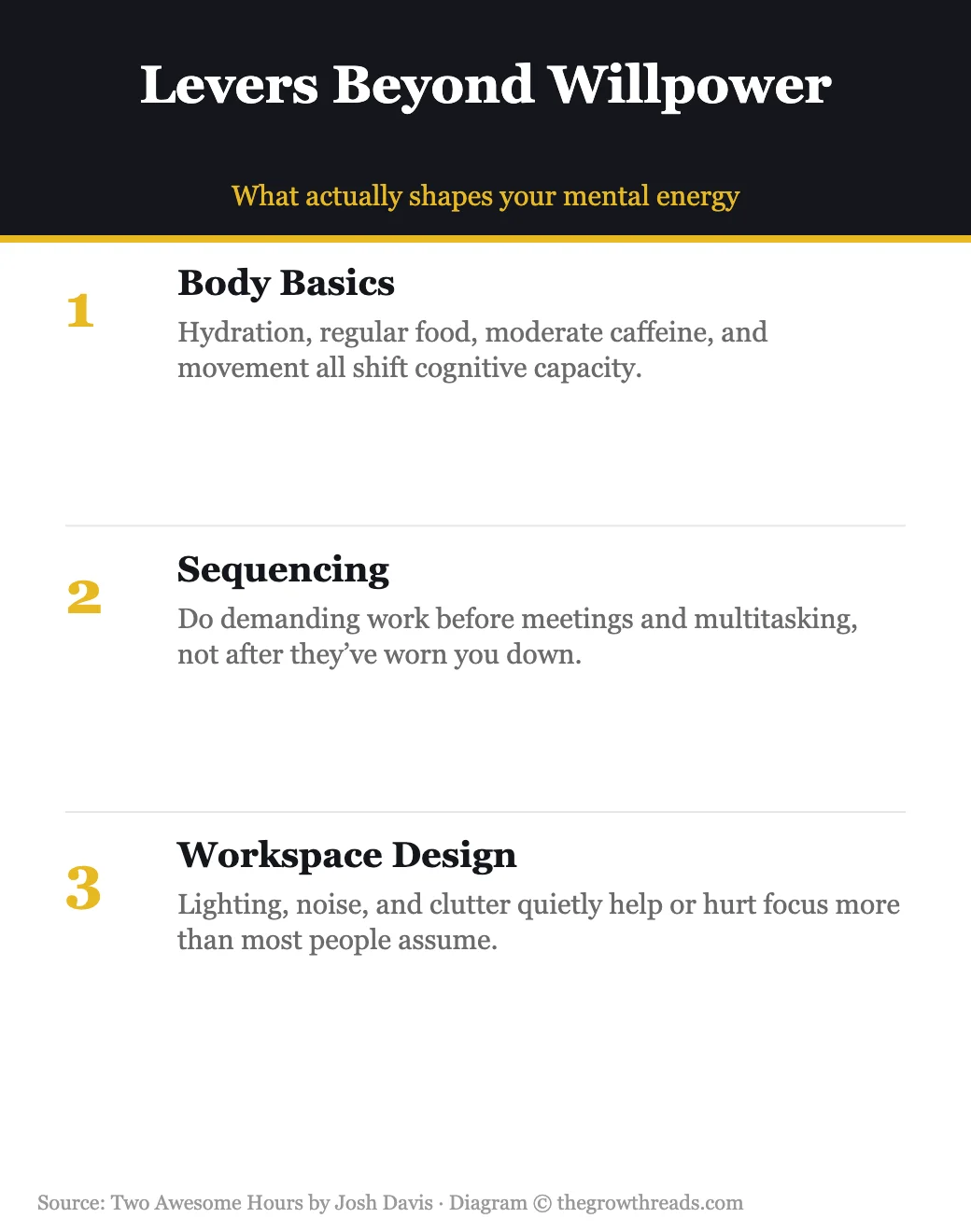
- Sequence demanding work first: do your hardest thinking before meetings and multitasking wear down your capacity, not after.
- Body basics are performance levers: hydration, regular food, moderate caffeine, and movement measurably shift cognitive capacity.
- Workspace design matters more than it seems: lighting, noise, and clutter quietly help or hurt focus.
- Protect, don’t just plan: identifying your awesome hours is easy — actually defending them from meetings and requests is the real work.
What is Two Awesome Hours about?
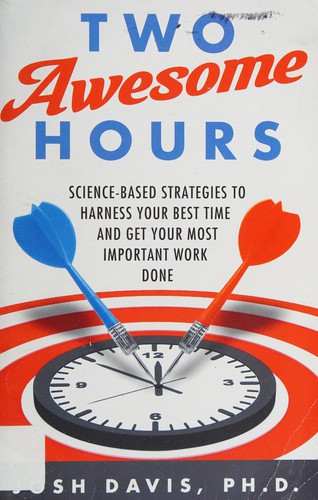
Two Awesome Hours is Josh Davis’s science-grounded framework for identifying and protecting your highest-capacity mental windows each day, rather than treating every hour of work as equally productive. Drawing on neuroscience and psychology research, the book argues that effectiveness — getting your most important work done well — should replace efficiency as the metric that matters, since raw hours worked don’t reliably translate into good output.
About the author
Josh Davis holds a PhD in psychology and neuroscience from Columbia University and previously taught as a professor at Barnard College, Columbia University, after earning an engineering degree from Brown. He held a senior research role at the NeuroLeadership Institute before founding the Science-Based Leadership Institute, and has written for Harvard Business Review, Fast Company, and Psychology Today. His research background gives the book’s advice a citation-backed tone that distinguishes it from purely anecdotal productivity writing, even where individual studies referenced are contested or hard to verify secondhand. His client work spans organizations including Goldman Sachs, IDEO, and Lululemon, and he co-authored The Difference That Makes the Difference alongside his work on Two Awesome Hours. Explore all Josh Davis book summaries →
Key concepts at a glance
| Concept | What it means | Use it when |
| Effectiveness vs. efficiency | Measuring output and quality, not just hours logged. | You’re evaluating whether a long workday actually produced anything. |
| Awesome hours | Your personal highest-capacity window for focus and decisions. | You’re deciding when to schedule your hardest task of the day. |
| Decision points | The micro-moments between tasks where you choose your next move. | You notice yourself drifting to easy tasks instead of priorities. |
| If-then plans | Pre-decided responses to predictable interruptions. | The same notifications or requests derail you every day. |
| Sequencing | Ordering demanding work before energy-depleting activities. | Your best thinking keeps landing after a full day of meetings. |
| Workspace design | Adjusting lighting, noise, and clutter to match the task at hand. | You can’t tell why one workspace feels more focused than another. |
Part 1: Effectiveness, not efficiency
Davis opens by challenging the default assumption of the modern workday: that more hours worked means more accomplished. He argues mental capacity for focus, self-control, and sound decision-making is biologically constrained and fluctuates — it isn’t a flat resource you draw down evenly from 9 to 5. Treating every hour as equally productive means your hardest, most important work sometimes lands in a low-capacity window purely by accident of scheduling.
The fix is to identify your own highest-capacity windows — which vary by person and even by day — and deliberately route your most cognitively demanding work into them, while pushing lower-stakes tasks (routine email, simple admin) into lower-capacity hours where the cost of reduced focus is smaller.
Davis is careful not to frame this as an excuse for a shorter workday — the point isn’t to work less, it’s to stop wasting your best cognitive hours on tasks that don’t need them. A reply-all email chain doesn’t require your sharpest thinking; a strategic proposal or a hard problem does. Matching the two correctly, rather than tackling whatever’s next on the list regardless of difficulty, is where most of the book’s practical value comes from.
Part 2: Recognize your decision points
The book’s second major idea is that most productivity failures don’t happen in big dramatic moments — they happen in small, easy-to-miss decision points between tasks, where you either consciously redirect toward what matters or default to whatever’s easiest. Davis illustrates this with case-style examples of professionals whose days quietly drift away from priorities one small choice at a time.
The practical fix is building if-then plans for predictable interruptions in advance: deciding ahead of time how you’ll handle a notification, a colleague’s request, or an open browser tab, so the decision doesn’t have to be made fresh — and under depleted willpower — every single time it comes up.
Davis’s case-style examples tend to follow a similar arc: a professional starts the day with a clear priority, then a string of small, individually reasonable-seeming decisions — checking one more email, taking one more quick call — quietly consumes the exact window that priority needed. No single decision looks like the culprit in isolation, which is precisely why the book treats decision points as a pattern to watch for rather than a single moment to fix.
Part 3: Manage your mental energy
Davis frames willpower and self-control as limited resources that need active management rather than a bottomless pool you can grind through with enough discipline. It’s worth noting for readers who like to dig into the research: this general territory overlaps with “ego depletion” and glucose-based models of willpower from psychology research in the 2000s and early 2010s, some of which faced a significant replication crisis starting around 2016, when several large studies failed to reproduce the original effects. That doesn’t mean the book’s practical advice is wrong — sequencing demanding work before draining activities is sound regardless of the precise underlying mechanism — but the specific “willpower runs on glucose” explanation should be treated as more contested than settled science.
What’s better supported and less contested is the broader pattern: demanding cognitive work performed after a stretch of meetings, multitasking, or difficult decisions tends to go worse than the same work done fresh. The practical guidance — sequence your hardest thinking before the draining stuff, not after — holds up even if the exact biological story behind it is still debated.
This is a useful distinction for skeptical readers: you don’t have to accept every mechanism the book cites to still benefit from its scheduling advice. Whether the underlying cause is glucose depletion, attentional fatigue, accumulated decision load, or some combination not yet fully mapped by researchers, the observable pattern — hard tasks go better earlier, before a stretch of draining activity — is the part worth acting on.
Part 4: Body basics and workspace design
The final major section moves from mindset to physical levers: hydration, regular food intake, moderate caffeine, and movement all measurably shift cognitive capacity across the day, according to Davis. None of these are exotic — the book’s contribution is connecting them explicitly to the “awesome hours” framework rather than treating them as generic wellness advice disconnected from actual work output.
Workspace design gets similar treatment: lighting (cooler light for analytical tasks), background noise levels, and simple decluttering are framed as small, controllable variables that quietly shape how much of your capacity actually gets used during a given hour, rather than being wasted fighting your own environment.
None of these levers work in isolation, either — a well-lit, quiet workspace won’t compensate for skipping meals all morning, and staying hydrated won’t fix a room full of visual clutter competing for attention. Davis’s framing treats body basics and workspace design as a small stack of independent variables that each nudge capacity up or down slightly, and stacking several of them well is what produces a noticeably better awesome-hours window than getting just one of them right.
Who is Two Awesome Hours best for — and who should read something else first?
This book is best for knowledge workers who assume more hours logged automatically means more accomplished, and haven’t stopped to question whether their hardest work is actually landing in their best hours. Its short, science-grounded chapters make it a fast, practical read for anyone wanting concrete adjustments rather than a full life overhaul.
It’s also a good fit for readers who’ve tried more prescriptive productivity systems and bounced off them — there’s no single app, planner, or morning ritual to adopt wholesale here. The book’s ask is narrower and arguably easier to sustain: pay attention to your own energy pattern for a week, then make a handful of small scheduling and environment changes based on what you actually observe rather than what a system prescribes for everyone.
If you want a deeper dive on willpower and environment design specifically, pair this with Willpower Doesn’t Work. If mornings specifically are your best window and you want a routine-first approach, What the Most Successful People Do Before Breakfast is a natural companion. And if you’re still deciding which goal deserves your awesome hours in the first place, start with Your Best Year Ever.
Questions to reflect on
- Looking back at the last week, which hours of the day did your best thinking actually happen in?
- Is your hardest work currently scheduled into your highest-capacity hours, or wherever there happened to be an open calendar slot?
- What’s one predictable interruption you could pre-decide a response to instead of relitigating it every time?
- Which body-basics lever — hydration, food timing, movement — do you most consistently neglect during a busy day?
- If you protected just two hours a day as truly non-negotiable, which two would you choose?
🔥 Ready to find your awesome hours?
Grab a copy and start protecting your highest-capacity windows this week.
How to apply Two Awesome Hours (7-day plan)
- Day 1 — Track your energy: Note your focus level every 2 hours through the day to start mapping your personal energy curve.
- Day 2 — Identify your awesome hours: Review the log and mark your one or two highest-capacity windows.
- Day 3 — Protect the window: Block your identified awesome hours on your calendar as unavailable for meetings.
- Day 4 — Schedule your hardest task first: Move your most demanding task of the day into your protected window.
- Day 5 — Write two if-then plans: Pre-decide your response to your two most common interruptions.
- Day 6 — Audit body basics: Check hydration, food timing, and movement against your energy log from Day 1.
- Day 7 — Adjust your workspace: Make one small lighting, noise, or clutter change for your protected window.
Frequently asked questions
What are the “two awesome hours” exactly?
They’re your personal highest-capacity windows for focus and decision-making — not a fixed universal time like 9-11am. Josh Davis argues these vary by individual and even by day, so the book’s core exercise is identifying your own pattern through observation rather than adopting someone else’s schedule.
Does the book rely on the “ego depletion” theory of willpower?
The book’s framing of limited daily self-control capacity overlaps with ego depletion and glucose-based willpower research from the 2000s and early 2010s, a body of work that faced a significant replication crisis starting around 2016. The book’s practical advice — sequence demanding work before draining activities — holds up regardless, but readers should treat the specific underlying mechanism as more contested than the book’s confident tone suggests.
Is this book only useful for office workers with flexible schedules?
The core exercise of identifying your personal energy pattern applies broadly, but protecting a specific two-hour block is genuinely harder for people with rigid shift work, caregiving duties, or back-to-back meeting cultures. Those readers may need to adapt the “protect a block” advice into smaller, more flexible wins — like sequencing whatever discretion they do have around their best-available window.
How is this different from general advice to “do your hardest work in the morning”?
Davis is explicit that mornings aren’t universally best — some people’s awesome hours fall in the afternoon or evening. The book’s contribution is the diagnostic step: track and identify your actual pattern rather than assuming a generic morning-person prescription applies to you.
What’s a “decision point” in this book’s terms?
It’s the small, easy-to-miss moment between finishing one task and starting the next, where you either consciously choose your next priority or default to whatever’s easiest or most visible. The book’s suggestion is to notice these moments deliberately and pre-decide responses to the most predictable ones via if-then plans.
Does the book address people who don’t have control over their schedule?
Not extensively — the strategies generally assume some ability to block time or influence when meetings happen. Readers in highly reactive roles (frontline support, shift-based jobs) will likely need to adapt the ideas toward smaller wins, like protecting even 20-30 minutes of discretionary time rather than a full two-hour block.
Is the book more about neuroscience theory or practical exercises?
It leans practical — Davis references research to back up recommendations but keeps the focus on actionable strategies (sequencing, if-then plans, workspace tweaks) rather than a deep academic literature review. Readers wanting heavier citation and theory may find the evidentiary depth lighter than the confident, research-backed tone suggests.
Related summaries
- Willpower Doesn’t Work Summary & Review
- What the Most Successful People Do Before Breakfast Summary & Review
- Your Best Year Ever Summary & Review
- The Miracle Equation Summary & Review
- Best Productivity Books