

★★★★★ 4.6/5 — A tiny, aphoristic book with one filter that reshapes how you say yes to anything.
Best for: Anyone who says yes too often out of obligation, guilt, or fear of missing out.
Reading time: ~1.5 hrs to read · guide: 15 min to skim this summary.
Difficulty to apply: Easy to understand, hard to practice — the filter is one sentence; using it consistently is the work.
Hell Yeah or No in one minute
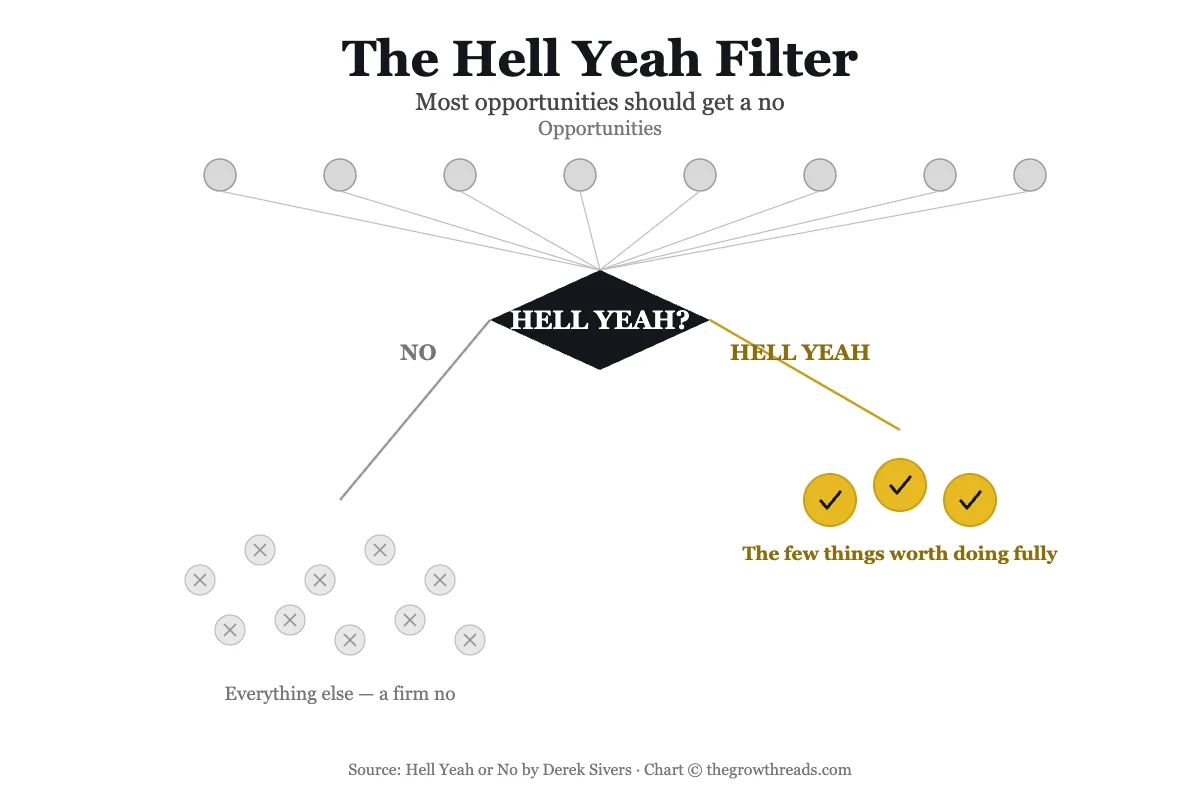
If a choice doesn’t make you say “Hell yeah!”, the answer is no. Derek Sivers’s Hell Yeah or No is a short collection of essays built around one decision filter: stop saying a lukewarm yes to things that just seem fine, and reserve your yeses for the opportunities that genuinely excite you. The book argues that every mediocre “sure, why not” commitment quietly uses up time and energy that could otherwise go toward something you’d actually be thrilled to do — and that most people say yes far too often, out of politeness, obligation, or fear of missing out.
Key takeaways
- Anything less than “hell yeah” is a no: if you’re not genuinely excited, the honest answer is to decline, not to settle for “maybe” or “sure.”
- Mediocre yeses have a real cost: every “good enough” commitment crowds out time and energy for something you’d actually love doing.
- Careers move through three stages: say yes broadly early on, focus narrowly mid-career, then filter ruthlessly once good options are abundant.
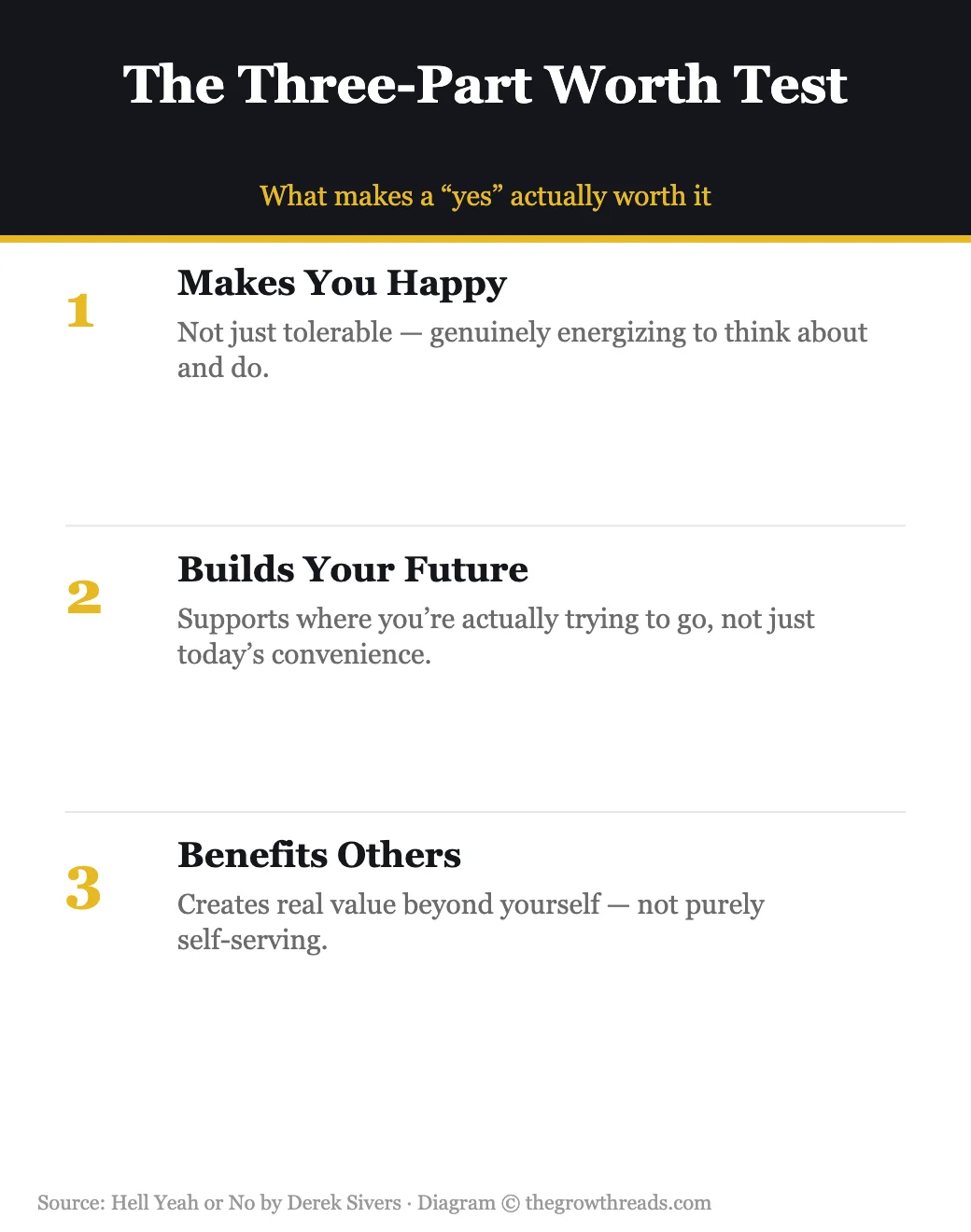
- A worthwhile yes passes three tests: it makes you happy, supports your long-term future, and benefits others — not just one of the three.
- Busy isn’t the same as productive: filling time with small obligations can feel productive while producing very little that matters.
- People underrate the long term: most overestimate what they can do in a year and underestimate what’s possible in ten.
- Actions reveal priorities, not declarations: what you actually say yes to shows your real priorities more honestly than what you claim they are.
- The filter gets easier with practice: the first few “no”s feel uncomfortable; saying no becomes more natural once you see the payoff.
What is Hell Yeah or No about?
Hell Yeah or No is Derek Sivers’s short essay collection built around a single decision filter: if a choice doesn’t make you say “Hell yeah!”, treat it as a no. The book argues that protecting your time for the small number of things that genuinely excite you produces a better life than saying yes to everything that seems reasonable, and it applies that filter across career, relationships, and daily commitments.
About the author
Derek Sivers founded CD Baby, an online store for independent musicians, in the late 1990s, growing it into one of the largest outlets of its kind before selling it in 2008 — he’s widely reported to have placed the proceeds, commonly cited as around $22 million, into a charitable trust for music education. He’s given several widely watched TED talks, including “How to Start a Movement” (the “dancing guy” talk) and “Weird, or Just Different?” His other books include Anything You Want, on his CD Baby experience and business philosophy, and How to Live, which presents 27 conflicting life philosophies without resolving which is correct. Sivers’s writing style across all his books is consistently terse and aphoristic — short essays over long narrative — and Hell Yeah or No follows that same format. Explore all Derek Sivers book summaries →
Key concepts at a glance
| Concept | What it means | Use it when |
| The Hell Yeah filter | If it’s not an enthusiastic yes, treat it as a no. | You’re deciding whether to take on a new commitment. |
| Three-part worth test | Makes you happy + builds your future + benefits others. | You want to check a “hell yeah” against something more concrete. |
| Three-stage career | Say yes broadly, then focus narrowly, then filter ruthlessly. | You’re deciding how selective to be at your current career stage. |
| Busy vs. productive | Filled time isn’t the same as time well spent. | Your calendar is full but little that matters is moving forward. |
| Ten-year thinking | Underrating what’s possible over a decade of consistent focus. | You’re weighing a short-term convenience against a long-term goal. |
Part 1: The filter itself
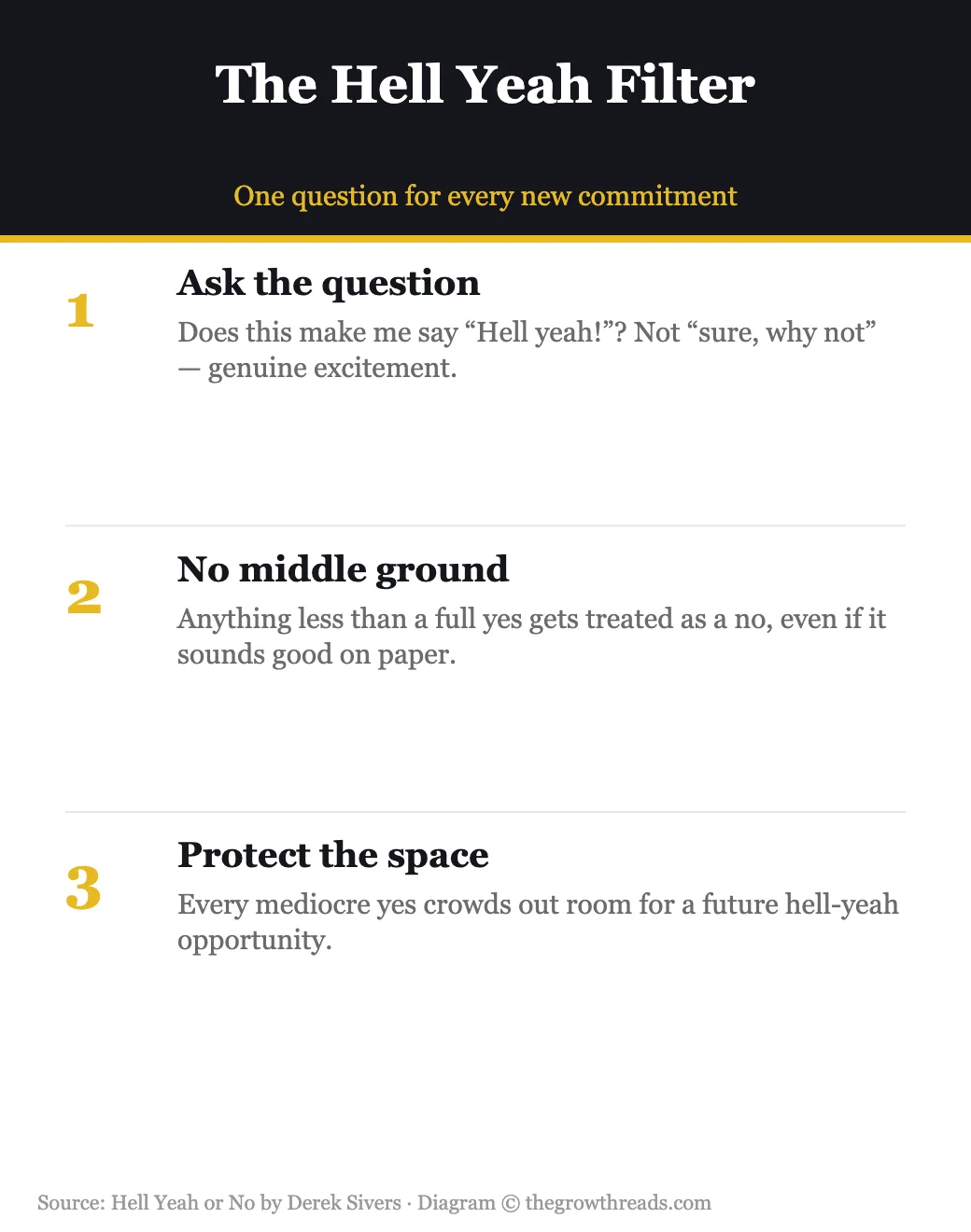
The book’s central idea, laid out early and returned to throughout, is simple to state: if something doesn’t make you say “Hell yeah!”, the answer is no. Sivers isn’t talking about mild interest or a reasonable-sounding opportunity — he means genuine, unambiguous excitement. Anything short of that, in his framing, is functionally a no dressed up as a maybe.
The reasoning behind the filter is about scarcity of attention, not scarcity of opportunity. Sivers argues that opportunities are usually abundant — the constraint is your own limited time and energy — so every “good enough” yes has a real, if invisible, cost: it’s time you can’t spend on something you’d actually love.
This reframes the usual guilt around saying no. Most people treat declining as a loss — turning down income, connection, or opportunity. Sivers’s framing flips that: every yes you give to something merely good is a smaller, quieter loss of the time and attention a genuinely exciting opportunity would have needed later. The cost is just harder to see because it’s paid in opportunities that never got the chance to happen.
Part 2: When to say yes to everything
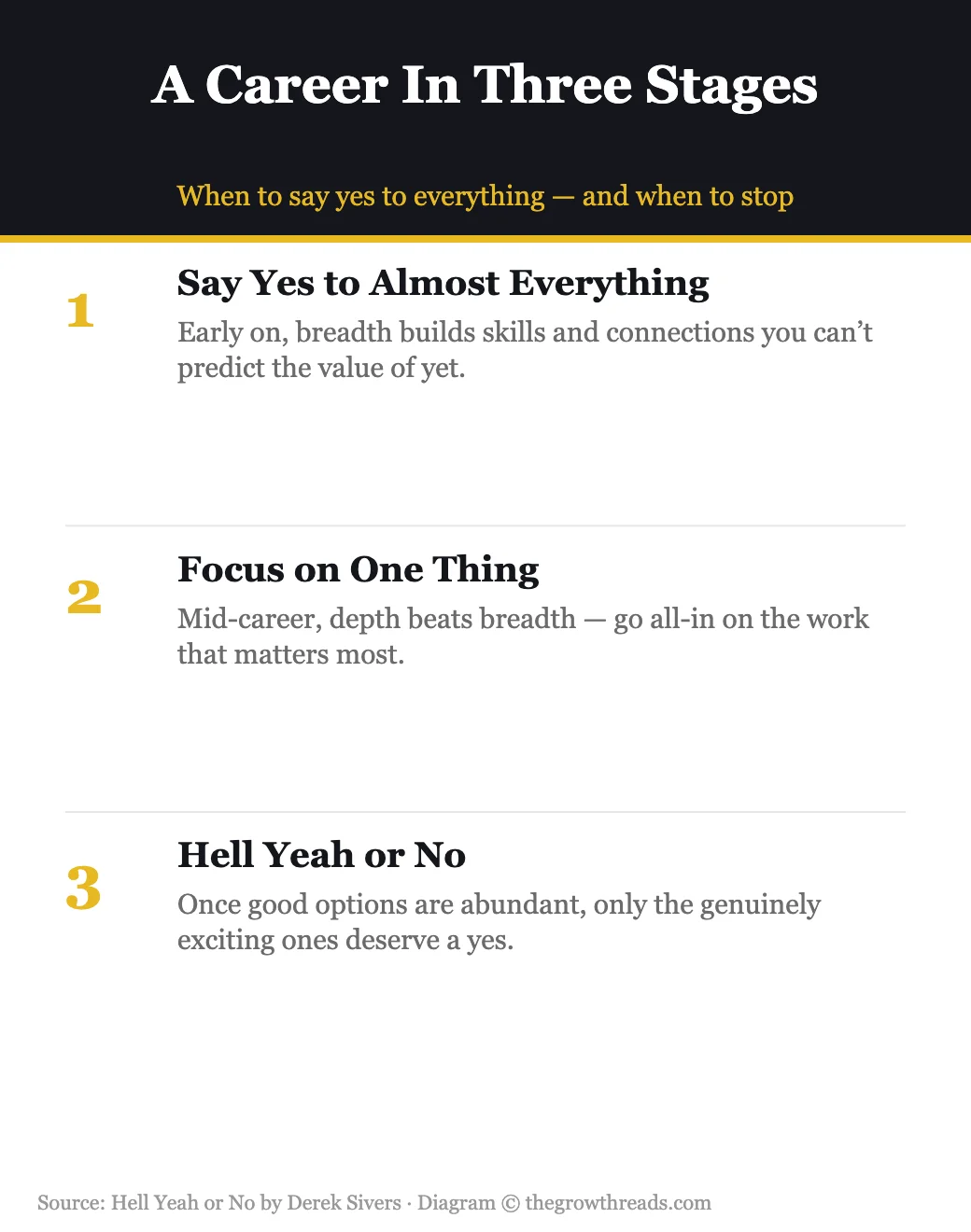
Sivers is careful to note the filter isn’t meant for every career stage. Early on, when you don’t yet know what you’re good at or who’s worth knowing, saying yes broadly to almost everything builds skills and connections whose value you can’t predict in advance. Turning down opportunities too early, before you’ve built any track record, can cut off paths you didn’t know you needed.
The shift comes in the middle stage: once you’ve built some breadth, the book argues for going all-in on one focused direction rather than continuing to spread thin. Only later, once genuinely good options become abundant as a result of that focused work, does the hell-yeah-or-no filter become the right tool — applying it too early, before you have any options worth filtering, can just look like standing still.
Sivers is candid that he didn’t apply this filter as a young musician trying to break into the CD Baby world — he said yes to nearly everything that came his way in the early years, and credits that breadth with surfacing opportunities he couldn’t have predicted or filtered for in advance. The book’s staging isn’t just theoretical; it’s presented as a lesson learned from his own career sequence, not a rule he applied from day one.
Part 3: What makes a yes actually worth it
To keep “hell yeah” from being purely a feeling, Sivers offers a more concrete check: a worthwhile yes should make you happy, support your long-term future, and benefit others — not just satisfy one of the three. A commitment that makes you happy but leads nowhere, or one that builds your future but benefits no one else, is treated as an incomplete yes even if part of it feels exciting in the moment.
This three-part test doubles as a way to catch a false “hell yeah” — enthusiasm generated purely by novelty or flattery, rather than genuine alignment with what you’re actually trying to build. The book’s short essays return to real and hypothetical examples of this distinction rather than presenting it as one abstract rule.
A useful way to apply the test in practice is running it backward on a past decision before trying it forward on a new one: pick something you said yes to recently and honestly score it against all three criteria. Most readers find at least one commitment that passed the excitement test but quietly failed the “builds your future” or “benefits others” test — a gap that’s easier to spot in hindsight than in the moment an opportunity first appears.
Part 4: Busy is not the same as productive
A recurring theme across the book’s short chapters is the distinction between a full calendar and a meaningful one. Sivers pushes back directly against the instinct to treat busyness as evidence of productivity, arguing that empty, unscheduled time has real potential, while time filled with small, low-value obligations has already used up that potential for very little in return.
He pairs this with a case for thinking in much longer horizons than most people default to — the book’s argument is that people consistently overestimate what a single year can hold and underestimate what ten consistent years can produce, which reframes short-term “hell yeah” excitement as something to weigh against a much longer timeline than just this week or this quarter.
Put together, the two ideas in this part reinforce each other: a genuinely full but low-value calendar and a genuinely exciting but short-sighted “yes” fail for similar reasons — both mistake short-term activity or feeling for long-term progress. The book’s short-essay format means neither idea gets a long, heavily cited chapter, but the repetition across many small chapters is itself part of how Sivers makes the point stick.
Who is Hell Yeah or No best for — and who should read something else first?
This book is best for people who already have some options to choose from but keep saying yes to too many of them out of guilt, obligation, or fear of missing out. Its short, punchy essay format makes it a fast read to return to whenever a new commitment lands on your plate and you’re not sure how to weigh it.
If you’re early in your career without much of a track record yet, read Part 2 carefully — the book itself cautions that saying yes broadly first is often the right move before this filter applies. If you want a framework for deciding which goal deserves a “hell yeah” in the first place, pair this with Your Best Year Ever. And if your struggle is less about filtering new commitments and more about sustaining daily effort on the ones you’ve already chosen, The Miracle Equation is the natural next read.
Questions to reflect on
- What’s a recent commitment you said yes to that, honestly, was never a “hell yeah”?
- Which of the three worth-test criteria — happy, future, benefits others — does your current biggest commitment fail?
- Is your calendar full of things that matter, or full of things that just feel productive?
- What would you have to say no to this month to leave room for a genuine hell-yeah opportunity?
- Are you early enough in a pursuit that saying yes broadly still makes sense, or is it time to start filtering?
🔥 Ready to start saying no more often?
Grab a copy and start filtering your commitments this week.
How to apply Hell Yeah or No (7-day plan)
- Day 1 — List your current commitments: Write down everything you’ve said yes to that’s still active on your plate.
- Day 2 — Run the hell-yeah test: Mark each one as a genuine “hell yeah,” a “meh,” or a “no” in hindsight.
- Day 3 — Apply the three-part worth test: For anything marked “meh,” check it against happy, future, and benefits-others.
- Day 4 — Decline one thing: Choose one “meh” commitment and start the process of stepping away from it.
- Day 5 — Notice your career stage: Decide honestly whether you’re in the say-yes-broadly stage or the filter-ruthlessly stage right now.
- Day 6 — Protect unscheduled time: Block one chunk of genuinely empty time this week instead of filling it with small obligations.
- Day 7 — Practice the filter on a new ask: The next time something new comes in, apply “hell yeah or no” before responding.
Frequently asked questions
Where did the phrase “Hell yeah or no” come from?
Derek Sivers presents it as his own articulated rule of thumb, laid out in an earlier essay before becoming the book’s title. We were not able to independently verify whether the phrase itself originated with someone else before Sivers popularized it, so it’s fairest to credit him with the framing as presented in his own writing rather than asserting a definitive single origin.
Is this book meant for people just starting their careers?
Not primarily. Sivers is explicit that early-career people often benefit more from saying yes broadly to build skills and connections, and that the “hell yeah or no” filter works best once you already have abundant good options to choose from. Applying it too early can look like turning down opportunities you actually need.
Isn’t this advice easier for someone who’s already financially successful?
That’s a fair critique worth naming: Sivers built this philosophy after selling CD Baby, which gave him more freedom to be selective than many readers have. The underlying principle — don’t fill your limited time with things you’re not excited about — still applies at smaller scale, but readers with less flexibility may need to apply it more gradually, starting with the smaller commitments they do have discretion over.
How long is Hell Yeah or No, and what’s the format?
It’s a short book — commonly cited around 130 pages — made up of dozens of very short essays grouped into thematic sections rather than one continuous narrative. It’s designed to be read straight through or dipped into individually, which makes it easy to revisit specific chapters when a relevant decision comes up.
Does the book explain how to actually say no gracefully?
The book focuses more on the internal filter — deciding what deserves a yes — than on scripts for declining gracefully. Readers looking for concrete language for turning things down diplomatically may want to pair this with a book more focused on communication or boundary-setting.
Can the “hell yeah” filter apply to relationships, not just work?
Sivers writes about applying the filter broadly, including personal commitments and relationships, not just professional opportunities. That said, relationships often involve reciprocal obligation and care that don’t map cleanly onto a pure excitement filter, so most readers apply the framework more loosely in personal contexts than in clear-cut work decisions.
Is this basically the same idea as Essentialism or other “less but better” books?
It shares the same broad instinct — do fewer things, more fully — but Sivers’s version is distinctively terse and built around one specific emotional test (genuine excitement) rather than a longer strategic framework. Readers who like the core idea but want more structure around prioritization may want to pair this with a more systematic essentialism-style book.
Related summaries
- Your Best Year Ever Summary & Review
- The Miracle Equation Summary & Review
- Willpower Doesn’t Work Summary & Review
- Atomic Habits Summary & Review
- Best Productivity Books