

⭐⭐⭐⭐✬ 4.5 / 5
One-liner: A practical operating manual for upgrading your brain, learning faster, and breaking through the limits you thought were permanent.
Best for: Lifelong learners, students, professionals, and anyone who feels mentally stuck or overwhelmed by information overload.
Reading time: ~6 hours (368 pages)
Difficulty to apply: Moderate — the techniques are simple individually, but building them into daily habits takes consistency.
Limitless in one minute
Your brain is not fixed — it is the most adaptable organ you possess, and you have barely scratched the surface of what it can do. Jim Kwik argues that most people operate with invisible limits on their mindset, motivation, and methods. By systematically upgrading all three, you can read faster, remember more, learn any skill in a fraction of the time, and perform at a level you never thought possible. Limitless is not a theory book — it is a hands-on toolkit filled with exercises, mnemonics, speed-reading drills, and daily habits that compound into extraordinary cognitive performance.
Key takeaways
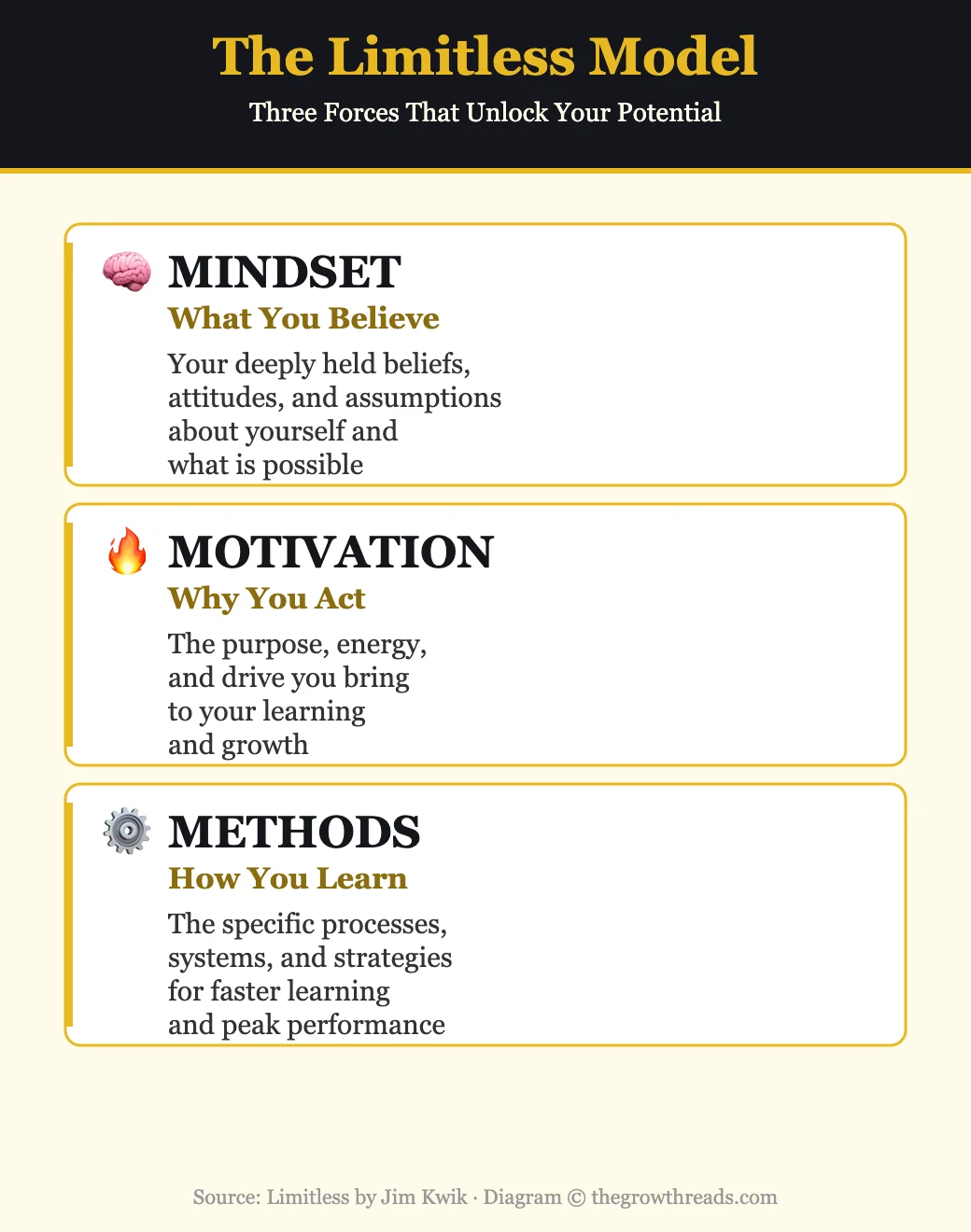
- There are three forces that make you limitless: Your mindset (what you believe), your motivation (why you act), and your methods (how you learn). All three must be strong — weakness in one creates a bottleneck.
- Your brain is neuroplastic at every age: Contrary to the old myth that brains stop growing, neuroplasticity means you can build new neural pathways well into old age. Learning itself makes you smarter.
- LIEs hold you back: Limited Ideas Entertained — beliefs like “I have a bad memory” or “I am not a reader” become self-fulfilling prophecies. Questioning them is the first step to growth.
- Motivation has a formula: Motivation = Purpose × Energy × Small Simple Steps. When any factor drops to zero, motivation collapses. You need all three firing together.
- Your state drives your learning: The emotional and physical state you are in when you study determines how much you absorb. Stand up, breathe deeply, stay curious — never learn in a bored slump.
- Speed reading is a trainable skill: Most people read at 150–200 words per minute. Using a visual pacer, reducing subvocalization, and expanding peripheral vision can double or triple that without losing comprehension.
- Memory is not talent — it is technique: Ancient techniques like the memory palace, chaining, and active recall are far more effective than passive re-reading or highlighting.
- Teach to learn: When you study with the intention of teaching the material to someone else, retention increases dramatically — this is the FAST method in action.
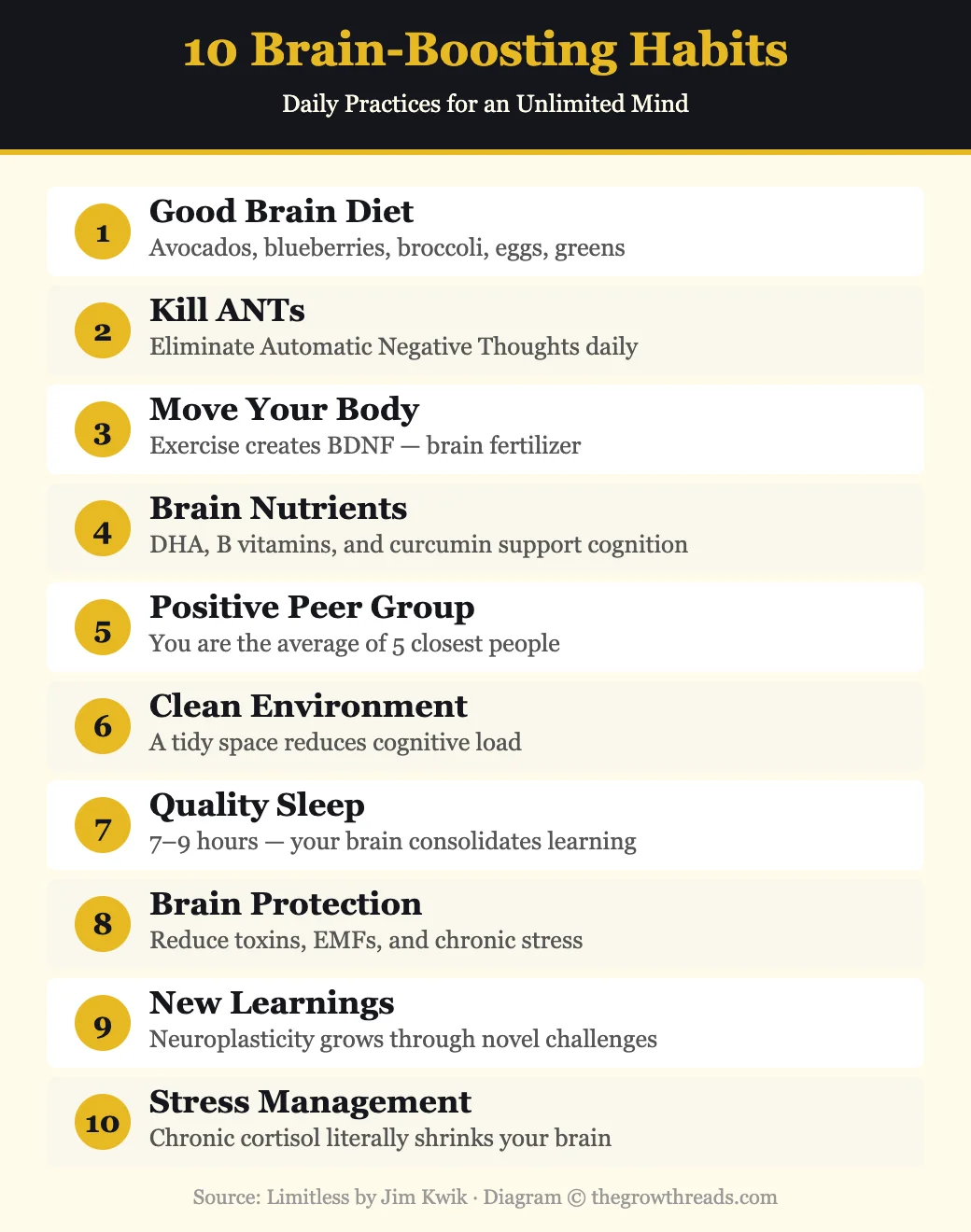
- Your brain needs fuel: Specific nutrients (omega-3s, blueberries, broccoli, dark chocolate) and habits (sleep, exercise, stress management) directly affect cognitive performance.
- Small daily habits beat heroic efforts: Twenty minutes of focused reading daily adds up to roughly twenty-four books per year. Consistency beats intensity every time.
What is Limitless about?
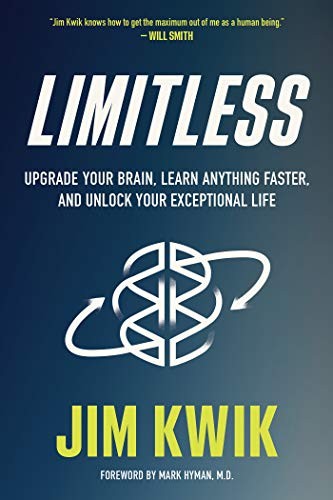
Limitless is a brain-performance guide by Jim Kwik that teaches readers how to upgrade their mindset, boost motivation, and apply proven learning methods — including speed reading, memory techniques, and focus strategies — to unlock their full cognitive potential and learn anything faster.
About the author
Jim Kwik suffered a traumatic brain injury as a five-year-old child that left him struggling in school. Teachers called him “the boy with the broken brain,” and he spent years believing he was simply not smart enough. That painful experience eventually became his motivation to study how the brain works, leading him to develop a set of accelerated learning techniques that he has now taught to millions of people worldwide. Kwik has coached executives at companies including Google, Nike, and SpaceX, and his online courses and podcast (Kwik Brain) have reached hundreds of millions of downloads. Limitless, published in 2020, distills over two decades of coaching into a single actionable framework. Explore all Jim Kwik book summaries →
Key concepts at a glance
| Concept | What it means | Use it when |
|---|---|---|
| Limitless Model | Mindset + Motivation + Methods = unlimited potential | Diagnosing why you feel stuck in any area |
| LIEs (Limited Ideas Entertained) | False beliefs that cap your abilities | You catch yourself saying “I can’t” or “I’m not” |
| Motivation Formula | Purpose × Energy × S3 (Small Simple Steps) | Procrastination hits — check which factor is zero |
| FAST Method | Forget, Active, State, Teach | Before any learning session — set up for maximum absorption |
| Memory Palace | Attach information to locations you know well | Memorising lists, speeches, or sequences |
| Speed Reading | Visual pacer + reduced subvocalization + wider eye span | Processing books, reports, or research faster |
| 10 Brain Foods | Nutrients scientifically linked to better cognition | Planning meals that support mental performance |
| Killing ANTs | Replacing Automatic Negative Thoughts with empowering ones | Negative self-talk undermines your learning |
| Flow State Triggers | Conditions (challenge level, focus, feedback) that push you into flow | You need deep concentration for creative or complex work |
Part 1: Free your mind — the Limitless Mindset
Kwik opens with his own story: as a child with a brain injury, he was labeled slow and internalized it. For years, he believed the label. It was not until a mentor asked him, “What would you do if you had no limits?” that he realized the cage was mental, not physical. This sets up the book’s first pillar: mindset.
The core argument is that most limitations are not real — they are what Kwik calls LIEs: Limited Ideas Entertained. These are beliefs you have absorbed from parents, teachers, media, or past failures that now operate as invisible ceilings. “I’m terrible with names,” “I’m not a math person,” or “I’m too old to learn something new” are all LIEs. They feel like facts, but they are opinions that have hardened through repetition.
Kwik introduces the concept of neuroplasticity — the brain’s ability to reorganize itself by forming new neural connections throughout life. Studies on London taxi drivers showed their hippocampi literally grew as they memorized the city’s 25,000 streets. Your brain adapts to what you ask of it. When you tell it nothing is possible, it complies. When you challenge it, it grows.
The practical takeaway is a daily exercise: catch yourself saying any version of “I can’t” and reframe it as “I haven’t yet.” This tiny linguistic shift keeps the door open for growth and begins to dismantle years of limiting conditioning.
Part 2: Fuel your drive — the Limitless Motivation
Kwik defines motivation not as a feeling you wait for, but as a formula you engineer. His equation: Motivation = Purpose × Energy × Small Simple Steps (S3). It is a multiplication formula, which means if any single factor is zero, the entire product collapses to zero. You can have enormous purpose, but if your energy is depleted from poor sleep and junk food, motivation dies. You can be energized and purposeful, but if the first step feels overwhelmingly large, you freeze.
Purpose is your “why.” Kwik pushes readers to connect their learning goals to reasons that are emotionally compelling — not “I should learn Spanish” but “I want to speak to my grandmother in her native language before she passes.” The stronger the emotional anchor, the more resilient the motivation.
Energy is both physical and mental. Kwik dedicates significant space to the 10 brain foods (avocados, blueberries, broccoli, coconut oil, dark chocolate, eggs, green leafy vegetables, salmon, turmeric, and walnuts), the importance of hydration (your brain is about 75% water), sleep quality, and exercise. He cites research showing that exercise produces BDNF (brain-derived neurotrophic factor), which he calls “fertilizer for the brain.”
Small Simple Steps is Kwik’s antidote to overwhelm. Instead of committing to read fifty pages, commit to reading one page. The tiny commitment bypasses the brain’s threat-detection system and, once you start, momentum carries you further. This mirrors the approach in Tiny Habits by BJ Fogg, though Kwik arrives at it from a brain-performance angle rather than a behavior-design one.
Part 3: Master the methods — speed reading and memory
The longest section of the book delivers Kwik’s concrete toolkit. He starts with focus, arguing that distraction is the number-one enemy of learning. He introduces the concept of “brain fog” caused by digital overload, poor nutrition, and constant notifications. The first method is simply to reduce distractions before you begin: phone in another room, single browser tab, and a clear intention for the session.
Then comes speed reading. Kwik explains that most people read slowly because of three habits: subvocalization (silently pronouncing each word), regression (re-reading lines), and word-by-word fixation (instead of taking in groups of words). His fixes: use a visual pacer (your finger or a pen under the line to guide your eyes), practice expanding your peripheral vision so you take in three to five words at a glance, and gradually reduce the inner voice. He claims these techniques alone can move a reader from 200 to 400+ words per minute within weeks of practice.
For memory, Kwik teaches several proven mnemonic systems. The memory palace (method of loci) involves mentally placing items you want to remember at specific locations in a building you know well — your home, your office, a familiar route. Because spatial memory is one of the brain’s strongest systems, this technique dramatically outperforms rote repetition. Research from the World Memory Championship consistently shows that nearly all competitors use this method.
He also covers chaining (linking items in a vivid story), the peg system (associating numbers with images), and active recall — testing yourself on material instead of passively re-reading it. The evidence on active recall is robust: a 2013 study in Psychological Science in the Public Interest ranked it as one of the most effective study strategies, far above highlighting or summarizing.
Part 4: Learn to learn — the FAST framework and beyond
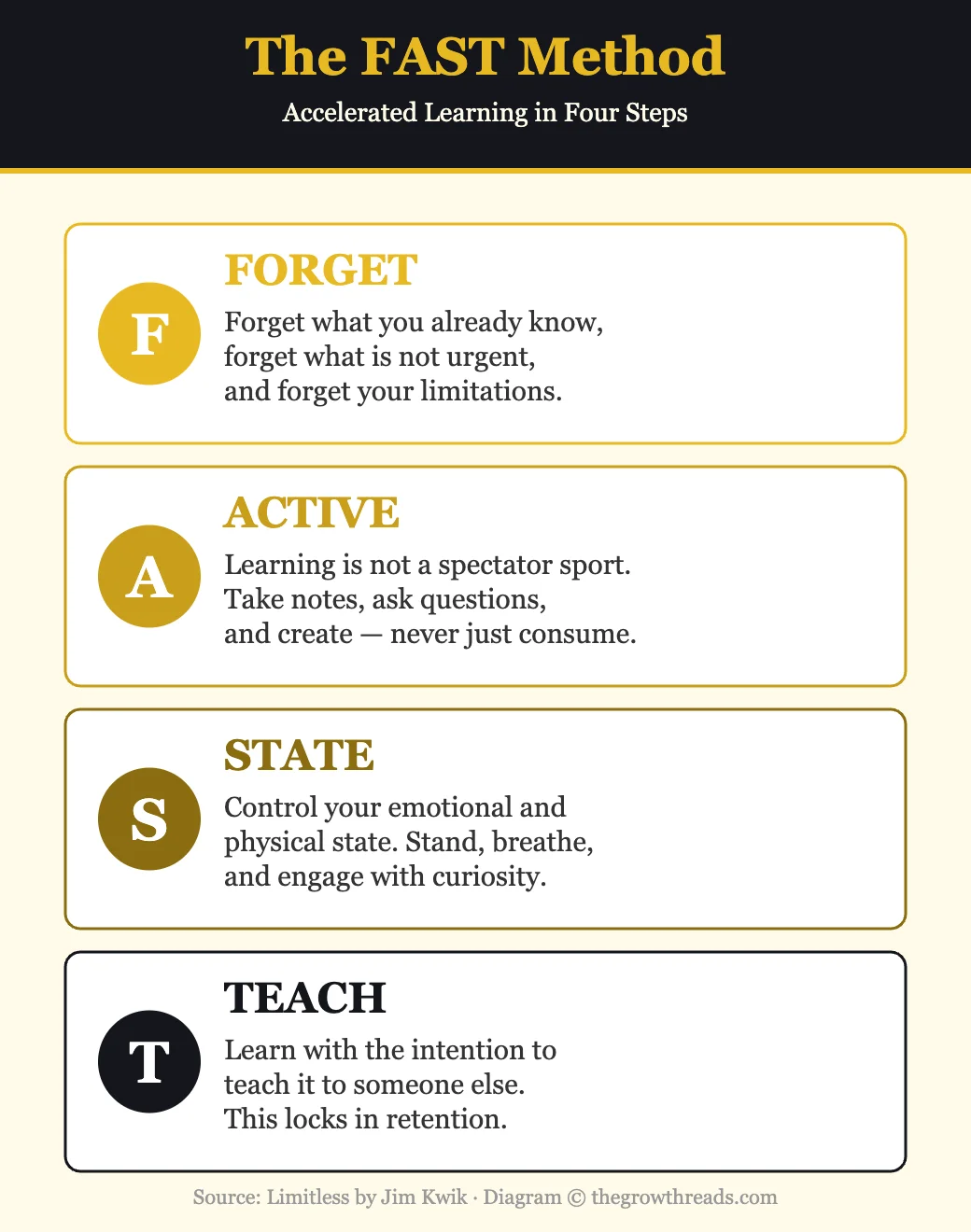
Kwik wraps the methods section with his signature learning framework: FAST. It stands for Forget, Active, State, Teach, and it is meant to be applied at the start of every learning session — a class, a podcast, a book chapter, or a meeting.
Forget means clearing three things: what you think you already know (beginner’s mind opens you to new information), what is not urgent (so your attention is fully present), and your limitations (drop the “I’m bad at this” narrative before you begin).
Active means treating learning as a participatory sport. Take notes by hand (research shows handwriting activates more brain regions than typing). Ask questions. Create summaries in your own words. Passive consumption — just watching or listening without engaging — wastes most of the opportunity.
State is your emotional and physical condition. If you are tired, slouching, and bored, your retention plummets. Kwik recommends standing when possible, taking deep breaths before a session, and deliberately choosing curiosity and excitement. Your brain attaches emotional tags to memories — the stronger the emotion, the stronger the encoding.
Teach is the most powerful lever. When you learn with the intention to teach the material, you pay closer attention, organize it more clearly, and identify gaps in your understanding. Kwik suggests explaining what you learned to a friend, a colleague, or even an imaginary audience within 24 hours.
Who is Limitless best for — and who should read something else first?
Limitless is ideal for students looking to study more efficiently, professionals drowning in information overload, and self-improvement enthusiasts who want a single, comprehensive brain-performance playbook. It is particularly strong for people who feel they are “not smart enough” — the mindset section alone can be transformative.
If you are already well-versed in learning science (you have read Ultralearning, Make It Stick, and Deep Work), some of the methods will feel familiar. In that case, the mindset and motivation sections still add value. If your primary challenge is focus rather than learning technique, start with Indistractable or Stolen Focus first.
Questions to reflect on
- What is one LIE (Limited Idea Entertained) you have carried since childhood that might be holding you back right now?
- If you applied Kwik’s motivation formula to your biggest current goal, which factor — purpose, energy, or small steps — is closest to zero?
- When was the last time you learned something with the specific intention of teaching it to someone else? What difference did it make?
- How many of the 10 brain-boosting habits are already part of your daily routine, and which one could you add this week?
- If you could double your reading speed, what would you do with the extra time — and how would that change your year?
🔥 Ready to unlock your brain’s full potential?
Get Jim Kwik’s complete toolkit for faster reading, sharper memory, and limitless learning.
How to apply Limitless (7-day plan)
- Day 1 — Identify your LIEs: Write down three beliefs about your intelligence or learning ability that might be holding you back. Rewrite each as “I haven’t yet” statements.
- Day 2 — Set your motivation formula: Pick one learning goal. Write your emotional purpose, rate your energy 1–10, and define the smallest possible first step you can take in under two minutes.
- Day 3 — Upgrade your brain fuel: Add one brain food to each meal today (blueberries at breakfast, salmon at lunch, walnuts as a snack) and drink an extra glass of water every two hours.
- Day 4 — Practice speed reading: Choose an article or book chapter. Use your finger as a visual pacer under each line. Time yourself for five minutes and count your words — this is your baseline. Repeat tomorrow.
- Day 5 — Build a memory palace: Pick ten items you need to remember (a grocery list, vocabulary words, or key points from a meeting). Mentally place each one at a specific location in your home. Walk the route and recall them.
- Day 6 — Apply FAST to a learning session: Before reading or watching a lecture, explicitly Forget what you know, commit to Active note-taking, set your State (stand up, breathe), and plan who you will Teach the material to afterward.
- Day 7 — Teach what you learned: Explain one key concept from this week to a friend, family member, or in a journal entry. Notice what gaps appear — fill them, and you will own the knowledge permanently.
Frequently asked questions
Is Limitless worth reading in 2026?
Absolutely. While the expanded edition added some new material, the core framework — mindset, motivation, and methods — is timeless. The speed-reading and memory techniques are based on cognitive science that does not expire. If you consume a lot of information for work or personal growth, the practical drills alone will pay back the reading time many times over. The book remains one of the most accessible introductions to learning how to learn.
What is the main message of Limitless by Jim Kwik?
The main message is that there is no such thing as a fixed level of intelligence or learning ability. Your brain is neuroplastic — it can grow and change at any age. Most of the limits you experience are beliefs (LIEs) you have absorbed, not biological facts. By upgrading your mindset, engineering your motivation, and applying proven learning methods, you can dramatically improve your memory, reading speed, focus, and overall cognitive performance.
How long does it take to read Limitless?
The book is 368 pages and takes the average reader about six hours. However, Kwik encourages you to treat it as a workbook rather than a novel — doing the exercises, practicing the speed-reading drills, and building memory palaces as you go. If you engage with the exercises, plan for about two weeks of 20–30 minutes per day. Ironically, the speed-reading chapter itself will help you finish faster.
What is the FAST method in Limitless?
FAST stands for Forget, Active, State, and Teach. Before any learning session, you Forget what you think you know and distractions, engage Actively through notes and questions, manage your emotional and physical State for peak absorption, and learn with the intention to Teach the material to someone else. It is a pre-learning checklist that dramatically increases retention and comprehension when applied consistently.
Does Limitless actually help you read faster?
Yes, the speed-reading techniques are evidence-based. Using a visual pacer (your finger under the line) alone can increase speed by 25–50 percent because it reduces regression. Expanding peripheral vision and reducing subvocalization add further gains. Most readers can move from 200 to 400+ words per minute with consistent daily practice over two to four weeks. Comprehension does not decrease — it often improves because you are more focused.
What are the 10 brain foods Jim Kwik recommends?
Kwik’s ten brain foods are: avocados (healthy fats for blood flow), blueberries (antioxidants for brain aging), broccoli (vitamin K for cognition), coconut oil (medium-chain triglycerides for energy), dark chocolate (flavonoids for focus), eggs (choline for memory), green leafy vegetables (folate and vitamin E), salmon (omega-3 DHA), turmeric (curcumin reduces inflammation), and walnuts (omega-3s and antioxidants). He recommends incorporating several of these daily.
How does Limitless compare to Ultralearning by Scott Young?
Both books teach you how to learn faster, but from different angles. Limitless is broader — covering mindset, motivation, brain health, and memory alongside learning techniques. Ultralearning is more focused and intense — it is about designing aggressive self-education projects (like learning a language in three months). If you want a complete brain-performance system, start with Limitless. If you want a blueprint for rapid skill acquisition, go with Ultralearning. They complement each other well.
Related summaries
- Ultralearning by Scott Young — aggressive self-education through nine universal principles
- Deep Work by Cal Newport — building the focus habits that make Kwik’s methods effective
- The Power of Habit by Charles Duhigg — the cue-routine-reward loop behind making brain habits stick
- Atomic Habits by James Clear — the gold standard for building small daily habits that compound
More productivity book summaries: The Best Productivity Books of All Time