

Happy Money in one minute
⭐⭐⭐⭐ 3.8/5
One-liner: A warm, paradigm-shifting guide that reframes money as energy — when you let it flow with gratitude, it transforms from a source of stress into a source of joy.
Best for: Anyone who earns enough but still feels anxious about money, and wants to repair their emotional relationship with it.
Reading time: ~4 hours (224 pages)
Difficulty to apply: Easy — the core practice is simply saying “thank you” to every transaction.
Money is energy, and like all energy, it can be positive or negative. That is the central premise of Ken Honda’s Happy Money, and it is deceptively simple. Honda — Japan’s most widely read personal development author on the topic of money — argues that most financial advice focuses exclusively on what he calls Money IQ (budgets, investments, compound interest), while ignoring Money EQ: the emotions, beliefs, and childhood programming that actually drive how we earn, save, spend, and give. The book introduces a Japanese concept called maro — the circular flow of giving and receiving — and makes the case that when you let money flow through your life with gratitude rather than fear, you end up with more of it, not less. This is not a get-rich-quick manual. It is an invitation to stop white-knuckling your finances and start enjoying them.
Key takeaways
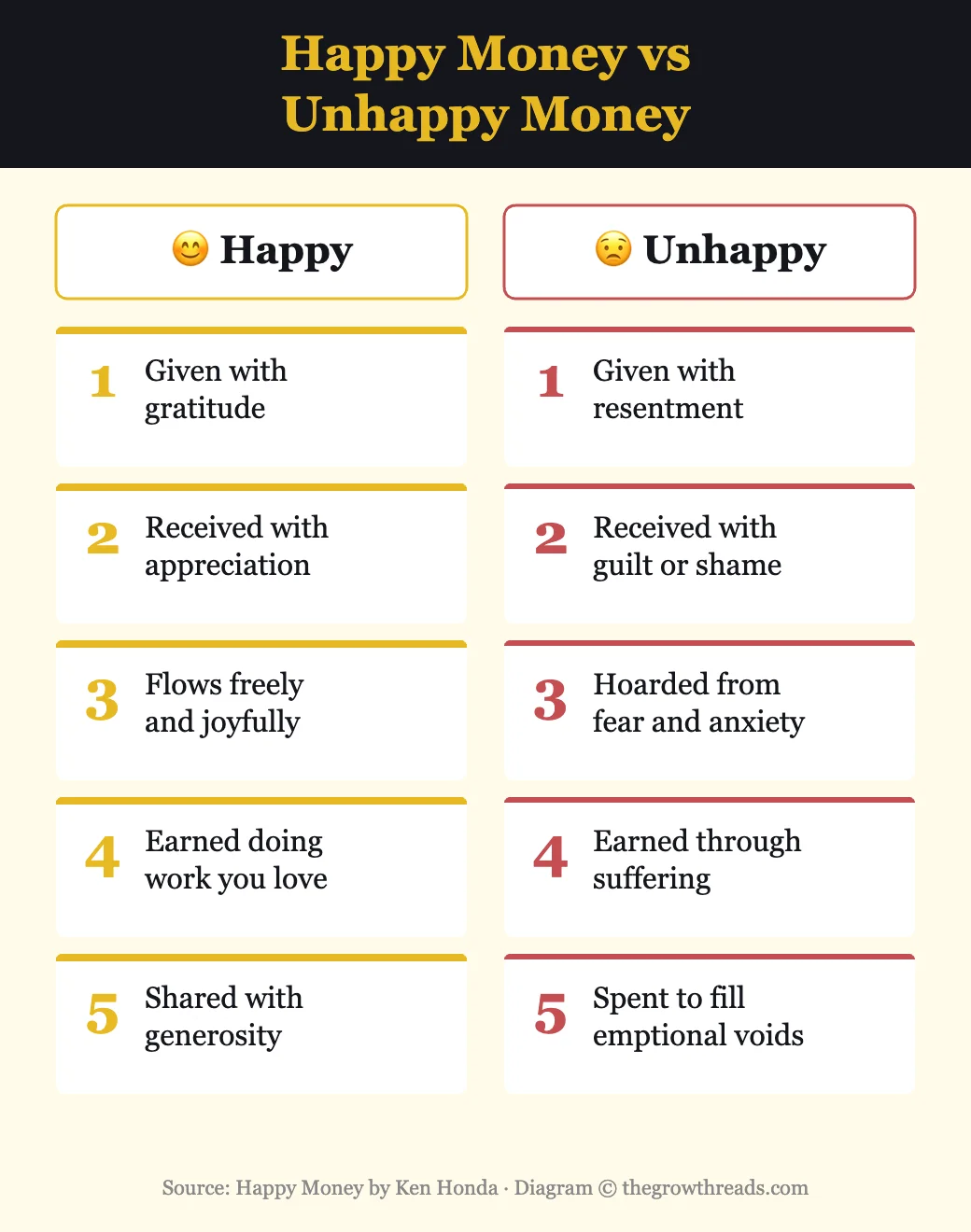
- Money carries emotional energy: Every transaction is infused with either gratitude and joy (“happy money”) or fear, guilt, and resentment (“unhappy money”). The energy you attach to money shapes the role it plays in your life.
- Money IQ is not enough: You can master budgeting, investing, and tax optimization, but if your emotional relationship with money is broken, you will still feel anxious and unfulfilled.
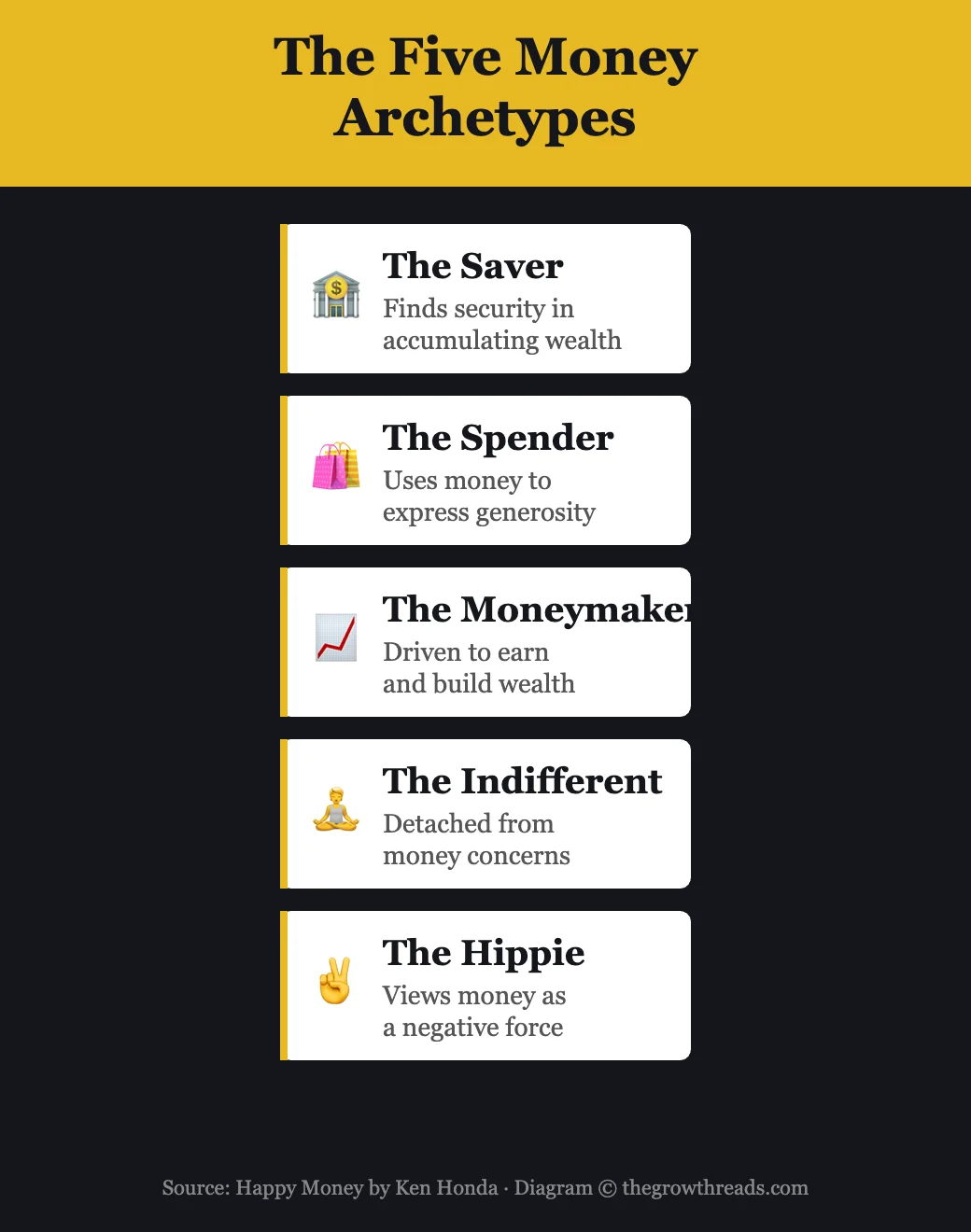
- Everyone has a Money Archetype: Honda identifies five types — Compulsive Saver, Compulsive Spender, Compulsive Moneymaker, Indifferent to Money, and the Hippie — each with distinct strengths and blind spots.
- Your money wounds started in childhood: The beliefs you absorbed watching your parents handle (or avoid) money conversations are still running your financial life decades later.
- The Arigato practice transforms transactions: Saying a silent “thank you” when you pay a bill or receive income rewires your nervous system’s response to money from stress to appreciation.
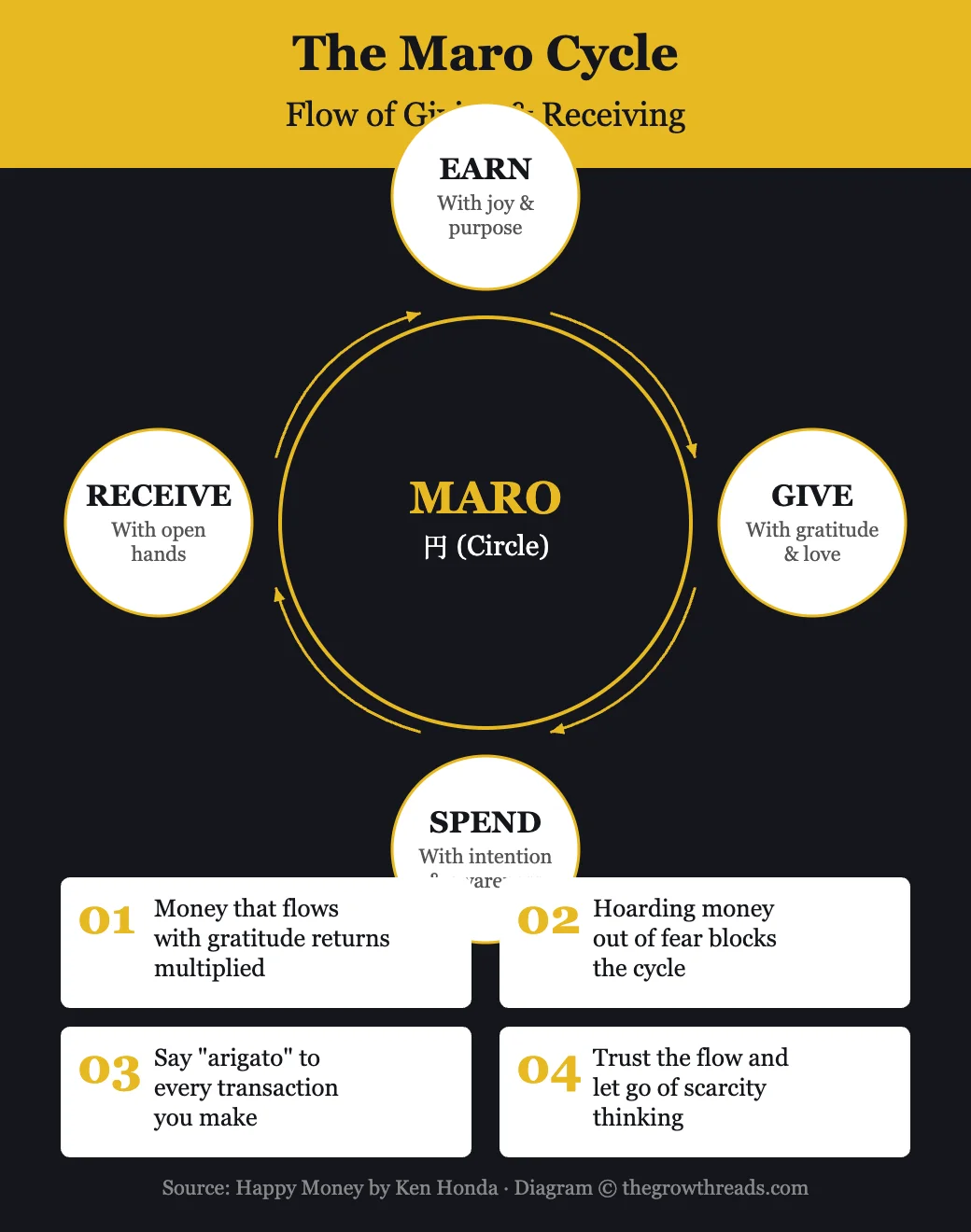
- Maro — the cycle of flow — is how wealth circulates: Money that is given freely and received gratefully keeps moving and multiplying. Hoarding it from fear stops the cycle.
- Your “life’s work” is the intersection of talent and joy: The highest-earning version of you is the one doing work that feels like play, because sustained excellence requires genuine enthusiasm.
- Generosity is a wealth strategy, not a sacrifice: People who give without keeping score tend to receive more opportunities, relationships, and resources than those who hoard.
- Trust replaces budgets as the operating principle: Honda does not teach spreadsheet discipline. He teaches emotional trust — the belief that you will always have enough if you stay in flow.
- Small shifts compound emotionally: You do not need to overhaul your finances overnight. One gratitude practice, one healed money wound, one generous act — these small shifts create lasting transformation.
What is Happy Money about?
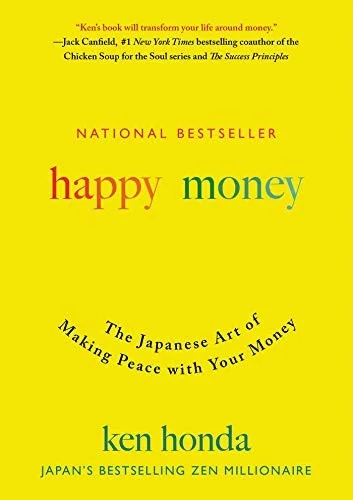
Happy Money by Ken Honda is about transforming your emotional relationship with money by treating it as energy that flows through your life. The book teaches you to distinguish between “happy money” (exchanged with gratitude and joy) and “unhappy money” (exchanged with fear and resentment), and provides a simple gratitude practice that shifts how you earn, spend, and give.
About the author
Ken Honda is Japan’s most prolific author on money and happiness, with more than 8 million copies of his books sold across Asia before Happy Money brought his work to English-speaking audiences in 2019. Raised in Kobe, Honda studied law at Waseda University but quickly pivoted to entrepreneurship, building and selling several businesses before age 30. He then spent years studying under Wahei Takeda, a legendary Japanese investor often called “the Warren Buffett of Japan,” whose philosophy of gratitude-based wealth deeply shaped Honda’s thinking. Honda’s teaching style blends Eastern philosophy with practical wisdom — less spreadsheet, more soul. He writes from a place of genuine warmth and first-hand experience managing significant wealth without letting it manage him. Explore all Ken Honda book summaries →
Key concepts at a glance
| Concept | What it means | Use it when |
|---|---|---|
| Happy Money vs Unhappy Money | Money exchanged with gratitude carries positive energy; money exchanged with fear carries negative energy | You notice resentment when paying bills or guilt when spending on yourself |
| Money EQ | Your emotional intelligence about money — how feelings drive financial behaviour | You are technically savvy with money but still feel anxious about it |
| The Five Archetypes | Five default patterns people fall into: Saver, Spender, Moneymaker, Indifferent, Hippie | You want to understand your automatic money habits and their hidden costs |
| Money Wounds | Childhood beliefs about money absorbed from parents and environment | You keep repeating the same financial patterns despite knowing better |
| Arigato Practice | Saying a silent “thank you” to every inflow and outflow of money | You want a daily practice to shift your money energy from negative to positive |
| Maro (Flow Cycle) | The Japanese concept of circular giving and receiving that multiplies wealth | You feel stuck or stagnant in your financial life |
| Life’s Work | The intersection of your natural talent, deep joy, and service to others | You are earning well but feel hollow, or earning little because you dread your work |
| Trusted Flow | Operating from trust that enough will come rather than from scarcity and control | You over-budget, over-save, or over-worry about money |
Part 1: What is happy money?
Honda opens with a deceptively simple question: does the money in your wallet feel good or bad? Most people have never considered it. We think of money as neutral — a number in a bank account, a tool for transactions. Honda disagrees. He argues that money carries the emotional signature of everyone who touches it. A tip left with genuine appreciation for great service carries different energy than a payment made grudgingly under obligation. The recipient can feel the difference, even if they cannot articulate it.
This is the foundation of Honda’s framework: happy money is money that flows with gratitude, appreciation, and joy. Unhappy money is money that moves through transactions soaked in fear, anxiety, obligation, or resentment. The distinction is not about the amount — a billionaire can have deeply unhappy money, and a modest earner can have deeply happy money. It is about the emotional state attached to each transaction.
Honda illustrates this with stories from his mentor Wahei Takeda, who made it a practice to literally say “arigato” (thank you) to his money. Takeda would thank money when it arrived and thank it when it left, treating each transaction as a gift exchange rather than a loss. The practice sounded eccentric to Honda at first, but he noticed something: Takeda was one of the wealthiest and happiest people he had ever met, and the two qualities seemed inseparable.
TGR Note: Honda’s “money as energy” framing echoes a pattern we see across the best money books: the inner game matters as much as the outer game. Morgan Housel makes a similar argument in The Psychology of Money — that financial success is more about behaviour than intelligence. And Ramit Sethi, in I Will Teach You to Be Rich, emphasises automating the mechanics so your emotions stop sabotaging your decisions. Honda takes the emotional layer even further by making it the entire operating system.
Part 2: Your money blueprint — the five archetypes
Honda identifies five default patterns people fall into when dealing with money. These are not personality types — most people carry elements of two or three — but understanding your dominant archetype reveals the hidden logic behind your financial habits.
The Compulsive Saver finds security in accumulation. They clip coupons, maximise discounts, and feel physical discomfort when spending on non-essentials. The strength is obvious: they build reserves. The blind spot is that they often deprive themselves and their loved ones of experiences, and they can develop a scarcity mindset that prevents them from investing in growth.
The Compulsive Spender uses money to express love, celebrate, and fill emotional gaps. They are often generous to a fault — the first to pick up a dinner tab, the one who buys elaborate gifts. The strength is their openness and warmth. The blind spot is that spending can become a substitute for addressing underlying emotional needs, and the cycle of spend-then-regret creates its own anxiety.
The Compulsive Moneymaker is driven by the thrill of earning. They equate net worth with self-worth and measure success primarily in financial terms. Their strength is relentless drive. Their blind spot is neglecting relationships, health, and rest — they keep score with a number that never feels high enough.
The Indifferent-to-Money type genuinely does not care about finances. They may be brilliant artists, academics, or spiritual practitioners who view money as beneath their attention. The strength is freedom from materialism. The blind spot is practical vulnerability — they can end up dependent on others or in crisis when an emergency strikes.
The Hippie actively distrusts money and views it as a corrupting force. They may feel morally superior to those who pursue wealth. The strength is their value system. The blind spot is that rejecting money does not make it go away — it simply means someone else controls it on their behalf.
TGR Note: Honda’s archetype framework is one of the most accessible money personality models available. If you want a complementary lens, Secrets of the Millionaire Mind by T. Harv Eker digs into the “money blueprint” concept — the subconscious programming that determines your financial thermostat. The two books pair well because Honda focuses on emotional energy while Eker focuses on belief reprogramming.
Part 3: Healing your money wounds
The middle of the book takes a more introspective turn. Honda asks readers to trace their money beliefs back to childhood. What did your parents say about money at the dinner table? Did they fight about it? Was it treated as taboo — something you never discussed openly? Did you grow up hearing “we cannot afford that” or “money does not grow on trees”?
These early experiences create what Honda calls “money wounds” — deep emotional grooves that shape adult financial behaviour without conscious awareness. A child who watched a parent go bankrupt may grow into an obsessive saver. A child who was rewarded with gifts may grow into someone who equates spending with love. A child who heard “rich people are greedy” may sabotage their own earning potential as an adult.
Honda’s healing process is surprisingly gentle. He does not prescribe journaling exercises or affirmation scripts. Instead, he suggests three steps: awareness (recognise the wound), acceptance (stop judging yourself for having it), and forgiveness (release the person — usually a parent — who inadvertently created it). The goal is not to erase the past but to stop letting it run your financial future on autopilot.
He shares a moving story about a woman who had inherited significant wealth from a father she resented. Every time she looked at her bank balance, she felt anger rather than gratitude. The money was objectively abundant, but emotionally it was poisoned. Only after she forgave her father — not for his sake, but for hers — did the money begin to feel like a resource rather than a burden.
TGR Note: The concept of inherited money beliefs shows up throughout the personal finance canon. Rich Dad Poor Dad by Robert Kiyosaki is essentially a book about two competing money blueprints — one from a father who feared financial risk, and one from a mentor who embraced it. Honda’s contribution is making the healing process explicit rather than implying you should simply adopt a new mindset through force of will.
Part 4: Maro — the flow of giving and receiving
The final and most philosophical section introduces maro, a Japanese concept that Honda translates loosely as “the cycle of flow.” The kanji character (円) literally means circle, and it is also the character used for the Japanese yen. Honda sees this as no coincidence: money, by its nature, is meant to circulate.
The maro principle works like this: when you give freely — whether money, time, skill, or kindness — you create a flow. That flow does not necessarily return from the same person you gave to. It circulates through the broader network of human connection and comes back to you in forms you may not expect: an introduction, a job offer, a piece of advice, a gift. The key is that you give without keeping score and receive without guilt.
Honda contrasts this with what he calls the “dam” mentality: hoarding resources out of fear that there will not be enough. The dam stops the flow. And just as a stagnant pond breeds mosquitoes while a flowing river sustains ecosystems, stagnant money breeds anxiety while flowing money breeds abundance.
This is where the book’s practical advice becomes most concrete. Honda suggests starting with small, deliberate acts of generosity — paying for a stranger’s coffee, overtipping a server who clearly needs encouragement, donating to a cause without calculating the tax deduction. The point is not the amount; it is the practice of releasing money with joy rather than gripping it with fear.
He also addresses the receiving side, which many people find even harder than giving. Honda observes that many generous people are terrible receivers. They deflect compliments, refuse gifts, and insist on splitting every bill. This, he argues, is just another form of control — and it blocks the maro cycle just as effectively as hoarding does. Learning to receive gracefully, with a simple “thank you,” completes the circle.
TGR Note: Honda’s maro principle resonates with the “give first” philosophy that shows up in The Almanack of Naval Ravikant, where Naval argues that wealth comes from creating value for others at scale. The mechanism differs — Naval is talking about leverage and equity; Honda is talking about energy and trust — but the underlying conviction is the same: abundance follows generosity, not accumulation.
Who is Happy Money best for — and who should read something else first?
Happy Money is ideal for people who have the basics of personal finance figured out — they earn a living, maybe even save and invest — but still feel a persistent undercurrent of anxiety, guilt, or resentment around money. If your problem is emotional rather than mechanical, this book speaks directly to it. It is also a strong pick for anyone who grew up in a household where money was a source of conflict and wants to break that pattern before passing it to their own children.
If you are looking for tactical advice on budgeting, investing, or debt repayment, this is not the right starting point. Read The Total Money Makeover for a debt elimination plan, The Simple Path to Wealth for an investment framework, or I Will Teach You to Be Rich for a complete financial automation system. Then come back to Happy Money once the mechanics are in place and you want to address the emotional layer underneath.
Questions to reflect on
- When you pay a bill, what emotion surfaces first — gratitude for what you received, or resentment that the money is leaving?
- Which of Honda’s five money archetypes do you recognise in yourself, and how has that pattern served or limited you?
- What is the earliest money memory you can recall from childhood, and what belief did it install about what money means?
- When was the last time someone offered you something generous and you deflected or refused it — and why?
- If you trusted that you would always have enough, what would you do differently with your money this week?
🔥 Ready to transform your relationship with money?
Learn the Japanese art of making peace with your finances — starting with a single “thank you.”
How to apply Happy Money (7-day plan)
- Day 1 — Identify your archetype: Read Honda’s five descriptions and write down which one (or two) you recognise as your default pattern. No judgment — just awareness.
- Day 2 — Trace your money wound: Spend 15 minutes recalling your earliest memory of money. Write down what happened, how it made you feel, and what belief it created.
- Day 3 — Start the Arigato practice: For every transaction today — coffee, groceries, a subscription renewal — say a silent “thank you” as the money leaves. Notice how it shifts the feeling.
- Day 4 — Practise receiving: Accept every compliment, offer, and kindness today with a simple “thank you” instead of deflecting, qualifying, or insisting on reciprocity.
- Day 5 — Give one unexpected gift: Buy a stranger’s coffee, leave an oversized tip, or donate a small amount to a cause you care about. Release it without tracking the karma.
- Day 6 — Audit your money energy: Review your last 10 transactions. For each one, note whether the money felt “happy” (given with joy or gratitude) or “unhappy” (given with resentment or anxiety).
- Day 7 — Write a forgiveness letter: Write a short letter (you do not need to send it) to the person who most shaped your money beliefs. Thank them for what they taught you, forgive what they got wrong, and release the hold it has on you.
Frequently asked questions
Is Happy Money a practical personal finance book?
Not in the traditional sense. It does not cover budgeting spreadsheets, investment allocation, or debt repayment strategies. Its focus is entirely on the emotional and psychological dimension of money. Think of it as the missing companion piece to a tactical book like I Will Teach You to Be Rich — Honda handles the inner game while books like Sethi’s handle the outer game. If you want both, read them as a pair.
What is the Arigato money practice?
It is Honda’s signature technique, inspired by his mentor Wahei Takeda. The practice involves saying a silent “thank you” (arigato in Japanese) to money every time it enters or leaves your life — when you receive your salary, when you pay for groceries, when you tip a waiter. The purpose is to rewire your emotional response to financial transactions from anxiety or indifference to gratitude. Honda argues that this single shift changes how money flows through your life over time.
What are Honda’s five money archetypes?
Honda identifies five default patterns: the Compulsive Saver (finds security in accumulation), the Compulsive Spender (uses money to express love or fill emotional gaps), the Compulsive Moneymaker (equates net worth with self-worth), the Indifferent-to-Money type (genuinely does not care about finances), and the Hippie (actively distrusts money as a corrupting force). Most people are a blend of two or three archetypes, and understanding your dominant pattern reveals the hidden logic behind your financial habits.
What does “maro” mean in Happy Money?
Maro is a Japanese concept that Honda translates as “the cycle of flow.” The kanji character (円) means circle and is also the character used for the Japanese yen. Honda uses it to describe the natural circulation of wealth: when you give freely, receive gracefully, and let money flow without clinging to it, it circulates through your network and returns to you in unexpected ways. The opposite — hoarding from fear — creates stagnation and blocks this natural cycle.
Who is Ken Honda?
Ken Honda is Japan’s most widely read author on the subject of money and happiness, with more than 8 million copies sold across Asia. He studied law at Waseda University, built and sold multiple businesses before age 30, and then spent years studying under Wahei Takeda, a legendary Japanese investor known as “the Warren Buffett of Japan.” Happy Money, published in 2019, was his first major English-language release and became an international bestseller, bringing his gratitude-based approach to money to a global audience.
How long does it take to read Happy Money?
At 224 pages, most readers finish Happy Money in about four hours. The writing is conversational and story-driven, so it reads quickly. Honda uses short chapters and plenty of anecdotes, making it accessible even for people who do not typically read personal finance or self-help books. The concepts are simple enough to grasp in a single sitting, though the real value comes from practising the Arigato technique consistently over weeks and months.
Is Happy Money relevant if I already have good financial habits?
Absolutely — and arguably more so. Honda’s core insight is that financial competence and financial peace are different things. Many disciplined savers and skilled investors still carry deep anxiety about money. They check their portfolio daily, feel guilty about discretionary spending, or cannot enjoy their wealth because they are always bracing for the next downturn. Happy Money addresses that emotional layer specifically, helping you enjoy the financial stability you have already built rather than constantly worrying about preserving it.
Related summaries
- The Psychology of Money by Morgan Housel — why financial success is about behaviour, not intelligence
- Secrets of the Millionaire Mind by T. Harv Eker — reprogramming your subconscious money blueprint
- Die with Zero by Bill Perkins — spending your money on experiences before it is too late
- The Almanack of Naval Ravikant — wealth through leverage, value creation, and inner peace
📚 Explore all Money books: Best Money & Personal Finance Books