

★★★★☆ 4.0 / 5
One-liner: A psychiatrist reveals the hidden psychological “games” people play in everyday interactions — predictable, unconscious scripts that sabotage relationships — and introduces transactional analysis as the framework for breaking free.
Best for: Anyone who notices recurring conflict patterns in relationships, therapists and counsellors, and readers interested in the psychology of interpersonal dynamics.
Reading time: ~6 hrs (guide: 24 min)
Difficulty to apply: Moderate (requires self-observation and willingness to change habitual responses)
Games People Play in one minute
Most of your interactions follow invisible scripts — and until you see the script, you cannot rewrite it. Eric Berne, a Canadian psychiatrist who trained in psychoanalysis before breaking away to create his own framework, introduced transactional analysis (TA) in this 1964 bestseller. His central insight: every person operates from three “ego states” — Parent, Adult, and Child — and most interpersonal conflicts occur when people engage from mismatched or manipulative ego states rather than communicating Adult-to-Adult. Berne catalogued dozens of “games” — recurring interaction patterns with predictable beginnings, moves, and payoffs — that people play unconsciously to avoid genuine intimacy. The book decodes these games, explains why people play them (the payoffs include avoiding vulnerability, confirming beliefs about self and others, and maintaining familiar emotional positions), and shows how to stop playing and start connecting authentically.
Key takeaways
- Everyone operates from three ego states: Parent (internalised rules and caregiving patterns), Adult (rational, present-moment processing), and Child (emotional responses and adaptations from childhood). These are not stages of development — all three are active in every adult.
- Transactions are the basic units of social interaction: Every exchange between two people involves a stimulus from one ego state and a response from another. When the lines are “complementary” (the response comes from the expected state), communication flows. When they “cross,” conflict occurs.
- Games are repetitive, unconscious interaction patterns: A “game” is a series of transactions with a hidden agenda, a predictable sequence, and an emotional payoff. People play games to avoid genuine intimacy while maintaining the illusion of connection.
- Every game has a payoff — and it is not what you think: The payoff is usually an emotional confirmation of an existing belief: “See? No one can help me,” or “I knew you would let me down.” Games are self-fulfilling prophecies that reinforce a person’s “life position.”
- “Why Don’t You — Yes But” is the most common game: One person presents a problem, the other offers solutions, every solution is rejected. The game’s real purpose is not to solve the problem but to prove that no one can help — reinforcing the player’s sense of helpless uniqueness.
- Games prevent intimacy: Genuine intimacy requires vulnerability, which feels dangerous. Games provide structured interactions that mimic closeness without the risk of being truly seen or truly hurt.
- The Adult ego state is the antidote: Responding from the Adult — calmly, rationally, without hooking into the emotional invitation of a game — disrupts the pattern and opens space for authentic communication.
- Crossed transactions can be therapeutic: When someone invites you into a game, responding from an unexpected ego state (crossing the transaction) breaks the script and forces a new type of interaction.
- Life positions shape which games you play: Berne identified four life positions: “I’m OK, you’re OK” (healthy), “I’m not OK, you’re OK” (depressive), “I’m OK, you’re not OK” (paranoid), and “I’m not OK, you’re not OK” (hopeless). Your default position determines your game repertoire.
- Awareness is the first step to freedom: Once you can see the game — name the ego states, identify the hidden agenda, predict the payoff — you have the power to choose a different response. Games lose their power when they become visible.
What is Games People Play about?
Games People Play introduces transactional analysis — a framework for understanding interpersonal dynamics through three ego states (Parent, Adult, Child). Eric Berne catalogues the unconscious “games” people play in relationships and explains how to recognise, disrupt, and replace them with genuine communication.
About the author
Eric Berne, MD (1910–1970), was a Canadian-born psychiatrist who trained in psychoanalysis at the New York Psychoanalytic Institute before developing transactional analysis (TA) as an alternative framework. After being denied membership in the San Francisco Psychoanalytic Institute — a rejection that, ironically, freed him to develop his own system — Berne spent two decades refining TA through clinical practice and academic publication. Games People Play, published in 1964, spent over two years on the New York Times bestseller list, sold over five million copies, and brought psychological concepts into mainstream conversation. Berne founded the International Transactional Analysis Association (ITAA), which continues to certify practitioners worldwide. He died in 1970, but his framework remains widely used in therapy, education, and organisational development. Explore all Eric Berne book summaries →
Key concepts at a glance
| Concept | What it means | Use it when |
|---|---|---|
| Ego states | Three modes of thinking and behaving: Parent, Adult, Child | You want to understand why you react differently in different contexts |
| Transaction | A stimulus-response exchange between two ego states | You are analysing a specific conversation or conflict |
| Complementary transaction | Response comes from the expected ego state — communication flows | A conversation feels smooth and natural |
| Crossed transaction | Response comes from an unexpected ego state — communication breaks | A conversation suddenly becomes tense or confusing |
| Game | A recurring pattern of transactions with a hidden agenda and emotional payoff | You notice the same conflict happening repeatedly |
| Payoff | The emotional reward a game provides — usually confirmation of a life position | You want to understand why someone keeps creating the same problem |
| Life position | Your default belief about yourself and others (I’m OK/not OK, you’re OK/not OK) | You want to understand your relational baseline |
| Intimacy | Game-free, authentic emotional exchange between two people | You want the opposite of game-playing |
Part 1 — The ego states
Berne’s framework begins with a deceptively simple observation: in any given moment, you are operating from one of three ego states. The Parent is the internalised voice of authority — the rules, judgments, caregiving patterns, and moral framework you absorbed from your parents and other authority figures. It has two modes: the Critical Parent (judgmental, controlling, “you should”) and the Nurturing Parent (protective, supportive, “let me help”). The Adult is the rational processor — it deals with present reality, gathers data, and makes decisions based on what is actually happening rather than what you fear or wish. The Child is the emotional core — the spontaneous, creative, playful part (Free Child) and the compliant or rebellious part shaped by early conditioning (Adapted Child).
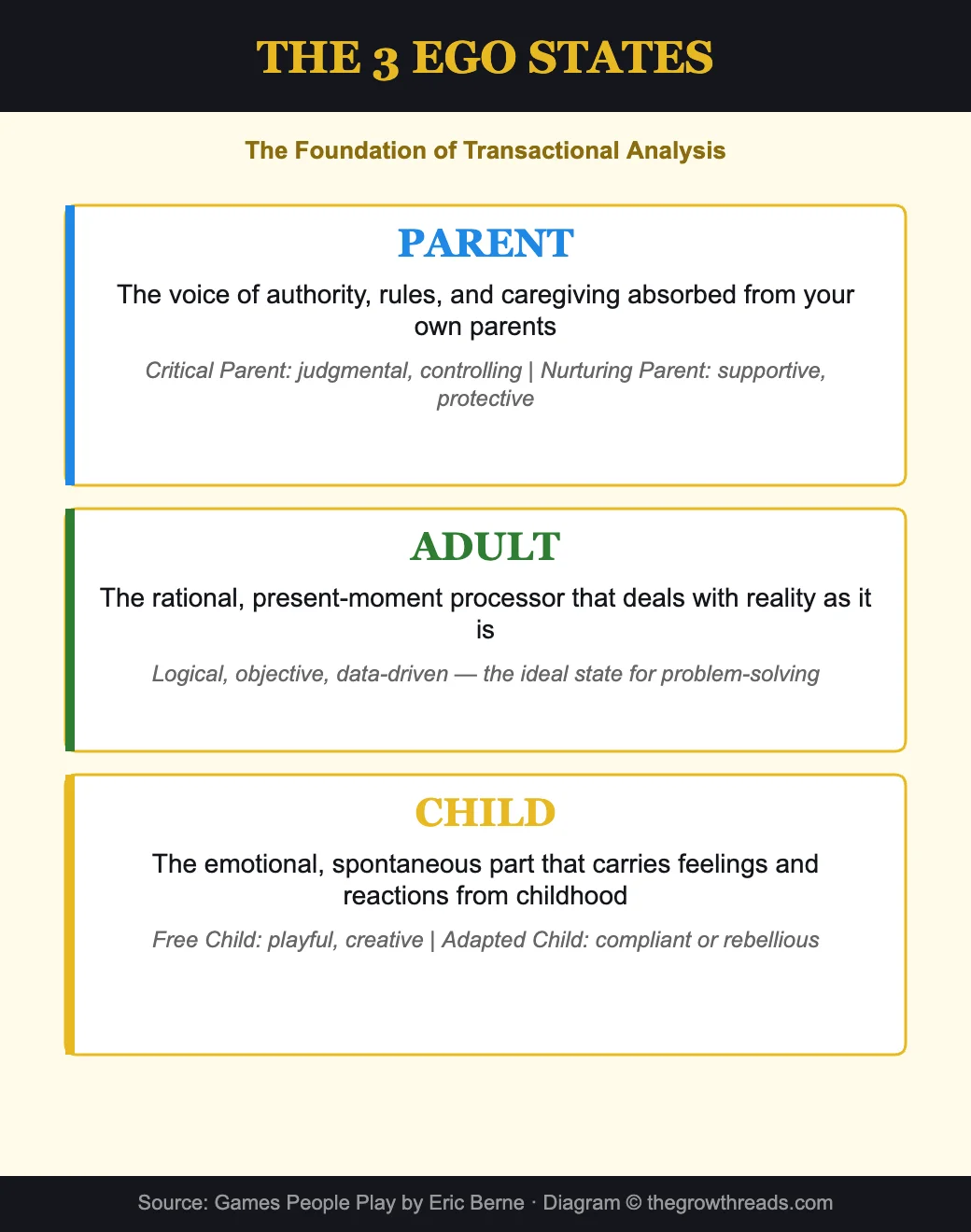
These are not abstract concepts — they are observable. When your boss criticises your report and you feel a flush of shame and the urge to apologise, your Child is responding to their Critical Parent. When you catch yourself lecturing a friend about their lifestyle, your Parent is speaking to their Child. When two colleagues calmly discuss data and reach a joint decision, they are operating Adult-to-Adult. Berne’s insight is that most interpersonal friction occurs not because of the content of communication but because of the ego-state mismatch. The same words can land completely differently depending on which ego state they come from and which ego state receives them.
The practical application is immediate: the next time a conversation goes sideways, ask yourself — which ego state am I in? Which ego state is the other person in? Is this a complementary transaction (both states are aligned) or a crossed one (the response came from an unexpected state)? This single question resolves a surprising number of conflicts that would otherwise escalate into hours of argument.
Part 2 — The games catalogue
The heart of the book is Berne’s catalogue of games — recurring interaction patterns with predictable structures and payoffs. Each game has a name (often darkly humorous), a thesis (the hidden agenda), a set of roles, a sequence of moves, and an emotional payoff that reinforces the player’s existing worldview. Berne catalogues games played in marriage, at parties, in therapy, in the courtroom, and in the bedroom — a taxonomy of human dysfunction that is equal parts clinical and entertaining.
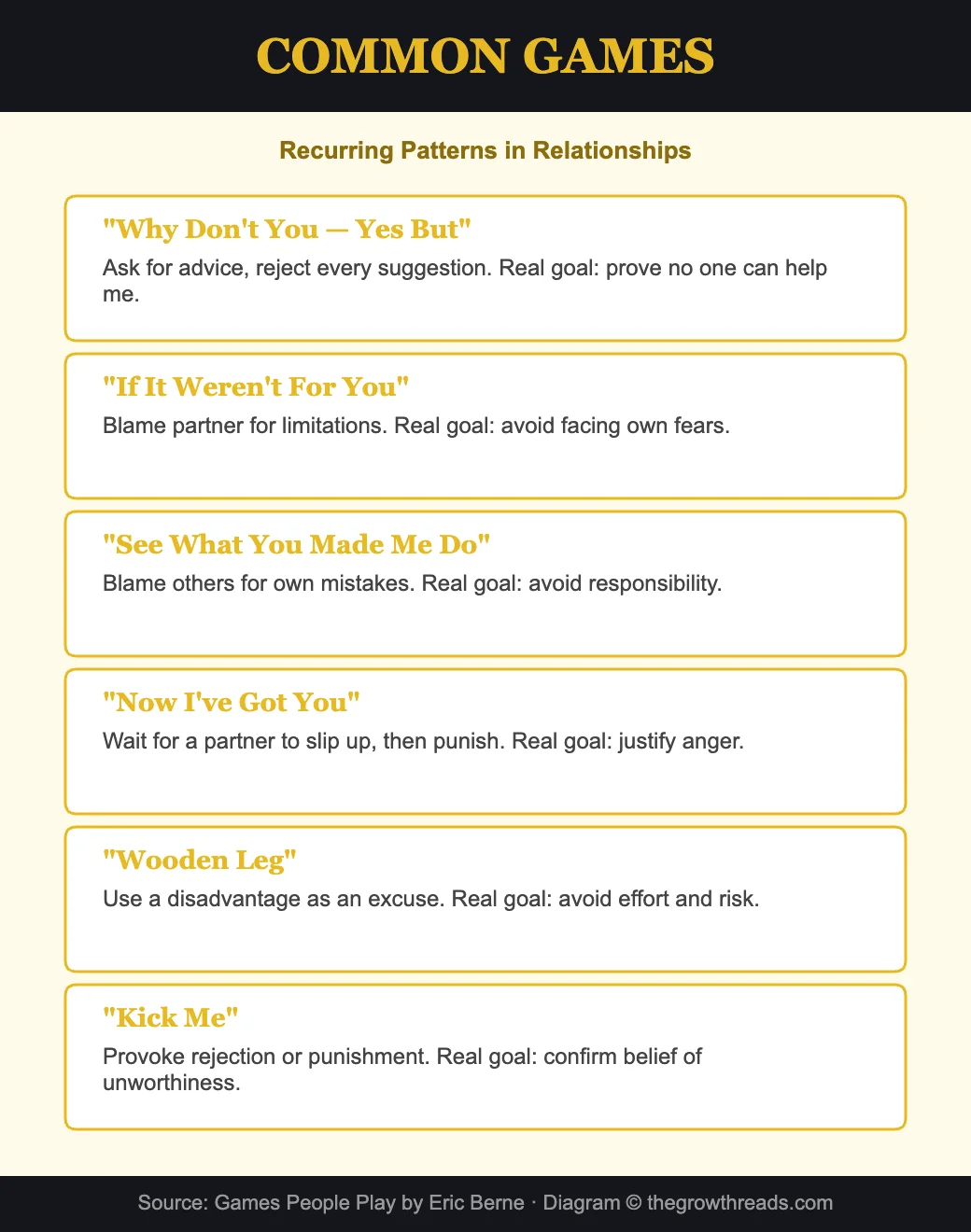
“Why Don’t You — Yes But” is the most commonly played game and the easiest to recognise. Player A presents a problem. Player B suggests a solution. Player A rejects it (“Yes, but…”) and offers a reason it will not work. Player B suggests another solution. Rejected again. The game continues until Player B runs out of suggestions and falls silent in frustration. The payoff for Player A: confirmation that the problem is unsolvable and that no one can help — a satisfying (if miserable) vindication of helplessness. The trap for Player B: they believe they are helping, but they are actually playing the role of “helpless helper” in someone else’s script.
“If It Weren’t For You” is a marriage game. One partner blames the other for restrictions that actually serve them. “I would travel the world if it weren’t for you” — said by someone who is actually afraid to travel. The partner’s restrictiveness provides a convenient excuse for avoiding risk. If the partner were to change, the game-player would have to confront their own fear, which is far more threatening than blaming the other person.
“Now I’ve Got You, You Son of a Bitch” is a game of righteous anger. The player waits (sometimes for months) for the other person to make a mistake, then erupts with disproportionate fury. The payoff: justified rage, which feels powerful and replaces the vulnerability of expressing genuine hurt or need. The underlying dynamic: the player cannot say “I feel hurt” so they wait for an excuse to say “you are wrong.”
Part 3 — Beyond games: toward intimacy
Berne’s final section is shorter than readers expect but carries the book’s most important message: the alternative to game-playing is intimacy, and intimacy is the most satisfying — and most terrifying — form of human interaction. Berne defines intimacy as “a candid, game-free relationship with mutual free giving and receiving, without exploitation.” In intimacy, there is no hidden agenda, no manipulative ego-state switching, and no emotional payoff beyond the connection itself.
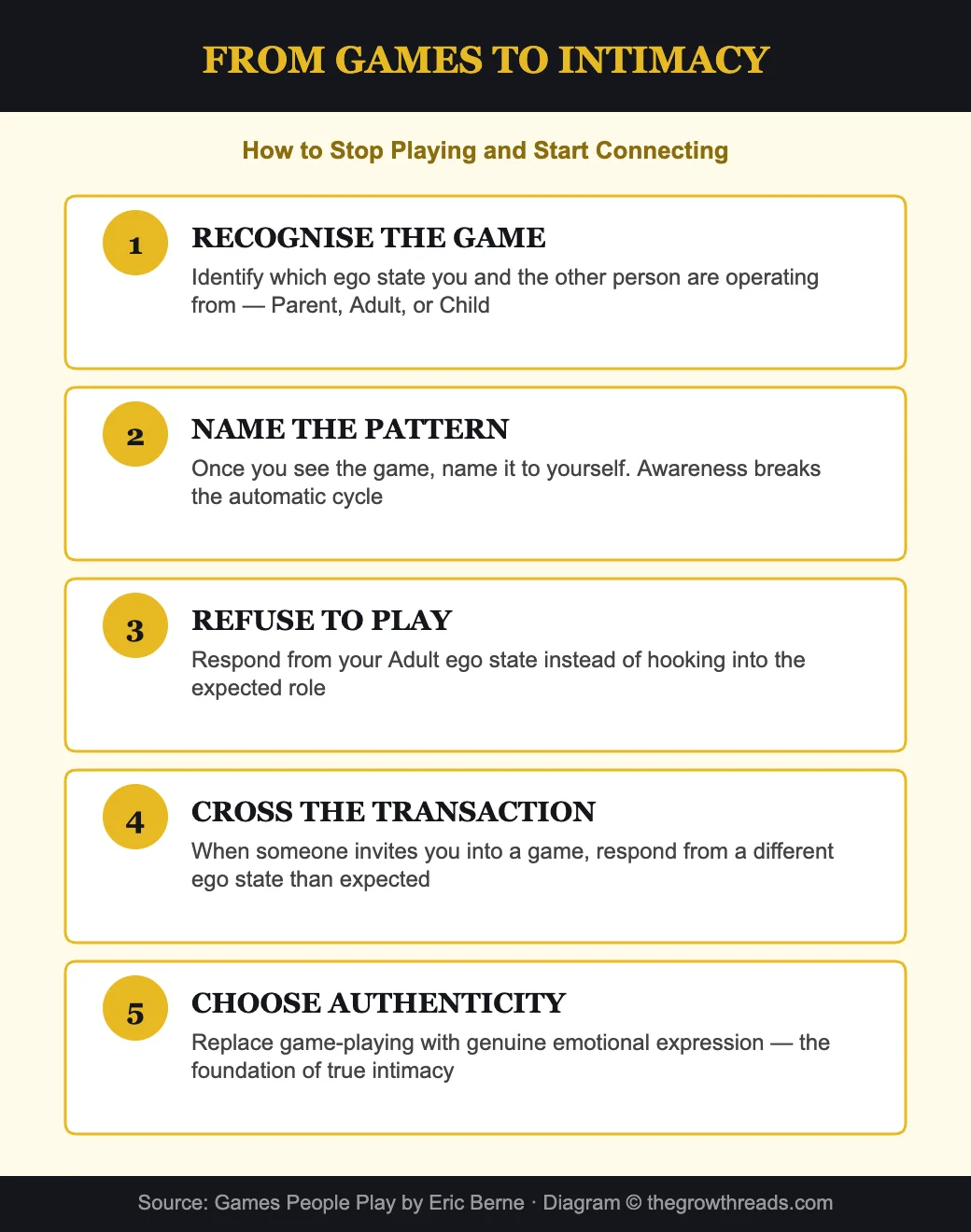
Most people find intimacy more frightening than conflict. In a game, the outcome is predictable — you know what role you will play and what emotional position you will land in. In intimacy, there is no script: you are genuinely present, genuinely vulnerable, and genuinely uncertain of the outcome. This uncertainty is what makes games attractive — they provide the structure and predictability that intimacy withholds. But it is also what makes intimacy infinitely more rewarding: the connection is real, not performed.
Berne’s prescription for breaking free of games is awareness. Once you can identify the game — name it, map the ego states, predict the payoff — it loses its automatic power. You can still choose to play (some social games are relatively harmless), but you are choosing consciously rather than being driven by an unconscious script. The shift from unconscious game-playing to conscious choice is, for Berne, the fundamental therapeutic achievement — the moment when a person moves from being lived by their patterns to living their own life.
Who is Games People Play best for — and who should read something else first?
This book is ideal for anyone who notices recurring patterns in their relationships — the same argument happening with different people, the same emotional position being reached regardless of context. It is especially valuable for therapists, counsellors, and coaches who want a framework for identifying and interrupting dysfunctional interaction patterns. The game catalogue alone is worth the read: you will recognise games you have been playing (and being played by) for years.
If you find Berne’s 1960s writing style dense (it is more clinical than modern self-help), consider starting with Crucial Conversations for practical communication tools, then returning to Berne for the theoretical depth. If your primary concern is attachment patterns rather than interaction scripts, Attached is more directly applicable. And if codependency is the presenting issue, Codependent No More addresses the emotional dimension that Berne treats analytically.
Questions to reflect on
- Which ego state do you default to in conflict — Parent (lecturing), Child (sulking), or Adult (problem-solving)?
- Can you identify a game you have been playing repeatedly in a current relationship — and what is the payoff you have been collecting?
- When someone offers you advice, do you genuinely consider it or automatically reject it (“Yes, but…”)? What does your answer reveal?
- What would your closest relationship look like if both people operated from the Adult ego state 80% of the time?
- What is more frightening to you: predictable conflict (games) or unpredictable vulnerability (intimacy)?
🔥 Ready to see the hidden scripts in your relationships?
Learn to recognise the unconscious games that sabotage intimacy — and how to stop playing them.
How to apply Games People Play (7-day plan)
- Day 1 — Learn the ego states: For one day, observe your own conversations and label which ego state you are in: Parent (advising, judging), Adult (discussing facts), or Child (reacting emotionally). Just observe — do not try to change anything yet.
- Day 2 — Spot a crossed transaction: Notice one conversation today that suddenly felt tense or confusing. Ask: which ego state did I send from, and which ego state responded? Was the response from an unexpected state? This is a crossed transaction.
- Day 3 — Identify one game: Think of a recurring conflict in a current relationship. Does it follow a predictable pattern? Can you name the roles, the moves, and the emotional payoff? Write it down. You are mapping a game.
- Day 4 — Refuse to play: The next time you recognise a game starting, respond from your Adult ego state instead of the role the game requires. If someone plays “Why Don’t You — Yes But,” try: “That sounds difficult. What have you already considered?” Then stop offering solutions.
- Day 5 — Check your life position: Ask honestly: do you default to “I’m OK, you’re OK” (healthy), “I’m not OK, you’re OK” (depressive), “I’m OK, you’re not OK” (superior), or “I’m not OK, you’re not OK” (hopeless)? Your default position shapes which games you attract.
- Day 6 — Practice Adult-to-Adult: In one important conversation today, consciously stay in your Adult ego state: state facts, ask questions, express feelings without blaming, and listen without judging. Notice how different it feels from your habitual pattern.
- Day 7 — Invite intimacy: Choose one person you trust. Share something genuine — a fear, a hope, an observation about yourself — without any agenda. No game, no payoff, no script. Just honest expression and see what happens. This is what Berne means by intimacy.
Frequently asked questions
Is transactional analysis still used in therapy today?
Yes. TA is practised worldwide, with professional bodies (ITAA, EATA) certifying therapists, counsellors, and organisational consultants. It has evolved significantly since Berne’s original work, integrating with relational, cognitive, and body-oriented approaches. Modern TA is less focused on game-cataloguing and more on relational patterns, early decisions, and therapeutic relationship. It is particularly strong in educational settings and organisational development, where the ego-state model provides an accessible framework for improving communication.
Are the ego states the same as Freud’s id, ego, and superego?
Similar but not identical. Freud’s model is structural and largely unconscious — the id is instinctual drives, the superego is internalised morality, and the ego mediates between them. Berne’s ego states are observable and phenomenological — you can see and feel when you shift from Parent to Adult to Child. Berne deliberately made his model more accessible and practical than Freud’s, and each ego state is considered a complete system of thinking, feeling, and behaving rather than a theoretical construct.
Does everyone play games?
According to Berne, yes — games are a universal feature of human social life. They range from mild, socially useful games (small talk, polite rituals) to destructive, relationship-ending games (repeated betrayals, escalating conflicts). The question is not whether you play games but which games you play, how intensely, and whether you are aware of them. Some games are relatively harmless social lubrication; others are deeply destructive patterns that repeat across relationships and decades. Awareness is the key variable.
Why do people play games instead of communicating directly?
Games serve several functions. They provide structure to interactions (reducing the anxiety of genuine spontaneity), they confirm existing beliefs about self and others (maintaining the familiar life position), and they provide emotional payoffs that feel satisfying even when they are painful. Most importantly, games allow people to avoid the vulnerability of genuine intimacy, which requires showing up without a script and risking rejection. For people whose early experiences taught them that vulnerability is dangerous, games are a rational (if ultimately self-defeating) adaptation.
Is the writing style difficult?
Berne writes in a clinical, 1960s academic style that some modern readers find dense. The game descriptions can feel like reading case notes rather than narrative. However, the core concepts are clear and the game names are memorably vivid. If you find the original text challenging, consider reading a modern introduction to TA first (such as I’m OK — You’re OK by Thomas Harris), then returning to Berne for the original catalogue. The ideas themselves are immediately applicable regardless of the prose style.
How do I stop a game once I recognise it?
The simplest technique is to “cross the transaction” — respond from a different ego state than the game expects. If someone invites you into a Critical Parent role (“tell me what I should do” — setting up for “Yes But”), respond from the Adult: “What options have you considered?” If someone tries to hook your Child with a guilt trip, respond from the Adult: “I understand you are upset. What specifically would you like me to do?” The game cannot continue if both players do not follow the script. Staying in your Adult ego state is the single most effective game-breaker.
How does this compare to other relationship psychology books?
Games People Play is the foundational text for understanding interaction patterns. Attached (attachment theory) explains why you enter certain relational dynamics. Codependent No More addresses the emotional experience of losing yourself in relationships. Crucial Conversations provides practical communication tools. Berne provides the analytical framework — the ability to see the structure of what is happening in an interaction. For maximum benefit, read Berne for pattern recognition, Attached for attachment understanding, and Crucial Conversations for communication skills.
Related summaries
- Crucial Conversations by Patterson et al. — Practical tools for the Adult-to-Adult conversations Berne advocates.
- Attached by Amir Levine — Why you enter certain relational dynamics — the attachment theory perspective.
- Codependent No More by Melody Beattie — The emotional experience of getting trapped in relational games.
- Emotional Intelligence by Daniel Goleman — The skills that enable Adult ego-state functioning under pressure.
- See all Relationships book summaries on our Best Relationship Books pillar page.