

★★★★☆ 4.0 / 5
One-liner: A therapist explains why people-pleasing men who avoid conflict, hide their needs, and seek approval through caretaking end up frustrated in love and life — and provides a direct path to reclaiming authenticity.
Best for: Men who recognise the people-pleasing pattern in themselves, their partners, and anyone interested in the psychology of approval-seeking behaviour.
Reading time: ~5 hrs (guide: 22 min)
Difficulty to apply: High (requires confronting deep-seated shame and behavioural patterns)
No More Mr Nice Guy in one minute
The “Nice Guy” is not actually nice — he is a people-pleaser running a set of invisible deals that guarantee his own unhappiness. Robert Glover, a marriage and family therapist, identifies a pattern he calls the Nice Guy Syndrome: men who learned in childhood that they must hide their flaws, suppress their needs, and please everyone in order to be loved. These men enter adult relationships carrying “covert contracts” — unspoken agreements where they give excessively while secretly expecting reciprocity. When the other person inevitably fails to fulfil a contract they never agreed to, the Nice Guy erupts in resentment, passive aggression, or withdrawal. Glover argues that this pattern is not generosity but manipulation — driven by shame and fear rather than genuine love — and that the path forward requires radical honesty, direct need-stating, boundary-setting, and the courage to be disliked.
Key takeaways
- Nice Guys are not actually nice: Their “niceness” is a strategy for gaining approval and avoiding conflict, not genuine kindness. Real kindness does not come with hidden expectations.
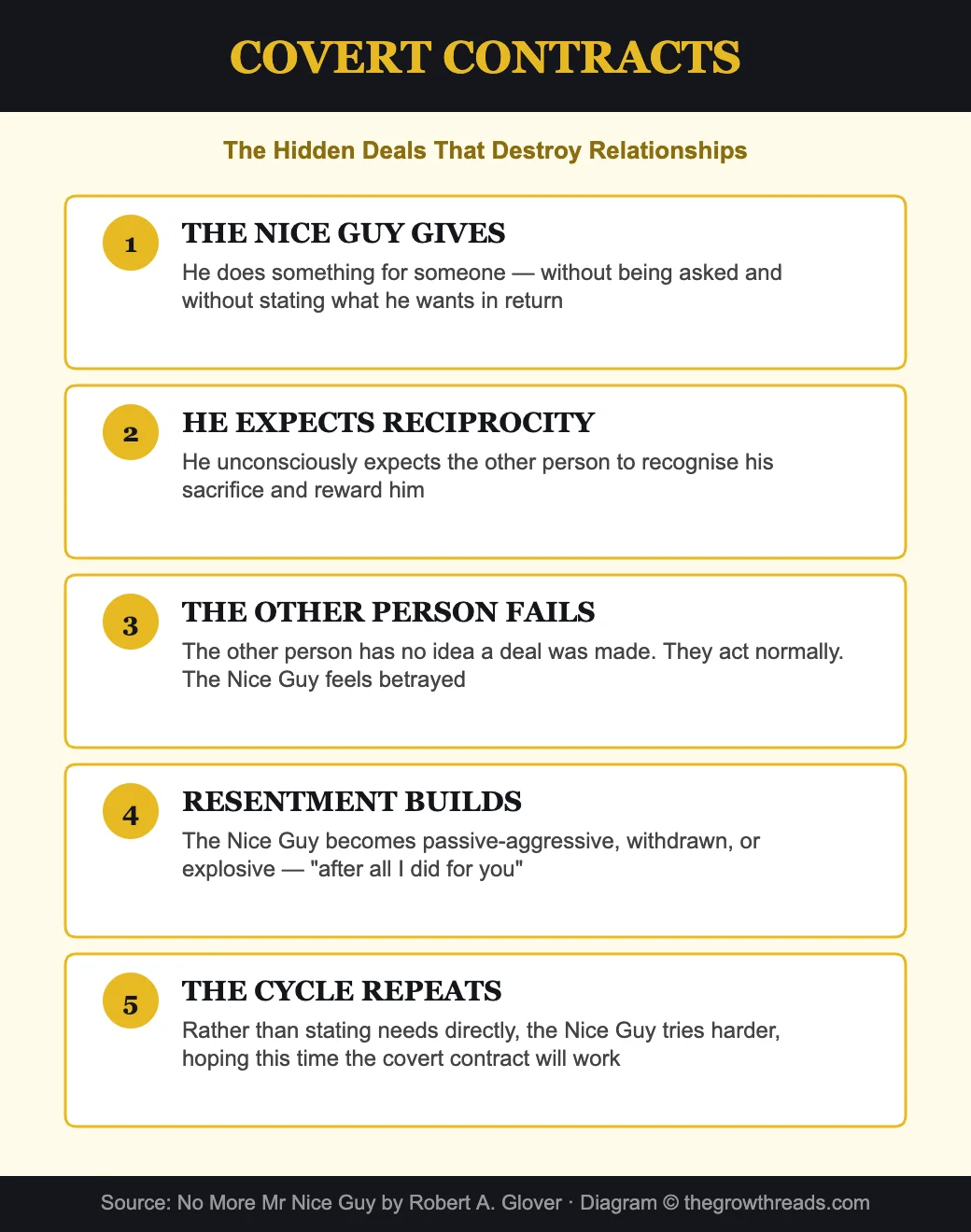
- Covert contracts are the core problem: Nice Guys give without being asked and expect reciprocity without stating it. When the unspoken deal is not honoured, they feel betrayed — but the other person never knew a deal existed.
- The Nice Guy Syndrome originates in childhood: Boys who received conditional love (“I will love you if you are good/quiet/helpful”) learn to suppress their authentic selves and perform a role to earn affection.
- People-pleasing is a form of control: By managing everyone’s perception of them, Nice Guys attempt to control how others feel about them — a strategy that exhausts both parties.
- Avoiding conflict creates worse conflict: Unexpressed needs and suppressed resentment do not disappear — they leak out as passive aggression, emotional withdrawal, addiction, or explosive anger.
- Shame drives the entire pattern: Nice Guys carry a core belief that they are fundamentally flawed and must compensate through performance. Until this shame is addressed, behavioural changes will not stick.
- Direct need-stating is the antidote: Instead of hoping others will intuit your needs (covert contracts), learn to ask clearly and tolerate the possibility of hearing “no.”
- Healthy selfishness is necessary: Taking care of your own needs first is not selfish — it is the foundation of genuine giving. You cannot give from an empty tank without building resentment.
- Male friendships are essential for recovery: Nice Guys typically lack close male friendships because they learned to seek validation exclusively from women. Men’s groups provide a space to practise vulnerability without the romantic dynamic.
- Integration, not perfection, is the goal: The “Integrated Male” accepts his imperfections, states his needs directly, sets boundaries confidently, and engages in relationships as his authentic self — not a performance.
What is No More Mr Nice Guy about?
No More Mr Nice Guy exposes the Nice Guy Syndrome — a pattern where men seek approval through people-pleasing, hide their true selves, and build relationships on unspoken expectations. Therapist Robert Glover explains why this pattern develops, how covert contracts destroy intimacy, and what it takes to become an authentic, integrated person.
About the author
Robert A. Glover, PhD, is a marriage and family therapist who has been counselling individuals and couples for over 30 years. He developed the Nice Guy concept after recognising the same pattern in hundreds of male clients: externally accommodating, internally resentful, and chronically frustrated in their relationships. Glover runs No More Mr Nice Guy workshops and men’s groups worldwide, and his book has sold over a million copies since publication in 2003. He is a self-identified “recovering Nice Guy” whose personal journey with the syndrome informed both the theory and the practical recovery exercises. His follow-up book, Dating Essentials for Men, extends the framework to single men navigating the dating world. Explore all Robert A. Glover book summaries →
Key concepts at a glance
| Concept | What it means | Use it when |
|---|---|---|
| Nice Guy Syndrome | A pattern of seeking approval through people-pleasing, need-suppression, and conflict avoidance | You give excessively and feel chronically unappreciated |
| Covert contracts | Unspoken expectations attached to giving — “I do this, so you should do that” | You feel resentful after helping someone |
| Toxic shame | The deep belief that you are fundamentally flawed and must compensate through performance | You feel you must earn love through being “good” |
| Approval seeking | Organising your behaviour around what others think of you | You change your opinions based on who you are with |
| Integrated Male | A person who accepts imperfections, states needs directly, and lives authentically | You want a clear picture of what recovery looks like |
| Healthy selfishness | Prioritising your own needs as a prerequisite for genuine generosity | You feel guilty about doing anything for yourself |
Part 1 — The Nice Guy Syndrome
Glover begins by profiling the Nice Guy in clinical detail. On the surface, he appears ideal: helpful, accommodating, attentive to others’ needs, and rarely angry. Beneath the surface, he is chronically resentful, sexually frustrated, prone to passive aggression, and unable to identify or articulate his own needs. He pours energy into managing other people’s perceptions while neglecting his own life. He volunteers for tasks he does not want to do, agrees with opinions he does not hold, and avoids any behaviour that might provoke disapproval — all while keeping a running mental ledger of how much he has given and how little he has received.
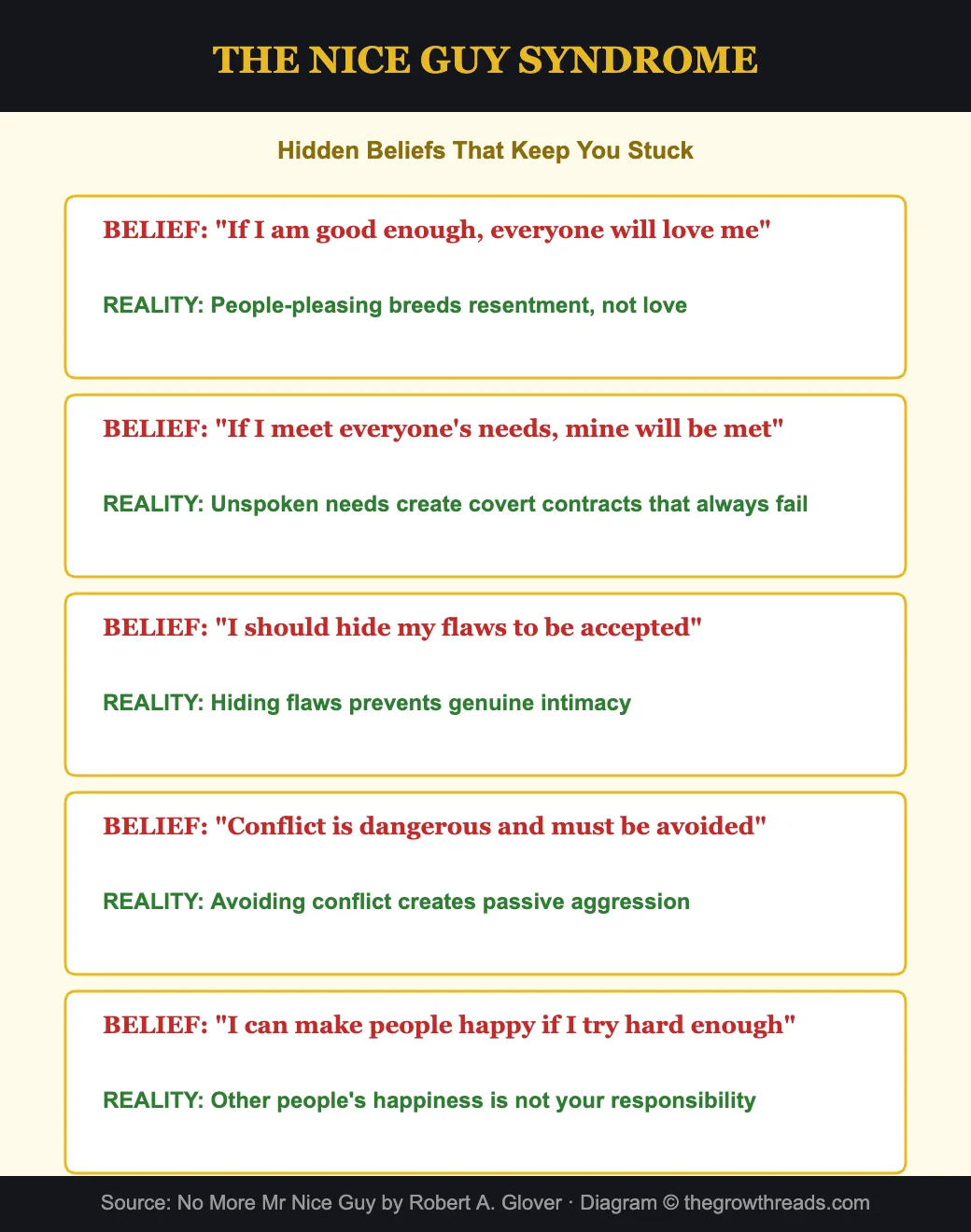
The covert contract mechanism is the book’s most powerful insight. A Nice Guy does not say: “I will cook dinner tonight if you will be affectionate afterward.” Instead, he cooks dinner without being asked, secretly expects affection, receives nothing (because the other person does not know a deal was made), and then feels betrayed. He might sulk, withdraw, or snap — all while insisting he is “fine.” The tragedy is that the other person is not being ungrateful; they are simply unaware that an invisible contract existed. This dynamic poisons relationships because it replaces honest communication with mind-reading expectations that always fail.
Glover traces the syndrome’s origin to childhood experiences where love was conditional. Boys who received the message “I will love you if you are good / quiet / helpful / no trouble” learn to perform rather than exist. They suppress anything that might provoke disapproval — anger, assertiveness, sexual desire, imperfection — and develop a sanitised “role self” designed to be liked rather than known. The toxic shame underneath says: “If people saw the real me, they would reject me.” This is the engine that drives all Nice Guy behaviour.
Part 2 — Breaking the pattern
Glover’s recovery framework is structured around what he calls “Breaking Free” activities — practical exercises designed to surface and dismantle covert contracts, toxic shame, and approval-seeking behaviour. The first step is awareness: identifying the specific covert contracts you are running in your relationships. Glover asks readers to list their resentments and work backward: “What did I expect to receive that I did not get? Did I ever state this expectation clearly? If not, why not?”
The second step is learning to state needs directly. This is terrifying for Nice Guys because it risks rejection — the very outcome their entire personality structure was designed to prevent. Glover argues that the fear of rejection is worse than actual rejection: when you state a need and hear “no,” you have real information to work with. When you rely on covert contracts, you live in a permanent state of ambiguity and hope that never resolves. Direct asking is vulnerable, uncomfortable, and infinitely more effective than hinting, hoping, or helping-to-receive.
The third step is what Glover calls “healthy selfishness” — and this is the concept Nice Guys find most threatening. He argues that putting your own needs first is not selfish; it is the prerequisite for authentic generosity. When you give from a full tank, there are no strings attached. When you give from depletion, every gift carries an invisible invoice. Healthy selfishness means: going to the gym instead of volunteering for another task, spending time with friends instead of hovering over your partner, pursuing your own interests instead of mirroring someone else’s. The paradox: partners of recovering Nice Guys almost always report that the relationship improves when the Nice Guy becomes “selfish,” because they are finally relating to a real person instead of a performance.
Part 3 — Becoming integrated
The final section describes the “Integrated Male” — Glover’s term for a man who has moved beyond the Nice Guy pattern. Integration does not mean becoming aggressive, cold, or uncaring. It means accepting all parts of yourself — including the parts you were taught to hide — and engaging in relationships honestly. The Integrated Male expresses anger directly rather than passive-aggressively, asks for what he wants rather than hoping, sets boundaries rather than resenting, and accepts that some people will not like him — and that this is not a catastrophe.
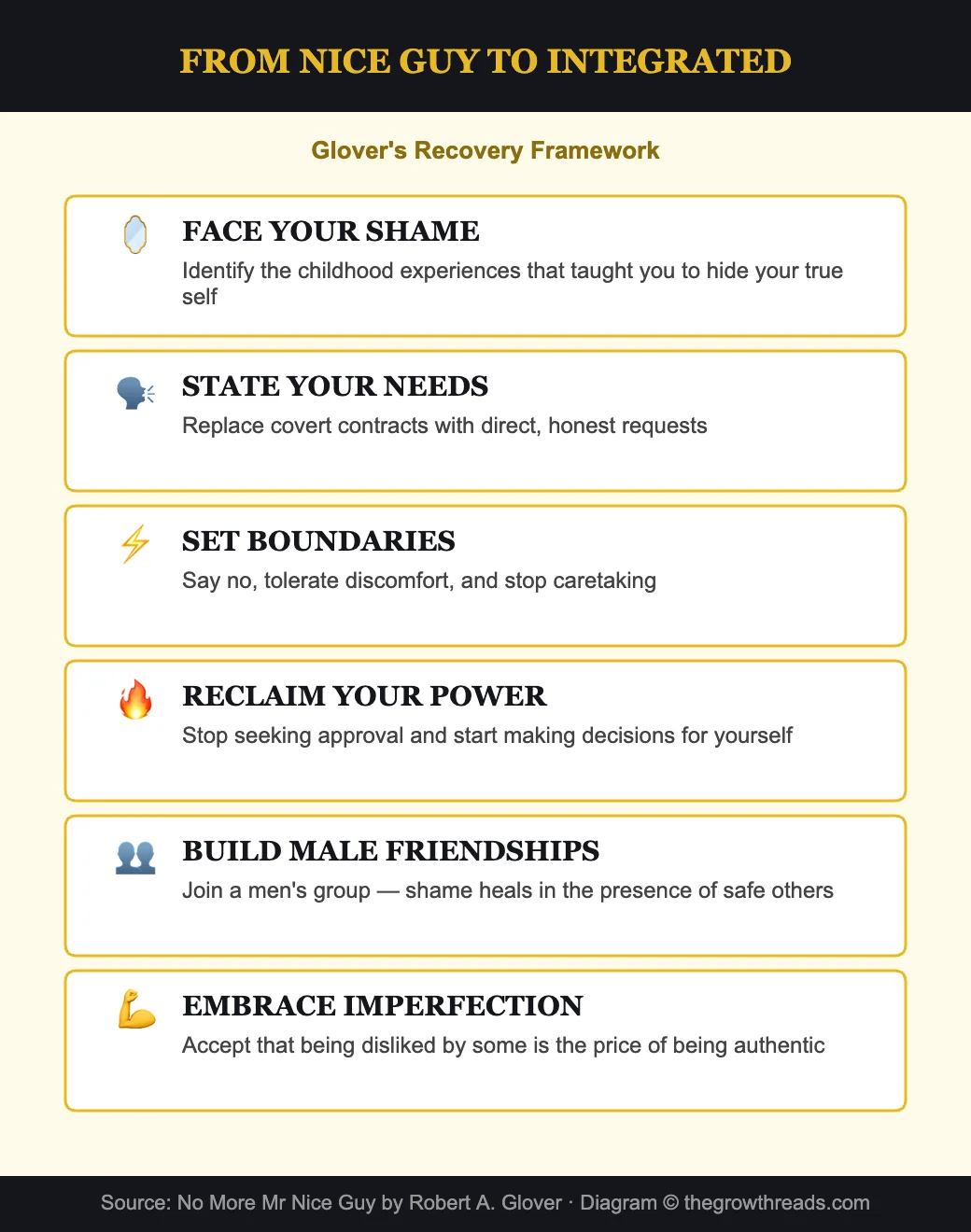
Glover places heavy emphasis on men’s groups as a recovery tool. Nice Guys typically lack close male friendships because they have learned to seek all validation from romantic partners — a dynamic that overloads the relationship. A men’s group provides a space to practise vulnerability, receive honest feedback, and discover that other men share similar struggles. The group context also disrupts the Nice Guy’s isolation, which shame depends on: shame cannot survive being spoken aloud in the presence of empathetic witnesses.
The book’s final message is both confronting and liberating: no one has ever loved your performance. The people who love you — or who could love you — want access to the real person underneath. Every moment you spend managing impressions is a moment stolen from genuine connection. The Nice Guy’s greatest fear (being seen and rejected) is actually less painful than his current reality (never being truly seen at all).
Who is No More Mr Nice Guy best for — and who should read something else first?
This book is essential for any man who recognises himself in the Nice Guy description — the chronic people-pleaser who gives endlessly, avoids conflict, suppresses his needs, and feels perpetually unappreciated. It is also valuable for women who are in relationships with Nice Guys and want to understand the dynamic. The book is direct, sometimes blunt, and deliberately provocative — Glover knows his readers need to be shaken out of their pattern, not validated in it.
If the Nice Guy pattern feels rooted in childhood, read Adult Children of Emotionally Immature Parents for the developmental context. If you need boundary-setting tools, Boundaries provides the framework. And if your primary challenge is romantic attachment anxiety, Attached offers the attachment-theory perspective that complements Glover’s relational model.
Questions to reflect on
- What covert contracts are you currently running — and what would happen if you stated those expectations out loud?
- When was the last time you said “no” to someone and tolerated their disappointment without apologising or backtracking?
- Do the people closest to you know what you actually want, or do they only know what you think they want to hear?
- What parts of yourself did you learn to hide in childhood, and what would change if you stopped hiding them?
- If being disliked by some people is the price of being authentic, are you willing to pay it?
🔥 Ready to stop performing and start living?
Learn why people-pleasing backfires and how to build relationships based on authenticity.
How to apply No More Mr Nice Guy (7-day plan)
- Day 1 — Identify your covert contracts: Write down three recent moments of resentment. For each, ask: what did I give? What did I expect in return? Did I ever state that expectation? You are mapping your invisible deals.
- Day 2 — State one need directly: Choose something you want from someone today and ask for it clearly. “I would like us to have dinner together tonight.” No hinting, no hoping, no caretaking your way to it.
- Day 3 — Say no once: When someone asks you to do something you do not want to do, say no. One sentence: “I’m not able to do that.” Do not explain, justify, or apologise. Sit with the discomfort.
- Day 4 — Do something for yourself: Take one hour today for an activity that is purely for you — not productive, not helpful to anyone else, not “useful.” Go for a walk, read for pleasure, play a game. Notice any guilt and let it pass.
- Day 5 — Share one imperfection: Tell someone you trust about a mistake you made, a flaw you have, or something you feel ashamed of. This is the opposite of the Nice Guy’s instinct to present a flawless surface. Notice what happens to the shame when it is witnessed.
- Day 6 — Express anger appropriately: If something bothers you today, say so in the moment rather than storing it. “That bothered me.” “I did not like that.” Direct, calm, honest. Anger expressed immediately is informative; anger stored becomes explosive.
- Day 7 — Find a male connection: Reach out to one male friend for a genuine conversation — not about sports or work, but about life, struggles, or goals. If you do not have such a friend, research local men’s groups or online communities. Nice Guy recovery is not a solo project.
Frequently asked questions
Is this book saying I should stop being nice?
No. It is saying you should stop being fake nice. Genuine kindness — given freely without hidden expectations — is one of the best human qualities. The problem Glover identifies is performance-niceness: giving in order to receive, accommodating in order to be liked, and suppressing authentic reactions in order to avoid conflict. The goal is not to become unkind but to become honest — to relate to people as your real self rather than a carefully managed impression.
Is this book only for men?
Glover wrote it primarily for men and the examples focus on male experience, but the Nice Guy pattern is not gender-exclusive. Many women recognise the same dynamics — people-pleasing, covert contracts, approval-seeking, suppressed needs — in themselves. The core concepts (covert contracts, toxic shame, healthy selfishness, direct need-stating) are universal. Women in relationships with Nice Guys also find the book illuminating for understanding their partner’s behaviour. If the gendered language bothers you, read Codependent No More by Melody Beattie, which covers similar territory in gender-neutral terms.
What is a covert contract exactly?
A covert contract is an unspoken, one-sided agreement where you do something for someone while secretly expecting a specific return — without ever stating the expectation. Example: you stay late at work to help a colleague, expecting them to praise you to the boss. They do not, and you feel betrayed. But they never agreed to do anything — the “contract” existed only in your head. Covert contracts fail 100% of the time because the other party does not know they exist. The solution is making contracts overt: “I will help you with this if you can do X for me.”
How is the Nice Guy different from codependency?
There is significant overlap. Codependency (as described by Melody Beattie) is a broader relational pattern of losing yourself in concern for others. The Nice Guy Syndrome is a specific male expression of codependency that emphasises approval-seeking, sexual frustration, and covert contracts. Both involve people-pleasing, poor boundaries, and suppressed needs. Beattie’s framework focuses on detachment and self-care; Glover’s focuses on directness, healthy selfishness, and masculine identity. Reading both gives you the broadest toolkit for dismantling people-pleasing patterns.
Why does Glover emphasise men’s groups?
Two reasons. First, Nice Guys typically lack close male friendships because they have learned to seek validation exclusively from women — overloading romantic relationships and leaving no space for male bonding. Second, toxic shame — the engine of the Nice Guy pattern — cannot survive being spoken aloud in the presence of empathetic witnesses. A men’s group provides a safe space to practise vulnerability, receive honest feedback, and discover that other men share similar struggles. Group settings also disrupt isolation, which shame depends on to maintain its power.
Does becoming an “Integrated Male” mean becoming aggressive?
No. Integration means accepting all parts of yourself, including parts you were taught to suppress — like anger, assertiveness, and desire. Expressing anger directly and appropriately (“that bothered me”) is fundamentally different from aggression (intimidation, threats, violence). Glover is clear that the Integrated Male is not the opposite of the Nice Guy (an aggressive jerk) but a third option: someone who is honest, boundaried, self-respecting, and capable of genuine intimacy. The goal is to expand your emotional range, not to flip from one extreme to another.
Is this book scientifically rigorous?
The book is clinically informed rather than academically rigorous. Glover draws on 30 years of clinical experience with hundreds of male clients, and his observations are consistent with established psychological constructs (attachment theory, shame research, assertiveness training). However, the Nice Guy Syndrome is not a formal psychological diagnosis, and the book does not cite controlled studies in the way a research monograph would. Its strength is pattern recognition and practical recovery exercises rather than empirical validation. The concepts have been widely adopted by therapists and align well with attachment-based and schema-therapy frameworks.
Related summaries
- Codependent No More by Melody Beattie — The broader relational pattern that includes the Nice Guy dynamic.
- Adult Children of Emotionally Immature Parents by Lindsay Gibson — The childhood origins of people-pleasing and self-suppression.
- Boundaries by Cloud and Townsend — The practical framework for setting the limits Nice Guys struggle with.
- Crucial Conversations by Patterson et al. — Communication tools for the direct conversations Nice Guys avoid.
- See all Relationships book summaries on our Best Relationship Books pillar page.