

★★★★☆ 4.3 / 5
One-liner: A refreshing, evidence-based argument that feeling good isn’t the opposite of getting things done — it’s the prerequisite.
Best for: Knowledge workers, creators, and anyone stuck in the hustle-harder trap who wants a sustainable alternative.
Reading time: ~6 hrs (304 pages)
Difficulty to apply: Low — the experiments are small and the concepts are intuitive.
Feel-Good Productivity in one minute
The entire productivity industry has it backwards. Ali Abdaal spent a decade as a doctor, YouTuber, and entrepreneur chasing output before realising that the people who sustain extraordinary results don’t rely on discipline alone — they feel genuinely good about the work they do. Feel-Good Productivity builds a three-part framework: Energise (use play, power, and people to generate positive emotions), Unblock (dismantle procrastination by tackling uncertainty, fear, and inertia), and Sustain (prevent burnout through deliberate rest, alignment, and experimentation). The book draws on positive-psychology research, behavioural science, and Ali’s own experiments to show that when you make the process enjoyable, results follow naturally.
Key takeaways
- Feel good first, produce second: Positive emotions broaden your cognitive resources, making you more creative and resilient — productivity is the side effect.
- Play is a performance tool: Approaching tasks with adventure, curiosity, and fun reduces friction and increases quality of output.
- Power comes from within: Confidence, self-efficacy, and a sense of personal control energise action more reliably than external rewards.
- People multiply energy: Working alongside others, feeling a sense of belonging, and helping people amplifies motivation.
- Procrastination is emotional, not moral: We avoid tasks because of uncertainty, fear, or inertia — not laziness. Address the emotion to unblock the action.
- The five-minute rule works: Commit to just five minutes of a dreaded task. Starting is almost always the hardest part.
- Burnout is preventable: Strategic rest, energy alignment, and constant micro-experimentation keep you performing without crashing.
- Reduce friction, don’t add willpower: Redesign your environment so the right action becomes the easy action.
- Align tasks with energy: Creative work belongs in high-energy windows; admin belongs in low-energy slumps.
- Experiment constantly: Treat your productivity system as a perpetual beta — small tweaks compound into major gains.
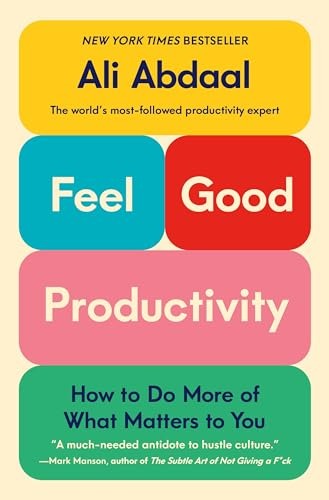
What is Feel-Good Productivity about?
Feel-Good Productivity argues that sustainable high performance comes from cultivating positive emotions rather than forcing discipline. Ali Abdaal presents a three-part system — Energise, Unblock, Sustain — backed by behavioural-science research and personal experimentation, showing readers how to do more of what matters by making the process enjoyable.
About the author
Ali Abdaal is a former NHS doctor turned entrepreneur, YouTuber, and podcaster based in London. With over six million YouTube subscribers, he has become one of the world’s most-followed productivity creators. Ali studied medicine at Cambridge, worked as a junior doctor, and simultaneously built multiple online businesses — including a course platform, a podcast studio, and a book club. His work blends academic rigour with accessible storytelling, drawing on his medical training and personal experiments to distil complex research into practical advice. Feel-Good Productivity is his debut book, published in 2023 by Celadon Books. Explore all Ali Abdaal book summaries →
Key concepts at a glance
| Concept | What it means | Use it when |
|---|---|---|
| Play | Infusing curiosity, adventure, and fun into tasks | Work feels dull or you dread starting |
| Power | Building confidence, autonomy, and self-efficacy | You feel stuck or like an imposter |
| People | Harnessing belonging, connection, and shared purpose | You work alone and feel unmotivated |
| Seek Clarity | Defining the very next concrete step | You procrastinate because you don’t know where to start |
| Find Courage | Reframing failure as data and lowering emotional stakes | Fear of judgement is holding you back |
| Get Started | Using the 5-minute rule and reducing friction | Inertia keeps you scrolling instead of working |
| Conserve | Treating rest as a skill, not a reward | You feel chronically drained |
| Align | Matching task type to energy level throughout the day | You waste peak hours on emails |
| Experiment | Running small personal trials to refine your system | Your productivity routine has gone stale |
Part 1 — Energise: the three sources of feel-good fuel
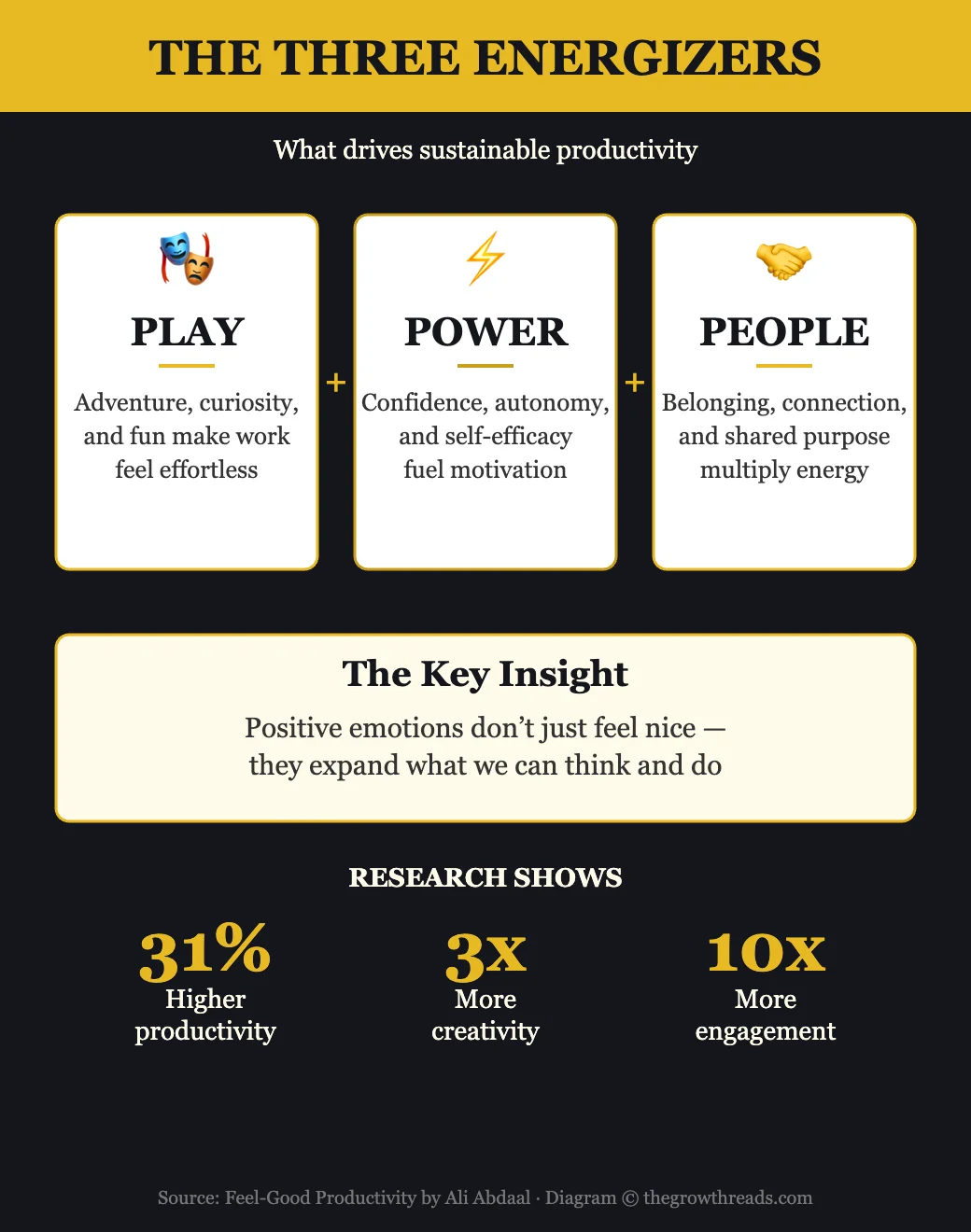
The first section of the book is where Abdaal lays out his central thesis: positive emotions don’t just feel nice — they are functional. He draws on Barbara Fredrickson’s broaden-and-build theory, which shows that positive emotions expand cognitive resources, widen the range of ideas and actions available to us, and build durable personal resources like resilience and creativity. In a study Abdaal cites, doctors primed with a small gift (a candy) diagnosed liver disease significantly faster than control groups. Positive mood literally improved their diagnostic accuracy.
From this foundation, he introduces three “energisers”: Play, Power, and People.
Play has three sub-components: adventure (seeking novelty), curiosity (asking what if?), and fun (finding humour in the mundane). Abdaal recalls how reframing surgical practice as a video-game challenge turned a dreaded task into one he looked forward to. He recommends what he calls “character mode” — asking yourself how a character you admire would approach this task — as a quick way to inject play into routine work.
Power centres on self-efficacy (Bandura’s concept), the sense of personal control, and confidence. Abdaal argues that the single fastest way to build power is through small wins: completing a tiny task creates a positive feedback loop that fuels the next one. He also introduces the “confidence switch”: acting as if you already have the skill, which research suggests can become a self-fulfilling prophecy.
People covers belonging, helping others (the “helper’s high” documented in volunteering research), and comradeship. Working alongside even one other person — body-doubling, as ADHD communities call it — can cut procrastination dramatically. Abdaal cites his own experience co-working with friends as a pivotal productivity unlock.
Part 2 — Unblock: dismantling procrastination
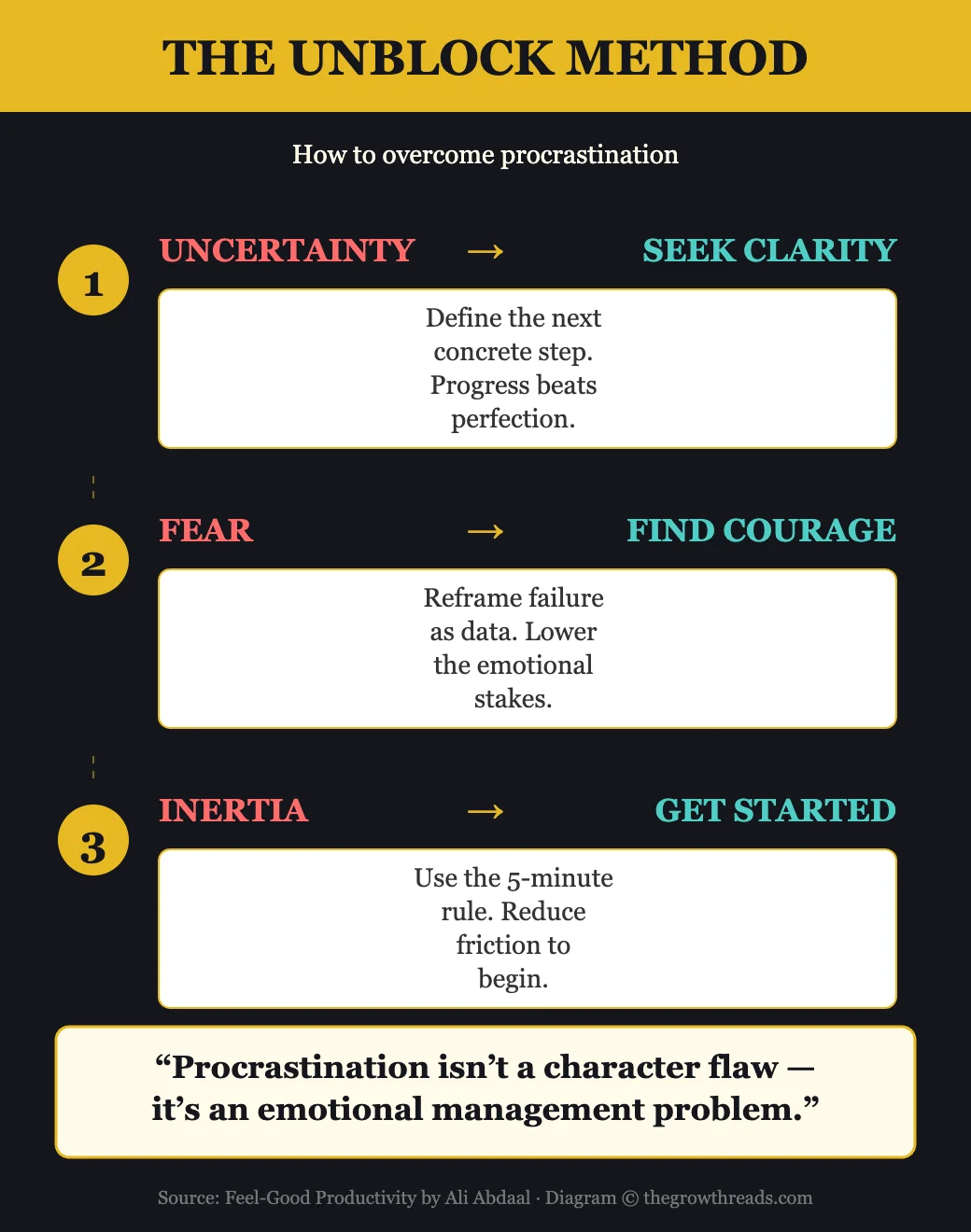
The second section reframes procrastination as an emotional-regulation problem rather than a character defect. Abdaal identifies three emotional blockers — uncertainty, fear, and inertia — and pairs each with a practical antidote.
Uncertainty is the most common cause. When we don’t know what to do next, our brain defaults to avoidance. The fix is to seek clarity: write down the single next physical action (a concept borrowed from David Allen’s Getting Things Done) and make it laughably small. Abdaal calls this the “crystal ball method” — imagine looking back from a completed task and asking what was the first thing you actually did.
Fear — of failure, judgement, or inadequacy — triggers avoidance on emotionally loaded tasks. Abdaal recommends three reframes: (1) treat every project as a “draft” rather than a finished product, (2) ask “what would I do if I knew I couldn’t fail?” and then do a tiny version of that, and (3) label the emotion explicitly (“affect labelling” from neuroscience), which research shows reduces its grip on behaviour. He shares how his first YouTube videos were terrible but publishing them anyway built the confidence muscle.
Inertia is the hardest to notice because it masquerades as laziness. The remedy is the five-minute rule: commit to working for just five minutes, then give yourself permission to stop. Most of the time, the initial friction dissipates and momentum carries you forward. Abdaal also recommends environmental design — reducing friction for desired behaviours and increasing friction for unwanted ones (inspired by BJ Fogg’s Tiny Habits research).
Part 3 — Sustain: preventing burnout
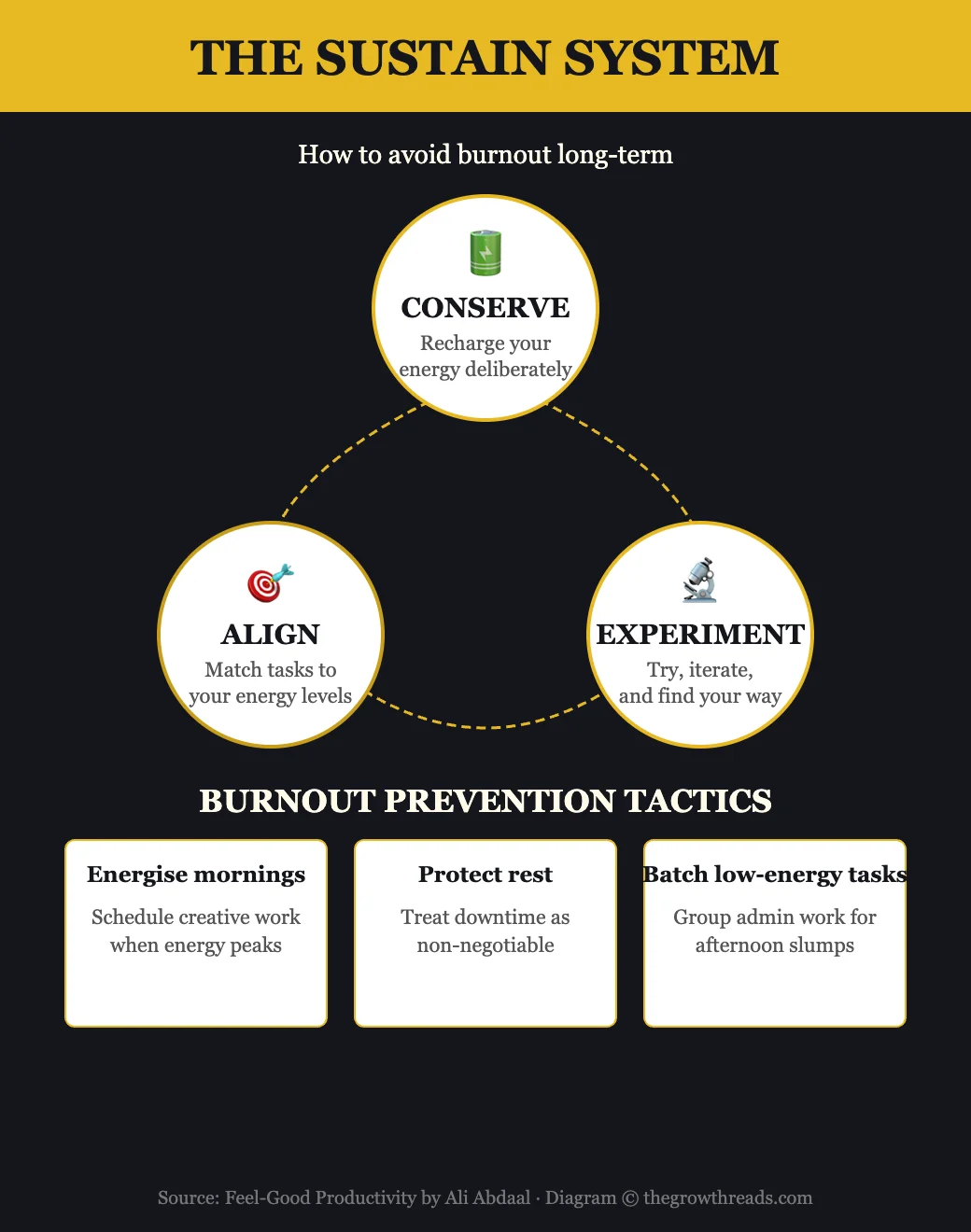
The final section tackles the long game. Abdaal argues that most productivity systems fail not because they don’t work — but because they’re unsustainable. He introduces three sustainability practices: Conserve, Align, and Experiment.
Conserve means treating rest as a skill rather than a reward. Abdaal distinguishes between passive rest (scrolling, Netflix) and active rest (hobbies, walks, social time), arguing that the latter genuinely recharges cognitive resources while the former often leaves people more drained. He cites research on creative incubation — the phenomenon where solutions appear during breaks because the default-mode network continues processing problems in the background. His practical recommendation: schedule “DISTILL” blocks (Downtime, Insight, Sleep, Time in nature, Interactions, Learning, and Letting go).
Align is about matching tasks to energy rather than time. Abdaal divides the day into three energy zones — peak, trough, and rebound — borrowing from Daniel Pink’s research in When. Creative and analytical work belongs in peak hours; routine admin fits the trough; social and collaborative work suits the rebound. He shares how shifting his writing to mornings and meetings to afternoons doubled his output without adding hours.
Experiment closes the loop. Abdaal models his personal productivity on the scientific method: form a hypothesis (“what if I batched emails to twice daily?”), run a one-week trial, measure the result, and keep or discard. He keeps a “productivity lab notebook” for these experiments, and encourages readers to never treat any system as permanent. The goal is continuous, low-stakes iteration rather than revolutionary overhauls.
Who is Feel-Good Productivity best for — and who should read something else first?
This book is ideal for knowledge workers, content creators, and students who have tried hustle-culture productivity and found it unsustainable. If you’ve read The ONE Thing or Eat That Frog and felt they lacked warmth, Abdaal’s approach will resonate. It’s also a strong starting point for anyone new to productivity literature — the concepts are accessible without being shallow.
If you already have a solid system (GTD, time-blocking, deep-work blocks) and want advanced tactics, you may find the book covers familiar ground. In that case, try Effortless by Greg McKeown for a complementary but more strategic lens, or Slow Productivity by Cal Newport for a counter-cultural take on doing less, better.
Questions to reflect on
- When was the last time you genuinely enjoyed a work task — and what made it enjoyable?
- Which of the three energisers (play, power, people) is most absent from your current routine?
- What task are you procrastinating on right now, and is the blocker uncertainty, fear, or inertia?
- Are you scheduling rest deliberately, or waiting until you’re exhausted to take a break?
- What is one small productivity experiment you could run this week?
🔥 Ready to make productivity feel good?
Discover the three-part system for doing more of what matters — without burning out.
How to apply Feel-Good Productivity (7-day plan)
- Day 1 — Identify your energiser gap: Write down which of Play, Power, and People is most missing from your week. Pick one experiment to add it (e.g., work from a café for people, or rename a task to make it feel like a game for play).
- Day 2 — Map your energy zones: Track your energy on a 1–10 scale every two hours. Identify your peak, trough, and rebound windows. Move one creative task to your peak window.
- Day 3 — Diagnose one procrastinated task: Pick a task you’ve been avoiding. Ask: is the blocker uncertainty, fear, or inertia? Apply the matching fix (next step, draft mindset, or 5-minute rule).
- Day 4 — Schedule active rest: Block 30 minutes of active rest (a walk, a hobby, a call with a friend) and protect it like a meeting. Notice how your energy shifts afterwards.
- Day 5 — Try character mode: Pick a role model and ask how they’d approach your hardest task today. Adopt their mindset for one hour and observe the difference.
- Day 6 — Reduce one friction point: Identify the biggest friction barrier in your workflow (opening the right app, finding the file, commuting). Redesign it so starting takes fewer than 20 seconds.
- Day 7 — Start your lab notebook: Write down what worked and what didn’t this week. Pick one tweak for next week. This is now your permanent experimentation habit.
Frequently asked questions
Is Feel-Good Productivity worth reading if I already read Atomic Habits?
Yes — the two books complement each other well. Atomic Habits focuses on building habit systems through cue-routine-reward loops and identity shifts. Feel-Good Productivity addresses the emotional layer underneath: why you procrastinate, how to generate the positive energy that makes habits stick, and how to sustain performance without burnout. Think of Atomic Habits as the structural blueprint and Feel-Good Productivity as the fuel system that keeps the engine running.
What is Ali Abdaal’s main argument in Feel-Good Productivity?
Abdaal argues that positive emotions are not a distraction from productivity but its primary driver. Drawing on Barbara Fredrickson’s broaden-and-build theory and decades of behavioural-science research, he shows that feeling good expands cognitive resources, increases creativity, and builds resilience. The book’s three-part framework — Energise, Unblock, Sustain — provides practical tools for harnessing this insight across work and personal projects.
What are the three energisers in Feel-Good Productivity?
The three energisers are Play (approaching tasks with curiosity, adventure, and fun), Power (building confidence, autonomy, and self-efficacy through small wins), and People (leveraging belonging, helping others, and working alongside others to amplify motivation). Together, they form the emotional foundation Abdaal argues is necessary for sustainable high performance.
How does Feel-Good Productivity address procrastination?
Abdaal reframes procrastination as an emotional-regulation problem rather than laziness. He identifies three emotional blockers — uncertainty (not knowing what to do), fear (of failure or judgement), and inertia (the difficulty of starting) — and provides specific tools for each: the crystal-ball method for clarity, draft mindset and affect labelling for courage, and the five-minute rule plus friction reduction for overcoming inertia.
What is the five-minute rule from Feel-Good Productivity?
The five-minute rule is a strategy for overcoming inertia. You commit to working on a task for just five minutes, then give yourself full permission to stop. The insight is that starting is almost always harder than continuing — once you’re five minutes in, momentum typically carries you forward. It works because it lowers the emotional stakes of beginning and sidesteps the all-or-nothing thinking that fuels procrastination.
How long does it take to read Feel-Good Productivity?
The book is 304 pages and most readers finish it in 5–7 hours of focused reading, or about one to two weeks of casual reading. The audiobook, narrated by Abdaal himself, runs approximately 7 hours and 3 minutes. The writing style is conversational and fast-paced, with personal anecdotes and research summaries that make it an engaging listen or read.
Does Feel-Good Productivity have practical exercises?
Yes. Each chapter ends with experiments — small, concrete actions readers can try immediately. These range from the five-minute rule and character-mode exercise to energy mapping and the productivity lab notebook. Abdaal explicitly encourages readers to treat the book as a menu rather than a prescription: pick the experiments that resonate, run them for a week, and keep what works. The experiments are accessible and require no special tools or setup.
Related summaries
If you enjoyed this summary, you’ll find these related reads valuable:
- Effortless by Greg McKeown — how to make the essential things easier instead of just trying harder.
- Slow Productivity by Cal Newport — a case for doing fewer things, working at a natural pace, and obsessing over quality.
- Tiny Habits by BJ Fogg — the behaviour-design science behind making small changes stick.
- The Power of Habit by Charles Duhigg — how habits form, how they change, and how to harness the habit loop.
📚 Explore more: Best Productivity Books — Our Complete Ranked List