

Fair Play in one minute
⭐⭐⭐⭐ 4.0/5
One-liner: A Harvard-trained lawyer builds a card-based system for dividing domestic labour that transforms resentment into partnership — and it actually works.
Best for: Couples where one partner (usually the woman) carries the invisible mental load of running a household and both want a fairer, more sustainable arrangement.
Reading time: ~7 hours (400 pages)
Difficulty to apply: Moderate — the card system requires an initial investment of time and genuine buy-in from both partners.
The fight about whose turn it is to unload the dishwasher is never really about the dishwasher. It is about the hundreds of invisible tasks — remembering the paediatrician appointment, noticing the nappies are running low, planning the holiday gift list, tracking the school permission slip deadline — that one partner carries in their head while the other remains blissfully unaware. Eve Rodsky calls this invisible burden “the mental load,” and Fair Play is her systematic solution to making it visible, divisible, and fair. The book introduces 100 cards representing every task required to run a household, a Conception-Planning-Execution (CPE) framework that ensures whoever holds a card owns it completely, and four ground rules that redefine what equity in a partnership actually looks like. The result is not a chore chart — it is a fundamental renegotiation of domestic life.
Key takeaways
- The mental load is real and measurable: Rodsky identifies 100 distinct tasks required to run a household. In most heterosexual couples, women hold 70–80 of those cards — including nearly all the invisible conception and planning work.
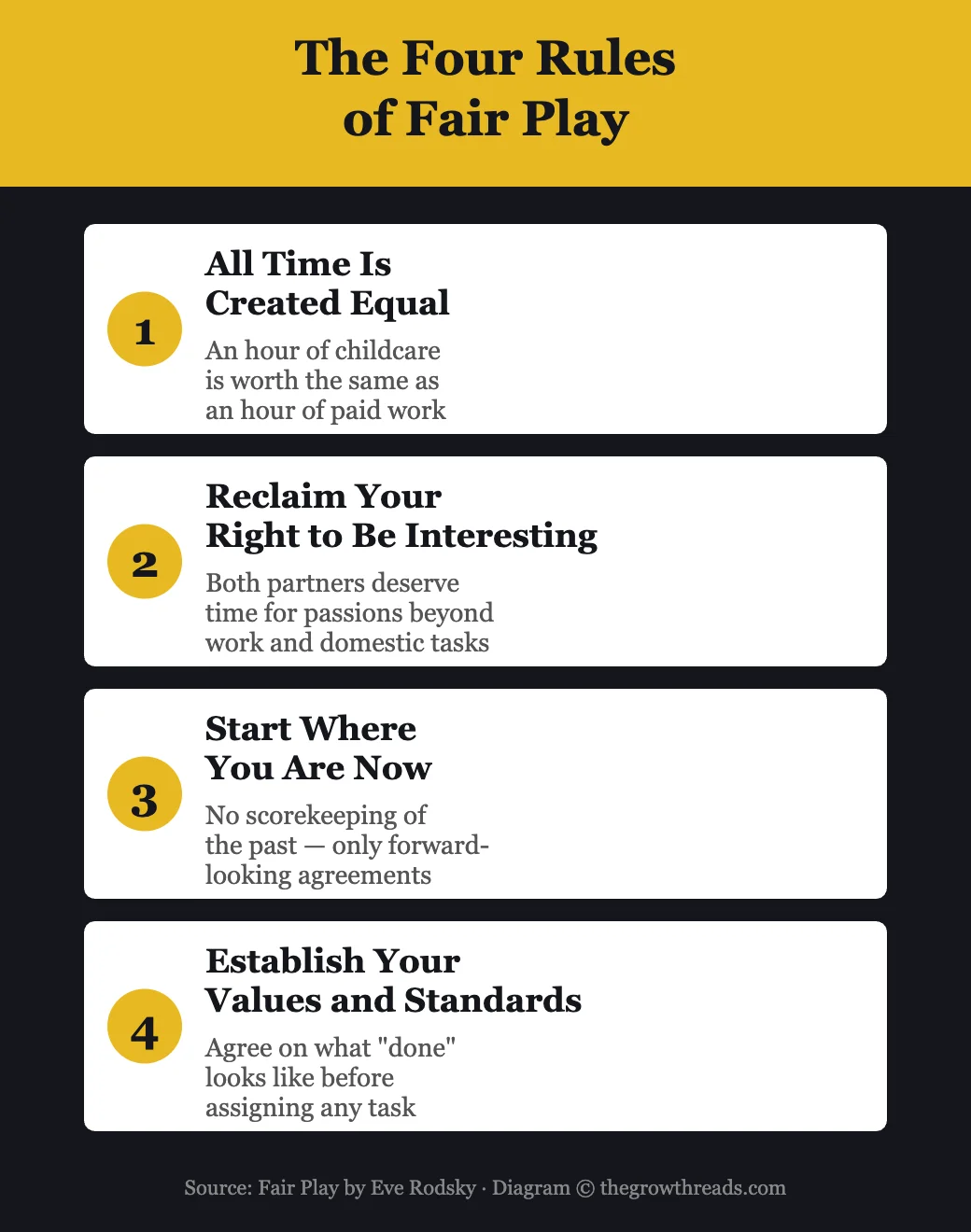
- All time is created equal: Rodsky’s first rule dismantles the assumption that paid work is more valuable than domestic work. An hour managing a household is worth the same as an hour at the office.
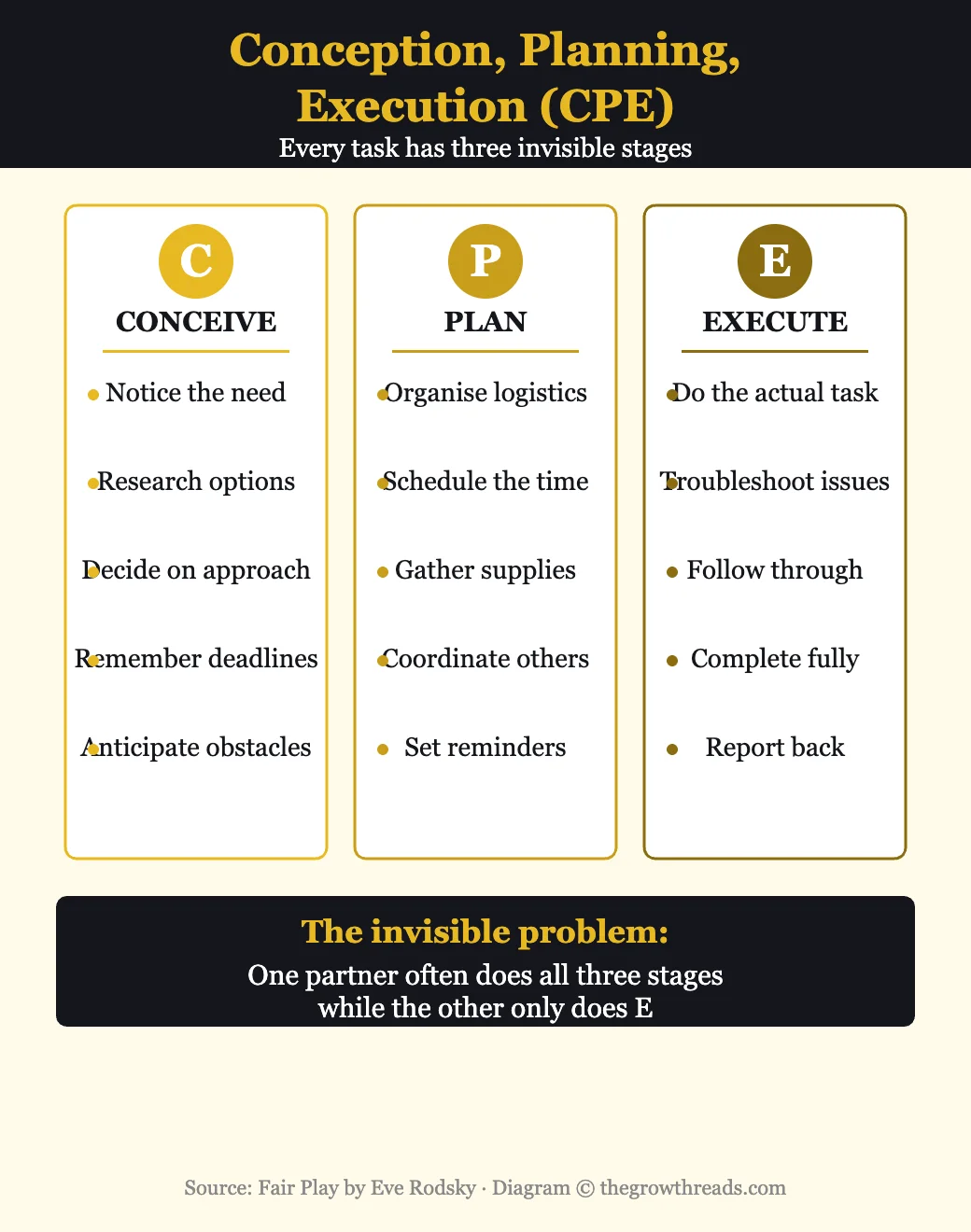
- Every task has three stages — CPE: Conception (noticing and deciding), Planning (organising logistics), and Execution (doing the thing). Most “helpful” partners only do E while their partner carries C and P.
- “Helping” is the problem, not the solution: When one partner “helps” the other with household tasks, it reinforces that the tasks belong to one person. Fair Play makes both partners full owners of their cards.
- The 100 cards make invisible work visible: By turning every domestic task into a tangible card, couples can see exactly who holds what — and negotiate redistributions based on capacity, not gender roles.
- Unicorn Space is non-negotiable: Rodsky insists that both partners deserve time for creative pursuits and personal passions — not as a luxury, but as a requirement for a fulfilled life and a healthy relationship.
- Minimum Standard of Care sets expectations: Partners must agree on what “done” looks like before assigning a card. Arguments about how a task was done disappear when the standard is defined upfront.
- Toxic time messages poison relationships: Phrases like “I don’t have time” or “I’m busier than you” create hierarchies that erode partnership. Fair Play replaces time competition with time equity.
- Resentment is the relationship killer: The book frames resentment as the predictable consequence of an unfair system, not a character flaw. Fix the system and the resentment dissolves.
- The system works beyond gender and orientation: While Rodsky’s research focuses on heterosexual couples, the card system applies to any partnership — same-sex couples, co-parents, even roommates.
What is Fair Play about?
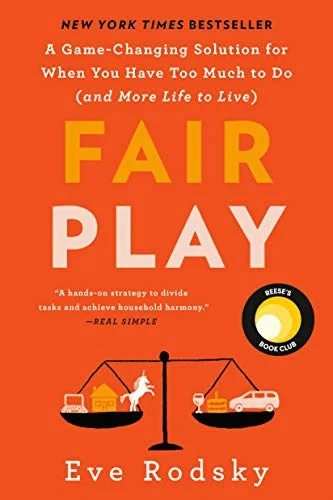
Fair Play by Eve Rodsky is about the unequal distribution of domestic labour in modern partnerships and a practical card-based system for fixing it. The book makes the invisible mental load visible through 100 task cards, introduces a Conception-Planning-Execution framework that ensures full ownership of each task, and establishes four rules that transform how couples divide the work of running a home and raising a family.
About the author
Eve Rodsky is a Harvard-trained lawyer and organisational management specialist who spent her pre-motherhood career structuring complex financial deals. When her own marriage hit a crisis point over the division of household labour — crystallised by a now-famous text from her husband asking her to pick up blueberries during a work meeting — she applied her deal-structuring skills to the problem. Over two years, she interviewed more than 500 couples across socioeconomic backgrounds and every state in the US, identifying patterns in how domestic work was divided and what strategies worked for the couples who got it right. Fair Play was a New York Times bestseller and a Reese’s Book Club pick, and was adapted into a documentary film. Rodsky followed it with Find Your Unicorn Space, which expands on the creative self-expression pillar of the system. Explore all Eve Rodsky book summaries →
Key concepts at a glance
| Concept | What it means | Use it when |
|---|---|---|
| The 100 Cards | Every task needed to run a household, divided into five suits: Home, Out, Caregiving, Magic, and Wild | You want to see the full scope of invisible domestic work |
| CPE (Conceive-Plan-Execute) | Every task has three stages; the person who holds a card owns all three | Your partner “helps” but never initiates or plans |
| All Time Is Created Equal | Domestic work hours have the same value as professional work hours | One partner’s time is treated as more important |
| Minimum Standard of Care (MSC) | An agreed-upon standard for what “done” looks like for each task | You fight about how tasks are completed rather than whether they are |
| Toxic Time Messages | Phrases that create hierarchies: “I’m busier,” “I don’t have time,” “you should be grateful” | Conversations about workload turn into competitions |
| Unicorn Space | Protected time for creative pursuits and personal identity beyond work and domestic roles | You have lost yourself in the roles of parent and partner |
| The Sh*t I Do list | A raw catalogue of everything each partner actually does — the starting point for redistribution | You need concrete evidence of the current imbalance |
| RAT (Random Assignment of Tasks) | The default mode where tasks are assigned based on who notices first or who complains | You want to understand why your current system breeds resentment |
Part 1: The invisible problem — why modern partnerships feel unfair
Rodsky opens with her own breaking point: sitting in a car during a work call when her husband texted to ask her to pick up blueberries for their toddler. It was not the blueberries that broke her. It was the assumption beneath the text — that she was the default parent, the one who tracked what was in the fridge, who knew the toddler needed a snack, who would reroute her day to solve the problem. Her husband was not being malicious. He was operating inside a system that neither of them had consciously designed.
This is the core insight of Part 1: the domestic labour imbalance in most partnerships is not caused by individual laziness or bad intentions. It is caused by a system — a set of unexamined assumptions about who notices, who plans, and who executes the hundreds of tasks required to keep a household running. Rodsky calls this default system RAT: Random Assignment of Tasks. In RAT mode, tasks go to whoever notices them first (usually the same person) or whoever complains loudest. The result is predictable and corrosive: one partner drowns in invisible work while the other genuinely believes they are “doing their share.”
Rodsky backs this up with data from her interviews with 500+ couples. She found that women in heterosexual partnerships typically hold 70–80 of the 100 domestic task cards, including nearly all of the conception and planning work. Their partners often hold 20–30 cards, and those tend to be the visible, episodic tasks (mowing the lawn, taking out the bins) rather than the invisible, daily, emotionally complex ones (managing the school calendar, tracking immunisation schedules, remembering in-law birthdays).
TGR Note: Rodsky’s framework for making invisible work visible complements the communication skills taught in Crucial Conversations. Where Crucial Conversations teaches you how to have the hard talk about workload, Fair Play gives you a concrete system to implement after the talk. If conversations about domestic labour tend to escalate in your household, read Crucial Conversations first for the dialogue skills, then Fair Play for the structural solution.
Part 2: The CPE framework — why “helping” makes things worse
The most powerful concept in the book is CPE: Conception, Planning, Execution. Rodsky argues that every domestic task — from grocery shopping to managing a child’s medical care — has three distinct stages, and that the real labour imbalance is hidden in the first two.
Conception is noticing that something needs to happen and deciding how to handle it. It is realising the child has outgrown their shoes, remembering the car registration is due, noticing the bathroom needs cleaning. This is the most invisible and most cognitively expensive stage.
Planning is organising the logistics: researching which shoes to buy, scheduling the appointment, gathering the cleaning supplies. It involves anticipating obstacles, coordinating schedules, and managing dependencies.
Execution is the visible act: buying the shoes, going to the DMV, scrubbing the bathroom. It is the only stage that gets credit in most partnerships.
Rodsky’s insight is that most “helpful” partners only execute. They will do what they are asked to do — but they need to be asked. The asking itself is conception and planning, and it stays with the partner who is already carrying the mental load. “Just tell me what to do” sounds collaborative, but it keeps the invisible work exactly where it was.
The Fair Play solution is radical in its simplicity: whoever holds a card owns all three stages. If you hold the “groceries” card, you notice when food is running low, you plan the shopping list, and you execute the trip. No reminders. No delegation. Full ownership.
TGR Note: The CPE framework resonates with what Nedra Glover Tawwab describes in Set Boundaries, Find Peace — that healthy boundaries require clarity about what you are and are not willing to carry. Rodsky turns boundary-setting into a tangible system: instead of saying “I need you to help more” (vague) you say “I need you to hold these specific cards, fully, including CPE” (concrete). The specificity is what makes it enforceable.
Part 3: The 100 cards — making invisible work tangible
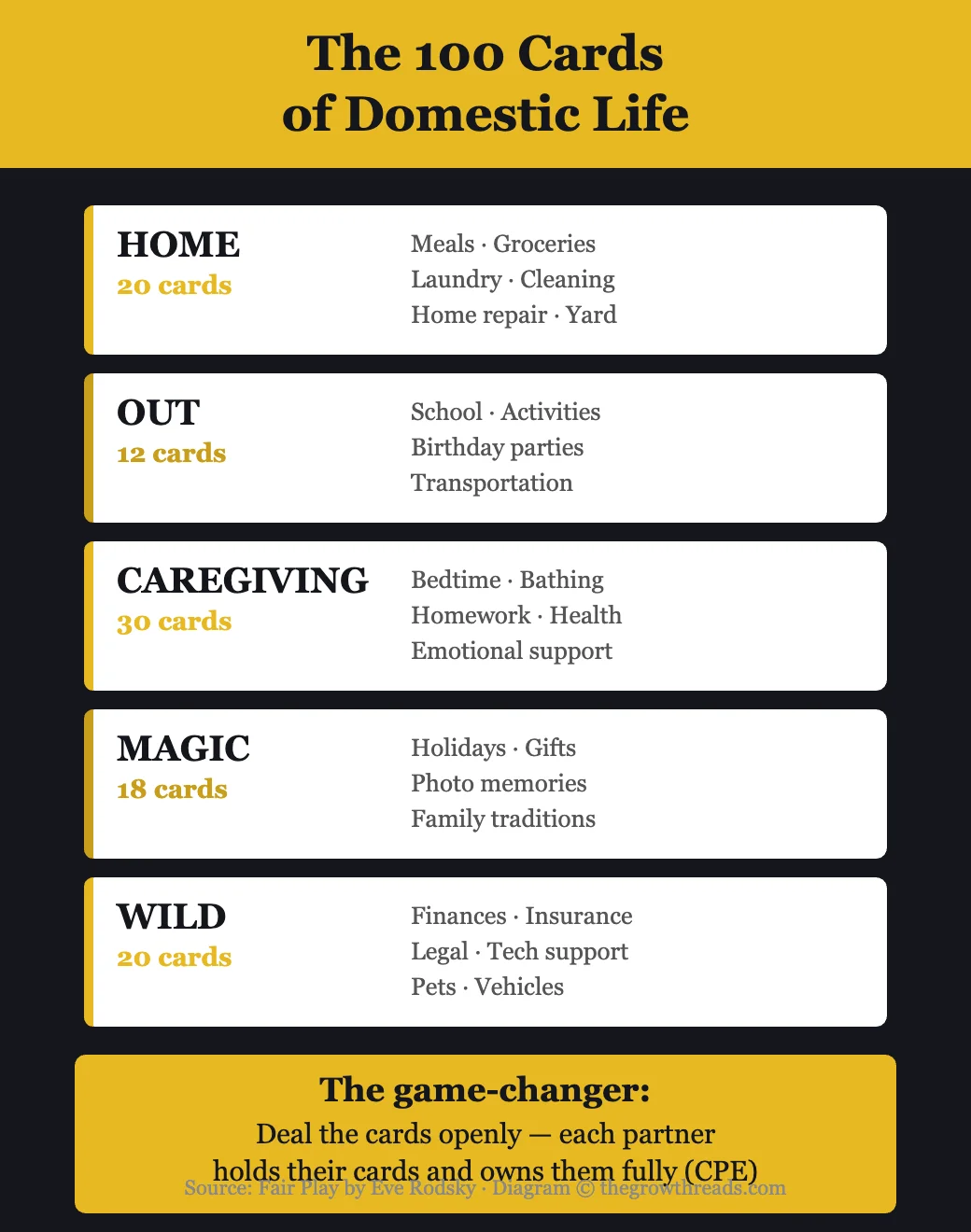
The practical engine of the book is the 100-card system. Rodsky has mapped every recurring task in domestic life into five suits, modelled on a deck of playing cards.
Home covers the physical household: meals, groceries, dishes, laundry, cleaning, home maintenance, yard work. These are the tasks most people think of when they hear “chores” — but even within this suit, there are invisible cards (like “tidying” or “home goods purchasing”) that often go unrecognised.
Out covers everything that connects the household to the outside world: school drop-off, extracurricular activities, birthday parties, playdates, transportation logistics. These cards tend to be heavily planning-intensive and time-sensitive.
Caregiving is the largest suit and covers the direct care of children and family: bedtime routines, bathing, homework supervision, medical and dental care, emotional support, discipline. Many of these cards are impossible to delegate to someone outside the partnership.
Magic covers the tasks that create meaning, memory, and tradition: holiday planning, gift buying, photo organisation, family traditions, thank-you notes. These are often the most emotionally rewarding tasks — and the most invisible when they are done well.
Wild covers the administrative and logistical cards that keep the household legally and financially sound: finances, insurance, legal documents, technology, pets, vehicles. These tend to skew toward one partner based on expertise or interest.
TGR Note: Rodsky’s card system makes a great practical companion to John Gottman’s The Seven Principles for Making Marriage Work. Gottman identifies contempt — which often grows from chronic resentment — as the single strongest predictor of divorce. Fair Play attacks the structural cause of that resentment: an invisible, unfair domestic system. Use Gottman for the relational skills and Rodsky for the operational system.
Part 4: Playing the game — implementation and Unicorn Space
The final section of the book guides couples through the implementation process. Rodsky recommends starting with a “Sh*t I Do” list — an unfiltered catalogue of every task each partner currently handles, including all the conception and planning work that usually goes unacknowledged. Most couples find this exercise revelatory. The partner who believes they are “doing half” is often confronted with a 30-card hand while their partner holds 70.
From there, couples lay out all 100 cards and decide together which ones apply to their household (not every couple needs all 100). They then negotiate who holds each card, following the CPE principle: whoever takes a card takes all three stages. Cards can be traded, but they should not be split — the whole point is that one person owns the full lifecycle of each task.
The book closes with what Rodsky considers the most important concept in the entire system: Unicorn Space. This is protected time for creative pursuits, personal interests, and activities that express who you are beyond your roles as partner, parent, and worker. Rodsky argues that Unicorn Space is not a luxury — it is a necessity for individual fulfilment and, by extension, for a healthy relationship. When one partner sacrifices their identity to the demands of domestic life, the relationship suffers even if the tasks get done. A fair system is not just about dividing labour — it is about ensuring both people have the space to remain interesting, engaged, and whole.
Who is Fair Play best for — and who should read something else first?
Fair Play is ideal for any couple where one partner carries a disproportionate share of the domestic mental load — particularly if this imbalance has created resentment, exhaustion, or a sense of lost identity. It is also a strong pick for couples who are about to have their first child and want to establish an equitable system before the sleep deprivation hits. Rodsky writes from a heterosexual perspective (with the woman typically carrying the heavier load), but the system applies equally to same-sex couples, co-parents, and any shared living arrangement.
If you are dealing with deeper relational issues — contempt, emotional disconnection, or communication breakdowns — start with The Seven Principles for Making Marriage Work or Hold Me Tight for the emotional foundation. If your challenge is less about domestic labour and more about boundary-setting in general, read Boundaries or Set Boundaries, Find Peace. Then bring in Fair Play for the operational system once the emotional groundwork is in place.
Questions to reflect on
- If you listed every domestic task you handle — including the ones nobody sees — how many cards would you be holding, and how many would your partner hold?
- When your partner “helps” with a task, are they doing the full CPE or just the execution while you carry the conception and planning?
- What toxic time messages (“I’m busier than you,” “at least I…”) show up most frequently in your household?
- When was the last time you had genuine Unicorn Space — time for a creative pursuit or personal passion that had nothing to do with work or domestic responsibility?
- If you could hand three cards to your partner tomorrow and know they would own them fully (CPE), which three would you choose and why?
🔥 Ready to stop keeping score and start playing fair?
Get the system that has transformed how hundreds of thousands of couples divide domestic life.
How to apply Fair Play (7-day plan)
- Day 1 — Write your Sh*t I Do list: Each partner independently writes down every domestic task they handle, including the invisible ones (remembering, planning, anticipating). Be brutally honest and comprehensive.
- Day 2 — Compare lists without judgment: Lay both lists side by side. Count the cards each partner holds. Note which tasks only one partner was aware of. Do not argue — just observe the data.
- Day 3 — Learn the CPE framework: For each task on your combined list, identify who currently does the Conception, Planning, and Execution. Mark any tasks where one partner only executes while the other conceives and plans.
- Day 4 — Lay out your 100 cards: Go through Rodsky’s full card list (available at fairplaylife.com) and identify which cards apply to your household. Remove any that are irrelevant to your current life stage.
- Day 5 — Negotiate the deal: Together, assign each card to one partner. The holder owns all three CPE stages. Start with volunteers (cards each person genuinely wants) before negotiating the rest.
- Day 6 — Set Minimum Standards of Care: For each reassigned card, agree on what “done” looks like. Be specific: “groceries” might mean “fresh produce, planned meals for the week, restocked staples by Sunday evening.”
- Day 7 — Claim your Unicorn Space: Each partner identifies one creative pursuit or personal passion they want to protect. Block time for it on the calendar. Treat it as non-negotiable — not a reward for finishing chores, but a right.
Frequently asked questions
Is Fair Play only for married couples with children?
No. While Rodsky’s research primarily focused on heterosexual married couples with kids, the system works for any partnership that shares domestic responsibilities. Same-sex couples, unmarried partners, co-parents in separate households, and even roommates can use the card system to make invisible work visible and negotiate a fairer division. The core principles — CPE ownership, Minimum Standards of Care, and protected personal time — are universal.
What if my partner refuses to participate?
Rodsky addresses this directly. She recommends starting with the data: write your own Sh*t I Do list and share it without accusation. Most partners are genuinely unaware of the imbalance until they see it quantified. If your partner is still resistant, Rodsky suggests framing it as a relationship investment rather than a complaint: “I want to protect our relationship from resentment.” The book also acknowledges that some resistance is rooted in deeper issues that may need couples therapy to address.
What is Unicorn Space?
Unicorn Space is Rodsky’s term for protected time devoted to creative pursuits, personal passions, and activities that express who you are beyond your roles as partner, parent, and employee. It might be painting, playing in a band, training for a marathon, writing a novel, or learning a language. Rodsky argues it is not a luxury but a necessity — without it, people lose their sense of identity and become less interesting partners, less patient parents, and less fulfilled human beings. She expanded this concept into a full follow-up book, Find Your Unicorn Space.
How does CPE work in practice?
CPE stands for Conception, Planning, Execution — the three stages of every domestic task. If you hold the “school lunches” card, you Conceive (notice what the kids like, track dietary needs, keep up with school food policies), Plan (shop for ingredients, prepare components, schedule prep time), and Execute (make and pack the lunch). The critical shift is that the cardholder does all three stages independently. No one reminds them, delegates to them, or checks their work. This eliminates the “manager and subordinate” dynamic that breeds resentment.
What are Minimum Standards of Care?
Minimum Standard of Care (MSC) is Rodsky’s term for an agreed-upon definition of what “done” looks like for each task card. Without an MSC, couples argue about quality: “You did the laundry but you didn’t fold it.” “You cleaned the kitchen but left the counters wet.” MSC eliminates these fights by defining the finish line upfront. Both partners agree on the standard before the card is assigned. The holder then meets that standard without supervision. MSC is not about perfection — it is about mutual clarity.
Is Fair Play anti-men?
No. Rodsky is careful to frame the problem as systemic rather than personal. She acknowledges that many men are unaware of the imbalance because they were socialised to equate contribution with earning — a message that is reinforced by culture, media, and often their own upbringing. The book’s tone is diagnostic, not accusatory. Its goal is to replace an invisible, unfair default system with a visible, negotiated one that benefits both partners. Many men who implement Fair Play report greater satisfaction because they finally understand what they are contributing and are appreciated for it.
How long does it take to implement the Fair Play system?
Rodsky estimates the initial setup — writing Sh*t I Do lists, reviewing the 100 cards, negotiating assignments, and setting MSCs — takes about 2–3 hours spread over a week. The ongoing maintenance is minimal: a brief weekly check-in to trade or adjust cards as circumstances change. Most couples report that the system feels natural within 2–4 weeks. The biggest time investment is the initial conversation, which is also the most transformative.
Related summaries
- The Seven Principles for Making Marriage Work by John Gottman — the emotional foundation for a healthy partnership
- Crucial Conversations by Patterson, Grenny et al. — how to have the hard talks about workload without escalation
- Set Boundaries, Find Peace by Nedra Glover Tawwab — boundary-setting skills that complement the Fair Play system
- Hold Me Tight by Sue Johnson — attachment science for deeper emotional connection
📚 Explore all Relationships books: Best Relationship & Communication Books