

⭐⭐⭐⭐✧ 4.3 / 5 — The definitive beginner-to-intermediate guide to low-cost index investing, written by the community that practices it.
Best for: New and intermediate investors who want a clear, evidence-based roadmap to building wealth through index funds.
Reading time: ~6 hours (336 pages)
Difficulty to apply: Low — the strategy is deliberately simple, though sticking to it during market crashes requires discipline.
The Bogleheads’ Guide to Investing in one minute
The best investment strategy is the one you can actually follow. Written by three devoted followers of Vanguard founder John C. Bogle, this book argues that most investors would be far better off buying a handful of low-cost index funds, keeping expenses to a minimum, diversifying broadly, and never trying to outsmart the market. The Bogleheads’ approach is radically simple: save aggressively, invest in the total market, rebalance occasionally, ignore the noise, and stay the course for decades. The evidence — drawn from academic research and real-world returns — overwhelmingly supports this approach over stock picking, market timing, and actively managed funds.
Key takeaways
- Start saving early and aggressively: The single most powerful variable in building wealth is time. A 25-year-old who saves moderately will almost always outperform a 45-year-old who saves aggressively, thanks to compound interest.
- Index funds beat most active managers: Over any 15-year period, roughly 90% of actively managed funds underperform their benchmark index after fees. Buying the index is not settling — it is winning.
- Costs are the one thing you can control: You cannot control market returns, but you can control what you pay in expense ratios, trading costs, and advisor fees. Every fraction of a percent matters over decades.
- Asset allocation drives 90% of returns: The split between stocks, bonds, and other asset classes — not individual security selection — determines the vast majority of your portfolio’s long-term performance.
- Diversification is your only free lunch: Owning thousands of stocks across geographies and sectors reduces risk without reducing expected returns. A total market index fund does this automatically.
- Never try to time the market: Missing just the 10 best trading days over a 20-year period can cut your total returns by more than half. The cost of being out when the market surges far exceeds the cost of being in when it dips.
- Rebalance annually, not emotionally: Set a target allocation, rebalance once a year to bring it back in line, and resist the urge to tinker based on headlines.
- Tax efficiency matters enormously: Place tax-inefficient investments (bonds, REITs) in tax-advantaged accounts and hold tax-efficient index funds in taxable accounts. This simple placement strategy can add meaningful returns.
- Keep it simple: A three-fund portfolio — total U.S. stock market, total international stock market, and total bond market — gives you global diversification at minimal cost.
- Stay the course: The hardest part of investing is not picking the right fund. It is holding on through bear markets, crashes, and panics without selling. Discipline is the real edge.
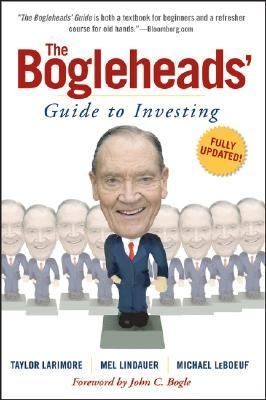
What is The Bogleheads’ Guide to Investing about?
The Bogleheads’ Guide to Investing is a comprehensive personal finance and investing manual written by three members of the Bogleheads community — an online forum of investors who follow the low-cost, index-based investing philosophy of Vanguard founder John C. Bogle. The book covers saving, asset allocation, index fund selection, tax planning, insurance, and retirement, all through the lens of evidence-based, cost-conscious investing.
About the authors
Taylor Larimore is known as the “King of the Bogleheads” and has been investing since the 1950s, making him one of the most experienced individual investors in the community. Mel Lindauer was an investment advisor and longtime Bogleheads forum contributor. Michael LeBoeuf is a retired business professor and bestselling author of Working Smart. The three combined decades of investing experience, academic rigor, and plain-language communication to produce what many consider the single best book for ordinary investors who want to build wealth without drama.
Key concepts at a glance
| Concept | What it means | Use it when |
|---|---|---|
| Total market indexing | Buy the entire market through one fund instead of picking individual stocks | Building your core investment portfolio |
| Expense ratio awareness | Every basis point in fund fees compounds against you over decades | Comparing funds or evaluating advisor costs |
| Asset allocation | Your stock/bond split determines ~90% of your returns | Setting up or reviewing your portfolio |
| Three-fund portfolio | Total U.S. + total international + total bond = complete diversification | Simplifying an overcomplicated portfolio |
| Tax-efficient placement | Put tax-heavy assets in tax-sheltered accounts | Deciding which fund goes in which account |
| Annual rebalancing | Restore your target allocation once per year, mechanically | Your portfolio has drifted from target |
| Stay the course | Do not sell during downturns — discipline is the real alpha | Markets are crashing and fear is high |
| Dollar-cost averaging | Invest a fixed amount regularly regardless of price | Building a savings habit with regular income |
Part 1 — Choose to save
The book opens not with investing theory but with a blunt message about saving: you cannot invest what you do not have. The authors argue that the gap between what you earn and what you spend is the single most important number in your financial life. They cite research showing that high earners who spend everything are financially worse off than moderate earners who consistently save 15-20% of their income.
The Bogleheads approach saving with the same discipline they bring to investing. They recommend automating savings before the money ever hits your checking account, treating it as a non-negotiable expense rather than something you do with leftovers. The target: save at least 20% of gross income if you are starting in your twenties, more if you are starting later.
This section also covers the power of compound interest with concrete examples. A 25-year-old who invests $500 per month at a 7% average annual return will have roughly $1.2 million by age 65. A 35-year-old doing the same will have about $567,000. Starting a decade earlier does not double the result — it more than doubles it, because compound growth accelerates over time.
Part 2 — The case for index funds
The heart of the Boglehead philosophy is index investing, and the authors build the case methodically. They start with the arithmetic: in aggregate, all investors collectively own the entire market. Before costs, the average investor earns the market return. After costs, the average investor earns less than the market return. Therefore, a low-cost index fund that matches the market will, by mathematical necessity, beat the majority of investors who pay higher fees.
The data supports this conclusively. The authors cite the SPIVA Scorecard, which has consistently shown that over 15-year periods, approximately 90% of actively managed large-cap funds underperform the S&P 500 index. The numbers are similar for mid-cap, small-cap, and international funds. Active management is not a bad bet because individual managers are incompetent — some are brilliant. It is a bad bet because the fees eat the advantage.
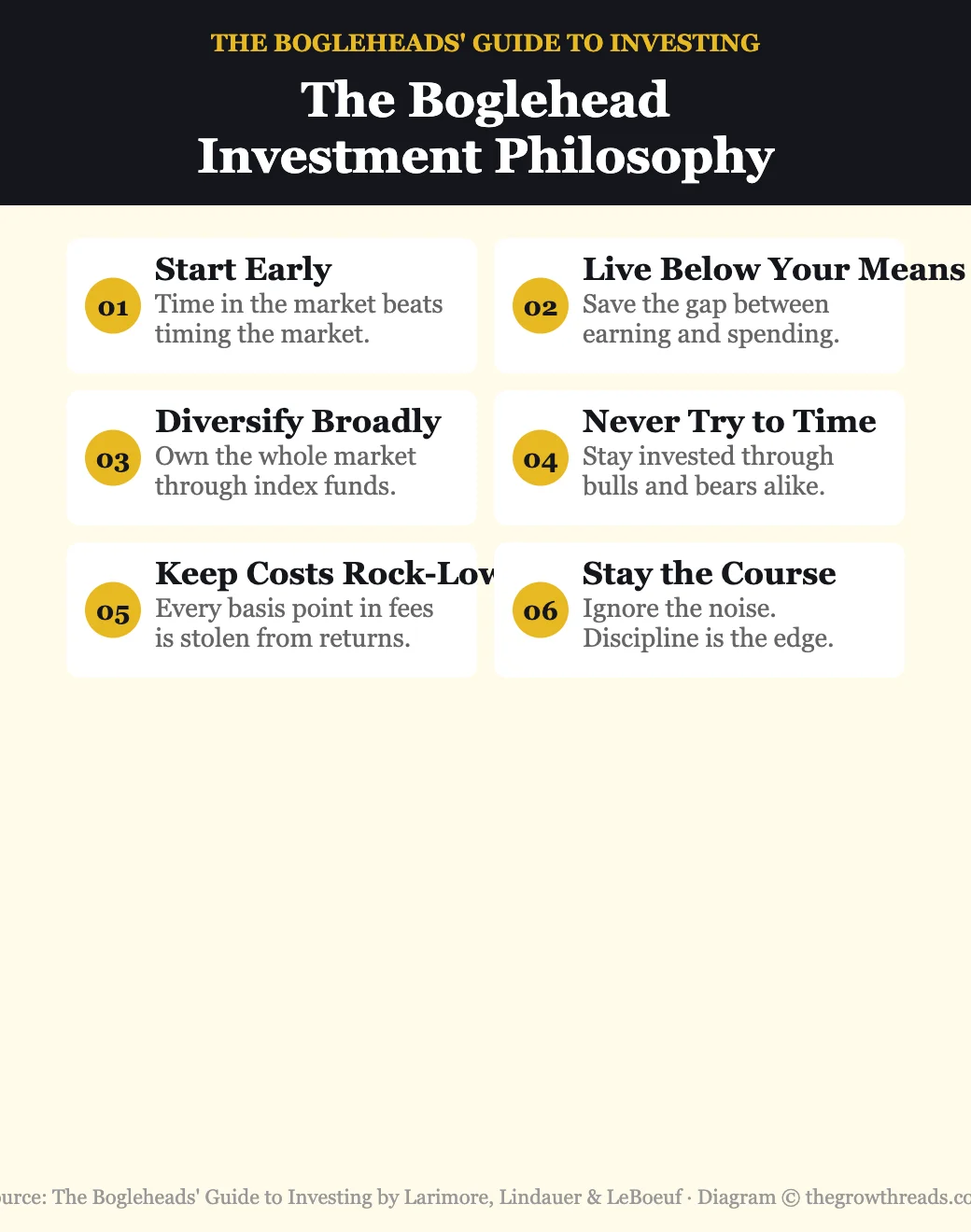
The authors introduce the three-fund portfolio as the practical implementation of this philosophy: a total U.S. stock market index fund, a total international stock market index fund, and a total bond market index fund. Three funds, three asset classes, global diversification, and expense ratios typically under 0.10%. Most investors will never need anything more complicated.
Part 3 — Asset allocation and portfolio management
With the case for index funds established, the book turns to what the authors consider the most important investment decision you will ever make: your asset allocation. Academic research by Brinson, Hood, and Beebower famously found that asset allocation — the percentage split between stocks, bonds, and other asset classes — explains over 90% of the variation in portfolio returns over time. Individual stock selection and market timing account for the remainder.
The general Boglehead guideline is straightforward: subtract your age from 110 (or 120 if you are comfortable with more risk) to get your stock allocation percentage. A 30-year-old might hold 80% stocks and 20% bonds. A 60-year-old might hold 50/50. The logic is that younger investors have decades to recover from market downturns, while older investors need more stability as they approach withdrawal.
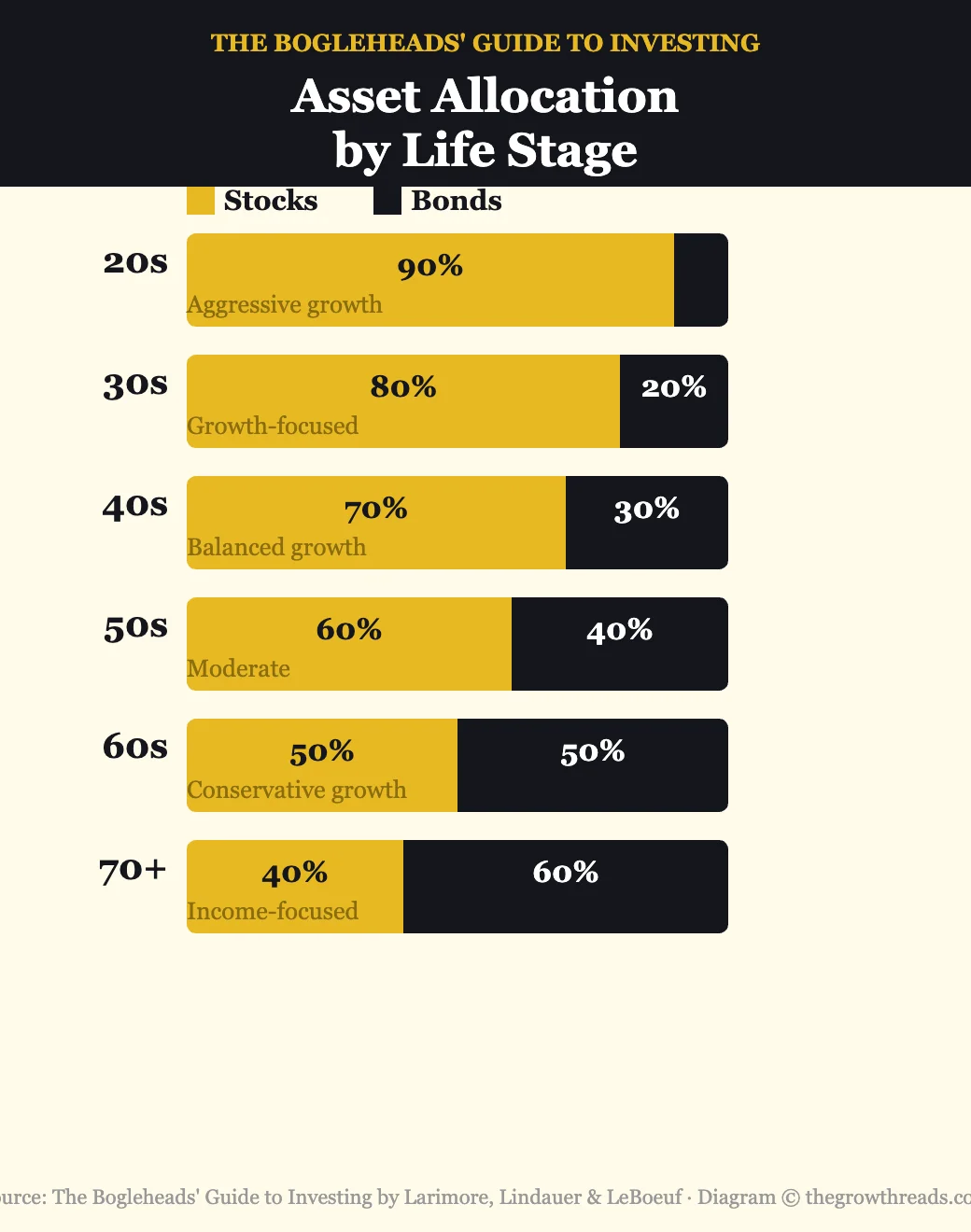
Rebalancing is the maintenance mechanism. Over time, stocks and bonds grow at different rates, causing your allocation to drift. If stocks surge and your portfolio shifts from 80/20 to 90/10, you are taking more risk than intended. The Bogleheads recommend rebalancing once per year — on a fixed date, mechanically, without emotion. Some investors use a threshold approach: rebalance only when an asset class drifts more than 5% from its target. Both methods work; the key is consistency.
The book also covers tax-efficient fund placement — a topic many investing books skip entirely. The principle is simple but powerful: place tax-inefficient investments (bonds, REITs, actively managed funds) in tax-advantaged accounts (401(k), IRA) and hold tax-efficient investments (total market index funds, growth-oriented funds) in taxable accounts. This placement strategy alone can add measurable basis points to your after-tax returns every year.
Part 4 — Behavioral discipline and staying the course
The final major section of the book tackles what the authors consider the hardest part of investing: your own psychology. They argue that the Boglehead strategy is intellectually simple but emotionally brutal. When the market drops 40% — as it did in 2008-2009 and briefly in 2020 — every instinct screams at you to sell. The investors who succeed are not the ones who picked the best funds. They are the ones who held on.
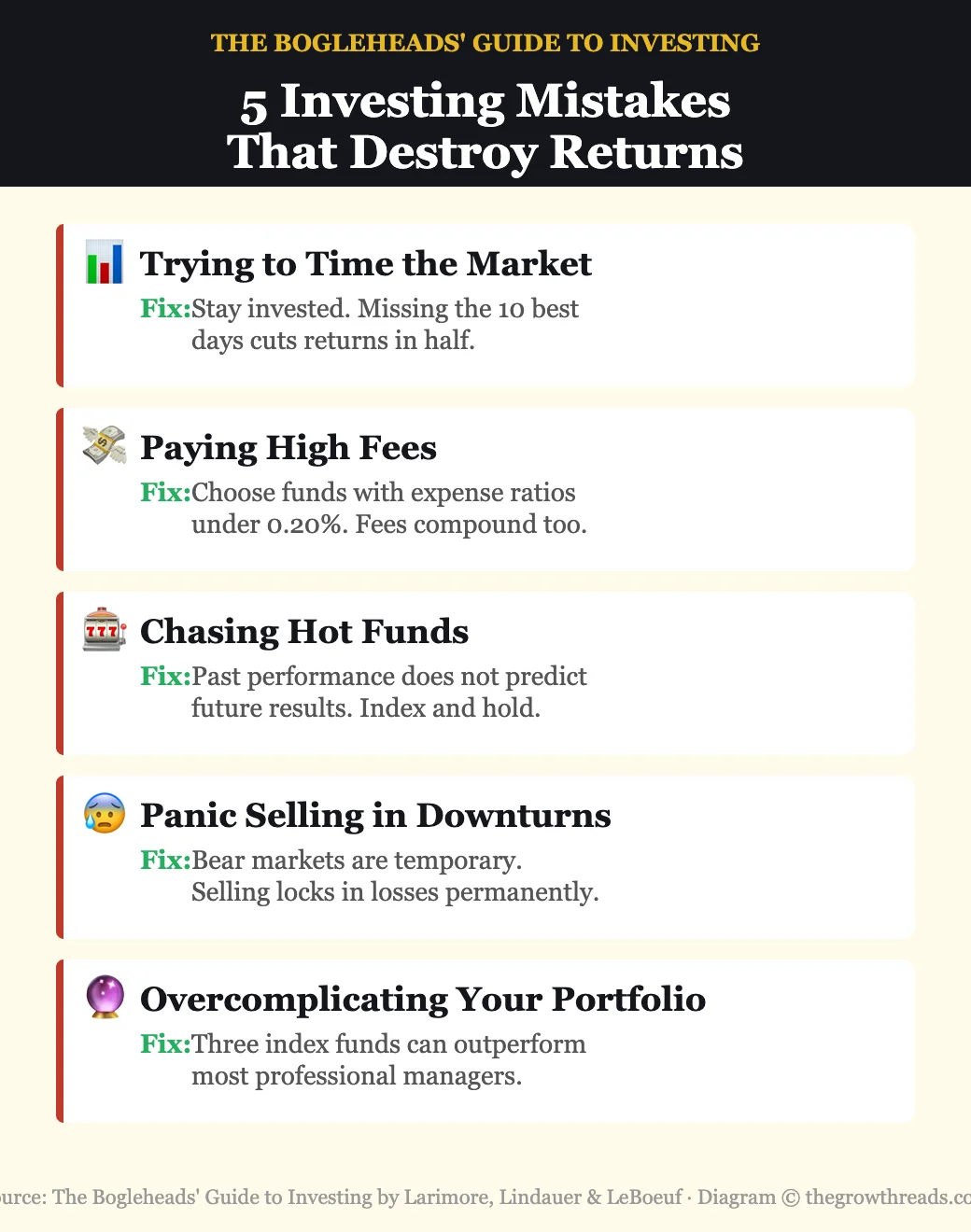
The authors catalogue the most common behavioral mistakes: chasing last year’s hot fund, panic selling during downturns, overtrading based on news headlines, checking your portfolio obsessively, and attempting to time the market. Each of these behaviors has been shown to reduce investor returns by 1-3% annually compared to a simple buy-and-hold approach.
Their advice for maintaining discipline is practical. First, write an investment policy statement — a one-page document spelling out your target allocation, rebalancing rules, and a reminder of your long-term goals. Read it when markets are in turmoil. Second, automate everything you can: contributions, reinvestment, even rebalancing if your platform supports it. Third, stop watching financial news. The signal-to-noise ratio is atrocious, and the primary effect of financial media is to make you trade more — which makes you earn less.
Who is The Bogleheads’ Guide to Investing best for — and who should read something else first?
This book is ideal for anyone who wants a complete, evidence-based investing education in one volume. It is particularly well suited for new investors who feel overwhelmed by options, intermediate investors who suspect their portfolio is too complicated or too expensive, and anyone who has been burned by actively managed funds or market-timing strategies.
If you want a shorter, more narrative introduction to the same philosophy, start with The Simple Path to Wealth by JL Collins. If you want to understand the emotional side of money before diving into mechanics, read The Psychology of Money first. Then come back to this book for the full implementation manual. Note that this book discusses general investing principles and is not a substitute for personalized financial advice.
Questions to reflect on
- What percentage of your income are you actually saving — and what would it take to increase it by 5%?
- How much are you paying in investment fees right now? Have you ever calculated the lifetime cost?
- Could you honestly hold your investments through a 40% market decline without selling? What would help you stay the course?
- Is your portfolio more complicated than it needs to be? Could a three-fund portfolio serve you just as well?
- When was the last time a financial news headline changed your investment behavior — and did that change help or hurt you?
🔥 Ready to invest the Boglehead way?
Get the definitive guide to low-cost, evidence-based investing.
How to apply The Bogleheads’ Guide to Investing (7-day plan)
- Day 1 — Calculate your savings rate: Add up your after-tax income and your total monthly savings (retirement contributions, brokerage deposits, emergency fund). Divide savings by income. Write down the number. If it is below 20%, identify one expense to cut this week.
- Day 2 — Audit your investment fees: Log into every account and note the expense ratio of each fund or ETF you own. Calculate the annual dollar cost. If any fund charges more than 0.20%, research an index fund alternative.
- Day 3 — Set your target asset allocation: Use the 110-minus-your-age rule as a starting point. Write down your target stock/bond split. Compare it to your current allocation. Note the gap.
- Day 4 — Research the three-fund portfolio: Look up the total U.S. stock market index, total international stock market index, and total bond market index fund available through your brokerage. Note the ticker symbols and expense ratios.
- Day 5 — Optimize tax placement: List your accounts by type (taxable, traditional IRA/401k, Roth). Place bonds and REITs in tax-advantaged accounts, stock index funds in taxable accounts. Adjust if needed.
- Day 6 — Write your investment policy statement: One page: your target allocation, your rebalancing schedule (annually on a fixed date), your savings rate target, and one sentence reminding yourself why you are investing for the long term.
- Day 7 — Automate and step away: Set up automatic contributions to your investment accounts. Set a calendar reminder to rebalance once per year. Unsubscribe from at least one financial news source. Your portfolio is now on autopilot.
Frequently asked questions
Is The Bogleheads’ Guide to Investing worth reading?
Yes — it is one of the most practical and evidence-based investing books available. It covers everything from saving and asset allocation to tax optimization and behavioral discipline in clear, jargon-free language. Whether you are a complete beginner or an intermediate investor who wants to simplify, this book provides a complete roadmap for building long-term wealth through low-cost index funds.
What is the three-fund portfolio?
The three-fund portfolio is the Bogleheads’ recommended approach to diversification. It consists of three index funds: a total U.S. stock market fund, a total international stock market fund, and a total bond market fund. Together, these three funds provide exposure to thousands of stocks and bonds across the globe at minimal cost. Many Bogleheads consider this the only portfolio most investors will ever need.
Who are the Bogleheads?
The Bogleheads are an online community of investors who follow the investment philosophy of John C. Bogle, the founder of Vanguard and the creator of the first index fund for individual investors. The community started as a forum on the Morningstar website and now operates at bogleheads.org. Members share a commitment to low-cost, diversified, long-term investing and regularly help newcomers build simple, effective portfolios.
How is this different from The Simple Path to Wealth?
JL Collins’ The Simple Path to Wealth is a more concise, narrative-driven book that recommends a single-fund approach (VTSAX) during the wealth-building years. The Bogleheads’ Guide is more comprehensive, covering tax strategies, insurance, estate planning, and international diversification in addition to the core investing philosophy. Think of Collins’ book as the quick-start guide and the Bogleheads’ book as the full reference manual.
Is this book still relevant in 2026?
Absolutely. The core principles — low costs, broad diversification, long-term holding, and behavioral discipline — are timeless. Market conditions change, but the arithmetic of low-cost indexing does not. The third edition was updated with current data and covers modern topics like target-date funds and factor investing, making it fully relevant for today’s investors.
What does “stay the course” mean in practice?
It means continuing to invest according to your plan regardless of market conditions. When stocks drop 30%, you do not sell — you rebalance. When a colleague brags about a hot stock, you do not chase it. When financial news predicts a crash, you do not move to cash. The research consistently shows that investors who maintain their discipline through downturns earn significantly higher long-term returns than those who react emotionally.
Can I use this approach outside the United States?
Yes, though the specific fund recommendations and tax strategies are U.S.-focused. The core philosophy — low-cost indexing, broad diversification, and disciplined holding — applies everywhere. International readers can find equivalent low-cost index funds through providers like Vanguard (available in many countries), iShares, or local equivalents. The Bogleheads wiki and forum have country-specific guides for adapting the strategy.
Related summaries
If you enjoyed this summary, you might also find these helpful:
- The Simple Path to Wealth Summary — JL Collins’ streamlined version of the Boglehead approach.
- The Little Book of Common Sense Investing Summary — John Bogle’s own case for index funds.
- The Psychology of Money Summary — Morgan Housel on why we make irrational financial decisions.
- A Random Walk Down Wall Street Summary — Burton Malkiel’s academic case for passive investing.
📚 Explore all Money summaries
This book is part of our best money books collection. Browse the full list for more actionable summaries on investing, personal finance, and building wealth.
How we analyze books at The Growth Reads: We read every book cover to cover, cross-reference key claims with primary sources and peer-reviewed research, and distill each into an actionable summary you can apply in under 7 days. Our 5-criteria rating evaluates practical applicability, evidence quality, writing clarity, depth of insight, and lasting impact. Read our full methodology.