

⭐⭐⭐⭐✦ 4.4 / 5 — A transformative meditation on what love actually means — and why most of us have been doing it wrong.
Best for: Anyone who wants a deeper, more honest understanding of love beyond romance — in friendships, family, community, and self.
Reading time: ~4 hours (240 pages)
Difficulty to apply: Medium-High — the ideas are clear, but unlearning a lifetime of cultural conditioning about love requires sustained effort.
All About Love in one minute
We cannot love what we do not understand, and most of us have never been taught what love actually is. bell hooks argues that our culture confuses love with romance, possession, and intensity — and that this confusion is the root cause of most relational suffering. Drawing on the work of M. Scott Peck, Erich Fromm, and her own life, hooks defines love not as a feeling but as a practice: the willful choice to nurture the spiritual growth of yourself and another person. Love, in her framework, requires care, affection, recognition, respect, commitment, trust, and above all, honesty. This book challenges readers to abandon the myth that love is something that happens to you and to embrace the harder truth that love is something you do — every day, on purpose.
Key takeaways
- Love is an action, not a feeling: hooks adopts Peck’s definition — love is the will to extend oneself for the purpose of nurturing one’s own or another’s spiritual growth. Feelings come and go; love is a sustained practice.
- Honesty is the foundation: You cannot love someone while deceiving them. hooks argues that a culture of lying — even small, socially acceptable lies — erodes the trust that love requires to survive.
- Love and abuse cannot coexist: One of the book’s most powerful claims is that abuse is not a distortion of love — it is the absence of love. Calling abusive behavior “love” prevents people from seeking the real thing.
- We learn love (or its absence) in childhood: Our first experience of love comes from our families. Many people grow up in homes where care and control are confused, teaching them patterns they carry into every relationship.
- Romantic love is overhyped: Our culture treats romantic love as the supreme form of love. hooks argues that friendship, community, and self-love are equally vital — and that placing all our emotional weight on one romantic partner is a recipe for collapse.
- A love ethic transforms everything: hooks envisions a society organized around a love ethic — where institutions, communities, and personal relationships prioritize care, justice, and mutual growth over domination and greed.
- Greed is the enemy of love: Consumer culture teaches us to fill emotional voids with material things. hooks argues that greed and love are fundamentally incompatible — you cannot love freely while hoarding.
- Community is essential: Love cannot thrive in isolation. Building communities of care — chosen families, friend circles, neighborhoods — is as important as building romantic partnerships.
- Men suffer from love deprivation: hooks devotes significant attention to how patriarchal culture teaches men to suppress emotional vulnerability, cutting them off from love and intimacy. Healing this wound benefits everyone.
- Self-love is not selfish: You cannot give what you do not have. hooks argues that genuine self-love — rooted in self-knowledge and self-acceptance — is the prerequisite for loving others well.
What is All About Love about?
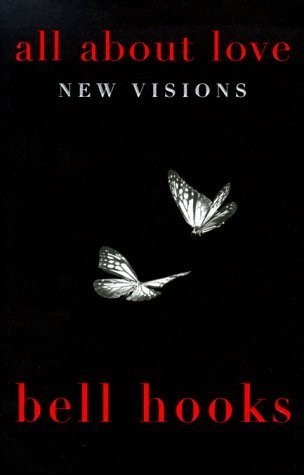
All About Love: New Visions is a philosophical and deeply personal exploration of what love means, why our culture gets it wrong, and how to build a life and a society centered on genuine love. bell hooks examines love across every domain — romantic relationships, family, friendship, community, spirituality, and self — arguing that love is an ethical practice requiring honesty, care, and the courage to reject domination in all its forms.
About the author
bell hooks (1952–2021) was the pen name of Gloria Jean Watkins, an American author, professor, feminist, and social activist. She wrote over 30 books spanning cultural criticism, education, feminism, and personal transformation. hooks taught at Yale, Oberlin, and Berea College, where she founded the bell hooks center. She chose to write her name in lowercase to shift focus from her identity to her ideas. All About Love, published in 2000, became her most widely read book and has experienced a cultural resurgence in the 2020s, particularly among younger readers seeking alternatives to superficial dating culture. Explore all bell hooks book summaries →
Key concepts at a glance
| Concept | What it means | Use it when |
|---|---|---|
| Love as practice | Love is a verb — a willful choice to nurture growth, not a passive emotion | You catch yourself waiting to “feel” love instead of acting on it |
| Honesty as foundation | Deception of any kind — even white lies — corrodes trust and therefore love | You are tempted to withhold truth to keep the peace |
| Love ethic | A personal and societal commitment to center care, justice, and mutual growth | Making decisions about how to treat others and structure your life |
| Love vs. cathexis | Cathexis (intense attachment) is not love — it is investment that can coexist with abuse | You feel intensely bonded to someone who hurts you |
| Domination culture | A system where power and control replace care and partnership | Recognizing unhealthy dynamics in family, work, or romance |
| Spiritual growth | The expansion of the self through love, not material accumulation | Feeling empty despite external success |
| Community of love | Love requires a network — friends, chosen family, neighbors — not just one partner | You feel isolated or over-reliant on a single relationship |
Part 1 — Clarity: defining love
hooks opens with a disarming admission: she spent years talking about love without ever defining it. When she finally tried, she realized that most people cannot define love either. We use the word constantly — for partners, parents, friends, pizza, sunsets — but we rarely stop to ask what it actually means.
She adopts psychiatrist M. Scott Peck’s definition from The Road Less Traveled: love is “the will to extend one’s self for the purpose of nurturing one’s own or another’s spiritual growth.” This definition is radical in its precision. Love is not a feeling (feelings fluctuate). Love is not attraction (attraction fades). Love is not need (need creates dependence). Love is an intentional act of will — a choice you make, and keep making, even when it is difficult.
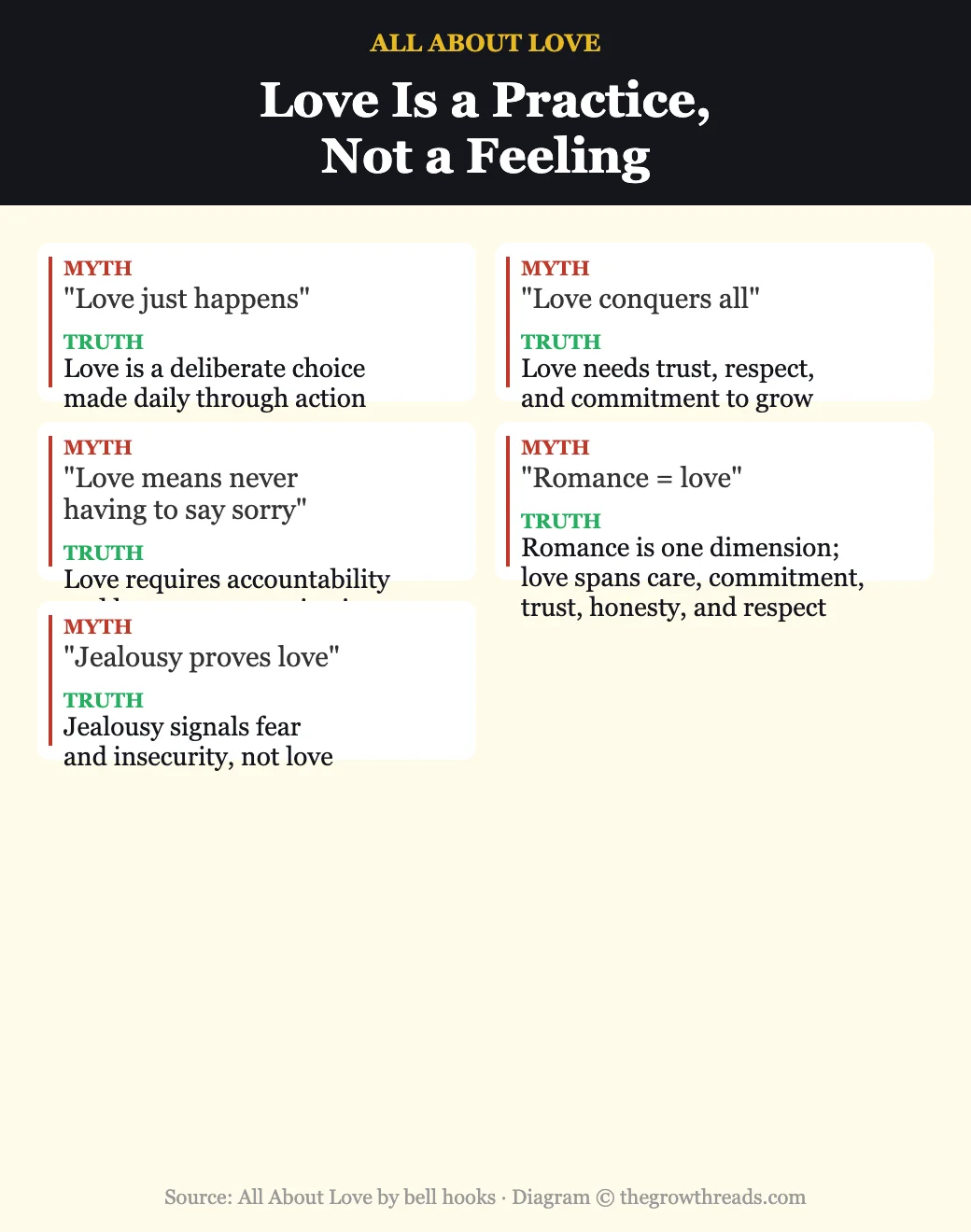
hooks draws a crucial distinction between love and cathexis — a psychoanalytic term for intense emotional investment in another person. Cathexis feels like love. It can look like love. But it can coexist with control, manipulation, and abuse, which genuine love cannot. A parent who controls every aspect of a child’s life may feel deeply cathected but is not loving that child — because love requires respecting the other person’s autonomy and growth.
Part 2 — Justice: honesty and the courage to love
If love is a practice, hooks argues that honesty is its foundation. She is uncompromising on this point: you cannot love someone while lying to them. Not little lies. Not lies by omission. Not “protective” lies. Deception of any kind corrodes the trust that love requires to function. A relationship built on dishonesty — even comfortable, well-intentioned dishonesty — is not a loving relationship.
This is where hooks becomes most challenging to her readers. She points out that our culture actively teaches dishonesty. We tell children to say they like gifts they do not like. We encourage “white lies” to avoid conflict. We praise people for being “diplomatic” when they are actually being evasive. Over time, this training in small deceptions creates adults who cannot be fully honest with the people they claim to love — and who have lost the ability to tell the difference between a convenient truth and a real one.
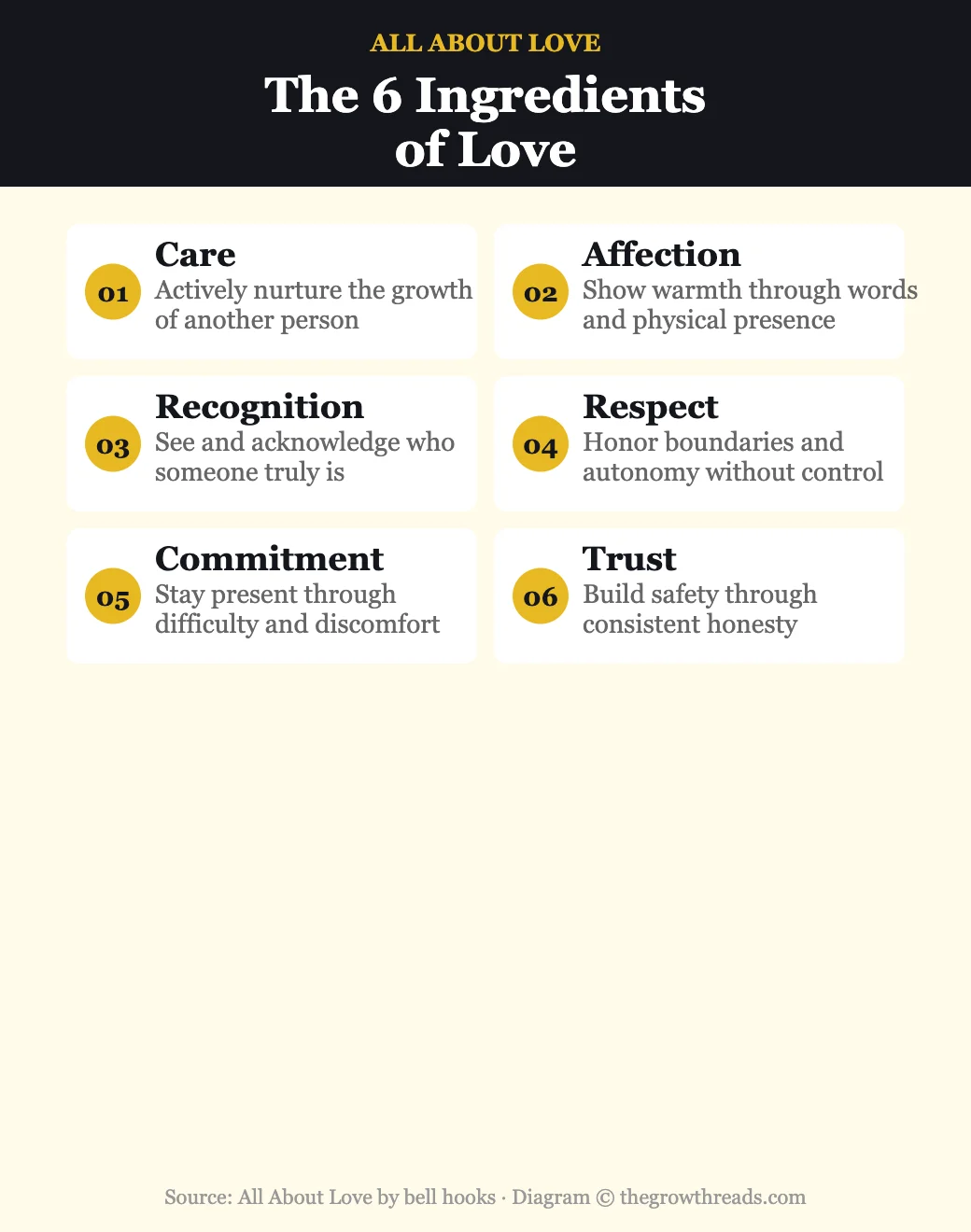
hooks also connects love to courage. Loving honestly means risking rejection, conflict, and discomfort. It means telling your partner something they do not want to hear. It means admitting your own failures. It means being vulnerable when every instinct tells you to protect yourself. This is why hooks insists love is an act of will — it requires choosing growth over comfort, again and again.
Part 3 — Destiny: the dimensions of love
In the middle section, hooks expands her exploration beyond romantic love to cover friendship, community, spirituality, and the cultural forces that distort our understanding of love. She argues that our society has elevated romantic love to an unhealthy extreme — treating it as the only “real” love — while devaluing the forms of love that actually sustain us through life.
Friendship, hooks writes, is often a more reliable source of love than romance. Friends choose each other freely, without the pressures of sexual attraction, financial entanglement, or social expectation. The best friendships embody everything hooks defines as love: care, honesty, mutual growth, and respect for autonomy. Yet our culture treats friendship as a lesser form of connection — something to maintain until a romantic partner comes along.
hooks devotes an entire chapter to how greed undermines love. Consumer culture teaches us to fill emotional voids with purchases — to mistake comfort for happiness and acquisition for growth. She argues that greed and love are fundamentally incompatible because greed is about accumulation while love is about giving. A culture organized around greed will always struggle to produce people capable of genuine love.
Part 4 — Healing: building a love ethic
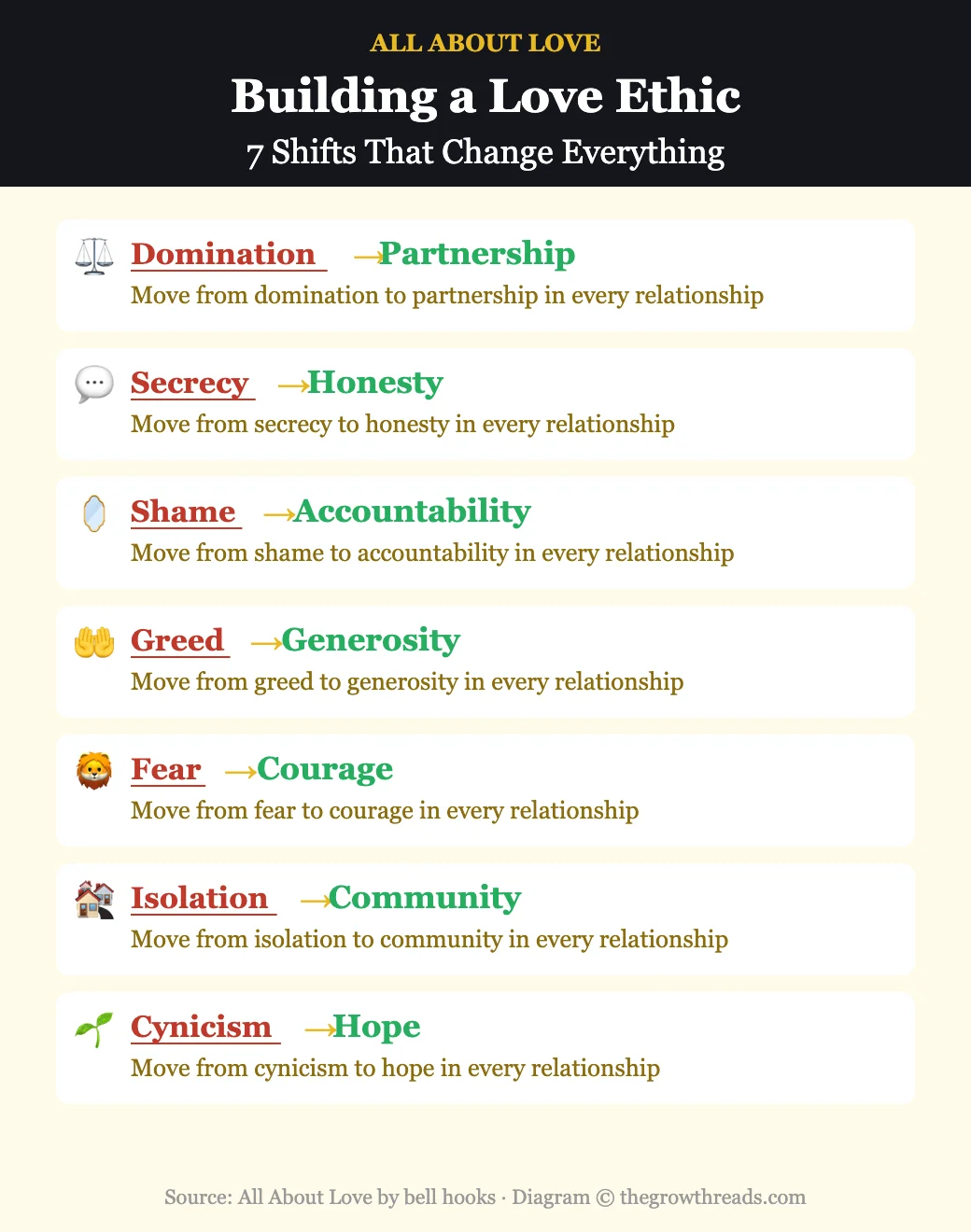
The final section is hooks at her most hopeful and most practical. She introduces the concept of a love ethic — a personal and collective commitment to making love the organizing principle of your life. A love ethic means asking, in every decision, “Is this choice consistent with love?” — and having the courage to change course when the answer is no.
hooks is clear that building a love ethic is not about being nice, accommodating, or conflict-avoidant. Love requires boundaries. Love requires accountability. Love sometimes requires ending relationships that cannot be made healthy. The love ethic is not passive — it is a fierce, deliberate practice of choosing care, justice, and mutual growth in a culture that rewards domination and self-interest.
She also addresses the role of spirituality in sustaining love — not necessarily organized religion, but a connection to something larger than the self. hooks argues that without some form of spiritual practice, the daily work of love becomes exhausting because there is no larger container to hold the effort. Meditation, prayer, nature, service — any practice that connects you to the bigger picture can replenish the capacity to love.
Who is All About Love best for — and who should read something else first?
All About Love is ideal for anyone who senses that something is off about the way our culture talks about love — and wants a more honest, more demanding, more rewarding framework. It is particularly valuable for people recovering from unhealthy relationship patterns, those who feel disconnected from community, and anyone who has confused intensity with intimacy.
If you want a more practical, skills-based approach to improving specific relationships, start with Nonviolent Communication or Crucial Conversations. If you want to understand your attachment patterns first, read Attached. Then come back to All About Love for the philosophical foundation that ties everything together.
Questions to reflect on
- How do you define love — and is your definition something you can actually practice, or is it just a feeling you wait for?
- Where in your life are you confusing cathexis (intense attachment) with genuine love?
- Are there relationships where you have substituted comfortable dishonesty for the harder work of loving truthfulness?
- How much of your emotional life depends on a single romantic relationship — and what would change if you invested more in friendships and community?
- If you applied a love ethic to one decision you are facing right now, what would you do differently?
🔥 Ready to rethink everything you know about love?
Get the book that is changing how a generation understands love.
How to apply All About Love (7-day plan)
- Day 1 — Define love for yourself: Write your personal definition of love using hooks’ framework: care, affection, recognition, respect, commitment, trust, and honesty. Post it where you will see it daily.
- Day 2 — Audit your honesty: For one full day, notice every time you are tempted to tell a small lie — a polite deflection, an exaggeration, an omission. Do not judge yourself; just observe the pattern.
- Day 3 — Distinguish love from cathexis: Think about your closest relationships. In which ones do you feel genuine mutual growth? In which ones is the intensity driven more by fear, need, or habit? Write down what you notice.
- Day 4 — Invest in friendship: Reach out to a friend you have been neglecting. Not a text — a real conversation. Ask them how they are doing and listen without rushing to your own story.
- Day 5 — Practice loving honesty: Have one conversation today where you share something true that you would normally hold back. Use Rosenberg’s NVC framework if it helps: observation, feeling, need, request.
- Day 6 — Examine your relationship with greed: Look at your last week of purchases. How many were genuine needs, and how many were attempts to fill an emotional gap? Identify one area where you can choose generosity over accumulation.
- Day 7 — Build community: Take one action to strengthen your community of care — invite a neighbor for coffee, join a group, volunteer, or simply show up for someone who needs support. Love is not a solo project.
Frequently asked questions
Is All About Love worth reading?
Yes — especially if you have ever felt confused about what love actually means or sensed that the cultural script about romance is missing something important. hooks writes with clarity, vulnerability, and intellectual rigor that make this both a philosophical work and a deeply personal one. It has become a modern classic for good reason, and its ideas are more relevant now than when it was published in 2000.
Who was bell hooks?
bell hooks (1952–2021) was the pen name of Gloria Jean Watkins, an acclaimed American author, professor, and cultural critic. She wrote over 30 books on topics including feminism, race, education, and love. She taught at Yale, Oberlin, and Berea College. hooks deliberately lowercased her pen name to emphasize her ideas over her identity. All About Love is her most widely read work and has experienced a major cultural resurgence among younger readers.
What is the main message of All About Love?
The central argument is that love is not a feeling that happens to you but a practice you choose — the willful decision to nurture your own and another person’s spiritual growth. hooks argues that our culture confuses love with romance, possession, and intensity, and that this confusion causes immense suffering. The book offers an alternative framework built on honesty, care, respect, and community.
Is this a self-help book or a philosophy book?
It is both. hooks draws on philosophy, psychology, and cultural criticism to build her argument, but she also shares deeply personal stories and practical reflections. It reads less like a step-by-step guide and more like a conversation with a wise mentor who challenges your assumptions while showing genuine care. Readers who want more structured advice should pair it with a practical communication book.
What does bell hooks mean by a love ethic?
A love ethic is a personal and societal commitment to making love — defined as care, honesty, and mutual growth — the organizing principle of your life and your community. It means asking, before every decision, whether your choice is consistent with love. hooks envisions a love ethic not just as an individual practice but as a social transformation — a shift away from domination culture toward partnership and care.
How is this different from other relationship books?
Most relationship books focus on romantic partnerships and offer techniques for better communication or conflict resolution. hooks goes far broader and deeper — she examines love in friendship, family, community, and spirituality, and she connects personal relationship patterns to larger cultural forces like patriarchy, consumerism, and domination. This is not a book about fixing your marriage; it is a book about transforming your entire understanding of love.
Why has All About Love become so popular recently?
The book has resonated with younger readers who are questioning traditional relationship models, hookup culture, and the emotional superficiality of social media. hooks’ insistence that love requires honesty, vulnerability, and community — not just attraction and convenience — speaks directly to a generation experiencing widespread loneliness and relational confusion. Its popularity surged after hooks’ death in 2021 and continues to grow through word of mouth and social media recommendations.
Related summaries
If you enjoyed this summary, you might also find these helpful:
- Nonviolent Communication Summary — Marshall Rosenberg’s practical toolkit for the radical honesty hooks advocates.
- The Four Agreements Summary — Don Miguel Ruiz on personal transformation through ancient Toltec wisdom.
- Attached Summary — Levine and Heller on how attachment styles shape our relationships.
- The Mastery of Love Summary — Don Miguel Ruiz on self-love as the foundation for loving others.
📚 Explore all Relationships summaries
This book is part of our best relationship books collection. Browse the full list for more actionable summaries on communication, connection, and building healthier relationships.
How we analyze books at The Growth Reads: We read every book cover to cover, cross-reference key claims with primary sources and peer-reviewed research, and distill each into an actionable summary you can apply in under 7 days. Our 5-criteria rating evaluates practical applicability, evidence quality, writing clarity, depth of insight, and lasting impact. Read our full methodology.