

★★★★★ 4.6/5 — A practical, structured roadmap for every stage of romantic love, from being single to breaking up and loving again.
Best for: Anyone dating, partnered, or recovering from a breakup who wants a framework instead of guesswork.
Reading time: ~15 min summary · ~6 hrs full book (320 pages)
Difficulty to apply: Moderate — the exercises take real reflection, not just reading.
8 Rules of Love in one minute
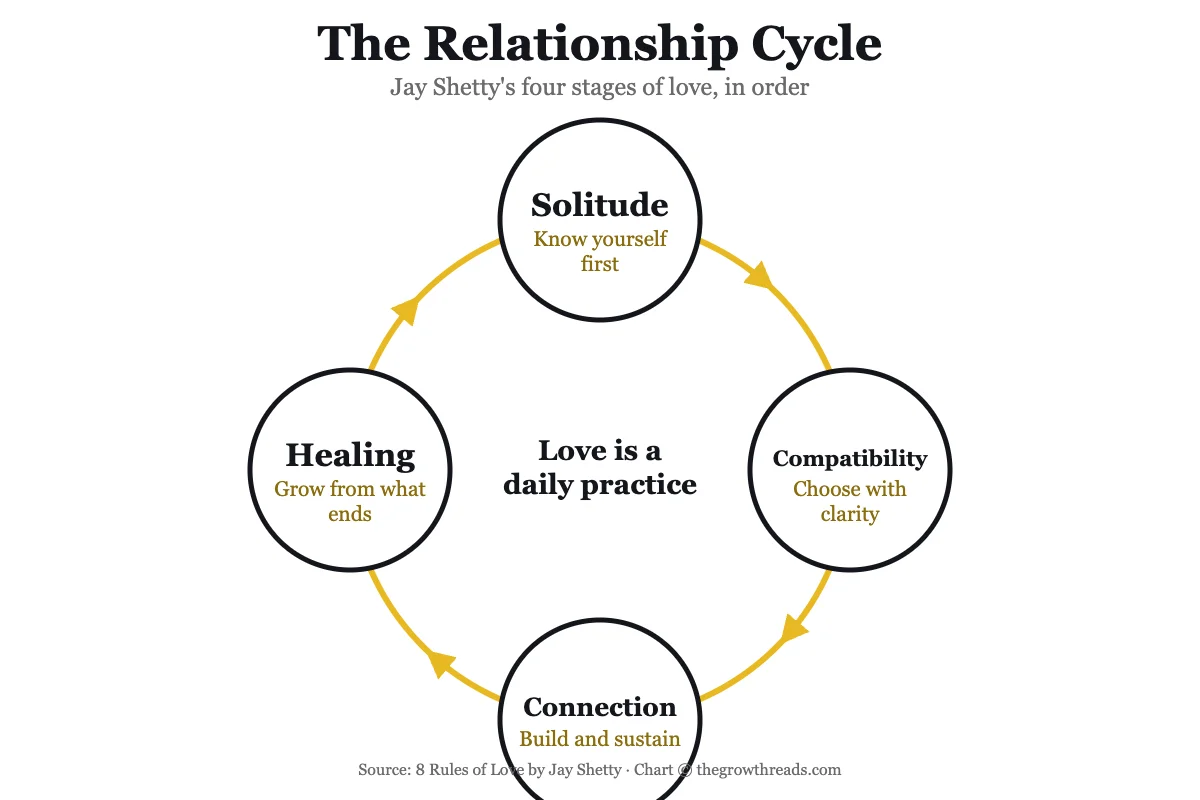
Nobody teaches us how to love — so most of us improvise, using rom-coms and guesswork as our only training. Jay Shetty, a former monk turned #1 New York Times bestselling author, argues that love is a skill you build in stages, not a feeling that either strikes or doesn’t. In 8 Rules of Love, he lays out eight actionable rules that walk through the entire relationship cycle: getting comfortable being alone, spotting your own relationship patterns, defining what love actually means to you, choosing a partner who helps you grow, building a life of shared purpose, staying a team through conflict, healing after a breakup without losing yourself, and being willing to love again. Drawing on Vedic philosophy from his years as a monk and modern relationship science, Shetty replaces vague romantic advice with specific steps — making this less a book about falling in love and more a manual for building it, on purpose.
Key takeaways
- Solitude comes before love: if you can’t enjoy your own company, you’ll likely date to escape loneliness rather than to build something real.
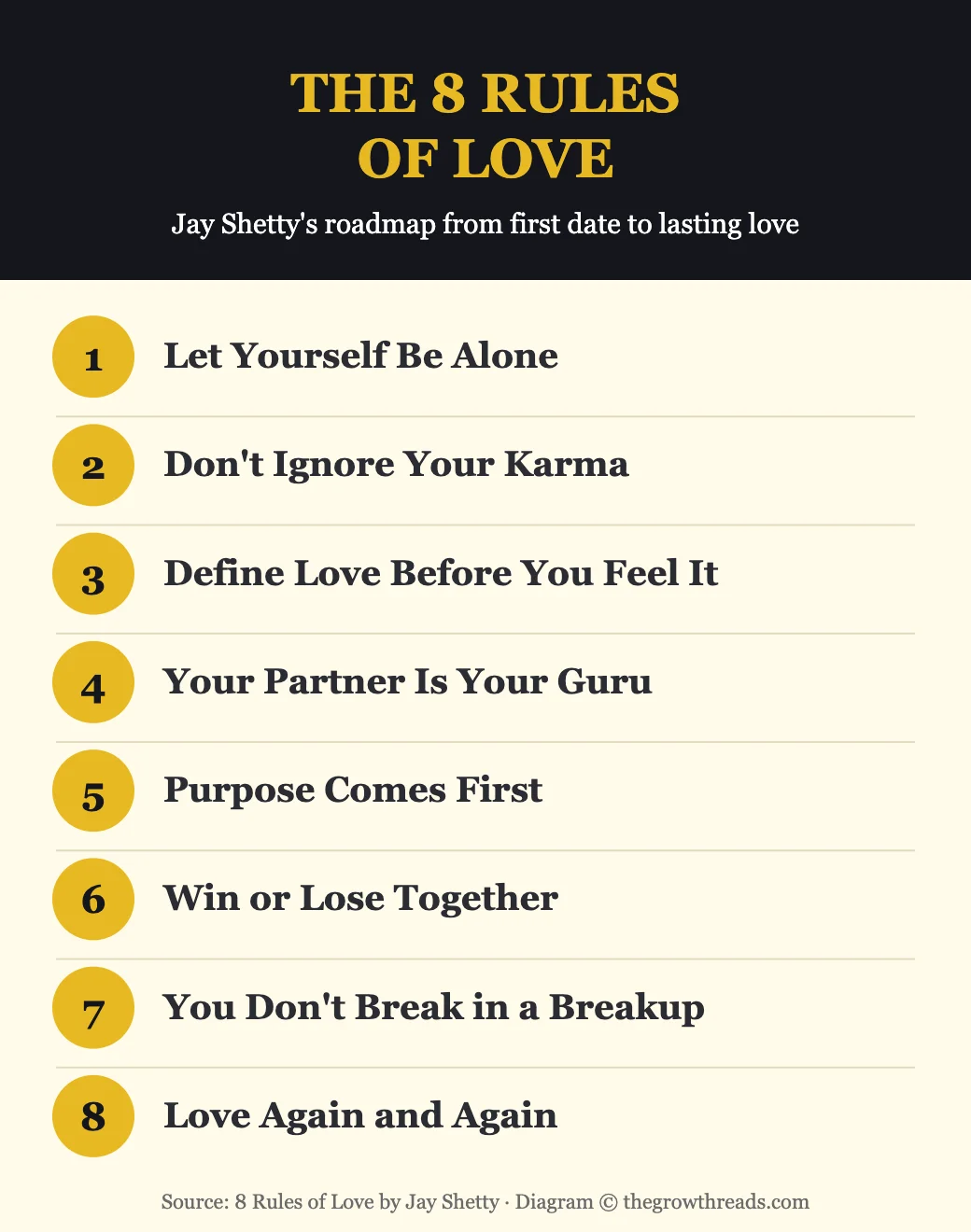
- Your relationship patterns are your karma: the same conflict keeps recurring until you notice the pattern and address the root, not just the latest partner.
- Define love before you feel it: most people can’t articulate what love means to them, so they mistake intensity, chemistry, or attention for the real thing.
- Your partner is your guru, not your enemy: the person who frustrates you most is often showing you exactly what you still need to work on.
- Shared purpose outlasts shared interests: couples who build toward something together stay connected longer than couples who just enjoy the same hobbies.
- Fight the problem, not each other: the strongest couples treat conflict as “us versus the issue,” never “me versus you.”
- A breakup ends a relationship, not your identity: the grief is real, but who you are doesn’t disappear when the relationship does.
- Healing has no universal timeline: comparing your recovery to someone else’s just adds shame to an already hard process.
- Every relationship leaves you a lesson: extracting it — instead of just moving on — is what makes the next relationship better than the last.
- Love is a daily practice, not a permanent state: it has to be renewed through small, consistent actions, long after the initial spark fades.

What is 8 Rules of Love about?
8 Rules of Love is Jay Shetty’s guide to every stage of romance — from being single to dating, committing, and eventually breaking up or growing old together. Combining Vedic wisdom with modern relationship science, it offers eight specific, practical rules for finding love, sustaining it, and letting it go with grace when it ends.
About the author
Jay Shetty spent three years as a monk in ashrams in Mumbai and London before trading his robes for a career as a storyteller, podcaster, and author. His viral videos on purpose and mindfulness have been viewed more than 10 billion times, and his podcast, On Purpose, is consistently ranked the world’s #1 health and wellness podcast. Shetty first reached a mass audience with Think Like a Monk, a #1 New York Times bestseller that distilled monastic training into everyday practices. In 8 Rules of Love, published in 2023, he turns that same lens on romantic relationships, drawing on ancient teachings from his time as a monk and interviews with relationship experts to build a practical framework for love. He lives in Los Angeles with his wife, Radhi Devlukia-Shetty, to whom the book is dedicated. Explore all Jay Shetty book summaries →
Key concepts at a glance
| Concept | What it means | Use it when |
|---|---|---|
| Solitude | Being at peace alone, not just tolerating it | Before you start dating again after a breakup |
| Karma (relationship patterns) | Recurring dynamics you unconsciously repeat | You notice the same fight in every relationship |
| Defining love | Naming what love means to you specifically | Before saying “I love you” for the first time |
| Partner as guru | Treating friction with a partner as a growth signal | You’re tempted to see conflict as purely their fault |
| Purpose-first partnership | Building toward shared goals, not just shared fun | Deciding whether to commit long-term |
| Win or lose together | Framing conflict as “us vs. the problem” | You’re in the middle of a recurring argument |
| Breakup identity | Separating who you are from the relationship that ended | Right after a breakup, when grief feels like erasure |
| Loving again | Staying open to love after loss, without rushing it | You’ve healed but feel afraid to date again |
Part 1: Solitude — get right with yourself first
Shetty opens with a rule that runs against most dating advice: before you look for a partner, learn to be alone without treating it as a problem to solve. He distinguishes solitude from loneliness — loneliness is an ache to escape, while solitude is a state you can enjoy and even seek out. People who skip this step, he argues, tend to date reactively: they pick partners who simply make the discomfort of being single go away, rather than partners who genuinely add to an already full life. That distinction shows up later in the relationship as neediness, difficulty setting boundaries, or staying too long in a relationship that isn’t working because leaving means facing the solitude again.
The second rule in this stage is about pattern recognition, which Shetty frames through the lens of karma — not fate, but the recurring dynamics people unconsciously carry from one relationship into the next. He encourages readers to look at their last two or three relationships and ask what problem showed up in all of them. If every partner eventually became “distant,” the pattern might be about the reader choosing emotionally unavailable people, or about the reader themselves pulling away first. Either way, the fix isn’t a better partner — it’s naming the pattern before it repeats a fourth time.
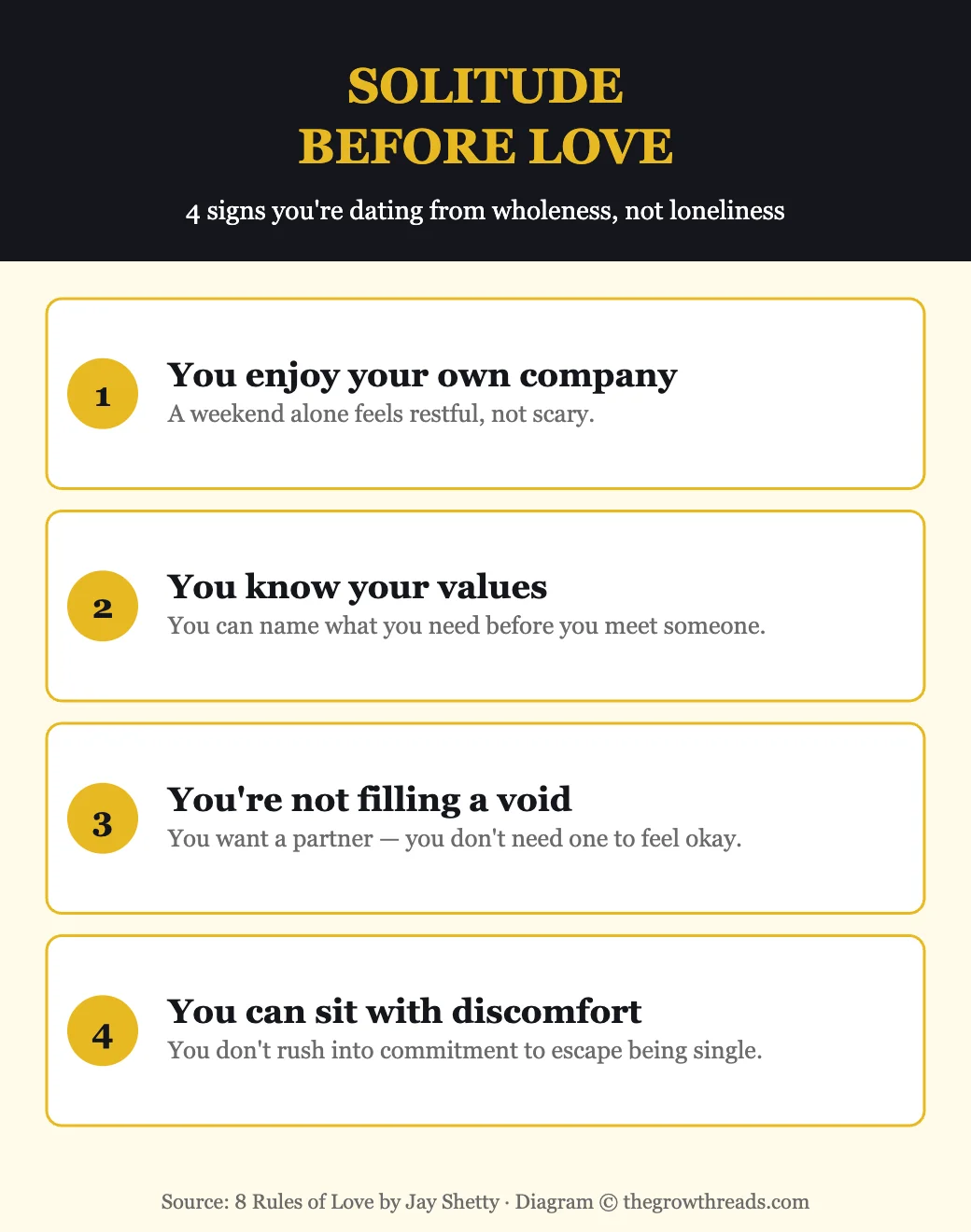
To make solitude concrete rather than abstract, Shetty suggests a few specific practices: spending time on a hobby that has nothing to do with dating or being seen, journaling about what a fulfilling single life would actually look like, and deliberately sitting with boredom instead of reaching for a phone or a new match. He also introduces the idea of “dating yourself” — treating your own routines, meals, and downtime with the same intentionality you’d bring to impressing someone else. The point isn’t to romanticize being single indefinitely; it’s to make sure that when a relationship does start, it’s chosen from a place of wanting rather than needing.
TGR Note: This idea overlaps closely with attachment theory, which Attached covers in more clinical detail — Shetty’s version is a more accessible entry point, while Attached gives you the research and a way to identify your specific attachment style.
Part 2: Compatibility — choose with clarity, not chemistry alone
Once solitude and pattern-awareness are in place, Shetty turns to selection: how do you actually choose a compatible partner? His third rule asks readers to define love in their own words before they’re in a relationship that clouds their judgment. Most people, he notes, describe love using vague terms like “a feeling” or “chemistry” — which makes it easy to mistake intensity, obsession, or even anxiety for love. He walks through concrete questions readers can use to build their own definition: what does being loved well look like in daily actions, not grand gestures? What have past relationships taught you that love is not?
The fourth rule, “your partner is your guru,” reframes friction as useful information rather than a red flag to react to immediately. The partner who annoys you by needing more communication, or who pushes back when you avoid conflict, is often surfacing something you’d otherwise never examine about yourself. Shetty is careful to separate this from tolerating mistreatment — the rule is about growth-oriented friction, not incompatibility or disrespect. He also introduces “purpose comes first,” the idea that couples who build toward a shared goal — raising a family with specific values, building a business, serving a community — tend to stay bonded longer than couples who share only hobbies or attraction, because purpose survives the moments when chemistry alone wouldn’t.
Shetty also offers a compatibility exercise worth doing before a relationship gets serious: separately list your top five non-negotiable values, then compare lists with a partner. Overlap doesn’t need to be perfect, but a values list that shares almost nothing in common is a more reliable warning sign than any single argument or awkward date. He contrasts this with the more common approach of gauging compatibility purely through how much fun a couple has together, which tells you about chemistry but very little about whether you can build a life together.
TGR Note: If this rule resonates, The 5 Love Languages is a useful companion — it gives you the vocabulary to translate “shared purpose” into the specific daily actions that make a partner feel loved.
Part 3: Connection — build and defend the relationship together
The sixth rule, “win or lose together,” addresses how couples handle conflict once they’re actually in a relationship. Shetty’s framing is simple but often missed in the heat of an argument: the goal isn’t to win against your partner, it’s to solve the problem as a team. He offers a practical shift — instead of asking “how do I convince them I’m right,” ask “how do we solve this together” — which changes the tone of the conversation even before either person has spoken. This section also covers the small, unglamorous maintenance behaviors that keep a relationship strong between big moments: regular check-ins, expressing appreciation before it’s prompted, and repairing quickly after small ruptures instead of letting resentment accumulate.
Shetty is direct that this stage requires more consistent effort than the early, chemistry-driven phase of a relationship. Passion naturally fades as novelty wears off, and couples who mistake that fading for the relationship failing often leave prematurely — when what’s actually needed is a shift from passive enjoyment to active maintenance. He recommends a weekly check-in ritual: a short, unhurried conversation where each partner shares one thing that felt good that week and one thing that felt hard, without either person being allowed to immediately problem-solve the other’s answer. The goal is simply to be heard first — most couples, he notes, jump to fixing before they’ve actually listened.
TGR Note: For a deeper toolkit on turning “win or lose together” into specific scripts during disagreements, Never Split the Difference and Nonviolent Communication both pair well with this section.
Part 4: Healing — recover from loss without losing yourself
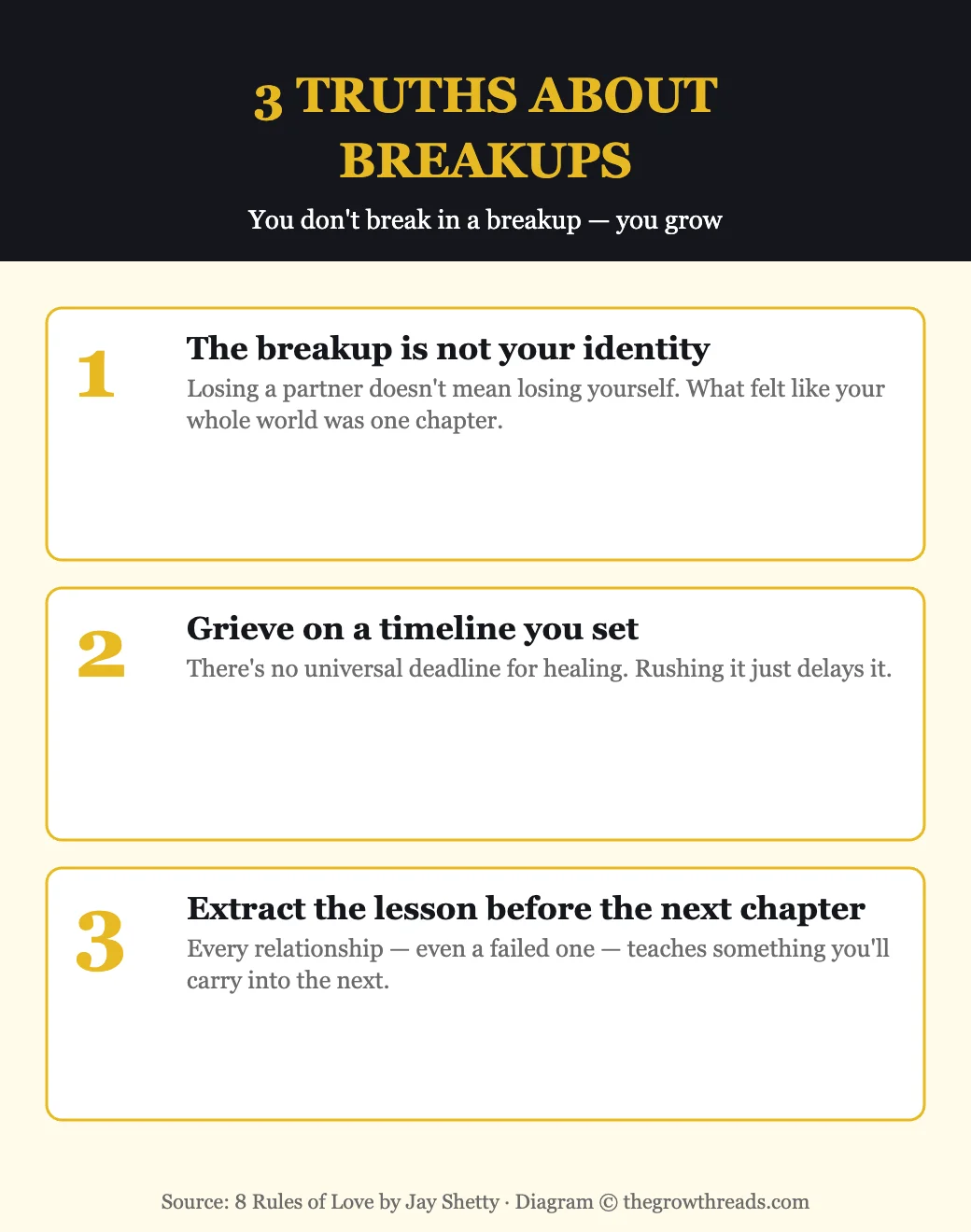
The final two rules deal with what happens when a relationship ends. “You don’t break in a breakup” is Shetty’s reminder that identity and relationship status are separate things, even though heartbreak makes them feel fused. He walks through why breakup grief hits so hard — the loss isn’t just the partner, but the imagined future, the shared routines, and often a version of your own identity that existed inside the relationship. His advice isn’t to minimize that grief, but to actively separate “who I am” from “what just ended,” so the healing process doesn’t quietly erode self-worth along with it.
The eighth and final rule, “love again and again,” pushes back against the instinct to close off after being hurt. Shetty argues that every relationship — including ones that failed — teaches something usable, and the goal isn’t to avoid future pain by avoiding future love, but to carry the lesson forward without carrying the wound. He’s explicit that this doesn’t mean rushing back into dating; healing has no fixed timeline, and readers who compare their pace to someone else’s just add shame on top of grief.
One exercise he suggests for this stage is writing an unsent letter to a past partner — not to reconcile or to vent anger, but to name specifically what the relationship taught you, good and bad. He also warns against two common overcorrections after a breakup: swearing off relationships entirely as self-protection, and jumping into a new relationship too fast to avoid sitting with the loss. Both, he argues, skip the actual healing work the earlier rules in this section are meant to support.
TGR Note: If a recent breakup is what brought you to this book, Rising Strong goes deeper on rebuilding after any kind of loss, and Self-Compassion is a strong next read for the shame that often piggybacks on heartbreak.
Who is 8 Rules of Love best for — and who should read something else first?
8 Rules of Love is best for people who are single and want a framework before dating again, couples who want language for handling conflict as a team, and anyone recovering from a breakup who wants structure for the healing process. It’s less suited to readers looking for research-heavy attachment theory — for that, Attached is the better starting point. Readers dealing specifically with a difficult or toxic family dynamic rather than a romantic one may get more direct value from Toxic Parents or Set Boundaries, Find Peace.
Questions to reflect on
- What pattern shows up in more than one of your past relationships — and whose behavior is actually driving it?
- If you had to define love in one sentence, without using the word “feeling,” what would you say?
- Think of the thing your current or most recent partner criticized most. What might it be trying to teach you?
- Are you and your partner building toward anything shared, or mostly just enjoying each other’s company?
- If a relationship ended tomorrow, what part of your identity would you need to actively remember doesn’t disappear with it?
🔥 Ready to build love on purpose instead of guesswork?
Get 8 Rules of Love and work through Shetty’s framework at your own pace.
How to apply 8 Rules of Love (7-day plan)
- Day 1: Spend one evening completely alone, phone in another room, and notice what comes up.
- Day 2: Write down the recurring pattern across your last two or three relationships.
- Day 3: Write your own one-paragraph definition of what love means to you.
- Day 4: Identify one piece of friction with a partner (or past partner) and reframe it as a lesson rather than a flaw.
- Day 5: Name one shared purpose you have — or want to build — with your current or future partner.
- Day 6: In your next disagreement, consciously reframe it as “us vs. the problem” before responding.
- Day 7: Write a short letter to a past relationship — thanking it for the lesson, without reopening the wound.
Frequently asked questions
What are the 8 rules in 8 Rules of Love?
The eight rules are: let yourself be alone, don’t ignore your karma (relationship patterns), define love before you think it, feel it, or say it, your partner is your guru, purpose comes first, win or lose together, you don’t break in a breakup, and love again and again. Together they walk through the full relationship cycle, from being single to choosing a partner, sustaining the relationship, and recovering if it ends.
Is 8 Rules of Love based on real research?
Yes, though it blends two sources. Jay Shetty draws on Vedic philosophy and monastic teachings from his three years training as a monk, alongside modern relationship science and interviews with researchers and therapists. Some readers note the balance leans more toward accessible storytelling than academic citation, so readers wanting a research-heavy treatment may prefer a title like Attached alongside this one.
Do I need to be in a relationship to benefit from this book?
No. The book is structured around the full relationship cycle, and the first section on solitude is explicitly written for single readers. Many readers report the solitude and pattern-recognition sections are most useful before dating again, not during an existing relationship.
How is 8 Rules of Love different from Think Like a Monk?
Think Like a Monk applies monastic wisdom broadly to purpose, mindset, and daily habits. 8 Rules of Love takes the same foundation of ancient wisdom plus modern science and applies it specifically to romantic relationships, covering dating, commitment, conflict, and breakups in more depth than Shetty’s first book.
Can this book help after a breakup?
Yes — the final two rules focus specifically on healing after a relationship ends, including separating your identity from the relationship and extracting the lesson before moving forward. It’s a practical companion for the weeks and months after a breakup, though readers navigating more complex grief may want to pair it with a book like Rising Strong.
What is the “your partner is your guru” concept about?
It’s the idea that a partner’s criticisms or the friction they create often point to something genuinely worth working on in yourself, rather than being purely a flaw in the relationship. Shetty is careful to note this applies to growth-oriented friction, not to mistreatment or incompatibility, which should be addressed directly rather than reframed.
Is 8 Rules of Love worth reading if I’ve already read other relationship books?
If you’ve read attachment-theory books like Attached or communication-focused books like Nonviolent Communication, 8 Rules of Love won’t replace them, but it offers a useful organizing structure — the full relationship cycle in one place — that most single-topic relationship books don’t attempt.
Related summaries
- Attached — the attachment-theory deep dive behind Shetty’s compatibility chapter.
- The 5 Love Languages — a practical companion for expressing the “purpose comes first” idea daily.
- Never Split the Difference — negotiation scripts for the “win or lose together” chapter.
- Rising Strong — a deeper resource for the healing and breakup-recovery section.
- See all the best relationship books we’ve reviewed →
How we analyze books: We read the full book, cross-reference the author’s claims against their published interviews and other research where relevant, and test the frameworks against real scenarios before writing. We never fabricate quotes or statistics. Read our full methodology.