

★★★★½ 4.5/5 — Pick the battles you can win. Then write the plan the team can run.
Best for: Sellers, founders, and managers who already have pipeline and still lose multi-buyer deals in committee.
Reading time: ~4 hrs (guide: 12 min)
Difficulty to apply: Easy to score one deal on six keys today; hard to qualify out a pretty maybe.
Hope Is Not a Strategy in one minute
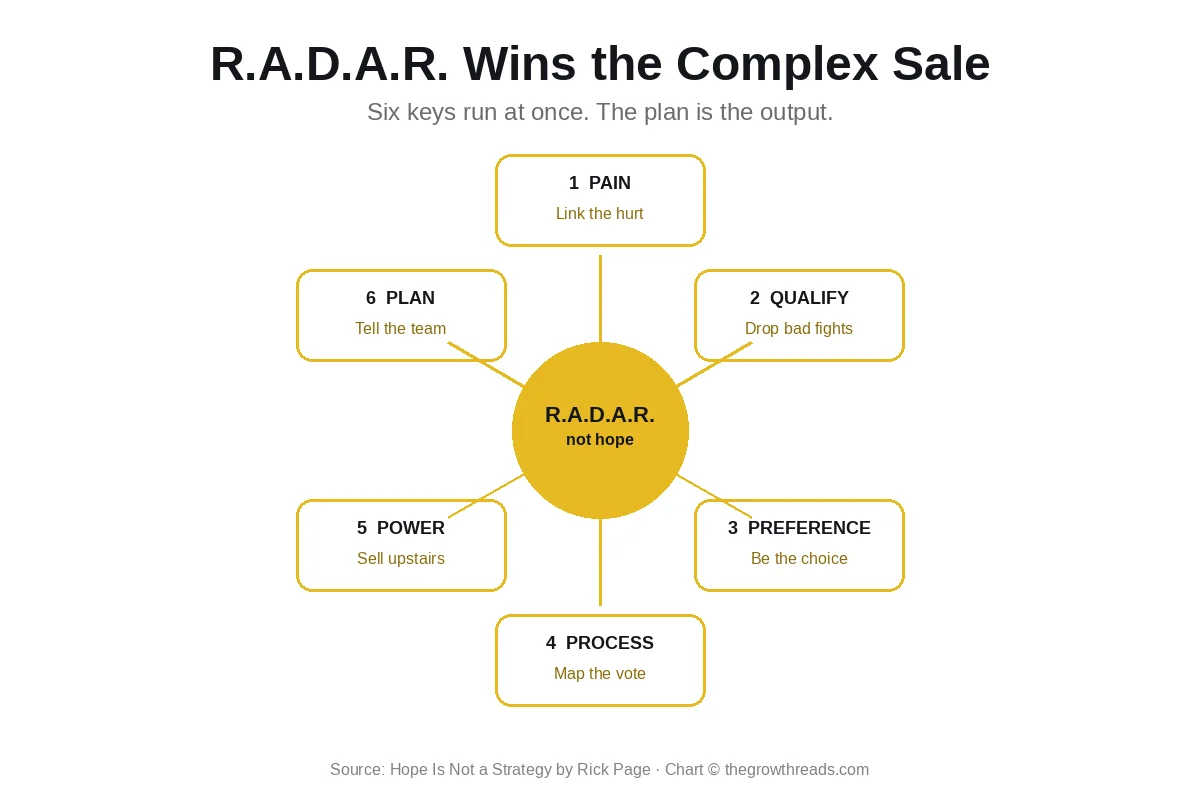
Pick the battles you can win, then win the battles you pick. Rick Page’s argument is a campaign, not a close. A complex sale has more than one buyer, a competitor in the evaluation, and a cycle too long to wing. Hope is what you do when the demo went well and you wait for the committee to be fair. Strategy is R.A.D.A.R. — Reading Accounts and Deploying Appropriate Resources. Six keys run at once: link the offer to pain or gain, qualify, build preference, map the decision process, sell to power, and communicate a written plan. The first five are inputs. The sixth is the output the team can actually run.
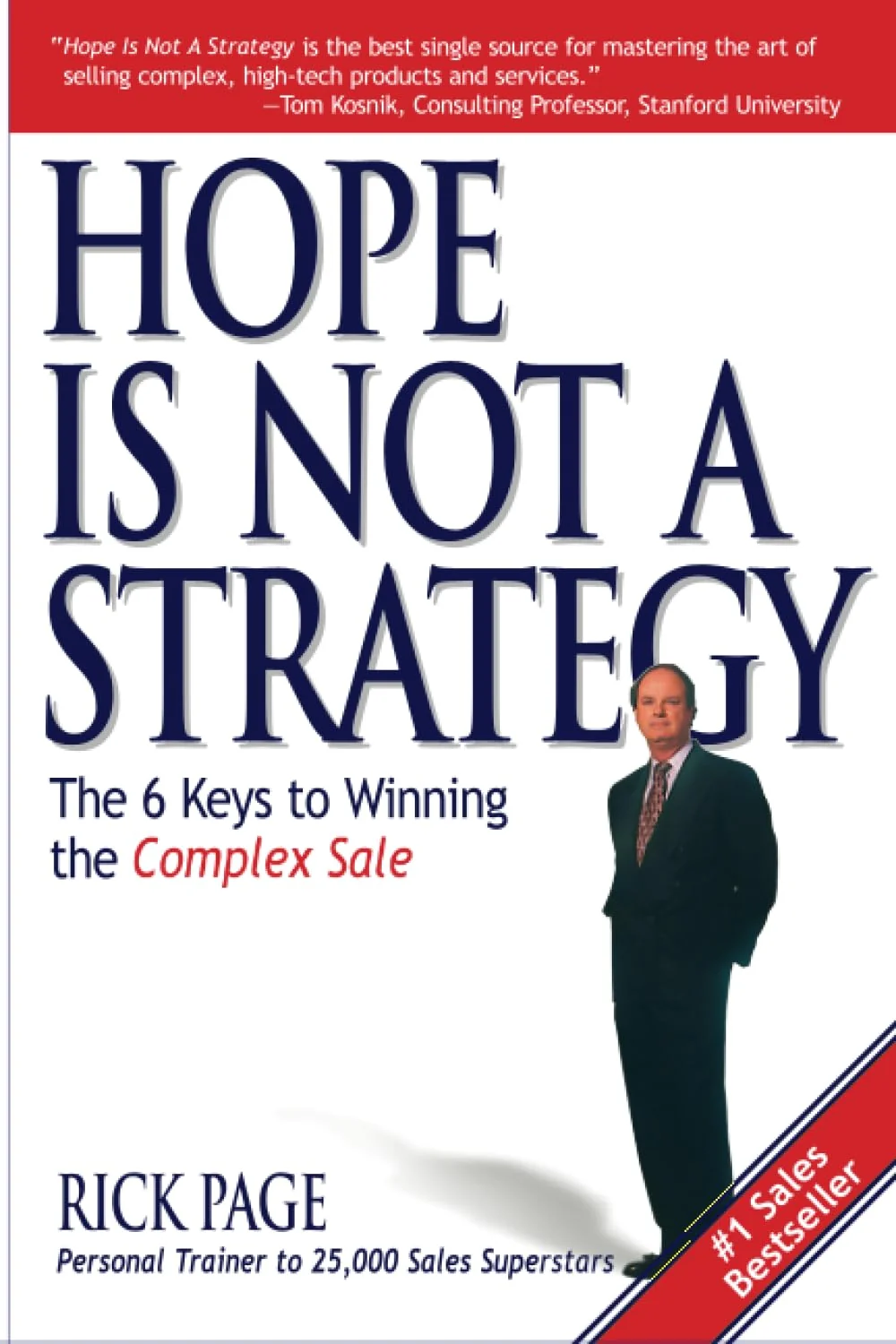
Hope Is Not a Strategy (McGraw-Hill, 2003, 192 pages) is the field guide Page used to train that habit. It is not a memoir and not a script book. If you already have conversations and still lose after a good meeting, start here.
Key takeaways
- Hope is not a strategy: A good demo plus a quiet week is still a loss you did not plan.
- Concentrate force: Pick fights you can win. Drop the rest before they tax the calendar.
- Link to pain or gain: Features without a business hurt are a tour, not a case.
- Qualify out: No pain or no power is a gift. Walk while the week still has room.
- Preference beats liking: Being the nice vendor is not being the safe yes.
- Map the vote: Who decides, how, and when — before you add another slide.
- Sell to power: Politics beats a pretty deck. Coaches are not buyers.
- Write the plan: The sixth key is the strategy the team can run without you in the room.
- Keys run together: R.A.D.A.R. is a panel, not a ladder you climb once.
- A maybe is information: A committee you never mapped taught you nothing.
What is Hope Is Not a Strategy about?
Hope Is Not a Strategy is a sales-productivity manual for the complex sale. Page trains you to stop hoping a committee will be fair and to run six keys at once: pain, qualify, preference, process, power, and a written plan. It is for anyone who already has pipeline and still loses after the demo.
About the author
Rick Page founded The Complex Sale, an Atlanta training firm built for deals that have more than one buyer. Hope Is Not a Strategy (McGraw-Hill paperback, 2003, 192 pages; the method first circulated in 2001) is the book that carried his R.A.D.A.R. process — Reading Accounts and Deploying Appropriate Resources — into 150 companies across 50 countries. He treats a complex sale as a campaign you plan, not a close you hope for. Geoffrey Moore, author of Crossing the Chasm, blurbed the thinking a good closer still needs. There is no usable Wikipedia page for this Page. Empty calendar: Fanatical Prospecting. Diagnosis in the chair: SPIN Selling. The politics after the demo: start here. Explore all Rick Page book summaries →
Key concepts at a glance
| Concept | What it means | Use it when |
|---|---|---|
| R.A.D.A.R. | Reading accounts and deploying the right resources. | The deal has many buyers. |
| Concentrate force | Pick battles you can win, then win them. | The pipeline is a pile of maybes. |
| Pain or gain | Link the offer to a hurt they already feel. | You tour features. |
| Qualify out | Walk when pain or power is missing. | A pretty deal eats the week. |
| Competitive preference | Become the safe yes, not the liked also-ran. | They like you and still stall. |
| Decision process | Who votes, how, and when. | You cannot name the vote. |
| Sell to power | Politics beats the deck. Coaches are not buyers. | You only know the user. |
| Written plan | The sixth key is the strategy the team can run. | Everyone improvises the next call. |
Part 1 — The complex sale is a campaign
Page’s first useful picture is not a funnel. It is a canyon. On one side: a champion who likes you. On the other: a competitive evaluation with legal, finance, a user who fears change, and a vice president you have never met. Hope is waiting for the champion to carry the deal across. Strategy is mapping the crossing before you spend another demo. That is why a 192-page sales book belongs in a productivity silo. The week is a set of scarce hours. If every hour goes to a deal you cannot win, Thursday is quiet and the forecast still looks full.
He names the talent mix in the team: tellers, sellers, hunters, farmers, business developers, partners, industry-networked consultants. A teller who recites the deck is not a hunter who picks a beachhead. Mixing them without a plan is how a good product still loses. Concentration of force is the first principle: pick the battles you can win, then win the battles you pick. A pipeline of twenty “interested” accounts is not force. It is a tax.
That is why this sits next to other TGR campaign books instead of replacing them. Crossing the Chasm is the beachhead when the category is new — and Moore blurbed Page for a reason. Fanatical Prospecting fills the chair. Page is what you do once the chair is a committee. A full calendar of unqualified evaluations is still hope with better stationery.
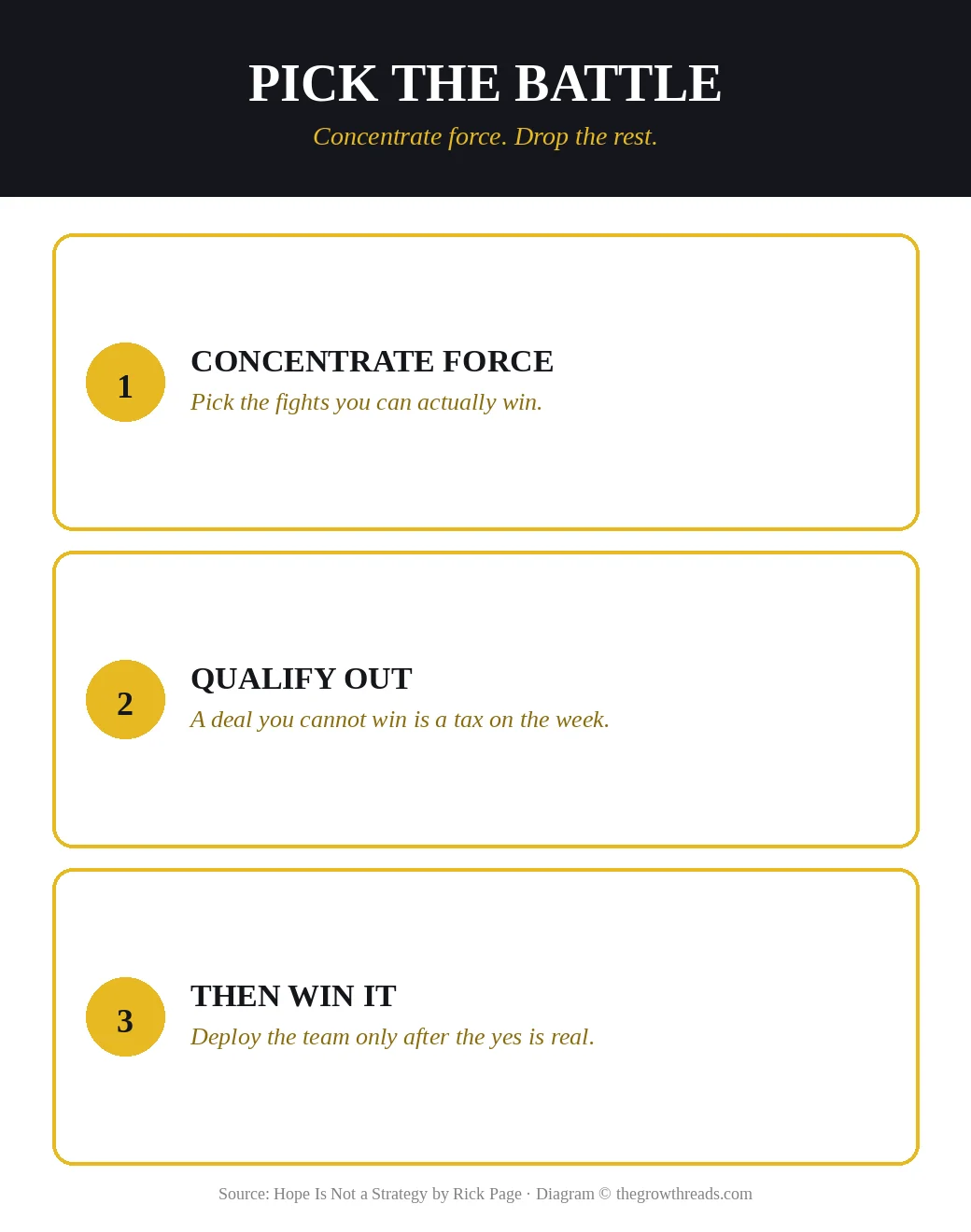
TGR Note: New category, one niche first: Crossing the Chasm — Moore wrote the blurb because a complex sale still needs a beachhead. Empty calendar: Fanatical Prospecting. Page sits after both: you will not win a committee you never chose to fight.
Part 2 — Pain, qualify, preference
The first three keys are how you stop touring. Link the solution to pain or gain — a business hurt they already feel, not a feature they might admire. A demo that does not name the cost of staying the same is a show. Qualify next. Time is the scarce resource. If there is no pain, no power, or no path to a decision, walking is the productive move. People who “stay in it because we are already in it” train themselves to work for free.
Then preference. Liked is not chosen. Page’s point is blunt: the evaluation will invent a reason to pick the safe vendor. Your job is to become that safe yes — proof, risk removal, a champion who can repeat the case without you. Being charming in the room and silent in the scoring rubric is how nice sellers finish second. Write the preference: why you, why now, why not the incumbent.
None of this replaces a diagnosis in the chair. A clean qualify into the wrong problem is still a wasted week. SPIN Selling is the question sequence once they will talk. The Mom Test is how you stop hearing compliments as demand. Page is why you did not spend Q3 on a deal that never had pain. Come back to him when the hurt is real and the committee is still a fog.
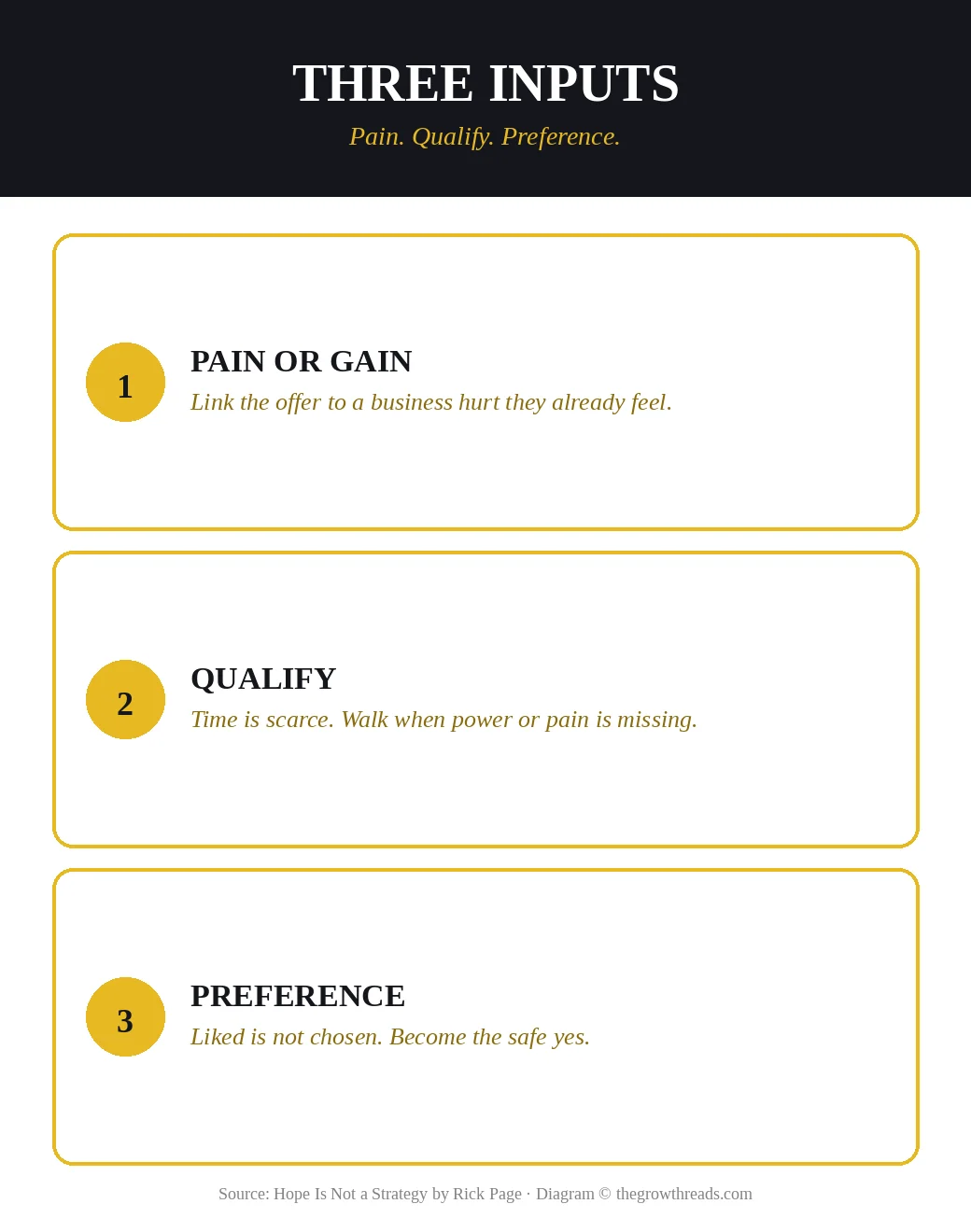
TGR Note: In the chair, SPIN Selling is the diagnosis. Compliments are not demand: The Mom Test. The first three keys are the gate: they decide whether the week is a campaign or a tour.
Part 3 — Process, power, and a written plan
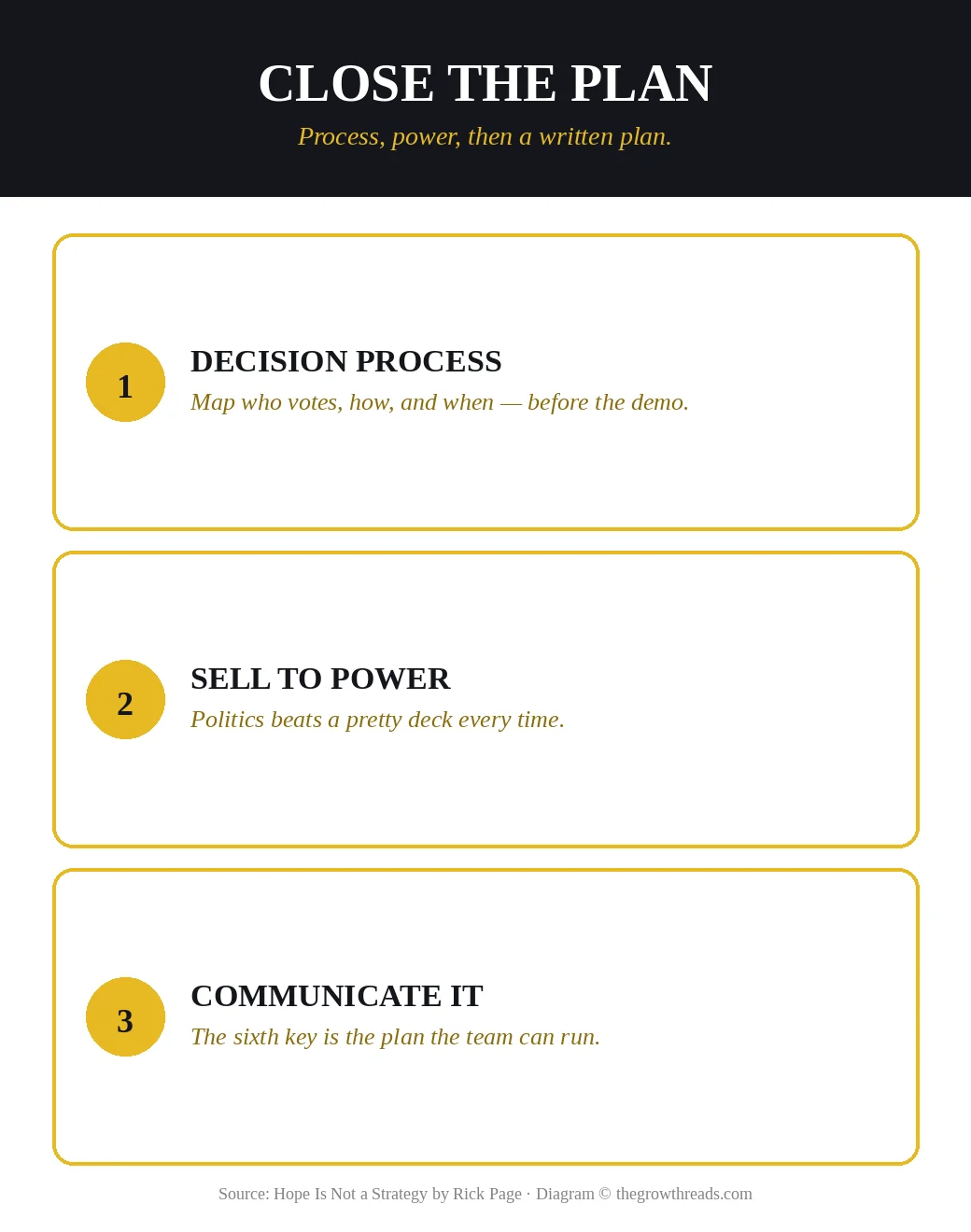
Keys four through six are how good talkers stop losing after the demo. Determine the decision-making process: who votes, in what order, with what criteria, by when. If you cannot draw that, you are hoping. Sell to power. A coach who loves you and a buyer who has not heard you is a story. Politics is not a dirty word here — it is the map. C-level calls are not a personality trick. They are how the vote actually moves.
The sixth key is the output: communicate the strategic plan. Page is clear that the first five keys are inputs and the last is the plan the team can run. Write it. Who owns the next call. Which red flag is still open. Which executive still has no pain story. A plan in one person’s head is still hope. A plan on a page is how a hunter, a farmer, and a specialist stop improvising three different deals.
Insight still has to live inside that plan. The Challenger Sale is the teaching that makes preference real — you reframe the problem, then take control. Pitch Anything is the frame so you are not interviewed by a mid-level committee. Use Dixon to teach. Use Klaff to take the room. Use Page so the week after the room is a campaign, not a vibe.
TGR Note: Teaching insight: The Challenger Sale. Frame in one room: Pitch Anything. The close is not a speech. It is the plan you wrote before they stalled in committee.
Part 4 — Run one deal on the six keys this week
Two practical rules sit on top of the sixteen opportunity strategies and the C-level chapter. First: do not collect the whole arsenal and use none. Pick one live deal. Score it on six lines — pain, qualify, preference, process, power, plan. If any line is blank, that is the work, not another demo. If you need a new theory every time, you are still hoping.
Second: qualify out in writing. A no on a clean score is information. A maybe you protected by adding two more meetings is a story. Go for No is the attempt cousin: collect nos so a hot morning cannot send you home. Page is more precise: the attempt is a scored campaign, not volume for its own sake. If you freeze on the sentence once you finally reach power, Exactly What to Say is the phrase. Come back to Page with one deal and a tally, not a longer highlight reel.
The week design is where R.A.D.A.R. becomes productivity. One deal. Six keys. A written plan the team can see. If you only present, you will see it. If you never name the vote, you will see it. If every stall earns another workshop, you will see it. An evaluation without a plan is a good story and a quiet Thursday.
Who is Hope Is Not a Strategy best for — and who should read something else first?
Best for sellers, founders, and managers who already have pipeline and still lose multi-buyer deals after a good demo. It is also for people who hate “process” but keep working unpaid evaluations. If you cannot name who votes, or you stay in deals because you are already in them, this is the book.
Read something else first if your calendar has no conversations — start with Fanatical Prospecting. If you get in the room and cannot diagnose, SPIN Selling. If they need a teaching insight, The Challenger Sale. If the room is a status fight, Pitch Anything. If the category is new, Crossing the Chasm. If you go blank on the ask, Exactly What to Say. Come back when access is not the issue — the campaign after the open is.
Questions to reflect on
- On your live deal, can you name the pain in one sentence the buyer would repeat?
- Which of the six keys is blank — pain, qualify, preference, process, power, or plan?
- Who actually votes, and when did you last speak to power rather than a coach?
- What would qualifying out this week give back to the calendar?
- If the team had to run the next two calls without you, is the plan on a page?
🔥 Ready to pick the battle you can win?
Score one live deal on six keys so a pretty maybe cannot eat the week.
How to apply Hope Is Not a Strategy (7-day plan)
- Day 1 — Pick one live deal. Write the six keys as blank lines. Do not add a second account.
- Day 2 — Name the pain. One sentence the buyer would repeat. If you cannot, you are touring.
- Day 3 — Qualify in writing. Pain, power, process: keep or walk. A walk is a win for the week.
- Day 4 — Map the vote. Who decides, who coaches, who can kill it. Put names, not roles.
- Day 5 — Reach power once. A short meeting or a champion-led intro. Note what you still do not know.
- Day 6 — Write the plan. Next two calls, owners, the open red flag. Share it with the team.
- Day 7 — Review the score. Which key moved? Set next week’s rule: one deal, six keys, no extra demo to hide a blank line.
Frequently asked questions
What is Hope Is Not a Strategy about?
Hope Is Not a Strategy is Rick Page’s field manual for the complex sale — many buyers, a competitor in the room, a cycle too long to wing. He names the method R.A.D.A.R.: reading accounts and deploying appropriate resources. Six keys run at once: pain or gain, qualify, preference, decision process, sell to power, and a written plan. It is not a closer’s pep talk. Read it when you already have pipeline and still lose in committee. Pair it with Crossing the Chasm if the category is new, and with SPIN Selling once you have a chair.
Who wrote Hope Is Not a Strategy?
Rick Page founded The Complex Sale, an Atlanta firm that trains teams on multi-buyer deals. Hope Is Not a Strategy (McGraw-Hill paperback, 2003; 192 pages) is the book that spread his R.A.D.A.R. method through 150 companies in 50 countries. Geoffrey Moore, who wrote Crossing the Chasm, blurbed it as the thinking a closer cannot fake. There is no usable Wikipedia page for this Page — leave the photo empty and start with the six keys. Empty calendar: Fanatical Prospecting. Diagnosis in the chair: SPIN Selling. Politics in the room: this book.
What is R.A.D.A.R. in Hope Is Not a Strategy?
R.A.D.A.R. stands for Reading Accounts and Deploying Appropriate Resources. Page’s first principle is concentration of force: pick the battles you can win, then win the battles you pick. The six keys are the instrument panel — pain, qualify, preference, process, power, and plan. The first five are inputs. The sixth is the written strategy the team can actually run. They happen together, not as a ladder you climb once. A pretty deck with no power map is still hope. A qualified-out deal is a gift to next week’s calendar.
What are the 6 keys to winning the complex sale?
Page’s six keys are: (1) Link solutions to pain or gain. (2) Qualify the prospect — walk when pain or power is missing. (3) Build competitive preference so you are the safe yes, not the nice also-ran. (4) Determine the decision-making process: who votes, how, and when. (5) Sell to power — politics beats a pretty slide. (6) Communicate the strategic plan so the team stops improvising. The keys are simultaneous. Scoring one demo while ignoring power is how good talkers finish empty. Write the plan. Then run it.
How long does it take to read Hope Is Not a Strategy?
About four hours for the 192-page McGraw-Hill paperback, or one focused evening. The TGR guide is twelve minutes. The useful unit is not a highlight reel of sixteen opportunity strategies. It is one live deal scored on the six keys this week: pain, qualify, preference, process, power, plan. If you only collect quotes, you will finish informed and still hope the committee votes your way. Read it when you have a multi-buyer deal on the board. If you do not, start with Fanatical Prospecting, then come back with a chair.
Is Hope Is Not a Strategy worth reading if I already know SPIN Selling?
Yes, because they do different jobs. SPIN Selling is the question sequence once someone will talk — situation, problem, implication, need-payoff. Hope Is Not a Strategy is the campaign around that chair: qualify out, map the vote, reach power, and write a plan the team can run. The Challenger Sale is the teaching insight. Pitch Anything is the frame in one room. Fanatical Prospecting fills the calendar. If your problem is a quiet discovery call, stay with Rackham. If your problem is losing in committee after a good demo, this is the book.
What should I read after Hope Is Not a Strategy?
If the calendar is empty, Fanatical Prospecting. If you get in the room and cannot find the hurt, SPIN Selling. If they need a teaching insight, The Challenger Sale. If the room is a status fight, Pitch Anything. If the category is new and the beachhead is the work, Crossing the Chasm — Moore blurbed Page for a reason. If you freeze on the sentence, Exactly What to Say. Page is the campaign. The other books fill a chair, diagnose, or keep you from hiding. Pick the gap you actually have this week, not a longer stack.
Related summaries
- Crossing the Chasm Summary & Review — win one niche first
- SPIN Selling Summary & Review — let the buyer name the need
- The Challenger Sale Summary & Review — teach, then take control
- Fanatical Prospecting Summary & Review — fill the empty chair first
- Best productivity books — the full Productivity silo
How we analyze books: we paraphrase arguments, add original application notes, and skip chapter-by-chapter reproduction. Read our full methodology.