

★★★★½ 4.6/5 — The mainstream does not buy from the early market. Win one niche first.
Best for: Founders, product marketers, and GTM leads whose early fans love it and the next fifty buyers stall.
Reading time: ~7 hrs (HarperBusiness 3rd ed., 2014, ~288 pp) · this guide ~13 min
Difficulty to apply: Easy to name the chasm. Hard to kill every other segment this quarter.
Crossing the Chasm in one minute
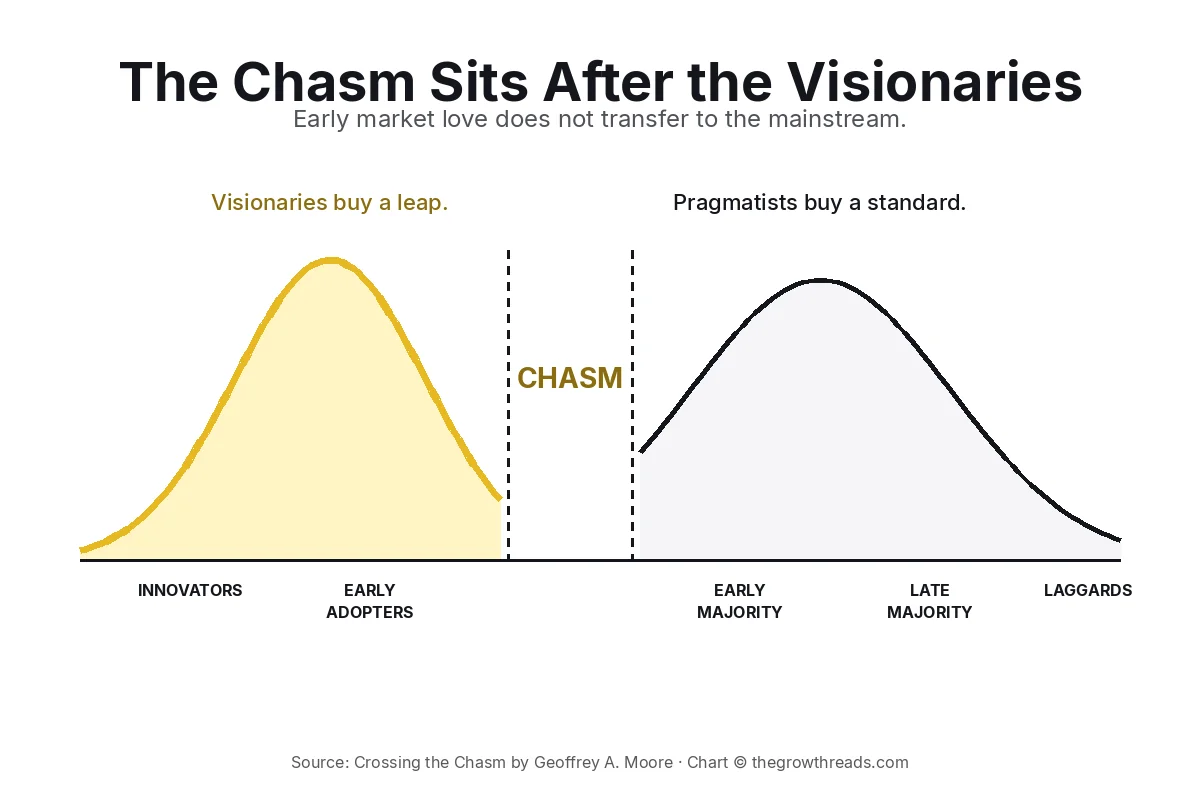
Your first customers are a trap if you treat them as the market. Geoffrey Moore’s Crossing the Chasm names the crack in the technology adoption curve: visionaries will buy an incomplete leap; pragmatists will not. The second group wants a finished offer, a category leader, and a reference from someone who looks like them. A keynote rave does not travel. The way across is not a louder launch. It is a beachhead — one use-case, one buyer, one place — plus the whole product that makes that buyer successful. Dominate that niche, collect proof, then bowl into the next pin. Everything else is a vanity pipeline.
Key takeaways
- The curve is not smooth. Innovators and early adopters sit on one side of a crack. The early majority sits on the other. You do not slide across.
- Visionaries and pragmatists do not share a lunch. One buys revolution and forgives the gaps. The other buys evolution and waits for a standard.
- References do not transfer. A design partner who loves you can scare the next buyer. They want a peer, not a prophet.
- Pick a beachhead you can actually win. One use-case, one economic buyer, one place. If you cannot become the default there, it is not a beachhead.
- Finish the whole product. Core software is not enough. Support, install, partners, and integrations are part of the offer the majority will pay for.
- Concentrate force. Moore’s D-Day rule: all eggs in one basket. Spread launches feel busy and still miss the crossing.
- Create a category they can compare. Pragmatists want an alternative in a named market. “We are unlike anything” is a visionary pitch.
- Proof is a list of names. Ten pragmatists in the beachhead who will take the call beat a thousand conference badges.
- Then bowl, don’t spray. Adjacent segments come after this one falls. The tornado is later. The beachhead is now.
What is Crossing the Chasm about?
Crossing the Chasm is a go-to-market book about the gap between early adopters and the pragmatic majority. Moore shows why high-tech products stall after the first fans, then how to cross by winning one beachhead and finishing the whole product those buyers need.
About the author
Geoffrey A. Moore is an American organizational theorist and consultant who spent the 1980s inside Silicon Valley’s marketing shops, including Regis McKenna and later Mohr Davidow Ventures. He wrote Crossing the Chasm in 1991 after watching company after company collect visionary logos and then miss the mainstream. The book became the default language for high-tech go-to-market: chasm, beachhead, whole product, bowling alley. He followed it with Inside the Tornado, Living on the Fault Line, Escape Velocity, and Zone to Win, and he still chairs the Crossing the Chasm Group. His lane is not how to invent the product. It is how to take a product that already works for a few and make it safe for the many. Explore all Geoffrey A. Moore book summaries →
Key concepts at a glance
| Concept | What it means | Use it when |
|---|---|---|
| Technology adoption life cycle | Five buyer types from innovators to laggards. | You treat “the market” as one person. |
| The chasm | The crack between visionaries and pragmatists. | Early fans love it and the next fifty stall. |
| Early market | Innovators plus visionaries who buy a leap. | Your references are all design partners. |
| Mainstream | Early majority and later, who buy a standard. | The deal dies in security or procurement. |
| Beachhead | One niche you can actually dominate. | The plan is “SMB plus mid-market plus enterprise.” |
| Whole product | Everything required to get the promised outcome. | They still need a hero to make it run. |
| Bowling alley | Adjacent niches that fall after the first pin. | You want the second segment before the first is won. |
| Compelling reason to buy | A broken process the beachhead cannot leave broken. | The pitch is “nice to have” and “strategic.” |
Part 1 — The high-tech marketing illusion
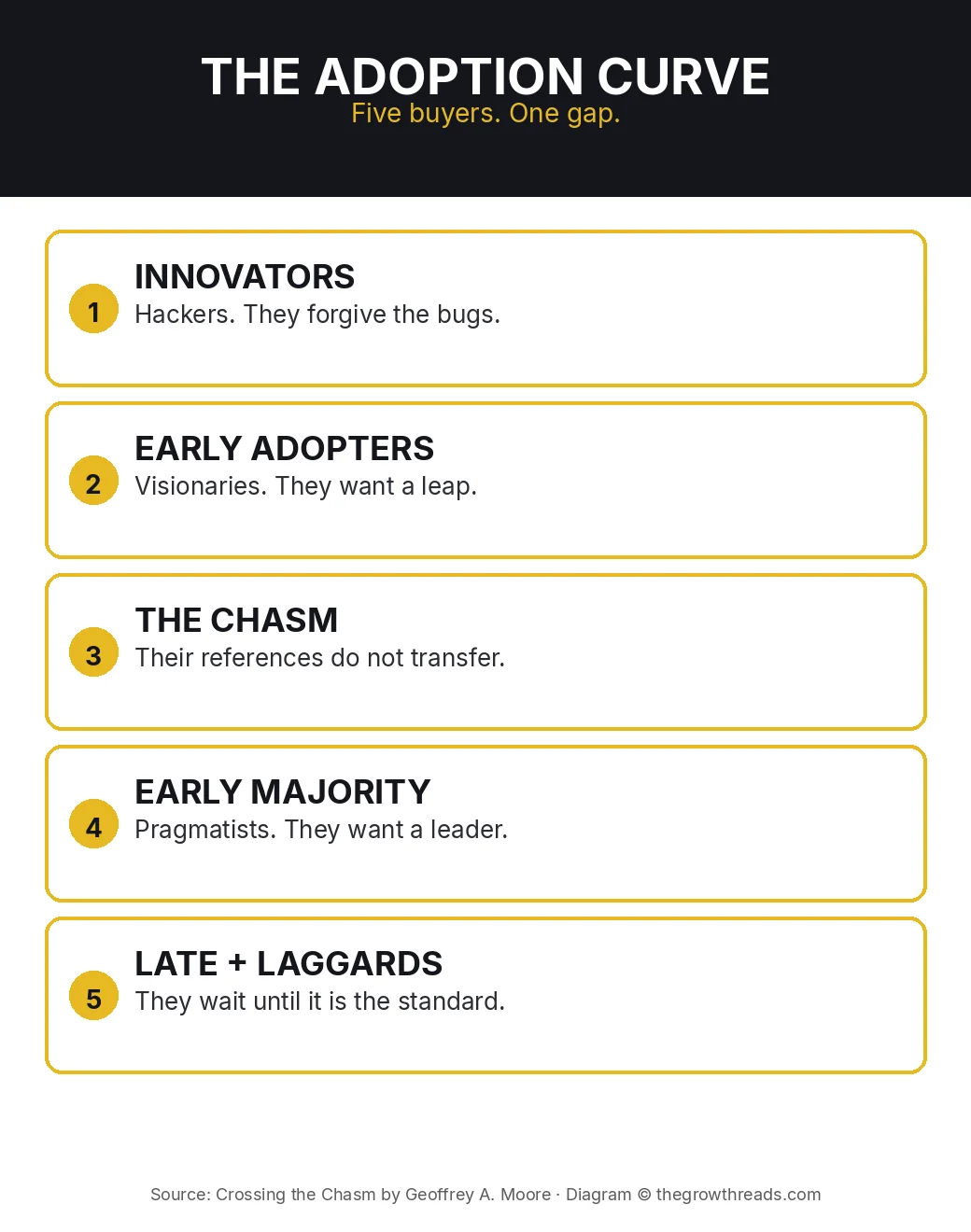
Moore starts with a curve every marketer already knows. Everett Rogers split adopters into innovators (about 2.5 percent), early adopters (13.5), early majority (34), late majority (34), and laggards (16). High-tech companies treat that bell as a slide: win the left, then the middle arrives because the left already said yes. Moore’s field notes from workstation vendors, database firms, and applications companies said otherwise. There is a crack between early adopters and the early majority. The left side will buy a revolution. The right side will buy an evolution. They do not use each other as references.
Visionaries want a strategic leap and will tolerate missing pieces if the story is large enough. They like being first. They will sit on an advisory board. Pragmatists want to know who else in their industry already runs this, who installs it, what happens at 2 a.m., and whether you are the safe leader in a named category. A keynote quote from a famous visionary can make them more cautious, not less. That is the illusion: a busy early market looks like momentum. It is often a different sport than the one you still have to play.
TGR Note: If you do not yet have anyone who loves the product, this is not your chapter. Start with The Mom Test or Continuous Discovery Habits and learn whether a real user will pay. Moore assumes an early market already exists. Inspired is how product teams find that first love. This book is what you do when that love does not convert the next logo.
Part 2 — Pick a beachhead like it is D-Day
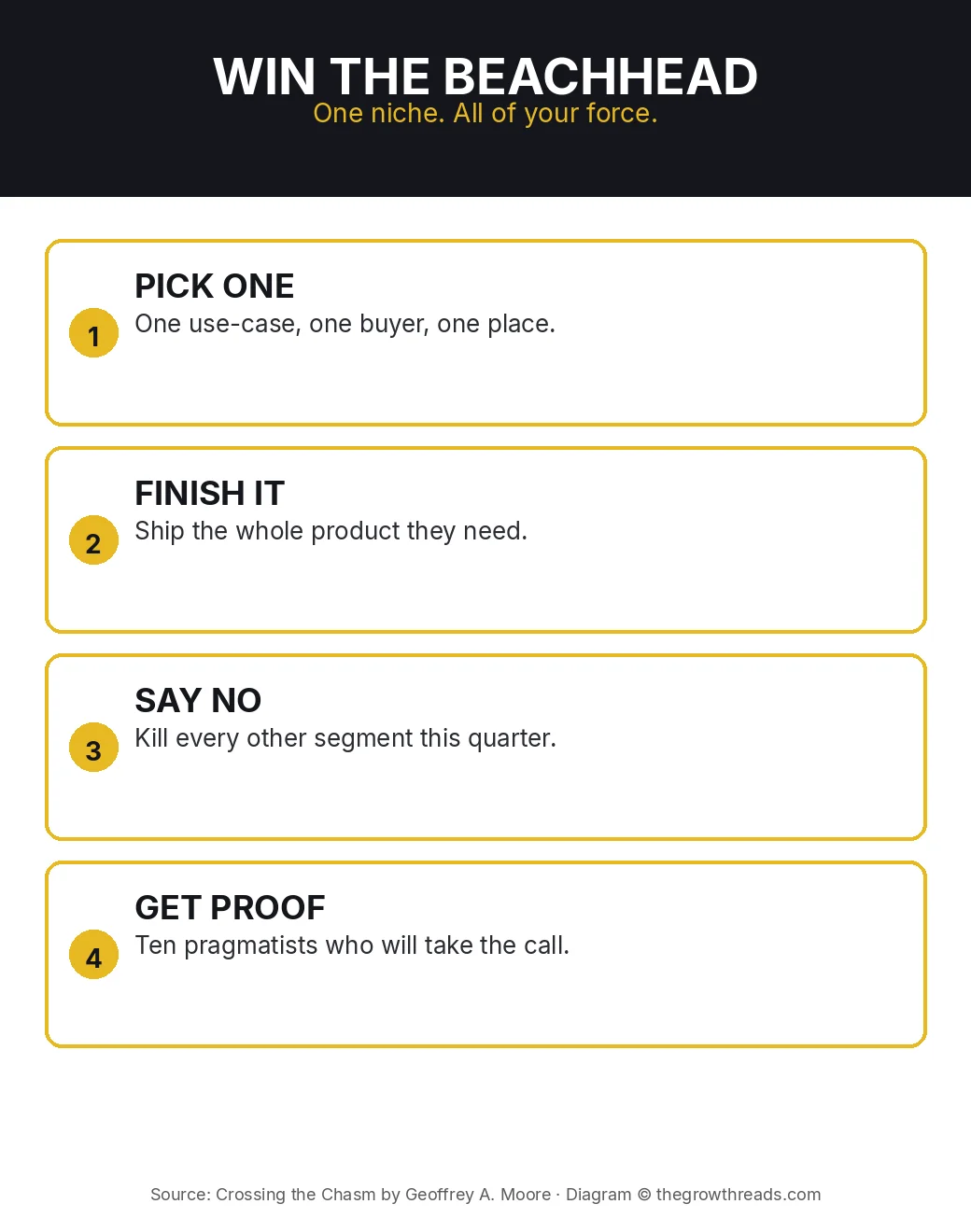
Once you admit the crack, the next mistake is to attack the whole early majority at once. Moore’s metaphor is the 1944 landing: you do not storm every beach. You pick one stretch of sand, put all of the force there, and hold it. In a company that means one target customer, one use-case, and one geography or channel you can actually cover. The document that matters is not a total-addressable-market slide. It is a day-in-the-life of a named buyer whose broken process you can finish. If you cannot write that scene, you do not have a beachhead. You have a hope.
The hard line in the book is concentration. Moore writes that the only safe way to cross is to put all your eggs in one basket. That offends a sales culture trained to take every inbound. A hospital IT deal, a consumer pilot, and a federal RFP can all look like “pipeline.” They are three different whole products. Each one steals the engineers you needed to make the first niche boringly complete. The test he wants is dominance: can you become the default in this niche in a few quarters, with references that a peer will accept? If the segment is too wide to win, shrink it. Adjacent pins wait.
TGR Note: Saying no to extra segments is the same muscle as Getting Real and Shape Up — build less, finish what you started. Those books police the backlog. Moore polices the market. If your week is a tour of every vertical that emailed you, you are not crossing. You are grazing.
Part 3 — The whole product and the invasion force
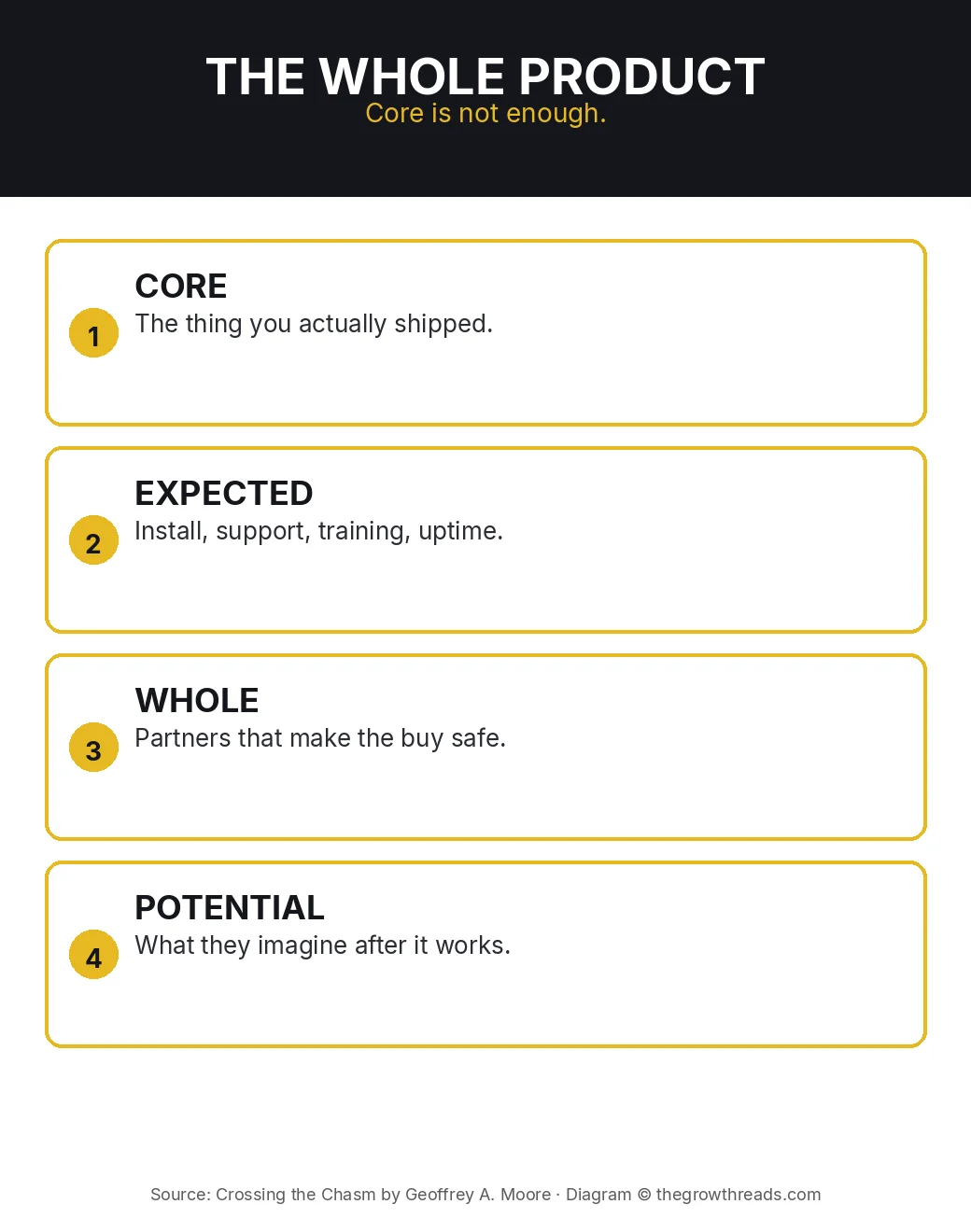
Pragmatists do not buy a toolkit. They buy an outcome that already works on Tuesday. Moore borrows the whole-product idea and applies it to high-tech: the generic product is what you shipped; the expected product adds install, support, training, and uptime; the whole product adds the partners, integrations, and standards that make the purchase safe; the potential product is what they imagine after it works. Early adopters will stitch the missing pieces themselves. The early majority will not. If your beachhead still needs a hero integrator on their payroll, you are selling a core product into a chasm.
That is why the “invasion force” is not just your sales team. It is the company plus the allies who complete the offer — the implementer, the hardware partner, the security questionnaire you can actually pass. Distribution changes too. The conference circuit and specialist VAR that fed visionaries are not the channel that a cautious majority trusts. Pricing changes with them. A pragmatist will pay for a complete solution. They will not pay a visionary premium for a box of parts. Moore also wants you to create competition: name a category with an alternative. “We are unlike anything on earth” is a pitch for the left side of the curve.
TGR Note: A beachhead that nobody notices still dies. If the offer itself is invisible, read Purple Cow. If you have a finished product and cannot name the smallest market that already wants it, that is This Is Marketing. Moore is the GTM sequencing layer on top: once they want it, which pragmatist do you win first, and what else has to be true for them to say yes.
Part 4 — Position, launch, and leave the chasm
Positioning, in this book, is a claim a pragmatist can repeat. For this beachhead, who has this broken process, our product is a named category that delivers this outcome. Unlike the alternative they already understand, we complete the whole product. That sentence is not copy decoration. It is the filter for the website, the demo, the partner one-pager, and the first three case studies. If you cannot say it without a paragraph of origin story, you are still talking to visionaries.
Launch is an invasion, not a sprinkle of awareness. You show up where that niche already meets, with proof and a partner, and you keep showing up until you are the default. After the beachhead falls, Moore points at the bowling alley: the next pin is an adjacent use-case that can reuse the whole product and the reference base. The tornado — the later rush when a category standardizes — is a different book (Inside the Tornado). Do not manage this quarter as if you are already in it. The 2014 edition updates the examples for digital products and consumerized IT. The sequence did not change. Measure names in the beachhead who will take a call. Do not measure how many people have heard of you.
TGR Note: Once the beachhead is real, the constraint often moves from GTM to the product org. Working Backwards and Empowered are how a team keeps shipping a complete offer instead of a pile of road-map souvenirs. Moore gets you across. Those books keep you from falling back in.
Who is Crossing the Chasm best for — and who should read something else first?
Best for founders, product marketers, sales leads, and PMs who already have early fans and a forecast that will not move. If last quarter’s design partners would still take the call and this quarter’s “real” buyers keep asking who else uses it, start here. The book is also useful inside a larger company launching a disruptive line that the core sales force does not know how to carry.
Read something else first if nobody loves the product yet — that is The Mom Test or Continuous Discovery Habits. If your strategy is to stay a small team shipping for yourselves, that is Getting Real. If the facts are fine and the story is not, that is This Is Marketing or All Marketers Are Liars. If you are still searching for a problem worth solving, read The Lean Startup (Leadership silo) first.
Questions to reflect on
- Which adoption-curve segment actually wrote you the last five checks?
- Would a pragmatist in that industry buy on your current references — or would those names scare them?
- If you had to win one use-case in one place this quarter, which one, and what would you stop selling?
- What is missing from the whole product that a hero customer is quietly supplying for you?
- Can you name ten people in that beachhead who would take a reference call next week?
🔥 Ready to pick the beachhead?
Stop pitching the whole coast. Finish one niche the majority will actually buy.
How to apply Crossing the Chasm (7-day plan)
- Day 1 — Name the last ten buyers. Put each one on the curve: innovator, visionary, pragmatist, later. If you cannot tell, you do not know who you are selling to.
- Day 2 — Run the transfer test. Would a cautious buyer in the same industry accept those ten as proof? Write yes or no. No means you are in the chasm.
- Day 3 — Write one beachhead sentence. One use-case, one economic buyer, one place. If the sentence needs a slash, it is two segments. Kill one.
- Day 4 — List whole-product gaps. Install, support, a partner, an integration, a security packet. Circle the one gap that is losing the pragmatist deal.
- Day 5 — Draft the positioning line. For this beachhead, who has this broken process, we are this category, unlike this alternative. Read it out loud. Cut the origin story.
- Day 6 — Build the reference list. Ten names in that niche who will take a call. If you cannot get to ten, the beachhead is still a hope.
- Day 7 — Kill one “everyone” motion. Pause one campaign, one outbound list, or one custom demo path that is not the beachhead. Put that time on the gap from Day 4.
Frequently asked questions
What is Crossing the Chasm about?
Crossing the Chasm is Geoffrey Moore’s 1991 playbook, updated in 2014, for taking a disruptive product from a few excited early buyers to a pragmatic mainstream. The early market loves a leap. The early majority wants a safe, complete product and references from people like them. Those two groups do not talk to each other, so a company that looks busy with visionaries can still stall. Moore’s fix is not a bigger launch. It is a beachhead: one use-case, one buyer, one place, plus the whole product that makes that buyer successful. Cross there, collect proof, then bowl into adjacent segments.
What is the chasm in Crossing the Chasm?
The chasm is the gap between early adopters and the early majority on the technology adoption life cycle. Innovators and visionaries will buy an incomplete product if it promises a strategic leap. Pragmatists will not. They wait for a market leader, a finished offer, and a reference from someone in their world. A rave from a visionary does not count. That is why a product can have a conference-circuit reputation and still miss the next fifty logos. Naming the chasm stops you from treating more pipeline as the fix when the real job is a different buyer.
What is a beachhead market?
A beachhead is the single niche you choose to win completely before you chase the rest of the market. Moore borrows D-Day: you do not land on the whole coast. You pick one stretch, concentrate force, and hold it. In practice that means one use-case, one economic buyer, and a geography or channel you can actually cover. The test is ugly and useful: can you become the default for that niche in a few quarters? If the segment is too broad to dominate, it is not a beachhead. Adjacent pins wait until this one falls.
What is “the whole product”?
The whole product is everything a pragmatist needs to get the promised outcome, not just the software or device you shipped. Core product is the thing in the box. Expected product adds install, support, training, and uptime. The whole product adds partners, integrations, and standards that make the buy safe. Potential product is what they imagine after it works. Early adopters will assemble the missing pieces themselves. The early majority will not. If your beachhead still requires a hero on their side to make it run, you have a core product and a stalled sale.
Is Crossing the Chasm still relevant in 2026?
Yes, because the buyer split did not die with on-prem software. A new AI tool, a climate hardware line, or a vertical SaaS product can still collect design-partner love and then stall when the next buyer asks for a security review, implementation partners, and two references in the same industry. Product-led loops change the surface. They do not remove the moment when a cautious majority wants a standard. Use the 2014 edition’s newer examples, then apply the same test: would this pragmatist buy on a visionary’s word? If not, you are still in the chasm.
Crossing the Chasm vs The Lean Startup — which first?
The Lean Startup, which we filed under Leadership, is how you find a problem worth solving and a product that works for someone. Crossing the Chasm is what you do after a small early market already said yes and the next market is silent. Lean says iterate with validated learning. Moore says stop iterating for every new persona and finish one beachhead. Read Lean or The Mom Test if you cannot name ten users who already care. Read Crossing the Chasm if those ten exist and the fiftieth deal keeps dying in procurement.
Who should read Crossing the Chasm?
Founders, product marketers, sales leads, and product managers who have early fans and a flat next-quarter forecast. It is also useful for operators inside a larger company launching a disruptive line that the core sales force does not know how to carry. Skip it as a first book if you do not yet have a product anyone loves — start with The Mom Test or Continuous Discovery Habits. If your whole strategy is to stay a small team shipping for yourselves, Getting Real is the closer cousin. This book is for the crossing, not the first sketch.
Related summaries
- Inspired Summary & Review — find the product the early market can love
- The Mom Test Summary & Review — learn whether anyone will tell you the truth
- This Is Marketing Summary & Review — name the smallest market that already wants it
- Getting Real Summary & Review — build less and finish what you started
- Best productivity books — the full Productivity silo
How we analyze books: we paraphrase arguments, add original application notes, and skip chapter-by-chapter reproduction. Read our full methodology.