

★★★★⅗ 4.6/5 — Stop chasing. Ask until they name the problem, then solve it.
Best for: Advisors, agents, and anyone with a list who is tired of sounding like a pitch.
Reading time: ~6 hrs (guide: 14 min)
Difficulty to apply: Easy to try FORD on three clients today; hard to drop the pitch when quota week arrives.
Ninja Selling in one minute
Hunting makes you busy. Attracting makes you paid. Larry Kendall spent decades inside a real-estate firm watching two kinds of producers. One group filled the week with doors, dials, and hours — and still had lumpy income. The other looked almost quiet. They asked better questions, protected a morning, treated the database as the business, went home, and earned more per hour.
Ninja Selling is that second path. Traditional selling starts with a pitch. This system starts with FORD — family, occupation, recreation, dreams — until they can say what they actually want. You present last, and only to the problem they named. The ninja is hard to see because the work looks like service. If you have names that go cold after you talk, this is the book. If you have no names, fill the chair first, then stop performing.
Key takeaways
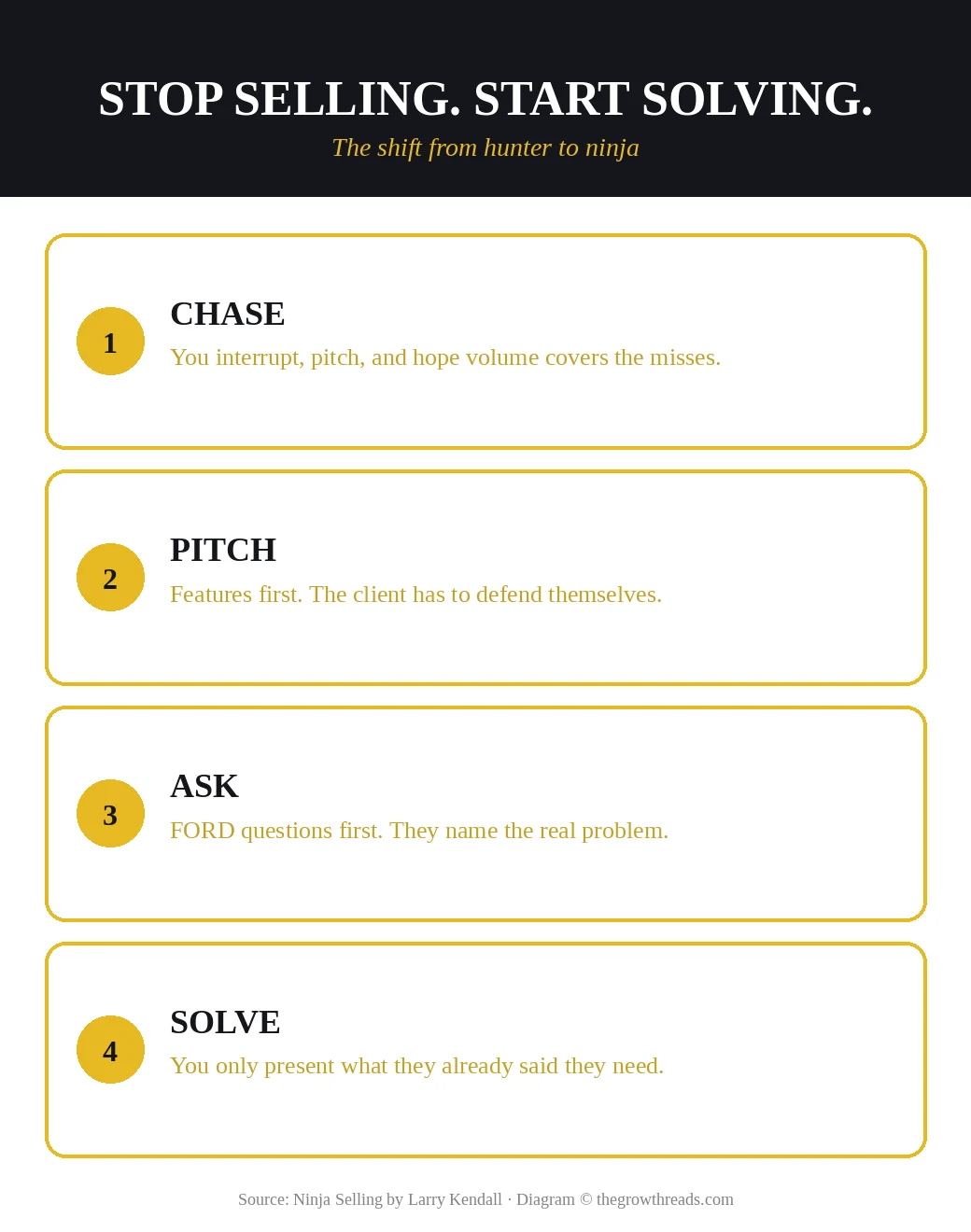
- Stop selling, start solving: A pitch asks them to defend themselves. A diagnosis asks them to tell the truth. You earn the right to present after they name a problem.
- Attract beats chase: Hunting is interruption plus volume. Attracting is a list you serve, questions you ask, and a reputation that sends people in.
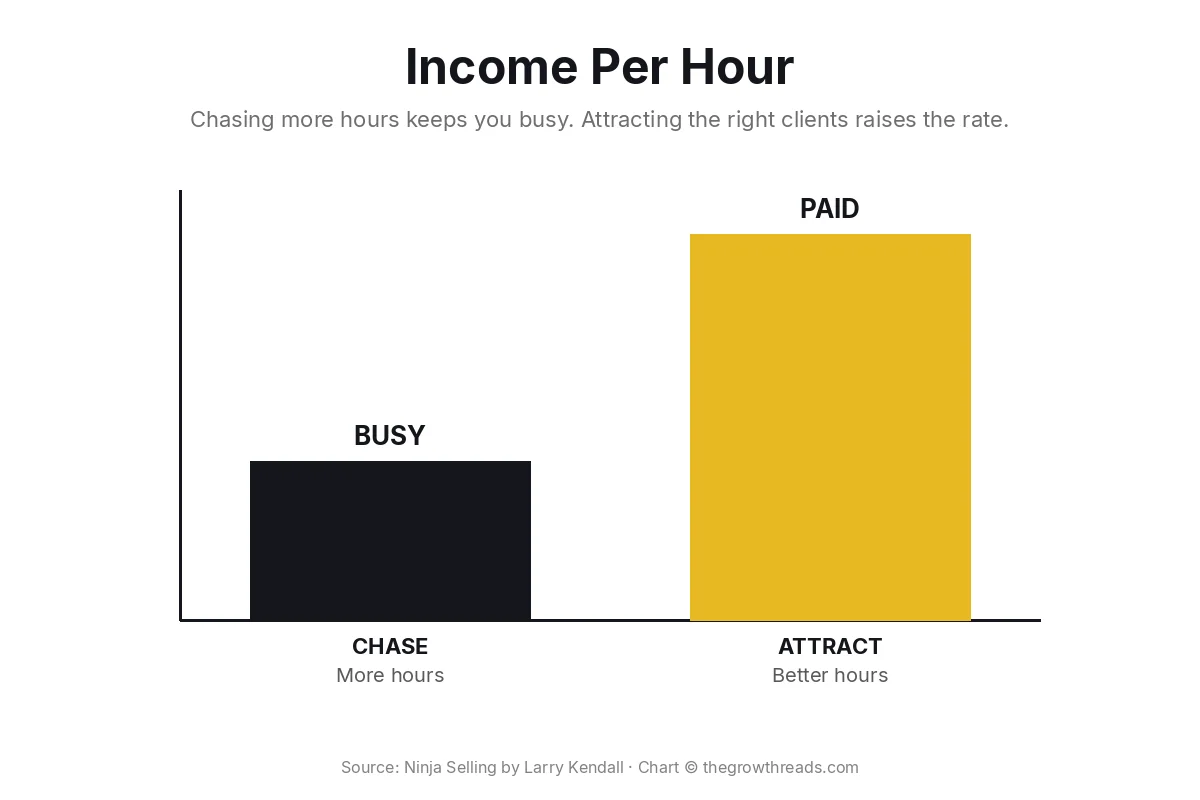
- Income per hour is the scoreboard: More hours can hide a weak offer. Raise the rate at which an hour turns into a served client, then protect those hours.
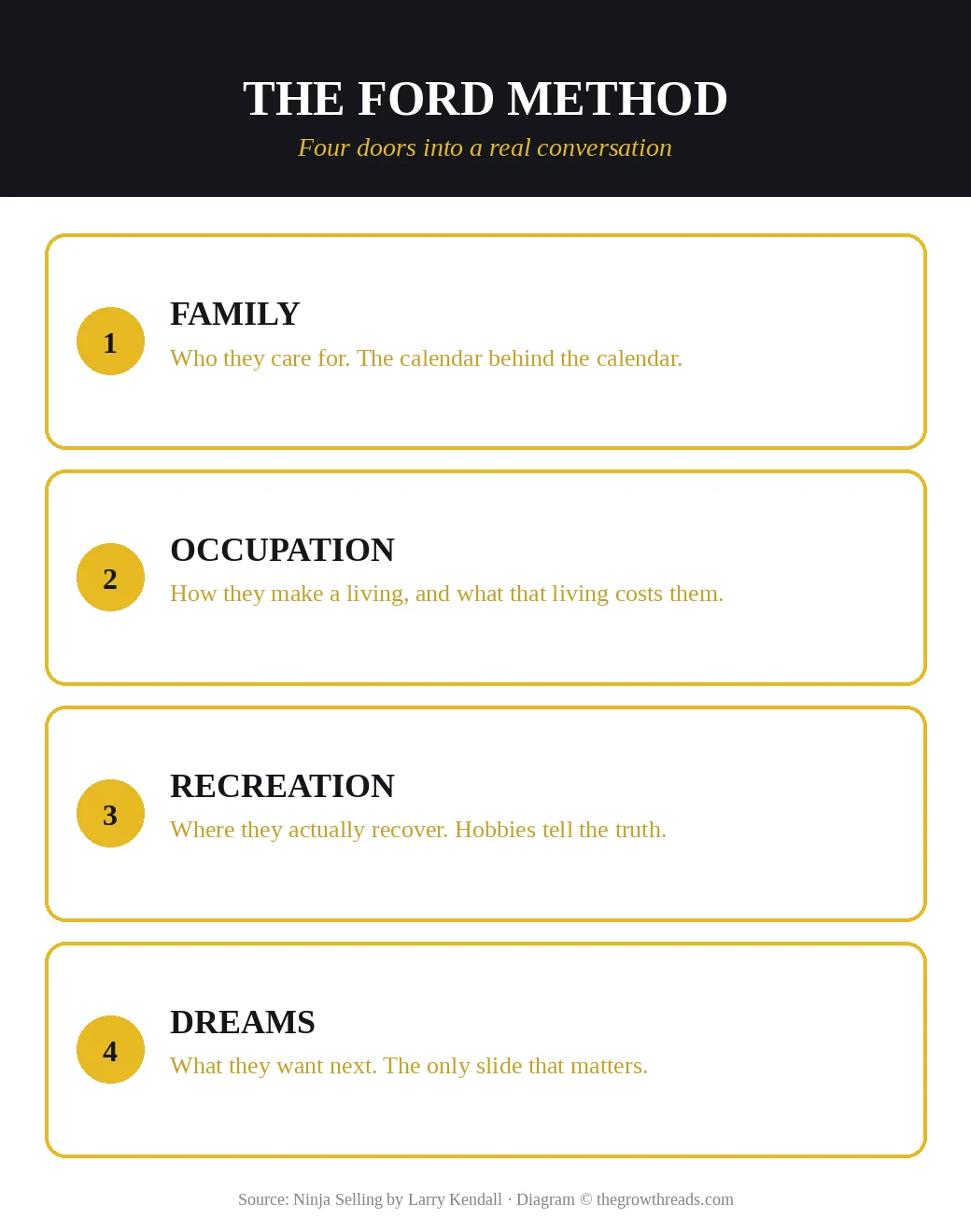
- FORD is the conversation: Family, occupation, recreation, dreams. Four doors. You are not collecting trivia. You are finding the life behind the appointment.
- Ask how it feels: Facts tell you the situation. Feeling tells you why it matters. One honest emotion is worth more than a ten-slide deck.
- The database is the firm: Strangers are expensive. People who already know you are the asset. Touch them on purpose, not when you are scared.
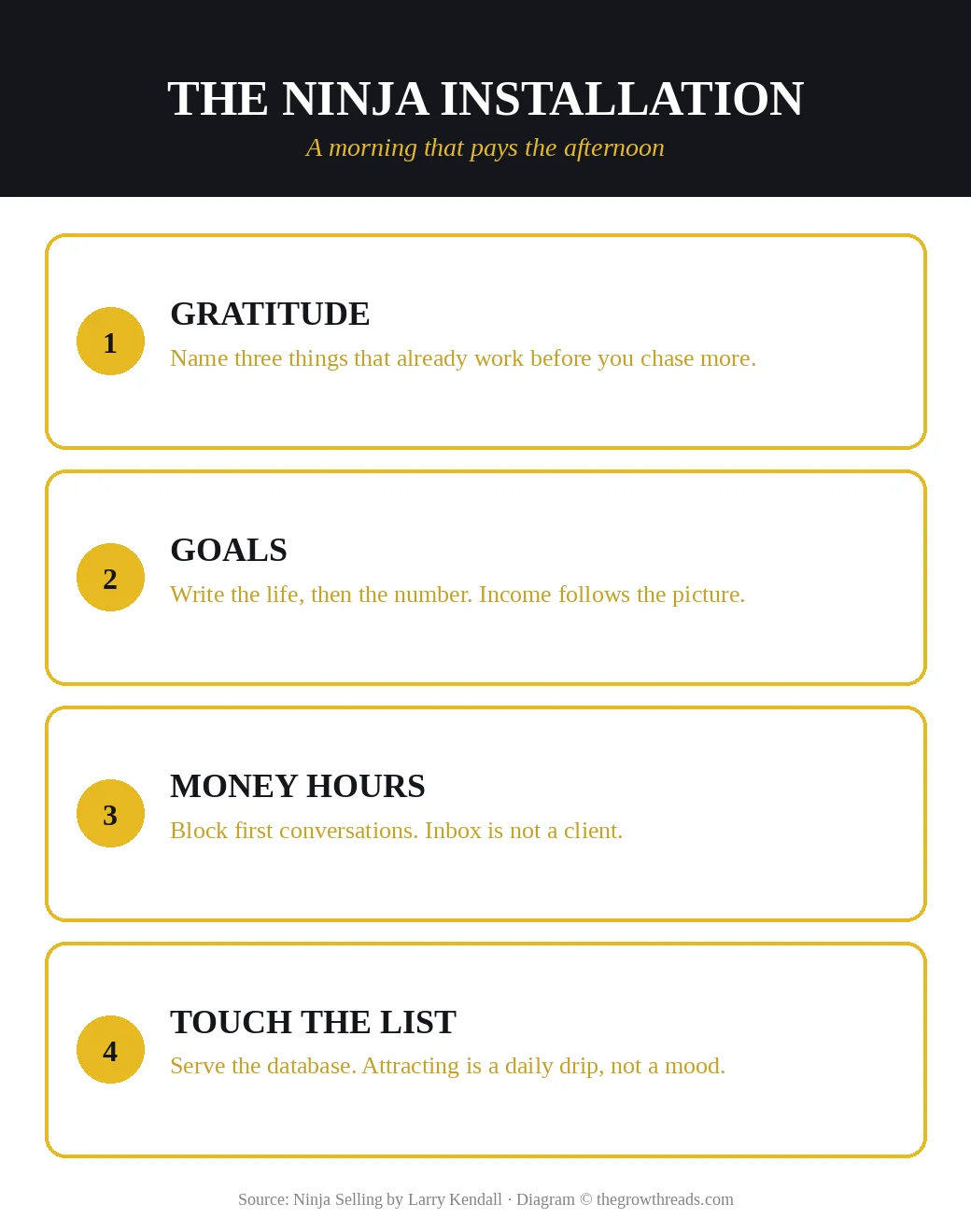
- Install the morning: Gratitude, goals, then money hours. Inbox is not a client. The Ninja Installation is how the afternoon stays clean.
- Service after the close: Referrals lag how you behaved once the contract was signed. The sale is the start of the relationship, not the peak.
What is Ninja Selling about?
Ninja Selling is Larry Kendall’s system for attracting clients by solving problems instead of pitching products. Built inside a real-estate company, it replaces hunting with FORD questions, a protected morning, and a database you serve. The scoreboard is income per hour, not hours at the desk.
About the author
Larry Kendall is a broker and trainer who helped build The Group, Inc. in Fort Collins, Colorado, into a high-producing independent real-estate firm. He watched agents who lived on the phone stay busy, and quieter colleagues who asked better questions take home more in fewer hours. That in-house playbook became Ninja Selling (Greenleaf Book Group Press, 2017), a 344-page field manual and Axiom gold medal winner: stop performing, start solving, and build a life that can hold the business. He is not a Wikipedia celebrity. For talks and the live curriculum, look up the Ninja Selling training company — not movie ninjas, and not a different Larry. Explore all Larry Kendall book summaries →
Key concepts at a glance
| Concept | What it means | Use it when |
|---|---|---|
| Stop selling, start solving | Diagnose first. Present only what they already named. | You hear yourself talking and they go polite. |
| Attract vs chase | Serve a list so people come in. Do not only hunt strangers. | Your week is full and your pipeline is not. |
| Income per hour | The real scoreboard. Hours are an input, not a virtue. | You wear 60-hour weeks like a medal. |
| FORD | Family, occupation, recreation, dreams — the conversation map. | You default to features in the first five minutes. |
| Feel questions | Ask what the situation costs them emotionally, not just logically. | They give facts and you still cannot help. |
| The database | Past clients and the sphere are the firm. Strangers are expensive. | You only call people you already know when quota hurts. |
| Ninja Installation | A short morning: gratitude, goals, then protected money hours. | Inbox and internal work eat the first two hours. |
| Service after the close | Referrals lag how you behaved once the contract was signed. | You disappear after the yes and wonder why the well is dry. |
Part 1 — Why hunting makes you busy, not rich
Kendall’s opening move is a reframe of “working hard.” The hunter’s calendar is a badge: more doors, more dials, more hours. Effort is not the problem. The unit of measurement is. If the only way to grow is to add time, you will run out of time — and the people you live with will notice first. He wants a different scoreboard: income per hour. A business that only works at 70 hours is a job with worse benefits.
Traditional selling trains you to chase. You interrupt, pitch, and hope volume covers the misses. Some of that still has a place — empty calendars do not fill themselves. The trap is making hunting the whole personality. A feature dump in the first five minutes is a request that they defend themselves. Kendall’s ninja is the opposite: hard to see, useful when they arrive, not performing in the lobby.
The Fort Collins lab is not a seminar. The Group, Inc. paid rent with listings. Kendall watched two careers in the same market. One agent lived in activity and called it pipeline. Another looked quiet from the hallway and raised the rate at which an hour became a served client. The income gap was not charisma. It was what they did with conversations they already had. Stop selling, start solving is a sequence: a problem, told in their words, then a presentation. Attracting is slower in week one and faster in year three because a served database compounds.
TGR Note: If the chair is empty, this book will feel like a luxury. Fanatical Prospecting is how strangers become meetings on a thirty-day lag. Come back to Kendall once you have names. If the meeting is complex B2B and you lose the room after you get in, The Challenger Sale is the teach-and-take-control layer. Ninja Selling is what you do so the people who already know you stop bracing for a pitch.
Part 2 — The FORD conversation
FORD is the tool people remember, and the one they turn into a gimmick. Family, occupation, recreation, dreams: four doors into a life. You are not collecting hobbies to fake rapport. Every purchase sits inside a life, and that life will not volunteer itself on slide three. Family is the calendar behind the calendar. Occupation is often the constraint. Recreation is the unguarded truth. Dreams are the only slide that matters.
You earn the next question by hearing the last answer. When they mention a parent, you do not pivot to inventory. Kendall pushes sellers toward feeling, not just facts. “What is that like?” is a small sentence, and it is where the real problem gets a name. Facts tell you they might move. Feeling tells you why waiting is expensive in a way a spreadsheet will not show.
Present last on purpose. Present before they name a problem and you are guessing — which sounds like selling. Present after they have said it out loud and you are solving. That is why the ninja looks subtle: you waited. Use FORD on people you already know, not only on a mythical perfect lead. You will not be the hero of their story. They will. That is the same posture To Sell Is Human asks of anyone who moves people. Kendall gives you four doors and a rule: do not walk in with a brochure.
TGR Note: Once you are in a live deal and need investigation, SPIN Selling is the question sequence for the meeting itself. If you are testing an idea and people are too nice to tell you the truth, The Mom Test keeps you in their life instead of your pitch. FORD is the relationship layer those two books assume you can already hold a human conversation.
Part 3 — The calendar, the list, the morning
Skills without a calendar become personality. The Ninja Installation is a morning you can repeat: gratitude so you do not start in deficit, goals so the number is attached to a life, then money hours — first conversations and database touches. Inbox is not a client. The hunter hides in internal work because it feels like effort. The ninja treats the first block like a meeting already booked with the business.
The database is the engine. Past clients and the sphere are cheaper than strangers, and they still have a cost: neglect. Kendall wants a drip you can keep — useful notes, real check-ins, service that does not only appear when you need a referral. Eight thoughtful touches beat eighty automated ones. Be present enough that when a need appears, you are easy to reach.
Income per hour is also a planning tool. Reverse the hours from the life you want: evenings, a sport, a person you do not ignore. How many served clients at your real close rate, how many conversations, how many protected money hours before noon? A 45-hour week with a clean first block usually beats a 60-hour week of being available to everyone except a prospect. Weekly review is the same drip: look at the list, the conversations, and the promises after the last close. Attracting only works if you do not skip it when you feel fine.
TGR Note: If the list is the job, Never Eat Alone is the relationship calendar for people who freeze at “networking.” The Go-Giver is the posture: value first, keep score last. Kendall adds the morning install so generosity has a slot, not just a slogan. Together: who to serve, how to show up, and when the work happens.
Part 4 — Service, mastery, and a life that fits
Kendall will not let the book be only tactics. Sleep, fitness, and a life you would actually want are part of production, not a prize after a record quarter. That sounds soft until you watch a hunter’s fifth decade. The body keeps the receipts. So do the people at home. A system that only works if you are slightly miserable is a sprint you will walk away from — or that someone else will.
Service after the close is where attracting becomes visible. The hunter peaks at the signature. The ninja starts a new clock: did we do what we said, and did we make the ugly parts less ugly? Referrals lag how you behaved when they no longer had to be nice to you. Vanish and you were renting attention. Stay useful and you are the person they send a friend to.
A tired seller pitches because pitching runs on empty. A rested seller can hear FORD and sit in a pause. Subtle skills are mostly self-control in a chair — which is why the morning install exists. If the business cannot hold a dinner or a Sunday, you built a more successful hunt, not a ninja practice. Write the picture first, then let the number serve it. The line to keep: stop selling, start solving. The rest is a calendar that makes that sentence true on a Wednesday, not only after a conference.
Who is Ninja Selling best for — and who should read something else first?
Best for real-estate agents, advisors, consultants, and anyone who already has a sphere and still sounds like a brochure. It is also for team leaders who inherited grinding hours as a culture. If you want a full life and a full practice, this is the book.
Read something else first if your calendar has no conversations — start with Fanatical Prospecting. If you get the meeting and cannot diagnose, start with SPIN Selling. If the room is a committee, The Challenger Sale is the better in-deal book. If you reject the word “sales,” start with To Sell Is Human. Come back to Kendall when access is not the issue — how you show up is.
Questions to reflect on
- What is your real income per hour this month — not the story you tell, the number?
- Who already knows you and has not heard from you in 90 days?
- On your last sales conversation, how many minutes passed before you presented?
- Which morning block is currently owned by inbox, and what first conversation could replace it?
- After your last close, what did the client hear from you besides a request for a review?
🔥 Ready to stop chasing?
Install FORD and one money-hour block this week from the list you already have.
How to apply Ninja Selling (7-day plan)
- Day 1 — Write the picture and the rate. Write the life it should hold. Then the rate.
- Day 2 — FORD three people you already know. No pitch. End with one feel question. Write what you heard.
- Day 3 — Install a 20-minute morning. Three gratitudes, the picture from Day 1, then block tomorrow’s first 60 minutes like a client meeting.
- Day 4 — Run the money hour. No inbox until the block ends. Call or write people from the database. Track conversations started, not “worked on my CRM.”
- Day 5 — Present last on one live call. If you must share an option, share it only after they have named the problem in their own words. If they have not named it, keep asking.
- Day 6 — Eight useful touches. Not a blast. Eight specific notes to past clients or the sphere: an article, a check-in, a door you can open. Serve the list.
- Day 7 — Service one closed client. Ask how it is going. Fix one friction. Do not ask for a referral first. If they offer a name, take it.
Frequently asked questions
What is Ninja Selling about?
Ninja Selling is Larry Kendall’s field book for attracting clients instead of chasing them. Traditional selling starts with a pitch. This system starts with FORD questions — family, occupation, recreation, dreams — until the other person names a real problem. Then you solve that problem. Kendall built the method at The Group, Inc., a real-estate company in Fort Collins, Colorado, and wrote it so advisors, agents, and anyone with a database can raise income per hour without living at the office. Read it when you already know people and still sound like a brochure.
Who is Larry Kendall?
Larry Kendall is a real-estate broker and trainer who helped build The Group, Inc. in Fort Collins into a high-producing independent firm. He spent decades watching agents who hunted all week stay busy and broke, while quieter colleagues who asked better questions and served their list earned more in fewer hours. Ninja Selling (2017) is the public version of that in-house system. He is not a Wikipedia celebrity and not a movie ninja — search the Ninja Selling training company if you want talks and the live curriculum that sits beside the book.
Is Ninja Selling only for real estate?
Kendall’s stories are mostly houses and listings, because that is the lab. The moves are not. FORD works on a software demo, a financial-planning meeting, and a consulting intro. Protected money hours work in any job where inbox work crowds out first conversations. A database you drip value into is how accountants, coaches, and agency owners stop restarting from zero every quarter. If you have no list and no one will take a meeting, start with Fanatical Prospecting. If you already know people and lose them with a pitch, this is the book.
What is the FORD method in Ninja Selling?
FORD is Kendall’s conversation map: Family, Occupation, Recreation, Dreams. You ask about the people they care for, how they make a living, how they actually rest, and what they want next. You do not use it as a script to trick someone into a close. You use it so you stop talking about yourself. The fourth door — dreams — is where a real need shows up. When they can picture a next chapter, you may present. Until then you are still gathering. Five FORD conversations this week will teach you more than rewriting your deck.
How is Ninja Selling different from Fanatical Prospecting?
Fanatical Prospecting fills an empty calendar with interrupts — phone, email, social — on a thirty-day lag. Ninja Selling assumes you already have names and teaches you not to burn them with a pitch. You probably need both. Blount is how strangers become meetings. Kendall is how a sphere becomes a practice: questions, service, and a morning that protects money hours. If you have no conversations, do not hide in FORD. If your calendar is full of people who go quiet after you present, stop presenting first. Attracting does not replace prospecting. It replaces performing.
How long does it take to apply Ninja Selling?
You can run FORD on three existing clients tomorrow. The Ninja Installation — a short morning of gratitude, goals, and a blocked first-conversation hour — can start on a weekday, not a sabbatical. The database drip takes a month to feel real because trust compounds on a lag, the same way skipped prospecting shows up later. Give it 30 days of money hours before you judge the system. Kendall’s point is not a personality transplant. It is a calendar you can keep without living at 70 hours and calling that a work ethic.
Should I read SPIN Selling or Ninja Selling first?
If your problem is the meeting itself — you get in the room and cannot diagnose — start with SPIN Selling. If the room is a complex B2B committee, The Challenger Sale teaches you to lead with insight. If the problem is that you still sound like a hunter even with people who already like you, start here. Ninja Selling is the relationship layer and the personal operating system. SPIN is the investigation once a live deal exists. Many sellers need Kendall on Monday morning and Rackham on the actual call. Do not make it an either/or.
Related summaries
- Fanatical Prospecting Summary & Review — fill the empty chair first
- SPIN Selling Summary & Review — questions once the meeting exists
- To Sell Is Human Summary & Review — moving others without the costume
- Never Eat Alone Summary & Review — the relationship calendar
- Best productivity books — the full Productivity silo
How we analyze books: we paraphrase arguments, add original application notes, and skip chapter-by-chapter reproduction. Read our full methodology.