

★★★★☆ 4.5/5 — A prescient, deeply researched case that our always-on digital habits are quietly reshaping how the brain works.
Best for: Anyone who feels their concentration has frayed and wants to understand why, in plain scientific and historical terms.
Reading time: ~7 hrs (about 280 pages, guide read: ~22 min)
Difficulty to apply: Moderate — the ideas are simple, but reclaiming deep focus takes sustained, deliberate practice, not just information.
The Shallows in one minute
The internet is not just a tool you use — it is an environment that trains your brain, and for most people it is training them toward skimming instead of understanding. Nicholas Carr’s The Shallows: What the Internet Is Doing to Our Brains argues that the brain is neuroplastic: it physically rewires itself based on how it is used. Every “intellectual technology” — spoken language, the written word, the printed book, and now the internet — has reshaped human cognition in ways people didn’t fully anticipate at the time. The internet, Carr argues, is the most intensive of these yet, because its hyperlinks, notifications, and infinite feeds are deliberately engineered to fragment attention rather than sustain it. Woven through the historical and scientific argument is Carr’s own account of losing — and slowly trying to rebuild — his capacity for deep, linear reading while researching and writing the book. The stakes, he argues, are not nostalgia for paper. They are the survival of the kind of sustained, contemplative thought that produces genuine understanding, creativity, and wisdom, as opposed to a constant, shallow flow of disconnected facts.
Key takeaways
- The brain is neuroplastic: neural pathways are not fixed in adulthood — they strengthen with repeated use and weaken with disuse, for better and worse.
- Every intellectual technology reshapes cognition: oral culture, the codex, the printing press, and the internet each retrained the human mind in ways their users didn’t foresee.
- The internet is uniquely intensive: hyperlinks, notifications, and multi-stream feeds are built to interrupt sustained attention by design, not by accident.
- Working memory is small and slow: it can hold only a handful of items at once, and needs unhurried time to transfer information into durable, long-term memory.
- Deep reading is a learned skill: the brain circuitry for sustained, linear reading is built through practice — and it can also be unbuilt through disuse.
- Multitasking degrades comprehension: switching between tabs, notifications, and streams measurably reduces how much readers understand and retain.
- Interruption breaks encoding: constant task-switching prevents the slow consolidation process that turns information into real, durable understanding.
- Outsourced memory changes what “knowing” means: when facts are always one search away, the brain has less incentive to encode them deeply.
- Carr’s own experience is the case study: he describes losing his own capacity for sustained reading while writing the book, and slowly rebuilding it through deliberate practice.
- The trend is reversible with effort: because the brain is plastic in both directions, deliberate deep-reading practice can rebuild the very capacity the internet erodes.
What is The Shallows about?
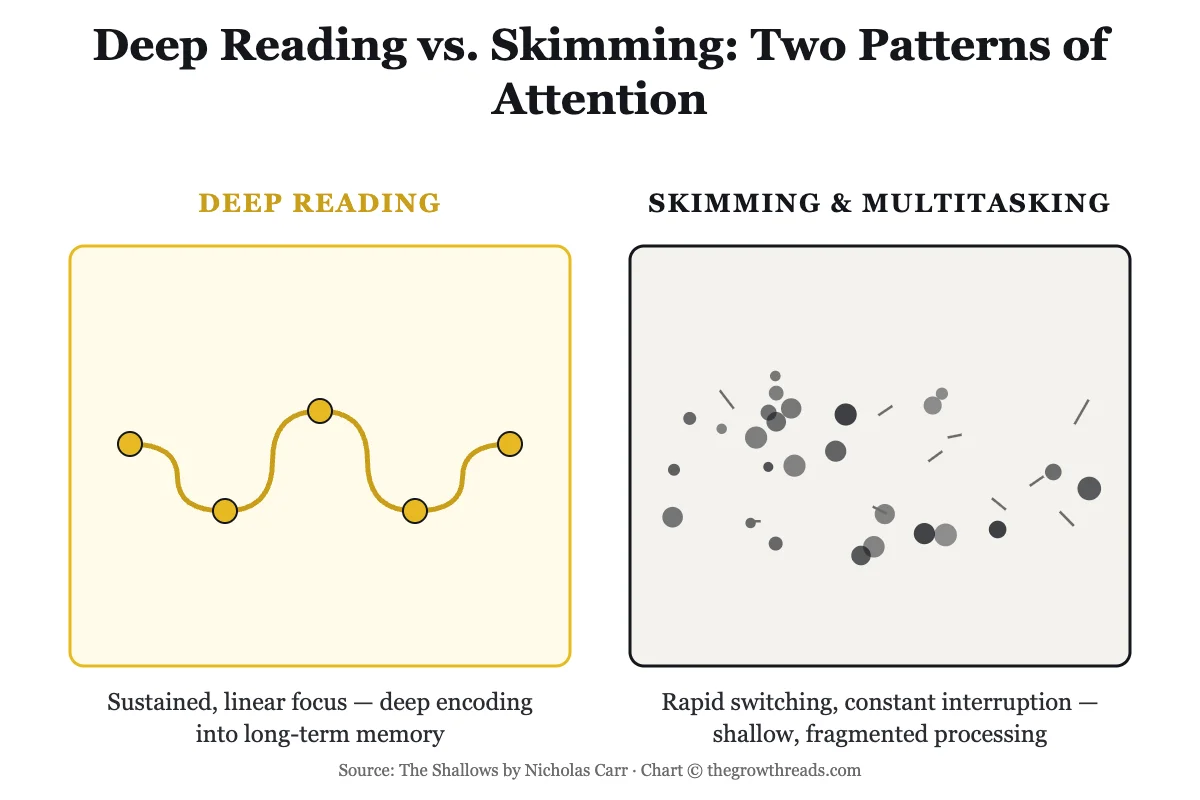
The Shallows argues that heavy internet use — with its hyperlinks, notifications, and skimming-friendly design — is physically rewiring the brain away from sustained, linear reading and deep thought, toward a faster but shallower mode of processing information, and explains the neuroscience behind why this happens.
About the author
Nicholas Carr is an American technology writer and former executive editor of the Harvard Business Review. He first drew wide attention with his 2008 Atlantic essay “Is Google Making Us Stupid?”, which became the seed of The Shallows, published in 2010 and a finalist for the Pulitzer Prize in general nonfiction. Carr’s broader body of work — including The Big Switch and Utopia Is Creepy — examines how computing technologies reshape business, culture, and everyday life, often pushing back against Silicon Valley’s more triumphant narratives about progress. He writes for a general audience but grounds his arguments carefully in neuroscience, media history, and his own candid, sometimes uncomfortable observations about his changing reading habits. Carr lives in Colorado and continues to write and speak about technology’s effects on attention, memory, and thought. Explore all Nicholas Carr book summaries →
Key concepts at a glance
| Concept | What it means | Use it when |
|---|---|---|
| Neuroplasticity | The brain’s capacity to physically rewire itself based on how it’s used, throughout adulthood. | Explaining why habits — good or bad — become easier and more automatic over time. |
| Intellectual technology | Any tool that extends or reshapes mental capacity — writing, the clock, the book, the internet. | Putting today’s digital habits into historical perspective. |
| Working memory | A small, fast mental workspace that holds only a few items at once before it overflows. | Understanding why interruptions during learning are so costly. |
| Long-term memory | The brain’s vast, durable storage, built only through slow, unhurried encoding. | Deciding when to slow down instead of skimming for speed. |
| Deep reading | Sustained, linear, single-focus reading that builds comprehension and reflection. | Tackling material that needs to be understood, not just skimmed. |
| Continuous partial attention | A state of scanning many inputs at once without fully focusing on any of them. | Recognizing the default mode most notification-heavy apps encourage. |
| Outsourced memory | Relying on search engines as external memory instead of encoding facts internally. | Deciding what’s worth memorizing versus what’s fine to look up. |
Part 1: The Long History of Intellectual Technologies
Carr opens with a simple but powerful idea: the tools we use to think are not neutral. Every major “intellectual technology” — the map, the clock, the alphabet, the printed book — has quietly reshaped the way human beings perceive the world and process information. The map trained people to think of space abstractly. The mechanical clock trained them to think of time as a sequence of uniform units rather than a felt experience. Writing itself, Carr argues, was the biggest shift of all: it externalized memory, allowed ideas to be revisited and refined, and eventually gave rise to the deep, linear, single-focus reading that defined intellectual life for roughly five centuries after Gutenberg.
That “deep reading” mode is historically unusual. For most of human history, information came through speech, ritual, and fragmented oral tradition. The printed page trained something new: an ability to sustain attention on one train of thought for hours, to follow an argument through hundreds of pages, to read in silence and solitude. Carr calls this a “strange anomaly” in the history of our species — a hard-won cognitive skill, not a default one.
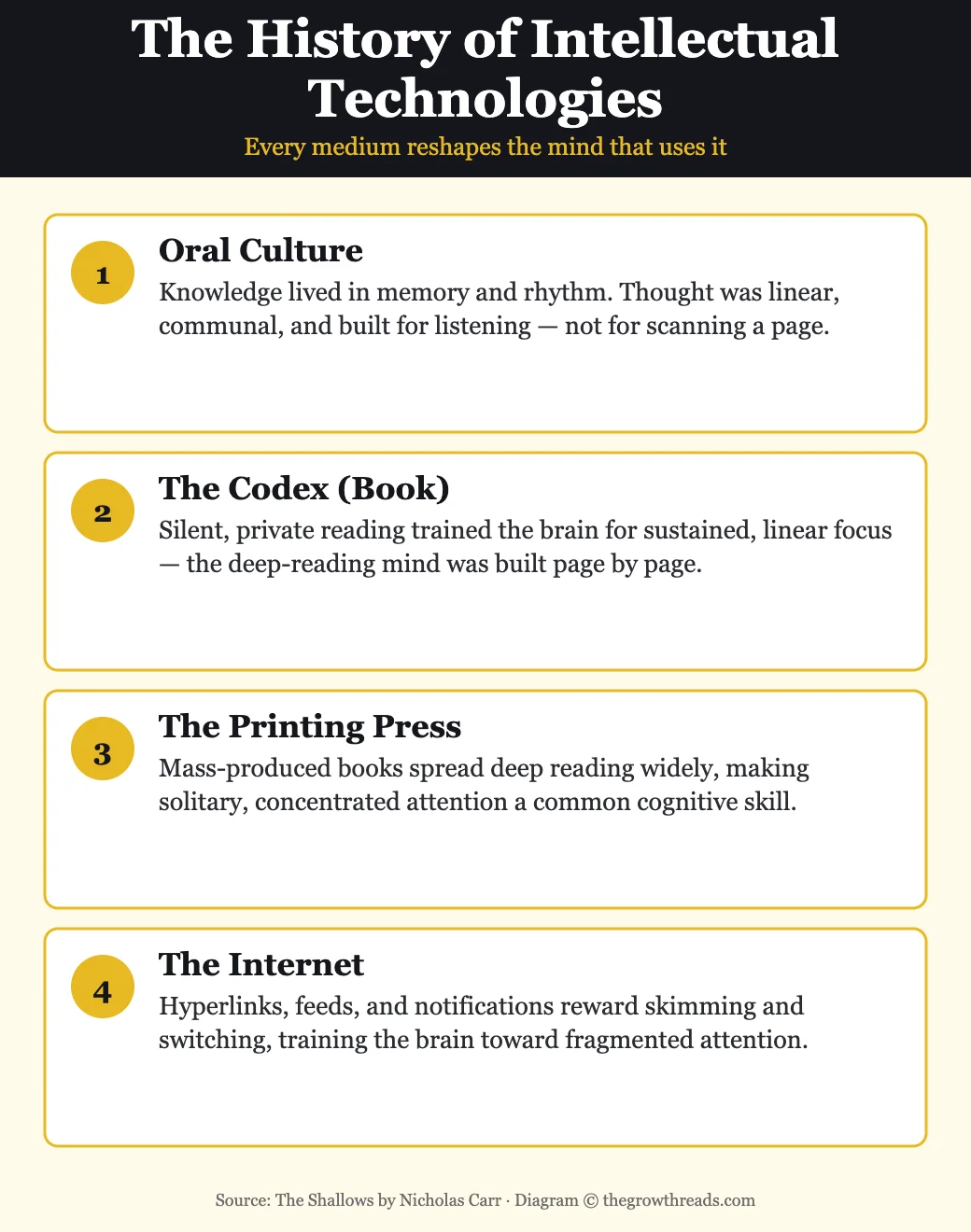
The internet, in Carr’s view, is the newest and most powerful intellectual technology yet — and it is trained on the opposite skill set. Where the printed page rewards linear focus, the web is built from hyperlinks, notifications, tabs, and feeds explicitly engineered to interrupt and redirect attention. It does not just deliver distraction alongside information; its fundamental structure is distraction. That distinction — medium as message, not just as pipe — is the intellectual backbone of the entire book.
Part 2: Neuroplasticity — Your Brain Is Not Fixed
The scientific spine of The Shallows is neuroplasticity: the now well-established finding that the adult brain physically rewires itself in response to repeated experience. Carr surveys landmark studies — London taxi drivers whose hippocampi (the brain region for spatial memory) grow visibly larger after years of memorizing the city’s streets; blind readers whose visual cortex gets repurposed to process touch as they read Braille. The underlying principle, often summarized as “neurons that fire together wire together,” means that whatever we practice repeatedly becomes physically easier and more automatic, while unused neural pathways weaken.
Applied to the internet, this cuts both ways. Heavy, habitual use of a medium built around skimming, switching, and rapid stimulus response trains the brain to be good at exactly that — and correspondingly worse at the slower, effortful concentration that deep reading requires. Carr is careful to frame this as adaptation, not damage: the brain is doing precisely what it evolved to do, optimizing itself for its actual environment. The problem is that the environment most of us now spend the most hours in is optimized for interruption, not depth.
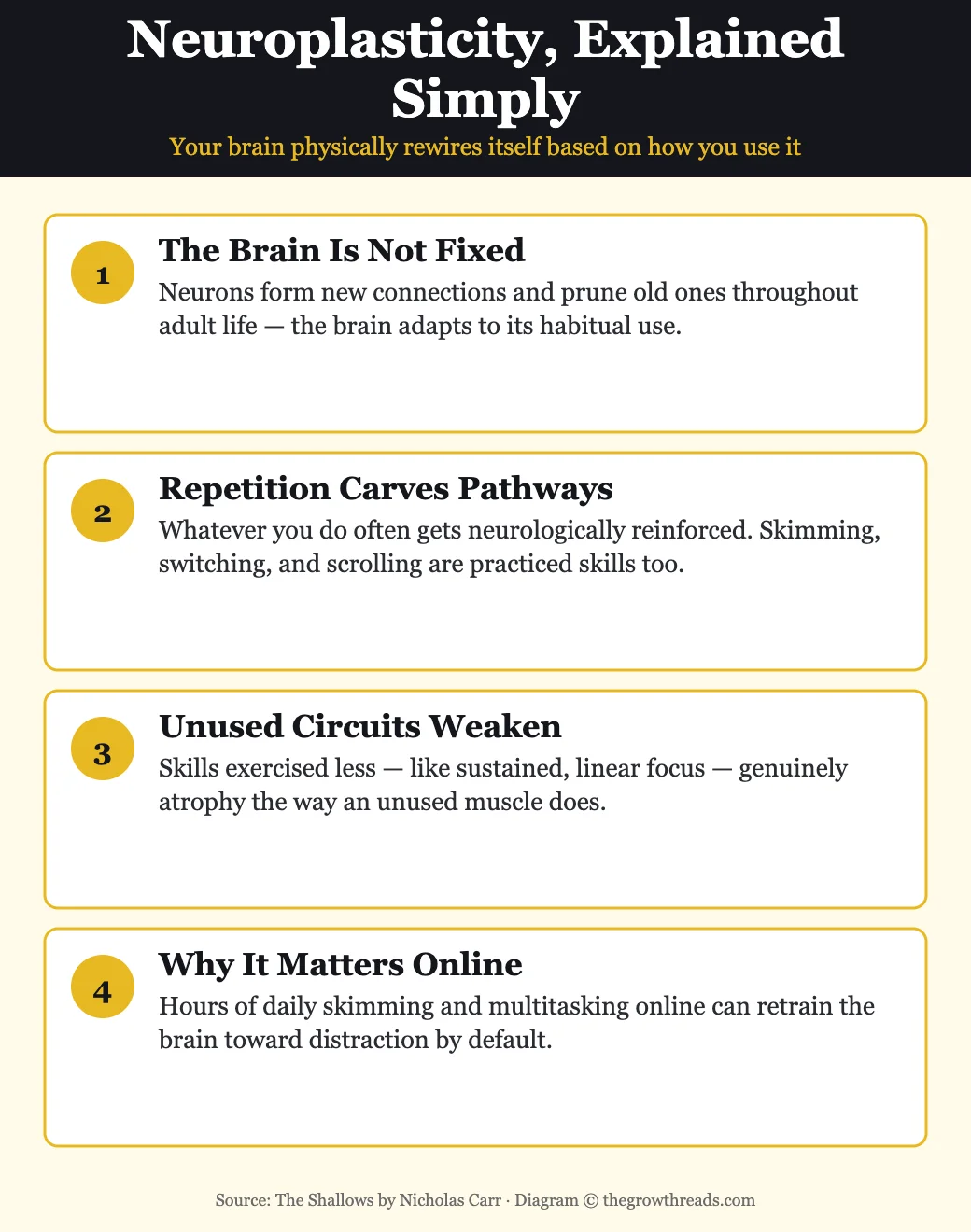
The good news buried in the neuroscience, and one Carr returns to at the book’s close, is that plasticity is not a one-way ratchet. The same mechanism that lets the internet retrain your brain toward distraction can be deliberately pointed the other way, toward sustained focus, through consistent practice.
Part 3: Working Memory vs. Long-Term Memory — Why We Forget What We Skim
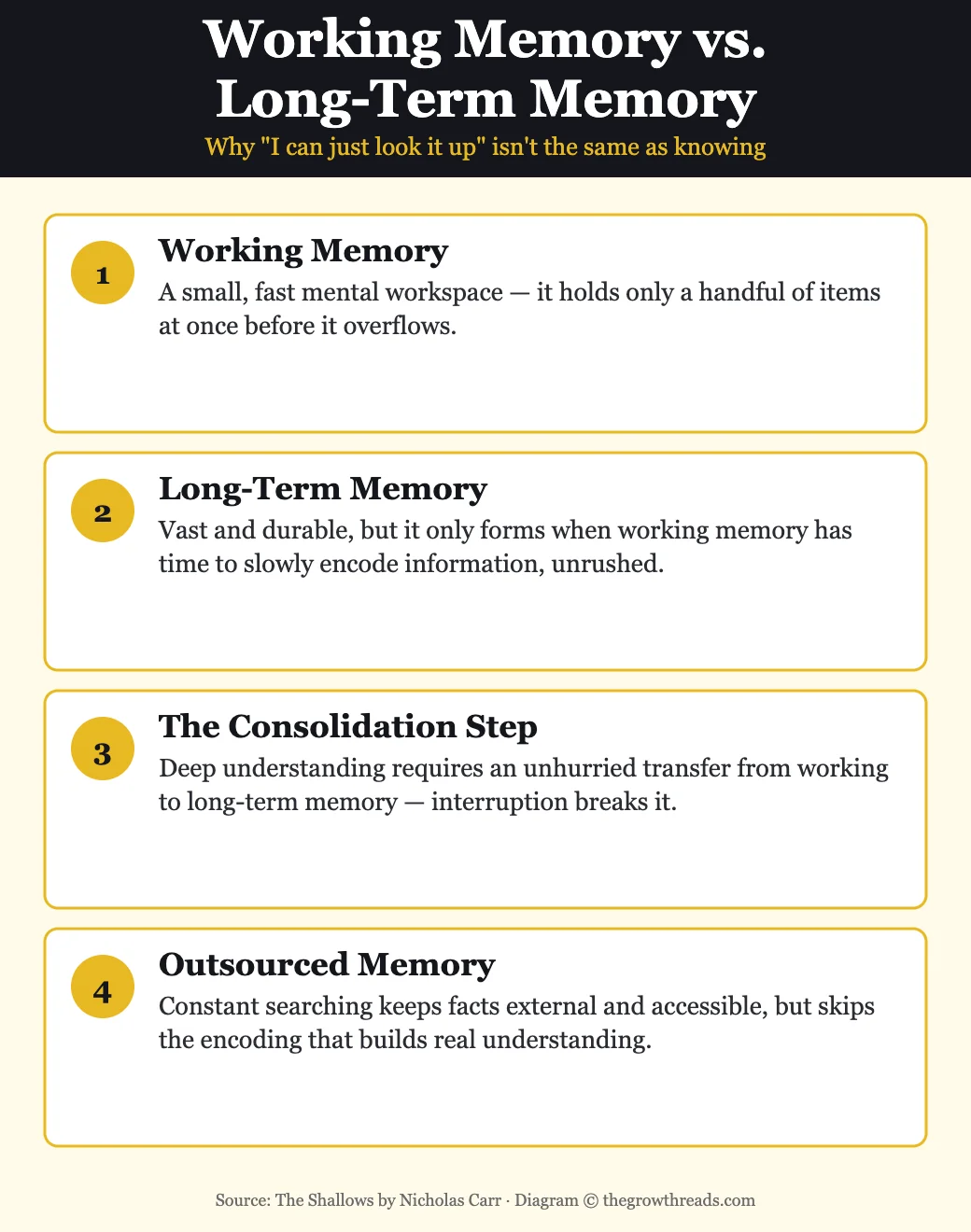
Carr draws a distinction that does a lot of work in the book: working memory (the small, temporary mental “workspace” that holds a handful of items at once) versus long-term memory (the vast, durable store where real knowledge and understanding live). Moving information from working memory into long-term memory — a process called consolidation, or encoding — is slow, effortful, and easily disrupted. It requires sustained, undivided attention over an extended stretch of time.
The internet, Carr argues, is almost perfectly designed to prevent this. Hyperlinks force constant micro-decisions (“click or keep reading?”). Notifications, tabs, and multi-window setups flood working memory with competing stimuli. Under this kind of “cognitive overload,” the brain can keep juggling surface-level information, but very little of it gets consolidated into lasting understanding. We come away having “read” a great deal and retained comparatively little. Carr extends this into a discussion of transactive memory — our growing habit of outsourcing recall to search engines — and asks a pointed question: if we no longer have to remember facts because we can always look them up, does that change what it means to actually know something?
Part 4: What’s at Stake — and Why It Matters More in the AI Era
Carr is candid about how the book began: as a personal observation that he could no longer read long, dense texts the way he once had. His mind, he noticed, expected information to arrive the way the web delivers it — in short, interruptible bursts. That anecdote is what sends him into the neuroscience and media history that make up the rest of the book, and it is part of why The Shallows reads less like a technology critique and more like a mind slowly examining itself.
The stakes he lays out are not really about productivity. Deep, sustained reading is where contemplative thought, sustained argument, and a certain kind of empathetic imagination are built — the capacity to hold a complex idea in mind long enough to turn it over. Losing ease with that mode of thinking, even gradually and without anyone intending it, is a quiet, cumulative loss rather than a dramatic one, which is part of why Carr argues it deserves deliberate attention.
The encouraging counterpart to the neuroscience is that it is genuinely two-directional. If plasticity explains how habitual web use trained the brain toward skimming, it equally explains how deliberate, protected time with sustained texts can retrain it back toward depth. Carr does not prescribe a specific plan for this — the practical playbook below is TGR’s own synthesis, built to put his diagnosis into action.
Who is The Shallows best for — and who should read something else first?
The Shallows is best for readers who sense they have lost some capacity for sustained concentration and want to understand the mechanism behind that feeling before trying to fix it. It rewards anyone curious about neuroscience, media history, or the psychology of attention, and it pairs naturally with a practical follow-up like TGR’s summary of Peak Performance for building the habit change itself.
If you already accept the “attention is being fragmented” premise and want a more current, AI-era treatment of algorithmic influence over behavior, start instead with TGR’s summary of The Age of Surveillance Capitalism. If your primary interest is the economic and labor impact of AI rather than cognition, TGR’s summary of Rise of the Robots is a better entry point.
Questions to reflect on
- When was the last time you read something longer than a few paragraphs without switching tabs, checking a notification, or reaching for your phone?
- How much of what you “read” online in a typical week could you accurately summarize a day later?
- Which daily habits are training your brain toward skimming, and which (if any) are training it toward depth?
- If transactive memory means you rarely need to recall facts yourself, what should you deliberately still commit to memory?
- What would one hour of genuinely undistracted reading a day change about how you think, six months from now?
How to apply The Shallows (7-day plan)
- Day 1 — Audit your inputs. For one day, notice every time you switch tabs, check a notification, or open a new app while reading or working. Just count; don’t change anything yet.
- Day 2 — Create one no-notification block. Turn off notifications and put your phone in another room for a single 30-minute reading session. Notice how it feels to resist the urge to check.
- Day 3 — Read one long-form piece start to finish. Choose a print book, a long article, or an essay and read it in one sitting without switching to any other screen.
- Day 4 — Batch your shallow tasks. Group email, messaging, and social scrolling into two or three fixed windows instead of checking continuously throughout the day.
- Day 5 — Extend the focus block to 45–60 minutes. Use the same distraction-free setup from Day 2, but stretch the duration, and notice where your attention wants to wander.
- Day 6 — Practice deliberate recall. After reading something substantial, close it and write a short summary from memory before looking anything up, to strengthen consolidation into long-term memory.
- Day 7 — Design your ongoing rhythm. Decide which single daily block of protected, single-tasked reading time you will keep permanently, and put it on your calendar.
Frequently asked questions
What is the main argument of The Shallows?
Nicholas Carr argues that the internet, as an “intellectual technology,” is reshaping how our brains process information — training us toward rapid skimming and task-switching and away from the sustained, linear focus that deep reading requires. He draws on neuroplasticity research to show the brain physically adapts to its habitual inputs, and on media history to show this is not the first time a new technology has changed how we think. The book’s core claim is descriptive rather than alarmist: it explains a mechanism, and leaves the response up to the reader.
Is The Shallows anti-technology or anti-internet?
No. Carr is a longtime technology writer and former executive editor at the Harvard Business Review, not a technology skeptic. The book does not argue for abandoning the internet; it argues for understanding what habitual use does to attention and memory so that use can be more deliberate. Its tone is analytical and personal rather than polemical, closer to a mind examining itself than a manifesto against a medium.
Is the neuroscience in The Shallows still considered accurate?
The foundational neuroplasticity research Carr cites — including landmark studies on London taxi drivers and sensory remapping in blind readers — remains well-established and widely cited in cognitive science. Some specific claims about internet use and cognition have been debated or refined by later research, as is normal for a fast-moving field; the book’s core mechanism (that habitual practice reshapes neural pathways) is uncontroversial and forms the basis of most modern attention and habit research.
How long is The Shallows and how long does it take to read?
The Shallows runs about 280 pages in most paperback editions. Most readers finish it in six to eight hours of reading time, or roughly a week at a relaxed pace of 30–40 pages a day. This TGR summary can be read in about 22 minutes and covers the book’s core arguments, structure, and a practical 7-day application plan.
What is neuroplasticity, in the context of this book?
Neuroplasticity is the brain’s capacity to physically reorganize itself — strengthening some neural connections and weakening others — in response to repeated experience, even in adulthood. Carr uses it to explain why habitual internet use (frequent switching, skimming, and interruption) can make sustained concentration feel harder over time, while also noting that the same mechanism means deliberate, repeated practice with deep reading can retrain the brain back toward focus.
Does The Shallows offer practical advice for improving focus?
The book is primarily diagnostic — it explains what is happening to attention and why — rather than prescriptive. It does not include a structured action plan. TGR’s 7-day plan above is our own practical synthesis, designed to translate Carr’s diagnosis (fragmented attention, weak consolidation into long-term memory) into concrete daily habits like protected no-notification reading blocks and deliberate recall practice.
How does The Shallows relate to today’s AI-driven platforms?
The Shallows was published in 2010, describing dynamics from ordinary hyperlinked browsing and early social media. Today’s AI-curated recommendation feeds apply the same interruption-and-reward mechanics far more precisely, using machine learning to optimize for engagement. Read now, Carr’s book functions as an early, prescient diagnosis of forces that AI systems have since intensified rather than invented.
Related summaries
- Atlas of AI by Kate Crawford — a sharper, more current look at how AI systems shape human behavior and attention.
- The Age of Surveillance Capitalism by Shoshana Zuboff — the commercial incentives behind engagement-optimized platforms.
- The Inevitable by Kevin Kelly — a broader look at the technological forces reshaping daily life.
- Rise of the Robots by Martin Ford — for the economic and labor side of the technology story.
- Best AI & Technology Books — TGR’s full technology reading list.
Related Technology Summaries
Our Final Invention Summary & Review: Is Superintelligent AI a Genuine Threat?
Superminds Summary & Review: How People and AI Think Smarter Together
Talking to Robots by David Ewing Duncan Summary & Review
The New Breed Summary & Review: What Animals Teach Us About Living with Robots
The Singularity Is Near Summary & Review: Why Kurzweil Thinks 2045 Changes Everything