

★★★★☆ 4.4/5 — A transformative guide that reveals the unconscious childhood patterns driving relationship conflict — and provides a structured dialogue process to heal them together.
Best for: Couples in the power struggle stage who want to understand why they fight about the same things — and therapists looking for a foundational framework.
Reading time: ~7 hours (336 pages)
Difficulty to apply: Medium-high — the Imago Dialogue requires practice and both partners’ commitment, but the exercises are clearly structured.
Getting the Love You Want in one minute
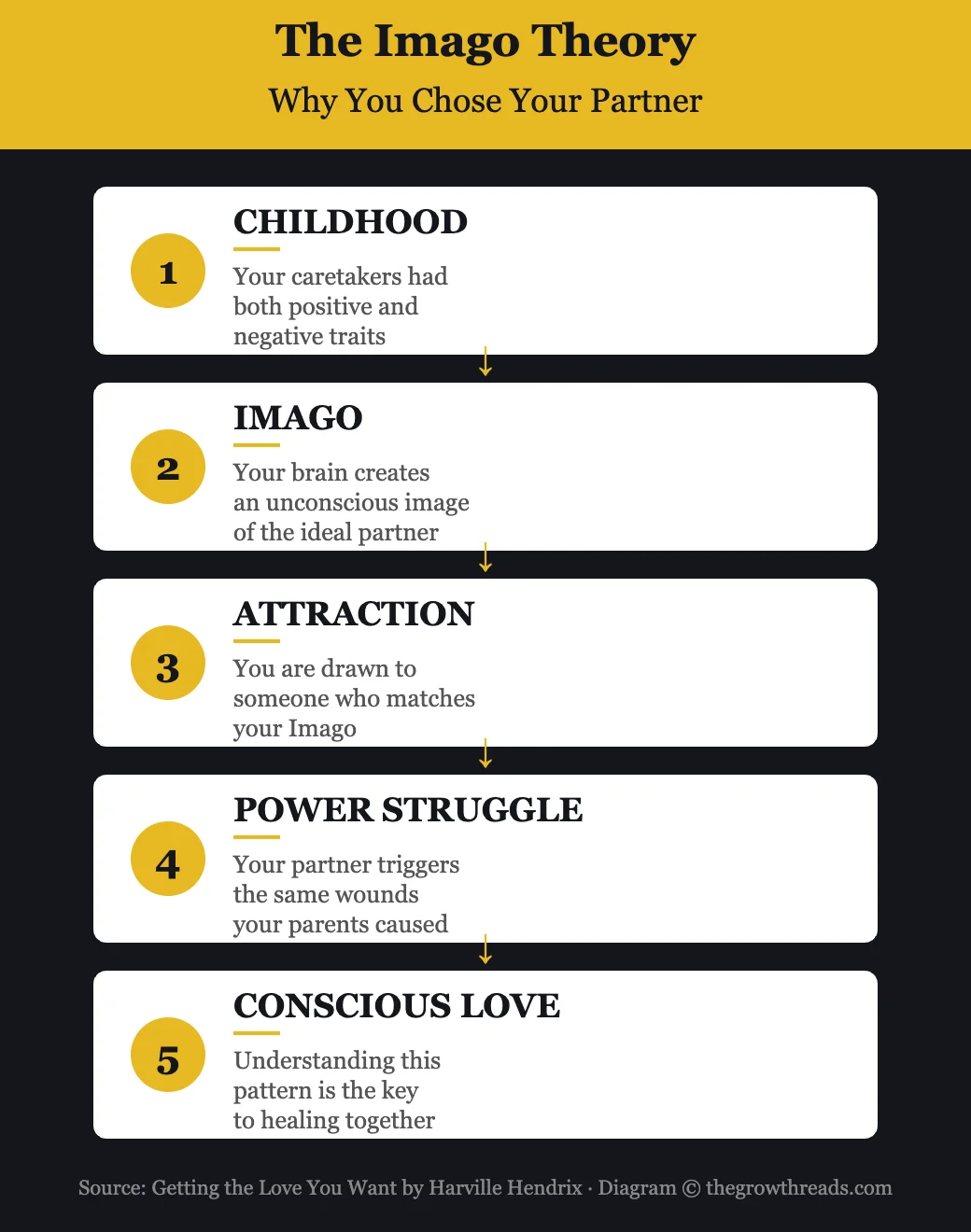
You did not choose your partner by accident — your unconscious mind selected them because they match the composite image of your childhood caretakers, both the good and the painful parts. Harville Hendrix and Helen LaKelly Hunt developed Imago Relationship Therapy on the premise that romantic attraction is driven by an unconscious image (the Imago) that combines the positive and negative traits of your early caretakers. You are instinctively drawn to a partner who can re-create the conditions of your childhood — not to repeat the pain, but because your psyche seeks to complete its unfinished business. The inevitable power struggle that follows romantic love is not a sign that you chose wrong. It is the signal that healing has begun. The book provides a structured dialogue process — Mirroring, Validation, and Empathy — that transforms conflict into connection and helps couples build what Hendrix calls a conscious relationship.
Key takeaways
- Your partner is not random: You are unconsciously attracted to someone whose traits — both positive and negative — match a composite image of your childhood caretakers.
- Romantic love is nature’s anaesthesia: The euphoria of early romance exists to bond you long enough for the real work — healing childhood wounds — to begin.
- The power struggle is inevitable: When romantic love fades, couples enter a phase where each partner’s wounds are triggered by the other. This is not failure — it is the relationship’s purpose.
- Your frustrations reveal your wounds: The things that most irritate you about your partner are precisely the things that echo the unmet needs from your childhood.
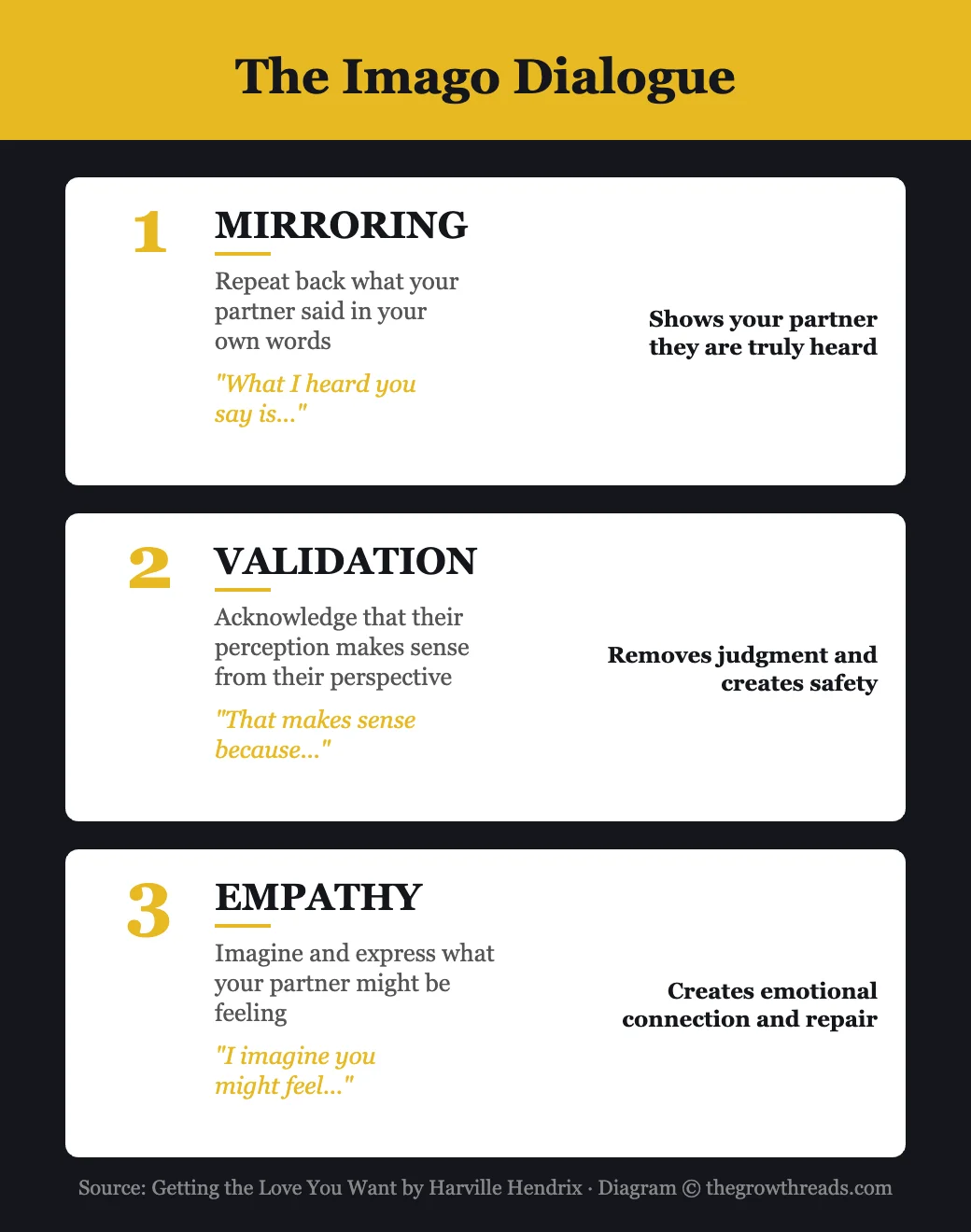
- The Imago Dialogue is the core tool: A structured conversation with three steps — Mirroring (repeating back), Validation (acknowledging their logic), and Empathy (imagining their feelings) — replaces reactive arguing with genuine connection.
- Safety is the foundation: Healing can only happen when both partners feel emotionally safe. The Dialogue creates safety by eliminating criticism, contempt, and defensiveness from communication.
- Stretching heals both partners: When you give your partner what they need — which is usually the behaviour that is hardest for you — you heal your own wounds in the process.
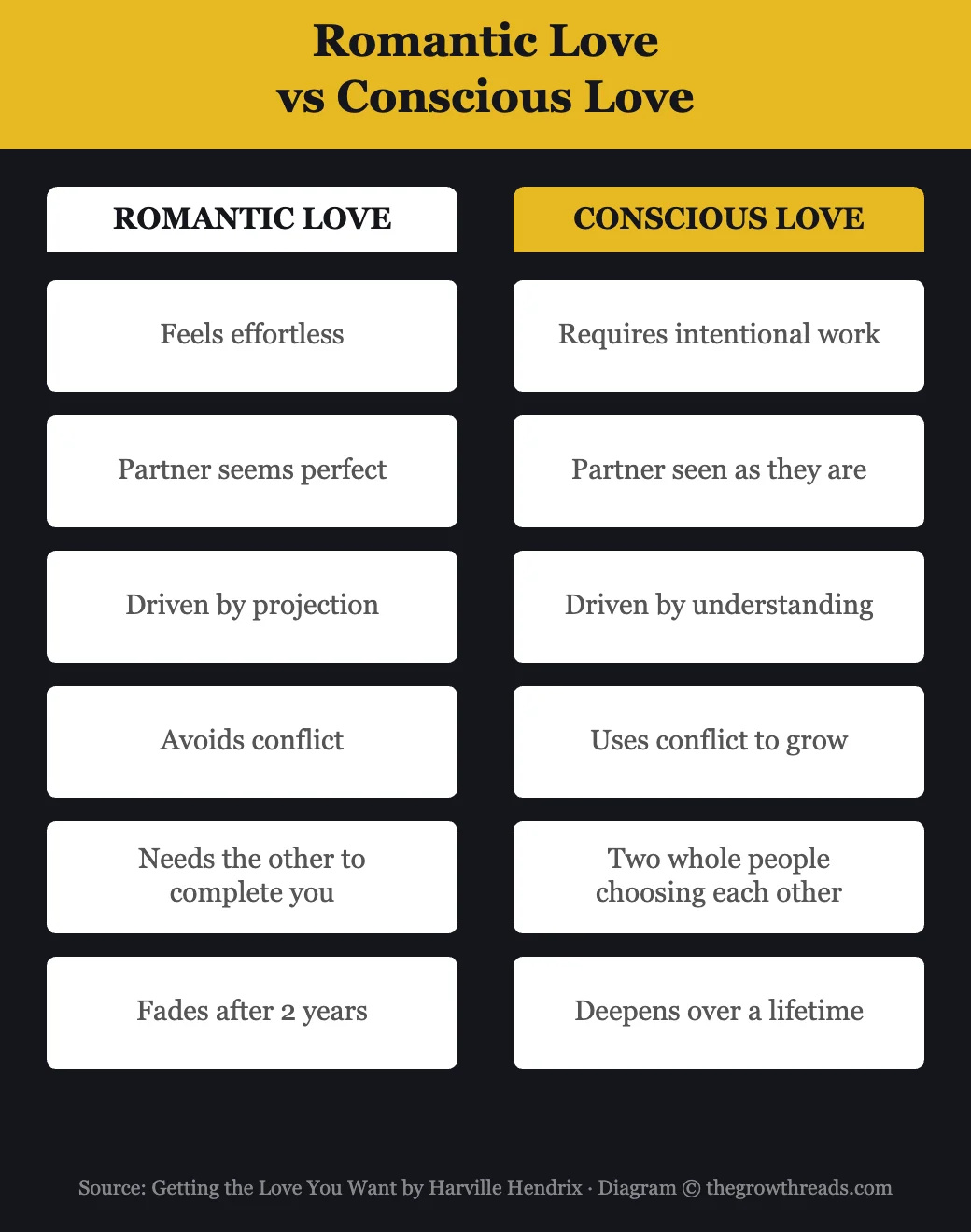
- Conscious love replaces romantic love: A conscious relationship is one where both partners choose to use the relationship as a vehicle for mutual growth rather than expecting the other to complete them.
- The exit closes the wound: The urge to leave, criticise, stonewall, or emotionally withdraw (exits) must be closed for the relationship to heal. Energy must flow between partners, not away.
- Your partner is your best therapist: No one else can trigger your deepest wounds the way your partner can — which is precisely why no one else can heal them as effectively.
What is Getting the Love You Want about?
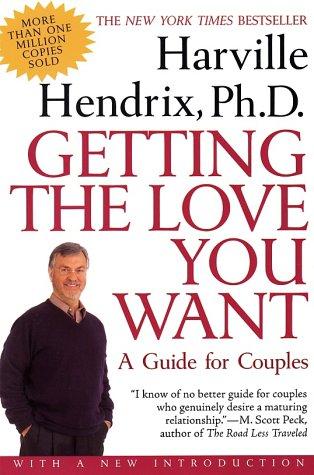
Getting the Love You Want presents Imago Relationship Therapy, which argues that romantic partners unconsciously select each other to heal childhood wounds. The book explains why the power struggle phase is a necessary stage of growth, introduces the Imago Dialogue as a structured communication tool, and provides exercises for transforming conflict into connection and building a conscious partnership.
About the author
Harville Hendrix, Ph.D., is a clinical pastoral counsellor and co-creator (with Helen LaKelly Hunt, Ph.D.) of Imago Relationship Therapy, one of the most widely practised couples therapy modalities in the world. Over 2,500 certified Imago therapists practise in more than 50 countries. Hendrix has appeared on The Oprah Winfrey Show seventeen times — Oprah called the book one of the most important on relationships she had ever read. He and Hunt have co-authored multiple books and continue to refine the Imago framework through their research and workshops. The third edition incorporates decades of clinical feedback and updated neuroscience. Explore all Harville Hendrix book summaries →
Key concepts at a glance
| Concept | What it means | Use it when |
|---|---|---|
| Imago | The unconscious composite image of your childhood caretakers that drives partner selection | You want to understand why you chose your partner |
| Romantic love | Nature’s bonding mechanism — euphoric but temporary, designed to keep you together long enough for real work | You wonder why the honeymoon phase ended |
| Power struggle | The inevitable conflict phase where childhood wounds surface through the relationship | You feel stuck in repetitive fights and wonder if you are with the wrong person |
| Imago Dialogue | Mirroring, Validation, Empathy — a structured conversation that replaces reactive conflict | Conversations escalate into arguments before anyone feels heard |
| Exits | Behaviours that redirect energy away from the relationship — withdrawal, criticism, affairs, overwork | You or your partner have checked out emotionally |
| Stretching | Giving your partner what they need even when it is uncomfortable for you | You want to grow personally while healing the relationship |
| Conscious relationship | A partnership where both people use conflict as a vehicle for mutual healing and growth | You want a deeper alternative to the romantic love ideal |
| Behaviour change request | A specific, positive, measurable action your partner can take to meet an unmet need | You need to translate vague frustrations into actionable asks |
Part 1: The unconscious relationship
Hendrix begins with a question that haunts most couples: why do relationships that start with such promise so often descend into frustration, resentment, and repetitive conflict? His answer draws on object relations theory, attachment research, and neuroscience to propose that romantic attraction is not random — it is a sophisticated unconscious search for a partner who matches the Imago, a composite image of your early caretakers’ most significant traits.
The Imago includes both the positive qualities (warmth, humour, protectiveness) and the negative ones (emotional unavailability, criticism, unpredictability) of the people who raised you. You are drawn to a partner who embodies this full package because your unconscious mind is trying to re-create the conditions of childhood — not to repeat the pain, but to finally resolve it. The person who can wound you in the same way your parents did is also the person uniquely positioned to heal those wounds, if both partners become conscious of what is happening.
Romantic love, Hendrix explains, is nature’s anaesthesia — a neurochemical cocktail of dopamine, oxytocin, and endorphins that bonds you to your Imago match long enough for the relationship to take root. During this phase, you idealise your partner, overlook their flaws, and project your unmet needs onto them. This is not deception — it is a biologically necessary bridge that gets two wounded people close enough for the real work to begin.
Part 2: The power struggle and the Imago Dialogue
When romantic love fades — typically after twelve to eighteen months — the power struggle begins. Your partner’s once-charming spontaneity now feels like irresponsibility. Their quiet strength now feels like emotional withdrawal. The very traits that attracted you become the source of your deepest frustrations. Hendrix argues this is not a sign you chose the wrong person — it is the relationship working exactly as it should. Your partner’s triggering behaviours are surfacing your childhood wounds, creating an opportunity for healing that no amount of individual therapy can replicate.
The problem is that most couples lack the tools to navigate this phase constructively. They react to each other’s wounding behaviour with counter-attacks, withdrawal, or attempts to change the other person. Hendrix introduces the Imago Dialogue as the solution — a structured communication process with three steps. Mirroring requires you to repeat back what your partner said in your own words, confirming you heard them accurately before responding. Validation requires you to acknowledge that your partner’s perspective makes sense from their point of view, even if you disagree. Empathy requires you to imagine and articulate what your partner might be feeling. This sequence — hear, validate, empathise — replaces the attack-defend cycle with genuine understanding.
The Dialogue is deceptively simple but profoundly powerful. By requiring each partner to fully receive the other before responding, it eliminates the reactivity that drives most relationship conflict. Hendrix reports that couples who practise the Dialogue consistently — even fifteen minutes a day — experience dramatic reductions in conflict intensity and frequency within weeks. The structure creates the emotional safety that is prerequisite for deeper healing work.
Part 3: Building a conscious relationship
The book’s final section moves from understanding the problem to actively building what Hendrix calls a conscious relationship — a partnership where both people choose to use their relationship as a vehicle for mutual healing and growth. This requires three commitments: closing exits, stretching into uncomfortable behaviours, and re-romanticising the relationship with deliberate care.
Exits are any behaviour that redirects energy away from the relationship: emotional withdrawal, overwork, affairs, excessive socialising, substance use, or even constant criticism (which creates emotional distance). Hendrix argues that exits must be closed — not because they are all equally destructive, but because healing requires that emotional energy flow between partners rather than away from them. When exits are closed, the relationship becomes a container that can hold the intensity of healing work.
Stretching is Hendrix’s term for the growth that occurs when you give your partner what they need, even when it requires you to move outside your comfort zone. If your partner needs more verbal affirmation and you grew up in a family that rarely expressed emotion, providing that affirmation is a stretch — and that stretch is precisely the growth your own psyche needs. This is the elegant reciprocity at the heart of Imago theory: what heals your partner’s wound simultaneously heals yours, because the behaviours that are hardest for you to offer are the ones that address your own developmental gaps.
Who is Getting the Love You Want best for — and who should read something else first?
This book is ideal for couples who have moved past the honeymoon phase and find themselves stuck in repetitive conflicts they cannot resolve. It is also valuable for therapists seeking a structured framework for couples work. If you are single and want to understand your attachment patterns before entering a relationship, start with Attached. If you want a more research-data-driven approach to what makes marriages work, try The Seven Principles for Making Marriage Work by John Gottman. If you are dealing with the aftermath of growing up with emotionally unavailable parents, read Adult Children of Emotionally Immature Parents first.
Questions to reflect on
- What are the three strongest positive traits and three strongest negative traits of the parent who influenced you most — and does your partner share any of them?
- When your partner frustrates you most, what unmet childhood need might that frustration be revealing?
- How do you typically react when your partner triggers a deep emotional response — do you attack, withdraw, or something else?
- What behaviour would be the biggest “stretch” for you to offer your partner — and what does your resistance to it tell you about your own wounds?
- What “exits” do you use to redirect emotional energy away from your relationship?
🔥 Ready to transform your relationship from power struggle to partnership?
Getting the Love You Want provides the framework millions of couples have used to build conscious, healing love.
How to apply Getting the Love You Want (7-day plan)
- Day 1 — Map your Imago: Write down your primary caretakers’ positive and negative traits. Note which ones you recognise in your partner. This is not about blame — it is about understanding the unconscious logic of your attraction.
- Day 2 — Identify your frustrations: List your top three frustrations with your partner. For each, ask: what childhood need does this frustration echo? Write the unmet need beneath each frustration.
- Day 3 — Practice Mirroring: Ask your partner to share something on their mind for three minutes. Mirror back what you heard: “What I heard you say is…” Do not interpret, advise, or respond — just reflect.
- Day 4 — Add Validation: Repeat the mirroring exercise, then add: “That makes sense because…” Validate their perspective even if you disagree. Notice how this changes the emotional tone.
- Day 5 — Add Empathy: Complete the full Dialogue: Mirror, Validate, then say “I imagine you might feel…” Allow your partner to correct your empathy guess. Switch roles.
- Day 6 — Close one exit: Identify one behaviour you use to redirect energy away from your relationship (phone scrolling during dinner, emotional withdrawal after conflict, overworking). Commit to stopping it for one week.
- Day 7 — Make a behaviour change request: Using the Imago framework, make one specific, positive, measurable request of your partner. Not “stop being cold” but “would you be willing to hug me for 30 seconds when you come home?”
Frequently asked questions
Does Getting the Love You Want work without a therapist?
Yes, though the experience is enriched by professional guidance. The book includes detailed exercises that couples can work through together at home. Many couples report significant improvements from practising the Imago Dialogue alone. However, if either partner has significant trauma or if the relationship involves abuse, professional support is strongly recommended. The book is designed as both a standalone guide and a companion to Imago therapy sessions.
What if my partner will not read the book or do the exercises?
Hendrix acknowledges this common situation. While the full Dialogue requires both partners, one person can begin applying the principles unilaterally: practising active listening, validating your partner’s perspective without being asked, and examining your own Imago patterns. Often, when one partner changes their behaviour, the relational dynamic shifts enough that the other partner becomes curious and willing to engage. Modelling the Dialogue’s spirit — hearing without defending — is powerful even without formal structure.
Is the Imago theory scientifically validated?
The Imago framework draws on well-established research in attachment theory, object relations theory, and interpersonal neurobiology. Several studies have shown that Imago therapy significantly improves relationship satisfaction and reduces distress. A 2016 meta-analysis found medium to large effect sizes for Imago-based interventions. The specific claim that partner selection is driven by an unconscious caretaker composite is harder to test directly, but it is consistent with attachment research showing that early relational patterns shape adult relationship behaviour.
How does this compare to The Seven Principles for Making Marriage Work?
Gottman’s approach is data-driven and focuses on observable behaviours: the Four Horsemen (criticism, contempt, defensiveness, stonewalling), repair attempts, and building friendship. Hendrix’s approach is depth-psychological: it traces current conflicts to childhood origins and uses the Dialogue to create mutual healing. Gottman tells you what to do differently in conflicts. Hendrix tells you why you are having those specific conflicts and how understanding the deeper pattern transforms them. The two approaches complement each other exceptionally well.
Does the book apply to non-romantic relationships?
The core principles — that we unconsciously seek partners who match our early caretakers, and that conflict reveals unmet developmental needs — apply specifically to committed romantic relationships. However, the Imago Dialogue (Mirroring, Validation, Empathy) is a powerful communication tool in any relationship: parent-child, friendship, workplace. The structured listening process works because it creates safety and reduces reactivity, regardless of the relationship type.
What does “closing exits” actually mean in practice?
An exit is any habitual behaviour that redirects emotional energy away from the relationship. Common exits include excessive screen time, overwork, emotional withdrawal after conflict, flirtation outside the relationship, substance use, over-involvement with children at the expense of the partnership, and chronic busyness. Closing an exit means consciously stopping the behaviour so that the emotional energy stays within the relationship. This does not mean eliminating all outside interests — it means identifying the specific behaviours you use to avoid intimacy and committing to redirect that energy toward your partner.
Can the Imago approach help after infidelity?
Hendrix has worked extensively with couples recovering from affairs. The Imago framework views the affair as an exit — a redirection of energy that signals unmet needs within the relationship. Recovery requires closing the exit completely, then using the Dialogue to process the pain, understand the unmet needs that drove it, and rebuild safety. It is painful and slow, but Hendrix reports that many couples who do this work emerge with stronger, more conscious relationships. Professional guidance is strongly recommended for affair recovery.
Related summaries
- Attached by Amir Levine — Understanding your attachment style before or during a relationship.
- Hold Me Tight by Sue Johnson — Emotionally Focused Therapy’s approach to creating secure bonds.
- The Seven Principles for Making Marriage Work by John Gottman — Data-driven relationship strategies based on decades of research.
- Nonviolent Communication by Marshall Rosenberg — A complementary framework for expressing needs without blame.
📚 Explore more in our Best Relationship Books guide.