

★★★★☆ 4.3/5 — A fascinating investigation into the world’s longest-lived communities, distilling their shared habits into nine actionable principles for a longer, healthier life.
Best for: Anyone interested in evidence-based longevity — not through supplements or biohacking, but through lifestyle design rooted in community, purpose, and whole food.
Reading time: ~6 hours (304 pages)
Difficulty to apply: Low to medium — most principles are simple daily habits, though some (like building a strong social circle) take time.
The Blue Zones in one minute
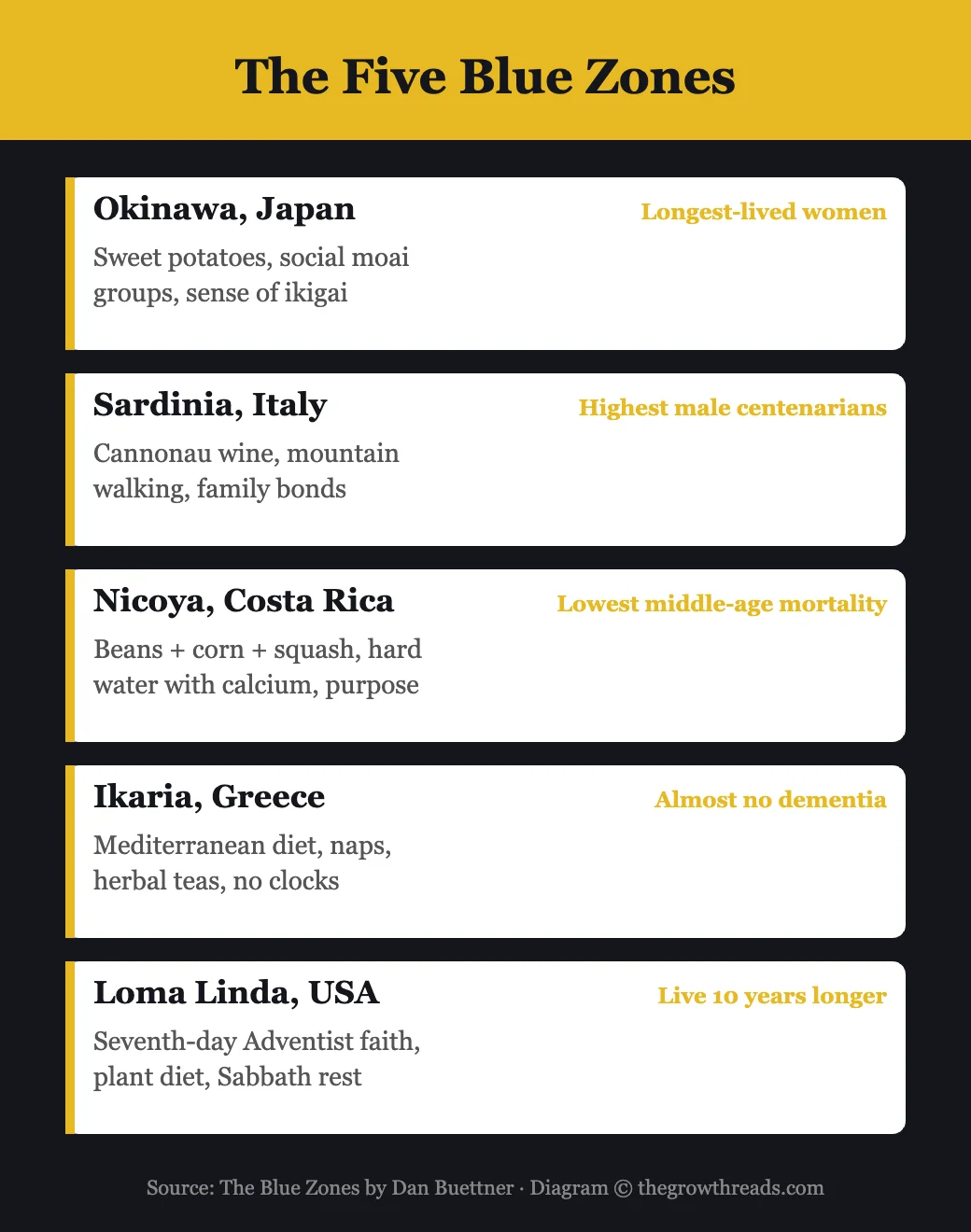
The world’s longest-lived people do not run marathons, take supplements, or follow diets — they live in environments that naturally promote movement, connection, purpose, and plant-rich eating. Dan Buettner spent years with National Geographic studying five communities around the world where people reach 100 at extraordinary rates: Okinawa (Japan), Sardinia (Italy), Nicoya (Costa Rica), Ikaria (Greece), and Loma Linda (California). Despite vast cultural differences, these Blue Zones share nine common lifestyle characteristics — the Power 9 — that explain their longevity. The book’s central insight is that longevity is not primarily genetic (only about 20% of lifespan is determined by genes) but is built by the unconscious daily habits that these communities have sustained for centuries.
Key takeaways
- Longevity is 80% lifestyle: Only about 20% of how long you live is determined by genetics. The remaining 80% is shaped by daily habits, environment, and social connections.
- Move naturally: Blue Zone centenarians do not go to gyms. They walk to the store, garden, knead bread, and build movement into every part of their day without thinking about it.
- Have a sense of purpose: Okinawans call it ikigai, Nicoyans call it plan de vida — knowing why you wake up in the morning adds up to seven years of life expectancy.
- Downshift daily: Every Blue Zone culture has a daily routine for shedding stress — Okinawans pause to remember ancestors, Ikarians nap, Sardinians do happy hour, Adventists pray.
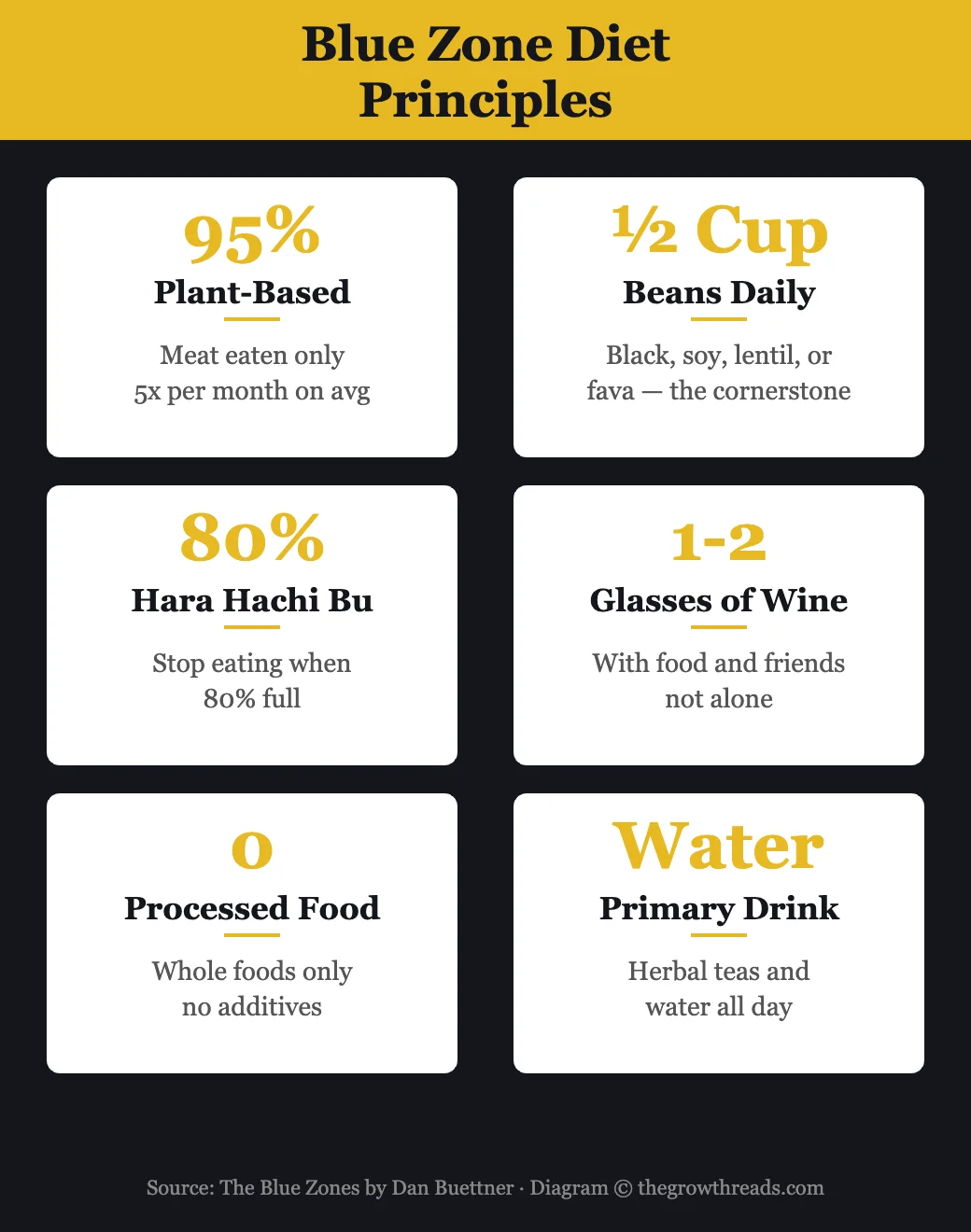
- Follow the 80% rule: Okinawans say “hara hachi bu” before meals — eat until you are 80% full, then stop. The 20% gap between not-hungry and full could be the difference between gaining and losing weight.
- Eat mostly plants: Beans — black, soy, lentil, fava — are the cornerstone of every Blue Zone diet. Meat is eaten on average only five times per month, in small portions.
- Moderate wine with meals: Moderate drinkers in Blue Zones (1–2 glasses per day, with food and friends) outlive non-drinkers. The key is consistency and social context, not quantity.
- Belong to a community: All but five of 263 centenarians Buettner interviewed belonged to a faith-based community. Denomination does not matter — attendance does.
- Put loved ones first: Blue Zone centenarians keep aging parents nearby, commit to a life partner, and invest time and love in their children, who then reciprocate in later years.
- Find your right tribe: Okinawans form moai — groups of five friends who commit to each other for life. Social circles powerfully shape health behaviours for better or worse.
What is The Blue Zones about?
The Blue Zones documents five communities around the world where people live measurably longer, healthier lives. Buettner identifies nine shared lifestyle principles — the Power 9 — covering natural movement, plant-based diet, stress management, social connection, purpose, and faith that explain their extraordinary longevity. The book argues these habits can be adopted anywhere.
About the author
Dan Buettner is a National Geographic Fellow, explorer, and bestselling author who has spent over two decades studying longevity around the world. He holds three world records for distance cycling and has led multiple National Geographic expeditions. His Blue Zones research, published in National Geographic’s cover story and developed through partnerships with AARP and the United Nations, has influenced public health policy in dozens of American cities through the Blue Zones Project. He is also the author of The Blue Zones Solution, The Blue Zones Kitchen, and The Blue Zones of Happiness. Explore all Dan Buettner book summaries →
Key concepts at a glance
| Concept | What it means | Use it when |
|---|---|---|
| Power 9 | Nine shared lifestyle characteristics of the world’s longest-lived people | You want a research-backed longevity checklist |
| Natural movement | Activity built into daily life rather than structured exercise | You hate the gym but want to stay active |
| Ikigai / plan de vida | A personal sense of purpose worth waking up for | You feel directionless or lack motivation |
| Hara hachi bu | Eat until 80% full, then stop | You struggle with portion control |
| Plant slant | A diet centred on beans, vegetables, and whole grains with minimal meat | You want to eat for longevity without extreme diets |
| Moai | Okinawan social groups of lifelong friends who support each other | You want to build a deeper social support network |
| Right tribe | Your social circle shapes your health behaviours | You want to surround yourself with people who reinforce healthy habits |
| Downshift | Daily routines for shedding stress — prayer, naps, happy hour | You carry chronic stress without a release valve |
Part 1: Discovering the Blue Zones
Buettner begins in Sardinia, where demographer Gianni Pes and researcher Michel Poulain had identified an extraordinary cluster of male centenarians in the mountainous Nuoro province. Working with shepherds who walked five or more miles daily over steep terrain, drank antioxidant-rich Cannonau wine, and ate a diet of whole-grain bread, beans, garden vegetables, and pecorino cheese, Buettner documented a lifestyle that kept men physically active and socially engaged well into their nineties. The social structure was critical: Sardinian men maintained their roles as patriarchs and community members throughout old age, never “retiring” from purpose.
In Okinawa, Buettner studied the world’s longest-lived women with a team of gerontologists who had tracked the population for decades. The Okinawan diet — centred on sweet potatoes, tofu, bitter melon, turmeric, and small amounts of pork — was calorically modest, and the practice of hara hachi bu (eating until 80% full) kept caloric intake naturally low without conscious dieting. But diet alone did not explain Okinawan longevity. The concept of ikigai — a personal reason for being — provided psychological purpose. And the moai system, where groups of five friends formed in childhood and committed to supporting each other for life, created a social safety net that no government program could replicate.
Buettner then profiles Loma Linda, California, where a community of Seventh-day Adventists live approximately ten years longer than the average American. Their longevity stems from a combination of plant-based diet (mandated by religious belief), weekly Sabbath rest (a built-in stress-relief day), strong community ties through the church, and abstinence from smoking and heavy drinking. Loma Linda demonstrates that Blue Zone principles work even in a modern Western context — environment design matters more than willpower.
Part 2: The Power 9 in detail
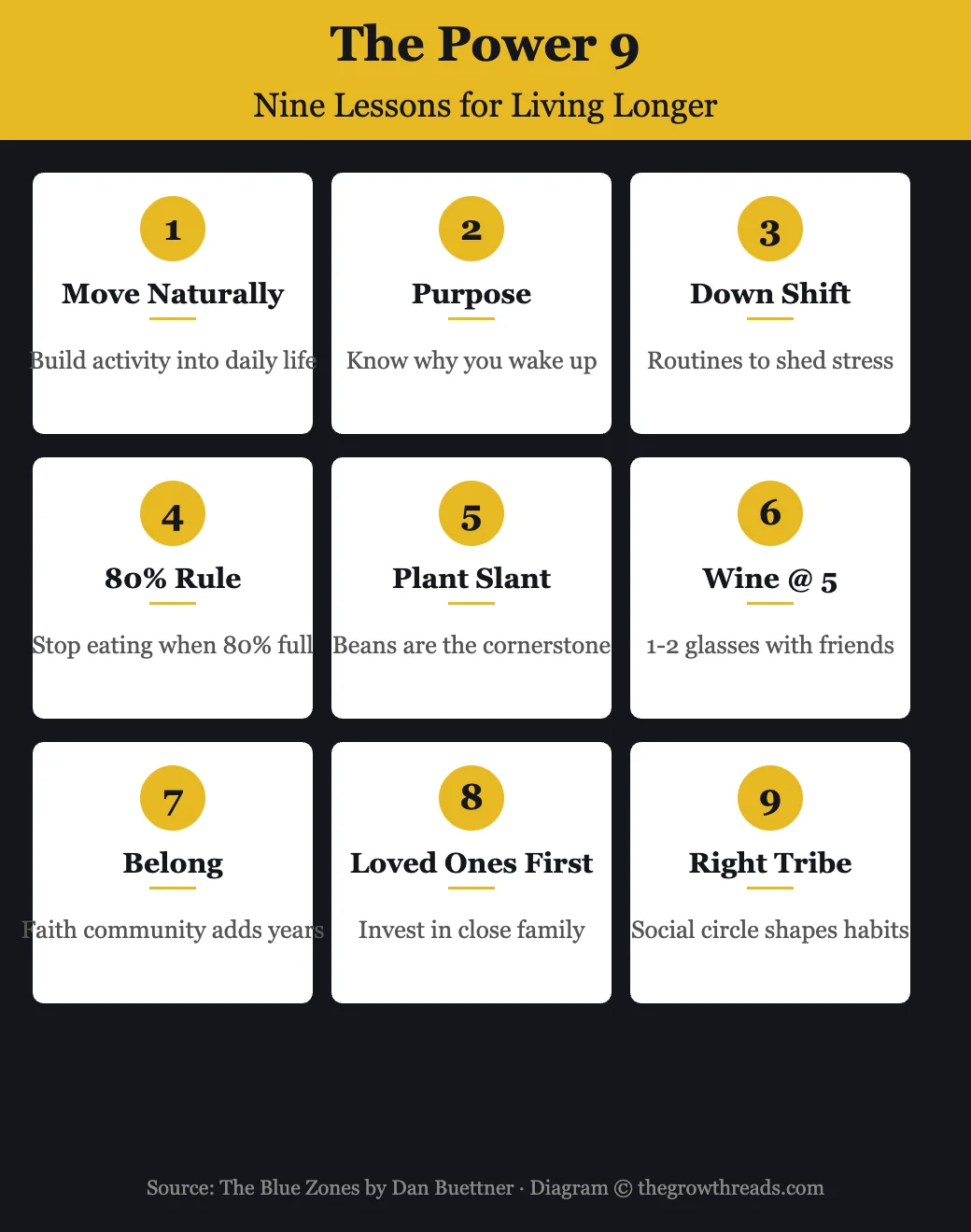
After profiling all five zones, Buettner synthesises their shared characteristics into the Power 9 — nine evidence-based lessons that appear consistently across cultures separated by thousands of miles. The first three are about movement and mindset: move naturally (build activity into your environment so it happens without conscious effort), have a sense of purpose (know why you wake up — this alone correlates with seven extra years), and downshift daily (every Blue Zone culture has ritualized stress relief, whether it is Okinawan ancestor remembrance, Ikarian napping, Sardinian happy hour, or Adventist prayer).
The next three are about eating: follow the 80% rule (stop eating before you feel full), maintain a plant slant (beans are the cornerstone — roughly a cup per day in every Blue Zone), and drink moderately (one to two glasses of wine per day, with food and friends, not alone). Buettner is careful to note that these are observational findings, not clinical prescriptions, but the consistency across cultures is striking.
The final three are about connection: belong to a community (faith-based attendance correlates with four to fourteen extra years regardless of denomination), put loved ones first (keep aging parents nearby, invest in your partnership and children), and cultivate the right tribe (Okinawan moai groups demonstrate that your social circle is one of the most powerful predictors of your health behaviours). Buettner calculates that adopting all nine practices could add ten to twelve years to an average American lifespan.
Part 3: Building your own Blue Zone
The book’s final section argues that you do not need to move to Sardinia to benefit from Blue Zone principles. Buettner advocates for environment design — structuring your life so that healthy choices become the default rather than the exception. This means keeping a fruit bowl on the counter instead of a cookie jar, owning a dog that requires daily walks, living in a walkable neighbourhood, and socialising with people who reinforce healthy habits.
Buettner’s Blue Zones Project has applied these principles to entire American cities. In Albert Lea, Minnesota, the project redesigned sidewalks to encourage walking, partnered with restaurants to offer smaller portions, and created community moai groups. Within a year, participants had added an estimated 3.1 years to their lifespans through measurable improvements in diet, exercise, social connection, and stress management.
Who is The Blue Zones best for — and who should read something else first?
The Blue Zones is perfect for anyone who wants a holistic, evidence-based approach to longevity that goes beyond diet and exercise to include purpose, community, and stress management. If you want a more clinical and detailed longevity protocol with specific biomarker targets, read Outlive by Peter Attia. If you are primarily interested in the dietary science, start with The Longevity Diet by Valter Longo. If you want to focus on the movement component, try Built to Move.
Questions to reflect on
- Which of the Power 9 practices are already part of your daily life, and which are completely absent?
- Do you have a clear sense of purpose — an ikigai — that motivates you beyond work and obligations?
- How much of your daily physical activity is structured exercise versus natural movement built into your routine?
- Who are the five people you spend the most time with, and do their health habits support or undermine yours?
- What would change if you adopted hara hachi bu and stopped eating at 80% full for the next two weeks?
🔥 Ready to design a lifestyle that adds years to your life?
The Blue Zones reveals nine simple principles from the world’s longest-lived people.
How to apply The Blue Zones (7-day plan)
- Day 1 — Audit your Power 9: Score yourself 1–10 on each of the nine practices. Identify the two or three with the lowest scores — these are your highest-leverage opportunities.
- Day 2 — Add natural movement: Walk to one destination you would normally drive to. Take a 15-minute walk after dinner. If possible, garden, clean, or do manual tasks instead of sitting.
- Day 3 — Try hara hachi bu: Before each meal, pause and say “I will eat until 80% full.” Use a smaller plate. Eat slowly and check in with your hunger halfway through.
- Day 4 — Eat a Blue Zone day: Make beans the centrepiece of at least one meal. Cut meat entirely for the day. Eat whole grains, vegetables, and nuts. Notice how you feel by evening.
- Day 5 — Downshift: Build a stress-relief ritual into your day. This could be a 20-minute nap, a quiet walk, 10 minutes of prayer or meditation, or an unhurried conversation with a friend.
- Day 6 — Connect: Call or visit someone you care about but have not contacted recently. Have a meal with family or friends with no screens present. Prioritise depth over breadth.
- Day 7 — Design your moai: Identify three to five friends who share your values and health goals. Propose a regular commitment — a weekly walk, a monthly dinner, a shared challenge — that creates accountability and connection.
Frequently asked questions
Are the Blue Zones findings scientifically rigorous?
The Blue Zones research is built on demographic verification by Gianni Pes, Michel Poulain, and other researchers who confirmed centenarian populations through birth records and civil registries. The findings are observational — they show correlations between lifestyle factors and longevity, not controlled experiments. However, the consistency of the same nine factors across five culturally distinct populations on different continents significantly strengthens the evidence. Individual claims (like specific years added by purpose) are estimates, but the overall pattern is robust.
Do I need to become vegetarian to follow the Blue Zone diet?
No. Blue Zone populations are not vegetarian — they eat meat, just much less of it than typical Western diets. The average is about five times per month in small portions (roughly 3–4 ounces). The emphasis is on a plant-slant diet where beans, vegetables, whole grains, and fruit form the foundation, with meat as an occasional complement rather than the centrepiece. Even modest reductions in meat consumption toward this pattern can produce health benefits.
Does the wine recommendation apply to everyone?
Buettner is careful to note that moderate wine consumption (1–2 glasses daily with food and friends) is observed in most Blue Zones, but he does not recommend that non-drinkers start drinking. The longevity benefit appears to come from the combination of moderate consumption, social context, and antioxidant-rich varieties like Cannonau. People with a history of alcohol dependency, certain medical conditions, or religious convictions against alcohol should not interpret this as medical advice to start drinking.
What is the most important of the Power 9?
Buettner resists ranking them because they work synergistically — the combination is more powerful than any single factor. However, if pressed, he has said that social connection (Right Tribe, Loved Ones First, Belong) is the most underrated and potentially the most impactful. The Okinawan moai system, which provides lifelong social support, is associated with lower stress, better eating habits, more physical activity, and greater purpose — it amplifies all the other factors.
How does The Blue Zones compare to Outlive by Peter Attia?
Outlive is a clinician’s guide to longevity focused on biomarkers, screening, exercise protocols, and nutritional biochemistry. The Blue Zones is an anthropologist’s guide focused on lifestyle design, community, purpose, and dietary patterns observed in real populations. Attia is more prescriptive and detailed about what to measure and optimise; Buettner is more holistic and emphasises the environmental and social conditions that make healthy behaviour automatic. The two books complement each other perfectly.
Can I create a Blue Zone in a modern city?
Yes — Buettner’s Blue Zones Project has done exactly this in dozens of American cities. The project redesigns environments to make healthy choices easier: wider sidewalks, community gardens, restaurant partnerships offering smaller portions, workplace wellness programs, and organised moai groups. In Albert Lea, Minnesota, participants gained an estimated 3.1 years of lifespan within a year. The key insight is designing your environment so you do not have to rely on willpower.
Is genetics not the main factor in longevity?
Research on Danish twins suggests only about 20% of how long you live is determined by genes. The remaining 80% is shaped by lifestyle, environment, and social factors. Blue Zone centenarians do not carry special longevity genes — they live in environments where the default behaviours happen to be the ones that promote long life. This is encouraging because it means most of the factors that determine your lifespan are within your control, particularly through environment design.
Related summaries
- Outlive by Peter Attia — A clinical approach to longevity with specific biomarker targets and exercise protocols.
- The Longevity Diet by Valter Longo — The scientific case for a plant-heavy, calorie-conscious diet modelled on centenarian populations.
- Breath by James Nestor — How breathing practices affect health, stress, and longevity.
- Why We Sleep by Matthew Walker — The science of sleep and its critical role in healthspan.
📚 Explore more in our Best Health Books guide.