

★★★★☆ 4.4/5 — A battle-tested leadership framework for transforming rigid hierarchies into adaptive networks, drawn from one of modern warfare’s most dramatic turnarounds.
Best for: Leaders managing complex, fast-moving environments who need their organisations to respond faster than traditional command structures allow.
Reading time: ~8 hours (304 pages)
Difficulty to apply: High — the principles are clear but require significant organisational change and leadership courage to implement.
Team of Teams in one minute
The most powerful military in history was losing to a decentralised insurgency — not because of inferior resources, but because of superior structure. General Stanley McChrystal discovered that his elite Joint Special Operations Command, optimised for efficiency and hierarchy, could not keep pace with Al Qaeda in Iraq’s flat, networked organisation. His solution was to transform a command of teams — where elite units operated in silos — into a team of teams, where shared consciousness replaced need-to-know secrecy and empowered execution replaced top-down approval chains. The result was a 17x increase in raid tempo and, ultimately, the dismantling of Al Qaeda in Iraq. This book extracts those lessons into a framework any organisation can use to thrive in complexity.
Key takeaways
- Efficiency is not enough: Organisations optimised for efficiency through rigid hierarchies cannot respond fast enough to complex, rapidly changing environments.
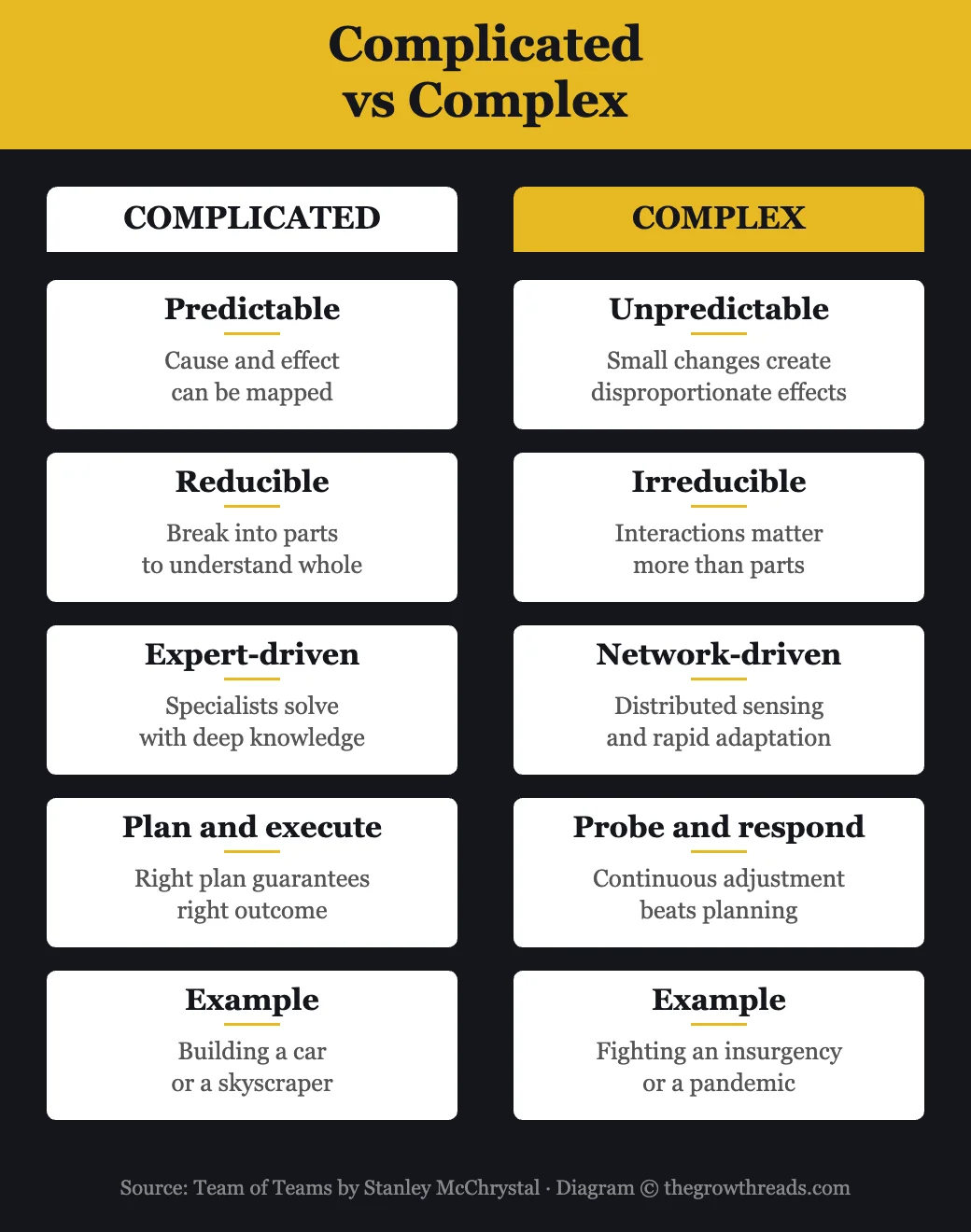
- Complicated is not complex: Complicated problems (like building a car) can be solved with expertise and planning. Complex problems (like fighting an insurgency) are unpredictable and require adaptability.
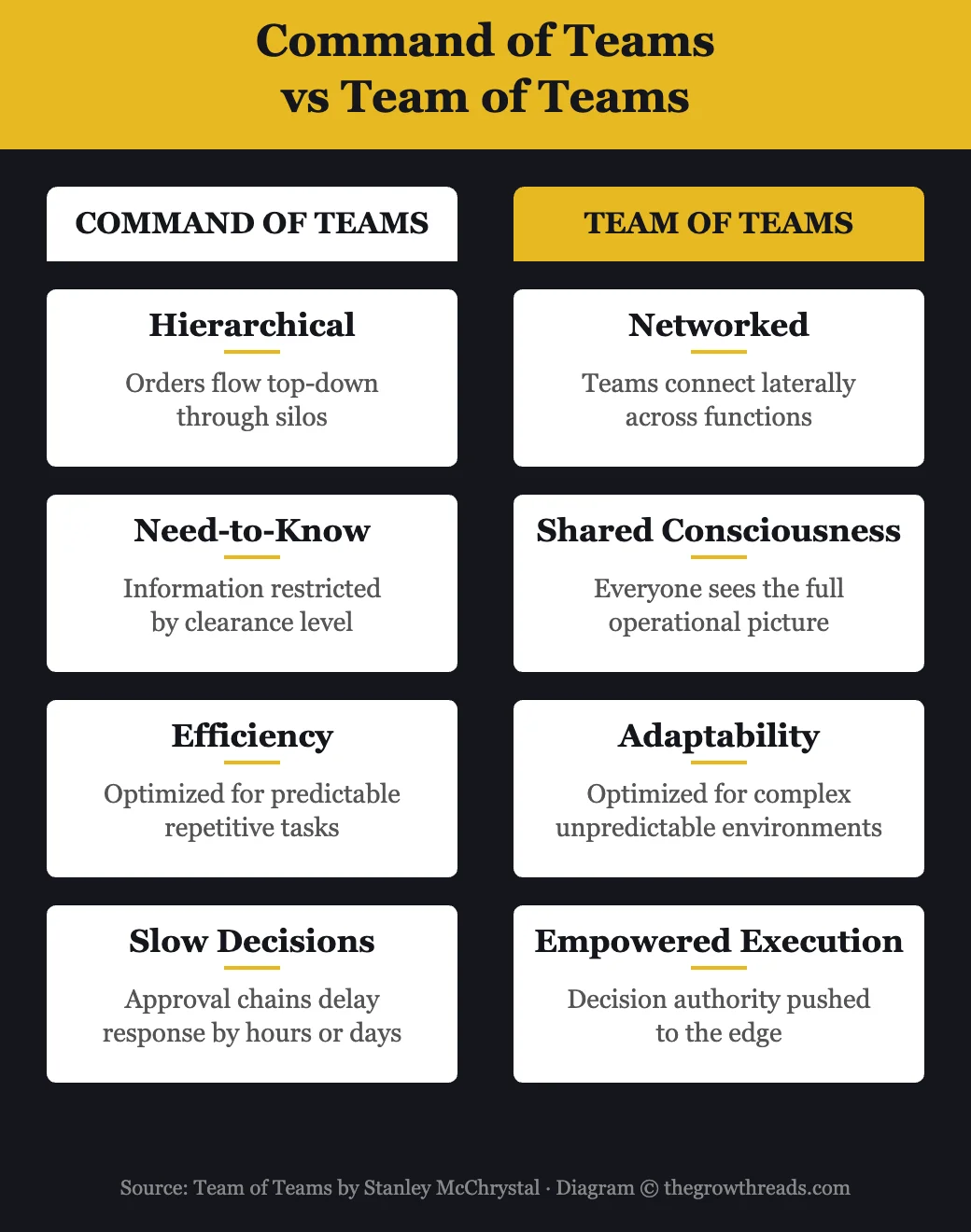
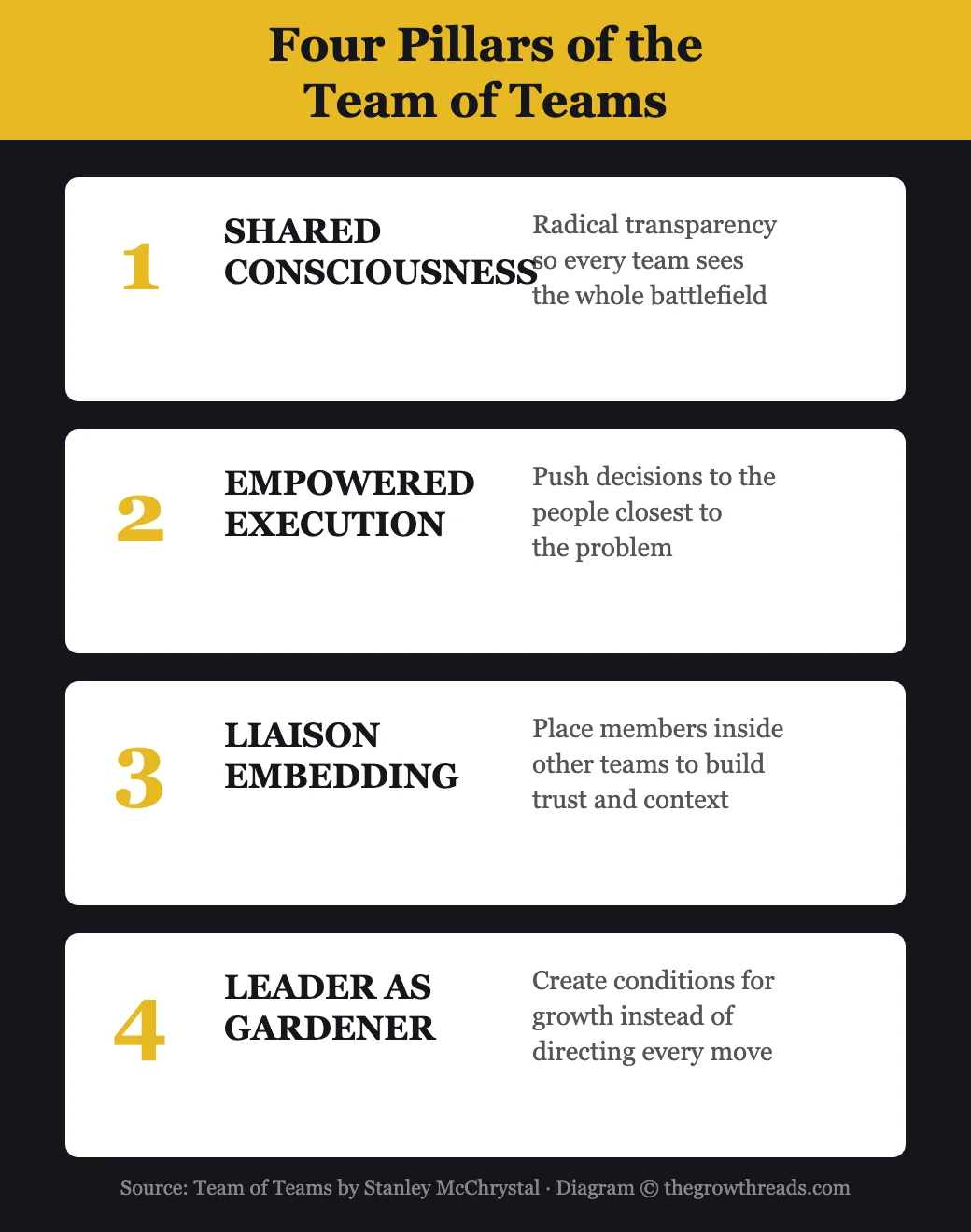
- Shared consciousness beats need-to-know: When every team understands the full operational picture, decisions improve dramatically because context replaces guesswork.
- Empowered execution beats approval chains: Pushing decision authority to the people closest to the problem eliminates the delay that kills effectiveness in fast-moving situations.
- Trust is the operating system: Shared consciousness and empowered execution only work when deep trust exists between teams — and trust must be deliberately built through embedding and transparency.
- Liaison embedding creates bridges: Placing trusted members from one team inside another team creates the personal relationships that transform siloed units into a connected network.
- Leaders must become gardeners: Instead of directing every action like a chess master, leaders must create the conditions — transparency, trust, shared purpose — that enable the network to self-organise.
- The O&I forum was transformative: McChrystal’s daily 90-minute Operations and Intelligence briefing connected 7,000 people across the globe, creating shared understanding at a scale previously thought impossible.
- Speed requires decentralisation: When the environment changes faster than information can travel up and down a hierarchy, the only option is to push authority outward.
- Resilience trumps prediction: In complex environments, the ability to adapt quickly to surprises matters more than the ability to predict and plan.
What is Team of Teams about?
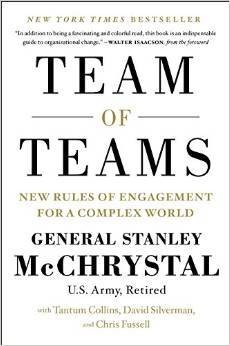
Team of Teams describes how General McChrystal transformed the Joint Special Operations Task Force from a traditional military hierarchy into an adaptive network to defeat Al Qaeda in Iraq. The book argues that in complex environments, organisations must replace efficiency-driven hierarchies with networks built on shared consciousness, empowered execution, and radical transparency.
About the author
General Stanley McChrystal (retired) led the Joint Special Operations Command from 2003 to 2008 and served as commander of all U.S. and international forces in Afghanistan. He is widely credited with transforming special operations from a collection of elite but siloed units into an integrated intelligence-driven network. After retiring from the military, he founded the McChrystal Group, a leadership consulting firm, and became a senior fellow at Yale University’s Jackson Institute for Global Affairs. He co-authored the book with Tantum Collins, David Silverman, and Chris Fussell, all of whom served under his command. Explore all Stanley McChrystal book summaries →
Key concepts at a glance
| Concept | What it means | Use it when |
|---|---|---|
| Complicated vs complex | Complicated problems are predictable; complex problems are emergent and interconnected | You need to decide whether planning or adaptability is the right response |
| Shared consciousness | Radical transparency so every team sees the full operational picture | Silos are causing decisions based on incomplete information |
| Empowered execution | Decision authority pushed to the edge of the organisation | Approval chains are creating dangerous delays |
| Liaison embedding | Placing members inside other teams to build trust and lateral connections | Teams cooperate on paper but compete or distrust each other in practice |
| Leader as gardener | Creating conditions for growth rather than directing every action | You realise you cannot personally make every decision fast enough |
| O&I forum | A daily cross-functional briefing connecting the entire organisation | You need to build shared consciousness at scale |
| Eyes on, hands off | Leaders maintain awareness but resist the urge to intervene in every decision | You trust your teams but need to stay informed for strategic decisions |
Part 1: The limits of efficiency
McChrystal opens with a candid admission: in 2004, the most elite, best-resourced military force in history was losing to a ragtag insurgency. Al Qaeda in Iraq, led by Abu Musab al-Zarqawi, operated with terrifying speed and adaptability. A car bombing in Baghdad would trigger a kidnapping in Mosul within hours, which would fund an IED campaign in Fallujah within days. The Task Force could win every individual engagement and still lose the war because the enemy’s network could adapt faster than the Task Force’s hierarchy could respond.
The book traces the roots of this mismatch to Frederick Winslow Taylor and the scientific management revolution of the early 20th century. Taylor’s insight — that complex tasks could be broken into simple, repeatable steps performed by specialists — produced extraordinary efficiency gains. Every large organisation since, including the military, has been built on Taylorist principles: hierarchical command, specialised roles, standardised procedures, and information flowing up while orders flow down. This model works brilliantly for complicated problems — problems where cause and effect are linear, expertise can be applied, and planning produces reliable outcomes.
But Iraq was not a complicated problem. It was a complex one. Complex systems — weather, ecosystems, insurgencies — are characterised by interdependence, nonlinearity, and emergent behaviour. Small changes produce disproportionate effects. Expertise in one domain does not predict outcomes because the domains are interconnected. Planning fails because the environment changes faster than plans can be updated. McChrystal realised the Task Force needed not a better plan but a fundamentally different organisational model.
Part 2: Building shared consciousness
McChrystal’s first transformation was dismantling the need-to-know information culture that had defined military intelligence for decades. In the traditional model, information was compartmentalised: each team saw only its own slice of the battlefield. A Navy SEAL team raiding a house might not know what the CIA analysts had learned about the network connecting that house to a broader financing operation. The result was that individual operations succeeded tactically but failed to generate strategic momentum because no one could see the connections.
The solution was what McChrystal calls shared consciousness — a state in which every member of the organisation has access to the information they need to understand not just their own task but the wider context in which that task sits. The centrepiece was the Operations and Intelligence (O&I) forum, a daily 90-minute video teleconference that eventually connected over 7,000 participants across dozens of agencies and countries. Every morning, representatives from SEAL teams, Army Rangers, CIA stations, NSA analysts, FBI agents, and State Department officials briefed each other on what they had learned, what they planned, and what they needed. Nothing was off-limits.
The effect was revolutionary. An analyst in Virginia could hear a SEAL team leader in Ramadi describe a document found during a raid and immediately connect it to a financial pattern she had been tracking for months. A CIA officer in Amman could alert a Special Forces team in Mosul that the target they were pursuing had connections to a cell the Jordanians were monitoring. Information that would have taken days or weeks to percolate through formal channels was now shared in real time across the entire network.
Part 3: Empowered execution and the leader as gardener
Shared consciousness alone was not enough. Even when everyone could see the full picture, decisions still bottlenecked at the top. A raid team might identify a time-sensitive target, but the approval chain required sign-off from multiple levels of command — a process that took hours in a situation that demanded minutes. By the time approval came, the target had moved. McChrystal realised he needed to push decision authority outward, to the people closest to the action.
This was empowered execution: giving teams the authority to act on their own judgment, within the boundaries of the organisation’s shared purpose and understood intent. It required enormous trust. McChrystal had to trust that a 28-year-old captain on the ground had enough context — provided by shared consciousness — to make decisions that previously required a general’s approval. And it worked. Raid tempo increased from roughly 10 operations per month to 10 per night — a 17x increase — because decisions that once took hours now took minutes.
McChrystal describes his own transformation as a leader. He had spent his career as what he calls a “heroic leader” — the chess master who personally directed every move. In the new model, he had to become a gardener: someone who creates the conditions (transparency, trust, shared purpose) in which the organisation can self-organise and adapt. His mantra became “eyes on, hands off” — maintaining awareness of operations without intervening in every decision. This was psychologically difficult for a leader trained to control, but it was essential for the system to work at the speed the environment demanded.
Who is Team of Teams best for — and who should read something else first?
Team of Teams is essential for leaders running organisations that face fast-changing, unpredictable challenges — which increasingly means everyone. It is particularly valuable for executives managing cross-functional teams, military and government leaders, and startup founders scaling beyond the stage where one person can make every decision. If you are looking for more interpersonal leadership skills rather than organisational design, start with Dare to Lead by Brené Brown. If you want a complementary bottom-up perspective on empowering teams, read Turn the Ship Around! by David Marquet.
Questions to reflect on
- Is your organisation structured for efficiency or adaptability — and which does your environment actually demand?
- Where do information silos in your organisation cause decisions based on incomplete context?
- What decisions currently require your approval that someone closer to the action could make faster and better?
- How would your team’s performance change if every member understood the full picture, not just their piece?
- Are you leading as a chess master or as a gardener — and which does your situation require?
🔥 Ready to build an organisation that adapts faster than the competition?
Team of Teams offers a battle-tested blueprint for leading in complexity.
How to apply Team of Teams (7-day plan)
- Day 1 — Map your information silos: List the teams or departments in your organisation. For each, note what critical information they hold that others would benefit from knowing. Identify the three biggest gaps.
- Day 2 — Launch a daily standup: Create a brief (15–30 minute) cross-functional meeting where each team shares what they are working on, what they have learned, and what they need. Start small with two or three teams.
- Day 3 — Identify your bottleneck decisions: Track every decision that requires your personal approval today. Categorise them: which genuinely need your judgment, and which could be made by someone closer to the action?
- Day 4 — Embed a liaison: Arrange for one person from your team to sit with another team for a day, and vice versa. The goal is not to supervise but to build understanding and personal relationships.
- Day 5 — Define commander’s intent: Write a one-paragraph statement of your team’s purpose and boundaries — what you are trying to achieve and what constraints apply. Share it so people can make autonomous decisions aligned with it.
- Day 6 — Practice eyes on, hands off: Monitor a project or decision you would normally control, but resist the urge to intervene. Observe what happens. Debrief with the team afterward about what went well and what they needed.
- Day 7 — Review and expand: Assess which practices from this week improved speed and quality. Plan how to scale them across more teams. Identify the next information silo or approval bottleneck to address.
Frequently asked questions
Is Team of Teams only relevant to the military?
Not at all. While the origin story is military, McChrystal explicitly designed the book for civilian leaders. The second half focuses on applying the principles in businesses, hospitals, and government agencies. Companies like Intuit, Under Armour, and numerous healthcare systems have adopted the framework. Any organisation facing rapid change, cross-functional complexity, or information silos will find the model directly applicable — which is most organisations today.
Does Team of Teams mean eliminating hierarchy entirely?
No. McChrystal is explicit that hierarchy still serves important functions: setting strategic direction, allocating resources, and ensuring accountability. The team of teams model retains hierarchy for these purposes but dismantles it for information flow and decision-making. The change is from a hierarchy where information and decisions flow vertically to a network where information flows laterally and decisions are made at the edge, within boundaries set by leaders.
How big does an organisation need to be for this to apply?
The principles scale across sizes, but the specific practices differ. A ten-person startup does not need a formal O&I forum — they naturally share consciousness. But as organisations grow beyond around 50 people, silos form organically and the team of teams principles become increasingly important. McChrystal’s implementation scaled from hundreds to over 7,000 people across dozens of agencies, demonstrating that the model works at extreme scale.
What is the difference between Team of Teams and Turn the Ship Around?
Both books advocate pushing decision authority downward, but they operate at different levels. Marquet’s Turn the Ship Around focuses on transforming a single team (a submarine crew) through leader-leader principles and intent-based leadership. McChrystal’s Team of Teams focuses on connecting multiple teams into a networked organisation through shared consciousness and liaison embedding. The books complement each other beautifully: Marquet shows how to empower a single team; McChrystal shows how to connect empowered teams into a larger system.
How did McChrystal achieve the 17x increase in raid tempo?
The increase came from eliminating decision bottlenecks and information delays simultaneously. Before the transformation, a raid required intelligence collection, analysis, approval through multiple command levels, mission planning, and execution — a process taking days. After shared consciousness connected every analyst and operator in real time, and empowered execution removed the approval chain for time-sensitive targets, the entire cycle could be compressed into hours. Teams could act on intelligence the same night it was collected.
What is the biggest risk of implementing these ideas?
The biggest risk is implementing empowered execution without first building shared consciousness. If you push decision authority to the edge without ensuring people have the context to make good decisions, you get chaos. McChrystal is clear that the sequence matters: shared consciousness must come first, creating the informational foundation that makes empowered execution safe. The second risk is half-hearted transparency — sharing some information while hoarding the rest undermines trust.
How does the O&I forum work in practice?
The Operations and Intelligence forum was a daily 90-minute video teleconference connecting over 7,000 participants across the globe. Each briefing covered the previous day’s operations, current intelligence picture, and planned activities. Representatives from every team and agency reported openly, and anyone could ask questions. McChrystal personally attended every session, modelling the behaviour he expected and maintaining his own situational awareness. The forum consumed enormous resources — thousands of person-hours daily — but McChrystal argues it was the single most important investment in the transformation.
Related summaries
- Turn the Ship Around! by L. David Marquet — The complementary bottom-up approach to empowering individual teams.
- The Culture Code by Daniel Coyle — How the world’s most successful groups build the trust that Team of Teams requires.
- Extreme Ownership by Jocko Willink — Another military leadership framework focused on personal accountability.
- The Lean Startup by Eric Ries — A startup-focused approach to the same challenge of thriving in uncertainty.
📚 Explore more in our Best Leadership Books guide.