

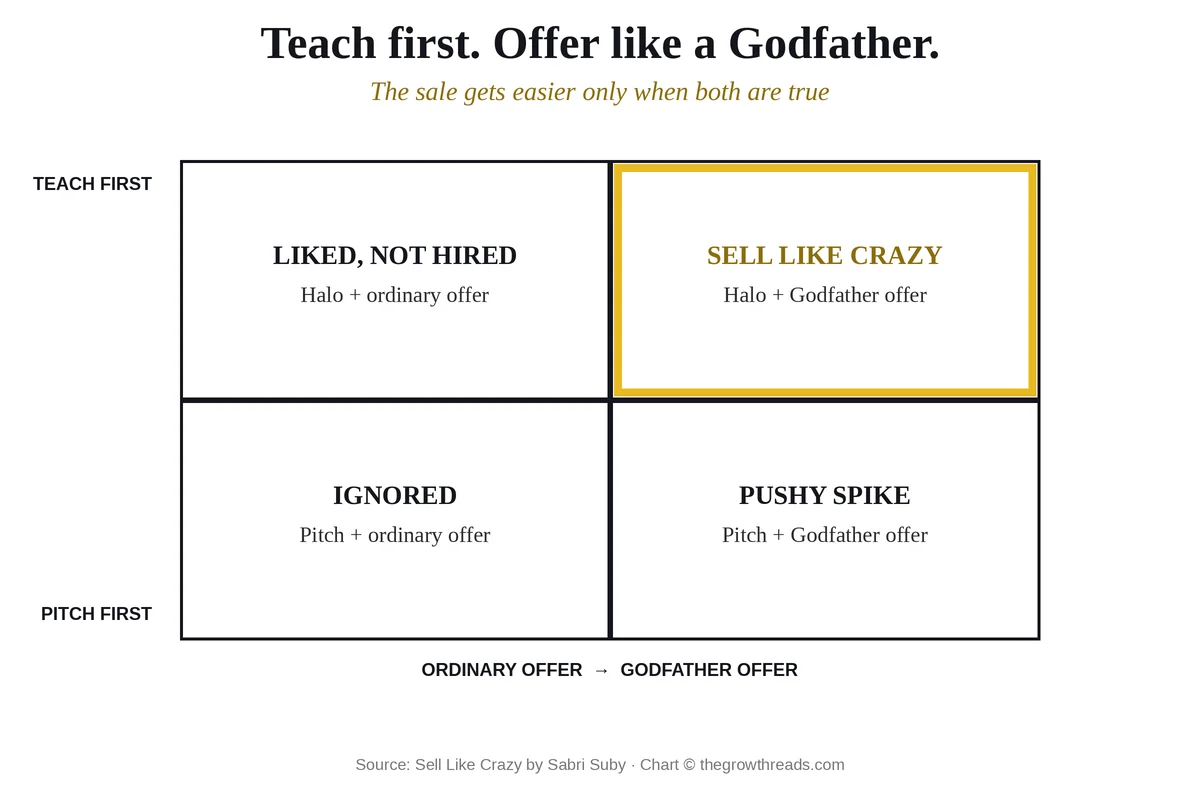
★★★★½ 4.6/5 — Teach the useful part first, then make the offer complete.
Best for: service businesses, agencies, and consultants who need clients.
Reading time: ~6 hrs, guide 18 min · Difficulty to apply: medium, once you have a real service.
Sell Like Crazy in one minute
Strangers do not buy a logo. They buy a clear next step from someone who already helped. Sabri Suby’s Sell Like Crazy is a client-getting sequence for people who sell expertise, not a catalog of ad hacks. You name one dream buyer, the person whose problem you can describe without looking at your services page. You publish a high-value piece that teaches the mechanism of the result they want. Then you present a Godfather offer: a promise, proof, a bonus, and a guarantee, priced against the cost of leaving the problem alone.
The middle of the book is where most owners quit. They will rename the buyer and they will not write the teaching piece. They will stack bonuses and they will not follow up with more help after the first quiet no. Suby’s point is that the sequence is the strategy. A clever headline on top of a vague offer still leaves the calendar empty. Run one buyer, one piece of teaching, and one complete offer for a week before you touch the brand.
Key takeaways
- Dream buyer first: one person, a painful now, and a wanted after, in their words.
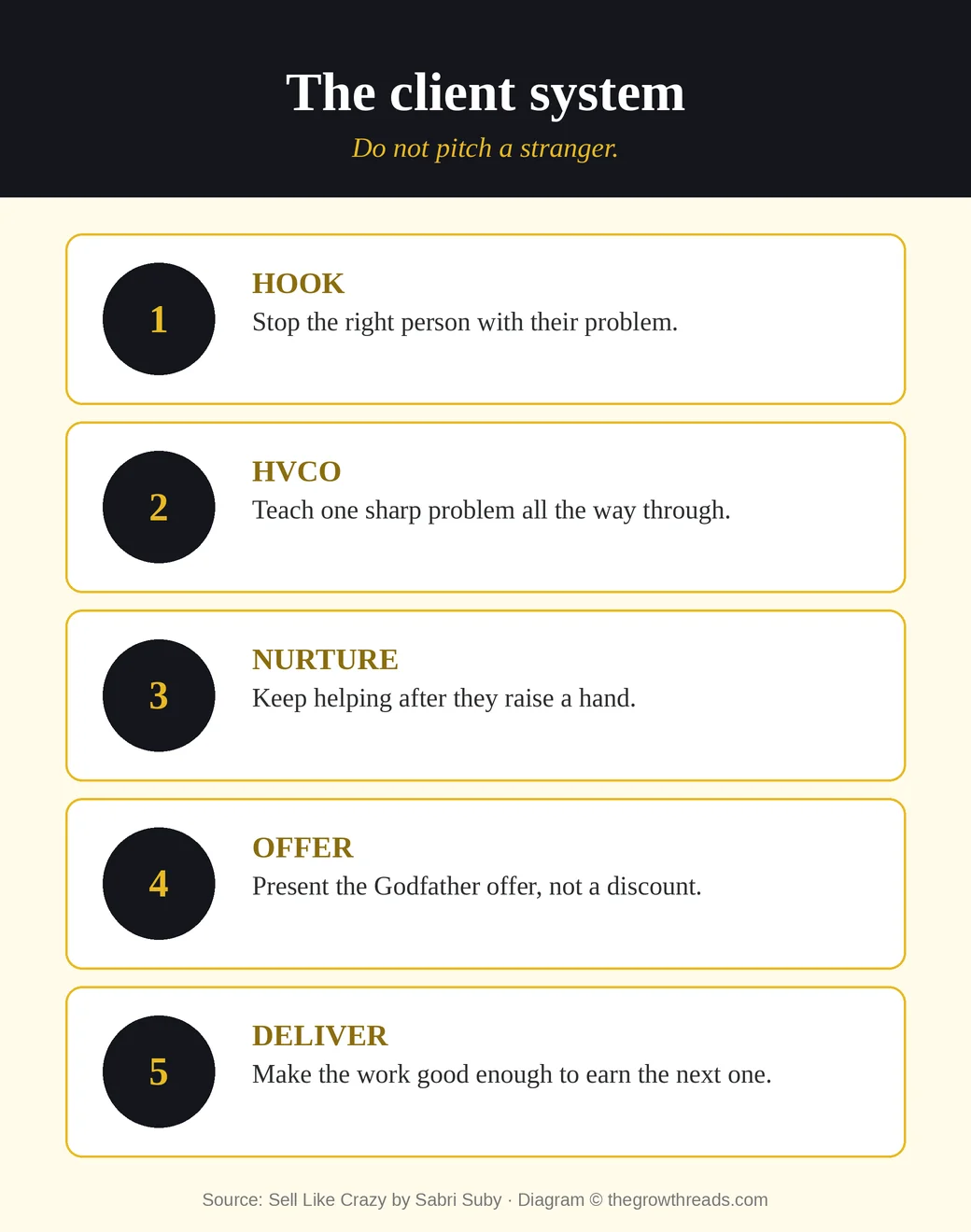
- A market is a sequence: hook, teach, nurture, offer, deliver. Random posts are not a market.
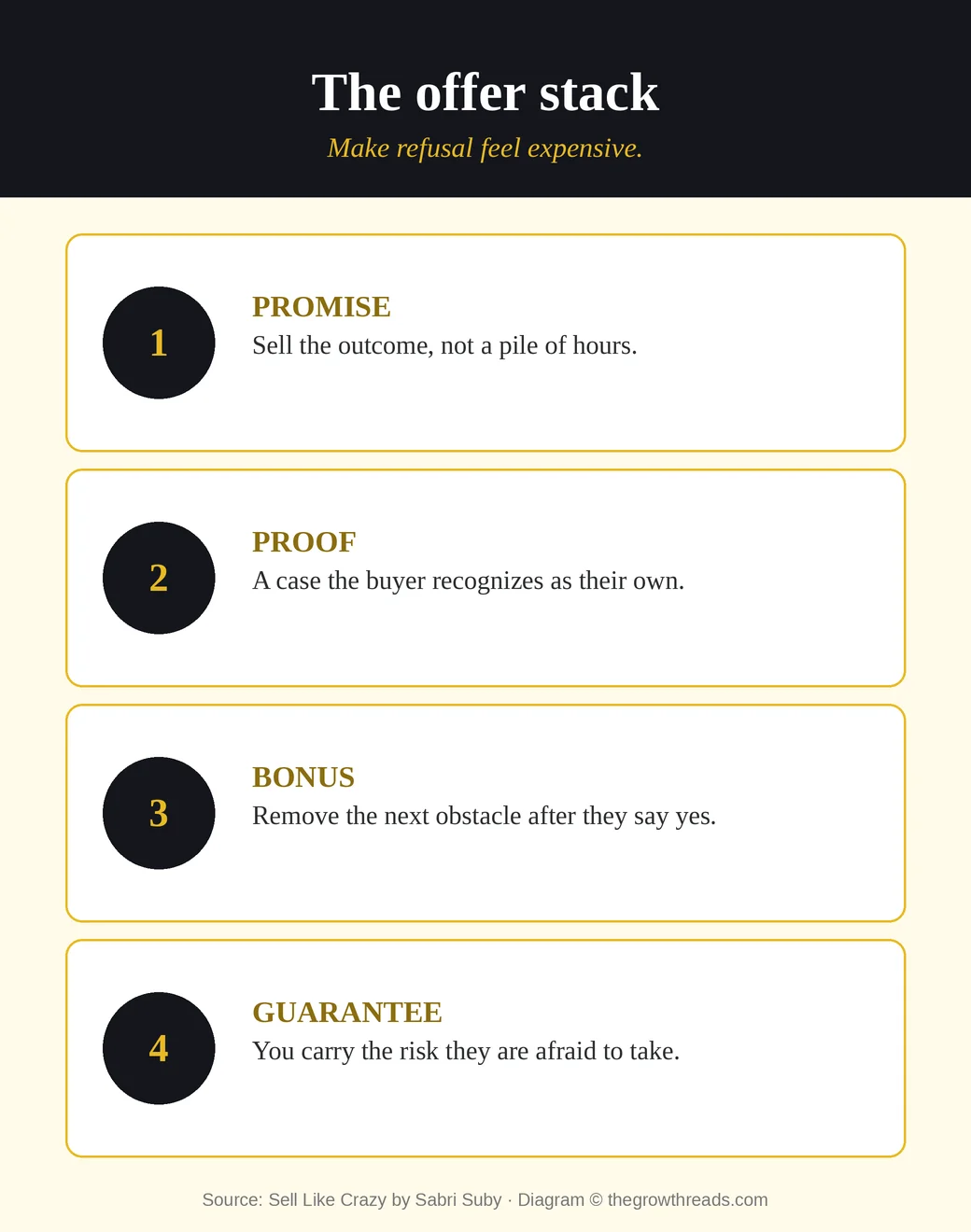
- Godfather offer: promise, proof, bonus, and a guarantee, so the status quo looks expensive.
- Halo strategy: teach the mechanism in public before you sell the done-with-you version.
- HVCO: the lead magnet solves one narrow problem. A five-tip teaser does not.
- Temperature: cold traffic gets education. Only warm traffic should see the hard ask.
- Follow-up is more teaching: the first no is usually not yet, or not clear.
- Price the problem: set the number against the cost of staying stuck, not against a cheap hourly rate.
- Delivery is marketing: the work after the yes is what makes the next buyer easier.
What is Sell Like Crazy about?
Sell Like Crazy is a client-getting system for people who sell a service. Sabri Suby argues that logos and random posts are not a market. You name one dream buyer, teach that person something useful in public, and only then present an offer so complete that refusing it feels expensive.
About the author
Sabri Suby founded King Kong, a direct-response agency in Australia, and published Sell Like Crazy in August 2019. The paperback runs 352 pages. He wrote it as an operator, not as a professor: the client-getting sequence a service business can run without a giant brand budget. The voice is direct. The subject is offers, teaching, and follow-up. Explore all Sabri Suby book summaries →
Suby does not have a Wikipedia page, and this summary does not invent a biography to fill the gap. What matters for the reader is the sequence. Name the buyer. Make the offer complete. Teach before you pitch. Keep helping after the first no. If you want the offer math in a later book from a different author, pair this with $100M Offers. If you want the whole market on one page first, pair it with The 1-Page Marketing Plan.
Key concepts at a glance
| Concept | What it means | Use it when |
|---|---|---|
| Dream buyer | One person, a painful now, and a wanted after, in their words. | You are about to say you help everyone. |
| Godfather offer | Promise, proof, bonus, and a guarantee. Refusal feels expensive. | The offer is a list of hours and a rate. |
| Halo strategy | Teach the mechanism before you ask for the money. | You are hiding the useful part and teasing. |
| HVCO | A high-value piece that solves one narrow problem. | The lead magnet is a thin checklist. |
| Traffic temperature | Cold traffic gets teaching. Hot traffic can see the offer. | You send a hard pitch to strangers. |
| Follow-up | More help after the first no, not a poke. | You stop after a single email. |
| Price framing | The number sits next to the cost of the unsolved problem. | You match the cheapest competitor. |
Name the dream buyer before you name the service
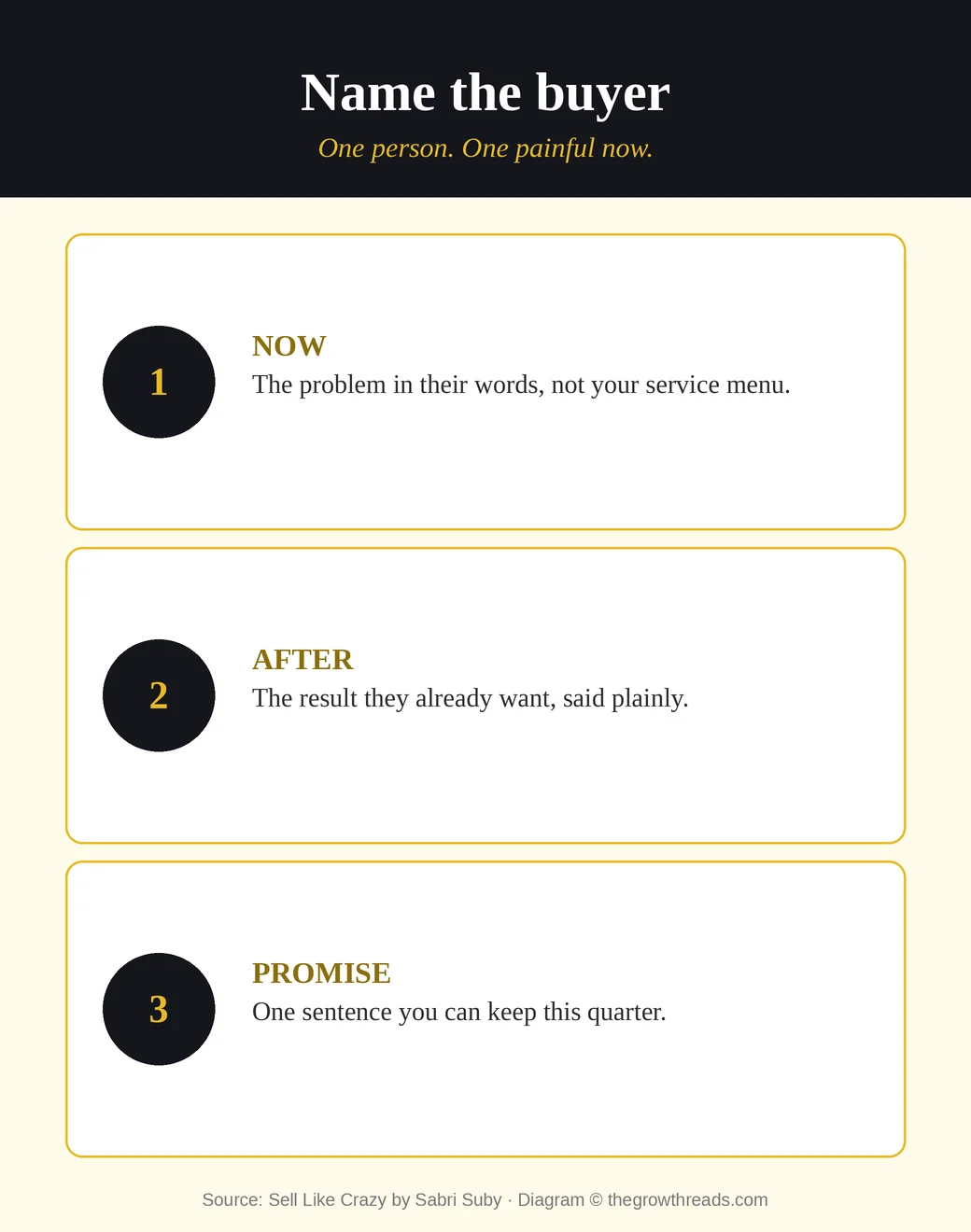
Most service sites open with the firm. Years in business. A row of logos. A menu of packages named after metals. Suby starts at the other end. The dream buyer is not a demographic slide. It is a person you could text. What hurts on a Tuesday. What they have already tried. What they would call the result if they were explaining it to a friend, with no jargon from your industry.
Write three lines and stop. The painful now. The wanted after. The promise you can actually keep this quarter. If the promise needs a comma and a second audience, you still have two buyers. Pick one. A clinic that wants local patients and a software firm that wants enterprise retainers are not one campaign. They do not share a hook, a story, or a guarantee.
The test is language. Read the three lines out loud. If you hear your brochure, rewrite them until you hear the buyer. That paragraph becomes the hook, the opening of the teaching piece, and the first line of the offer. Everything later in the book is a waste if this paragraph is still about you.
TGR Note: Allan Dib puts the same instinct on one page in The 1-Page Marketing Plan: before, during, and after, with a specific market rather than a slogan. Use Suby when you need the words the buyer already uses. Use Dib when you need the nine squares so nothing in the path is blank.
Build the Godfather offer
The Godfather offer is the book’s signature idea, named for an offer that is hard to refuse because the alternative is worse. Suby is not asking you to copy a film, and he is not asking you to fake scarcity. He wants four pieces on one sheet. A promise of the outcome, not the tasks. Proof the buyer recognizes, a case or a number you can stand behind. A bonus that removes the obstacle that appears the day after they say yes. A guarantee that puts the risk on you.
Then put the price next to the cost of doing nothing. A bookkeeping firm that prevents a five-figure tax mess is not competing with the cheapest hourly bookkeeper. A consultant who shortens a stalled launch is not competing with a free PDF. If you cannot name the cost of the unsolved problem, you do not have an offer yet. You have a rate card.
Keep the sheet short enough to read without a call. If it needs a sixteen-page deck before it makes sense, the promise is still muddy. One outcome. One proof. One bonus. One guarantee. One price. You can add sophistication after a real buyer has said yes or no to that sheet.
TGR Note: Alex Hormozi builds the same muscle in $100M Offers, with more time on the value equation and less on the path that leads a stranger to the page. If your sheet is still a menu of packages, read Hormozi before you buy more traffic. If the sheet is sharp and nobody sees it, stay with Suby and publish the teaching piece.
Teach first with a high-value piece
The Halo strategy is how the offer gets a fair hearing. You give away the thinking. You sell the implementation, the speed, and the accountability. The vehicle is what Suby calls a high-value content offer. Not a teaser. A piece that takes one narrow problem from the dream-buyer paragraph and teaches it far enough that a diligent reader could start on Monday.
Pick the problem that sits just upstream of the paid work. A web designer might teach how to tell a weak homepage from a clear one, then sell the rebuild. A sales coach might teach how to write the first three lines of a follow-up, then sell the weekly practice. The piece can be a short guide, a recorded walkthrough, or a live working session. The format matters less than the completeness. If the reader finishes and still does not know what to do, it was a brochure.
Match the depth to the temperature. Someone who has never heard of you needs the teaching. Someone who already read it, replied, or sat in the session can hear the offer. Sending the price to a cold list is how small firms train the market to ignore them. Russell Brunson maps a related ladder in DotCom Secrets and the congregation in Traffic Secrets. Suby’s version is blunter: be useful in public, on purpose, for one buyer.
TGR Note: Marcus Sheridan’s They Ask, You Answer is the same instinct in a content library: answer the questions buyers already ask, including price and fit. Use Sheridan when you need a publishing habit. Use Suby when you need one flagship piece that leads to one offer, not fifty blog posts with no ask.
Follow up until the decision is easy
The first response is rarely a signed agreement. It is silence, a polite not now, or a question that shows the promise was fuzzy. Suby treats follow-up as more of the halo, not as a nudge that only says checking in. Each note should teach one more slice, answer one objection, or show one proof. Three useful notes beat seven pokes.
Write them before you need them. Note one: the mistake buyers make when they try the mechanism alone. Note two: a short case in their language, without invented numbers. Note three: the guarantee again, in one paragraph, next to the price and the cost of waiting. If you cannot write note two without making up a result, you do not have proof yet. Go get one small win and tell that story honestly.
Delivery closes the loop. The work after the yes is the next campaign. A client who got the outcome will say the words your dream-buyer paragraph was missing. Put those words back into the hook. That is how the sequence compounds. A funnel diagram on a whiteboard does not compound. Finished work does.
TGR Note: If the gap is the live conversation rather than the path into it, switch books. The Mom Test keeps you from pitching during a learning call. To Sell Is Human is the broader case that selling is helping someone decide. Fanatical Prospecting is the daily habit when the channel is outbound, not a published piece. Come back to Suby when you are ready to put a complete offer behind that habit.
Who is Sell Like Crazy best for — and who should read something else first?
Read this if you already sell a service and the calendar depends on referrals you cannot predict. Agencies, consultants, coaches, clinics, and specialist firms get the most from it, because the dream buyer is specific and the work has a clear after. You need enough skill to teach one mechanism without giving away the whole engagement. You do not need a media team.
Read something else first if you do not yet have an offer. The $100 Startup is the smaller door: a skill, a simple offer, one customer. Read $100M Offers first if every package on your site still looks the same. Read Building a StoryBrand first if the homepage cannot say what you do in a sentence. This book assumes that sentence exists, then shows you how to make it travel.
Questions to reflect on
- Who is the one buyer you could describe without opening your services page?
- What is the cost, in their life, of leaving the problem for another quarter?
- Which single mechanism could you teach completely in one guide or one session?
- What bonus would remove the fear that shows up the day after they pay?
- What would your next three follow-ups teach, if you were not allowed to write checking in?
🔥 Ready to make an offer people feel silly refusing?
Name one buyer, teach one useful idea, and put a guarantee next to the price.
How to apply Sell Like Crazy (7-day plan)
- Day 1 — One buyer. Write the painful now, the wanted after, and one promise. Half a page. No second audience.
- Day 2 — The sheet. Promise, proof you can stand behind, one bonus, one guarantee, one price next to the cost of waiting.
- Day 3 — The piece. Outline a high-value guide or a twenty-minute walkthrough that teaches the mechanism. Cut anything that is about your firm.
- Day 4 — Publish. Put it where that buyer already is. Send it to ten named people. Ask only whether the problem is the right problem.
- Day 5 — Note one. Write the first follow-up: the mistake people make when they try this alone. Send it to anyone who opened the piece.
- Day 6 — Note two. Add one true proof story and restate the guarantee in a short paragraph. No invented results.
- Day 7 — Decide. If two people understood the promise, keep the offer and improve the teaching. If nobody understood it, rewrite the promise before you buy traffic.
Frequently asked questions
What is Sell Like Crazy about?
Sell Like Crazy is Sabri Suby’s system for turning strangers into clients when you sell a service. The book argues that a logo, a color palette, and a stream of random posts are not a market. You pick one dream buyer, describe the painful now and the wanted after in their words, and publish something useful before you ask for money. The offer itself has to be complete: a clear promise, proof, a bonus that removes the next obstacle, and a guarantee. It is a field manual from agency work, written for owners who still do the selling.
What is a Godfather offer?
A Godfather offer is Suby’s name for an offer that feels irrational to refuse because the status quo is now the expensive choice. It is not a thicker pile of deliverables and it is not a discount. You name the outcome the buyer already wants, show proof they recognize, add a bonus aimed at the fear that shows up after they say yes, and put a guarantee next to the price. The price is framed against the cost of leaving the problem in place. Hourly rates and feature lists do not do that job. The offer has to make the decision feel obvious.
What is the Halo strategy?
The Halo strategy is the decision to teach the mechanism before you sell the implementation. Suby wants a high-value content offer, a piece that solves one narrow problem well enough that a motivated buyer could start, and still wants help doing it properly. The halo is the trust that sits over the later ask. Cold traffic gets the teaching. Hot traffic, people who already know you, can see the offer sooner. Opening with a price for a stranger throws away the only advantage a small firm has, which is being useful in public before the invoice.
Who is Sabri Suby?
Sabri Suby is the founder of King Kong, a direct-response agency in Australia, and the author of Sell Like Crazy, published in 2019. The book is the client-getting sequence he used with service businesses: name the buyer, build the offer, teach in public, and follow up with more help rather than more pressure. He is not an academic researcher, and the book does not pretend to be a literature review. It is an operator’s manual. There is no Wikipedia page to lean on. The useful test is whether you can run one week of the sequence with a real service.
Is Sell Like Crazy worth reading if you already know funnels?
Yes, if your funnel is a diagram and your calendar is still empty. Knowing the words opt-in, nurture, and close is not the same as having one buyer, one promise, and a piece of teaching you would send your best friend. The book is worth the time when your marketing is a stack of tactics that never became a sequence. It is less useful if you do not yet have a service, or if the real gap is the live conversation rather than the path into that conversation. In that case, read it after you can describe the work you sell in one sentence.
How is Sell Like Crazy different from $100M Offers?
Both books care about an offer that is hard to wave away. $100M Offers, Alex Hormozi’s book, spends its pages on the offer itself: value, proof, and the math of a grand slam. Sell Like Crazy spends more of its pages on the path around that offer. Who is the dream buyer, what do you teach them first, and how do you keep helping after the first no. Read Hormozi when the offer is mush. Read Suby when the offer is decent and strangers still never meet it. They sit well together. Neither replaces a week of actually publishing the useful piece.
What should I do the week after I finish it?
Do not rebuild the website. Write the dream buyer in a half page: the painful now, the wanted after, and one promise you can keep. Draft the offer on a single sheet with promise, proof, bonus, and guarantee. Publish one high-value piece that teaches the mechanism of that promise, and send it to ten people who match the buyer. Follow up twice with more help, not a nudge that only says checking in. At the end of the week you will know whether the offer is clear. A new brand board will not tell you that.
Related summaries
- $100M Offers — the offer math, when the sheet is still a menu.
- The 1-Page Marketing Plan — before, during, and after on one page.
- They Ask, You Answer — the publishing habit behind the halo.
- DotCom Secrets — the ladder a stranger climbs before the core offer.
- Best productivity books — the full shelf, including the sales and focus titles.
How we analyze books: we read for the mechanism you can use this week, paraphrase in our own words, and check the edition before we link to a retailer. Read our full methodology.