

★★★★½ 4.6/5 — One page you will actually run.
Best for: Owners who market in bursts and cannot point to a written plan.
Reading time: ~4.5 hrs, guide: 18 min
Difficulty to apply: Moderate. The grid is short. The follow-up is the work.
The 1-Page Marketing Plan in one minute
Stop collecting tactics and put customer-getting on one page you will reread. Allan Dib wrote The 1-Page Marketing Plan for owners who are still the marketing department. The page is nine squares. Before a stranger knows you, name the market, the message, and a channel you can measure. While they decide, capture a lead, teach them more than once, and make one clear offer. After they pay, deliver a result worth describing, grow what they are worth, and ask for referrals on purpose.
Key takeaways
- One page beats a binder: a plan you will not open on Tuesday is not a plan. Fit the system where you can see it.
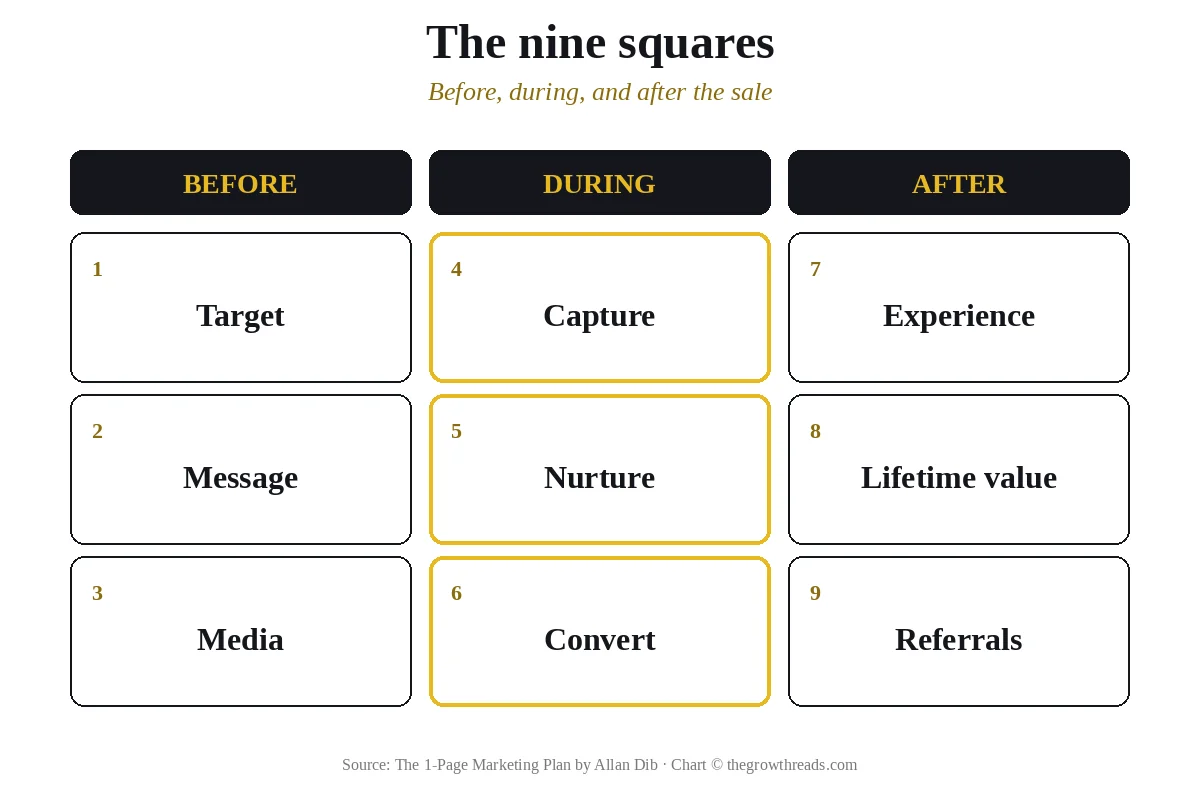
- Nine squares, three phases: before, during, and after. Three jobs in each phase, and no extra column for “someday.”
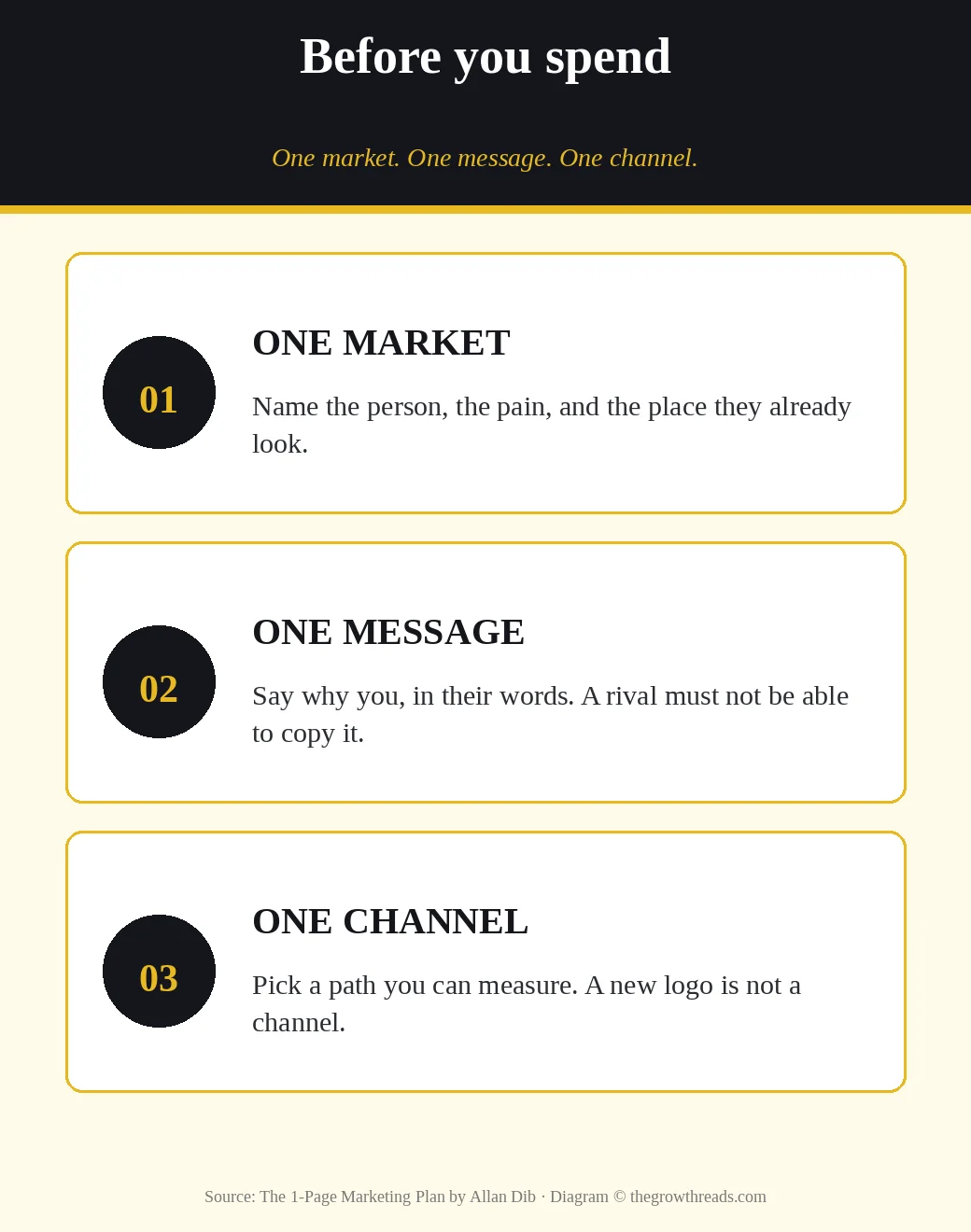
- Name one market: “everyone” is a way to be ignored. Describe a person, a pain, and the place they already look.
- Say why you, in their words: if a competitor could paste your sentence unchanged, square two is not finished.
- Measure the channel: pick a path that can report cost and leads. A fresh logo is not a media plan.
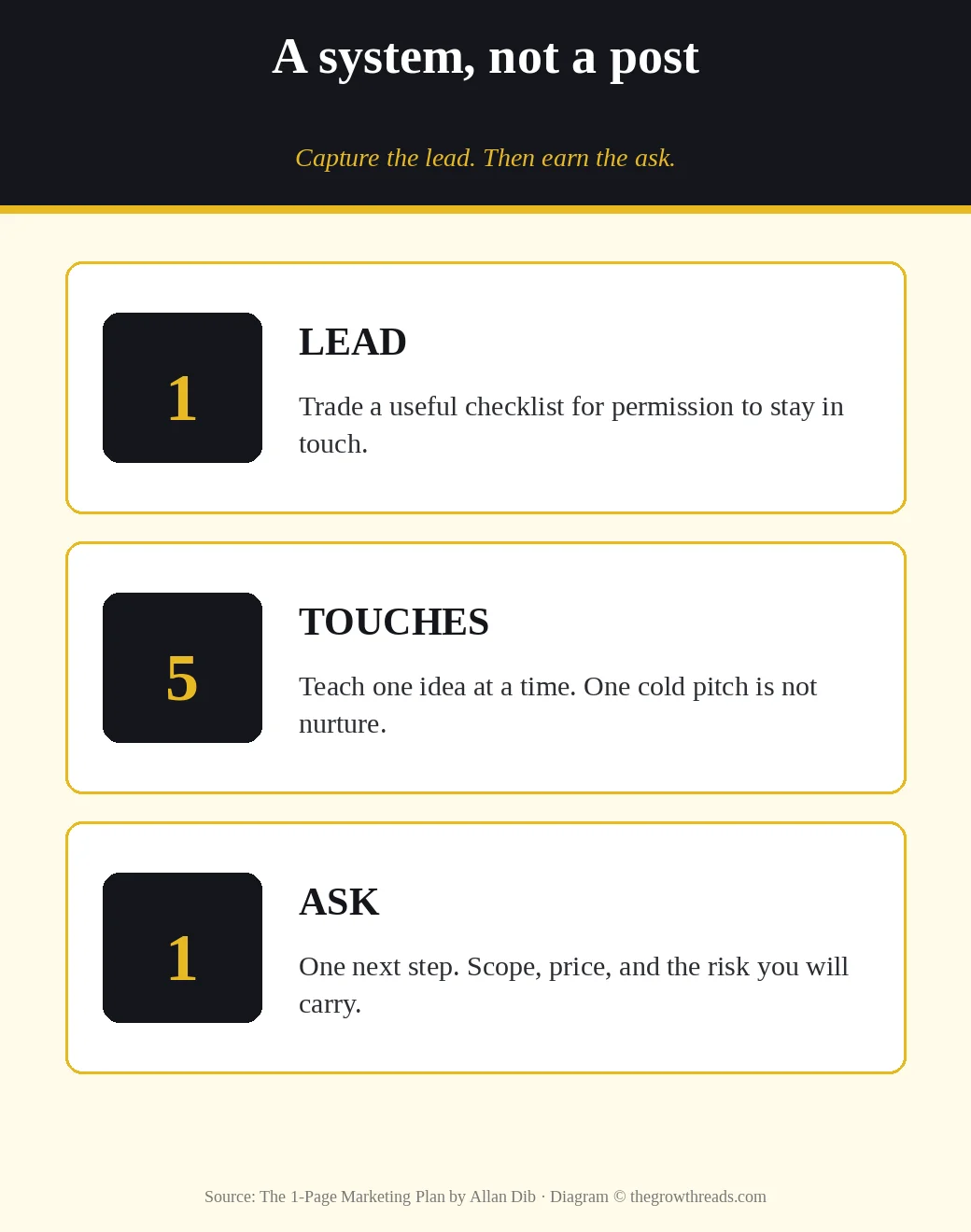
- Capture, then nurture: trade something useful for permission, then show up on purpose more than once.
- Make the offer obvious: what they get, what it costs, what happens next, and which risk you carry.
- Know the number: a rough lifetime value tells you what a lead may cost. Without it, every quiet week feels like failure.
- Profit sits after the yes: delivery, a next purchase, and a referral ask belong on the page, not in a later quarter.
What is The 1-Page Marketing Plan about?
The 1-Page Marketing Plan is Allan Dib’s system for owners who market without a department. Nine squares name who you serve, what you say, where you show up, how you capture and nurture a lead, how you ask for the sale, and how you deliver, expand, and earn referrals after the yes.
About the author
Allan Dib is an Australian entrepreneur and the founder of Successwise, a marketing practice built for owners who do not have a department. He wrote The 1-Page Marketing Plan after watching capable operators collect ads, logos, and funnels and still freeze when asked what a new customer was worth. The book is the grid he used in those rooms. Nine squares force a market, a message, and a measured way to reach people before any budget is spent. Explore all Allan Dib book summaries →
Dib’s authority is operational. He built and sold businesses, then taught the same direct-response sequence to consultants, local services, and small product companies. He is not asking you to become a brand agency. He is asking you to keep one page current, run the follow-up, and let the numbers decide which square to fix next. The 2025 Authors Equity edition keeps that grid intact across 240 pages.
Key concepts at a glance
| Concept | What it means | Use it when |
|---|---|---|
| Nine squares | One page, three phases, three jobs each. | The “plan” is a folder you do not open. |
| Target market | One named person and one painful job. | You still say you serve everyone. |
| Message | Why you, in the customer’s language. | The homepage lists features you like. |
| Media | A channel that can report cost and leads. | Activity is up and inquiries are not. |
| Lead capture | A useful trade for permission to continue. | The ad dumps strangers on a buy button. |
| Nurture | Several useful touches before the ask. | You call once and blame the lead. |
| Lifetime value | What a customer is worth over time. | Every ad feels expensive and vague. |
| Referral system | An ask, a sentence, and a moment. | You hope word of mouth will happen. |
Part 1: Before — choose one market and one message
The first phase is everything that happens before someone raises a hand. Dib starts here because most owners start in the middle. They buy an ad, point it at a homepage, and call the silence a marketing problem. The grid will not allow that shortcut. Square one is the target. Not a crowd the size of a city. A person you could describe to a colleague: the role, the pain that made them look, and the place they already pay attention.
Square two is the message. One sentence that answers why you, said in the customer’s words, not in the features you are proud of. Read it as if you were the buyer scanning a screen between meetings. If the sentence could sit on a rival’s site unchanged, it is a category label, not a message. Specifics do the work: the situation you handle, the result you are willing to be judged on, the people you are not for.
Square three is the media. Pick a channel you can tie to a lead. A search ad with a ceiling, a talk you repeat, a partner list, a newsletter. After a week you should be able to say what it cost and who showed up. A logo redesign fails that test. So does a burst of posts you cannot connect to a conversation. Credible design supports the message. It does not replace the square.
TGR Note: Square two gets easier after Building a StoryBrand, which puts the customer at the center of the sentence. Square one rhymes with Positioning: own an open place in the mind instead of shouting in a crowded one. Fill those ideas into Dib’s page rather than starting a second binder.
Part 2: Reach — direct response, then capture the lead
Dib draws a hard line between direct response and brand advertising, and he is plain about which one a small business can judge. Brand advertising hopes people remember you later. Direct response asks for a next step now and keeps the receipts. That does not mean shouting “buy today” at a stranger who does not trust you. It means every touch has a job you can count.
The during phase opens by capturing a lead. Offer something useful in exchange for a way to continue: a one-page checklist, a short diagnostic, a sample of the thinking. He treats the list as the asset and the ad as rent. When the campaign ends, the list remains. When you only rent attention and send it to a homepage, the month disappears with the invoice.
Then nurture. One call is not a system. A short sequence of useful notes, each with one idea and one next step, does the work a single pitch tries to force. The sequence can be email, a call rhythm, or a handful of short lessons. The point is that the prospect hears from you on purpose, more than once, before you ask for money. Most stalled pipelines are not a talent problem. They are a one-touch problem wearing a confident voice.
TGR Note: They Ask, You Answer is the content version of this nurture: publish the questions a serious buyer already has. DotCom Secrets builds the ladder those touches walk people up. Use Dib’s squares to see which rung you skipped.
Part 3: During — nurture the lead, then make the offer
Conversion gets its own square because a warmed lead can still stall. Dib wants the offer to be obvious. What they get. What it costs. What happens the day after they say yes. Which risk you take off the table. A guarantee, a clear scope, a pilot, a start date. The reader should not have to assemble the deal from three pages and a mood.
Urgency belongs here only when it is real. A cohort date, a season, a capacity limit you will actually honor. A fake countdown trains people to ignore you, and it cheapens the nurture you just did. The ask itself is one action. Owners who add three buttons and a line that says “let me know what you think” are still hiding from the square.
He also wants the math in the room. If you know what a customer is worth across the months they stay, you know what you can pay for a lead without flinching. A simple version is enough: the first sale, plus what a retained customer buys in a year, times the share who stay. Correct it when the books teach you better. If you will not write the number, every ad feels expensive and every quiet Friday feels like proof that marketing does not work. The feeling is not data. The number is.
TGR Note: When the convert square is the leak, go deeper with $100M Offers and make the promise hard to compare. If you are still guessing the customer’s words, pause and use The Mom Test before you polish the headline. Dib’s grid assumes those words are real.
Part 4: After — experience, lifetime value, and referrals
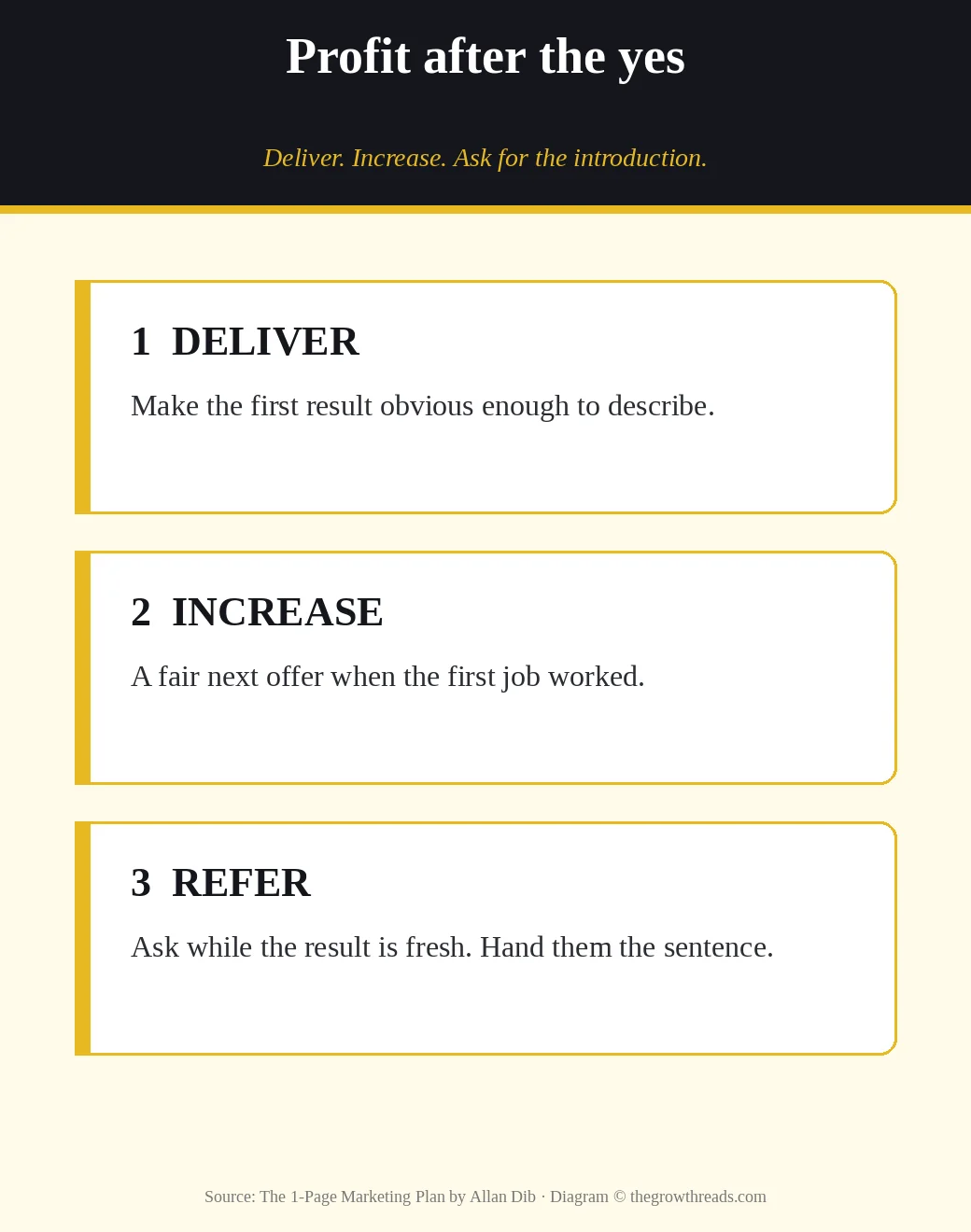
The after phase is where Dib says the profit actually sits, and where most one-page drafts go blank. Delivery is not a slogan under the logo. It is the onboarding, the first win the customer can name, and the way you handle the afternoon something slips. People refer a result they can describe. They do not refer a vibe. Design the first two weeks so a fair customer could tell a friend what changed.
Then increase the relationship on purpose. A logical next offer, a rhythm that brings them back, or a scope that grows when the first job worked. More buyers, a larger order, and a more frequent order are the only three levers. Pick one and write it down so you are not hunting a brand-new stranger every month.
Referrals come last because they need the other two. Do not wait for word of mouth as if it were weather. Ask when the result is fresh. Hand over a sentence the customer can forward. Make the introduction a single reply, not a homework assignment. Track it the way you track leads. A referral system you are too polite to run is an empty square, and empty squares are how good delivery stays a secret.
Once a month, mark the square that is leaking. A fuzzy market. A sentence no one repeats. A channel you cannot measure. A list you do not write to. An offer with no risk named. A delivery that creates silence. No next sale. No ask. Fix that square before you adopt a new platform. The nine squares are not a poster for the wall. They are a queue.
TGR Note: The delivery square is the whole argument of Raving Fans: satisfied is not the same as a customer who brings the next one. Read it beside this phase if people buy once and go quiet. Keep Dib’s page as the index so the story does not replace the ask.
Who is The 1-Page Marketing Plan best for — and who should read something else first?
Read this first if you are the marketer in a service firm, a practice, or a small product company, and your current plan is a pile of tactics. It is especially useful when you can sell, but you cannot show a page that says who the work is for and what happens after the invoice.
Read something else first in three cases. If you cannot yet say the problem in the customer’s language, start with The Mom Test and bring those words back to square two. If the offer itself is vague and you are hoping reach will hide it, start with $100M Offers. If the homepage is a list of features with you as the hero, start with Building a StoryBrand, then return to the grid. If customers already buy and the leak is the story they tell afterward, pair this after phase with Raving Fans.
Questions to reflect on
- Which of the nine squares am I calling “later” because it is uncomfortable to write?
- If I described my best customer in two sentences, would a stranger recognize them?
- Which line on my homepage could a competitor paste without changing a word?
- Where did last month’s leads come from, and what did each conversation cost?
- When did I last ask a happy customer for an introduction, and did I hand them the sentence?
🔥 Ready to fill the nine squares?
One page for the market, the message, and the follow-up you keep skipping.
How to apply The 1-Page Marketing Plan (7-day plan)
- Day 1 — Name one avatar. Write the role, the pain that makes them search, and the watering hole where they already are. Do not add a second avatar.
- Day 2 — Write the why-you sentence. Use their words. Read it aloud. If it fits a rival, rewrite it once and stop.
- Day 3 — Draw the nine squares. Leave a square blank rather than inventing a tactic you will not run this month.
- Day 4 — Publish one lead offer. A checklist or a ten-minute diagnostic. One URL. One field. One thank-you that tells them what happens next.
- Day 5 — Draft five touches. Each teaches one idea from their problem and ends with a single next step. Put them on the calendar.
- Day 6 — Rebuild the offer. Scope, price, the risk you will carry, and one button. Delete the extra asks.
- Day 7 — Set the number and make one ask. Estimate lifetime value from the first sale plus a year of repeat work. Cap what you will pay for a lead. Ask one happy customer for a referral and give them a sentence to forward.
Frequently asked questions
What is The 1-Page Marketing Plan about?
The 1-Page Marketing Plan is Allan Dib’s field manual for owners who do the marketing themselves. A plan you will not reread is not a plan, so the system has to fit on one page. That page is nine squares in three phases. Before someone knows you, choose a target, a message, and a channel you can measure. While they decide, capture a lead, nurture it more than once, and convert with a clear offer. After they pay, deliver a result worth describing, increase what they are worth, and ask for referrals on purpose.
What are the nine squares?
Dib splits the work into before, during, and after. Before: the target market, the message, and the media you will use. During: how you capture a lead, how you nurture it, and how you convert. After: the experience you deliver, how you increase lifetime value, and how you earn referrals. Read down a column and you see one phase. Read across and you see how the job changes once money has changed hands. The squares are short on purpose. If a square needs an appendix, it is not ready to run on a Tuesday morning.
Who is this book for?
Dib writes for owners of services, consultancies, and small product companies who are still the marketer. It fits a founder who posts in bursts and cannot point to a written plan. It is a weak first book if you do not yet know how customers describe the problem, or if the offer is mush and you hope ads will hide that. Talk to buyers or fix the offer, then drop the words into the grid. A firm with a brand team can still use the measurement rule, but the tone assumes you touch the work yourself.
How is it different from Building a StoryBrand?
Building a StoryBrand is about the message square: make the customer the hero and give them a problem, a guide, and a plan. Dib assumes you need that clarity, then asks where the sentence will run, how a stranger becomes a lead, and what happens after they pay. StoryBrand can leave you with a better homepage and no follow-up. This book can leave you with a grid only as strong as square two. Use StoryBrand to stop describing yourself, then use Dib to put that message into a channel, a sequence, and a post-sale ask.
How is it different from $100M Offers or DotCom Secrets?
$100M Offers goes deep on one square: make what you sell hard to compare and easy to accept. DotCom Secrets goes deep on the ladder a stranger climbs. Dib stays one level up. He wants every square named, including the ones those books treat as later. If the offer is fuzzy, write it before you buy more media. If you already have a ladder and the leak is an unnamed market or a referral habit you never run, the grid shows that faster than another funnel diagram. Read them as a set.
What does Dib mean by direct response?
Direct response here means marketing that asks for a measurable next step and keeps the receipts. You can say what the touch cost and who raised a hand. Brand advertising, as he uses the phrase, hopes to be remembered later and is hard for a small firm to judge. He is not against looking credible. He is against spending the month on a visual identity and calling it a plan. A direct-response touch can still be generous: a checklist, a straight answer, a short diagnostic. If a quiet week produces no number, the channel is not on the page yet.
Do I need a large ad budget to use the plan?
No. Several squares cost attention rather than media spend: the sentence, the lead offer, the five touches, the first result, and the referral ask. Paid media belongs in the channel square only after you know what a customer is worth and what you will pay for a lead. An unmeasured boost is a guess. Start with one channel you can tally by hand, even a weekly talk, a partner list, or a search ad with a ceiling. Add spend when the nurture and the offer are already written down.
Related summaries
- They Ask, You Answer — publish the questions buyers ask before they trust you.
- Building a StoryBrand — fix the message square by making the customer the hero.
- $100M Offers — go deeper when the convert square is the leak.
- Positioning — claim an open place in the mind before you buy more reach.
- Best productivity books — the rest of the shelf, including the sales and focus titles.
How we analyze books: we read for the ideas you can apply, check the edition, and write an original summary with a plan for the week ahead. Read our full methodology.