

★★★★½ 4.6/5 — Teach the answer before you ask for the call.
Best for: owners and marketers whose buyers research everything before they talk to sales. Reading time: about 6 hours (guide: 16 min). Difficulty to apply: moderate. The ideas are simple. The honesty is the work.
They Ask, You Answer in one minute
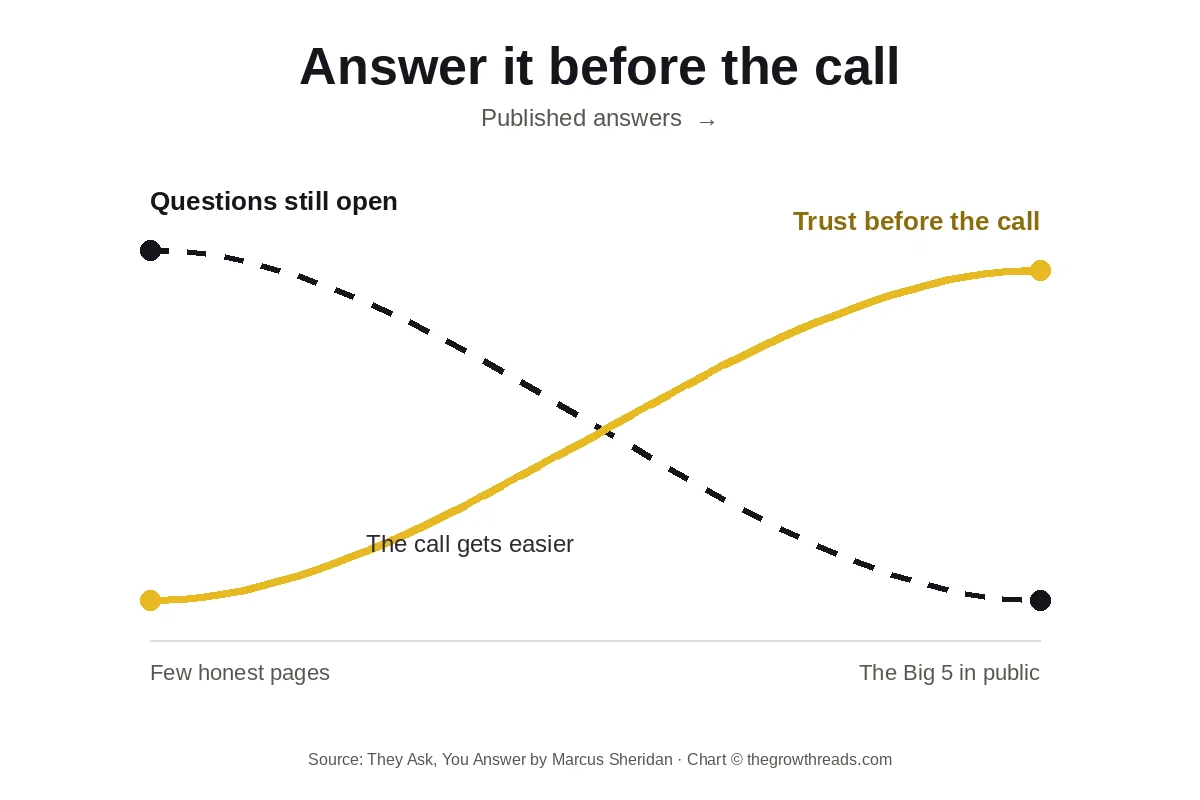
Buyers already have the questions. The company that answers them in public becomes the one they trust.
Marcus Sheridan wrote They Ask, You Answer after River Pools and Spas nearly failed in the 2008 downturn. The recovery was a set of plain pages on cost, problems, and comparisons. The revised Wiley edition (2019) makes that an operating system: publish the Big 5, put practitioners on camera, and do not start a sales call until the buyer has done a short assignment.
Key takeaways
- Answer the search, not the brochure: strangers arrive with a question. A page that teaches it earns the next click. A page that only praises the company does not.
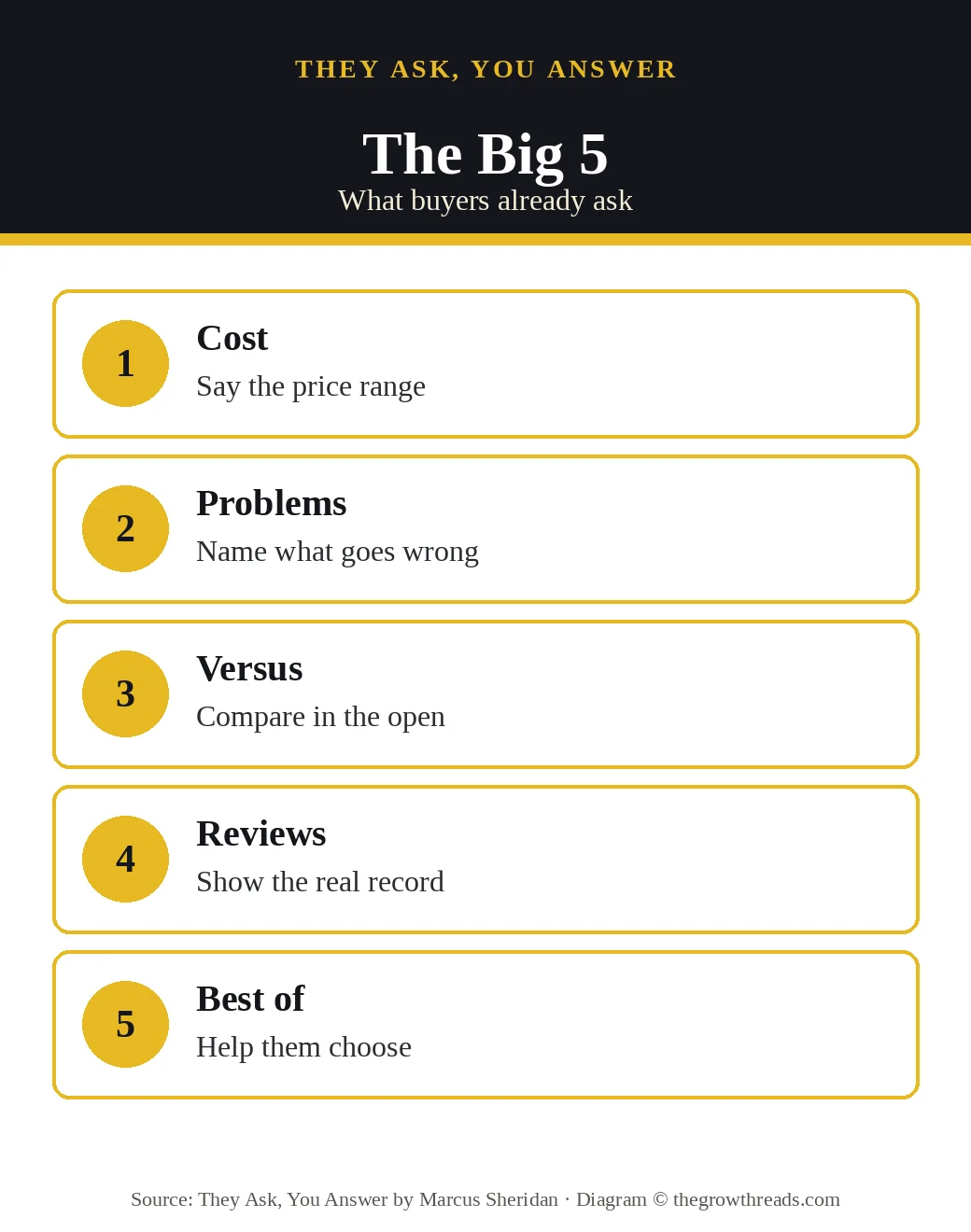
- The Big 5 are the syllabus: cost, problems, comparisons, reviews, and “best of” lists. If any one is missing, buyers finish the lesson on someone else’s site.
- Price is a trust test: hiding the number does not hide the question. It tells people you will be vague in the conversation too.
- Problems are part of the sale: naming what can go wrong, and who it is not for, filters bad fits and calms good ones.
- Assignment Selling changes the call: send the specific articles and videos first. The meeting then confirms a decision instead of repeating a class.
- Insource the voice: the person who installs, advises, or supports the customer should be the one on the page. An outside script cannot hear the real question.
- Video is the same honesty, shown: the revised edition treats video as proof, not decoration. Show the thing. Say the tradeoff. Keep it specific.
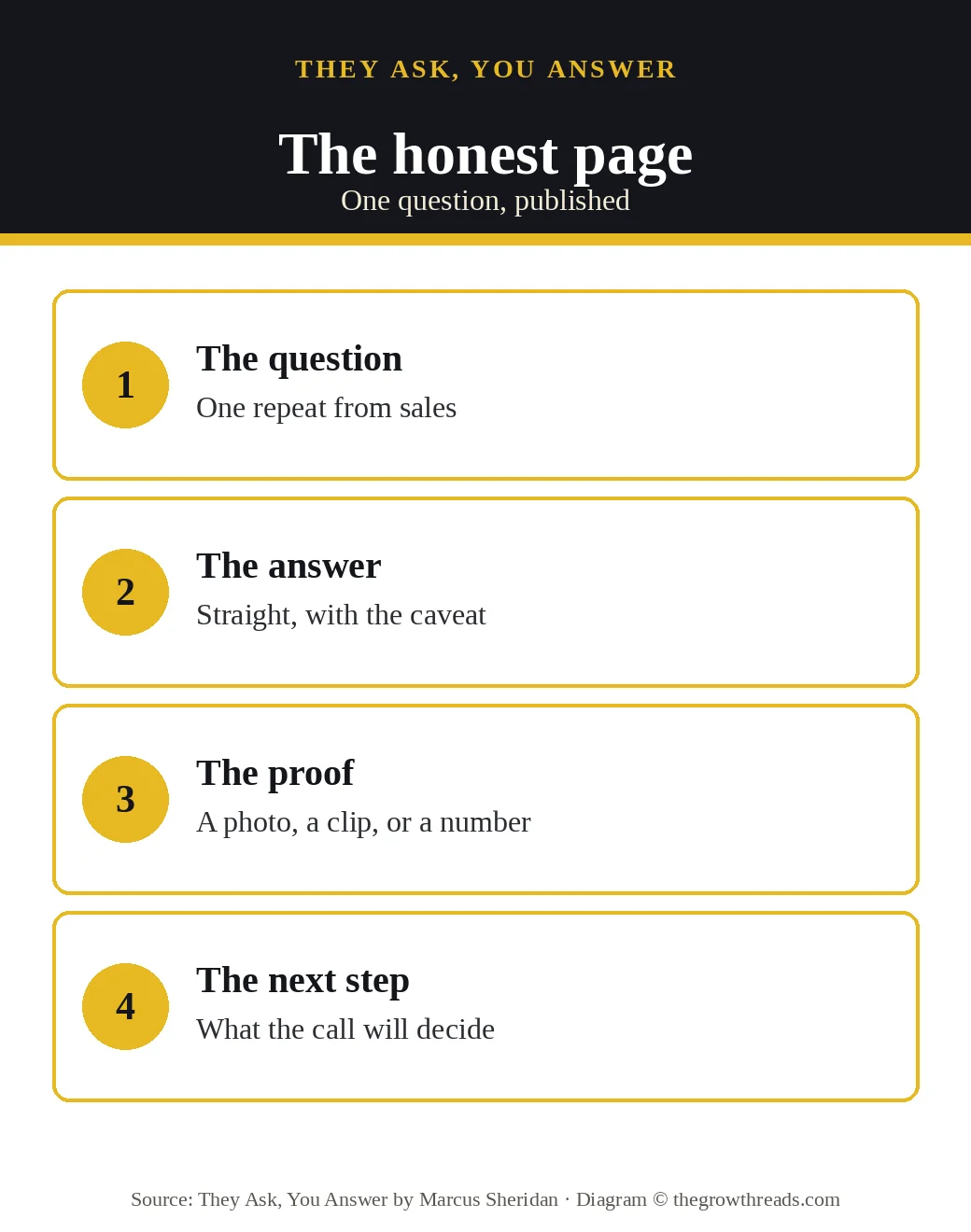
- One question a week beats a rebrand: pick a question from the inbox, publish a straight answer, add one proof, and link a next step.
What is They Ask, You Answer about?
They Ask, You Answer is a practical system for inbound sales and content. Sheridan argues that buyers decide with whoever teaches them best, so a company should publish honest answers to cost, problems, comparisons, reviews, and “best” questions, then use that library as homework before any sales call.
About the author
Marcus Sheridan co-founded River Pools and Spas in Virginia and nearly lost it when the 2008 housing crash froze pool buyers. Instead of spending what was left on ads that still sounded like a brochure, he published the questions people were already asking: what a fiberglass pool costs, what fails, and how it compares with concrete. That library became the company’s best salesperson and the seed of this book, first released in 2017 and revised by Wiley in 2019. Sheridan now teaches owners to insource that voice, put the Big 5 on the site, and hand buyers a short assignment before a sales conversation. The book is his field manual for becoming the teacher of a market that has learned to ignore the pitch. Explore all Marcus Sheridan book summaries →
Key concepts at a glance
| Concept | What it means | Use it when |
|---|---|---|
| They Ask, You Answer | The questions buyers type are the editorial calendar. | The site talks about the company more than about the decision. |
| The ostrich | Hiding price, problems, or comparisons and hoping nobody asks. | Sales keeps repeating facts the website is afraid to print. |
| The Big 5 | Cost, problems, versus, reviews, and best-of guides. | You need the first five pages, not a fifty-topic brainstorm. |
| Assignment Selling | A short required reading list before the sales conversation. | Calls burn half an hour re-teaching what a page could teach. |
| Insource the voice | Practitioners explain the work in their own words. | Agency copy sounds smooth and still misses the real objection. |
| The honest page | One question, a straight answer, one proof, one next step. | You are about to publish a post that could have been an ad. |
| Teacher of the category | Be the reference buyers finish before they talk to anyone. | Competitors rank for the questions you refuse to answer. |
The year the buyers stopped waiting
River Pools and Spas sold fiberglass pools in Virginia. When the housing market seized in 2008, the phone went quiet. Nicer photos and a louder claim could not answer a scared buyer who wanted to know the real cost and what they were buying.
Sheridan’s turn was editorial. He wrote the questions from emails, calls, and search as if he were at the kitchen table: cost ranges, what fiberglass cannot do, how it differs from concrete. The pages were complete rather than clever. Strangers found them, arrived already taught, and were easier to serve.
He names the opposite habit the ostrich. That company knows the buyer will ask the price and still publishes “contact us for a quote.” Buyers do not stop asking. They ask a forum or a rival, and the company that hid the answer is no longer in the room.
TGR Note: The questions worth publishing are the ones a buyer says in their own words. The Mom Test is the listening drill: ask about their life, not about your idea, and write down the phrases they already use. Sheridan tells you to publish those phrases. Fitzpatrick tells you how to hear them without biasing the answer.
The Big 5 questions you are not publishing
Sheridan then groups the questions that move a deal into five buckets, the Big 5. They are the subjects buyers research whether you participate or not.
Cost and pricing. People want a range, what changes the number, and what is included. You can still sell custom work. You stop pretending the question is offensive. Buyers who cannot afford you leave earlier, which saves the calendar.
Problems. What breaks, what the work cannot do, who should not buy. A straight paragraph on the downside is a filter. The company that explains the problem first is the one invited to solve it.
Versus and comparisons. You against the real alternative, including doing nothing. Buyers name competitors whether you do or not. A fair comparison, with the case where the other option wins, beats a page that claims you have no peers.
Reviews. Not a widget in the footer. A plain discussion of what customers say, including the pattern in the complaints, and what you changed.
Best of. Buyers type “best” because they want a guide. The company that writes it, with criteria and tradeoffs, becomes the editor of the purchase.
A practical test: search your own product plus “cost,” “problems,” “vs,” “review,” and “best.” If the first useful result is not yours, that gap is this week’s writing assignment. Do not start with the topic you wish they cared about. Start with the topic they already typed.
TGR Note: The Big 5 is the syllabus. Building a StoryBrand helps you say what the buyer wants in one line. Use that for the message, and Sheridan for the pages the message has to survive: price, problems, and comparisons. When those pages exist, DotCom Secrets is the path from the honest article to a specific offer.
Assignment Selling: homework before the call
Content that nobody on the sales team uses is a magazine. Sheridan’s bridge from publishing to revenue is Assignment Selling. Before a salesperson spends an hour on a call, the buyer receives a short, specific assignment: these articles, these videos, in this order. The conversation is scheduled after they have actually consumed them.
A buyer who has read the pricing guide and the “who this is not for” page arrives oriented. The salesperson stops performing the website out loud and starts confirming scope, fit, and timing. Many people never wanted a call. They wanted the article. The calls that remain are shorter.
Keep the assignment short. Two pages and one brief video, chosen for this buyer’s question, will be read. Five links that take a weekend will not. If the call is the classroom, you repeat yourself forever. If the page is the classroom, the call can be a decision.
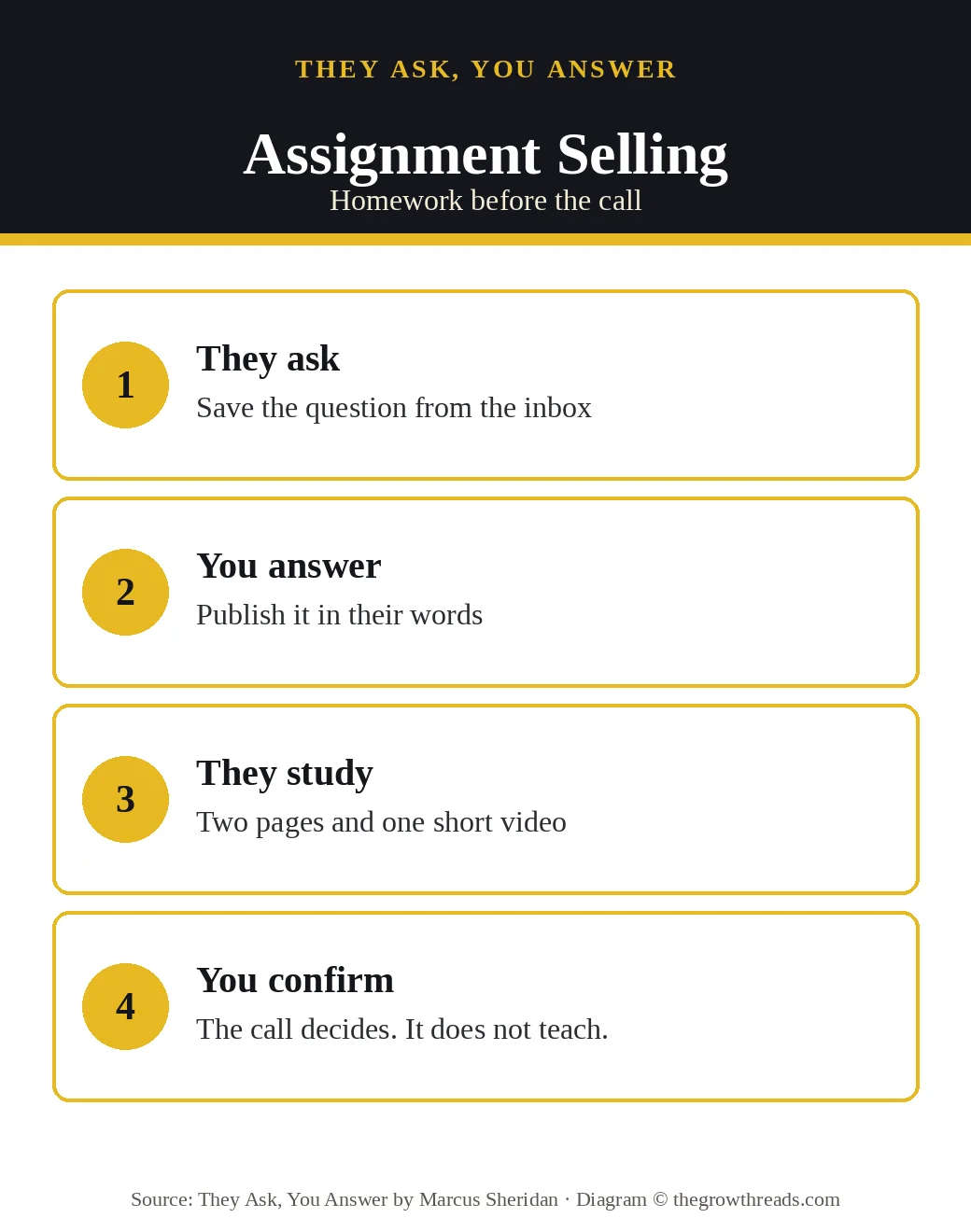
Start with one offer, not the whole catalog. Write the assignment as a three-line email: the question they raised, the page that answers it, and the single decision the call will make. Track two numbers for a month. How many booked calls consumed the page. How many of those calls still begin with “so what do you charge?” If the second number stays high, the page is vague or the team is not sending it.
TGR Note: Assignment Selling assumes someone can find you. $100M Leads is about making sure strangers know you exist. Sheridan is about what they should find when they look. Publish the Big 5 first so the attention you buy or earn lands on a teacher, not a placeholder. This Is Marketing adds the posture: the work is to serve a specific group, not to shout at everyone.
Run the company like a media company
The revised edition spends real time on how a team keeps this up after the first enthusiastic month. Sheridan’s line is to think like a media company that happens to sell a service. Media companies have a beat, a publishing rhythm, and people who are allowed to explain the work without a committee sanding off every useful detail.
Insourcing is the staffing rule. The best pages come from the person who has done the job: the installer, the advisor, the specialist who has heard the objection a hundred times. An agency can help with structure and distribution. It cannot invent the scar tissue. The book’s workshops and on-camera advice point the same direction. Put the practitioner in frame. Let them say the tradeoff in a normal voice. A shaky honest video outperforms a polished video that never answers the question.
Publishing a price range feels like a risk to anyone rewarded for keeping options open. Sheridan’s remedy is managerial. Someone owns the pricing page. Someone owns the problems page. Sales is required to send the assignment. Marketing is not a side hobby that dies when the quarter gets busy.
You do not need a newsroom. You need one repeated question and the nerve to answer it in public, then the same loop next week.
Who is They Ask, You Answer best for — and who should read something else first?
Read this if you sell something people research before they talk to a human: home services, software, professional advice, education, specialty products. It is especially useful when the team is busy on calls that keep restarting at zero, and when the website is a brochure with a contact form.
Read The Mom Test first if you do not yet know what buyers ask, because you have not listened without pitching. Read Building a StoryBrand first if visitors do not understand what you do in one sentence. The Big 5 cannot rescue a muddy offer. Read DotCom Secrets alongside this book if the honest pages exist and you now need a clear path from the article to a specific offer. If your work is a personal productivity system rather than a market you teach, start with a book about your own focus, then come back when you have a buyer on the other side of the page.
Questions to reflect on
- Which question do buyers ask on every call that your website still refuses to answer in print?
- If a stranger searched your product plus “cost” tonight, would they find your explanation or a stranger’s guess?
- What is one downside of your offer that a fair teacher would say before the deposit?
- Which single page, if a lead actually read it, would make the next call twenty minutes shorter?
- Who on the team has done the work with their hands, and when were they last asked to explain it in public?
🔥 Ready to answer what buyers already ask?
Use the Big 5 and one Assignment Selling email on a real offer this week.
How to apply They Ask, You Answer (7-day plan)
- Day 1 — Harvest the questions. Export the last twenty sales emails or call notes. Highlight every question asked before the purchase. Group the repeats. Circle the one that appears most often.
- Day 2 — Name the gap. Search your product plus cost, problems, vs, review, and best. Write down which of the Big 5 you do not own. Pick the missing one that matches Day 1’s question.
- Day 3 — Draft the honest page. Answer in the buyer’s words. Include a range or a rule of thumb if the topic is price. Include who it is not for. Cut any sentence that could sit in an ad unchanged.
- Day 4 — Add one proof. A photo, a short clip of the practitioner, or a specific example with the tradeoff visible. If you cannot show it, you are not ready to claim it.
- Day 5 — Publish and assign. Put the page live. Write a three-line email that sends this page before the next call. Tell the reader what decision the call will make.
- Day 6 — Use it on real leads. Send the assignment to every new inquiry for this offer. Do not attach a second pitch. Note who reads it and what they still ask.
- Day 7 — Keep one, queue the next. If callers still open with the same question, revise the page until they do not. Then put the next Big 5 gap on next week’s calendar. One question. One page. Repeat.
Frequently asked questions
What is They Ask, You Answer about?
They Ask, You Answer is Marcus Sheridan's operating system for inbound sales and content. He argues that buyers already have the questions, so the company that teaches cost, problems, comparisons, reviews, and best-of choices in public becomes the one they trust. The story starts at River Pools and Spas, which nearly failed in 2008 and recovered by publishing those answers. The 2019 revised edition adds video, the modern website, and Assignment Selling, which sends a short reading list before a sales call. It is a way to run marketing and sales as teaching, not a set of social-media tricks.
What are the Big 5 in They Ask, You Answer?
The Big 5 are the subjects buyers research whether you publish them or not: cost and pricing, problems and downsides, comparisons against the real alternative, reviews, and best-of guides. Sheridan treats them as the syllabus, not a brainstorm. If one is missing, people finish the lesson on a forum or a competitor's site, and your sales call starts from zero. A useful first pass is to search your product plus cost, problems, versus, review, and best, then write the gap you do not own. Start with the question your inbox already repeats.
What is Assignment Selling?
Assignment Selling means a buyer does a short, specific homework list before a salesperson spends an hour on a call. The list is two relevant pages and one short video, not a weekend of links. The meeting then confirms scope, fit, and timing instead of repeating the website out loud. People who only wanted the article never book, which saves the calendar. People who book arrive oriented. If callers still open with the same basic question, the page is vague or the team is not sending it. Fix the page before you add another pitch.
Is They Ask, You Answer only for home-service companies?
No. River Pools is the origin story, not the limit. The book fits any offer people research before they talk to a human: software, professional advice, education, specialty products, and local services. The test is simple. If strangers compare price, problems, and alternatives before they email you, you are in the audience. A pure internal productivity system, with no buyer on the other side of a page, will get less from it. In that case, learn the personal system first, then come back when you have a question a customer keeps asking.
How is this different from a funnel or messaging book?
They Ask, You Answer tells you which pages honesty requires: price, problems, comparisons, reviews, and best-of guides. A funnel book tells you how a convinced reader moves toward an offer. A messaging book helps you say what you do in one clear line. They work as a set. Use StoryBrand when visitors still cannot tell what you do. Use this book when they understand the offer and still cannot find a straight answer. Use a funnel, such as the ladder in DotCom Secrets, after those answers exist, so attention lands on a teacher rather than a placeholder.
Should a company publish its prices?
Sheridan says yes, at least as a range and the choices that move the number. Hiding the price does not hide the question. It sends people to a rival, a forum, or a review site, and it signals that the conversation will be vague too. A range still leaves room for custom work. Buyers who cannot afford you leave earlier, which is kinder to both sides. You do not need a single sticker price for every job. You do need a page that respects the question enough to give a real band and the reasons it changes.
How long does it take to apply the book?
One honest page can go up in a week, and that is the right size for a start. Day by day: collect questions, find the Big 5 gap, draft the answer with the caveat, add one proof, publish it, and send it as the assignment before real calls. Judge the page by whether the next callers still open with that same question. If they do, revise the page before you write a second one. The culture change is slower than the first article. Someone has to own the pricing page, and sales has to actually send the link. The book works as a weekly loop, not a rebrand.
Related summaries
- DotCom Secrets Summary & Review — build the path a convinced reader walks after the honest page.
- Building a StoryBrand Summary & Review — clarify the buyer’s story so the Big 5 pages have a point.
- The Mom Test Summary & Review — hear the questions in the buyer’s words before you publish them.
- $100M Leads Summary & Review — make sure strangers can find the teacher you just became.
- Best Productivity Books — the full silo, including marketing and sales systems.
How we analyze books: we read for the moves you can use this week, check the edition, and write original teaching notes. We do not grade authors against each other. Read our full methodology.