

★★★★½ 4.5/5 — Find the room your customer already sits in, then earn a way to speak there.
Best for: Founders and marketers who have an offer and need a repeatable way to reach the people who would buy it.
Reading time: ~7 hrs, guide: 18 min
Difficulty to apply: Medium. The list is simple. Showing up for people who did not ask for you is the work.
Traffic Secrets in one minute
The right people are already in a room. Most ad budgets never ask which one. Traffic Secrets, by Russell Brunson, is the distribution book in his Secrets trilogy. DotCom Secrets builds the offer. Expert Secrets builds the belief. This book asks where the dream customer already pays attention, and how you earn a conversation there before you rent a larger crowd. Brunson calls the working list the Dream 100: the publishers, shows, and communities that already gather those people. Every note you send them, and every ad you run later, needs a hook, a story, and one offer. Traffic you only rent is a bridge. Traffic you own is the list you can still reach when the platform changes the rules.
Key takeaways
- Name the congregation before the campaign: your dream customer already gathers somewhere, and that somewhere is a better brief than a broad interest target.
- The Dream 100 is a list of publishers: hosts, writers, and community owners who hold attention, not a blast list of strangers.
- Work your way in first: be useful in public to those publishers before you ask for an introduction or a mention.
- Buy your way in second: ads and sponsorships amplify a message that already earns a reply. They are a poor place to discover the message.
- Every piece needs a hook, a story, and an offer: the hook stops the right person, the story gives a new way forward, and the offer asks for one step.
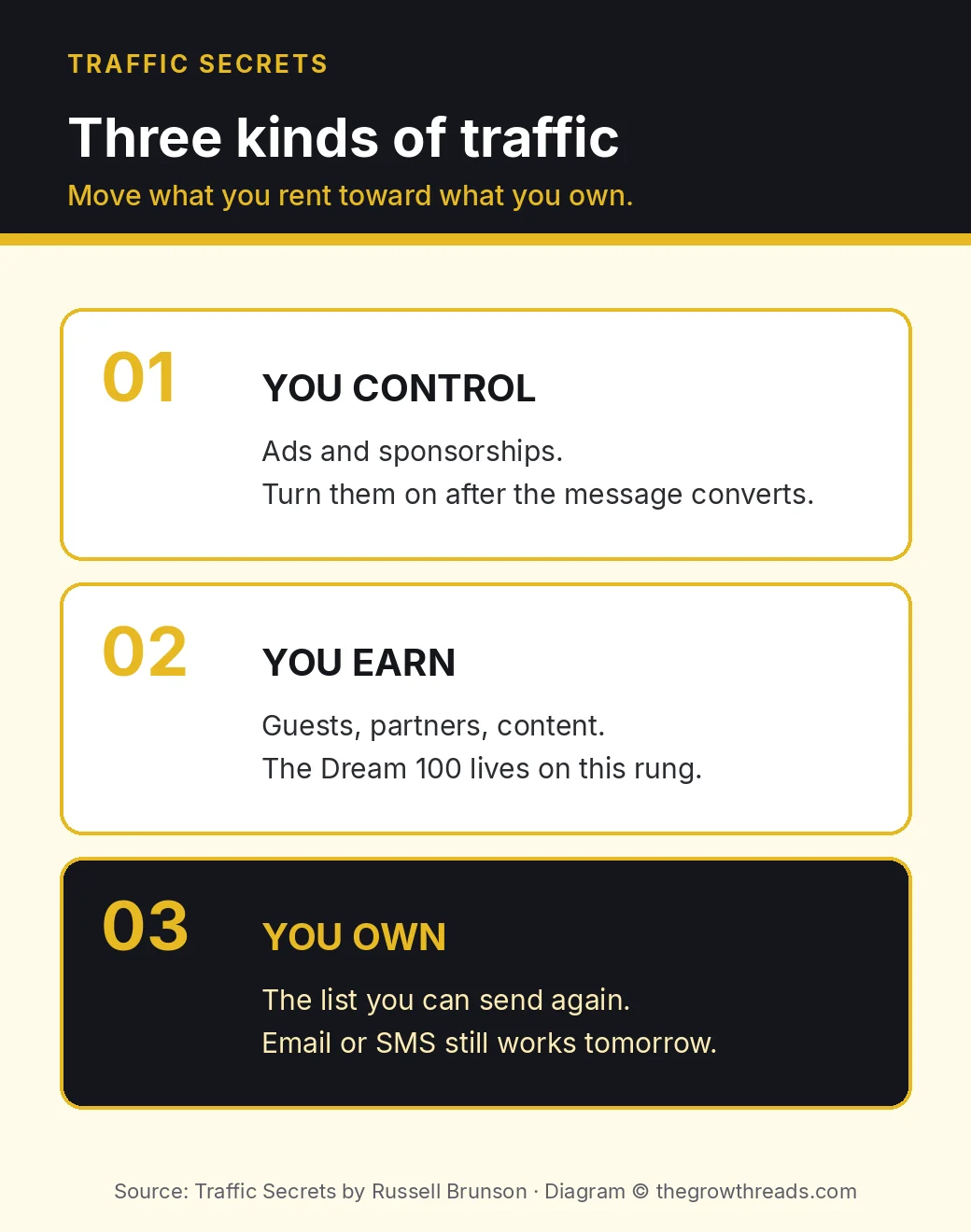
- Sort traffic by who controls it: you control paid reach, you earn guest spots and content, and you own the list you can contact again.
- Dig the well on ordinary days: publish and serve the Dream 100 before the week you need sales, or you will be asking strangers for water.
- Give the click a job: a funnel, a lead page, or a simple email signup must exist before you send a larger crowd at it.
What is Traffic Secrets about?
Traffic Secrets is Russell Brunson’s guide to finding the people who already gather your dream customer, earning a way into that congregation, and moving the click onto a list you can reach again. The method is a Dream 100 list, a hook-story-offer on every piece, and a habit of publishing before you need the sale.
About the author
Russell Brunson is the cofounder of ClickFunnels and the author of the Secrets trilogy. He came up through direct-response marketing, the craft of one clear offer and a reason to respond now, and that schooling shows in the way he treats a page as a salesperson rather than a brochure. DotCom Secrets first appeared in 2015 and later in a longer Hay House edition. Expert Secrets followed, on the story that makes a new opportunity feel worth taking. Traffic Secrets, published by Hay House in March 2020 with a foreword by Dean Graziosi, is the distribution volume. It assumes you have something to say and asks where the right people already pay attention. The examples lean toward coaches, courses, and small teams. The frame travels further than those examples. Explore all Russell Brunson book summaries →
Key concepts at a glance
| Concept | What it means | Use it when |
|---|---|---|
| Dream customer | The person whose problem you already know how to solve. | You are tempted to target “everyone” with a budget. |
| Congregation | The room where that person already pays attention. | You are picking a channel before you can name a host. |
| Dream 100 | The publishers who hold that room. A working list, not a cold blast. | You need a route that does not depend on one algorithm. |
| Hook, story, offer | Stop the right person, show a new way, ask for one step. | A post, an email, or an ad is getting attention and no action. |
| Work your way in | Serve the Dream 100 in public before you ask for a door. | You want a mention you have not earned yet. |
| Buy your way in | Ads and sponsorships, after the message converts. | You are about to scale a hook you have not tested. |
| Traffic you own | The list you can email or text again tomorrow. | A platform change would silence your reach overnight. |
| Dig the well | Publish and build the relationship before you need the sale. | The only marketing week on the calendar is launch week. |
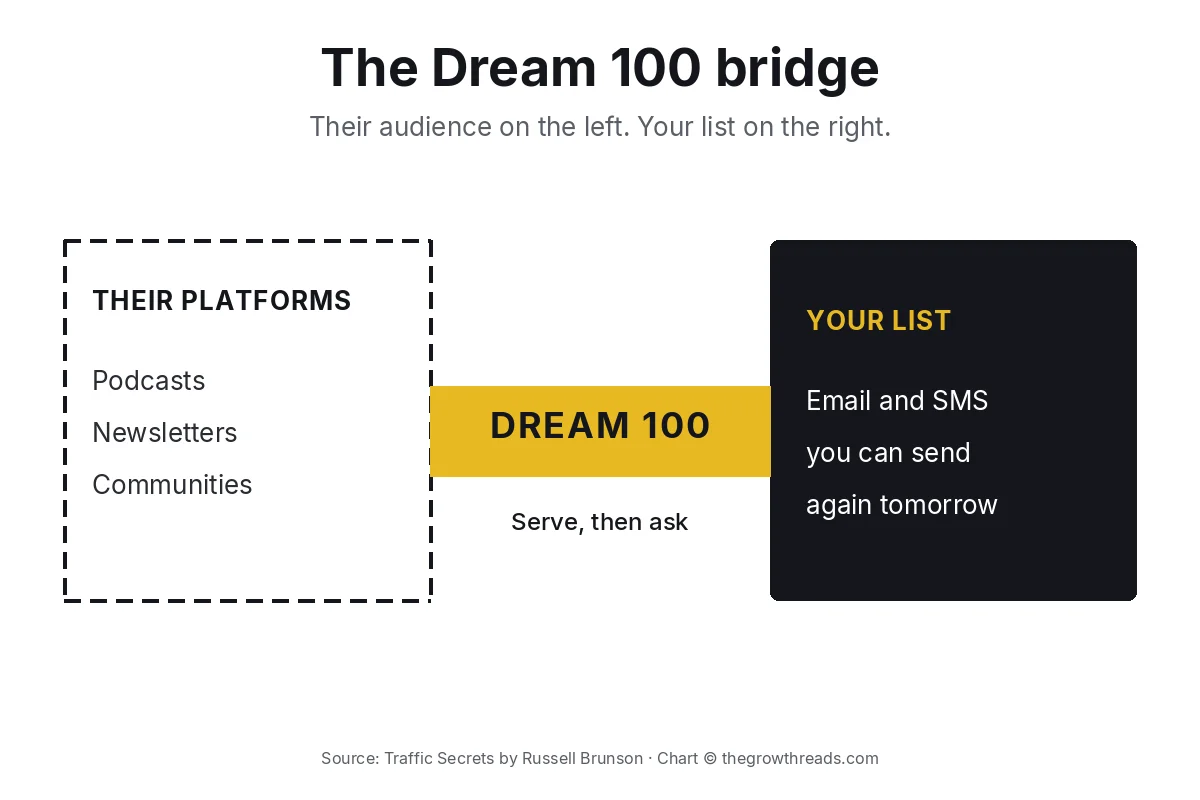
The Dream 100
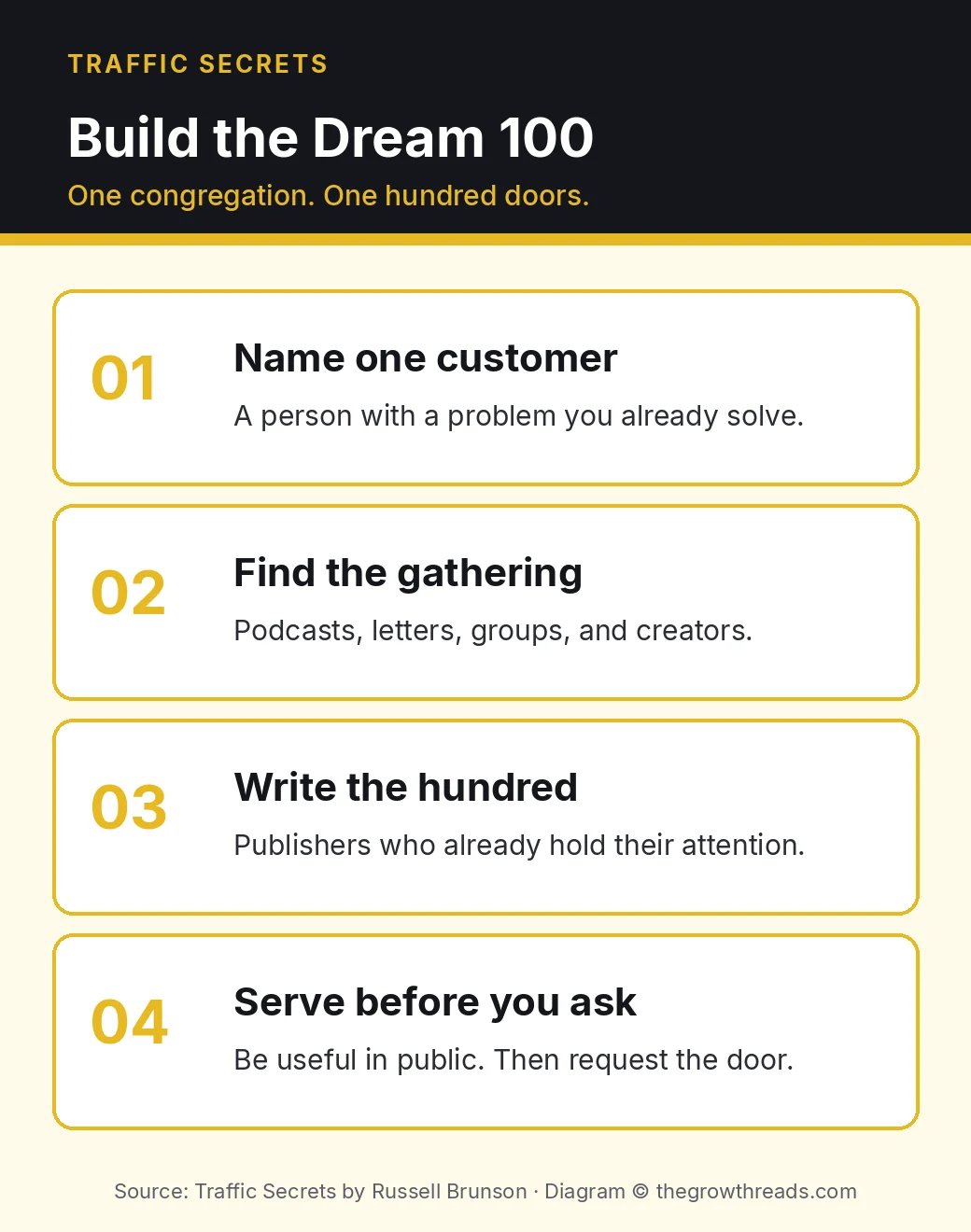
Brunson starts with a blunt picture. Your future customer is not waiting in a blank targeting box. She already belongs to a room that meets without you. Name her with a job, a problem, and a result you have produced. That sentence is what lets you recognize the room.
From there, look for congregations: podcasts, newsletters, communities, creators, and the search phrases she types when the problem is expensive. The Dream 100 is the list of publishers behind those rooms. A hundred is large enough to survive a few nos and small enough to remember. You are collecting doors, not a blast list.
He splits the approach into two moves. Work your way in: quote their idea, add one example, and offer a guest story that serves their audience. Buy your way in: a sponsorship or an ad aimed at the same congregation, once you know what those people already respond to. Service teaches you the language. Money only makes a good sentence louder.
TGR Note. Fill the market square before you fill the hundred. The 1-Page Marketing Plan asks for one market and one message before you spend. A Dream 100 built on a fuzzy customer becomes a list of impressive strangers. If the offer those people would climb is still unclear, read DotCom Secrets first and give the click a ladder.
Hook, story, offer
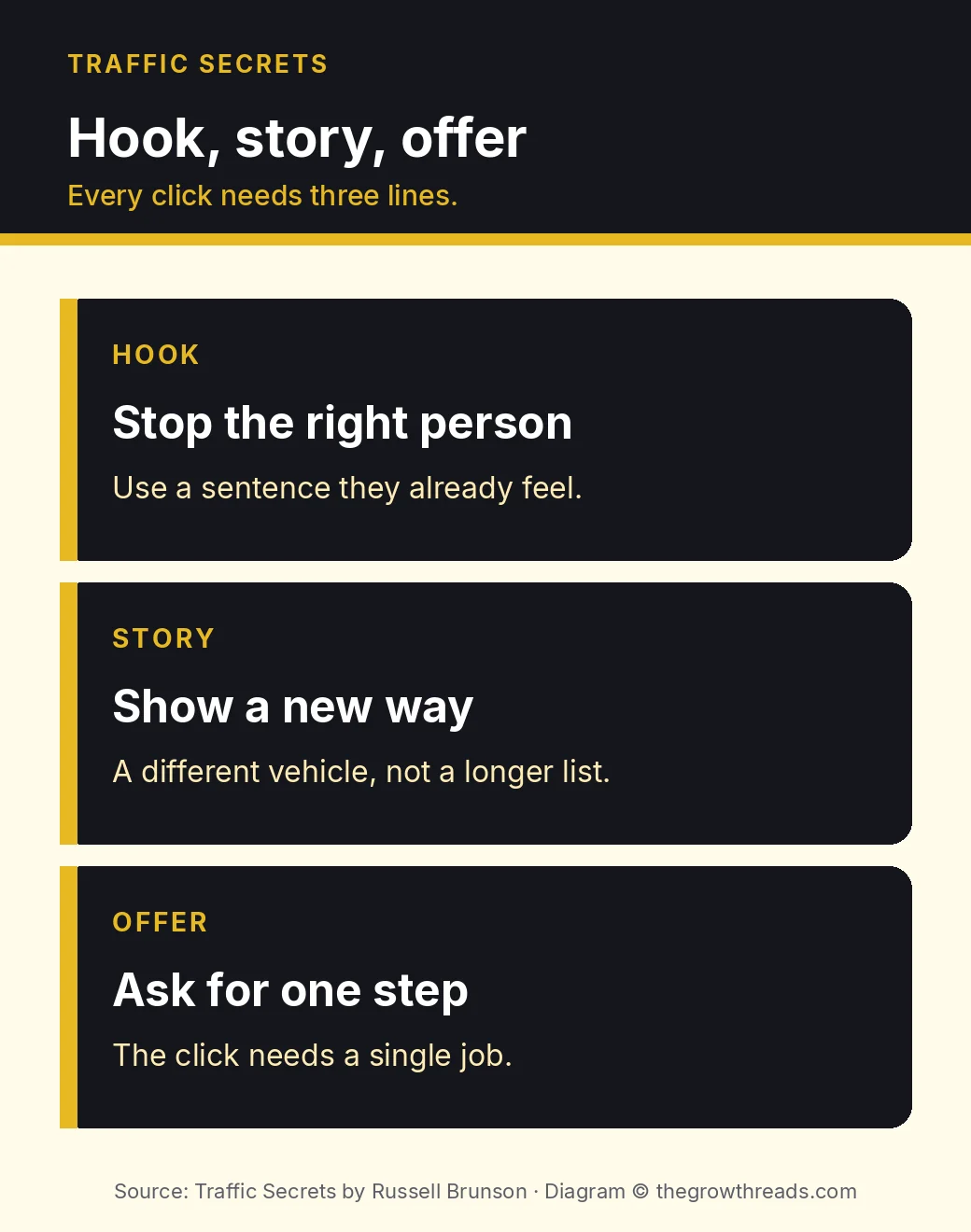
Once you know the room, every unit of traffic needs three lines. The hook is the sentence that makes the right person stop. It should sound like a thought she has already had. The story is the short path from that thought to a new way of solving it. The offer is one next step, small enough to accept today.
This is where the book leans on the one before it. People change vehicles faster than they try harder at a failing one. The story in the middle is that new vehicle. A feature list is not a story. A complaint about the old way, followed by one concrete scene of the new way, is. Use the same trio on the organic piece and on the ad, so you are not inventing a second personality when you pay to amplify.
Read the piece out loud. If you cannot point to the hook, the story, and the offer, it is not ready for the Dream 100 or for a budget. One trio, used everywhere, beats a folder of clever lines that never ask for anything.
TGR Note. The story only works if it is a new opportunity, not a louder version of the old grind. Expert Secrets is the companion on that belief. If the words themselves are muddy, borrow the clarity test from Building a StoryBrand: one character, one problem, one guide, one step. Traffic cannot repair a message that the reader cannot retell.
Work your way in, then buy your way in
The Dream 100 do not owe you a mention. You earn the right to be useful on their pages, in their comments, and on their shows. That is working your way in. It looks slow if you count closed deals this afternoon. It looks fast next to years of shouting at a cold audience that has no reason to trust you.
Buying your way in is the second door. A sponsorship on a show your customer already loves, or an ad pointed at that audience, puts you in the room with a budget instead of a favor. Buy only after you have listened. You will know which examples landed and which offer feels native. Then the money is a multiplier. Before that, it is a guess with a receipt.
The platform chapters are illustrations of the same two doors. Channels age. The sort does not. If a new room appears, ask who already publishes there, serve them, and only then pay to stand next to them.
Traffic you own
Traffic you control is paid. You can start it and stop it, and you do not own the people on the other side. Traffic you earn is the guest spot, the share, the ranking. You worked for it, and you still do not own it. Traffic you own is the list: email or a message channel where you can reach the same person tomorrow without asking a platform for permission.
Every Dream 100 appearance needs a landing place. A mention that dumps people on a homepage with eight buttons wastes the favor. A mention with one next step, and a way to continue the conversation, pays the favor forward. Brunson calls the daily version of this digging the well before you are thirsty. Publish when you do not need the sale. The launch then writes to people who already said yes.
TGR Note. A list is permission, not a pile of addresses. Permission Marketing makes the same demand Seth Godin has made for years: the follow-up has to be anticipated, personal, and relevant, or you spent the bridge to build a nuisance. When the owned list needs a sharper offer on the next rung, go back to the ladder in DotCom Secrets.
Who is Traffic Secrets best for — and who should read something else first?
This book is best for a founder, a coach, or a small marketing team that can already say who the customer is, what result they buy, and what the next step costs. You are stuck on where the right people are. If that describes the week you just had, start here.
Read something else first in three cases. If the offer is still a pile of services, start with DotCom Secrets and build the ladder before you invite anyone onto it. If the offer is clear and nobody believes the new path, start with Expert Secrets. If you want a content engine that answers the buyer’s real questions instead of a funnel, read They Ask, You Answer. When you later want the math of lead getters on top of a congregation you understand, $100M Leads is the next workbook. Traffic Secrets is the bridge between a message you can repeat and a list you can keep.
Questions to reflect on
- If your ad account closed on Friday, where would you still find people like your best customer?
- Which ten publishers already have that person’s attention every week, and have you been useful to any of them?
- What would you give those publishers before you asked for a mention?
- Does every piece you shipped this month have a hook, a story, and one next step?
- Which traffic could you still reach if the platform changed the rules this weekend?
🔥 Ready to earn the congregation?
Build the Dream 100, show up with a hook, a story, and one offer, and move the click onto a list you own.
How to apply Traffic Secrets (7-day plan)
- Day 1 — Write the customer in one sentence. Name the person, the expensive problem, and the result you already know how to deliver. Stop at one sentence.
- Day 2 — Find ten congregations. List podcasts, newsletters, creators, groups, and search phrases where that person already pays attention. Circle the three with the clearest overlap.
- Day 3 — Turn the three into names. Expand them into a first Dream 100 of real publishers, not categories. You should be able to picture each one.
- Day 4 — Draft the trio. Write one hook in their words, one story that shows a new way, and one offer with a single next step.
- Day 5 — Serve one name. Leave a useful public note on one Dream 100 publisher’s work. Add an example. Do not pitch.
- Day 6 — Give the click a home. Publish one short piece on a channel you control that points to a page you own, with one way to continue.
- Day 7 — Open both doors a crack. Ask one publisher for a small collaboration, and put a tiny paid test behind the hook only if Day 6 has a place to land.
Frequently asked questions
What is Traffic Secrets about?
Traffic Secrets is the distribution book in Russell Brunson’s Secrets trilogy. It assumes you already have an offer and a reason someone should care, then asks where those people already pay attention. Brunson wants a working list of publishers, shows, and communities that gather your dream customer. You earn a place in those rooms with a hook, a story, and one clear next step. Paid reach comes after that message has a page to land on. The result he cares about is not a single viral week. It is a list you can still reach when a platform changes the rules.
What is the Dream 100?
The Dream 100 is a list of the people and platforms that already hold your customer’s attention. Think hosts, newsletter writers, community owners, and search pages, not a spreadsheet of cold strangers. A hundred is a working size: long enough to stop depending on one gatekeeper, short enough that you can actually show up. You study what they publish, help in public, and only then ask for a small collaboration. The list is also a map for later ads, because you have watched which messages those audiences already reward. Start with ten names if a hundred feels theatrical. The habit matters more than the round number.
What does “dig your well before you’re thirsty” mean?
Brunson uses the line to describe publishing and relationship work before you need a launch. The well is the list, the body of useful posts, and the Dream 100 people who already know your name. If you wait until the week you need sales, you are asking strangers for water. A small weekly publishing rhythm, plus one useful appearance in someone else’s room, fills the well while the offer is quiet. Then a launch is a letter to people who asked to hear from you, not a scramble for rented clicks. The phrase is a timing rule. Do the slow work on ordinary days.
Should you buy ads before you build a list?
Buy ads after you can say the hook, the story, and the offer in one breath, and after the click has a page you own. Traffic you control, the kind you pay for, is useful because you can turn it on. It is a poor first home, because the bill stops the moment the card does. Brunson wants the paid test to amplify a message that already earns a response in a Dream 100 room or in your own email. A small spend behind a clear offer is a lesson. A large spend behind a fuzzy one is a donation. Own the follow-up before you rent a bigger crowd.
How is Traffic Secrets different from DotCom Secrets and Expert Secrets?
Read them as three jobs, not three slogans. DotCom Secrets builds the ladder: who the customer is, what you offer first, and what you offer next. Expert Secrets works on belief, especially the idea that people will change vehicles faster than they will try harder inside a broken one. Traffic Secrets starts when those two pieces exist and the room is still empty. It answers where the right people already gather and how you earn, then buy, a way in. You can preview this book first if distribution is the stuck point. You will still feel the gaps if the offer or the story is missing.
Who should read Traffic Secrets first?
Read it first if you can already describe the customer, the result, and the next step, and the missing piece is a steady flow of the right visitors. Founders, coaches, and small marketing teams who sell from a page recognize themselves quickly. If you do not have that offer yet, start with DotCom Secrets so the click has a job. If people hear the offer and do not believe the new path, start with Expert Secrets. If you would rather answer buyer questions in public than build a funnel, They Ask, You Answer is the cleaner companion. Traffic Secrets is a distribution book. It rewards a message that already exists.
How long does the Dream 100 take to show results?
A careful first pass takes a week: one customer sentence, ten congregations, a short list of names, and a single public act of help. Relationships with those publishers take longer than a week, and Brunson does not pretend otherwise. What you can finish immediately is the asset the relationship points to, a simple page and a reason to join a list. Treat the hundred as a route you walk, not a campaign you launch once. One useful note, one clear hook, and one owned next step will teach you more than a month of browsing analytics. The scoreboard is replies and list growth, not impressions.
Related summaries
- DotCom Secrets — build the ladder before you buy the crowd.
- Expert Secrets — the story that makes a new opportunity believable.
- The 1-Page Marketing Plan — one market and one message before the hundred.
- Permission Marketing — what you owe the list once you own it.
More titles in this silo live on the best productivity books pillar.
How we analyze books: we read for the moves you can use, check the author’s public record, and turn the argument into a one-week plan. Read our full methodology.