

Technology
Homo Deus: A Brief History of Tomorrow Summary & Review (2026)
Harari's sequel to Sapiens: having tamed famine, plague, and war, humanity's next agenda is immortality, bliss, and divinity — as algorithms out-predict…
Read Summary →
"The historian who traced humanity's rise to our shared belief in fictions."
Yuval Noah Harari is a historian whose book, Sapiens: A Brief History of Humankind, traces the arc of human history from the emergence of Homo sapiens through the cognitive, agricultural, and scientific revolutions that reshaped how humans live, organize, and understand themselves. Harari's central argument is that what truly separates humans from other animals is not tool use or intelligence alone, but the unique capacity to believe in and cooperate around shared fictions — money, nations, religions, corporations, and human rights — that exist only because large numbers of people collectively agree to believe in them. His broader argument traces how the agricultural revolution, often assumed to be pure progress, may have made life harder for most individuals even as it enabled civilization's rise, and how the scientific revolution's admission of ignorance unlocked unprecedented power over nature. Harari closes by examining where these forces may be taking humanity next, raising unresolved questions about happiness, meaning, and human agency in an era of increasingly powerful technology.
Our in-depth summaries and reviews of his work
Harari's sequel to Sapiens: having tamed famine, plague, and war, humanity's next agenda is immortality, bliss, and divinity — as algorithms out-predict…
Read Summary →
Yuval Noah Harari argues history is a story of information networks, not truth-seeking — and warns AI is the first technology that…
Read Summary →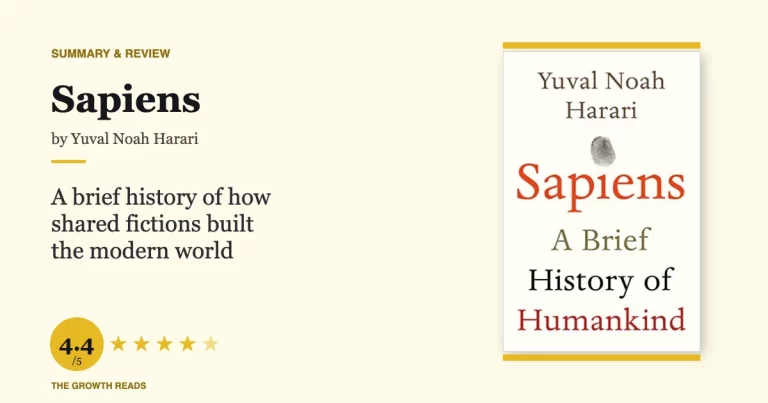
Yuval Noah Harari's sweeping history of humankind reveals how shared fictions — money, nations, religions — enabled Homo sapiens to conquer the…
Read Summary →Harari argues that humanity's defining advantage is the ability to believe in and organize around shared fictions — money, nations, religions, corporations — enabling cooperation among strangers at a scale no other species achieves.
Harari challenges the assumption that agriculture was pure progress, arguing it may have made daily life harder for most individuals even as it enabled population growth and civilization.
Harari frames the scientific revolution's key insight as the willingness to admit what we don't know, which unlocked a systematic pursuit of new knowledge and unprecedented power over nature.
In Nexus, Harari extends his framework to argue that information's main job throughout history has been to build shared stories and enable cooperation, not to represent facts — and that only self-correcting mechanisms, not raw data volume, make a network trustworthy.
In Homo Deus, Harari argues liberal humanism's trust in individual feelings is being quietly challenged by "Dataism" — a worldview that treats the flow and processing of information, not human experience, as the ultimate source of value and authority.
Having largely tamed famine, plague, and war, Harari argues humanity's ambitions are shifting toward defeating aging, engineering sustained happiness, and acquiring god-like creative power through biotechnology and AI.
"Fiction has enabled us not merely to imagine things, but to do so collectively."— Sapiens
"The Agricultural Revolution was history's biggest fraud."— Sapiens
"We are more powerful than ever before, but have very little idea what to do with all that power."— Sapiens
"AI is not just a tool — it is the first technology in history that can generate new ideas and make decisions by itself."— Nexus
"Once technology enables us to re-engineer human minds, Homo sapiens will disappear."— Homo Deus
"Humans agreed to trust the free market, democratic elections and human feelings... because these arrangements are still supposed to serve human interests."— Homo Deus
Harari's sequel to Sapiens: having tamed famine, plague, and war, humanity's next agenda is immortality, bliss, and divinity — as algorithms out-predict us.
Yuval Noah Harari argues history is a story of information networks, not truth-seeking — and warns AI is the first technology that can generate ideas and decide things on its own.
Yuval Noah Harari's sweeping history of humankind reveals how shared fictions — money, nations, religions — enabled Homo sapiens to conquer the world through four transformative revolutions.
