

★★★★½ 4.5/5 — A short parable that turns customer service into three rules you can run this week: decide the experience, discover what the customer wants, and deliver that promise plus one small extra.
Best for: owners and team leads who want one service promise a new hire can keep.
Reading time: about 2.5 hours · this guide: 12 minutes
Difficulty to apply: easy to start, harder to keep on a busy day.
Raving Fans in one minute
A satisfied customer will still leave you. Ken Blanchard and Sheldon Bowles argue that fine is not loyalty. A fan can predict the experience, gets it every time, then gets one extra.
An area manager is worn out by service that depends on whoever is working. A guide named Charlie takes him through three companies. Each one has a picture of the visit, has checked it with customers, and has trained the team to deliver it the same way on a slow morning and a slammed afternoon.
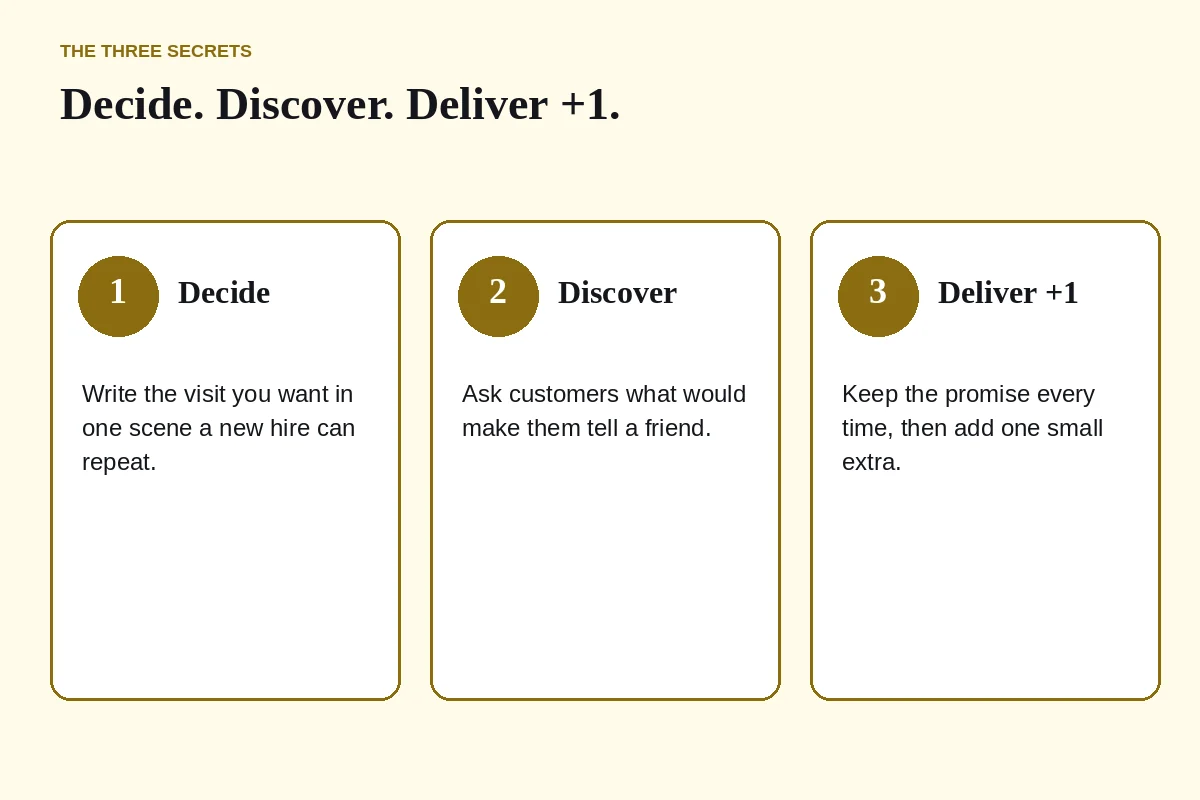
The sequence is the useful part. Decide the experience in concrete detail. Discover what the customer wants, and drop the parts of your vision they do not care about. Deliver the overlap every time, then add one percent. Not twelve improvements. One. The story is short. The work is writing your own promise and making it repeatable.
Key takeaways
- Satisfied is not loyal: A customer who says the visit was fine has not promised to come back. Fans are created by a promise they can count on.
- Decide before you decorate: Write the experience you want as a scene, not as a value on a poster. If a new hire cannot picture it, it is not a standard yet.
- Discover the customer’s picture: Your vision and their vision have to overlap. Where they do not, change the promise or serve someone else.
- Narrow beats impressive: The companies in the story win by repeating a few things, not by adding surprises.
- Deliver plus one: Hit the promise, then add one small extra you can repeat. A spectacular exception that nobody can copy next Tuesday does not create fans.
- Systems carry the promise: If the experience depends on your best person, you have a hope, not a promise.
- Ask, then stop adding: Customer comments are for editing the promise, not for stapling every request onto the standard.
- One percent is a sequence: Roll out a single improvement, let it become normal, then choose the next one. A pile of new perks collapses on a busy week.
What is Raving Fans about?
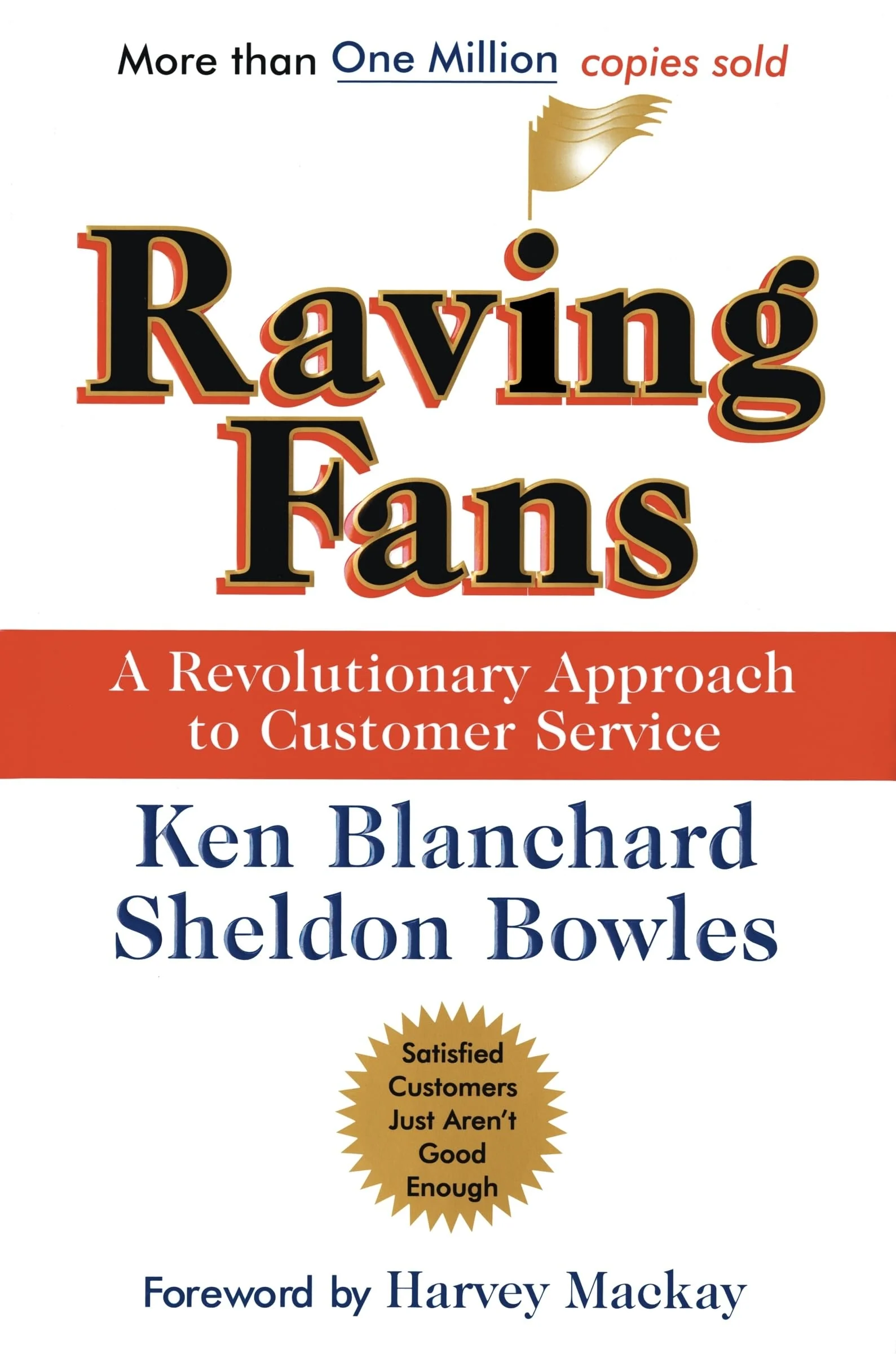
Raving Fans is a business parable by Ken Blanchard and Sheldon Bowles about why a satisfied customer is not a loyal one. Charlie, a guide, walks an area manager through three firms that keep one narrow promise every time, then add a small extra. Three rules come out of that tour.
About the author
Ken Blanchard is an American author and leadership consultant. With Spencer Johnson he wrote The One Minute Manager, then spent decades teaching managers to set a clear finish line and respond when people hit it or miss it. He co-founded The Ken Blanchard Companies and kept writing short books managers finish. Raving Fans, published by William Morrow in 1993, points that same taste for simple rules at the customer’s visit instead of the one-on-one with an employee. Explore all Ken Blanchard book summaries →
Sheldon Bowles co-wrote the parable, and later story-books such as Gung Ho! They teach with a tour rather than a manual. Many editions carry a foreword by Harvey Mackay, and this cover notes more than one million copies sold.
Key concepts at a glance
| Concept | What it means | Use it when |
|---|---|---|
| Satisfied customer | The visit was fine. Nothing broke. There is no story to retell. | Scores look calm and repeat visits are not. |
| Raving fan | A customer who can describe your promise and brings someone else. | You want referrals that sound like your own words. |
| Decide | A concrete picture of the experience you intend to deliver. | The team says be great and each person improvises. |
| Discover | The customer’s picture of a good visit, heard in their words. | You are proud of a perk nobody mentions. |
| Deliver plus one | Keep the promise every time, then add one repeatable extra. | Heroics happen and the next shift cannot copy them. |
| Narrow promise | A few standards you can hit on your worst ordinary day. | The service list is longer than the training. |
| The system | Steps, wording, and checks that do not depend on one star employee. | Quality drops when a particular person is off. |
| One percent next | A single improvement, made normal, before the next one starts. | A relaunch tries to fix everything in a week. |
Why satisfied customers still leave
Blanchard and Bowles treat satisfaction as a weak signal. It often means expectations were low and you cleared them. Low expectations are not a moat. They are a gap a clearer competitor can walk through.
Charlie, the guide in the story, does not start by scolding the staff for being unfriendly. He starts by showing companies that decided what the visit would feel like before they hired for smiles. The area manager’s company has effort. It does not have a picture. Without a picture, two good employees create two different versions of good, and the customer cannot tell a friend what to expect.
Ask three teammates to describe the guarantee in one sentence, without the words great, friendly, or quality. If the sentences do not match, you are still in the opening chapter. The fix is a scene everyone can see: the first minute, what the customer leaves with, and what never happens on your watch.
TGR Note: The Go-Giver is the posture: give value first. The Go-Giver summary covers that stance. Raving Fans is the service design. Read both if your team is generous in spirit and inconsistent at the counter.
Secret 1: Decide what you want
The first secret is to decide the experience you want to be known for, in detail, before the market edits it. Blanchard and Bowles want a vision you could film. Who greets the customer. What they hear. How long a step takes. What stays true when the shop is short-staffed. A vision that only works when the founder is on the floor is a wish.
Charlie’s three stops are specific in different trades. A retailer builds the visit around a few promises the team can perform from open to close, including help that continues to the car. A service stop builds the visit around checks that happen every time, not a rotating list of extras. A manufacturer promises the spec exactly, because a surprise change feels like care in the moment and like risk to the buyer who needed the drawing. The trades differ. Each leader can point at the experience.
Decide also means you will disappoint someone on purpose. Promise every custom request and you have promised a different business to every customer. Choose the customer you can serve cleanly, and let the vision exclude the rest. Kind teams resist that. It is how the promise stays true.
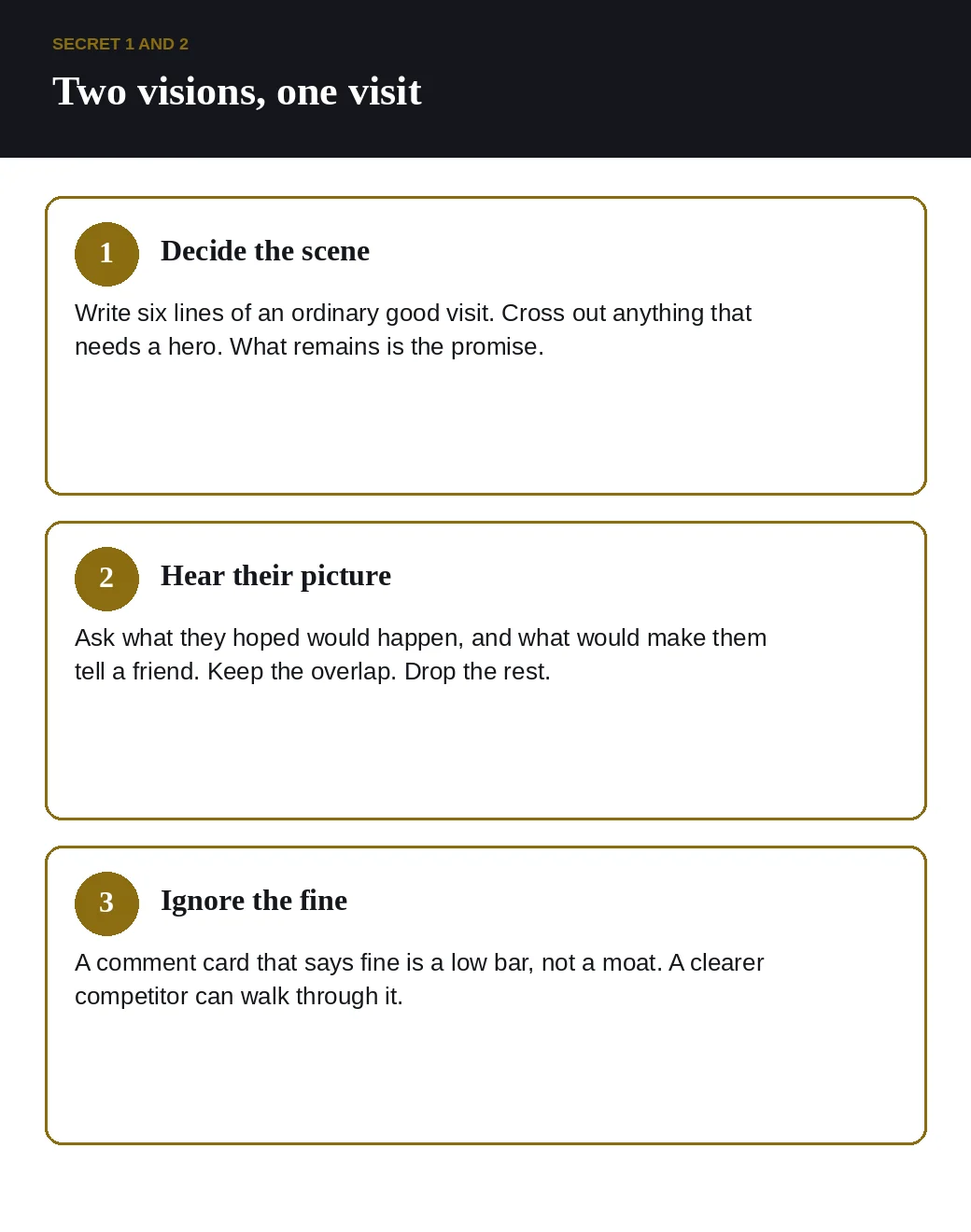
Write a six-line scene of an ordinary good visit, then cross out any line that needs a specific personality. What remains is the candidate promise. If nothing remains, you have been relying on heroes.
Secret 2: Discover the customer’s vision
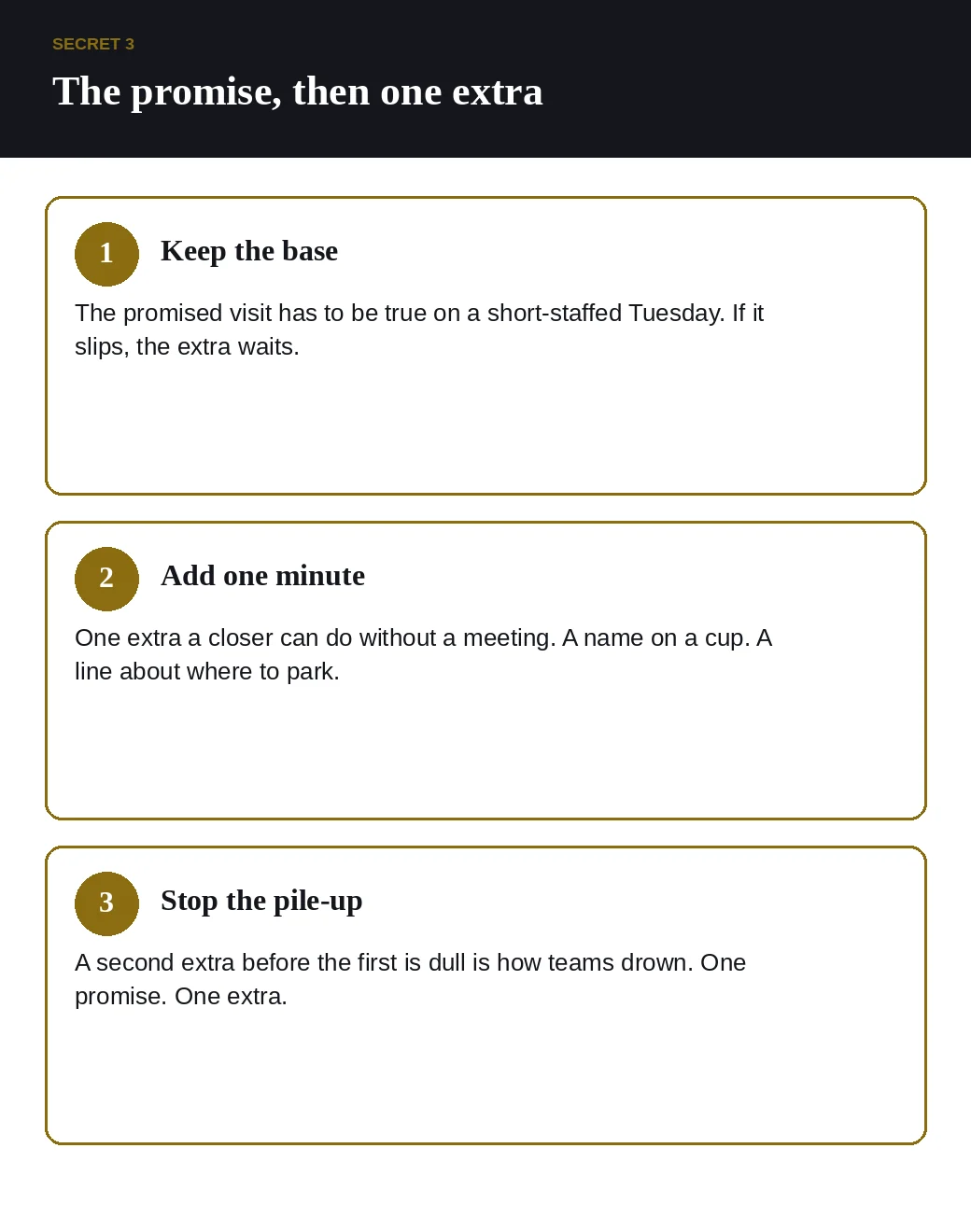
The second secret keeps the first one honest. Your film of a perfect visit may miss the thing the customer was anxious about. Blanchard and Bowles send the manager out to hear that picture in the customer’s words: what they hoped would happen, and what would make them tell a friend.
Discovery is a comparison, not a suggestion box. Lay your scene next to theirs. The overlap is the promise you can keep and they will notice. The parts only you care about are vanity. The parts only they care about are a new line in the promise, or a sign you are talking to the wrong customer.
A support team timed replies and felt proud, then heard that customers only wanted the name of the person who owned the problem next. Speed was the company’s vision. The name was the customer’s. The overlap became a same-day human reply that names the next owner. A clinic front desk had the mirror image: the team wanted to sound warm, and callers wanted a confirmed time before the day ended. Warmth stayed. The promise became the time.
TGR Note: If you do not yet trust what customers say they want, do the listening with more care before you standardize. The Mom Test summary shows how to ask about real past behavior instead of polite opinions. They Ask, You Answer is the publishing side of the same instinct: answer the questions buyers already have, in public, before the sales call.
Secret 3: Deliver the vision plus one
The third secret is where service programs die. The vision is agreed, and then the team launches every improvement in one week. Blanchard and Bowles say deliver the vision completely, and only then add one percent. One percent is an extra a stranger on the team can do after a short demonstration. It is not a surprise that needs the founder.
The memorable companies in the story are not chaotic with generosity. They are reliable, then slightly more than the promise. A clean windshield every time, then one extra check. A product that matches the spec, then one courtesy the contract did not require. The customer learns the floor will not move. The extra feels like character because the floor showed up first.
Kind people skip consistency. They would rather do something special for the person in front of them than repeat a plain standard. The book treats that impulse as the enemy of fans. A special moment the next customer does not get is a broken promise in disguise. Write the standard, train it, and watch it on a bad day. When it holds for two weeks, add one extra and freeze the list.
A cafe makes the size obvious. Any drink in sixty seconds fails when the line hits the door. A right order and a wiped table is a vision a closer can keep. The plus one, a regular’s usual on the cup, starts only after that base has been true all week, and it comes off the moment orders go wrong.
TGR Note: A clear promise is also a story the customer can repeat. Building a StoryBrand helps you say the promise in the customer’s language, with you as the guide and them as the hero. The New One Minute Manager is the companion for the people who have to keep it: one clear goal, fast praise when it happens, a quick redirect when it does not.
Who is Raving Fans best for — and who should read something else first?
Read Raving Fans if you already have customers and the experience depends on who is working. Owners, support leads, and office managers can change one promise this month. The book is short, the rule fits on a card, and it starts with one promise rather than a rebrand.
Read something else first if you do not yet know the struggle. Start with The Mom Test so questions track real behavior. If the offer is muddy, read Building a StoryBrand before you standardize the wrong visit. If standards exist and the team is the bottleneck, read The New One Minute Manager. For the ethic under good service, read The Go-Giver alongside this, not instead of it.
Skip it for now if you need pricing or a funnel. It will not tell you what to charge. It will tell you what must be true after someone arrives.
Questions to reflect on
- If a customer described us to a friend in one sentence, would it match the sentence we want?
- Which part of our service only happens when a specific person is working?
- What do customers ask for that never appears in our training?
- What do we keep offering that customers never mention?
- What is the one extra we could add only after the base promise has been true for two weeks?
🔥 Ready to build a promise people can feel?
Read the parable, then write one scene your next shift can repeat.
How to apply Raving Fans (7-day plan)
- Day 1: Name the moment. Pick one customer moment you will redesign: the first reply, the front desk, the handoff, or the delivery. Ignore the rest of the business for this week.
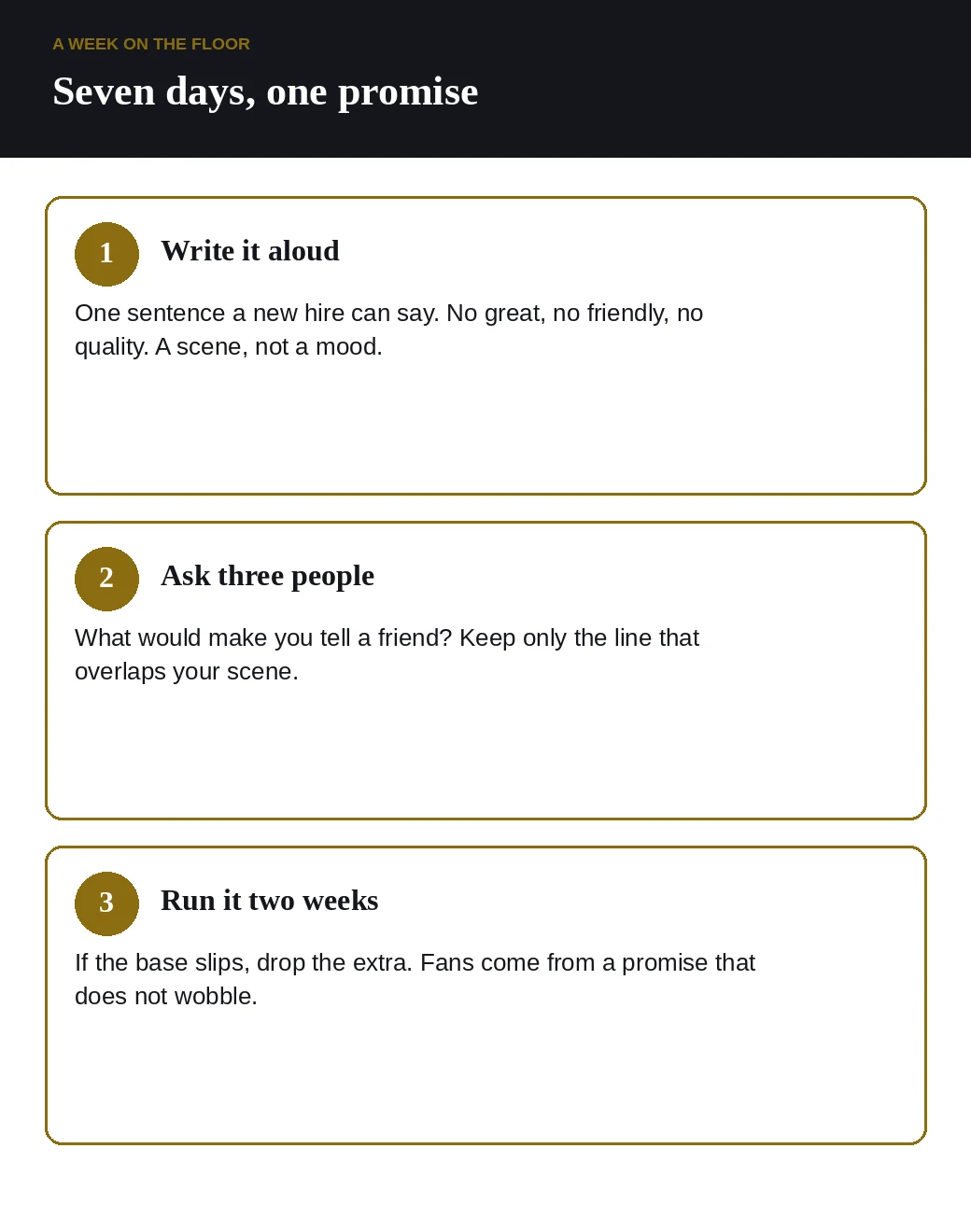
- Day 2: Film it in six lines. Write the visit as a scene. Cut every line that needs a hero. Read it to one teammate. If they cannot act it, rewrite the line.
- Day 3: Ask five customers. Ask what they hoped would happen last time, and what they would tell a friend. Write their words beside your scene. Circle the overlap.
- Day 4: Publish the promise. Reduce the overlap to one sentence. Put it where the team can see it. Remove one perk you cannot keep on a bad day.
- Day 5: Run the base only. Deliver that sentence all day. No plus one yet. Note every time the promise slipped and what got in the way.
- Day 6: Fix the slip. Change one step, one script, or one checklist so yesterday’s slip is harder. Train it in ten minutes, then run it again.
- Day 7: Add one percent. Choose one extra that takes under a minute and does not depend on a personality. Announce it as the only addition for the next two weeks.
Frequently asked questions
What is Raving Fans about?
Raving Fans is a short business parable by Ken Blanchard and Sheldon Bowles. An area manager tired of polite, forgettable service meets a guide named Charlie. Charlie walks him through three companies that refuse to impress everyone. Each one picks a narrow picture of great service, checks it against what customers want, and builds a system that delivers that picture every time, plus one small extra. A satisfied customer had a fine visit. A raving fan can predict the visit, comes back, and tells someone else. The book is a story, not a survey. You leave with three rules and one promise you can start this week.
What are the three secrets in Raving Fans?
The three secrets are decide, discover, and deliver plus one. Decide means drawing the experience in concrete detail: what the customer sees, hears, and leaves with. A slogan like be friendly dies on a busy Tuesday. Discover means asking buyers what they hoped would happen, then noticing where your picture and theirs do not match. Change the promise, or admit you are serving the wrong person. Deliver plus one means hitting the agreed vision every time, then adding a single extra the next shift can repeat. Consistency creates fans. A spectacular day followed by a sloppy week does not.
Who should read Raving Fans?
Read it if your team faces customers and the standard is still we try our best. Owners, support leads, and front-desk coordinators can change one promise this month. It is also a clean first book if service writing usually feels fluffy. It is a weak fit when you need pricing, a marketing plan, or an interview method. Use The Mom Test when you do not yet know what customers mean, and Building a StoryBrand when the offer is unclear. If the promise is written and the gap is how you lead, start with The New One Minute Manager.
Is Raving Fans a story or a textbook?
It is a story on purpose. Blanchard and Bowles put the rules inside a tour of three businesses so a supervisor can retell them in a staff meeting. You will not find score charts, scripts for every industry, or a literature review. That is a limit if you wanted a data book, and it is why new managers finish it. Treat the parable as a design brief. When you close it, write your own version with your customers, your constraints, and one promise a new hire can keep without a hero on the shift. The story teaches the rule. Your counter, inbox, or route has to prove it.
How is Raving Fans different from The Go-Giver?
Both are short parables, and both prefer generosity to a hard close. They do different jobs. The Go-Giver is about how you show up with a person: give value first, and let the return follow the way you treat them. Raving Fans is about the service system. It asks what you will promise, whether the customer wants that promise, and whether tomorrow’s shift can repeat it. You can practice every Go-Giver law and still run a counter that surprises people differently each day. Use The Go-Giver for the team’s posture. Use Raving Fans to standardize one experience. Neither book sets your price.
How is Raving Fans different from The One Minute Manager?
Ken Blanchard links the two books. The New One Minute Manager is about leading a person: one minute goals, one minute praising, and one minute redirects. Raving Fans is about leading the customer’s experience. The manager book sets a finish line for an employee and tells you how to respond when they hit it or miss it. The service book sets a finish line for a visit, a delivery, or a reply. Read the manager book when people do not know what good work is. Read Raving Fans when everyone works hard and the customer still cannot say what you guarantee.
How do you apply deliver plus one without adding chaos?
Write the promise in one sentence a new hire can say aloud, and cut any clause you cannot show on a bad day. Then pick one extra that takes less than a minute and does not depend on a personality. A support desk might promise a human reply before noon, plus the name of whoever owns the next step. A front desk might promise a same-day confirmed time, plus a line on where to park. Run that pair for two weeks. If the base slips, drop the extra until the base is dull and reliable.
Related summaries
- The Go-Giver summary — give value first, then let the relationship compound.
- They Ask, You Answer summary — publish the answers buyers are already seeking.
- The Mom Test summary — hear what customers do, not what they politely say.
- The New One Minute Manager summary — Blanchard on clear goals, praise, and redirects.
- Best productivity books — the rest of the shelf, ranked.