

★★★★☆ 4.6/5 — Own a simple place in the mind, then repeat it until the market files you there.
Best for: Founders, marketers, and specialists who are tired of saying they are better.
Reading time: ~4 hrs, guide: 16 min
Difficulty to apply: Medium. The rules are short. Choosing one hole, and ignoring the rest, is the work.
Positioning in one minute
The market does not keep the product with the longest feature list. It keeps a short list of names, and you are either on it or you are noise. Positioning, by Al Ries and Jack Trout, is the 1981 argument that still decides homepages, pitch decks, and category names. You do not win by changing the product first. You win by claiming a simple place in the prospect’s mind, a place that was empty or that you can open with one clear contrast. Be first if you can. If you cannot, open a narrower category you can lead, or reposition the leader so a rung clears. Then give that place a name people can repeat, and stop spending the name on side projects. The rest of the book is a tour of traps that look like growth and act like forgetting: the no-name, the free ride, and the line extension.
Key takeaways
- Position the mind, not the spec sheet: a new feature does not create a new memory unless it attaches to a place the prospect already has.
- The ladder is short: people store a first name, maybe a second, and a blur after that. Know your rung before you write the claim.
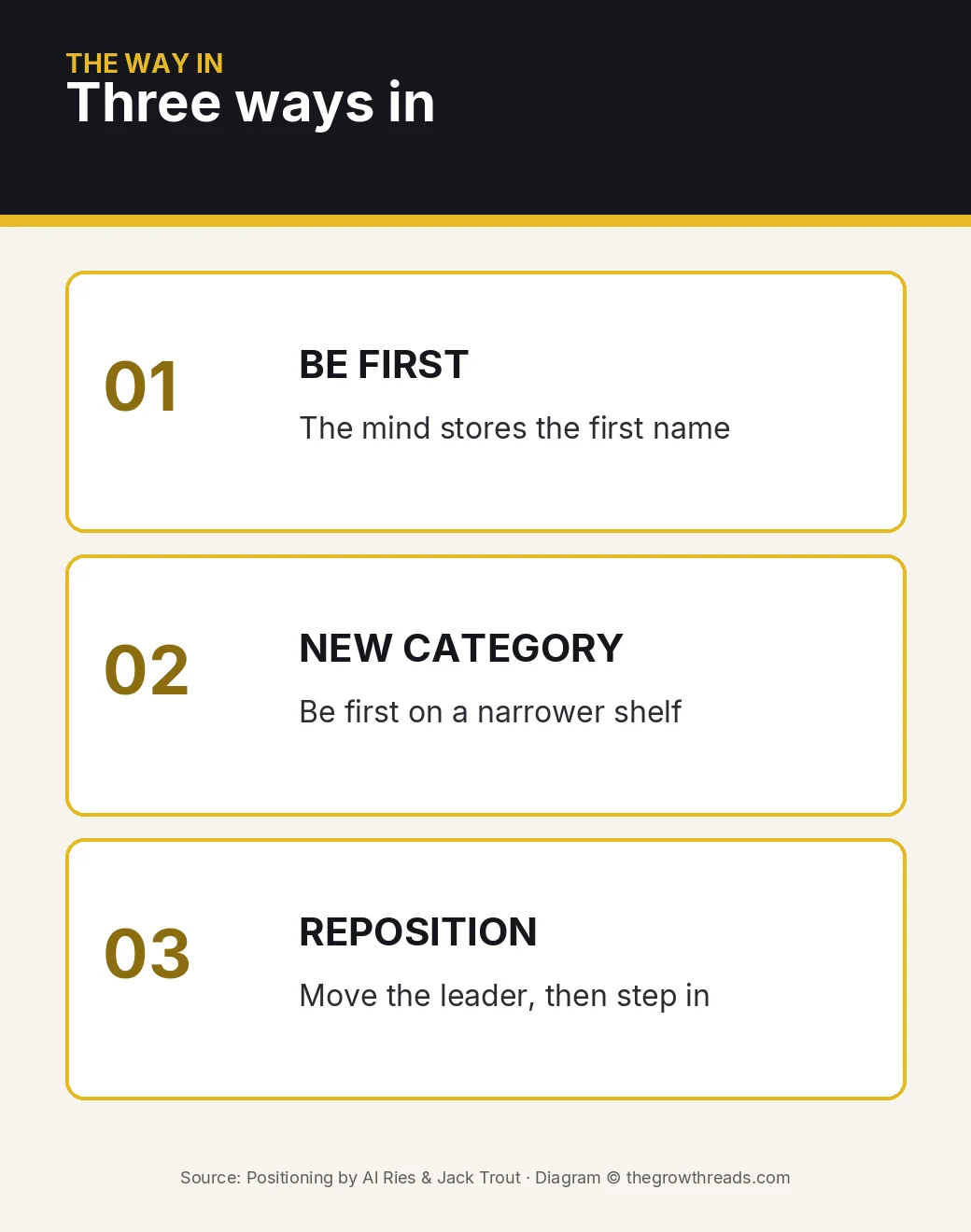
- Being first is the easy door: the first brand to make a category clear gets filed as the category.
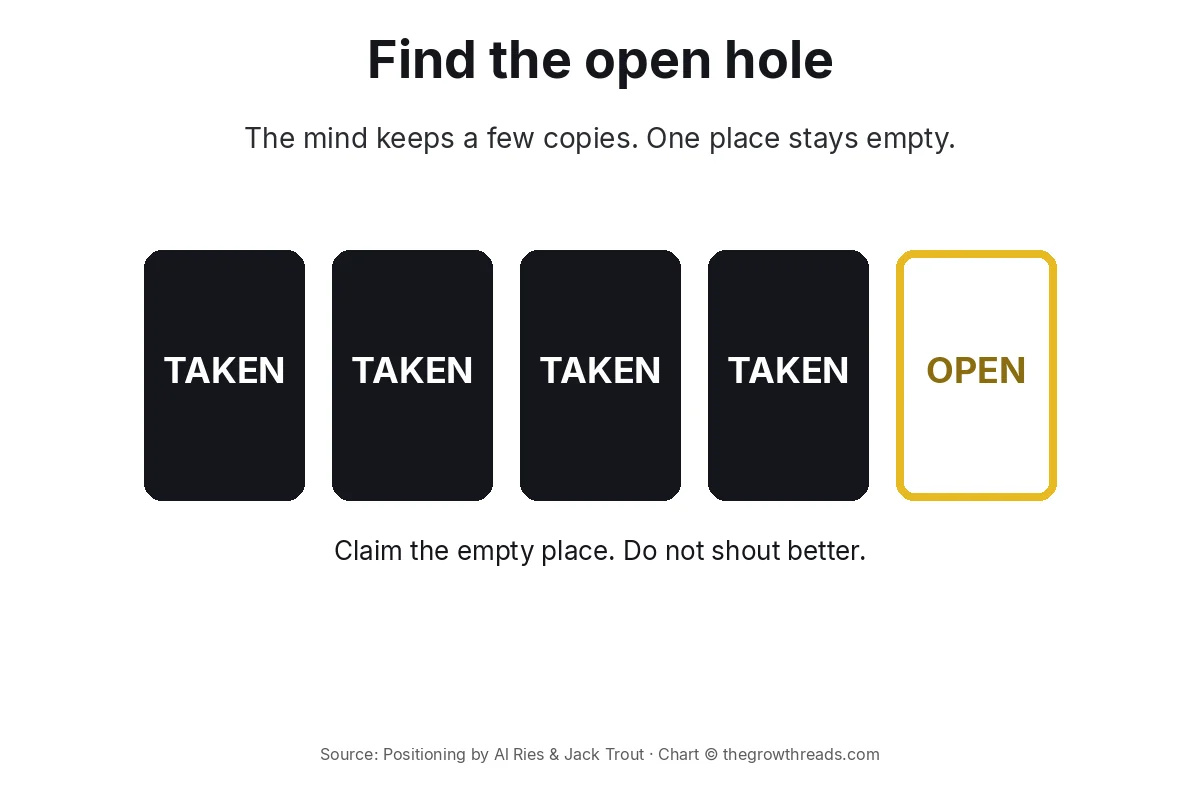
- Find the hole: if you cannot be first, claim an empty use, customer, or contrast instead of shouting that you are better.
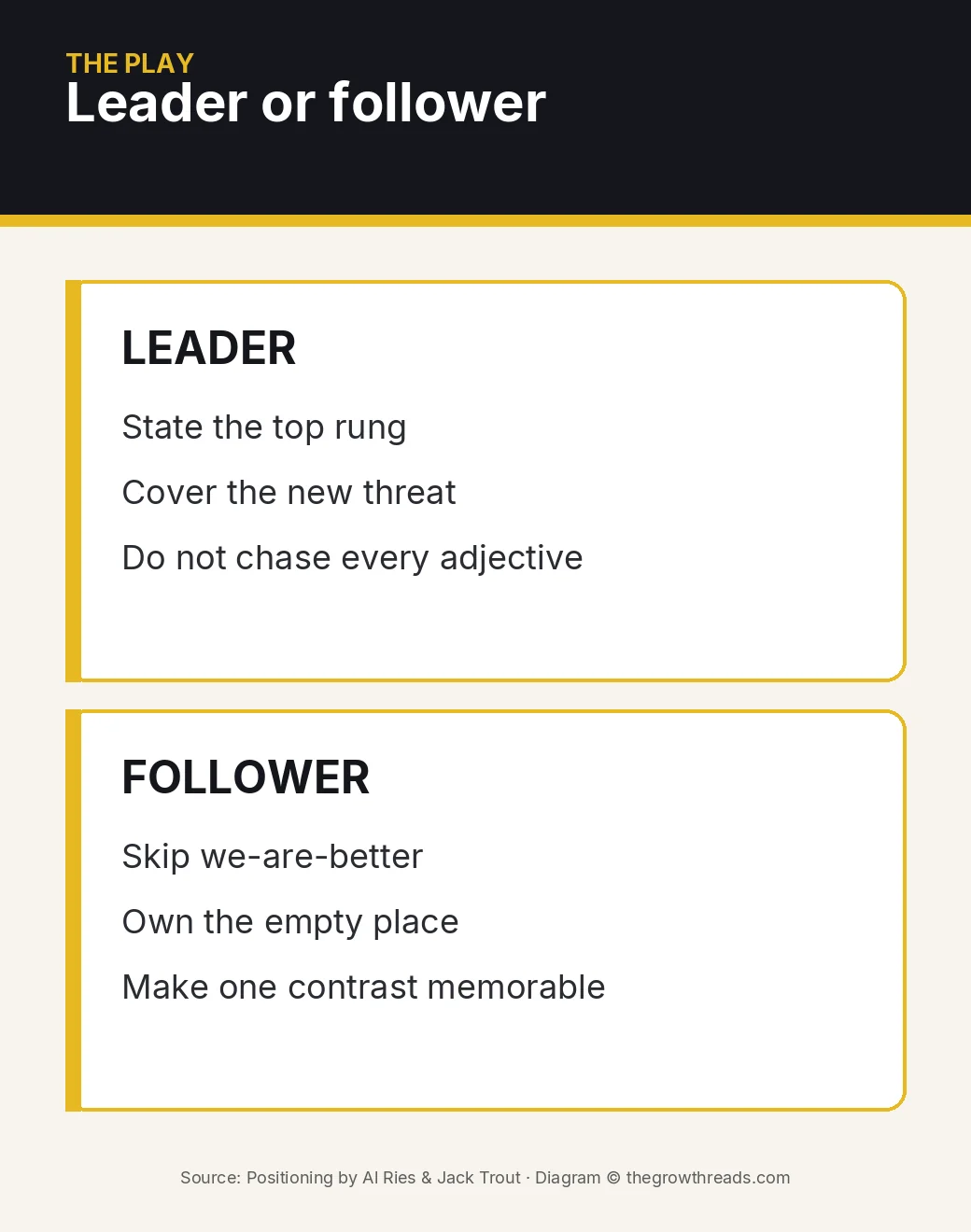
- Leaders and followers play differently: a leader states the top rung and covers new threats. A follower owns an opposite.
- Reposition with one contrast: a plain difference can move the leader’s meaning. A vague unlike-the-big-guys line cannot.
- The name is the handle: if a stranger cannot repeat it after one hearing, the position will not travel.
- Line extension spends the word: a new idea usually needs a new name. A flavor or a size can support the old one.
- Repeat longer than feels comfortable: the building gets tired of the line in a week. The market has usually heard it once.

What is Positioning about?
Positioning is Al Ries and Jack Trout’s field manual for being remembered. You win by owning a simple place in the prospect’s mind, not by listing more features. Be first, open a new category, or reposition the leader, then repeat one clear idea until the market files you there.
About the author
Al Ries and Jack Trout gave positioning its name. In 1972 they published the Positioning Era series in Advertising Age and argued that the battleground had moved from the product to the prospect’s mind. Trout came up through advertising strategy. Ries built the agency practice beside him. The 1981 book turned those columns into a short course a founder can finish in a few sittings. McGraw-Hill’s anniversary edition keeps the same rules, adds a foreword by Philip Kotler, and runs 213 pages. Trout died in 2017 and Ries in 2022. Their later field guide, The 22 Immutable Laws of Marketing, is the checklist version of this argument. Start here when you need the original case, then use the laws to audit a name, a ladder, and a line extension. Explore all Al Ries book summaries →
Key concepts at a glance
| Concept | What it means | Use it when |
|---|---|---|
| Position | A place in the mind, not a feature list | Your words could be swapped with a rival |
| The ladder | A short ranked list the buyer already keeps | You need to know the real rung |
| Being first | The easiest way to be filed as the category | You are early and the shelf is still unnamed |
| The creneau | An empty use, customer, or contrast | The leader already owns the generic word |
| Repositioning | One contrast that moves the leader’s meaning | No empty rung is visible yet |
| The name | The handle that carries the place | People cannot repeat your sentence |
| Line extension | A new idea wearing a famous name | The roadmap is about to share the brand |
| Oversimplified message | One idea, repeated on purpose | The draft still has three claims |
The overcrowded mind
The book opens on a communication problem, not a creative one. Prospects already receive more messages than they can file. Ries and Trout put the thesis in one line: positioning is not what you do to a product. Positioning is what you do to the mind of the prospect. A new feature does not create a new memory. It has to attach to a memory the person already has, or it bounces off.
That is why better is a weak entry. Better asks the mind to reorder a ladder it already built. The ladder is short. People keep a first brand, maybe a second, and a blur after that. The practical test is rude and useful. Can a stranger name you as the answer to one narrow job, without your tagline in front of them?
Three doors still work. Be first, and the mind stores you as the category. Open a smaller category where you are first. Or reposition the leader with a contrast so a rung clears. The chapters on the assault on the mind and the little ladders are the whole thesis. Everything later is how not to waste the place you claimed.
TGR Note: Pair this ladder test with The 22 Immutable Laws of Marketing, the same authors’ checklist for being first and owning one word. If the empty place is a niche you must win before any mainstream pitch, read Crossing the Chasm next and pick one beachhead, not a bigger slogan.
Leaders, followers, and the open hole
Leaders and followers should not run the same play. A leader’s job is to state the position the market already half-believes. We are number one sounds boastful inside the company and obvious outside it, which is why it works. The leader also has to cover a new idea before a follower turns it into a separate ladder. Ignore a new category and you donate it.
A follower who says we are better is volunteering to be compared on the leader’s word. The book’s famous moves are contrasts, not spec sheets. Avis did not try to evict Hertz from first. It took the next rung and made effort the meaning of second place. 7-Up did not try to be another cola. It became the un-cola, a different ladder. A small car did not out-size Detroit. It took the opposite word. None of those moves required a longer list of improvements. They required an empty place and the nerve to stand only there.
Repositioning is the sharper tool when no empty rung is visible. You offer a plain contrast that moves the leader’s meaning. The old choice becomes the one with the problem. Yours becomes the one that escapes it. A vague unlike the big guys is not a position. A single memorable difference is.
TGR Note: Choosing the field is the strategy step before the slogan. Playing to Win asks where you will play and how you will win. Good Strategy Bad Strategy asks for a diagnosis and a focus that leaves most fights alone. Positioning tells you how that choice should sound once the prospect only keeps a few names.
Names, traps, and line extension
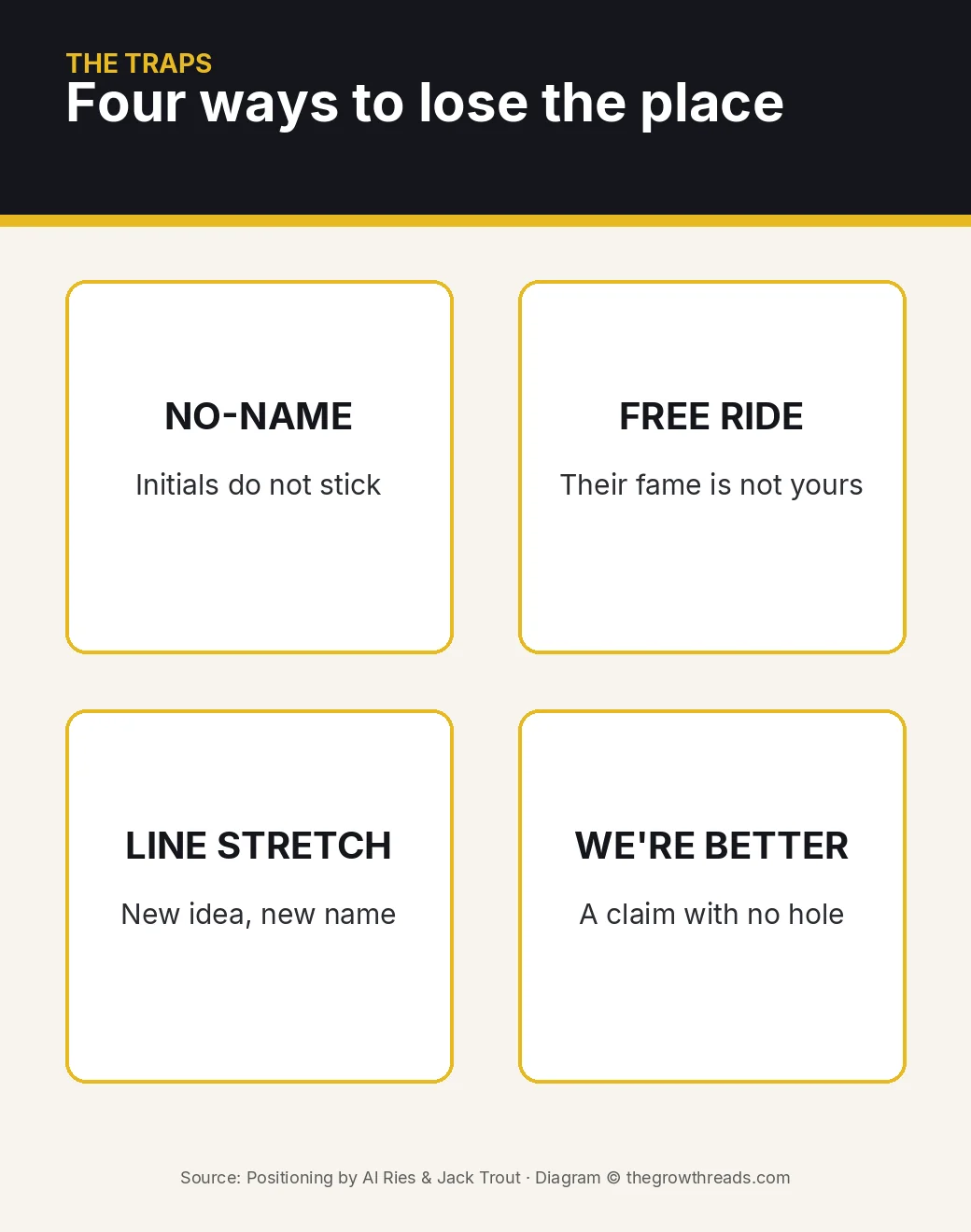
The name is the handle the mind uses to pick the position up. If the name needs a paragraph, the position will not travel. Initials and clever coinages often fail the dinner-table test. That is the no-name trap. The company is known to itself and invisible to everyone else.
The free-ride trap is borrowing a fame you do not own. A product that only makes sense next to someone else’s brand is still their position. The line-extension trap is the one careful teams walk into on purpose. The flagship finally means something, so the next product wears the same name. Each extension spends a little of the word. The book is blunt that a new idea usually needs a new name. It also shows the narrow case where an extension helps. The new item must reinforce the same word for the same person, not open a second story.
Look at the roadmap with that test. A flavor, a size, or a format can support the word. A new buyer, a new job, or a new promise usually cannot. Xerox meant copiers. Stretching the name into every adjacent machine asked the mind to forget the memory that made the company valuable.
TGR Note: Once the place is chosen, the page still has to say it in the customer’s language. This Is Marketing and Purple Cow are the Godin companions for a specific, remarkable promise. Building a StoryBrand helps when the position is right and the homepage is still about the company.
How to play the positioning game
Playing the game is a sequence, not a mood. Find the hole in the category as the customer would describe it. Name the hole in words a non-expert repeats after one hearing. Put that sentence where strangers actually look: the headline, the first line of a pitch, the bio, the subject line. Then repeat it longer than feels comfortable inside the building. Inside the company the line gets old in a week. Outside, most people have not heard it once.
The later chapters apply the same move to a company, a service, a product, a place, and a career. The career chapter is the one operators skip and then need. A generalist story is a line extension of you. Pick the problem you want to be filed under, and let the other skills support that word instead of competing with it. You can do this before a rebrand. Write the ladder, circle one rung, and delete every public sentence that argues a different case. The position is real when a customer can repeat it and a teammate can stop adding a second one.
TGR Note: A position still has to earn the next conversation. Permission Marketing is the Godin piece on being anticipated, personal, and relevant instead of interrupting. If the sentence is sharp and people still forget it, Made to Stick shows how to make one idea travel without adding a second idea.
Who is Positioning best for — and who should read something else first?
This book is for founders, marketers, and specialists who can talk about the work for ten minutes and still not leave one idea behind. It is for teams about to launch a second product under a name that finally means something. It is for anyone whose homepage could be swapped with a competitor’s and nobody would notice.
Read something else first if the field is not chosen. Playing to Win is the book for where you will compete. Crossing the Chasm is the book for winning one niche before a broad pitch. If the place is chosen and the page still talks about you, start with This Is Marketing or Building a StoryBrand. Read The 22 Immutable Laws of Marketing second, as the checklist, not instead of the original argument.
Questions to reflect on
- If a stranger filed us under one word this week, what would that word be?
- Which rung are we actually on, not the rung in the deck?
- What hole has the leader left empty that we could own without asking them to move?
- Which product, page, or offer is spending the word we still need?
- Which sentence would we repeat for six months after we are tired of it?
🔥 Ready to own one place in the mind?
Use Ries and Trout’s rules to find the open hole, name it, and stop arguing that you are better.
How to apply Positioning (7-day plan)
- Day 1 — Write their ladder. Ask one customer, or one honest non-buyer, which three names they remember in your category. Write those names in their words. Do not correct them.
- Day 2 — Circle one word. Pick the single word you want attached to your name. If you need a comma, you have two words. Park the second one.
- Day 3 — Replace one better. Find one public sentence that says you are better, faster, or easier. Rewrite it as a place: the open hole, the opposite, or the narrower shelf.
- Day 4 — Name the hole. Write the empty job, customer, or contrast the leader is not defending. If you cannot say it in one breath, it is not a hole yet.
- Day 5 — Test the name. Say the position once to someone outside the company. If they cannot repeat it, shorten the words. Do not add an explanation.
- Day 6 — Check the extensions. List every product, page, and offer using the flagship name. Keep what reinforces the word. Give a working name to anything that opens a second story.
- Day 7 — Publish one sentence. Put the position in one place a stranger sees: the headline, the bio, or the first line of the pitch. Leave it there for the next week before you add anything.
Frequently asked questions
What is Positioning by Al Ries and Jack Trout about?
Positioning is a short course in being remembered. Ries and Trout argue that a market does not store your feature list. It stores a few names, each tied to a simple idea, and it ignores the rest. The book shows three ways onto that list: be first, open a new category you can lead, or reposition the leader so a place opens. Then it shows how a muddy name, a borrowed brand, or a we-are-better claim throws that place away. The anniversary edition keeps the 1981 argument. Read it when the offer is real and the words still sound like every rival.
What does “own a word” mean in Positioning?
Owning a word means a stranger can name you when that word comes up, without a logo in front of them. Ries and Trout treat the word as a handle for a place in the mind, not as a slogan contest. It has to be empty enough to claim and narrow enough to repeat. Hertz could be first. Avis could be the one that tries harder. A cola rival could be the un-cola. If the homepage needs three ideas to explain the word, you do not own it yet. Put one word in the first line a stranger sees, and add nothing until that word comes back unprompted.
Is Positioning still useful in 2026?
Yes. The cases come from older categories, and the move is the same wherever a stranger only keeps a few names. Search results, an app store, a feed, and a group chat all behave like the short ladder in the book. People still file the first name they understood. They still ignore the brand that says it is better at everything. Use the book to choose one open place and one sentence. Use newer channels only to repeat that sentence. A new format does not replace the need to be filed under a word the market still has room for.
How is Positioning different from The 22 Immutable Laws of Marketing?
Positioning is the original argument. It explains why the mind is the battleground, how ladders form, and what leaders and followers should do differently. The 22 Immutable Laws of Marketing, by the same authors, turns that argument into a checklist: be first, own one word, and refuse the line extension that spends it. Read Positioning when you need the reasoning and the traps in story form. Read the laws when you already agree and want a fast audit of a name or a roadmap. On The Growth Reads, this page is the start, and the laws summary is the companion checklist.
What is a creneau in Positioning?
A creneau is the hole: an unoccupied place the leader is not seriously defending. Ries and Trout use it for the opening a follower should claim instead of shouting from under the leader. The hole can be a use, a customer, a contrast, or an opposite. We are also innovative is not a hole. The overnight option, the un-cola, or the specialist for one job can be. Write the ladder as the customer would, then circle the job no stored name already answers. If you cannot say the hole in one breath, it is still a paragraph, not a position.
Who should read Positioning first?
Founders, marketers, and specialists who can describe the product for ten minutes and still not hear a stranger repeat one idea. It is also the right first book when a new offer is about to inherit a famous name. Read Playing to Win first if you have not chosen where you will compete. Read Crossing the Chasm first if the urgent job is one niche before a mainstream pitch. Read This Is Marketing or Building a StoryBrand first if the position is chosen and the page still talks about you. Positioning is for the moment the words are crowded and the place is not chosen.
How long does it take to apply Positioning?
You can run the first pass in a week, in short sessions, without a rebrand. Day one is the ladder a customer would write. Day two is the single word. The middle of the week finds the hole and deletes one we-are-better line. The name test is one conversation outside the company. The last day puts the sentence in one public place. Owning the word takes longer than drafting it. The market needs repetition, so the week is a start. Do not add a second idea on day eight. Repeat the first one until a customer says it back.
Related summaries
- The 22 Immutable Laws of Marketing — the checklist version of this argument.
- Crossing the Chasm — win one niche before you ask the whole market to care.
- Playing to Win — choose where you will play before you name the rung.
- This Is Marketing — say the position in the customer’s language.
- Best productivity books — the silo shelf this summary sits on.
How we analyze books: we read for the moves you can use, check the author’s public record, and turn the argument into a one-week plan. Read our full methodology.