

★★★★★ 4.5/5 — A short, blunt field manual: train until you have no favorite weapon, take the initiative, and treat every contest as the same geometry.
Best for: Operators and founders who keep waiting for a perfect playbook while the other side is already moving
Reading time: ~3 hrs for Musashi’s five books (~5 hrs with the Yagyu companion in this edition) · ~16 min for this guide
Difficulty to apply: Easy to read; the hard part is dropping the technique you like
The Book of Five Rings in one minute
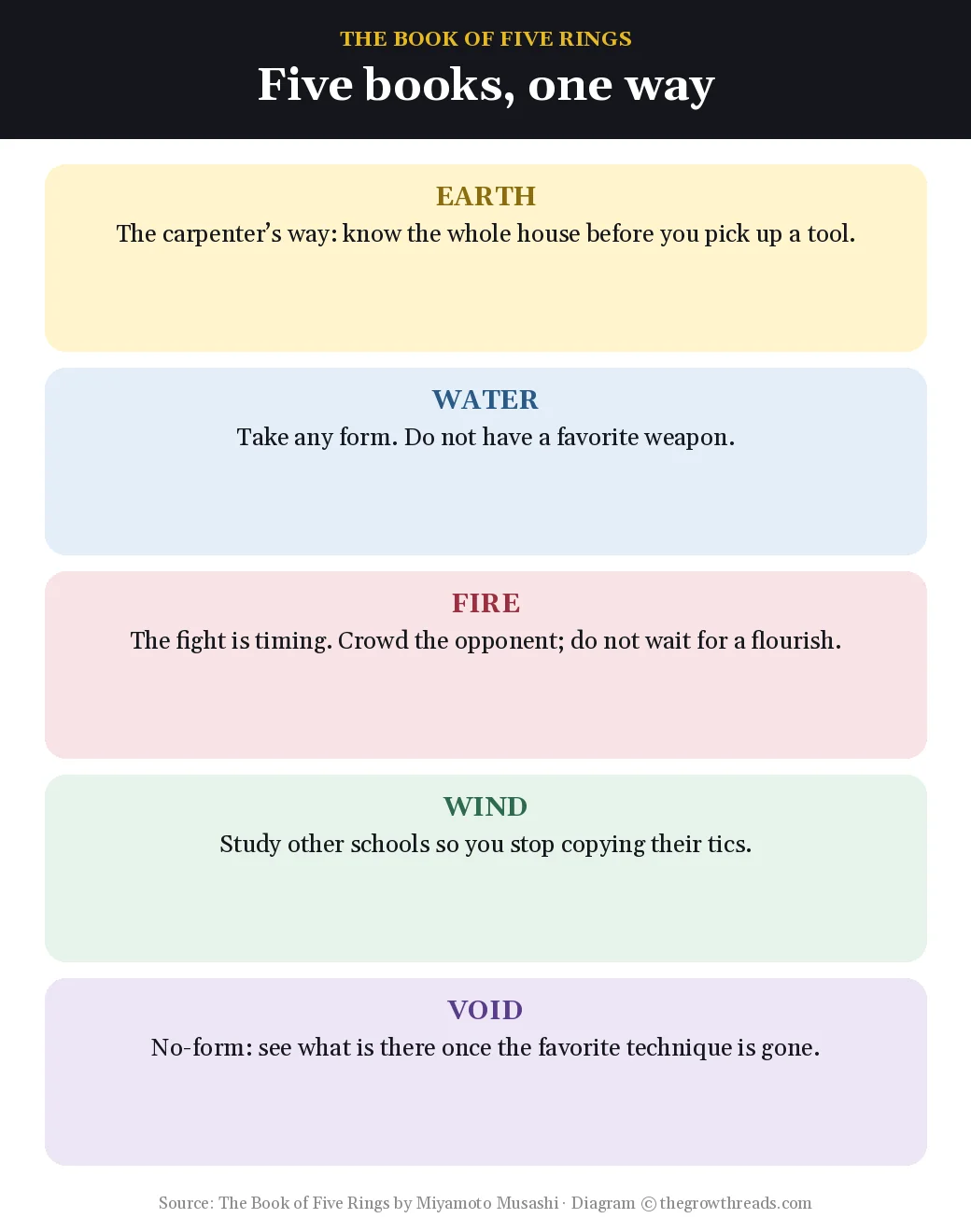
A contest is decided by timing and spirit, not by the flourish you practised in a quiet room. That is Miyamoto Musashi’s brief, written in a cave in 1645 after a lifetime of undefeated duels. The Book of Five Rings (Go Rin no Sho) is five short books named Earth, Water, Fire, Wind, and Void. Earth says know the whole house before you pick up a tool. Water says take any form — do not have a favorite weapon. Fire says crowd the opponent and seize one of three initiatives. Wind is a tour of other schools so you can see your own tics. Void is what remains when the favorite technique is gone. Read it as a diagnostic for modern leadership, not as costume. The usable moves are still blunt: train both hands, move while they are still arranging the room, and finish the contest instead of decorating it.
Key takeaways
- The Way is one: A duel and a campaign use the same geometry. Do not keep a “small” strategy and a “large” strategy in separate drawers.
- Know the house: Earth-book strategy is the carpenter’s way — layout, timber, and the whole building — not a single clever joint.
- No favorite weapon: A tool you hide in is a room that can beat you. Train the neglected hand until the contest, not your identity, picks the instrument.
- Spirit like water: Take the opponent’s shape. A rigid stance looks skilled until the floor changes.
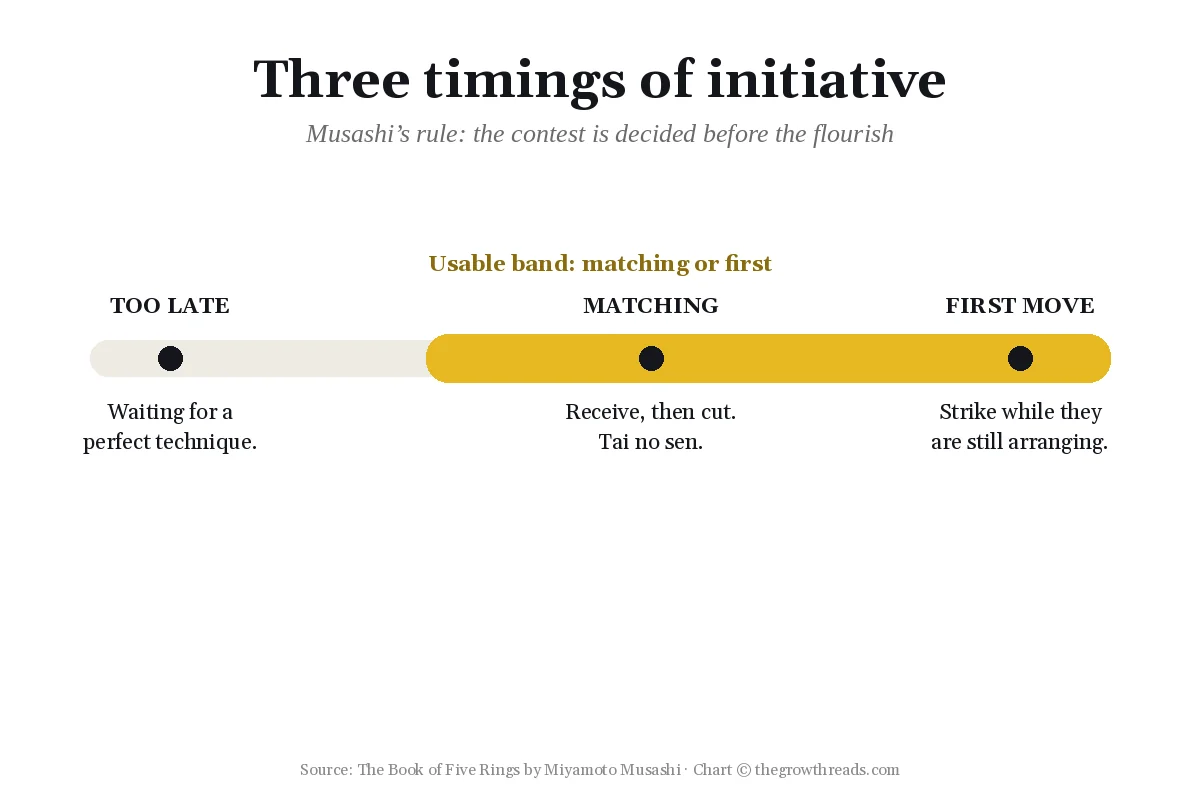
- Timing is the fight: Ken no sen, tai no sen, tai tai no sen. Late is the failure mode, not “waiting wisely.”
- Crowd the opponent: Distance is how flourishes survive. Close in until their favorite move has no room.
- Study other schools: Wind-book work is seeing the tic you copied. Keep a habit only if it still cuts.
- Void is not a mood: It is no-form: what you can see once you stop clutching a technique.
What is The Book of Five Rings about?
The Book of Five Rings is Miyamoto Musashi’s 1645 handbook on strategy as one Way. In five short books — Earth, Water, Fire, Wind, Void — he argues that you train until you have no favorite weapon, you take the initiative, and a duel and a campaign use the same geometry of spirit and timing.
About the author
Miyamoto Musashi (c. 1584–1645) was a swordsman, painter, and strategist who became Japan’s kensei, or sword saint, through stories of an undefeated record in some sixty duels. He fought as a young man around Sekigahara, wandered as a ronin, and founded the two-sword school later called Niten Ichi-ryū. In his final years he withdrew to Reigandō, a cave in present-day Kumamoto, and wrote Go Rin no Sho for a senior student, Terao Magonojō, along with the short Dokkōdō, or Way of Walking Alone. He died on 13 June 1645. The book is not a memoir of those duels. It is the method he wanted left behind: a Way you investigate with the body, not a list of favorite tricks. Explore all Miyamoto Musashi book summaries →
Key concepts at a glance
| Concept | What it means | Use it when |
|---|---|---|
| The Way as one | Duel and campaign share timing and spirit | You keep a “small” playbook and a “large” playbook that contradict |
| Carpenter’s way | Know the whole house before you pick a tool | A clever tactic is standing in for a layout |
| No favorite weapon | A preferred tool is a blind spot | You lose every time the room is a different shape |
| Ken no sen | Attacking initiative: move while they arrange | You are waiting for a perfect brief |
| Tai no sen | Waiting initiative: receive, then cut | You freeze when someone else speaks first |
| Crowding | Close distance so flourishes have no room | The work lives in status updates, not in the problem |
| Wind | Study other schools to see your own tics | A ritual continues because “that is how we do it” |
| Void | No-form: seeing after the favorite move is gone | You cannot describe the contest without a framework |
Part 1: Earth — the carpenter’s way and knowing the whole house
Musashi opens like a builder, not a mystic. The Earth book is the ground plan: what this Way is, and why a man who can win a duel and still lose a war has not yet understood strategy. He compares the warrior to a carpenter. A carpenter does not fall in love with one joint. He knows the timber, the plan of the house, the weather the roof must take. Strategy, he says, is the same whether you are one person or a commander of many. If your “small” method and your “large” method disagree, you do not yet have a Way — you have hobbies.
He lists the accomplishments a warrior should touch so the mind is not a single blade. He is not asking you to become a dilettante. He is asking you not to be helpless the moment the favorite instrument is missing. Earth is the reason for the later sentence operators steal: do not have a favorite weapon. A house is not a chisel.
He also sorts other warriors the way a carpenter sorts bad practice: schools that only like the long sword, only like interior fighting, only like speed, only like a particular stance. Each is a house with one window. If your team can only win in a slide review, or only win when you are in the room, you do not have a Way. You have a weather-dependent trick. Musashi’s fix is not a new slogan. It is to put the whole building on the table — the people, the timing, the second-order contest — before you reach for the tool you like.
TGR Note: The carpenter image is the same job as Grove in High Output Management: you are scored on the house, not on one elegant joint. The Art of War is the Chinese cousin — terrain before the flourish.
Part 2: Water — form, gaze, and no favorite weapon
Water takes any container. That is the spirit Musashi wants in the body. The Water book is the technical heart: how to stand, how to hold the two swords, how to look, how to cut. He is impatient with decorative kamae. A stance that exists to look like a school is already late. The gaze is the same lesson at the level of attention. Do not stare at the opponent’s weapon. See the whole person. A modern translation is cheap and accurate: do not stare at the metric someone is waving. See the system that produced it.
“Do not have a favorite weapon” is the sentence operators steal, and they are right to. Musashi trained with the long sword and the short, and with whatever was in reach, so that a close room did not turn him into a beginner. He is not against mastery. He is against identity fused to one instrument. If you only trust a dashboard, the customer conversation beats you. Water-book work is to become equally useful with both hands.
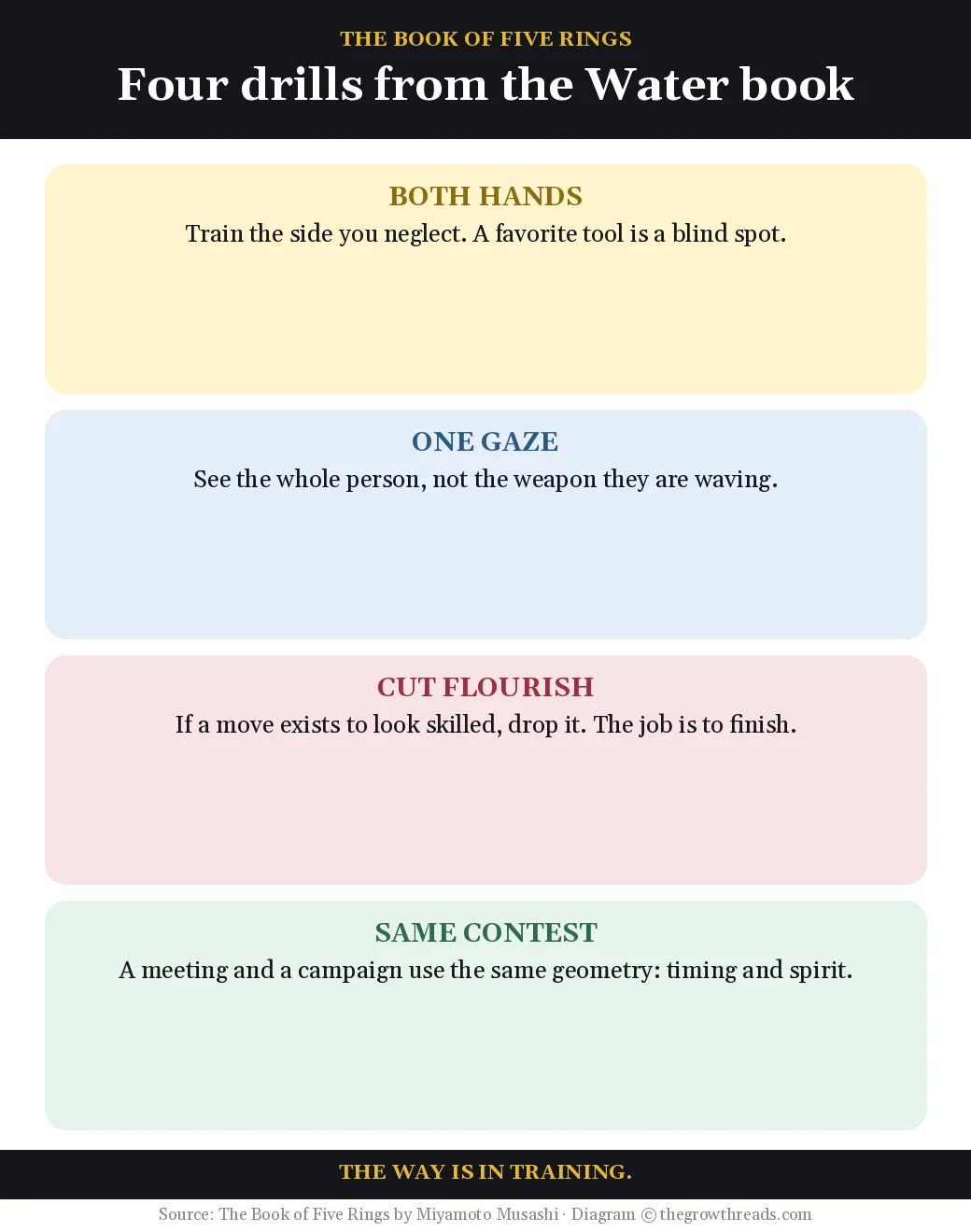
He keeps ending paragraphs with a command later readers find either useful or irritating: investigate this thoroughly. He will not write you a complete catalogue of cuts. The Water book is a set of shapes you must put into the body until they are not shapes anymore. The practice is to pick one neglected hand — the short email, the unglamorous staffing, the conversation you keep postponing until you have a perfect deck — and train it until it is boring. Boring is the point. Water does not congratulate itself for filling a cup.
TGR Note: Dropping a favorite weapon is the leadership version of Ego Is the Enemy: the identity that needs to look skilled is the first thing the contest will use against you. Extreme Ownership is the same demand in modern uniform.
Part 3: Fire — timing, crowding, and the three initiatives
Fire is the book of the actual fight. Musashi’s subject is not anger. It is collision: two forces, a rhythm, a chance to finish. He names three initiatives. Ken no sen is attacking initiative: you move while they are still arranging. Tai no sen is waiting initiative: you receive the move and then cut, which is not freezing. Tai tai no sen is matching initiative: you enter together and still decide the beat. None of these is a personality. They are timings you can train.
Late is the habit to kill. Waiting for a perfect technique while the other side occupies the ground is how decorative schools die. Crowding is the physical version. Distance is where flourishes live. Close in until their favorite move has no room. In a company that is not “be loud in Slack.” It is shortening the distance to the work: sit with the customer, the broken process, or the person you have been managing by status update.
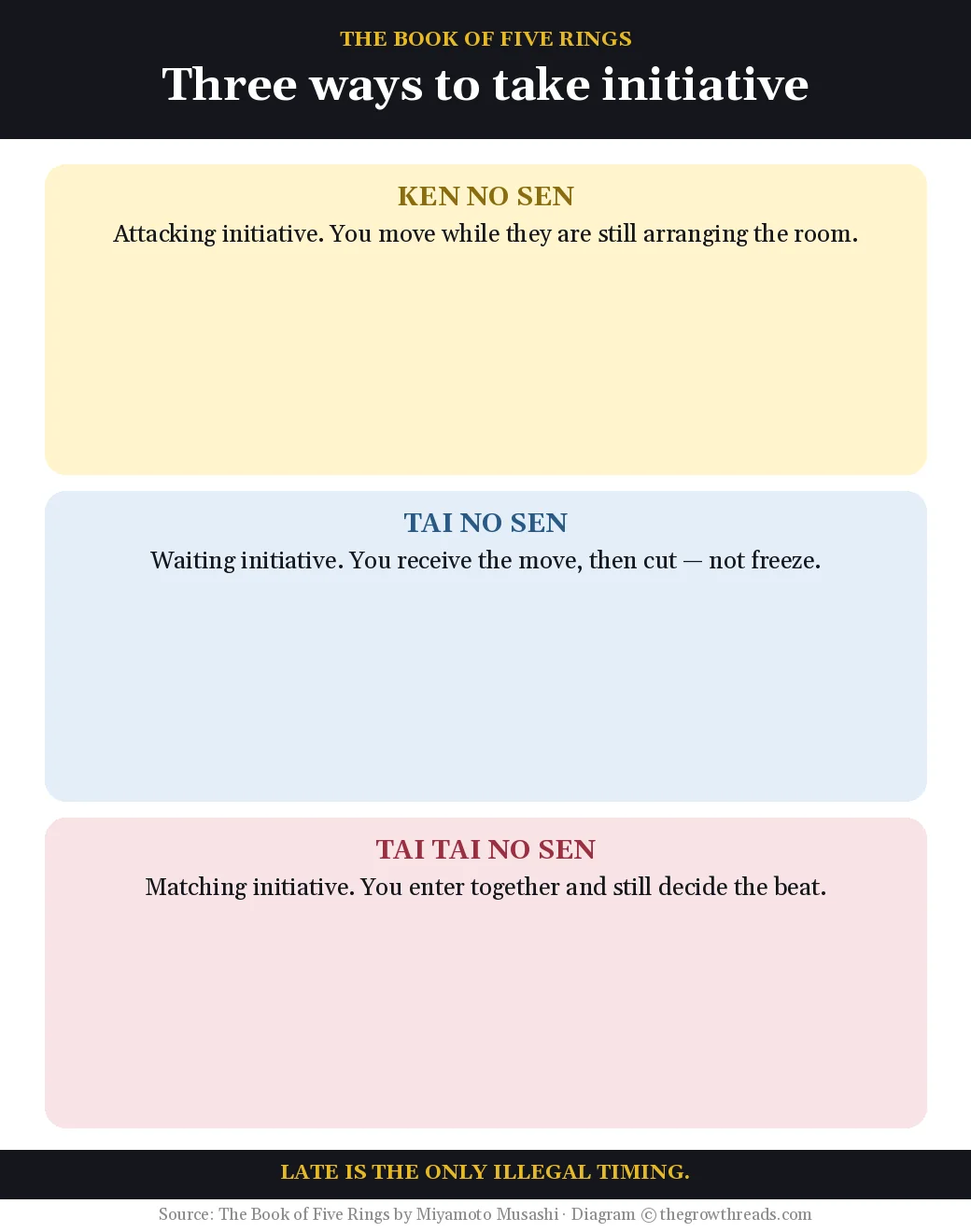
He also writes about the opponent’s rhythm: beginning, exhaustion, a mind gone to a new plan. A meeting has the same seasons. Ken no sen is the brief that arrives before people have chosen a story. Tai no sen is letting a bad proposal land, then cutting it with a fact. Tai tai no sen is walking into a live argument and still setting the beat. The Fire book is short because the instruction is not a catalogue. Stop decorating. Collide with the real timing.
TGR Note: The three initiatives are a more martial cousin of The Prince on fortuna: half of events are unscheduled, and the other half is whether you already moved. Good to Great builds the flywheel in calm weather; Musashi wants that motion in the minute the contest starts.
Part 4: Wind and Void — other schools, then no-form
Wind is a critique of other martial houses: schools that only prize extra-long swords, only speed, only a particular look of the body. Musashi is showing you a gallery of tics so you can catch your own. The leadership translation is a one-hour audit. Which rituals did you import from a famous company and never test? Wind-book work is seeing the habit that is running you.
Void is the shortest book. Musashi’s void is not a vibe. It is what is left when you are no longer clutching a form: you can see the contest that is actually there. In practice that is thirty minutes with no framework. Write what the contest is. If you cannot write it without a branded term, you are still in a school, not in the room.
He bequeathed the text days before his death. Pair Wind and Void as a weekly loop: drop one imported tic, then look at the real contest with no favorite weapon.
TGR Note: Void is the inner version of Meditations: control the seeing that is yours. Wind’s gallery of other schools is what Think Again asks of a mind that has fused identity to a method.
Who is The Book of Five Rings best for — and who should read something else first?
Read it if you hold a team, a product, or a company and you keep waiting for a perfect playbook while the other side is already moving. It is also the right book if you have one favorite tool and you lose whenever the room is a different shape.
Read something else first if you need a purpose story before you need a timing diagnostic — start with Start with Why. If you need a clean accountability drill without seventeenth-century swords, use Extreme Ownership. For terrain and preparation in a Chinese key, use The Art of War. For inner governance rather than collision, use Meditations.
Questions to reflect on
- What is the contest you keep losing, and which favorite weapon are you still bringing to it?
- Where does your team only win in one weather — a certain meeting, a certain hire, your presence in the room?
- Which of the three initiatives did you use last week, and where were you simply late?
- What habit did you copy from another school and never test against this quarter’s actual fight?
- If you had to describe the work with no framework for thirty minutes, what would you actually see?
🔥 Ready to drop the favorite weapon?
Get The Book of Five Rings and start training the neglected hand.
How to apply The Book of Five Rings (7-day plan)
- Day 1: Name the contest you keep losing this quarter — a launch, a hire, a meeting that always slips. Write one sentence on what “losing” looks like.
- Day 2: List your favorite weapons: the tools, frameworks, or meeting types you hide in. Circle one you will not be allowed to use tomorrow.
- Day 3: Train the neglected side for twenty minutes: the short email, the hallway conversation, the other hand. Do not add a new framework.
- Day 4: Practise ken no sen once: send the one-page brief, staff the decision, or name the trade-off before the room convenes.
- Day 5: Crowd one problem. Shorten the distance — sit with the work, the customer, or the person you have been managing by status update.
- Day 6: Watch one habit you copied from another school (a ritual, a slide template, a phrase). Keep it only if it still cuts.
- Day 7: One void session: thirty minutes on the real contest with no favorite technique. Write what you actually saw.
Frequently asked questions
What is the main message of The Book of Five Rings?
Musashi’s claim is that strategy is one Way, practised until you no longer hide in a favorite technique. Earth says know the whole house. Water says take any form. Fire says the fight is timing — ken no sen, tai no sen, tai tai no sen — not a flourish. Wind says study other schools so you stop copying their tics. Void is what remains when the favorite move is gone. The usable sentence is short: train both sides, and move while they are still arranging the room.
What are the five rings in Musashi’s book?
They are five short books named for the five elements. Earth is the foundation: the carpenter’s way, the layout of the whole house. Water is form and spirit — stance, gaze, both swords, taking the opponent’s shape. Fire is combat: crowding, rhythm, the three initiatives. Wind is a critique of other schools so you can see your own habits. Void is no-form: not emptiness as a mood, but what you see after you stop clinging to a technique. Read them as one argument in five rooms, not as five slogans.
What does Musashi mean by “do not have a favorite weapon”?
He means a favorite tool is a blind spot. If you only trust the long sword, a close room will beat you. If you only trust a slide deck, a hallway conversation will beat you. Water-book training is to become useful with both hands so the contest, not your identity, picks the instrument. In a company that is the operator who can write, staff, and decide — not the specialist who waits for the one meeting format they like. Dropping a favorite weapon is not becoming vague. It is becoming hard to corner.
What is ken no sen in The Book of Five Rings?
Ken no sen is attacking initiative: you move while the other side is still arranging. Musashi pairs it with tai no sen (receive, then cut) and tai tai no sen (enter together and still decide the beat). None of the three is “always charge.” Late is the failure mode — waiting for a perfect technique while they occupy the ground. In a modern room ken no sen looks like the one-page brief before the meeting, or naming the trade-off while everyone is still being polite. Initiative is a skill you train, not a personality type.
How long does it take to read The Book of Five Rings?
Musashi’s own text is short — often under a hundred pages of the five books, in a spare voice that tells you to investigate each point in practice. A careful reader finishes it in two to four hours. The Shambhala Library edition used here (Thomas Cleary) also includes Yagyu Munenori’s Family Traditions on the Art of War, which adds an evening. This guide is about sixteen minutes. Two sittings work well: Earth and Water first, Fire and Void on the second night, with one timing drill between them.
Is The Book of Five Rings a business book?
It was written as a martial strategy text in 1645, not as a management fable. Business readers keep returning because Musashi insists that a duel and a campaign use the same geometry — timing, spirit, and a refusal to hide in technique. He never mentions a P&L. The translation into a launch or a board fight is yours: crowd the problem, train the neglected hand, do not wait for a flourish. Treat it as a field manual you apply, not as décor for a slide. For org design or OKRs, read High Output Management beside it.
Who should read The Book of Five Rings today?
Read it if you lead a team, a product, or a company and you keep waiting for a perfect playbook while the other side is already moving. It is also the right book if you have one favorite tool and you lose whenever the room is a different shape. Skip it as a first leadership book if you need a purpose story (Start with Why) or a clean accountability drill (Extreme Ownership). Come back when you can tell a technique you like from a contest you have to finish.
Related summaries
- The Art of War — terrain and preparation, the Chinese cousin.
- The Prince — holding a state when likability is not a strategy.
- Extreme Ownership — own the outcome, not the method you prefer.
- Ego Is the Enemy — the identity that needs to look skilled.
Browse every title in our Best Leadership Books pillar page.
How we analyze books: our summaries are built from a full read of the source text, cross-referenced against the author’s published interviews and research where relevant, and structured around practical application rather than critique. We disclose our editorial process and affiliate relationships in full. Read our full methodology.