

⭐⭐⭐⭐✬ 4.5 / 5
One-liner: A clinical psychologist distills decades of therapy tools into a warm, practical handbook for navigating low mood, anxiety, grief, self-doubt, and motivation loss.
Best for: Anyone going through a difficult time emotionally, people curious about therapy techniques without committing to therapy, and readers who want evidence-based mental health tools explained in plain language.
Reading time: ~5.5 hours (352 pages)
Difficulty to apply: Low to moderate — each chapter ends with a specific tool you can try immediately.
Why Has Nobody Told Me This Before? in one minute
This book reads like having a kind, brilliant therapist in your pocket — one who finally explains the things everyone should have learned about their own mind. Dr. Julie Smith draws on cognitive behavioural therapy, acceptance and commitment therapy, and compassion-focused therapy to give readers a practical toolkit for everyday mental health. Each short chapter tackles a specific struggle — low mood, loss of motivation, anxiety, grief, self-doubt, or fear — and delivers one clear, evidence-based technique you can apply that same day. It is not a replacement for professional help, but it is the mental health education most people never received.
Key takeaways
- Emotions are data, not destiny: Feelings are signals from your nervous system, not facts about who you are. Learning to observe them without fusing with them is the foundation of emotional resilience.
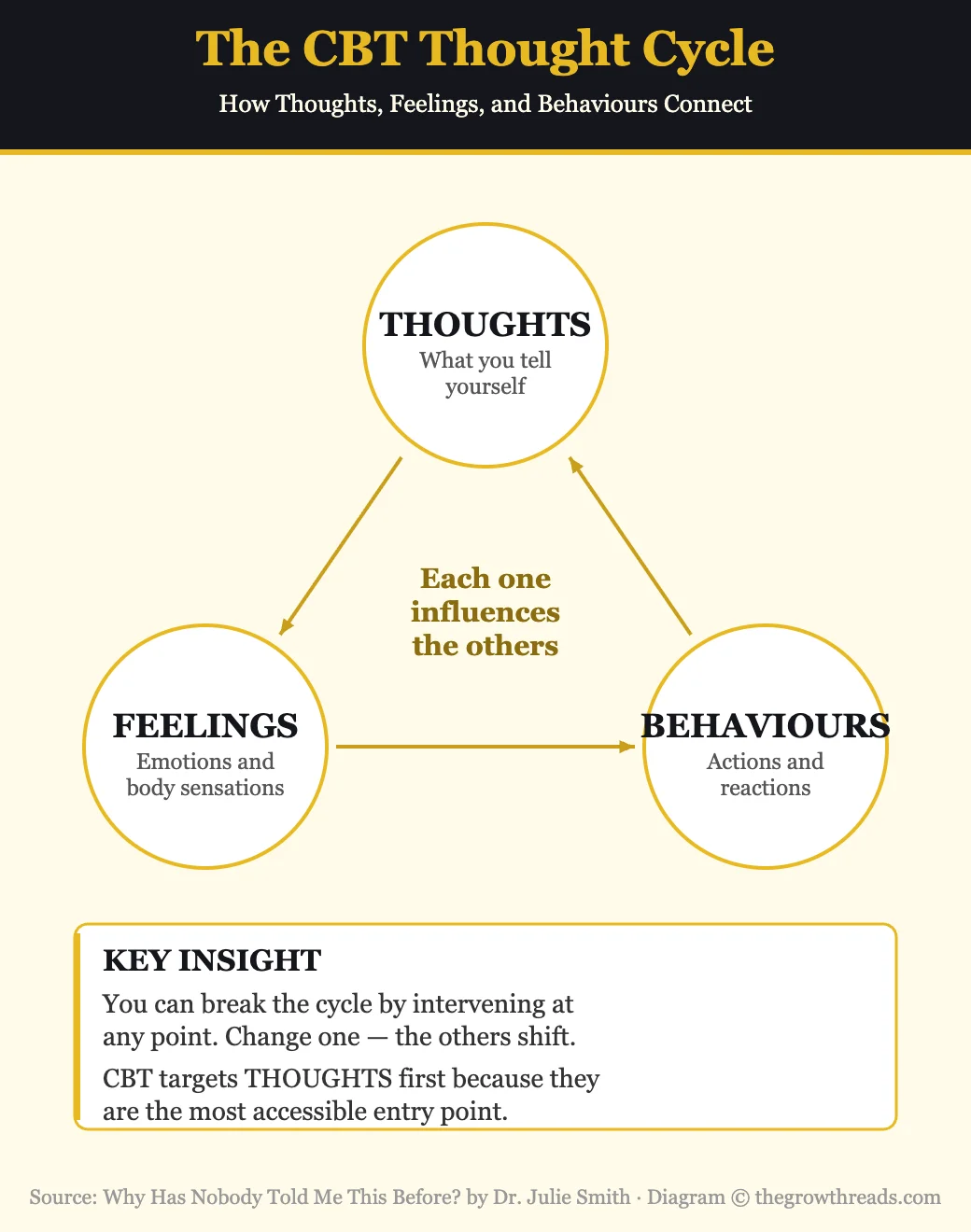
- The CBT triangle connects thoughts, feelings, and behaviours: Each one influences the others. Change any one point of the triangle and the others shift — you do not have to fix everything at once.
- Low mood is not the same as depression: Everyone experiences dips. The danger is when avoidance behaviours (withdrawing, sleeping more, stopping activities) deepen the dip into a spiral. Behavioural activation — doing something small even when you do not feel like it — reverses the slide.
- Motivation follows action, not the other way around: Waiting to “feel motivated” before acting is backwards. Start with a tiny action, and motivation catches up.
- Grief is not linear: The five stages model is widely misunderstood. Grief moves in waves, not steps, and there is no correct timeline for processing loss.
- Self-doubt speaks loudest in silence: Your inner critic gains power when unchallenged. Writing down critical thoughts and examining the evidence against them shrinks their hold dramatically.
- Anxiety is your brain over-predicting danger: The threat-detection system that kept our ancestors alive now fires at emails, social situations, and imagined futures. Understanding this mechanism reduces its power.
- Self-compassion is not self-indulgence: Research shows people who treat themselves with kindness recover faster from setbacks, take more responsibility for mistakes, and are more resilient — not less disciplined.
- Values are your compass through pain: When everything feels overwhelming, asking “What matters to me?” provides direction. Values-aligned action creates meaning even in suffering.
- Small daily practices beat crisis interventions: A few minutes of mood tracking, breathing exercises, or thought journaling each day builds a buffer that prevents small dips from becoming crises.
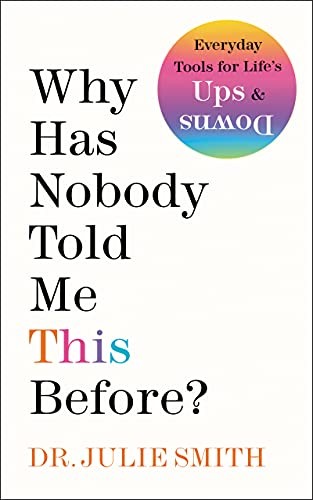
What is Why Has Nobody Told Me This Before? about?
Why Has Nobody Told Me This Before? is a practical mental health guide by clinical psychologist Dr. Julie Smith that teaches evidence-based therapy tools — from CBT thought records to self-compassion exercises — for managing low mood, anxiety, grief, motivation loss, and self-doubt in everyday life.
About the author
Dr. Julie Smith is a clinical psychologist who spent over a decade working in the UK’s National Health Service before building one of the largest mental health followings on social media. Her short, accessible videos on TikTok and YouTube — where she explains therapy concepts in under sixty seconds — have reached over four billion views. What sets her apart is her ability to translate complex psychological research into language anyone can use. Why Has Nobody Told Me This Before?, published in 2022, became an instant international bestseller, spending months on the Sunday Times and New York Times lists. She approaches mental health without jargon, without judgment, and with a deep respect for her readers’ intelligence. Explore all Dr. Julie Smith book summaries →
Key concepts at a glance
| Concept | What it means | Use it when |
|---|---|---|
| CBT Thought Cycle | Thoughts, feelings, and behaviours form a loop — intervene at any point | You notice negative spirals gaining momentum |
| Behavioural Activation | Act first, even in a small way — motivation follows action | You feel stuck, flat, or unable to start anything |
| Affect Labelling | Naming an emotion precisely reduces its intensity | Strong emotions feel overwhelming and shapeless |
| Cognitive Reframing | Finding alternative explanations for the same event | Your inner critic has locked onto one interpretation |
| Values Compass | Using your core values to guide decisions through pain | Everything feels meaningless or you have lost direction |
| Self-Compassion Practice | Speaking to yourself as you would to a close friend in pain | Self-criticism is making a bad situation worse |
| Grief Waves Model | Grief comes in waves of varying intensity, not linear stages | You feel guilty about “not grieving right” |
| Anxiety Defusion | Observing anxious thoughts without believing or fighting them | Worry spirals are consuming your attention |
Part 1: On low mood — understanding and reversing the downward spiral
Smith opens with the most common struggle she sees in practice: low mood that slowly deepens because people respond to it in ways that make it worse. When you feel down, the natural instinct is to withdraw — cancel plans, stay in bed, stop exercising, eat comfort food. These behaviours provide momentary relief but remove the very activities that generate positive emotion, creating a feedback loop that pulls you deeper.
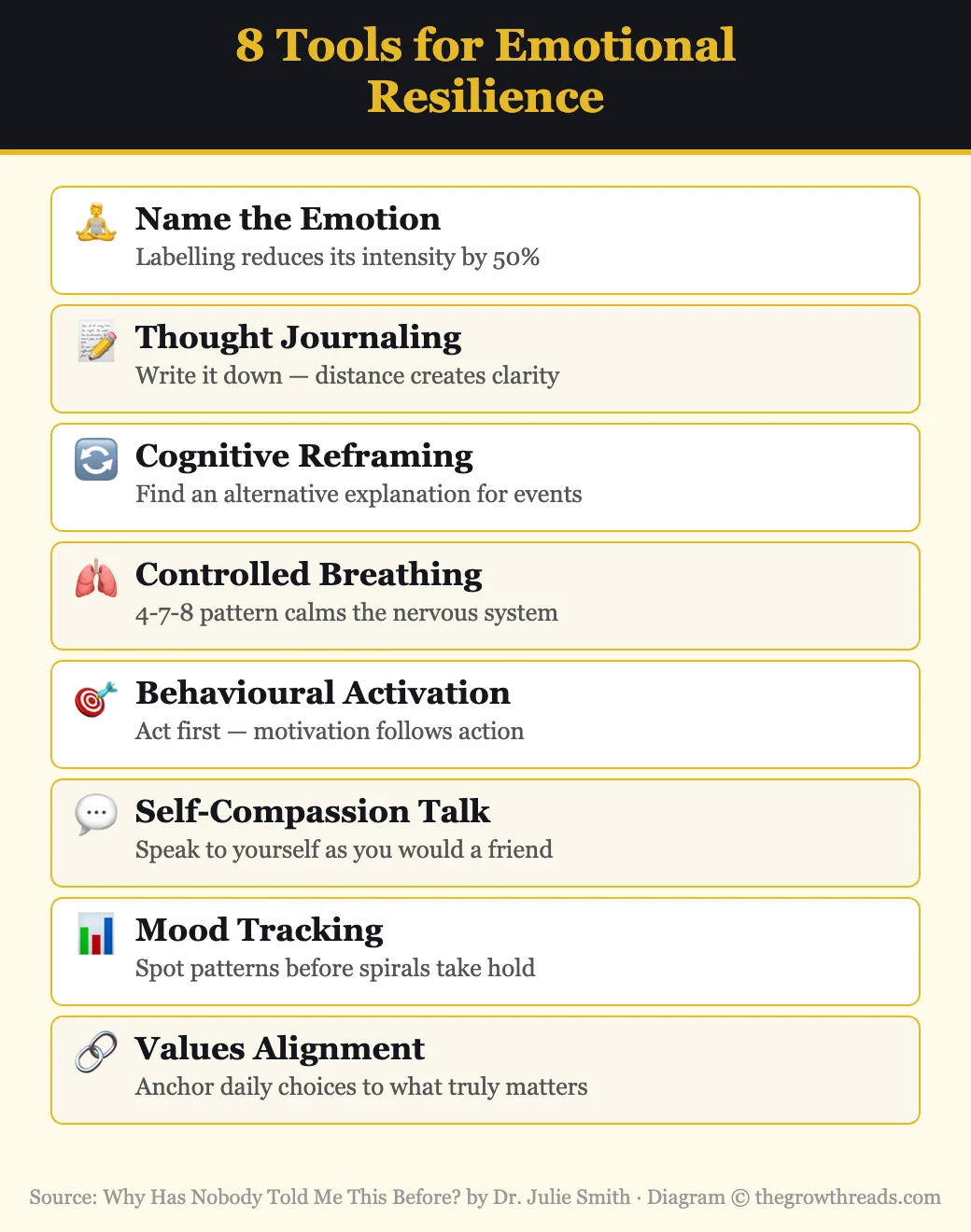
The clinical term for the fix is behavioural activation. Instead of waiting to feel better before doing things, you do things in order to feel better. The key insight is that the action comes first and the feeling follows. Smith emphasizes starting extremely small — not “go for a run” but “put your shoes on and step outside the front door.” The barrier to entry must be so low that your depleted motivation can clear it.
She also introduces the CBT thought cycle here: thoughts, feelings, and behaviours are connected in a triangle, and each one influences the others. If you are lying in bed thinking “nothing will help,” that thought generates hopelessness (feeling), which makes you stay in bed (behaviour), which produces more evidence for the thought. The cycle is vicious — but the good news is that breaking it at any point changes the whole system. You do not need to fix your thinking to change your life. Sometimes just changing your behaviour is enough.
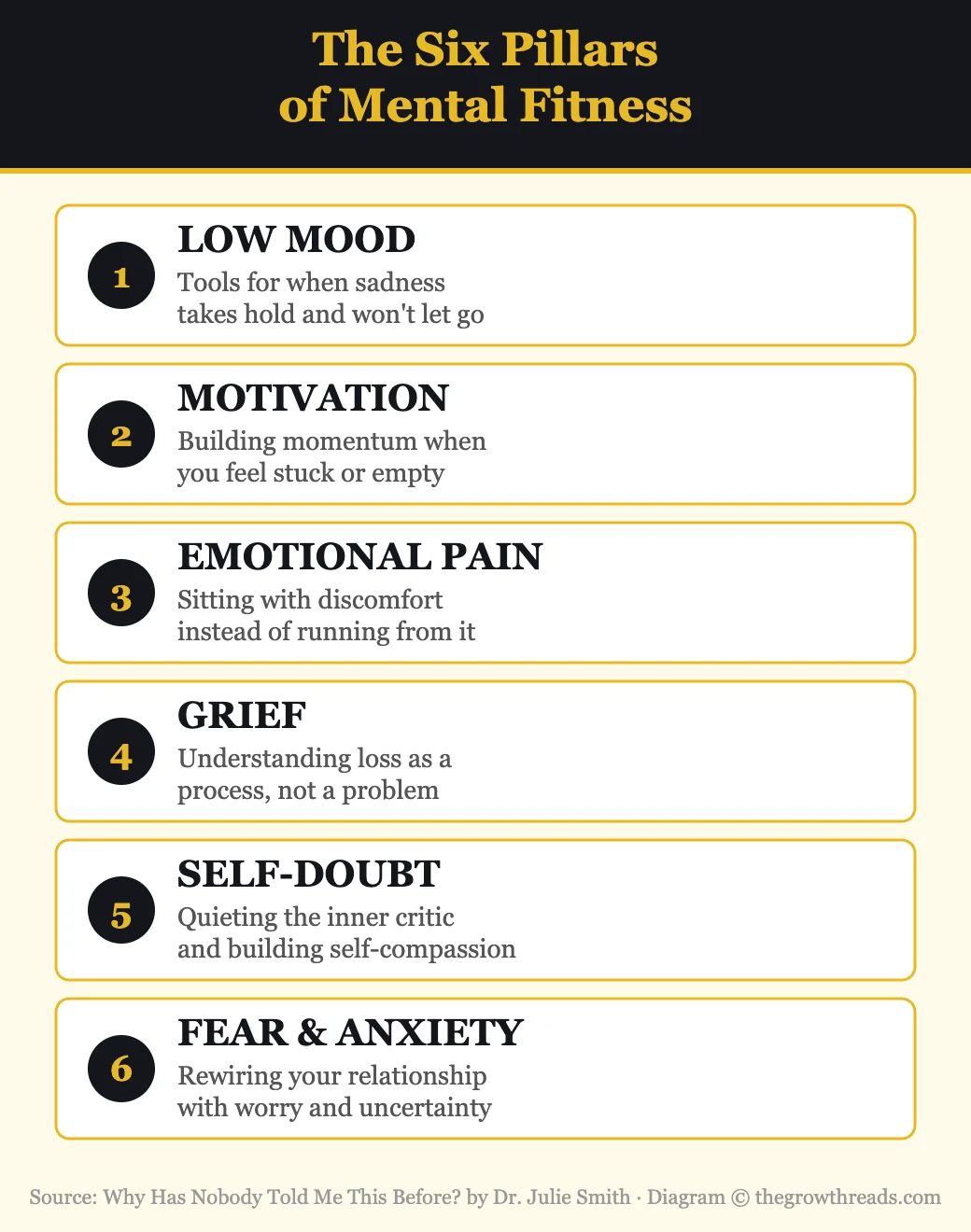
Part 2: On motivation — why waiting for inspiration is backwards
Smith tackles the myth of motivation head-on. Most people believe motivation works like this: inspiration strikes → you feel energized → you take action. In reality, the sequence is reversed: you take a tiny action → momentum builds → motivation appears. This is backed by decades of research on the progress principle — the finding that small wins generate disproportionate motivation for the next step.
She introduces a practical framework: instead of asking “Do I feel like doing this?”, ask “What is the smallest possible version of this task?” Then commit only to that version. Want to exercise? Commit to putting on gym clothes. Want to write? Commit to opening the document. The micro-commitment bypasses the resistance your brain puts up when facing a large, energy-intensive task.
Smith also explores the role of values in sustaining motivation. External goals (promotions, numbers, approval) provide temporary fuel that burns out. Internal values (growth, connection, contribution) provide renewable energy because they are process-oriented, not outcome-dependent. She asks readers to identify their top three values and check whether their daily actions align with them. The gap between values and behaviour is often the hidden source of that nagging emptiness people describe as “something is missing.”
Part 3: On grief, loss, and emotional pain — sitting with what hurts
The chapters on grief are among the most compassionate in the book. Smith dismantles the popular misconception of Elisabeth Kübler-Ross’s five stages of grief. The stages (denial, anger, bargaining, depression, acceptance) were never meant to be a linear checklist — Kübler-Ross herself clarified this before her death. Grief does not move in a straight line from stage one to stage five. It moves in waves: some days are calm, some days a song or a smell pulls you back into the deep end without warning.
Smith normalizes the messiness of grief. Laughing at a funeral does not mean you are not grieving. Crying six months later does not mean you are “not over it.” She introduces the concept of continuing bonds — the idea that your relationship with someone who has died does not end; it transforms. You can maintain a connection through rituals, conversations, memories, and the values they passed to you.
On emotional pain more broadly, Smith draws on ACT to make a crucial distinction: pain is inevitable, but suffering is the result of struggling against pain. When you fight an emotion — telling yourself you should not feel this way, trying to suppress it, judging yourself for having it — you add a second layer of suffering on top of the original pain. The alternative is not to enjoy the pain but to allow it to exist without resistance, knowing it will pass.
Part 4: On self-doubt, fear, and anxiety — quieting the noise
Smith devotes her final major section to the inner critic and the anxious mind. She explains that self-doubt is not evidence of inadequacy — it is evidence that you are attempting something that matters. The inner critic evolved to protect you from social rejection (which, in ancestral environments, could be fatal). Understanding this biological origin helps you hear the critical voice without obeying it.
Her primary tool here is cognitive defusion from ACT: instead of thinking “I am not good enough,” reframe it as “I am having the thought that I am not good enough.” This tiny linguistic shift creates distance between you and the thought, making it easier to see it as a mental event rather than a truth. She pairs this with a self-compassion exercise: write down what your inner critic is saying, then write what you would say to a close friend in the same situation. The gap between those two responses reveals how harshly you treat yourself.
On anxiety, Smith explains the threat-detection system. Your amygdala — the brain’s alarm — is designed to over-predict danger. It is better (evolutionarily) to run from a hundred shadows that are not tigers than to miss the one shadow that is. But in modern life, this system fires at emails, social events, deadlines, and imagined futures, producing chronic anxiety. Smith teaches controlled breathing (the 4-7-8 technique: inhale for 4, hold for 7, exhale for 8) as a direct way to activate the parasympathetic nervous system and physically calm the alarm.
Who is Why Has Nobody Told Me This Before? best for — and who should read something else first?
This book is ideal for anyone who wants a warm, practical introduction to therapy tools without the formality of a textbook. It is especially strong for people going through a rough patch who want actionable strategies immediately, readers curious about what therapy actually involves, and anyone who never received emotional education growing up.
If you are already well-versed in CBT and ACT (you have read Feeling Good and The Happiness Trap), the concepts will be familiar — though Smith’s tone and examples may still offer fresh perspective. If your struggle is primarily with boundaries in relationships rather than internal emotional management, start with Set Boundaries, Find Peace first.
Questions to reflect on
- When you feel low, what is your default response — and does that response tend to deepen the dip or reverse it?
- If motivation follows action rather than preceding it, what is the smallest action you could take right now toward something that matters?
- How would you describe the difference between how you speak to yourself and how you would speak to a close friend in the same situation?
- Is there a loss or grief you have been judging yourself for not being “over” yet — and what would it feel like to give yourself permission to grieve on your own timeline?
- What are your three core values, and how closely do your daily choices align with them this week?
🔥 Ready to build your mental health toolkit?
Get Dr. Julie Smith’s evidence-based strategies for navigating low mood, anxiety, grief, and self-doubt.
How to apply Why Has Nobody Told Me This Before? (7-day plan)
- Day 1 — Map your mood patterns: Start a simple mood journal. Three times today (morning, afternoon, evening), rate your mood 1–10 and note what you were doing. This baseline reveals patterns you cannot see from the inside.
- Day 2 — Try behavioural activation: Identify one activity you have been avoiding because you do not feel like it. Commit only to starting it for two minutes. Notice how your mood shifts once you begin.
- Day 3 — Practise the CBT thought record: When you notice a negative thought, write it down. Then write the evidence for and against it. Finally, write a balanced alternative thought. Do this once today.
- Day 4 — Use controlled breathing: Set three alarms throughout the day. At each one, do the 4-7-8 breathing technique (inhale 4 counts, hold 7, exhale 8) for three cycles. Notice the physical shift.
- Day 5 — Talk to yourself like a friend: When your inner critic speaks today, pause and write down what it said. Then write what you would say to a friend who told you the same thing about themselves. Use the kind version going forward.
- Day 6 — Identify your core values: Write down the three values that matter most to you (e.g., growth, connection, honesty). Rate how well this week’s actions have aligned with each one on a scale of 1–10.
- Day 7 — Build your toolkit card: On a single index card, write down the three tools from this week that felt most useful. Keep it in your wallet or phone case. This is your personal mental health first-aid kit.
Frequently asked questions
Is Why Has Nobody Told Me This Before? worth reading?
Yes — particularly if you have never explored therapy techniques before. Dr. Smith has a rare gift for making clinical psychology feel accessible and warm without dumbing it down. The book delivers concrete tools you can use immediately, and each chapter is short enough to read in a single sitting. Even readers familiar with CBT and ACT report finding Smith’s framing and examples helpful. It has sold millions of copies worldwide for good reason.
What is the main message of Why Has Nobody Told Me This Before?
The core message is that mental health is a skill set, not a trait you either have or lack. Just like physical fitness, emotional resilience can be built through daily practice using evidence-based techniques. Dr. Smith argues that these tools — drawn from CBT, ACT, and compassion-focused therapy — should be taught to everyone, not reserved for people in crisis. The book is structured so you can dip into whatever chapter matches your current struggle.
Can this book replace therapy?
No, and Smith is clear about this. The book provides tools that overlap with what a therapist might teach, but it cannot replicate the personalised assessment, accountability, and relational safety of a therapeutic relationship. Think of it as mental health education — it gives you a strong foundation and may help you get more from therapy if you do pursue it. If you are in crisis or dealing with severe symptoms, professional help is essential.
What therapy approaches does the book draw from?
Primarily three: Cognitive Behavioural Therapy (CBT), which focuses on identifying and reframing unhelpful thought patterns; Acceptance and Commitment Therapy (ACT), which teaches you to observe thoughts without fusing with them and to act according to your values; and Compassion-Focused Therapy (CFT), which addresses the inner critic through self-compassion practices. Smith blends all three seamlessly, choosing whichever approach fits the specific problem.
How is Why Has Nobody Told Me This Before different from Feeling Good?
Feeling Good by David Burns is a deeper, more systematic treatment of CBT — it is essentially a self-administered therapy course. Why Has Nobody Told Me This Before is broader (covering grief, values, self-compassion, and anxiety alongside CBT) and more accessible in tone. Smith writes shorter chapters with a warmer, conversational style. If you want the comprehensive CBT textbook, go with Feeling Good. If you want a wider toolkit in a friendlier package, this book is the better starting point.
Is this book suitable for teenagers?
Yes, and many parents have found it valuable for older teenagers (ages 15+). The language is clear and jargon-free, the chapters are short, and the tools are immediately practical. Smith’s background in social media means she writes in a way that feels natural to younger readers. The sections on self-doubt and anxiety are particularly relevant for teens navigating social pressure and academic stress. It is an excellent book to read together and discuss.
What should I read after Why Has Nobody Told Me This Before?
If you want to go deeper into CBT, read Feeling Good by David Burns. If self-compassion resonated most, try The Gifts of Imperfection by Brené Brown. If the values work sparked something, read The Happiness Trap by Russ Harris for a full ACT-based approach. And if you are curious about how emotional patterns form in childhood, Adult Children of Emotionally Immature Parents by Lindsay Gibson is an excellent complement. All of these are covered in our psychology book summaries.
Related summaries
- Feeling Good by David Burns — the foundational CBT self-help book that pioneered the techniques Smith teaches
- The Happiness Trap by Russ Harris — ACT-based approach to living a rich life even when emotions are difficult
- The Gifts of Imperfection by Brené Brown — cultivating self-compassion and letting go of perfectionism
- Man’s Search for Meaning by Viktor Frankl — finding meaning and purpose through suffering
More psychology book summaries: The Best Psychology Books of All Time