

★★★★☆ 4.3 / 5 — A fascinating exploration of how timing shapes every dimension of our lives, packed with actionable frameworks.
Best for: Professionals, leaders, and anyone who wants to make smarter decisions about when to act — not just what to do.
Reading time: ~5 hours (256 pages)
Difficulty to apply: Easy — the frameworks translate directly into daily scheduling, break habits, and project planning.
When in one minute
The secret to a better life is not what you do — it is when you do it. Daniel Pink synthesizes research from economics, social psychology, biology, and endocrinology to reveal that timing is not an art — it is a science. Every day follows a hidden emotional pattern (peak → trough → recovery) that determines when you should do analytical work, when you should rest, and when creative insights are most likely. Beginnings, midpoints, and endings carry psychological weight that shapes motivation, meaning, and performance. And synchronizing with others — through group timing, rituals, and shared purpose — amplifies individual effort into collective momentum. The core message: stop treating timing as an afterthought and start treating it as a strategic decision.
Key takeaways
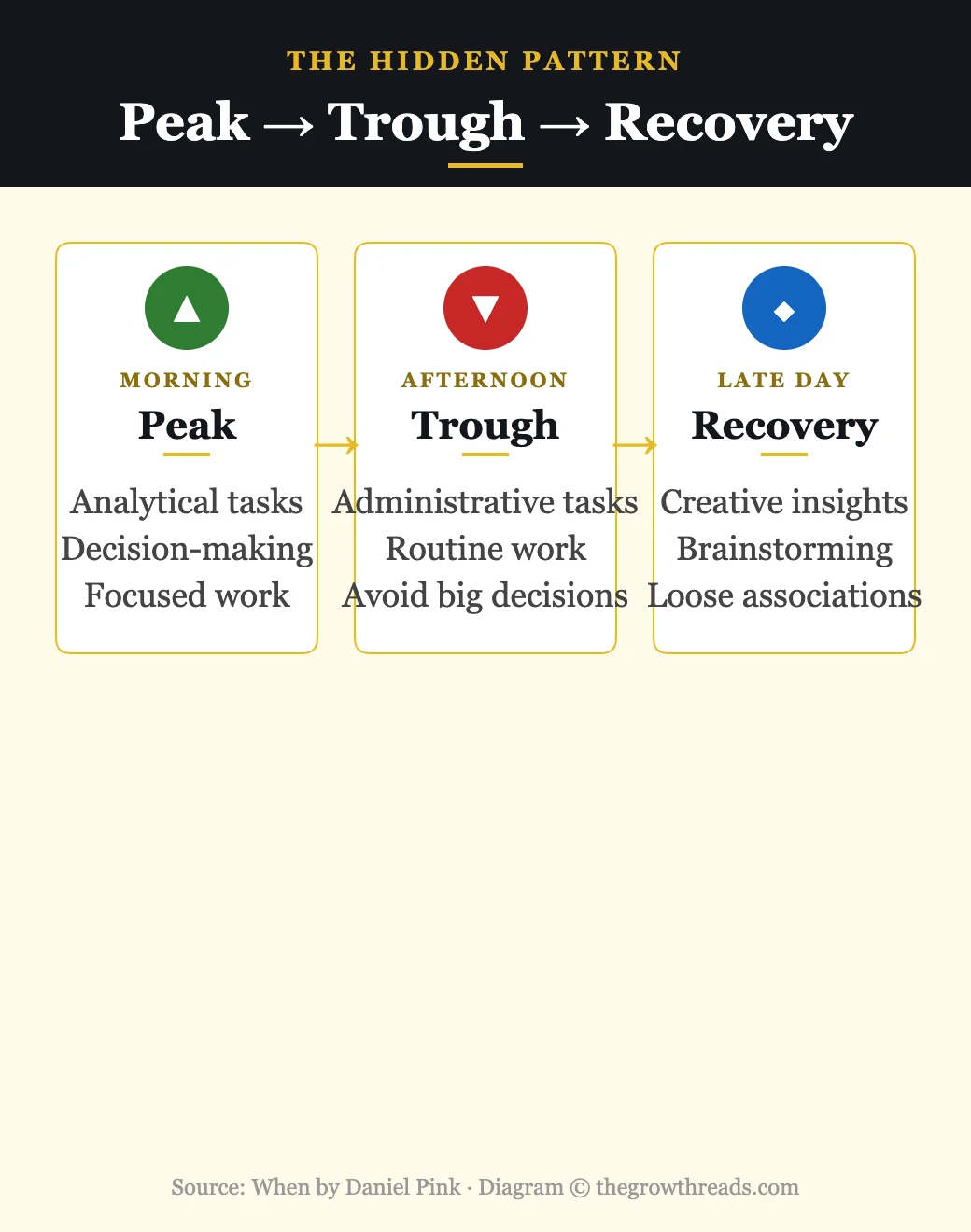
- Your daily mood follows a predictable arc: Most people experience a peak in analytical ability in the morning, a trough in the early-to-mid afternoon, and a recovery of creative energy in the late afternoon and evening.
- Chronotype determines your ideal schedule: Larks (early risers) follow the standard peak-trough-recovery pattern, while owls experience it in reverse — their creative peak arrives in the morning and analytical sharpness comes later.
- Breaks are not a sign of laziness: Strategic breaks — especially those involving movement, nature, social connection, and full detachment — restore focus and boost performance far more than powering through.
- The nappuccino is real science: Drinking coffee immediately before a 10–20 minute nap produces a compounding alertness boost when caffeine kicks in as you wake.
- Beginnings matter more than you think: A bad start can cascade into poor performance for months or years, but you can create fresh starts using temporal landmarks (new year, new month, a birthday) to reset motivation.
- Midpoints can trigger either a slump or a spark: When people become aware they are at the midpoint of a project or deadline, it creates an “uh-oh effect” that can dramatically accelerate effort.
- Endings shape how we remember and evaluate experiences: People disproportionately weight the final moments of any experience when judging its quality — the peak-end rule governs memory.
- Group synchronization builds belonging: Singing in choirs, rowing together, or even walking in step activates the same neurochemical reward pathways, increasing trust, cooperation, and pain tolerance.
- Hospital timing affects outcomes: Medical errors spike in the afternoon trough, and anaesthesia-related adverse events are significantly more common after 3 PM.
- Nostalgia is a forward-looking emotion: Rather than trapping people in the past, nostalgic reflection has been shown to increase optimism, creativity, and a sense of social connectedness.
What is When about?
When is a research-backed guide to the science of timing. Daniel Pink examines how the hidden patterns of the day, the psychology of beginnings and endings, the power of midpoints, and the neuroscience of group synchronization all shape our decisions, health, and performance — and how understanding these patterns lets us live and work more effectively.
About the author
Daniel H. Pink is the author of seven books, including the #1 New York Times bestsellers Drive, To Sell Is Human, and A Whole New Mind. His books have been translated into 45 languages and have sold millions of copies worldwide. Before becoming a full-time author, Pink served as chief speechwriter to Vice President Al Gore. He holds a J.D. from Yale Law School and a B.A. from Northwestern University. His TED Talk on motivation has been viewed more than 40 million times, and he is widely considered one of the most influential business thinkers of the past two decades. Explore all Daniel Pink book summaries →
Key concepts at a glance
| Concept | What it means | Use it when |
|---|---|---|
| Peak-Trough-Recovery | Daily emotional and cognitive cycle that most people experience | Planning your workday and scheduling important tasks |
| Chronotype | Your biological tendency toward morning or evening alertness | Deciding whether to do analytical work early or late |
| The Nappuccino | Coffee + 20-minute nap = compounding alertness boost | Fighting the afternoon energy crash |
| Temporal Landmarks | Dates that feel like fresh starts (Mondays, birthdays, January 1) | Launching a new habit or resetting motivation |
| The Uh-Oh Effect | Awareness of reaching a midpoint that triggers urgency | Re-energizing a stalled project at its halfway mark |
| Peak-End Rule | People judge experiences primarily by the peak and the ending | Designing experiences, presentations, or customer journeys |
| Group Synchronization | Moving, singing, or acting in unison with others builds trust | Strengthening team cohesion and collective performance |
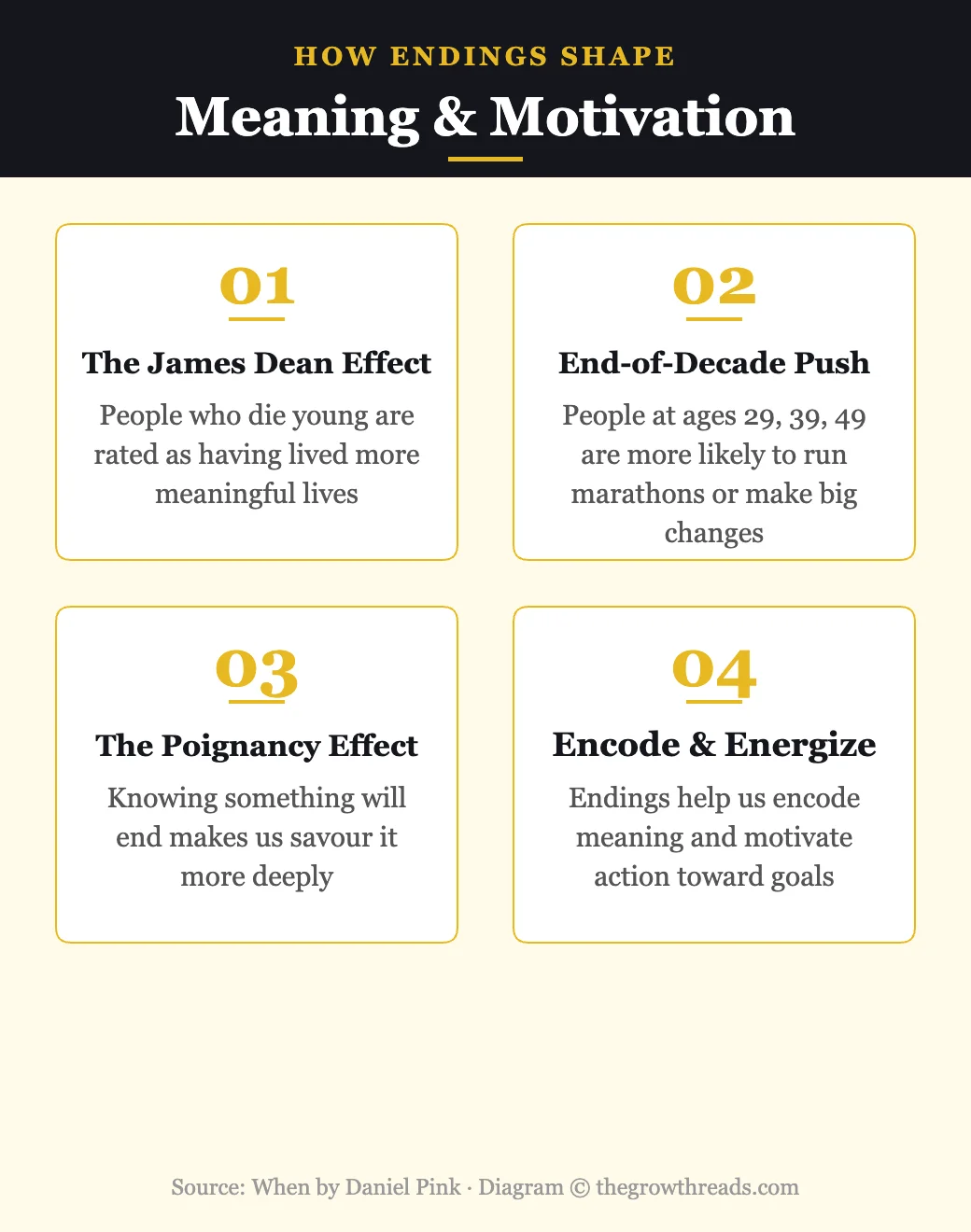
| The Poignancy Effect | Knowing something will end makes us appreciate it more | Approaching final moments of any meaningful experience |
Part 1: The hidden pattern of the day
Pink opens with a striking dataset: researchers who analyzed 500 million tweets across 84 countries discovered that positive affect (language reflecting happiness, enthusiasm, warmth) follows a remarkably consistent daily pattern regardless of geography or culture. Mood rises in the morning, drops sharply in the early afternoon, and rebounds in the late evening. This is not a social media quirk — it maps directly onto biological evidence from endocrinology and chronobiology.
The pattern is driven by circadian rhythms: core body temperature, cortisol levels, and serotonin production all follow predictable daily arcs. During the peak phase (typically morning for 75% of people), the prefrontal cortex is most active, making it the ideal window for analytical tasks that require focused attention, logical reasoning, and inhibitory control — things like financial analysis, writing arguments, or editing code. During the trough (typically early-to-mid afternoon), vigilance drops measurably: one study found that students who took standardised tests in the afternoon scored significantly lower than those who tested in the morning, with the effect equivalent to missing two weeks of school. During the recovery phase (late afternoon and evening), the loosening of inhibitory control becomes an advantage for creative and insight-based tasks — people are better at solving problems that require non-obvious connections.
Pink introduces the concept of chronotype — the individual biological clock that determines whether someone is a lark (early riser), an owl (late riser), or a third bird (somewhere in between). About 20–25% of the population are strong owls whose pattern runs in reverse: they hit their creative peak in the morning and reach analytical sharpness later. The practical implication is that scheduling must be personalised, not one-size-fits-all.
Part 2: Beginnings, endings, and in between
The second major section of When turns to the psychology of temporal landmarks — how the positioning of events in time dramatically shapes their impact. Pink cites research showing that the date on which someone starts a new job, enters a school, or begins a career can have lasting effects on earnings, motivation, and health outcomes that persist for decades. A study of MBA graduates found that those who entered the job market during a recession earned less money not just initially but for 15–20 years afterward — the start point cast a long shadow.
But Pink is not fatalistic about bad beginnings. He introduces the research of Hengchen Dai and colleagues at Wharton, who coined the term “fresh start effect.” Their work shows that certain dates — the first day of a new year, a birthday, a Monday, the start of a new semester — trigger a psychological reset that increases goal-setting, gym attendance, and diet commitment. The mechanism is that temporal landmarks create a mental accounting separation between the “old self” (who failed) and the “new self” (who can succeed). This means you can manufacture fresh starts by deliberately anchoring behaviour changes to these dates.
Midpoints receive equally fascinating treatment. Pink describes a study of NBA basketball games that found teams trailing by one point at halftime actually won more often than teams leading by one — the awareness of being slightly behind at the midpoint triggered an uh-oh effect that galvanised effort. He extends this to corporate and academic settings: projects that drift through their first half often see a sudden acceleration of work precisely at the midpoint, as if the awareness of time running out flips a motivational switch. The practical lesson is that if you are managing a team through a long project, explicitly calling attention to the midpoint can be a powerful intervention.
The section on endings draws on Daniel Kahneman’s peak-end rule — the finding that people evaluate an experience not by its totality but primarily by its most intense moment (the peak) and by how it ends. Pink extends this with original examples: chocolate tastes better when people are told it is the last piece, runners speed up dramatically in the final kilometre of a race, and people at ages ending in 9 (29, 39, 49) disproportionately run their first marathon. Endings are not merely conclusions — they are meaning-making devices that encode significance and motivate action.
Part 3: The science of breaks and the nappuccino
One of the most immediately actionable sections of When is Pink’s deep dive into break science. He cites a study of Danish schoolchildren who took standardised tests at different times of day: those who tested later in the day scored significantly worse — unless they received a 20–30 minute break before the test, which completely eliminated the time-of-day effect. Breaks did not just pause the decline; they reversed it.
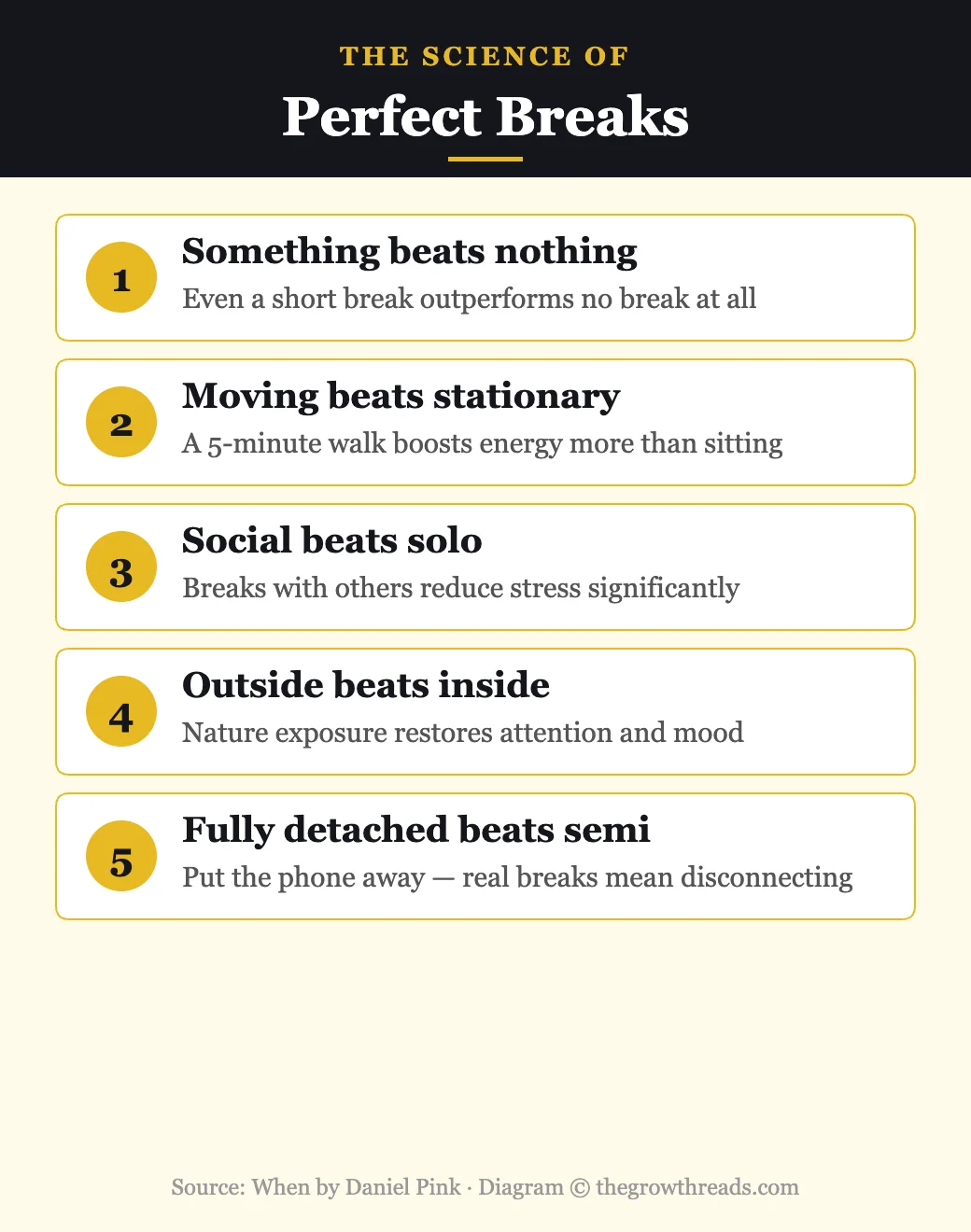
Pink distils the research into five principles of restorative breaks. First, something beats nothing — even a brief micro-break outperforms continuous work. Second, moving beats stationary — a five-minute walk produces more cognitive restoration than five minutes of sitting. Third, social beats solo — breaks taken with other people, even casual conversation, reduce cortisol levels and improve mood. Fourth, outside beats inside — exposure to nature (even a view of trees) restores directed attention more effectively than indoor environments. Fifth, fully detached beats semi-detached — checking your phone during a break is not a real break; genuine cognitive detachment is required for restoration.
The highlight of this section is the “nappuccino” — a technique backed by multiple sleep studies. You drink a cup of coffee, immediately take a 10–20 minute nap, and wake up just as the caffeine begins to take effect (caffeine takes about 25 minutes to enter the bloodstream). The result is a compounding boost: the nap clears adenosine (the neurochemical that makes you sleepy) while the caffeine blocks its receptors. Studies show this combination produces greater alertness than either a nap or coffee alone.
Pink also examines the DeskTime study of the most productive 10% of workers, who worked in 52-minute sprints followed by 17-minute breaks. The finding is not that 52/17 is a magic ratio, but that the most productive people treat breaks as a feature of their work architecture, not as interruptions.
Part 4: Synchronizing with others
The final section of When explores a dimension most productivity books ignore entirely: the timing of groups. Pink examines choral singing, rowing teams, and flash mobs to show that synchronizing with others is not merely a logistical challenge — it triggers a neurochemical response. Studies of rowing crews found that those who rowed in sync had significantly higher pain thresholds than those who rowed alone at the same intensity. Singing in a choir releases oxytocin and triggers vagal tone changes that reduce stress. Even walking in step with a stranger increases subsequent cooperation in economic games.
The mechanism, Pink argues, is that group synchronization operates through three channels: a boss (an external pacing signal like a conductor or a shared deadline), a tribe (a sense of belonging to a group with shared purpose), and a code (a shared set of norms, standards, or values that coordinate behaviour without constant instruction). All three must be present for a group to maintain temporal alignment over extended periods.
Pink closes with practical applications: how Indian lunch delivery networks (the dabbawalas of Mumbai) coordinate 200,000 daily deliveries with a near-zero error rate through impeccable temporal synchronization; how hospital handoff protocols can be redesigned to account for circadian vulnerability; and how rituals — from family dinners to team stand-ups — function as temporal anchors that maintain group cohesion across time.
Who is When best for — and who should read something else first?
When is ideal for professionals who sense that their daily schedule is working against them, managers who want to design better team routines, and anyone curious about the hidden science behind timing. It is especially valuable if you have already read productivity books about what to do (like Getting Things Done or Atomic Habits) and want the missing timing layer.
If you are looking for a deep dive into habit formation specifically, start with Atomic Habits. If you need a comprehensive motivation framework, Drive (Pink’s earlier book) is the better entry point. When assumes you already have goals and systems — it optimises their timing.
Questions to reflect on
- What is your chronotype, and does your current schedule align with your biological peak for your most important work?
- When did you last take a genuine break — one with movement, nature, and full detachment from screens?
- Is there a stalled project in your life that might benefit from a deliberate midpoint intervention?
- How could you redesign the endings of your meetings, presentations, or customer experiences to leave a stronger impression?
- What temporal landmark could you use to create a fresh start for a goal you have been putting off?
🔥 Ready to master the science of perfect timing?
Redesign your schedule, breaks, and key decisions around what the research actually says about when.
How to apply When (7-day plan)
- Day 1 — Identify your chronotype. Take the free Morningness-Eveningness Questionnaire (AutoMEQ) online. Note whether you are a lark, owl, or third bird, and write down your likely peak, trough, and recovery windows.
- Day 2 — Audit your current schedule. Track what tasks you do at what times today. Highlight any mismatches — analytical work during the trough, routine admin during the peak.
- Day 3 — Redesign your day. Block your peak hours for your most demanding analytical or creative work (depending on your type). Move meetings and admin into trough hours. Protect recovery time for brainstorming or insight tasks.
- Day 4 — Implement strategic breaks. Set two alarms for break times. Take a 15-minute break that involves movement, going outside, and putting your phone away. Try the nappuccino if your schedule allows.
- Day 5 — Create a fresh start. Choose one stalled goal. Pick the next temporal landmark on your calendar (a Monday, the first of the month, a birthday) and set it as your official restart date. Write down one small first step to take on that day.
- Day 6 — Apply the midpoint check. For your most important ongoing project, calculate the midpoint. If you are past it, use the uh-oh effect — explicitly acknowledge “we are past halfway” to your team or yourself to trigger urgency.
- Day 7 — Design a better ending. Choose one recurring experience (a weekly meeting, a client call, a family dinner) and redesign its final five minutes to be more intentional, meaningful, or uplifting — applying the peak-end rule.
Frequently asked questions
What is the main idea of When by Daniel Pink?
The main idea is that timing is a science, not an art. Daniel Pink draws on research from psychology, biology, and economics to show that when we do things — what time of day, what point in a project, what stage of life — affects our performance, health, and happiness as much as what we do or how we do it. The book provides practical frameworks for optimising the timing of daily tasks, strategic decisions, and group activities.
What is the peak-trough-recovery pattern?
It is the daily emotional and cognitive cycle that most people experience. During the peak (typically morning), analytical ability and focus are highest. During the trough (typically early-to-mid afternoon), vigilance drops and errors increase. During recovery (late afternoon or evening), mood rebounds and creative thinking improves. This pattern is driven by circadian rhythms and applies to about 75% of the population, though “owls” experience a reversed sequence.
What is a nappuccino and does it actually work?
A nappuccino is a technique where you drink a cup of coffee immediately before taking a 10–20 minute nap. Because caffeine takes approximately 25 minutes to enter the bloodstream, you wake up just as it kicks in. The nap clears sleep-inducing adenosine from your brain while the caffeine blocks its receptors, creating a compounding alertness boost. Multiple controlled studies have confirmed that this combination outperforms either a nap or caffeine alone in measures of alertness and cognitive performance.
How do I find my chronotype?
Pink recommends asking yourself what time you naturally wake up on days when you have nothing scheduled. If you consistently wake before 7 AM without an alarm, you are likely a lark. If you prefer to sleep past 9 AM and feel most alert late at night, you are probably an owl. Most people are “third birds” who fall somewhere in between. You can also take the Morningness-Eveningness Questionnaire (MEQ), a validated psychometric tool available free online, which places you on a 16–86 point scale.
What is the fresh start effect?
The fresh start effect is a psychological phenomenon identified by Hengchen Dai and colleagues at Wharton Business School. It describes how temporal landmarks — dates that feel like new beginnings, such as the first day of a new year, a birthday, a Monday, or the start of a new semester — create a mental separation between a past self and a present self. This separation increases motivation for goal pursuit. Gym attendance, diet commitment, and goal-setting all spike reliably after these landmarks, making them ideal moments to launch new habits or restart stalled ones.
How long does it take to read When?
When is 256 pages in its paperback edition and takes approximately 5 hours to read at an average pace. The book is structured in three main parts plus a collection of practical “Time Hacker’s Handbook” exercises at the end of each section. It reads quickly because Pink writes in a journalistic, example-driven style. Most readers report finishing it in 2–3 sittings. The audiobook, narrated by Pink himself, runs about 5 hours and 47 minutes.
Is When worth reading if I have already read Drive or To Sell Is Human?
Yes. When covers entirely different territory from Pink’s earlier books. Drive explores intrinsic motivation (autonomy, mastery, purpose), while To Sell Is Human examines persuasion and influence. When focuses on the science of timing — a dimension that neither of those books addresses. In fact, When enhances both: once you understand the daily performance cycle, you can apply Drive’s motivation principles and To Sell Is Human’s persuasion techniques at the optimal moments for maximum effect. Think of it as the missing “when” layer on top of the “what” and “how.”
Related summaries
- Deep Work by Cal Newport — The definitive guide to focused, distraction-free productivity.
- Atomic Habits by James Clear — Build better habits with small changes that compound over time.
- The Power of Habit by Charles Duhigg — Understand the neurological loop behind every habit.
- Drive by Daniel Pink — Pink’s earlier exploration of what motivates us beyond external rewards.
📚 See all productivity book summaries