

★★★★☆ (4.4/5) — A Canadian personal-finance classic that teaches the fundamentals through a barbershop parable instead of spreadsheets, and holds up remarkably well decades later.
Best for: Anyone who wants the basics of saving, insurance, and investing explained in plain English, without jargon or a single chart.
Reading time: ~13 min summary (book: ~5–6 hrs)
Difficulty to apply: Easy — the core advice is a handful of simple, automatic habits
The Wealthy Barber in one minute
Roy the barber has been quietly wealthy for years, and his secret isn’t a hot stock tip — it’s a single habit repeated for decades. David Chilton tells the story of three twenty-somethings who gather in Roy’s barbershop for a series of informal money lessons, and the advice is almost defiantly simple: save 10% of every paycheck automatically, get proper insurance, write a will, and let compound interest do the heavy lifting over 30 or 40 years. There’s no market timing, no picking winning stocks, and no elaborate budget. The entire philosophy fits on an index card, which is exactly the point.
Key takeaways
- Pay yourself first, always 10%: save a fixed slice of every paycheck automatically, before any bill or expense gets a chance at it.
- Automatic beats disciplined: a habit that happens without a decision each time is far more durable than willpower-based budgeting.
- You don’t need a detailed budget: once the 10% is gone, spend the rest however you like — the point is removing the decision, not restricting every purchase.
- Time is the real engine: a modest amount invested in your twenties can outgrow a much larger amount invested starting in your forties.
- Insurance protects people, not portfolios: life insurance exists to replace lost income for dependents, not to double as an investment vehicle.
- A will isn’t optional: without one, a court — not your family — decides how your estate is divided.
- A house is shelter first: treating your home purely as an investment leads to decisions that often work against you financially.
- Small leaks sink large ships: minor recurring expenses, left unexamined, quietly cost more over 30 years than most big one-time purchases.
- Debt has a cost beyond interest: every dollar of consumer debt is a dollar that isn’t compounding for your future instead.
- Simple, sustained habits beat complex, abandoned plans: the best financial plan is the unglamorous one you’ll actually keep doing for decades.
What is The Wealthy Barber about?
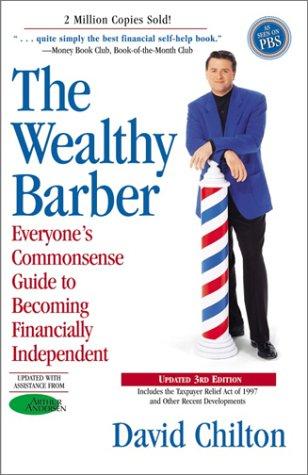
The Wealthy Barber is David Chilton’s plain-English guide to personal finance, told as a parable about a small-town barber who teaches three young friends the handful of simple habits — automatic saving, proper insurance, a will, and patient long-term investing — that quietly build real wealth over a lifetime.
About the author
David Chilton is a Canadian personal-finance author and entrepreneur who wrote The Wealthy Barber in 1989 after growing frustrated with financial advice that was either too complicated or too focused on picking winning investments rather than building good habits. The book became one of the best-selling Canadian books of all time, selling millions of copies and spawning multiple updated editions, including a sequel, The Wealthy Barber Returns. Chilton later became a well-known media personality in Canada, appearing as a “Dragon” on the Canadian version of Shark Tank, Dragons’ Den. His central pitch has always been consistency: he’d rather people follow a boringly simple plan for 30 years than an impressive one they abandon after six months.
Key concepts at a glance
| Concept | What it means | Use it when |
|---|---|---|
| Pay yourself first | Save a fixed percentage automatically before any spending happens | Setting up a new paycheck, account, or savings habit |
| The 10% rule | Chilton’s specific recommended savings rate, applied consistently over decades | Deciding how much to automatically transfer to savings |
| Compound growth | Investment returns earning returns of their own, accelerating over long time horizons | Explaining why starting early matters more than starting big |
| Term life insurance | Pure income-replacement protection for dependents, without an investment component | Protecting a family’s finances against an early death |
| Estate planning (a will) | A legal document directing how your assets are distributed after death | Making sure your wishes, not a court’s default rules, are followed |
| Homeownership as shelter | Viewing a house primarily as a place to live, not a primary investment | Deciding how much home to buy relative to your income |
| The latte factor | Small recurring expenses that quietly add up to large sums over decades | Finding easy places to redirect money toward saving |
Part 1: The 10% Rule and Why Automatic Beats Disciplined
The barbershop lessons start with the book’s single load-bearing idea: pay yourself first. Roy’s advice isn’t to build a detailed monthly budget and track every category — it’s to set up an automatic transfer of 10% of every paycheck into savings the moment it arrives, before rent, groceries, or anything else gets a claim on it. Once that transfer happens, the remaining 90% is free to spend however you like, no guilt required.
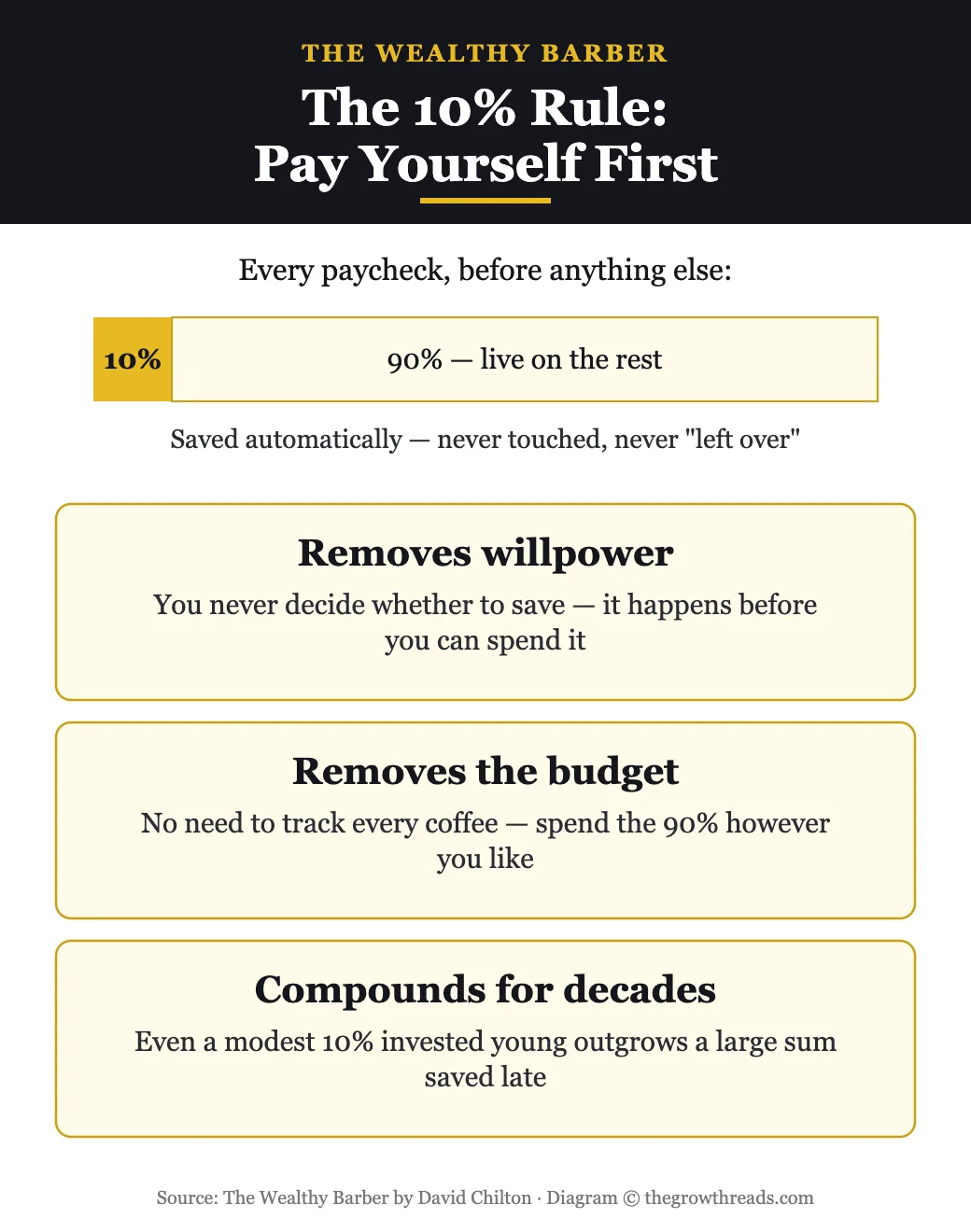
The genius of the approach, Chilton argues, is psychological rather than mathematical. Most budgeting systems fail not because the math is wrong but because they require an ongoing decision every single day — do I spend this or save it? — and willpower is a depleting resource. Automating the save removes the decision entirely. You’re not choosing to be disciplined every day; you’ve made one decision, once, that does the work for the next 30 years.
The book also spends real time on the “latte factor” — the small, recurring, easy-to-ignore expenses that don’t feel like they matter individually but compound into surprisingly large sums over a working lifetime. Chilton isn’t arguing for total austerity; he’s pointing out that a little awareness of where money leaks out unnoticed frees up more room for the 10% rule to work without feeling like a sacrifice.
TGR Note: If the “pay yourself first, automate everything” philosophy resonates, The Automatic Millionaire builds an entire modern system around the same core idea, with more specific mechanics for setting it up.
Part 2: Why Time Beats Timing
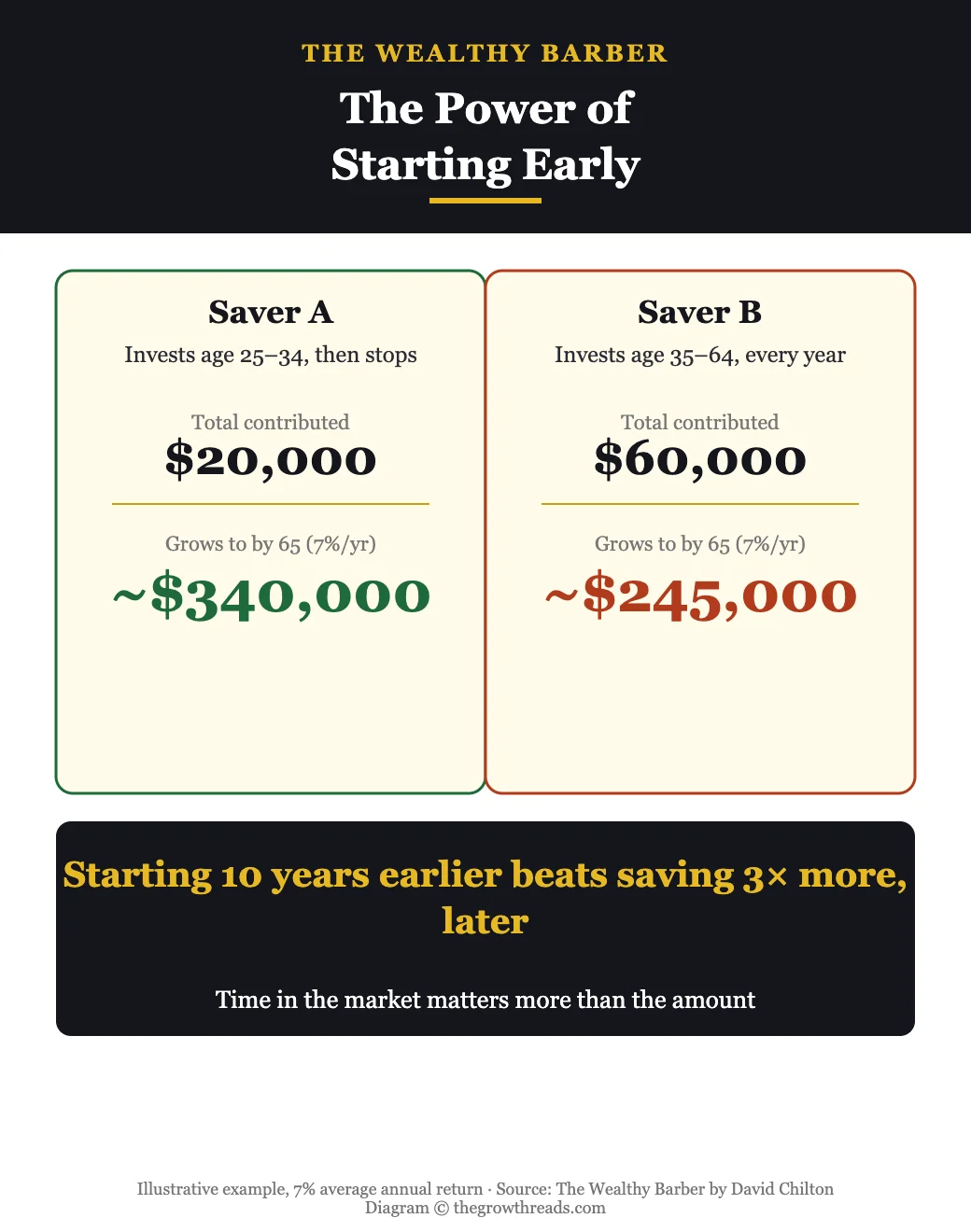
Roy’s second major lesson is about time, not timing. Chilton is refreshingly uninterested in stock-picking or predicting market movements — the book barely mentions individual securities. Instead, it leans entirely on the mathematics of compound growth: money invested a decade earlier has a decade longer to compound, and that head start is nearly impossible to make up later, even with much larger contributions.
This is illustrated through the classic comparison of two savers: one who invests consistently for a shorter window early in life, and one who invests for a much longer window but starts a decade later. The early starter, despite contributing far less money in total, often ends up ahead simply because their money had more years to compound. The lesson isn’t “invest perfectly” — it’s “invest early and leave it alone,” which is a far more achievable instruction for most people.
Chilton extends this into a broader point about investment complexity: for most savers, a simple, low-cost, consistent approach beats an elaborate one that requires constant attention and decision-making. The value isn’t in finding the cleverest possible strategy — it’s in finding a boring one you’ll actually stick with for three or four decades.
TGR Note: For a deeper, more modern treatment of exactly why simple and low-cost tends to beat complex investing, The Simple Path to Wealth is the natural next read.
Part 3: Protecting What You’ve Built — Insurance and Wills
A large portion of the book is dedicated to two subjects most personal-finance advice skips entirely: insurance and estate planning. Roy is blunt about life insurance’s actual purpose — it exists to replace a breadwinner’s income for the people who depend on it, not to serve as an investment. Chilton is skeptical of insurance products marketed as combined investment vehicles, arguing that mixing protection and investing usually costs more and performs worse than buying inexpensive term coverage and investing the difference separately.
Wills get similar blunt treatment. Chilton’s point is uncomfortable but simple: dying without a will doesn’t mean your assets disappear, it means a court — following a generic formula, not your specific wishes — decides who gets what and who raises your children if applicable. The book pushes hard on the idea that a will is not a “someday” task for wealthy older people; it’s a basic piece of financial hygiene for anyone with dependents, at any income level.
The chapters on real estate follow the same “shelter first” logic. Roy pushes back on the idea that a home is primarily an investment vehicle, arguing that buying more house than you need in pursuit of appreciation often backfires financially once you account for the actual costs of ownership — maintenance, property tax, interest, and opportunity cost of the money tied up in it.
TGR Note: If this section’s emphasis on real-world money mechanics — insurance, debt, taxes — appeals to you, The Barefoot Investor covers very similar ground with an equally accessible, step-by-step approach.
Part 4: Roy’s Complete Checklist
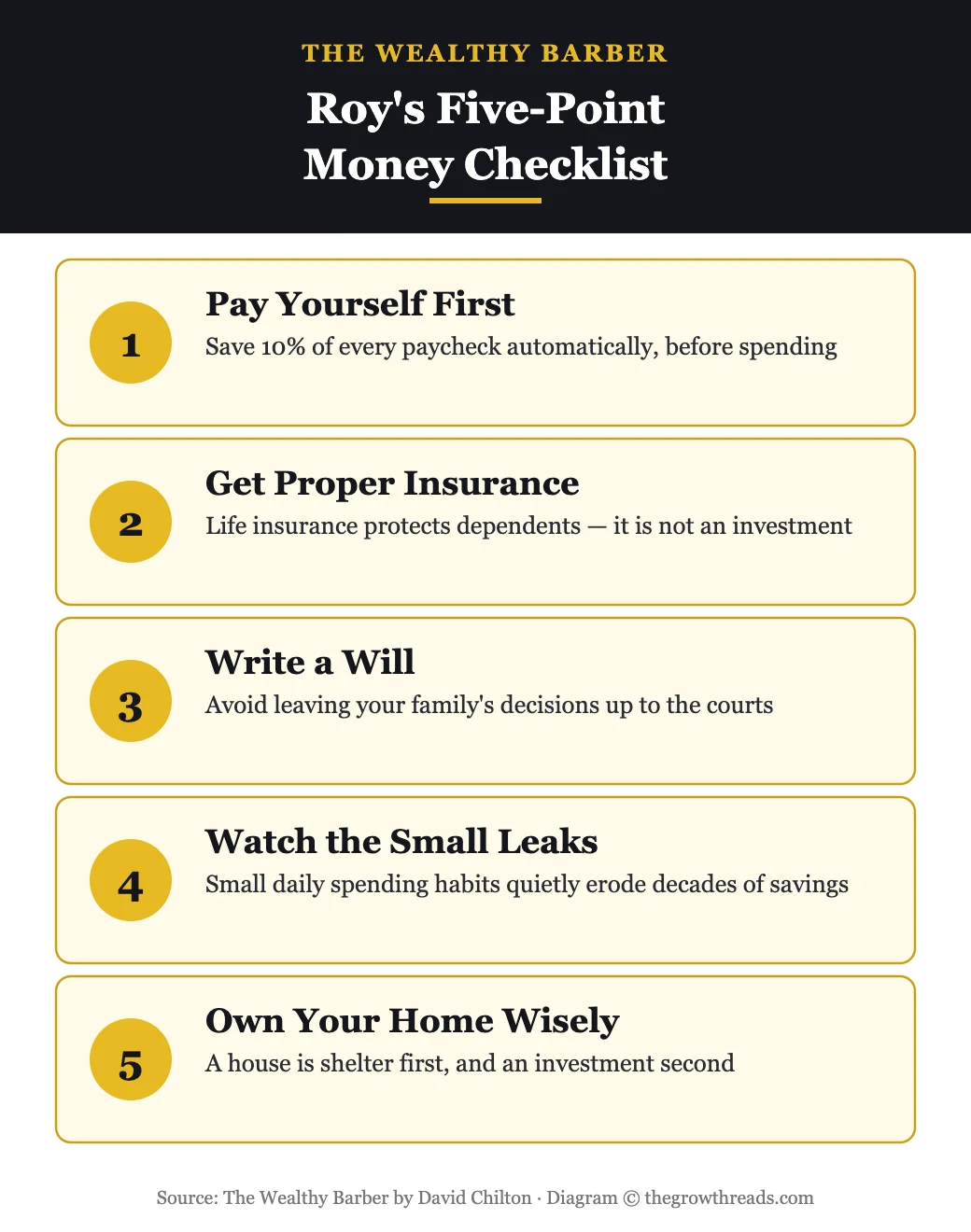
By the book’s final chapters, Roy’s scattered lessons converge into a short, repeatable checklist — deliberately unglamorous, because Chilton’s whole argument is that unglamorous and repeatable beats sophisticated and abandoned. Pay yourself first. Get proper term insurance. Write a will. Watch the small recurring leaks. Treat your home as shelter, not a trading asset.
What holds the checklist together is a psychological insight as much as a financial one: most people don’t fail at money because they lack information — they fail because their system requires too many ongoing decisions. Roy’s approach systematically removes decisions wherever possible, replacing “should I save this month?” with a standing instruction that runs in the background of an ordinary life. Three decades later, that background process is the entire difference between Roy the barber and everyone else on his street.
TGR Note: For the psychological side of why simple, automatic habits beat willpower — in money and everywhere else — The Psychology of Money pairs naturally with this book’s practical checklist.
Who is The Wealthy Barber best for — and who should read something else first?
This book is best for people who feel overwhelmed by personal finance and want the absolute fundamentals explained without jargon, spreadsheets, or a sales pitch for a specific product. Its parable format makes it an unusually easy, fast read for something covering saving, insurance, wills, and investing all at once.
If you want a more contemporary, U.S.-focused take on the same “automate everything” philosophy, start with The Automatic Millionaire instead. If you’re specifically interested in why simple investing beats complicated investing, The Simple Path to Wealth goes deeper on that single idea. And if you want a step-by-step system with specific bank-account mechanics, The Barefoot Investor is a natural next step.
Questions to reflect on
- Do you currently save automatically, or does saving depend on a decision every payday?
- What would change if you set your savings rate at 10% and never looked at it again?
- Do you have proper term life insurance if anyone depends on your income?
- Do you have a will — and if not, what’s actually stopping you from writing one this month?
- What’s one small recurring expense you’ve never questioned that might be worth a second look?
🔥 Ready to put Roy’s advice to work?
Grab a copy of The Wealthy Barber and build the same simple habits that quietly compound for decades.
How to apply The Wealthy Barber (7-day plan)
- Day 1 — Calculate your 10%: Work out 10% of your regular take-home pay and see how it compares to what you currently save.
- Day 2 — Automate the transfer: Set up an automatic transfer to a separate savings or investment account on payday, before you can spend it.
- Day 3 — Audit one small leak: Identify one small recurring expense and calculate what it costs over 10 years, not just this month.
- Day 4 — Check your insurance: If anyone depends on your income, confirm you have term life insurance sized to actually replace it.
- Day 5 — Start (or update) your will: Look up what’s required to write or update a basic will in your area, and book the first step.
- Day 6 — Reassess your housing math: Add up what your home actually costs you each year beyond the mortgage — maintenance, tax, insurance, interest.
- Day 7 — Write your one-index-card plan: Summarize your entire financial plan in five bullet points, the way Roy would.
Frequently asked questions
Is The Wealthy Barber still relevant today?
Yes, largely because its advice is deliberately timeless rather than tactical. The core ideas — automate your savings, buy proper term insurance, write a will, keep investing simple, treat your home as shelter first — don’t depend on any particular market condition, tax law, or country’s specific financial products. Some of the original figures and account names are dated (it was written in Canada in the late 1980s), which is part of why the Updated 3rd Edition exists, but the underlying philosophy has aged unusually well.
Is this book only useful for Canadian readers?
The book uses Canadian examples and account types, which means a few specific product names won’t translate directly for readers elsewhere. That said, the core principles — pay yourself first, buy term insurance, write a will, invest simply and consistently — apply regardless of country. Readers outside Canada may need to substitute their own local retirement accounts and insurance products, but the underlying advice holds up fine.
Why is it written as a story instead of a straightforward guide?
Chilton’s parable format — following three young friends through a series of barbershop conversations — is a deliberate choice to make personal finance approachable and memorable rather than dry. It also lets him introduce concepts gradually, in the order a young adult would actually encounter them: a first paycheck, a first insurance decision, a first home purchase. Some readers find the story elements a little dated or corny, but most agree it makes the content far easier to finish than a textbook-style guide.
Who is David Chilton?
David Chilton is a Canadian personal-finance author who wrote The Wealthy Barber in 1989, which went on to become one of the best-selling Canadian books of all time. He later wrote a sequel, The Wealthy Barber Returns, and became a well-known public figure in Canada as a “Dragon” on the Canadian version of Shark Tank, Dragons’ Den. His consistent message across both books is that simple, sustainable financial habits beat sophisticated strategies that people eventually abandon.
Does the book cover investing in specific stocks or funds?
No, and that’s intentional. The book deliberately avoids stock-picking or market-timing advice, focusing instead on the discipline of consistent saving and the mathematics of long-term compound growth. Chilton’s argument is that most individual investors do more harm than good trying to pick winners, and that a simple, low-cost, consistent approach to investing will outperform most attempts at cleverness over a multi-decade horizon.
Is 10% actually the right savings rate for everyone?
Chilton presents 10% as a strong, achievable default rather than a universal law — the real point is picking a consistent percentage and automating it, not landing on the exact “correct” number. Readers with higher incomes, later starts, or specific retirement goals may reasonably choose a higher rate, while someone in a genuinely tight financial position might need to start lower and build up. The book’s deeper argument is that the automation and consistency matter more than the precise percentage chosen.
What’s one practical takeaway from the book?
If you take just one idea from the book, make it this: set up an automatic transfer of a fixed percentage of your income to savings or investments on the day you get paid, so the decision to save is made once instead of every payday. Removing the ongoing willpower requirement is, according to Chilton, the single biggest reason some people build wealth quietly over decades while others with similar incomes never quite manage to save consistently.
Related summaries
- The Automatic Millionaire — a modern system built on the same pay-yourself-first idea
- The Simple Path to Wealth — why simple, low-cost investing wins over decades
- The Barefoot Investor — a similarly practical, step-by-step money system
- The Psychology of Money — the psychology behind why simple habits beat clever strategies
See all our best money books →
How we analyze books: Every TGR summary is built from a full read of the book, cross-checked against the author’s interviews and published research, then structured into a practical, apply-it-this-week format. Read our full methodology.