

⭐⭐⭐✬ 3.5/5
One-liner: The fastest management book you will ever read — and one that has quietly shaped how millions of leaders give feedback.
Best for: New managers, first-time team leads, and anyone who wants a dead-simple framework for setting expectations and giving feedback.
Reading time: ~1.5 hours (112 pages)
Difficulty to apply: Low — the three techniques can be practiced immediately after reading.
The New One Minute Manager in one minute
Great management is not complicated — it is three simple practices done consistently. Ken Blanchard and Spencer Johnson strip management down to its essential core: set clear goals (One Minute Goals), catch people doing things right (One Minute Praisings), and redirect mistakes immediately and warmly (One Minute Re-Directs). Written as a parable about a young man seeking the world’s best manager, the book has sold over 15 million copies since 1982 and remains the most widely read management book in history. The 2015 “New” edition updates the language for modern workplaces, replacing “reprimands” with “re-directs” to reflect a coaching-oriented approach, but the core system is unchanged.
Key takeaways
- One Minute Goals create clarity: Write every goal in 250 words or less on a single page. Both manager and direct report must agree on what good performance looks like. Limit goals to three to six at any time.
- Catch people doing something right: Most managers focus on catching mistakes. One Minute Praisings flip this — praise immediately, be specific about what was done well, and tell the person how their work made you feel.
- Re-direct mistakes immediately: Do not save feedback for quarterly reviews. Address problems within minutes. Be specific about the behavior, share how it affects results, then reaffirm that you believe in the person.
- Separate the person from the behavior: People are not their mistakes. Criticize the action, never the person. This principle makes re-directs feel supportive rather than punitive.
- People who feel good produce good results: This is the book’s central thesis. Helping people feel competent and valued is not soft management — it is the most effective strategy for driving performance.
- The best investment is time spent with people: Spending one minute on a praising or re-direct saves hours of disengagement, confusion, and turnover down the road.
- Self-management is the goal: The One Minute Manager’s ultimate objective is to make themselves unnecessary. People who understand their goals and receive consistent feedback learn to manage themselves.
- Goals are the foundation: Without clear goals, praisings and re-directs are meaningless. People cannot hit a target they cannot see.
- Feedback must be immediate: Delayed feedback loses its power. The closer the feedback is to the behavior, the stronger the learning connection.
- Touch base regularly, not just at reviews: In the updated edition, Blanchard emphasizes ongoing check-ins over annual reviews — brief, frequent conversations beat formal, infrequent evaluations.
What is The New One Minute Manager about?
The New One Minute Manager is a management parable that teaches three core leadership practices: setting brief, clear goals; praising people immediately when they do well; and re-directing mistakes quickly and warmly. The book argues that effective management takes minutes, not hours, when done with clarity and genuine care for people.
About the author
Ken Blanchard is a management consultant, speaker, and author who has written or co-authored over 65 books, including the One Minute Manager series, which has sold over 15 million copies worldwide. He co-founded The Ken Blanchard Companies, a global leadership training firm, and developed Situational Leadership II, one of the most widely taught leadership models in corporate training. Spencer Johnson, who passed away in 2017, was a physician and author best known for Who Moved My Cheese? — another bestselling business parable. Together, they created one of the most enduring management frameworks ever published.
Key concepts at a glance
| Concept | What it means | Use it when |
|---|---|---|
| One Minute Goals | Each goal written in 250 words on one page, agreed by both parties, reviewed daily in about a minute | You need to set clear expectations for a direct report or yourself |
| One Minute Praisings | Immediate, specific positive feedback when someone does something right, paired with how it makes you feel | You catch someone performing well and want to reinforce the behavior |
| One Minute Re-Directs | Immediate, specific correction of behavior, followed by a reaffirmation of the person’s value | Someone makes a mistake and you want to correct it without damaging the relationship |
| Results + People | The best managers care about both results and the people producing them — not one at the expense of the other | You need to decide between an autocratic and a democratic management style |
| Self-Management | The ultimate goal is for direct reports to manage themselves, reducing dependency on the manager | You want to develop your team’s independence rather than creating bottlenecks |
| Behavior vs. Person | Always separate who someone is from what they did — praise and redirect the action, not the identity | You need to give tough feedback without making it personal |
Part 1: The search for the effective manager
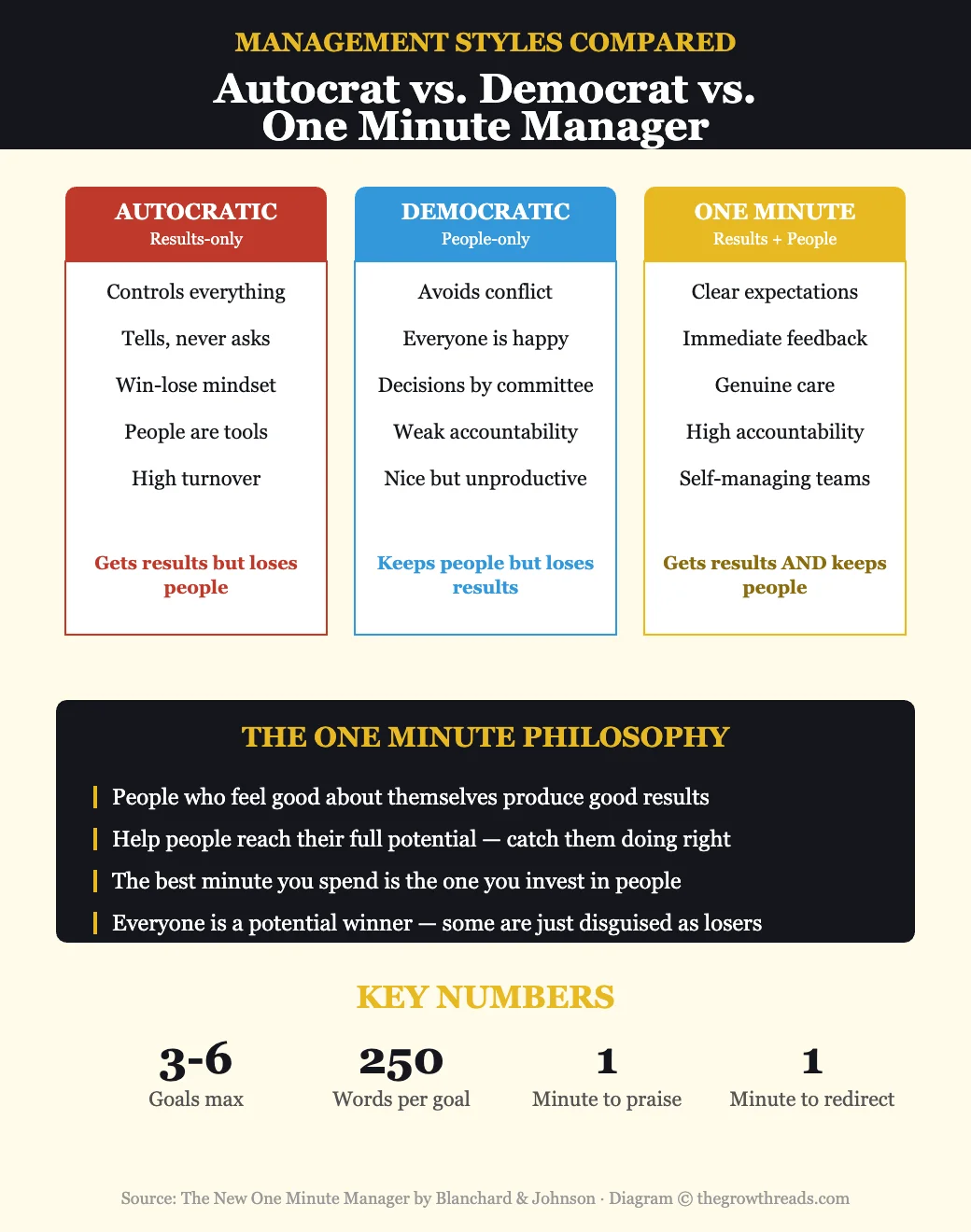
The book opens with a young man traveling the world in search of an effective manager. He encounters two types: autocratic managers who care only about results (the organization wins, people lose) and democratic managers who care only about people (people feel good, but results suffer). Neither type produces lasting success. Then he hears about a remarkable manager whose team consistently delivers outstanding results while reporting high satisfaction and growth.
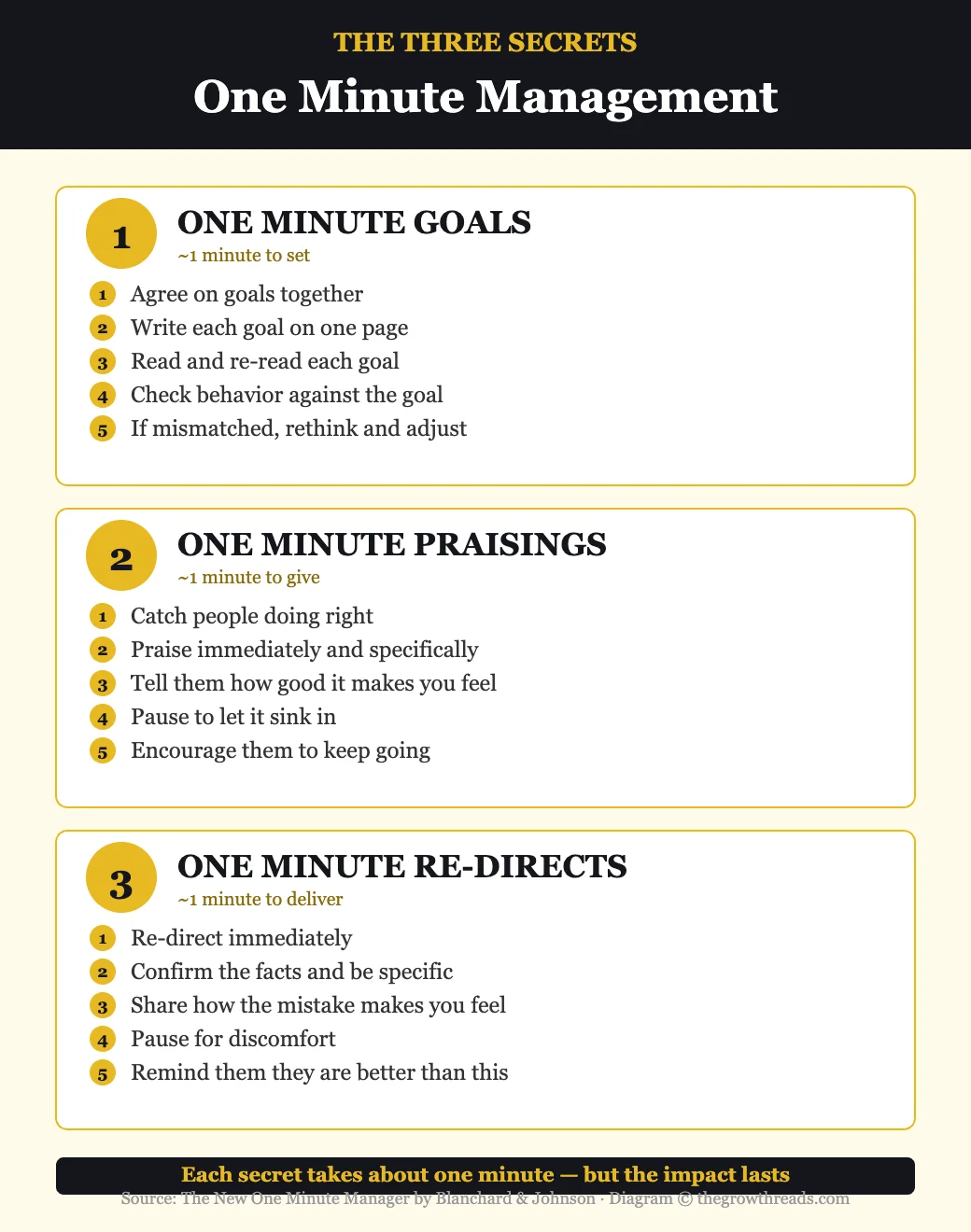
When the young man visits this manager, he discovers something unexpected. The manager is rarely in his office. His door is open. He describes himself not as an autocratic or democratic manager but as a One Minute Manager — someone who gets great results from people in very little time. The simplicity is disarming. The young man suspects there must be more to it. There is not. The entire system rests on three practices, each designed to take about one minute.
This framing — the parable of the searching young man — is deliberate. Blanchard and Johnson know that management books filled with research and frameworks sit unread on shelves. By wrapping their system in a story, they make it memorable. Every concept is illustrated through conversation, not citation. The tradeoff is depth: readers seeking rigorous evidence will need to look elsewhere. But for sheer clarity and memorability, the format works — which is why the book has remained in print for over 40 years.
Part 2: The three secrets in practice
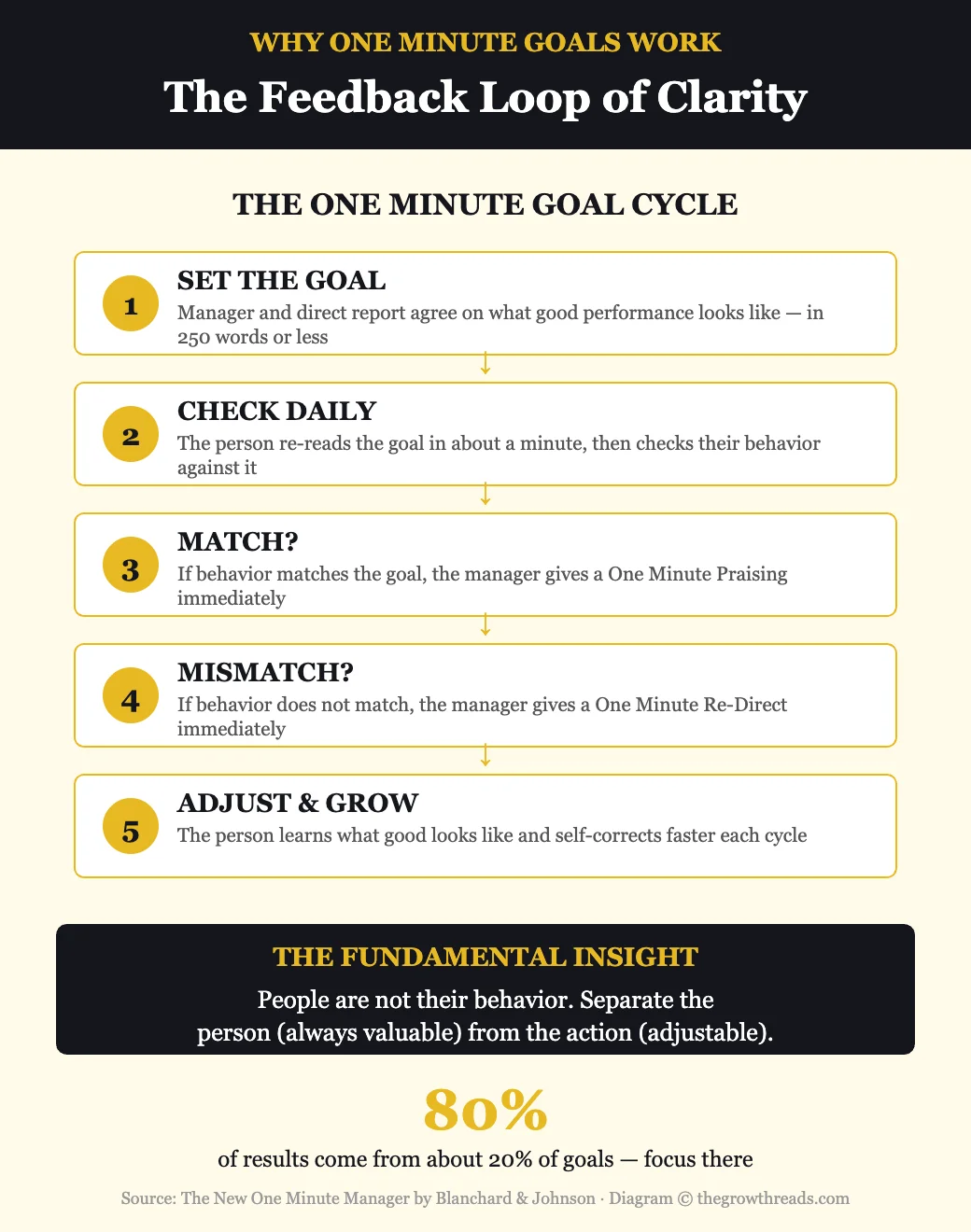
One Minute Goals are the foundation. The principle is that most people fail at work not because they are lazy or incapable, but because they do not know what is expected of them. Blanchard’s solution: every goal is written in 250 words or less on a single page. Both the manager and the direct report agree on the goal and the standard of good performance. The person re-reads the goal regularly (about one minute) and checks whether their behavior matches it. If it does, they keep going. If it does not, they adjust. The constraint of three to six goals at any time forces prioritization — a principle that echoes the Pareto insight that most results come from a small number of activities.
One Minute Praisings are the motivational engine. Blanchard argues that most managers wait for the annual review to tell people they are doing well — by which point the motivational power has evaporated. Instead, the One Minute Manager catches people doing something right as close to the moment as possible. The praising is specific (“You handled that customer complaint in a way that turned a frustrated person into a loyal one”), includes how the behavior makes the manager feel (“That makes me proud to have you on this team”), and ends with encouragement to keep it up. The pause after sharing feelings is deliberate — it lets the emotion register.
One Minute Re-Directs replace the traditional reprimand. When someone makes a mistake, the manager addresses it immediately — not at the next scheduled meeting. The re-direct has two halves. The first half addresses the behavior: what happened, what should have happened, and how the mistake affects results. There is a deliberate pause for discomfort. The second half addresses the person: a genuine reaffirmation that the manager believes in them and values them, and that the re-direct is about the behavior, not their worth. This two-part structure is what makes the technique work — it corrects without crushing.
Part 3: The philosophy behind the method
Beneath the techniques, Blanchard presents a management philosophy that is deceptively deep. The central thesis is that people who feel good about themselves produce good results. This is not a feel-good platitude — it is a performance strategy. When people have clear goals, receive immediate recognition for good work, and are corrected without shame, they develop confidence, autonomy, and accountability. The manager’s job is to create the conditions for this cycle, then step back.
The ultimate goal of the One Minute Manager is self-management. Blanchard wants direct reports to internalize the goal-setting, self-praising, and self-correcting cycle so thoroughly that they no longer need the manager to drive it. This is the opposite of micromanagement — it is a deliberate investment in people’s independence. The manager who makes themselves unnecessary has succeeded.
The updated edition adds a nuance about collaboration. Where the original 1982 version had a slightly top-down tone (“the manager sets goals, the manager praises, the manager reprimands”), the 2015 version emphasizes co-creation. Goals are set together. Praisings go both ways. Re-directs replace reprimands, reflecting a shift from command-and-control to coaching. The core system is the same, but the framing has matured to fit a workplace that values partnership over hierarchy.
Who is The New One Minute Manager best for — and who should read something else first?
This book is ideal for brand-new managers who need a starter framework they can use immediately. It is also a useful refresher for experienced leaders who have gotten away from the basics. The brevity is a feature — you can read it in a single sitting and apply the techniques the next morning. Parents and teachers will also find the praising and re-directing techniques immediately transferable.
If you want more depth and nuance in feedback conversations, read Radical Candor. If your challenge is managing a team through dysfunction, The Five Dysfunctions of a Team goes much deeper. And if you are managing for the first time and want a more modern, comprehensive guide, The Making of a Manager by Julie Zhuo covers the full scope of the role.
Questions to reflect on
- Do your direct reports (or you) have written goals that can be re-read in one minute — or are expectations vague and assumed?
- When was the last time you caught someone doing something right and praised them immediately and specifically?
- Do you save feedback for formal reviews, or do you address behaviors — both positive and negative — in real time?
- When you give corrective feedback, do you separate the behavior from the person, or does it feel like a personal attack?
- If you disappeared tomorrow, could your team self-manage — or have you inadvertently made yourself indispensable?
🔥 Ready to manage better in less time?
Learn the three-technique system that has helped over 15 million managers become more effective — in under two hours of reading.
How to apply The New One Minute Manager (7-day plan)
- Day 1 — Write your One Minute Goals: Pick the three most important outcomes you expect from yourself or each direct report. Write each in 250 words or less on a single page. Include what good performance looks like and the standard for completion.
- Day 2 — Share and align: Meet with each person (or your own manager) and review the goals together. Agree on the standards. Make sure both parties could describe the goal in the same words. Pin the goals where they are visible.
- Day 3 — Catch someone doing right: Actively look for one person doing something well today. Walk over and give an immediate, specific praising. Name the behavior, share how it made you feel, and encourage them to keep going. Notice their reaction.
- Day 4 — Practice a re-direct: When you notice a mistake or off-track behavior, address it within minutes. Name the specific behavior, explain the impact, pause, then reaffirm the person’s value. Notice how separating person from behavior changes the conversation tone.
- Day 5 — Re-read and self-check: Spend one minute re-reading each of your goals. Honestly assess: is your behavior matching the goal? If not, what specifically needs to change? This is the self-management loop in action.
- Day 6 — Give a second praising and re-direct: Repeat both techniques. Notice whether they feel more natural the second time. Pay attention to whether the recipient’s behavior shifts after real-time feedback.
- Day 7 — Reflect on self-management: Ask yourself: are your direct reports (or you) any closer to self-managing this week? What needs to happen for them to internalize the goal-check-adjust cycle without you driving it?
Frequently asked questions
Is The New One Minute Manager different from the original?
The core system is identical — One Minute Goals, Praisings, and the third technique. The main change is language and tone. The original 1982 edition used “One Minute Reprimands,” which the 2015 edition replaces with “One Minute Re-Directs” to reflect a coaching-oriented approach. The updated edition also emphasizes collaboration in goal-setting and acknowledges that modern workplaces are less hierarchical. If you have read the original, the new edition is a quick refresher with a softer, more partnership-oriented voice.
Can you really manage in one minute?
The title is a slight exaggeration for effect. Each individual technique — setting a goal, giving a praising, delivering a re-direct — takes about one minute per interaction. The total time spent managing depends on your team size and situation. What Blanchard means is that effective management is about frequency and brevity, not lengthy meetings and annual reviews. Many managers who apply the system report that they spend less time managing overall because problems are caught and corrected before they escalate.
Is The One Minute Manager too simplistic?
It depends on what you need. The book is deliberately simple — it is designed to be read in under two hours and applied immediately. For a new manager who has never given feedback before, it is perfect. For a seasoned leader dealing with complex organizational dynamics, it may feel thin. Think of it as a starting framework rather than a comprehensive management system. Books like Radical Candor, High Output Management, and The Making of a Manager add layers of complexity for those who want them.
What is the difference between a praising and a re-direct?
A praising reinforces good behavior by naming what was done well, expressing how it made you feel, and encouraging the person to continue. A re-direct corrects off-track behavior by naming the specific mistake, explaining the impact, pausing for discomfort, and then reaffirming the person’s value. Both are immediate, specific, and brief. The key structural difference is that a re-direct has a deliberate two-part structure: the first half addresses the behavior, the second half addresses the person.
How many goals should a person have?
Blanchard recommends three to six goals at any time. Fewer than three may not cover the most important aspects of the role; more than six dilutes focus and makes the daily one-minute review impractical. The constraint forces prioritization — an implicit application of the Pareto principle that 80% of results come from about 20% of activities. Each goal should fit on one page in 250 words or less, which naturally prevents vague or overly complex objectives.
Does The One Minute Manager work for remote teams?
The principles transfer well to remote settings, though the delivery mechanism changes. One Minute Goals can be shared in a document. Praisings can be given immediately via video call, voice message, or Slack — the key is that they happen close to the behavior, not saved for a weekly meeting. Re-directs are best delivered by video or phone rather than text, since tone and warmth are harder to convey in writing. The system’s emphasis on frequency over formality actually makes it well-suited to remote environments where casual check-ins replace scheduled meetings.
Why has The One Minute Manager stayed popular for 40 years?
Three reasons. First, simplicity: three techniques is the right number for busy managers to remember and apply. Second, the parable format makes the lessons stick in memory far better than a textbook presentation. Third, the advice is genuinely useful — immediate, specific feedback is validated by decades of organizational psychology research that came after the book was published. The system works because it addresses the two things most managers struggle with: setting clear expectations and giving honest, timely feedback.
Related summaries
If you found The New One Minute Manager valuable, explore these related summaries:
- Radical Candor by Kim Scott — the deeper framework for caring personally and challenging directly.
- The Making of a Manager by Julie Zhuo — a modern, comprehensive guide for first-time managers.
- Multipliers by Liz Wiseman — how the best leaders amplify the intelligence of everyone around them.
- 📚 Browse all leadership book summaries