

⭐⭐⭐⭐✬ 4.5/5 — The definitive playbook for anyone stepping into a new leadership role, promotion, or lateral move.
Best for: New managers, executives in transition, internal promotees, and anyone starting a new job where the first impression sets the trajectory.
Reading time: ~6 hours (304 pages) | Difficulty to apply: Moderate — the frameworks are clear but require political awareness and discipline to execute under pressure.
The First 90 Days in one minute
Leaders are most vulnerable and most impactful in their first three months — and most people wing it. Michael Watkins studied hundreds of leadership transitions and found that new leaders who fail almost always fail early, usually because they cling to the strategies that made them successful in their previous role. The book provides a systematic acceleration framework: diagnose the business situation using the STARS model, negotiate expectations with your boss through five structured conversations, secure early wins that build credibility, build the right team and coalitions, and align strategy with structure. The goal is to reach the “breakeven point” — the moment your net contribution to the organization becomes positive — as quickly as possible. Watkins argues that a well-planned 90-day transition can compress what typically takes six to twelve months of fumbling into a focused sprint.
Key takeaways
- Transitions are the most dangerous periods: failure in a new role costs the organization up to 2.7 times the leader’s salary, and most derailments trace back to the first 90 days.
- Stop doing what made you successful before: the skills and strategies that earned your promotion are often exactly what will undermine you in the new role — this is the “promote yourself” challenge.
- Diagnose the situation with STARS: every transition falls into one of five categories — Start-up, Turnaround, Accelerated Growth, Realignment, or Sustaining Success — and each demands a fundamentally different strategy.
- Negotiate success with your boss early: have five structured conversations about the situation, expectations, resources, working style, and your personal development within the first two weeks.
- Secure early wins that matter: early wins must be visible, meaningful to others (not just you), and aligned with the organization’s priorities — they build the credibility you need for bigger moves later.
- Build coalitions before you need them: map the influence landscape, identify who supports you, who opposes you, and who is persuadable — then invest energy in winning the persuadables.
- Align strategy, structure, systems, and skills: misalignment between any of these four elements is where organizational performance breaks down.
- Manage yourself through the transition: the emotional toll of a new role is real — discipline your learning, build a personal advisory network, and protect your personal equilibrium.
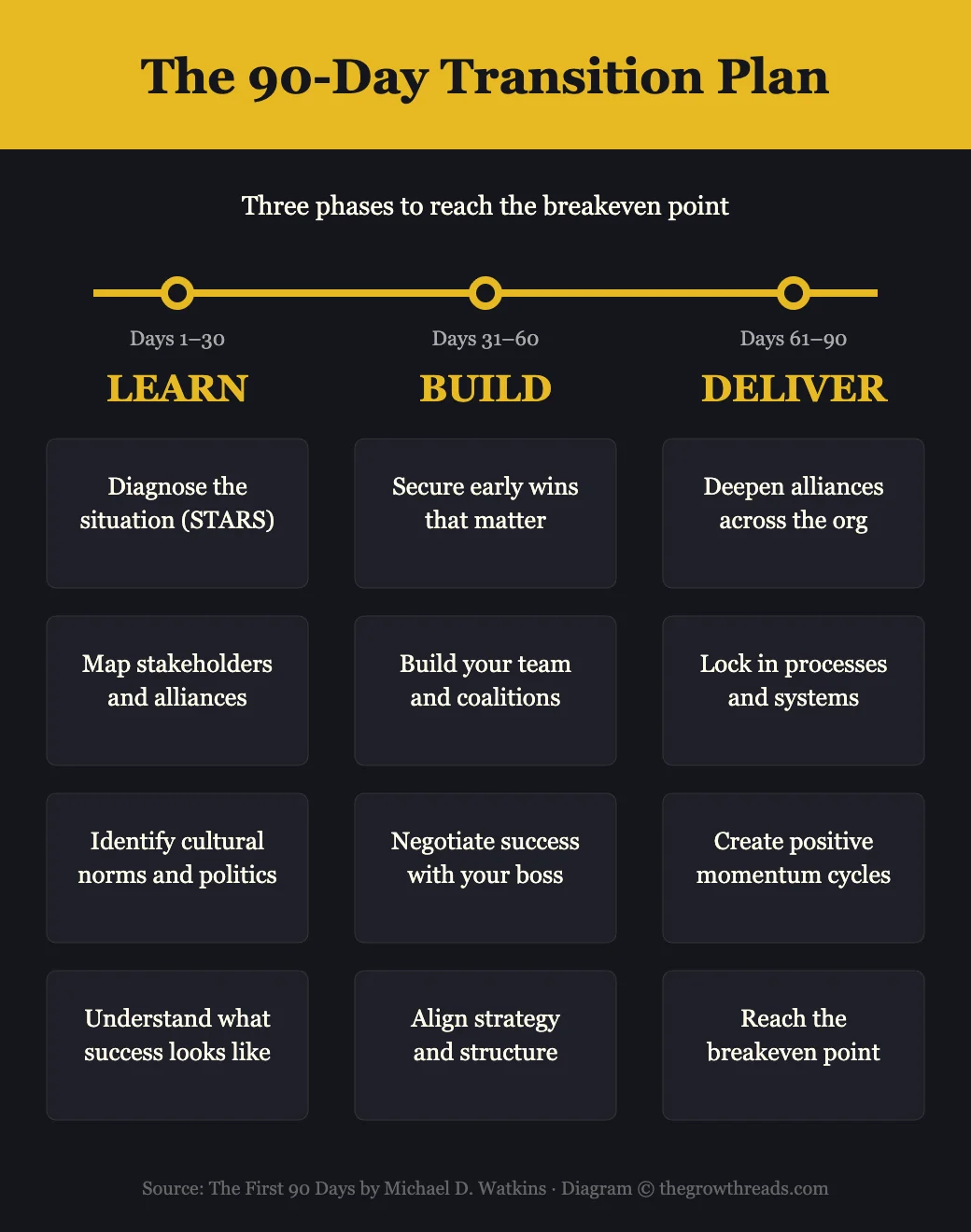
- Create a 90-day plan with clear milestones: plan your transition in three 30-day blocks with learning objectives, relationship goals, and early wins for each phase.
- Accelerate everyone around you: if you manage a team, use the same framework to help your direct reports through their own transitions.

What is The First 90 Days about?
The First 90 Days is a transition acceleration framework for leaders entering new roles. It teaches you to diagnose your business situation, negotiate success criteria with your boss, build political coalitions, secure early wins that establish credibility, align organizational architecture, and create a structured 90-day plan — so you reach your contribution breakeven point months faster than peers who improvise.
About the author
Michael D. Watkins is a professor at IMD Business School in Lausanne, Switzerland, and the co-founder of Genesis Advisers, a leadership development consultancy specializing in transition acceleration. Before IMD, he spent over a decade on the faculty at Harvard Business School and Harvard Kennedy School. His research on leadership transitions began in the late 1990s when he noticed that most leadership development programs focused on steady-state performance and almost entirely ignored the critical period when a leader first takes charge. The First 90 Days has sold over two million copies, been translated into 27 languages, and become the standard onboarding text at companies including Microsoft, Johnson & Johnson, and Goldman Sachs. Explore all Michael D. Watkins book summaries →
Key concepts at a glance
| Concept | What it means | Use it when |
|---|---|---|
| Breakeven Point | The moment your net contribution to the organization exceeds the resources invested in you | Setting the overall goal of your transition plan |
| STARS Model | Five business situations (Start-up, Turnaround, Accelerated Growth, Realignment, Sustaining Success) each requiring a different approach | Diagnosing what kind of challenge you’ve inherited |
| Five Conversations | Structured dialogues with your boss about situation, expectations, resources, style, and development | Your first two weeks in a new role |
| Early Wins | Visible, meaningful improvements that build credibility and political capital | Choosing where to focus your limited energy in month one |
| Coalition Building | Mapping supporters, opponents, and persuadables — then systematically winning the persuadables | Navigating organizational politics to get things done |
| Strategy-Structure Alignment | Ensuring the organization’s strategy, structure, systems, and skills are mutually reinforcing | Identifying root causes of underperformance |
| Learning Plan | A systematic approach to understanding the organization’s history, culture, politics, and technical landscape | Avoiding the trap of acting before you understand |
| Personal Discipline | Managing energy, building an advisory network, and staying grounded through high-stress transitions | Protecting yourself from burnout during the transition |
Part 1: Promoting yourself and accelerating your learning
Watkins opens with a counterintuitive warning: the biggest threat to your success in a new role is you — specifically, the version of you that succeeded in your old role. He calls this the “promote yourself” challenge. When a star salesperson becomes a sales manager, their instinct is to keep selling. When a brilliant engineer becomes an engineering director, they keep designing. But the new role demands entirely different competencies — delegation, political navigation, strategic thinking — and clinging to old strengths becomes a liability.
The antidote is a structured learning plan. Watkins is emphatic that new leaders must resist the pressure to act decisively in week one. Instead, he prescribes a systematic approach to understanding the organization: its history, its culture (the real one, not the one on the website), its political dynamics, and its technical landscape. He recommends scheduling a round of one-on-one conversations with key stakeholders using a consistent set of questions: What are the biggest challenges facing this part of the organization? What are the best unexploited opportunities? If you were me, what would you focus on? The consistency lets you triangulate — when five people independently name the same problem, you’ve found something real.
He introduces the concept of “actionable insight” as the goal of learning: you’re not collecting information for its own sake, you’re building a mental model of the organization that lets you make smart decisions. The learning plan has three layers: technical learning (the products, markets, and processes), cultural learning (how decisions really get made), and political learning (who has influence and how they use it).
Part 2: Matching strategy to situation and securing early wins
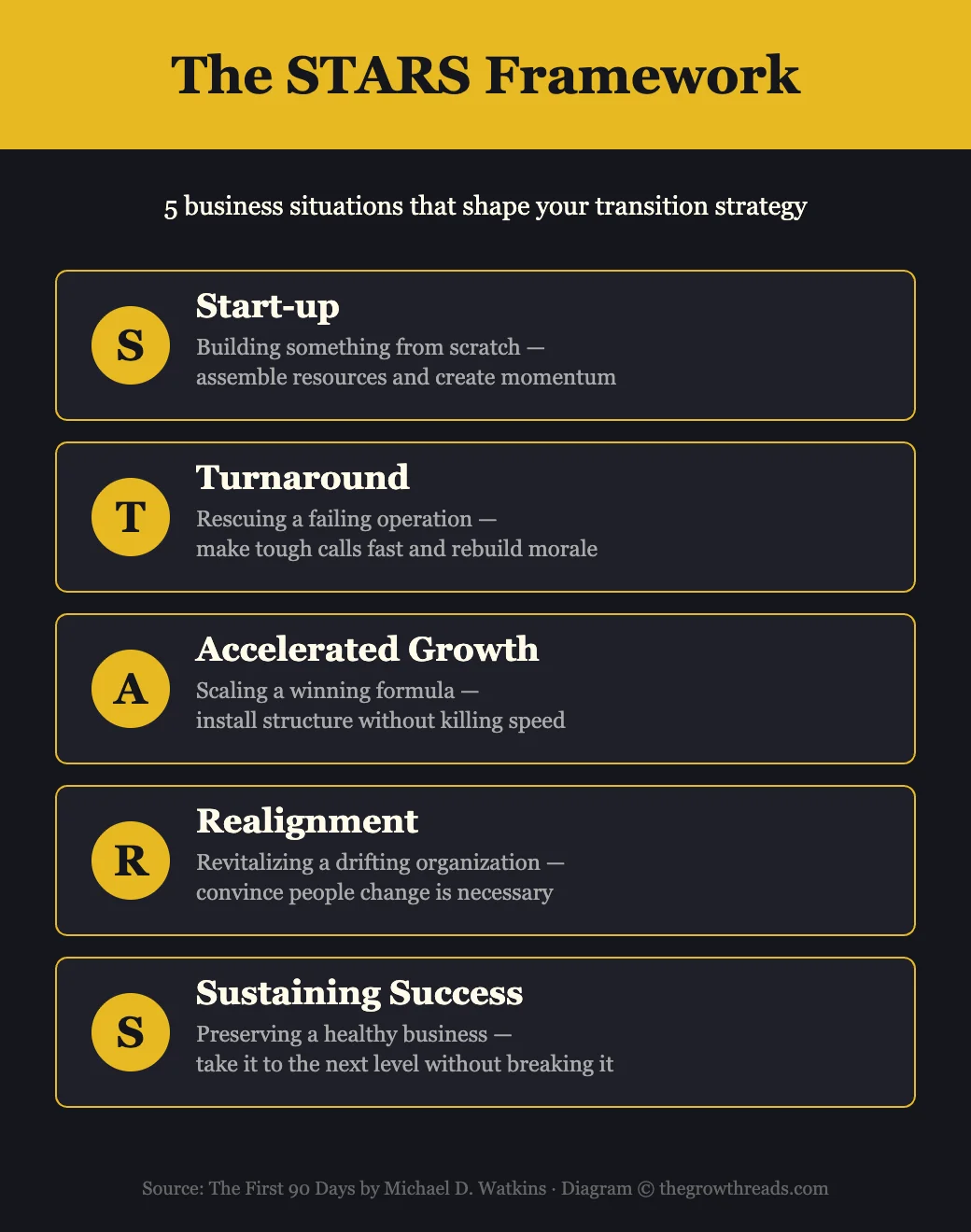
The STARS framework is Watkins’s most enduring contribution to leadership thinking. He argues that most transition advice fails because it assumes all new roles are the same. In reality, leading a turnaround (where the building is on fire and everyone knows it) is a fundamentally different challenge from leading a realignment (where the building is slowly sinking and nobody wants to admit it). A turnaround leader needs to make fast, visible, sometimes painful decisions. A realignment leader needs to spend months building the case that change is even necessary before they can act.
For each STARS scenario, Watkins prescribes different priorities. In a start-up, focus on assembling the right team and creating the initial architecture. In a turnaround, focus on stopping the bleeding, then rebuilding morale. In accelerated growth, focus on installing the systems and processes that will scale. In realignment, focus on creating a shared diagnosis of the problem. In sustaining success, focus on identifying the next growth lever without destroying what already works. Many transitions involve a blend — you might be sustaining success in one product line while turning around another — and Watkins teaches you to diagnose each piece separately.
Early wins are the currency of a new leader’s credibility. But Watkins is precise about what qualifies. An early win must be visible (people notice it), aligned with the organization’s goals (not just your own pet project), and built on a foundation of learning (so you’re not optimizing the wrong thing). He also warns about the shadow side: early wins pursued recklessly can create enemies faster than allies. The ideal early win is one that simultaneously demonstrates your competence, builds relationships, and advances the organization’s strategy.
Part 3: Building the team and negotiating with your boss
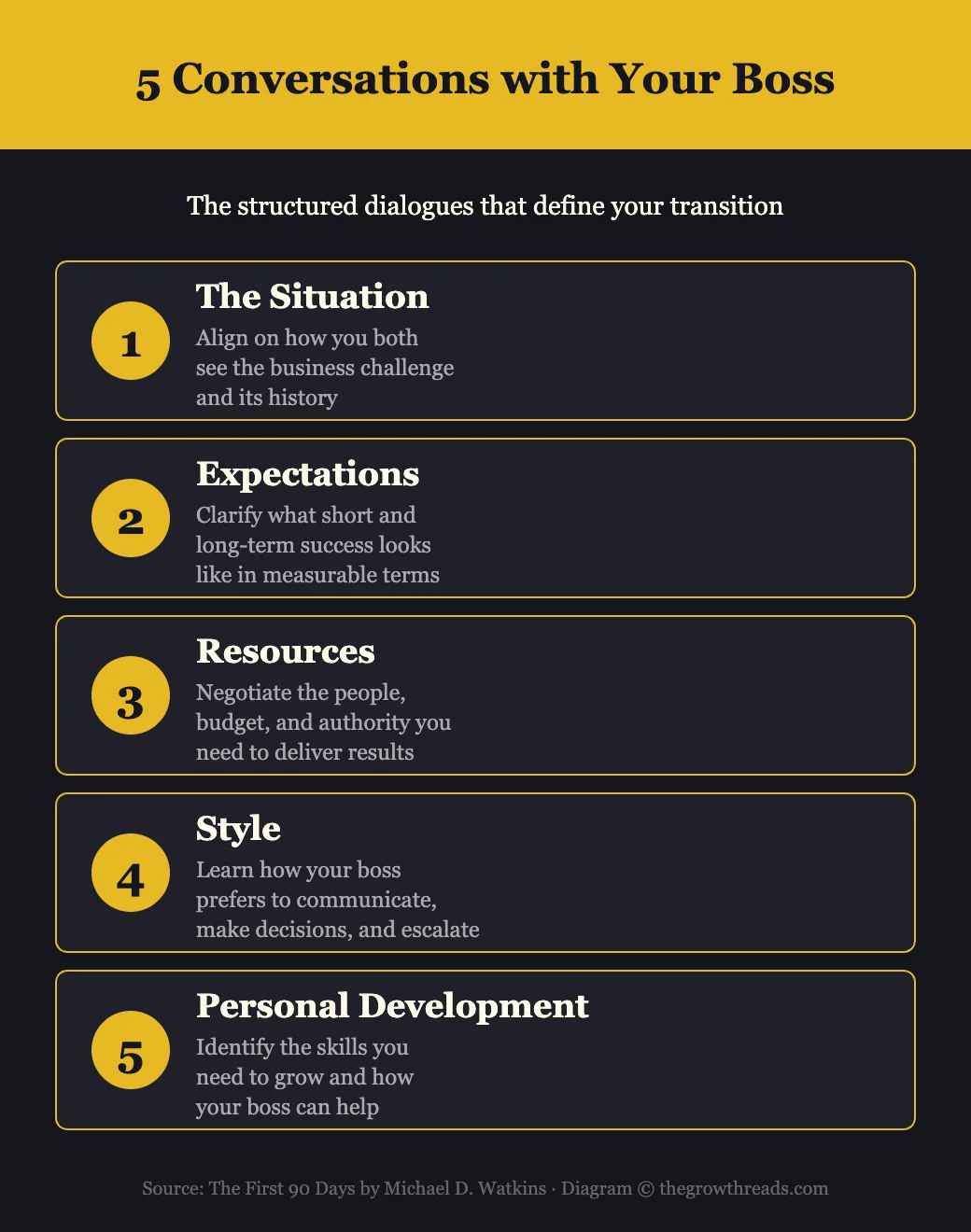
Watkins devotes significant attention to the most high-leverage relationship in any transition: the one with your new boss. He prescribes five conversations that should happen within the first two weeks. The Situation Conversation aligns you on how you both see the current business reality. The Expectations Conversation makes success criteria explicit and measurable. The Resources Conversation ensures you have the people, budget, and authority to deliver. The Style Conversation reveals how your boss prefers to communicate, receive bad news, and make decisions. The Personal Development Conversation identifies what skills you need to grow in this new role.
He’s blunt about the purpose: these conversations are not about impressing your boss. They’re about creating a shared framework for your transition so that when you hit inevitable obstacles, you have a pre-negotiated foundation to work from. Leaders who skip these conversations often discover six months in that their boss’s definition of success was completely different from their own — by which point the trust deficit is hard to recover.
On team building, Watkins introduces the framework of assessing every team member across two dimensions: will (attitude and motivation) and skill (capability for the current role). This produces four quadrants, and each demands a different management response: develop, delegate, motivate, or replace. He’s also pragmatic about the politics of team changes: you rarely have the luxury of rebuilding from scratch, so you need to make a few high-signal moves that communicate your standards without destabilizing the entire group.
Part 4: Coalitions, alignment, and managing yourself
The final section addresses the political dimension that most leadership books gloss over. Watkins argues that organizational politics are neither optional nor inherently corrupt — they’re the mechanism through which competing priorities get resolved in any group of humans. The leader who ignores politics doesn’t transcend it; they just lose to those who don’t.
His coalition-building framework is pragmatic. Map every key stakeholder on two axes: how much they support your agenda and how much influence they have. This reveals four groups: allies (high support, high influence), opponents (low support, high influence), persuadables (uncertain support, moderate to high influence), and fence-sitters. The common mistake is spending all your energy either preaching to allies or fighting opponents. The highest-leverage activity is winning the persuadables, because each one you convert changes the calculus for everyone else.
Watkins closes with organizational alignment and self-management. He uses a four-element model — strategy, structure, systems, and skills — and argues that most organizational problems trace back to misalignment between two or more of these elements. A brilliant strategy with the wrong organizational structure will underperform a mediocre strategy that’s properly structured. The diagnostic question is always: where’s the mismatch?
On managing yourself, Watkins is refreshingly honest about the emotional cost of transitions. New leaders face a potent mix of high expectations, limited knowledge, and constant evaluation. He prescribes three disciplines: build a personal advisory network (not just mentors — people who will tell you the truth), create structured reflection time (even 30 minutes per week), and protect your personal foundation (exercise, sleep, and relationships outside work). The leader who burns out in month two doesn’t reach the breakeven point at all.
Who is The First 90 Days best for — and who should read something else first?
This book is ideal for anyone entering a new leadership role — whether it’s your first management position, a promotion to a larger scope, a lateral move to a new function, or a jump to a new company. It’s especially valuable for leaders in fast-moving organizations where the window to establish credibility is narrow. Executives joining during periods of rapid change or crisis will find the STARS framework immediately applicable.
If you’re not yet in a leadership role and want to build foundational management skills, start with The Making of a Manager by Julie Zhuo. If your challenge is less about transition and more about sustaining high performance in your current role, High Output Management by Andy Grove is the classic. And if you want to go deeper on the organizational design questions Watkins raises, The Lean Startup covers the start-up scenario in far more depth.
Questions to reflect on
- Which STARS situation best describes the role you’re stepping into right now — and how does that diagnosis change your priorities for the first 30 days?
- What strengths from your previous role might actually become liabilities in this new one? Where do you need to “promote yourself” mentally?
- If you had to name one early win that would simultaneously build your credibility, advance the organization’s goals, and strengthen a key relationship — what would it be?
- Have you had the five conversations with your boss? Which one have you been avoiding, and why?
- Map your key stakeholders right now: who are your allies, your opponents, and — most importantly — your persuadables?
🔥 Ready to own your next leadership transition?
Get the framework that two million leaders use to hit the ground running in a new role.
How to apply The First 90 Days (7-day plan)
- Day 1 — Diagnose your STARS situation: Write down which of the five business situations best describes your new role. If it’s a blend, identify the primary and secondary scenarios and note how each changes your approach.
- Day 2 — Draft your learning plan: List 10 questions you need answered in your first 30 days. Categorize them into technical, cultural, and political. Schedule the first five one-on-one conversations to start answering them.
- Day 3 — Prepare the five boss conversations: Write one page of notes for each of the five conversations (situation, expectations, resources, style, personal development). Schedule the first one this week.
- Day 4 — Map your stakeholders: Create a simple grid of your key stakeholders with two columns: “support for my agenda” (high/medium/low) and “influence” (high/medium/low). Circle the persuadables.
- Day 5 — Identify three potential early wins: For each, answer: Is it visible? Does it align with organizational priorities? Can I deliver it in 30 days? Does it build a relationship I need? Pick the one that scores highest on all four.
- Day 6 — Assess your team: Plot each direct report on the will/skill matrix. Identify one person to develop, one to delegate more to, and one difficult conversation you need to have.
- Day 7 — Write your 90-day plan: Structure it in three 30-day phases with specific learning goals, relationship milestones, and deliverables for each phase. Share it with your boss for alignment.
Frequently asked questions
What is the breakeven point in The First 90 Days?
The breakeven point is the moment when a new leader’s net contribution to the organization becomes positive — when the value they’re creating exceeds the resources being invested in their onboarding, learning, and mistakes. Watkins estimates this typically takes six to twelve months for leaders who don’t plan their transitions systematically. The entire premise of the book is that a structured approach can compress this timeline to roughly 90 days, saving the organization months of sub-optimal performance and reducing the risk of transition failure.
What does STARS stand for?
STARS is Watkins’s framework for diagnosing the type of business situation you’ve inherited. S = Start-up (building something from nothing), T = Turnaround (rescuing a failing operation), A = Accelerated Growth (scaling a winning formula), R = Realignment (revitalizing a drifting organization that doesn’t yet recognize the problem), S = Sustaining Success (preserving and extending a healthy operation). Each scenario demands different priorities, different timelines, and different leadership behaviors. Many transitions involve a blend of two or more STARS situations across different parts of the organization.
What are the five conversations with your new boss?
Watkins prescribes five structured dialogues to have with your boss in the first two weeks. The Situation Conversation aligns on how you both see the business challenge. The Expectations Conversation clarifies what success looks like. The Resources Conversation negotiates the people, budget, and authority you need. The Style Conversation reveals communication and decision-making preferences. The Personal Development Conversation identifies skills to grow. These aren’t one-time events — Watkins recommends revisiting them periodically as your understanding deepens.
Does The First 90 Days apply to non-executive roles?
Absolutely. While the case studies lean toward senior leadership, the core frameworks — STARS diagnosis, learning plans, early wins, stakeholder mapping, boss conversations — apply to any role transition: first-time managers, individual contributors joining new teams, lateral moves within the same company, or even major project assignments. Watkins himself notes that the principles scale down naturally because every new role involves the same fundamental challenges: learning the landscape, building relationships, and establishing credibility under time pressure.
How do you secure early wins without being seen as pushy?
Watkins emphasizes that the best early wins emerge from listening, not from charging in with a plan. Spend your first two to three weeks in learning mode — conducting one-on-ones, observing team dynamics, and understanding the history of previous change attempts. The early wins that build credibility are those that solve problems people already know about, that require collaboration rather than solo heroics, and that align with organizational priorities rather than personal preferences. The key test: would this win still be valuable if someone else had delivered it?
What’s the biggest mistake new leaders make in their first 90 days?
Watkins identifies acting before learning as the number one failure mode. New leaders feel intense pressure to demonstrate competence quickly, so they start making decisions and launching initiatives before they understand the organizational context. This leads to three predictable problems: they solve the wrong problems (because they haven’t diagnosed the real ones), they alienate key stakeholders (because they haven’t mapped the political landscape), and they burn credibility on visible missteps that could have been avoided with two more weeks of listening.
How does The First 90 Days compare to The Making of a Manager?
The two books are complementary. Julie Zhuo’s The Making of a Manager focuses on the day-to-day skills of management — giving feedback, running meetings, hiring, coaching — and is best for people stepping into their first management role. Watkins’s book focuses specifically on the transition period and the strategic/political dimensions of taking charge. If you’re a first-time manager, read Zhuo first for the foundational skills, then read Watkins for the transition strategy. If you’re an experienced manager moving to a new role, Watkins is the more immediately relevant read.
Related summaries
- The Making of a Manager Summary — Julie Zhuo’s guide to the foundational skills every new manager needs.
- High Output Management Summary — Andy Grove’s classic on maximizing your leverage as a leader.
- Good to Great Summary — Jim Collins on the leadership behaviors that separate good companies from great ones.
- Best Leadership Books — Our full ranked list of the most impactful leadership reads.