

★★★★☆ 4.3 / 5
One-liner: A clinical psychologist’s urgent, evidence-backed argument that your twenties are the single most defining decade of your life — and you cannot afford to waste them.
Best for: Twentysomethings feeling lost, directionless, or stuck in “exploration mode,” and anyone who mentors, parents, or manages people in their twenties.
Reading time: ~6 hours (256 pages)
Difficulty to apply: Moderate — the advice is clear and specific, but requires making uncomfortable commitments at an age when keeping options open feels safer.
The Defining Decade in one minute
Your twenties are not a throwaway decade — they are the single most transformative period of your adult life, and the decisions you make (or avoid) during them shape everything that follows. Meg Jay, a clinical psychologist at the University of Virginia, draws on years of therapy sessions with twentysomethings and extensive developmental research to argue that the modern culture of “thirty is the new twenty” is doing enormous damage. She shows that roughly 80% of life’s most defining moments happen by age 35, that the brain undergoes its last major growth spurt for emotional learning in the twenties, and that the choices you make about work, love, and identity during this decade compound dramatically. Jay organizes her argument around three domains — identity capital (building assets that make you who you are), relationships (choosing partners intentionally rather than sliding into commitments), and the brain and body (leveraging your neuroplasticity before it diminishes).
Key takeaways
- Thirty is not the new twenty: The idea that your twenties don’t matter because you have plenty of time is the most damaging myth in modern culture. Most major life milestones cluster in the late twenties and early thirties.
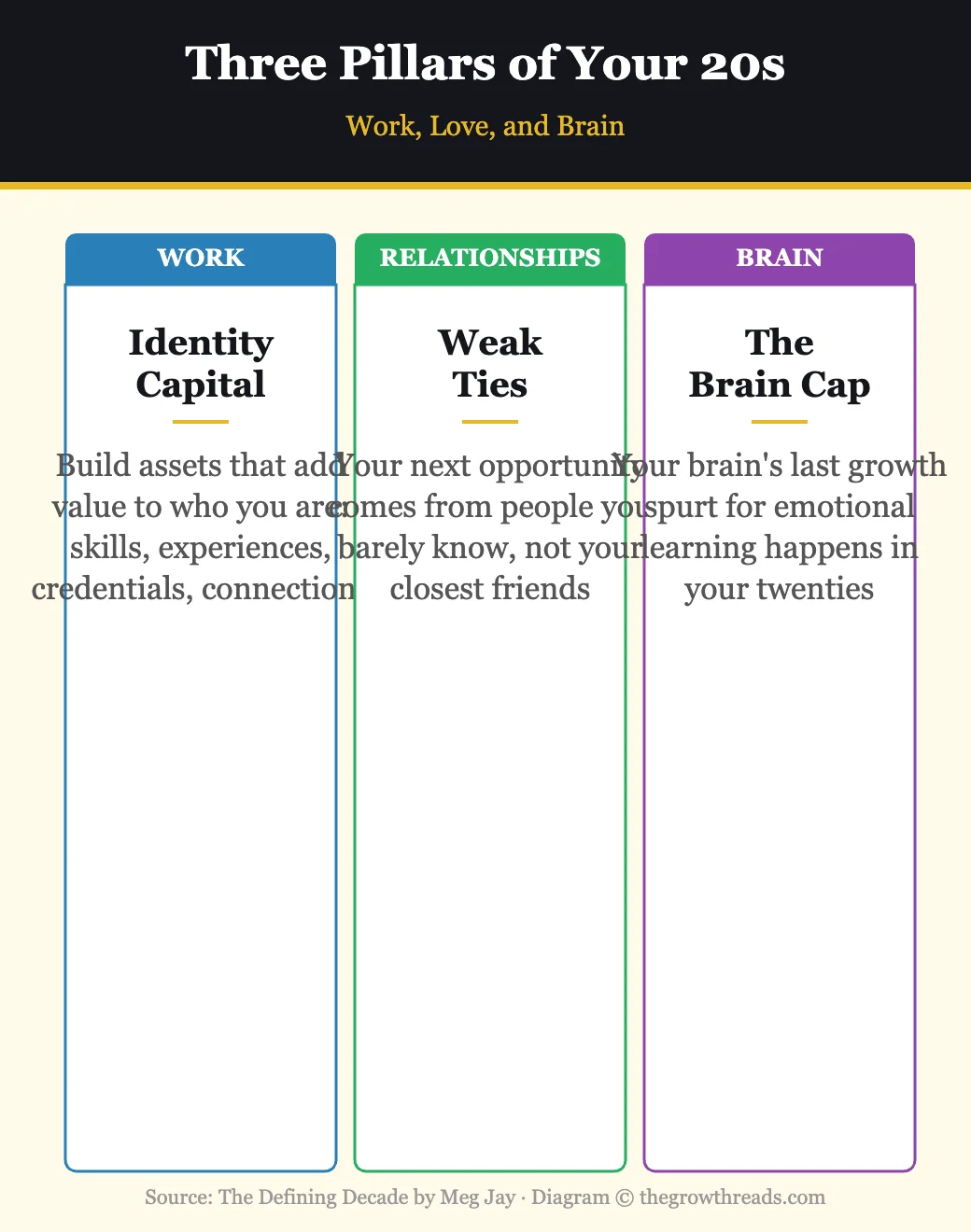
- Build identity capital: Invest in experiences, skills, credentials, and relationships that add value to who you are. These are the “currency” you use to trade for the life you want.
- Weak ties matter more than strong ties: Your next job, partner, or opportunity will almost certainly come through someone you know loosely, not your closest friends. Expand your network beyond your urban tribe.
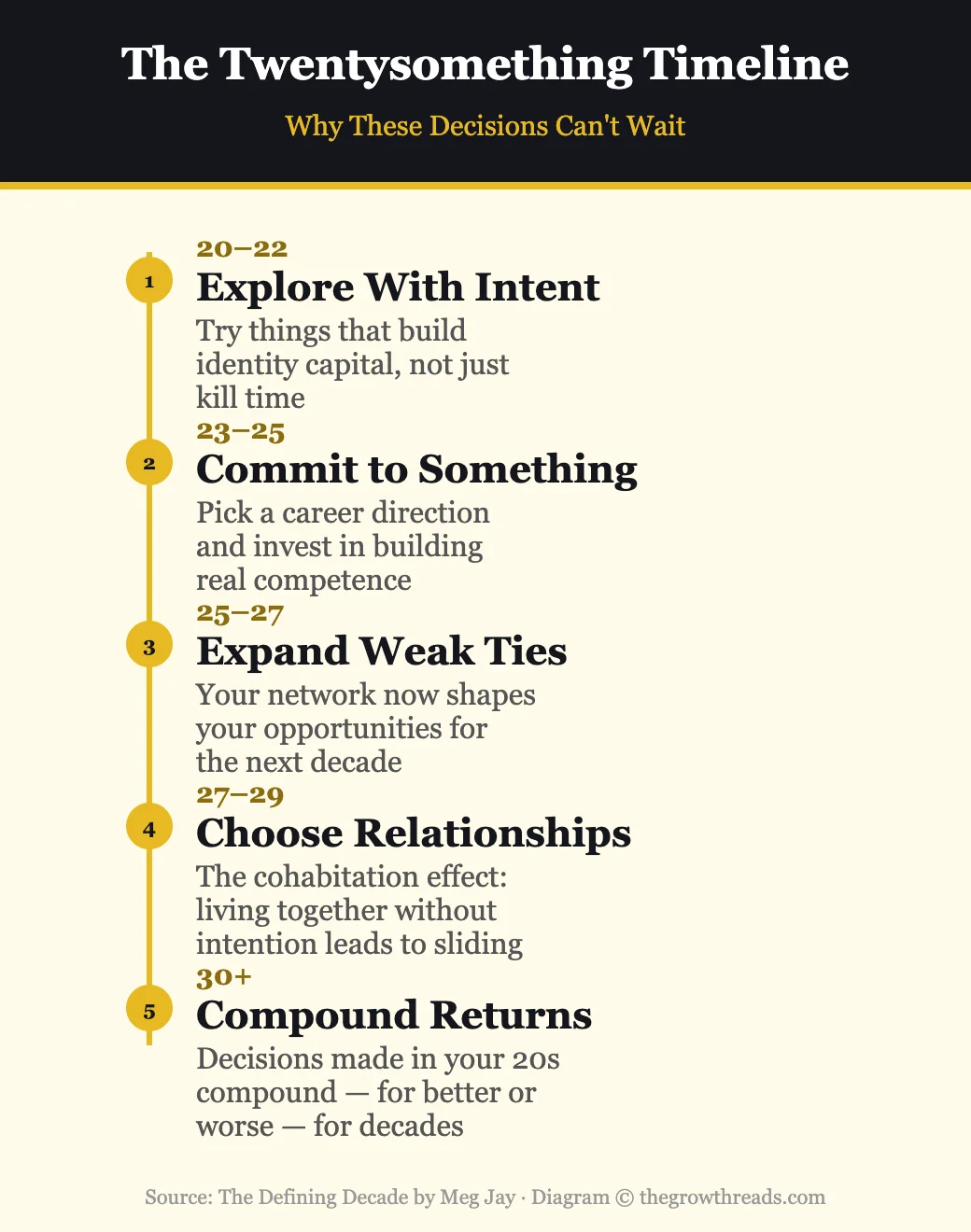
- Explore with intent, not aimlessly: Exploration is valuable only when it builds toward something. Taking random jobs and traveling without purpose is not self-discovery — it is avoidance.
- The cohabitation effect is real: Couples who move in together for convenience (sliding, not deciding) are more likely to stay in mediocre relationships and have higher divorce rates than those who commit intentionally.
- Your brain is still developing: The frontal lobe — responsible for planning, judgment, and emotional regulation — undergoes its final growth spurt in your twenties. How you use your brain now literally wires it for life.
- Stop thinking about what you want to be and start thinking about what you want to do: Identity is built through action, not introspection. You discover who you are by doing things, not by thinking about doing things.
- Claim your twenties: The best time to work on your career, relationships, and personal development is now — not after some imaginary threshold of readiness. Start before you feel ready.
- The Ben Franklin effect works: Asking for help — from mentors, weak ties, and professionals — is not a sign of weakness but a strategy. People like you more when they help you.
- Every person has an unthought known: You already know things about yourself, your desires, and your fears that you have not yet allowed yourself to think about consciously. Therapy, journaling, or honest conversation can surface them.
What is The Defining Decade about?
The Defining Decade is a psychology and personal development book by clinical psychologist Meg Jay that argues your twenties are the most important decade of adulthood. Drawing on clinical case studies and developmental research, Jay demonstrates that the choices twentysomethings make about work, relationships, and identity have disproportionate impact on the rest of their lives, and provides a framework for making the most of this critical period.
About the author
Meg Jay is a clinical psychologist and professor at the University of Virginia who specializes in adult development, with a particular focus on twentysomethings. She earned her doctorate in clinical psychology and gender studies from the University of California, Berkeley, and completed a postdoctoral fellowship at UC Berkeley and UCSF. Her private practice in Charlottesville, Virginia gave her years of firsthand experience counseling young adults who felt stuck, confused, or directionless. Her TED talk “Why 30 is not the new 20” has been viewed over 20 million times and translated into 40 languages. The Defining Decade, published in 2012 and revised in 2021, became a New York Times bestseller and has been widely adopted in university counseling centers and young adult programs worldwide. Explore all Meg Jay book summaries →
Key concepts at a glance
| Concept | What it means | Use it when |
|---|---|---|
| Identity capital | Assets — skills, degrees, experiences, networks — that add value to who you are | You feel like you haven’t built anything tangible in your twenties |
| Weak ties | Acquaintances and loose connections who bridge you to opportunities your close friends cannot | You’re job searching only through best friends and family |
| The cohabitation effect | Moving in together out of convenience often locks people into mediocre relationships | You’re about to move in with a partner without discussing long-term intentions |
| Unthought known | Things you know about yourself but haven’t consciously acknowledged | You feel vaguely dissatisfied but can’t articulate why |
| Frontal lobe development | Your brain’s planning and judgment center undergoes its last growth spurt in your twenties | You assume your brain is “done developing” after adolescence |
| The urban tribe | Your close circle of twentysomething friends who feel like family but can’t provide what you actually need | Your entire social life revolves around the same small group |
| Intentional choosing | Making active decisions about career, partner, and lifestyle rather than passively sliding into them | You realize you’ve been defaulting rather than deciding |
| The customized life | Designing your life based on your own values rather than following a prescribed or reactive path | You want clarity on what your twenties should look like for you specifically |
Part 1: Work — building identity capital
Jay opens with the story of a client she calls Emma, a twentysomething working as a barista and nanny despite having a college degree, who tells herself she is “just figuring things out.” Jay’s diagnosis is direct: Emma is not figuring things out — she is hiding from the anxiety of commitment behind a veneer of exploration. Jay argues that exploration without intention is not self-discovery but avoidance, and that the twenties are the critical period for building what she calls identity capital.
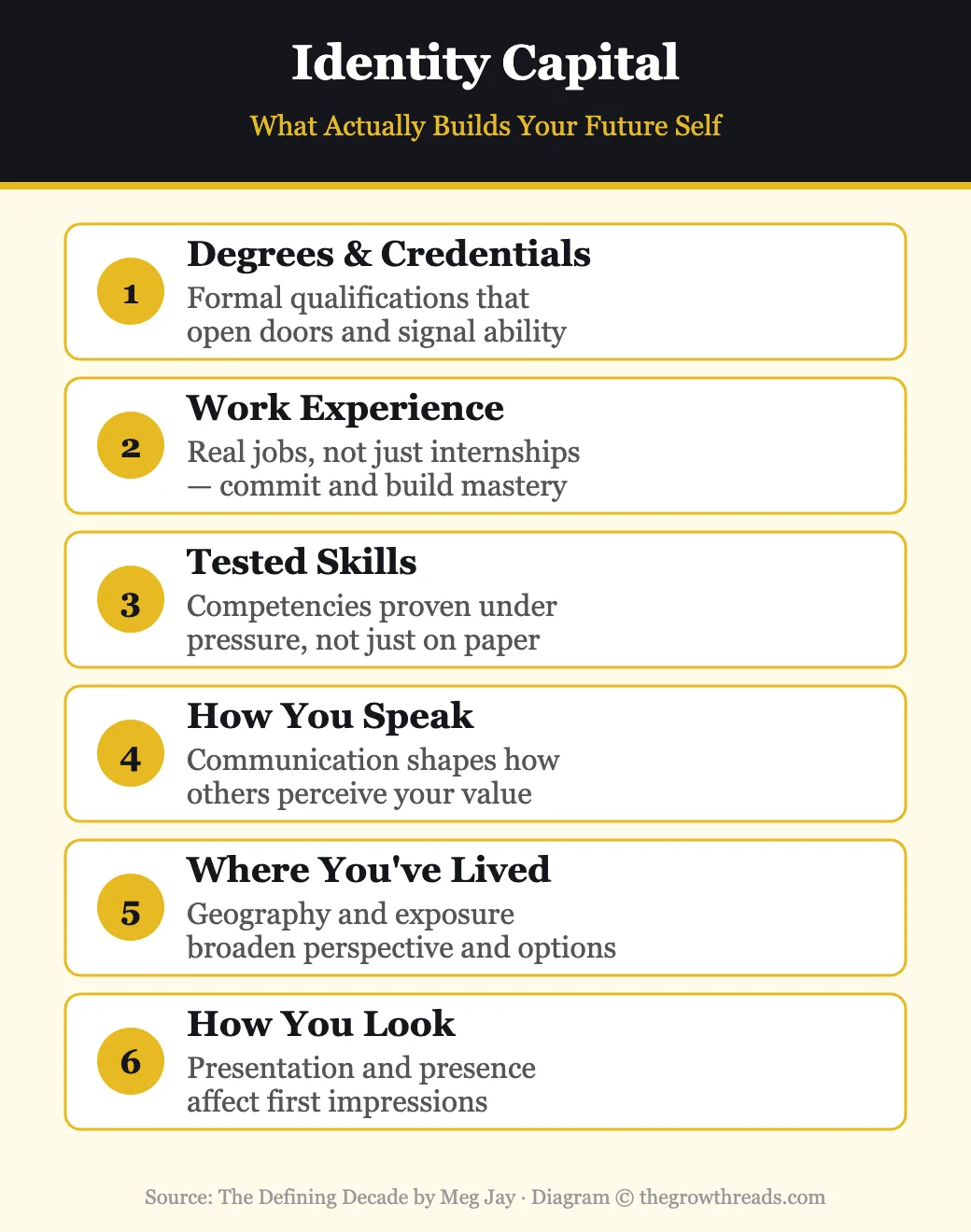
Identity capital encompasses everything that adds value to who you are: degrees, work experience, tested skills, how you present yourself, where you’ve lived, and the competencies you’ve developed under pressure. These are the assets you trade on when you want to change your life — when you apply for a job, ask for a raise, pursue a relationship, or start a business. Twentysomethings who spend their decade building identity capital have dramatically more options at thirty than those who spent the same years “keeping their options open” by avoiding commitment.
The most counterintuitive finding involves weak ties — the sociological concept introduced by Mark Granovetter. Jay shows that your next important opportunity (job, introduction, idea) will almost certainly come not from your closest friends (strong ties) but from acquaintances, former colleagues, friends of friends, or people you’ve met once (weak ties). The reason is that your close friends know the same people and information you do, while weak ties bridge you to entirely different networks and opportunities. Yet twentysomethings tend to cocoon inside their “urban tribe” of close friends, limiting their exposure to exactly the kind of connections that would advance their careers and relationships.
Part 2: Love — choosing relationships intentionally
The relationship section is where Jay is most provocative. She challenges the common twentysomething practice of “dating around” indefinitely and then panicking about partnership at thirty. Her clinical experience reveals a pattern she calls the “cohabitation effect”: couples who move in together for convenience — to save on rent, because a lease expired, because it just happened — are statistically more likely to stay in mediocre relationships and have higher divorce rates than couples who move in together after a clear commitment decision.
The mechanism Jay identifies is called “lock-in.” When you share an apartment, furniture, a pet, mutual friends, and financial obligations, the cost of leaving the relationship increases dramatically even if the relationship is not right. Couples slide from cohabitation to engagement to marriage not because they actively choose each other but because leaving becomes logistically and emotionally too expensive. Jay doesn’t argue against cohabitation — she argues against uncommitted cohabitation, where neither partner has clearly stated their intentions about the future.
Jay also addresses the “picking a partner” question with surprising directness. She argues that twentysomethings should be far more intentional about their romantic choices, treating partner selection as one of the most important decisions of their lives rather than something that should “just happen.” She encourages clients to think about compatibility across multiple dimensions — values, lifestyle goals, conflict styles, family expectations — rather than relying primarily on chemistry and attraction, which are poor predictors of long-term satisfaction.
Part 3: The brain and the body — neuroscience of the twenties
The final section grounds Jay’s argument in neuroscience. She explains that the human brain undergoes its second and final critical period of development in the twenties, particularly in the frontal lobe — the region responsible for planning, reasoning, impulse control, and emotional regulation. This means the experiences you have in your twenties literally shape the neural architecture you carry for the rest of your life.
Jay describes this as a “use it or lose it” window. Neural pathways that are repeatedly activated during the twenties become more efficient and permanent, while pathways that are not used are pruned away. A twentysomething who spends the decade building professional skills, navigating complex relationships, and managing emotional challenges is literally building a more capable brain than one who avoids challenge, stays in comfortable routines, and postpones difficult decisions.
She also addresses the biological clock directly and unapologetically, presenting fertility data showing that reproductive capacity begins declining in the late twenties and drops significantly after thirty-five. Jay argues that twentysomethings deserve to know this information so they can make informed choices about if and when to have children, rather than being blindsided at thirty-five by a biological reality that their culture told them not to worry about.
The book closes with a call to action that is both compassionate and urgent: your twenties are happening right now, and the decisions you make during them will compound for decades. The good news is that you still have time — but only if you start claiming that time today rather than waiting for some mythical moment of readiness that never arrives.
Who is The Defining Decade best for — and who should read something else first?
The Defining Decade is essential reading for anyone in their twenties who feels stuck, directionless, or overwhelmed by the pressure to “figure it all out.” It is equally valuable for parents, mentors, therapists, and managers who work with twentysomethings and want to understand what this generation is facing developmentally. Jay writes with empathy but refuses to coddle — her tone is that of a therapist who cares enough to be honest rather than merely supportive.
If your primary challenge is career direction rather than general life direction, start with our So Good They Can’t Ignore You summary by Cal Newport. If you’re past your twenties and wondering how to apply these principles later in life, our Four Thousand Weeks summary by Oliver Burkeman addresses the same urgency of finite time from a broader age perspective. And if you want the habit systems to actually implement the changes Jay recommends, our Atomic Habits summary by James Clear provides the behavioral framework.
Questions to reflect on
- If you assessed your twenties so far (or looking back on them), how much identity capital did you build versus how much time did you spend “keeping options open”?
- When was the last time an opportunity came to you through a weak tie — someone you barely knew — rather than a close friend? Are you investing in those connections?
- If you’re in a relationship, did you actively choose your partner and discuss your future together, or did you slide into the arrangement through convenience and inertia?
- What is your “unthought known” — the thing you already know about what you want but haven’t allowed yourself to acknowledge or act on?
- If your brain is still being wired by how you use it, what kind of brain are your current daily habits building?
🔥 Ready to claim your twenties?
The best time to start was yesterday. The second best time is right now.
How to apply The Defining Decade (7-day plan)
- Day 1 — Audit your identity capital: List every asset you currently have — degrees, skills, work experiences, certifications, languages, networks, and accomplishments. Then identify the three biggest gaps between where you are and where you want to be.
- Day 2 — Reactivate a weak tie: Reach out to one person you haven’t spoken to in months — a former colleague, classmate, or acquaintance. Send a genuine message reconnecting and asking what they’re working on. This is how opportunities find you.
- Day 3 — Name your unthought known: Sit quietly for 15 minutes and write honestly: “What do I already know about what I want but haven’t admitted to myself?” The answer might surprise you. Don’t judge it — just write it down.
- Day 4 — Make one commitment: Choose one area of your life — career, relationship, health, skill development — where you’ve been keeping options open instead of committing. Make a specific, time-bound commitment today. Tell someone about it.
- Day 5 — Evaluate your relationships: Write down the five people you spend the most time with. Ask: are these strong ties (who reinforce my current path) or weak ties (who expose me to new possibilities)? Make a plan to expand beyond your urban tribe.
- Day 6 — Invest in your brain: Choose one challenging activity that pushes your frontal lobe development — learn a complex skill, have a difficult conversation you’ve been avoiding, or take on a responsibility that requires planning and emotional regulation.
- Day 7 — Write a letter to your 35-year-old self: Describe the life you want at 35 — career, relationships, health, daily routine. Then work backward: what needs to happen in the next 1–3 years to make that life possible? Create a timeline and one concrete next step.
Frequently asked questions
Is The Defining Decade only for people in their twenties?
While the book is written primarily for twentysomethings, it is equally valuable for anyone who mentors, parents, manages, or therapizes people in this age group. Many readers in their thirties and forties report that the book helped them understand decisions they made (or didn’t make) in their twenties, and gave them language for guiding younger people. The underlying principles — building identity capital, leveraging weak ties, committing intentionally — apply across ages, even if the neuroplasticity window is most open in the twenties.
Does Meg Jay argue against exploring in your twenties?
No — she argues against aimless exploration that builds nothing. Jay distinguishes between exploration with intention (trying different jobs that build transferable skills, traveling with a purpose, testing career hypotheses) and exploration as avoidance (drifting between unrelated jobs, traveling to escape decision-making, using “I’m still figuring things out” as a shield against commitment). The former builds identity capital; the latter consumes your most valuable developmental years.
What is the cohabitation effect?
The cohabitation effect describes the finding that couples who move in together before a clear mutual commitment (engagement or an explicit discussion about marriage) have higher rates of relationship dissatisfaction and divorce than couples who cohabit after making a deliberate decision about their future together. The mechanism is “lock-in”: shared leases, furniture, pets, and social circles make it expensive to leave, so couples slide into marriage by default rather than choosing it actively. Jay doesn’t oppose cohabitation — she opposes uncommitted cohabitation.
What is identity capital?
Identity capital is Meg Jay’s term for the collection of personal assets that define who you are and what you can offer. It includes tangible assets (degrees, certifications, work experience, savings) and intangible ones (skills tested under pressure, communication ability, emotional intelligence, professional reputation). These assets function as currency: the more identity capital you accumulate in your twenties, the more options and leverage you have when making major life decisions in your thirties and beyond.
Is the brain science in The Defining Decade accurate?
Yes. Jay draws on well-established neuroscience showing that the frontal lobe (prefrontal cortex) continues developing into the mid-twenties, with some research suggesting it doesn’t fully mature until around age 25–30. This region controls executive functions like planning, impulse control, risk assessment, and emotional regulation. The concept of neural pruning — where unused pathways are eliminated and frequently used ones are strengthened — is a core principle of developmental neuroscience that has been validated across decades of research.
How is The Defining Decade different from other self-help books?
Unlike most self-help books that apply broadly across ages, The Defining Decade makes a specific developmental argument: your twenties are uniquely important because of neurological, social, and statistical realities that don’t apply to other decades. Jay writes as a clinician, not a motivational speaker — her case studies come from real therapy sessions, and her recommendations are grounded in developmental psychology research. The tone is urgent but compassionate, more like a wise therapist than a cheerleader.
Is The Defining Decade still relevant in 2026?
More relevant than ever. The trends Jay identified — delayed adulthood, extended exploration, cohabitation without commitment, career indecision — have only intensified since the book’s original publication in 2012. The 2021 revised edition updates the research and addresses new challenges like social media comparison, remote work, and the post-pandemic economy. In a world that increasingly tells twentysomethings they have unlimited time, Jay’s counterargument that time is finite and the twenties are structurally irreplaceable remains essential.
Related summaries
If The Defining Decade motivated you to take your twenties (or your remaining years) more seriously, these summaries explore complementary ideas:
- So Good They Can’t Ignore You by Cal Newport — the career capital framework that aligns with Jay’s identity capital concept.
- Four Thousand Weeks by Oliver Burkeman — the broader philosophical case for taking time seriously, regardless of your age.
- Atomic Habits by James Clear — the behavioral systems to actually implement the changes Jay recommends.
- Mindset by Carol Dweck — how growth beliefs shape what your developing brain is willing to attempt.