

⭐⭐⭐⭐ 4.0/5 — The science of circadian rhythms translated into an actionable daily health protocol.
Best for: Anyone who wants to optimize energy, sleep, and metabolism by aligning daily habits with their body clock.
Reading time: ~7 hrs
Difficulty to apply: Low to moderate — the eating window is the biggest adjustment; most other changes are simple timing shifts.
The Circadian Code in one minute
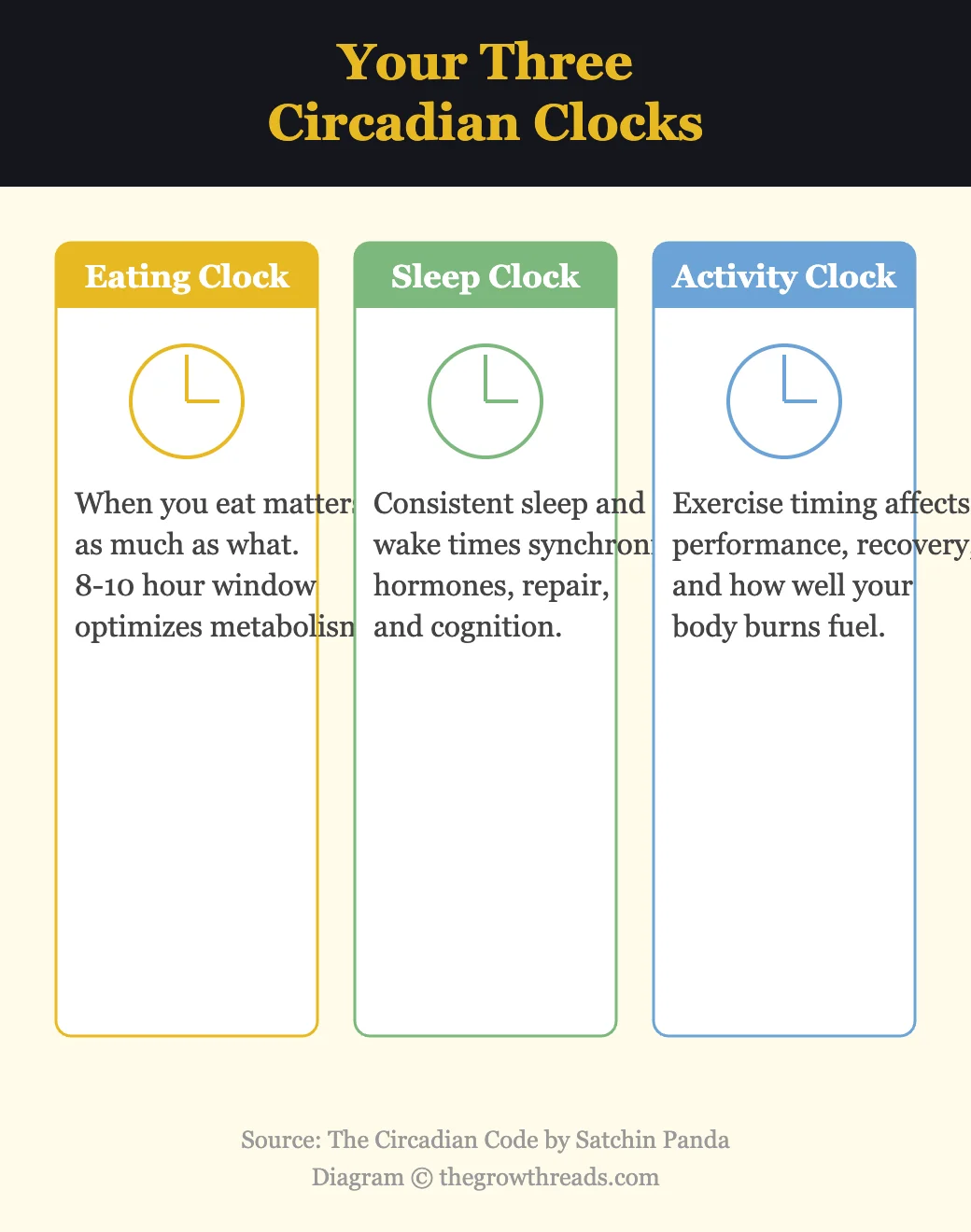
Your body has an internal clock that governs everything — and most of us are living out of sync with it. Dr. Satchin Panda, a leading circadian rhythm researcher at the Salk Institute, presents decades of research showing that when you eat, sleep, exercise, and expose yourself to light matters as much as what you eat or how much you exercise. The book introduces three circadian clocks — eating, sleeping, and activity — and shows how misaligning them with your biology leads to weight gain, poor sleep, chronic disease, and cognitive decline. The practical solution is elegant: confine eating to an 8–10 hour window, maintain consistent sleep and wake times, get morning sunlight, and dim lights at night. Panda’s own lab research on time-restricted eating (TRE) in mice showed that animals eating the same calories in a restricted window gained 28% less weight and had dramatically better metabolic markers than animals eating around the clock.
Key takeaways
- You have a master clock and billions of peripheral clocks: The suprachiasmatic nucleus (SCN) in your brain is the master clock, synchronized by light. But every organ — liver, gut, heart, muscles — has its own clock that needs to be aligned through consistent eating, sleeping, and activity patterns.
- Time-restricted eating works even without dieting: Confining all eating to an 8–10 hour window gives your body 14–16 hours to repair, detoxify, and burn stored fat. In lab studies, this produced weight loss, reduced inflammation, and improved metabolic health — without changing what or how much was eaten.
- Late-night eating is the worst habit: Eating close to bedtime disrupts sleep quality, impairs digestion, and forces your liver and gut to work when they should be in maintenance mode. The gut lining, which repairs itself during overnight fasting, cannot heal when food is present.
- Morning light is the most powerful reset: Exposure to bright light within the first hour of waking synchronizes your master clock, suppresses melatonin, and initiates the cortisol awakening response. This single habit improves alertness, mood, and sleep quality more than any supplement.
- Blue light at night disrupts the entire system: Screens, LED lights, and bright indoor lighting after sunset suppress melatonin production by up to 50%, delaying sleep onset and reducing sleep quality even when you eventually fall asleep.
- Exercise timing affects outcomes: Morning exercise tends to support weight loss and circadian alignment. Afternoon exercise (2–5 PM) produces peak strength and coordination. Late-night intense exercise can delay sleep onset.
- Consistency matters more than duration: A consistent 7-hour sleep schedule produces better health outcomes than an inconsistent 8-hour schedule. Your body clock thrives on predictability — variable timing creates chronic jet lag.
- Shift work is a health hazard: Panda presents data showing shift workers have significantly higher rates of obesity, diabetes, heart disease, and cancer. For those who must work shifts, he provides specific protocols to minimize the damage.
- Your gut microbiome has a clock too: The beneficial bacteria in your gut follow circadian patterns. Disrupting these patterns through irregular eating times changes the composition of your microbiome in ways that promote inflammation and metabolic dysfunction.
- Children and teenagers have different clocks: Adolescent circadian rhythms shift later — teens are biologically programmed to sleep later and wake later. Early school start times work against their biology and impair learning.

What is The Circadian Code about?
The Circadian Code explains how circadian rhythms — the biological clocks in every cell of your body — govern metabolism, sleep, immunity, and cognition. Dr. Satchin Panda translates his research at the Salk Institute into a practical protocol: time-restricted eating, consistent sleep schedules, strategic light exposure, and optimally timed exercise.
About the author
Dr. Satchin Panda is a professor at the Salk Institute for Biological Studies and one of the world’s leading researchers on circadian rhythms. His lab discovered that cells in the retina send light signals to the brain’s master clock — a finding that changed the field’s understanding of how light exposure governs health. His research on time-restricted eating has been published in Cell Metabolism, Science, and other top journals, and has been featured in the New York Times, BBC, and NPR. He also created the myCircadianClock app, which has gathered data from tens of thousands of users to study real-world eating and sleep patterns.
Key concepts at a glance
| Concept | What it means | Use it when |
|---|---|---|
| Time-restricted eating (TRE) | Confine all eating to an 8–10 hour daily window | You want to lose weight or improve metabolic health without strict dieting |
| The master clock (SCN) | The brain’s light-sensitive clock that synchronizes all other body clocks | You want to understand why morning light and evening darkness matter so much |
| Peripheral clocks | Individual clocks in organs like the liver, gut, and heart | You want to understand why meal timing affects digestion and metabolism |
| Melatonin suppression | Blue and bright light at night reduces sleep-promoting melatonin | You struggle with falling asleep or feel wired at bedtime |
| Cortisol awakening response | Morning cortisol spike triggered by light that drives alertness | You feel groggy in the morning and rely on caffeine to wake up |
| Social jet lag | The difference between your weekday and weekend sleep schedules | You sleep in on weekends and feel off on Monday mornings |
| Gut clock | Microbiome activity follows circadian patterns affected by meal timing | You have digestive issues, bloating, or irregular gut health |
Part 1: The science of your internal clocks
Panda opens with a revelation that most readers will not expect: your body does not have one clock — it has trillions. Every cell in your body contains clock genes that cycle roughly every 24 hours, governing when that cell should be active, when it should repair itself, and when it should rest. The suprachiasmatic nucleus (SCN), a tiny cluster of neurons behind your eyes, serves as the master conductor — synchronized by light exposure through specialized retinal cells that Panda’s own lab discovered.
But the master clock is only as effective as its connection to the peripheral clocks in your organs. Your liver has its own clock that determines when it is best at processing nutrients and detoxifying. Your gut has a clock that governs digestion and microbiome activity. Your heart, muscles, and immune system all run on their own circadian schedules. When these clocks are aligned — when you eat during the day, sleep at night, and get light exposure at the right times — the system works beautifully. When they are misaligned — by late-night eating, irregular sleep, or constant artificial light — the result is metabolic chaos.
Panda presents data from his lab showing that mice fed a high-fat diet within an 8-hour window stayed lean, while mice eating the same diet around the clock became obese and developed metabolic syndrome. The only difference was timing. This finding, replicated across multiple studies, is the foundation of the entire book: when you eat is a health variable as powerful as what you eat.
Part 2: The eating code
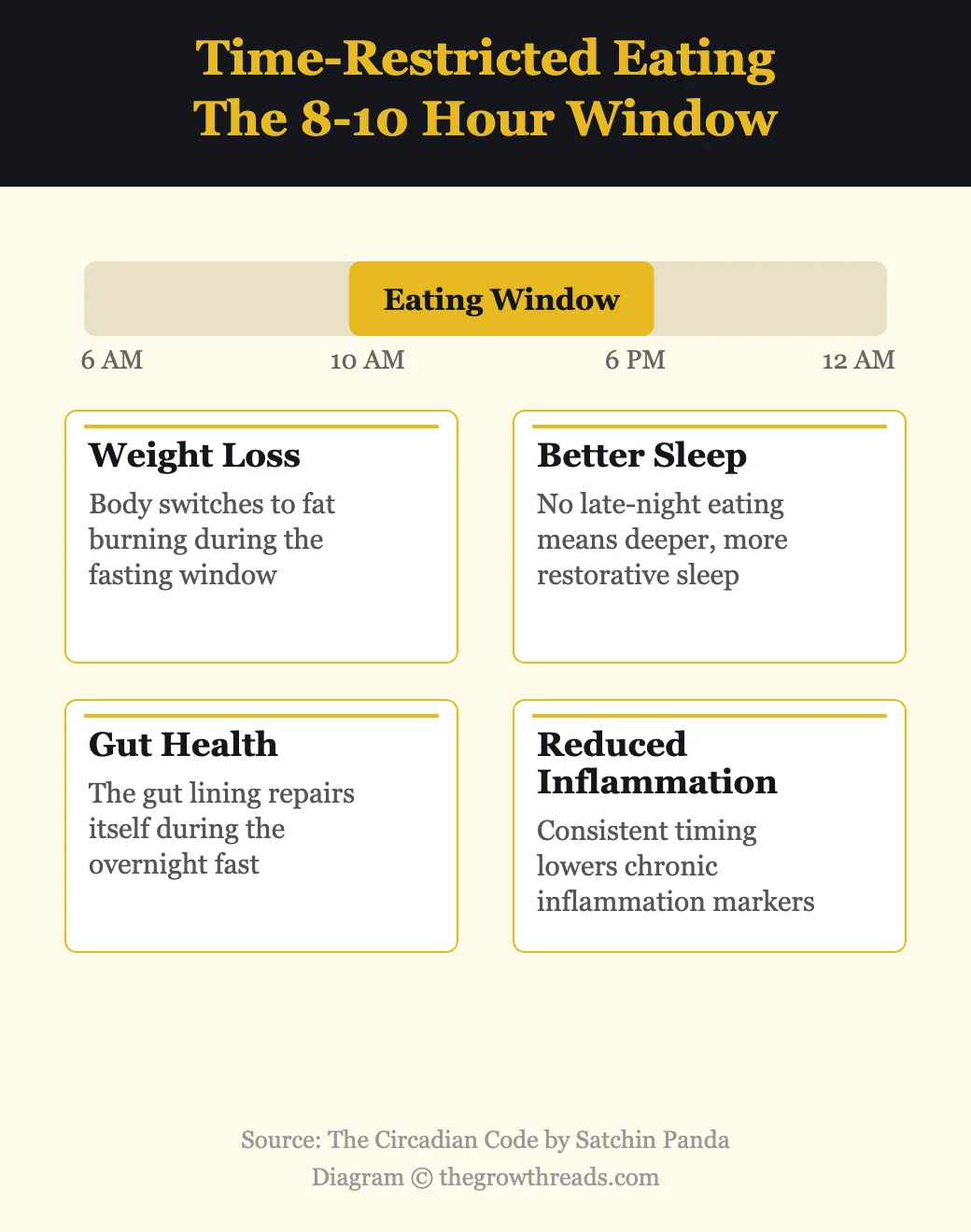
The practical centerpiece of the book is time-restricted eating (TRE). Panda walks through the evidence that confining all caloric intake — including snacks, caloric beverages, and supplements — to an 8–10 hour window provides dramatic health benefits. His lab’s research shows that TRE improves insulin sensitivity, reduces inflammation, lowers cholesterol, promotes fat loss, and even appears to protect against cancer in animal models.
The mechanism is straightforward: during the eating window, your digestive system, liver, and pancreas are in “processing mode” — actively breaking down food, storing nutrients, and managing blood sugar. During the fasting window, these organs switch to “maintenance mode” — repairing damaged cells, clearing metabolic waste, and burning stored fat. When you eat around the clock — the typical pattern of modern life, where most people eat for 15+ hours per day — your body never gets a chance to complete these essential maintenance cycles.
Panda provides specific guidelines: start counting from your first caloric intake (including coffee with cream or sugar), aim for an 8–10 hour window (beginners can start at 12 hours and gradually narrow), and close the window at least 3 hours before bedtime. He emphasizes that this is not a diet in the conventional sense — you do not need to restrict what you eat or count calories. The timing adjustment alone produces measurable improvements in most people within two to four weeks.
Part 3: The sleep and activity codes
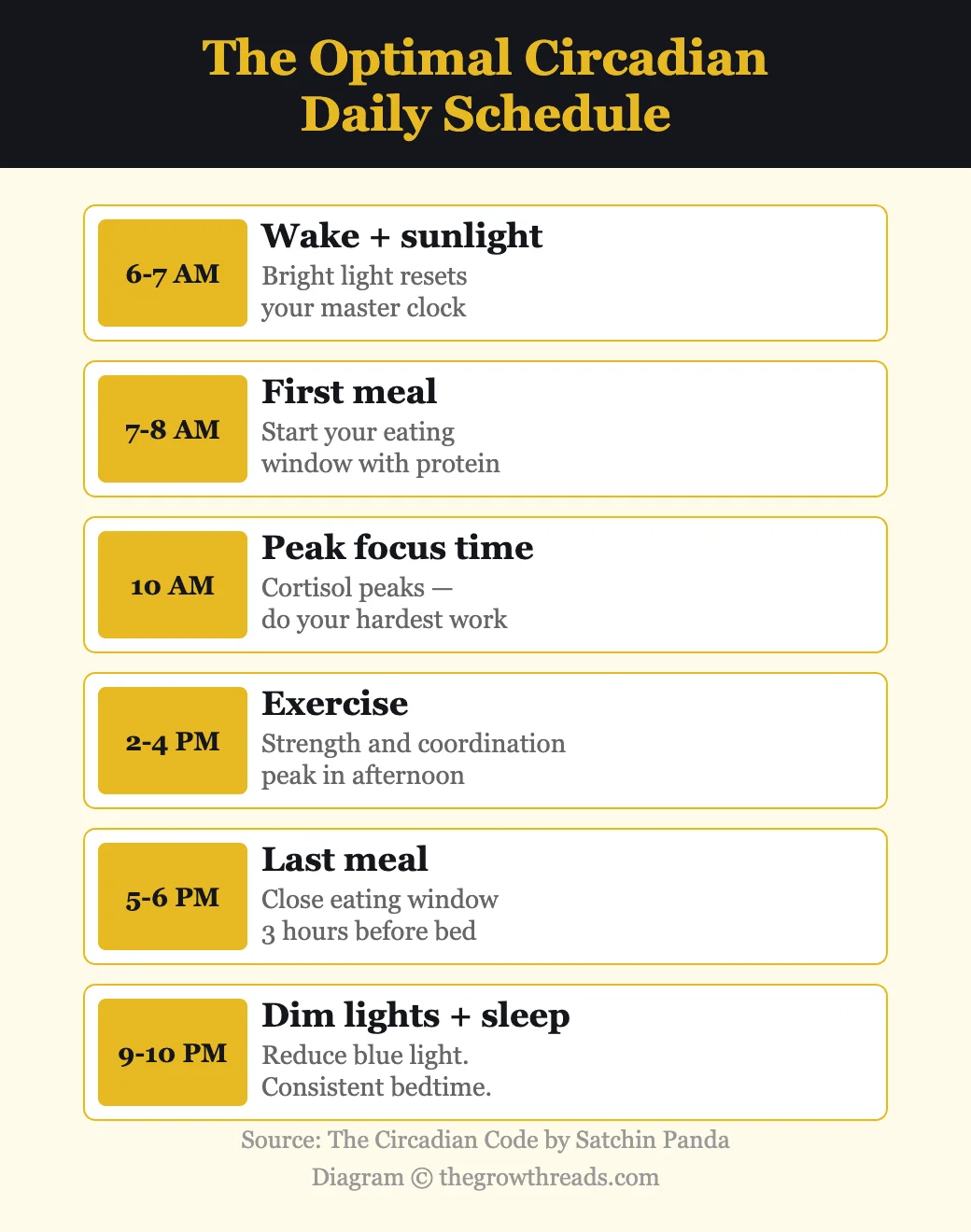
Beyond eating, Panda tackles the two other major circadian inputs: light/sleep and physical activity. On sleep, his advice is specific and research-backed. The most important intervention is consistency — going to bed and waking up at the same time every day, including weekends. “Social jet lag” — the gap between weekday and weekend sleep schedules — is a major source of circadian disruption that most people do not even recognize as a problem.
Light exposure is the second critical factor. Panda recommends getting bright light (ideally sunlight) within 30–60 minutes of waking to trigger the cortisol awakening response, which drives alertness and starts the internal countdown to melatonin release roughly 14–16 hours later. In the evening, reducing light exposure — especially blue-rich light from screens — allows melatonin to rise naturally. Panda notes that even dim light exposure at night can suppress melatonin by 50%, which explains why so many people struggle with sleep onset despite feeling tired.
On exercise, Panda presents data showing that exercise timing affects outcomes in ways most people do not consider. Morning exercise tends to support weight loss and reinforce circadian rhythms. Afternoon exercise (roughly 2–5 PM) produces peak physical performance — strength, reaction time, and coordination are all highest at this time. Late-evening intense exercise can delay sleep onset by raising core body temperature at a time when the body is trying to cool down for sleep. The practical takeaway is not that there is one “best” time to exercise but that awareness of timing can help you match your workout goals to your biological rhythms.
Who is The Circadian Code best for — and who should read something else first?
Best for: Anyone who struggles with energy, sleep quality, or weight management and wants a science-backed approach that does not require dramatic dietary changes. People who eat late at night, have irregular schedules, or spend most of their time under artificial light will see the biggest improvements. Health professionals who want to understand the emerging science of chrononutrition and circadian medicine.
Read something else first if: You want a comprehensive sleep book — start with Why We Sleep. If you want nutrition science focused on what to eat rather than when, try How Not to Die. And if you want a more general health optimization framework, Outlive by Peter Attia covers a broader range of longevity strategies.
Questions to reflect on
- What is my actual eating window right now — from first caloric intake to last? Is it closer to 8 hours or 15 hours?
- Do I get bright light exposure within the first hour of waking, or do I start most mornings in dim indoor light?
- How consistent is my sleep schedule across the week? What is my “social jet lag” between weekdays and weekends?
- Am I using bright screens within an hour of bedtime, and how might that be affecting my melatonin production and sleep quality?
- If I were to close my eating window 3 hours before bedtime, what time would my last meal need to be — and what would I need to change to make that work?
🔥 Ready to align your habits with your biology?
Discover how the timing of eating, sleeping, and light exposure transforms your health.
How to apply The Circadian Code (7-day plan)
- Day 1 — Track your current eating window: Write down the exact time of your first and last caloric intake today (including coffee with cream, snacks, and drinks). Most people discover their window is 12–15 hours. Awareness comes first.
- Day 2 — Get morning sunlight: Within 30 minutes of waking, step outside for at least 10 minutes of natural light (even on a cloudy day). Notice how this affects your alertness compared to going straight to a screen indoors.
- Day 3 — Close the kitchen 3 hours before bed: If you go to bed at 10 PM, stop all eating by 7 PM. Use herbal tea (non-caloric) if you feel hungry. Notice how your sleep quality changes.
- Day 4 — Narrow your eating window to 12 hours: If you currently eat from 7 AM to 10 PM, shift to 7 AM to 7 PM. This is the gentlest starting point — no meal skipping, just boundary setting.
- Day 5 — Dim the lights after sunset: At sunset or 8 PM (whichever comes first), switch to dim, warm lighting. Use night mode on all screens. Notice how drowsiness arrives earlier and more naturally.
- Day 6 — Set a consistent sleep schedule: Choose a bedtime and wake time you can maintain 7 days a week — including weekends. Set an alarm for both. Aim for less than 30 minutes of variation.
- Day 7 — Narrow to 10 hours: Shift your eating window from 12 hours to 10 hours (e.g., 8 AM to 6 PM). After one week with the basics in place, this adjustment feels natural. Maintain for two weeks and track how you feel.
Frequently asked questions
Is The Circadian Code the same as intermittent fasting?
Time-restricted eating (TRE) is a form of intermittent fasting, but with an important distinction: the focus is on aligning your eating window with your circadian rhythm, not on calorie restriction. Traditional IF protocols (like 16:8) focus on the fasting duration. TRE focuses on when the window falls relative to daylight and your sleep schedule. Panda’s research shows that an 8-hour eating window during the day produces better metabolic results than the same window shifted to evening hours.
Does black coffee break the eating window?
This is one of the most common questions. Panda is clear: any caloric intake starts the clock, including coffee with cream or sugar. However, he notes that plain black coffee (no calories) is a gray area — caffeine does affect circadian rhythms, but the absence of calories means it does not activate the gut’s digestive clock in the same way. If you drink black coffee before your eating window, be aware that it may still shift some circadian signals.
How long before I see results from time-restricted eating?
Most people notice improved sleep quality within the first week — especially if they close the eating window 3 hours before bedtime. Energy improvements typically appear in weeks two to three. Measurable changes in weight, blood sugar, and inflammation markers usually show up within four to six weeks. Panda recommends committing to at least four weeks before evaluating results, and starting with a 12-hour window before narrowing further.
Is time-restricted eating safe for everyone?
TRE is generally safe for healthy adults, but Panda recommends consulting a healthcare provider if you are pregnant, breastfeeding, diabetic, taking medications that must be taken with food at specific times, or have a history of eating disorders. Children and adolescents should not restrict their eating windows because their bodies need consistent fuel for growth and development. The book includes specific modifications for people with medical conditions.
What is the best eating window?
Panda’s research suggests that an eating window aligned with daylight hours produces the best metabolic results — roughly 8 AM to 6 PM, or 9 AM to 7 PM. Eating the majority of calories earlier in the day (front-loading) appears to have additional benefits for blood sugar regulation and weight management. The worst pattern is skipping breakfast and eating most calories at night, which misaligns the eating clock with the light-based master clock.
How does The Circadian Code relate to Why We Sleep?
The two books are highly complementary. Matthew Walker’s Why We Sleep focuses on what happens during sleep and why it matters. Panda’s Circadian Code focuses on how your daytime behaviors — especially eating timing and light exposure — determine the quality of that sleep. Walker tells you why sleep is essential; Panda tells you how to set up the conditions that make great sleep possible. Reading both gives you the complete picture.
What should I read after The Circadian Code?
For sleep science specifically, read Why We Sleep by Matthew Walker. For nutrition-focused health optimization, try How Not to Die by Michael Greger or Glucose Revolution by Jessie Inchauspé. For a broader longevity framework that includes exercise and metabolic health, read Outlive by Peter Attia. And for the habit-building skills needed to sustain these changes long-term, Atomic Habits by James Clear is the essential companion.
Related summaries
If The Circadian Code resonated with you, explore these related summaries:
- Why We Sleep — The science of sleep and why it is the foundation of all health
- How Not to Die — Evidence-based nutrition for disease prevention
- Outlive — Peter Attia’s comprehensive framework for extending healthspan
- Glucose Revolution — How to flatten your glucose curves for better energy