

★★★★★ 4.6/5 — A blunt, high-energy case for replacing long, fragile plans with short, honest cycles of work.
Best for: Team leads, product managers, and anyone whose projects keep slipping despite careful planning.
Reading time: ~5 hours to read the book, about 20 minutes to read this guide.
Difficulty to apply: Moderate — the mechanics are simple, but they only work if the whole team adopts the rhythm together.
Scrum in one minute
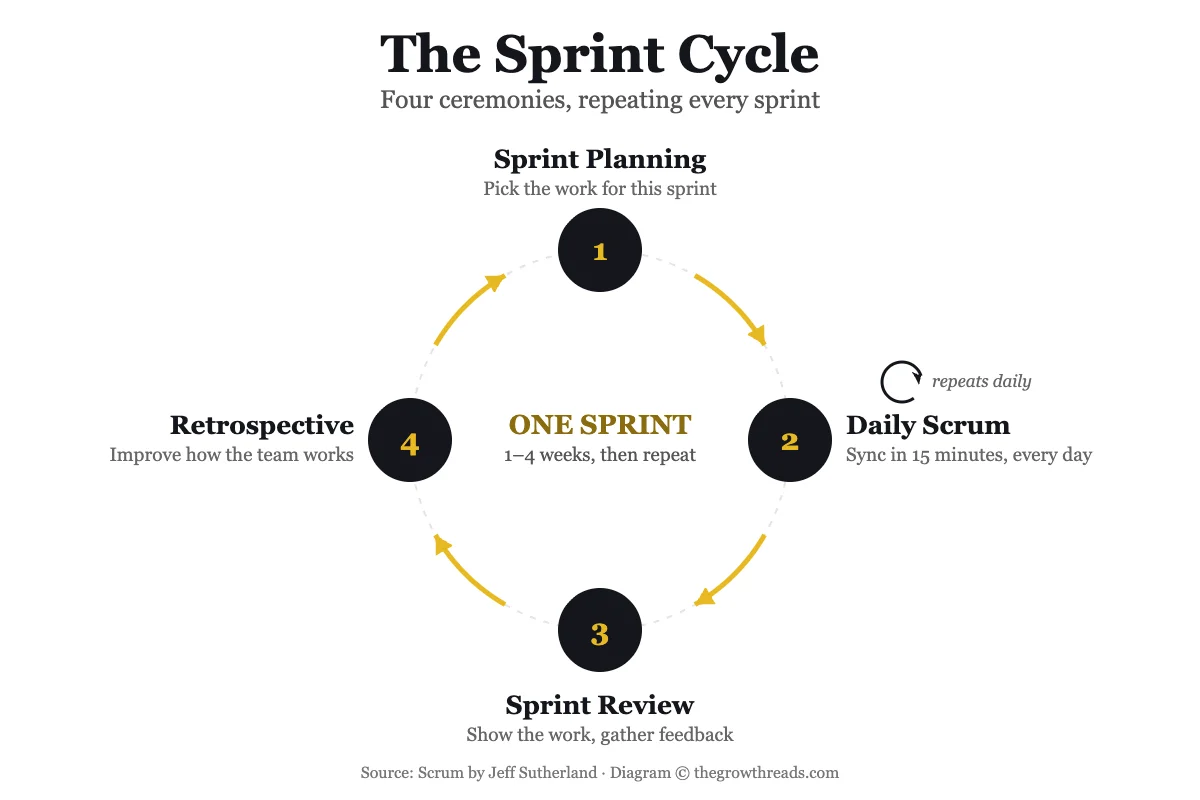
Most plans do not fail because people work badly — they fail because the plan itself was wrong the moment it was written. That is the core claim in Scrum: The Art of Doing Twice the Work in Half the Time, Jeff Sutherland’s account of the team-management framework he helped create in the early 1990s. Instead of mapping out a project months in advance and hoping reality cooperates, Scrum breaks work into short, fixed-length cycles called sprints, usually one to four weeks long. At the start of each sprint the team picks a small, achievable slice of work; every day they meet for fifteen minutes to say what they did, what they will do, and what is in their way; at the end of the sprint they show what they built and ask what to build next; and before starting over, they pause to ask how they could work better together. Repeat that loop enough times and, Sutherland argues, most teams stop drowning in status meetings and start actually shipping.
Sutherland traces Scrum’s roots to a 1986 Harvard Business Review article by Hirotaka Takeuchi and Ikujiro Nonaka, “The New New Product Development Game,” which described high-performing teams at companies like Honda and Canon moving work forward the way a rugby team advances the ball in a scrum — together, in tight formation, rather than passing a finished piece down a fixed assembly line from one specialist to the next. Sutherland, a former U.S. Air Force fighter pilot and West Point graduate who later moved into medicine and then software, combined that idea with Toyota’s lean production principles to build a framework he first used to rescue a struggling software project in 1993. The book is his case for taking that same discipline into any kind of team work, not just software — from marketing to manufacturing to government.
Key takeaways
- Plans are guesses: The further out a plan reaches, the less accurate it is — so build short cycles that let you correct course constantly instead of committing to a guess for months at a time.
- Work in sprints: A sprint is a fixed, short block of time (one to four weeks) in which a team commits to finishing a specific, small set of work — and then does exactly that, no more and no less.
- Ask three questions daily: The Daily Scrum is a 15-minute stand-up built around three questions: what did I do yesterday, what will I do today, and what is in my way.
- Name the blocker out loud: Obstacles that stay private stay unsolved — saying a blocker out loud in front of the team is the fastest way to get it removed.
- Multitasking has a real cost: Sutherland cites research suggesting that switching between tasks can waste a meaningful share of a person’s working time — the practical takeaway is to protect focused blocks for one piece of work at a time.
- A backlog beats a plan: Instead of a fixed project plan, keep one prioritized list of everything that could be built — the Product Backlog — and pull the top items into each sprint.
- Show, don’t report: At the Sprint Review, the team demonstrates working output instead of narrating progress in a status update — seeing something real invites sharper feedback than reading about it.
- Retrospect every cycle: The Sprint Retrospective is a standing appointment to ask what worked, what didn’t, and what the team will change next sprint — improvement becomes a habit, not an event.
- Velocity reveals the truth: Tracking how much a team actually finishes each sprint, rather than how much it promises, produces forecasts that get more honest over time.
- Happiness predicts performance: Sutherland argues that a team’s sense of autonomy, purpose, and connection is not a soft perk — it is one of the better predictors of whether the team will perform well.
What is Scrum about?
Scrum is Jeff Sutherland’s explanation of the team framework of the same name: a way of organizing work into short, repeatable cycles called sprints, with daily check-ins, a working demo at the end of each cycle, and a built-in habit of asking how to improve. The book argues this rhythm helps any team, not just software developers, ship better work faster by replacing long-range guessing with constant, honest course correction.
About the authors
Jeff Sutherland is one of the co-creators of the Scrum framework and a signatory of the Agile Manifesto. Before moving into technology, he served as a fighter pilot in the U.S. Air Force and graduated from West Point; he later earned a medical degree and worked in biometrics research before shifting into software development and management. He developed the early version of Scrum in 1993 while working to rescue a struggling software project, and has spent much of his career since teaching and refining the framework with organizations of many sizes. J.J. Sutherland, his son and co-author on this book, spent years as a correspondent and editor for NPR before joining Scrum Inc., the company his father founded to train teams in the framework; he brings a journalist’s eye for narrative and case studies to the book’s real-world examples.
Key concepts at a glance
| Concept | What it means | Use it when |
|---|---|---|
| Sprint | A fixed, short block of time (1–4 weeks) in which the team commits to finishing a defined slice of work | You need steady, predictable delivery instead of one long deadline |
| Product Backlog | A single prioritized list of everything that could be built or done, ranked by value | You want one source of truth for what matters most right now |
| Sprint Backlog | The specific slice of the Product Backlog the team has committed to finishing this sprint | You are starting a new sprint and need a clear, bounded target |
| Daily Scrum | A 15-minute daily check-in built around three questions: done, doing, blocked | Your team needs fast visibility into progress and obstacles |
| Sprint Review | A working demonstration of what the team built, held at the end of each sprint | You want real feedback instead of a status report |
| Sprint Retrospective | A recurring meeting to ask what worked, what didn’t, and what to change | Your team wants improvement to be routine, not accidental |
| Product Owner | The person who owns and prioritizes the backlog on behalf of stakeholders | Someone needs final say on what matters most |
| Scrum Master | The person who protects the team’s process and removes obstacles | Your team needs a coach, not another boss |
Part 1: Why Scrum exists
Sutherland opens with a familiar picture: a project plotted out on a detailed Gantt chart, every task sequenced months in advance, every dependency mapped — and then reality intrudes. Requirements change, a key assumption turns out to be wrong, a competitor ships first, and the beautiful plan becomes a liability, because everyone keeps working to a schedule that stopped being true weeks ago. This is what Sutherland calls “waterfall” thinking: work flows in one direction, from planning to execution to delivery, with no structured way to notice you were wrong until the very end. The book argues that the problem is not the discipline of planning itself — it is the assumption that a long-range plan can stay accurate simply because it was made carefully.
Scrum’s answer is to shrink the distance between planning and finding out you were wrong. Instead of one long plan, a team plans one short sprint at a time, learns from what happened, and re-plans the next sprint with better information. Sutherland calls this an “empirical” approach — inspect what actually happened, adapt the plan, repeat — borrowed loosely from the scientific method and from Toyota’s practice of stopping the production line the moment a defect appears rather than waiting until the end of the line to find it.
TGR Note: This distrust of long-range plans echoes David Rock’s argument in Your Brain at Work that the brain’s capacity for holding complex, uncertain information is small and easily overloaded — a short planning horizon is not just a project-management trick, it is a better match for how people actually think under uncertainty.
Part 2: The framework — roles, backlog, and the sprint
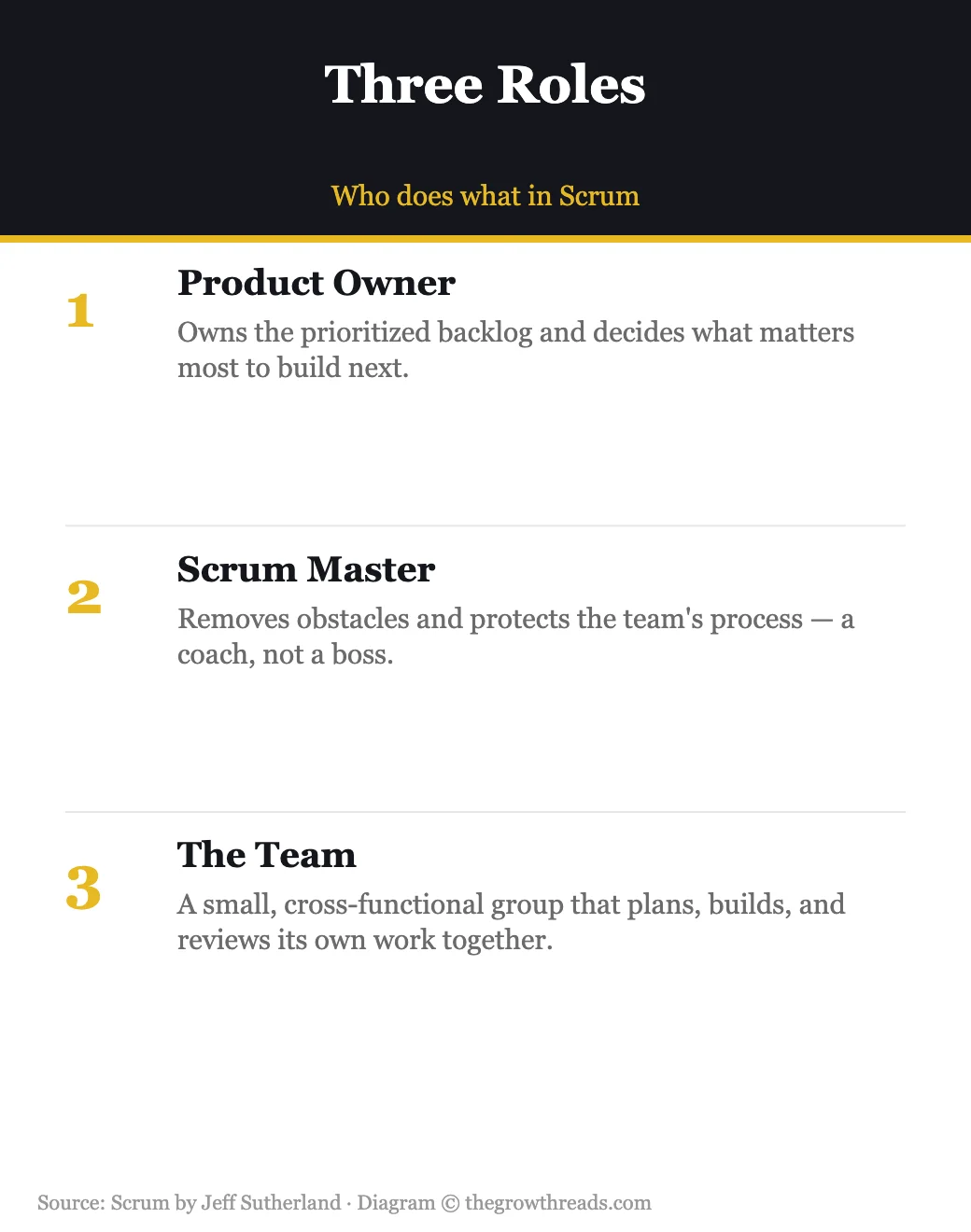
Scrum defines exactly three roles, deliberately fewer than most organizational charts. The Product Owner holds the vision and owns the Product Backlog — the single prioritized list of everything the team could build — and decides what matters most right now. The Scrum Master is not a manager in the traditional sense; their job is to protect the team’s process, remove obstacles, and coach the team toward better collaboration, more a facilitator than a boss. The Team itself is small, cross-functional, and self-organizing — it decides how to do the work, rather than waiting to be told task by task.
Sutherland is emphatic that the Product Backlog is not a wish list. It is ruthlessly ranked, so that the most valuable, most urgent work always sits at the top, ready to be pulled into the next sprint. This single list replaces the scattered spreadsheets, email threads, and competing priorities that Sutherland says quietly sink most teams — not through one dramatic failure, but through the constant cost of confusion about what actually matters today.
TGR Note: The idea of a single, ranked list of what matters most shows up again in Kory Kogon, Adam Merrill, and Leena Rinne’s The 5 Choices, which makes a similar case for individuals: most productivity problems are not a shortage of time but a failure to rank what actually deserves it.
Part 3: The rhythm — sprints and the daily scrum
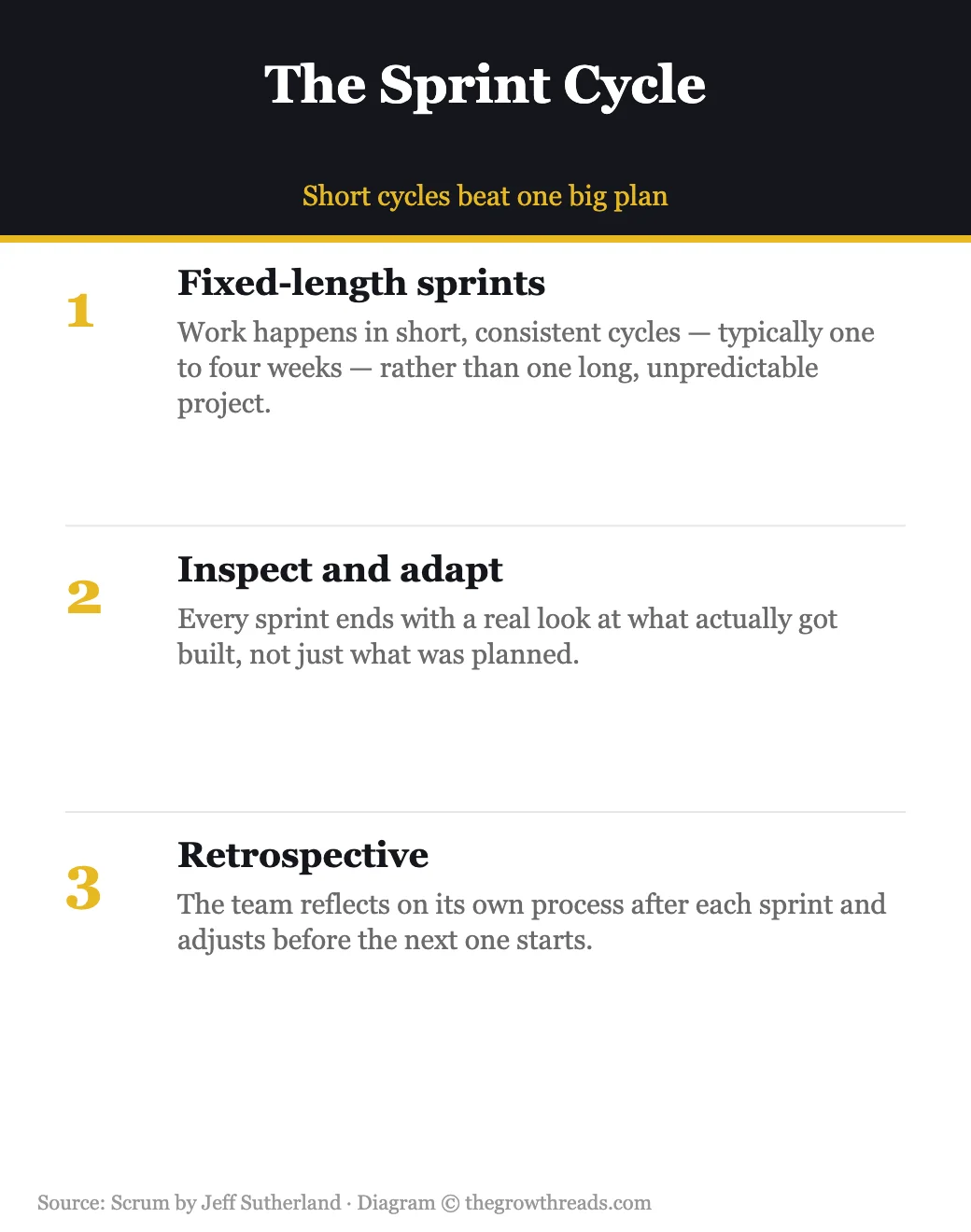
The sprint is Scrum’s heartbeat: a fixed window, typically one to four weeks, that never gets extended mid-cycle. Sutherland is strict about this — once a sprint starts, the scope is locked, because renegotiating the goal partway through is exactly the kind of drift that makes long plans fail in the first place. If new information arrives, it waits for the next sprint, which is never more than a few weeks away. This constraint is less about rigidity and more about honesty: a short, protected commitment is one a team can actually keep.
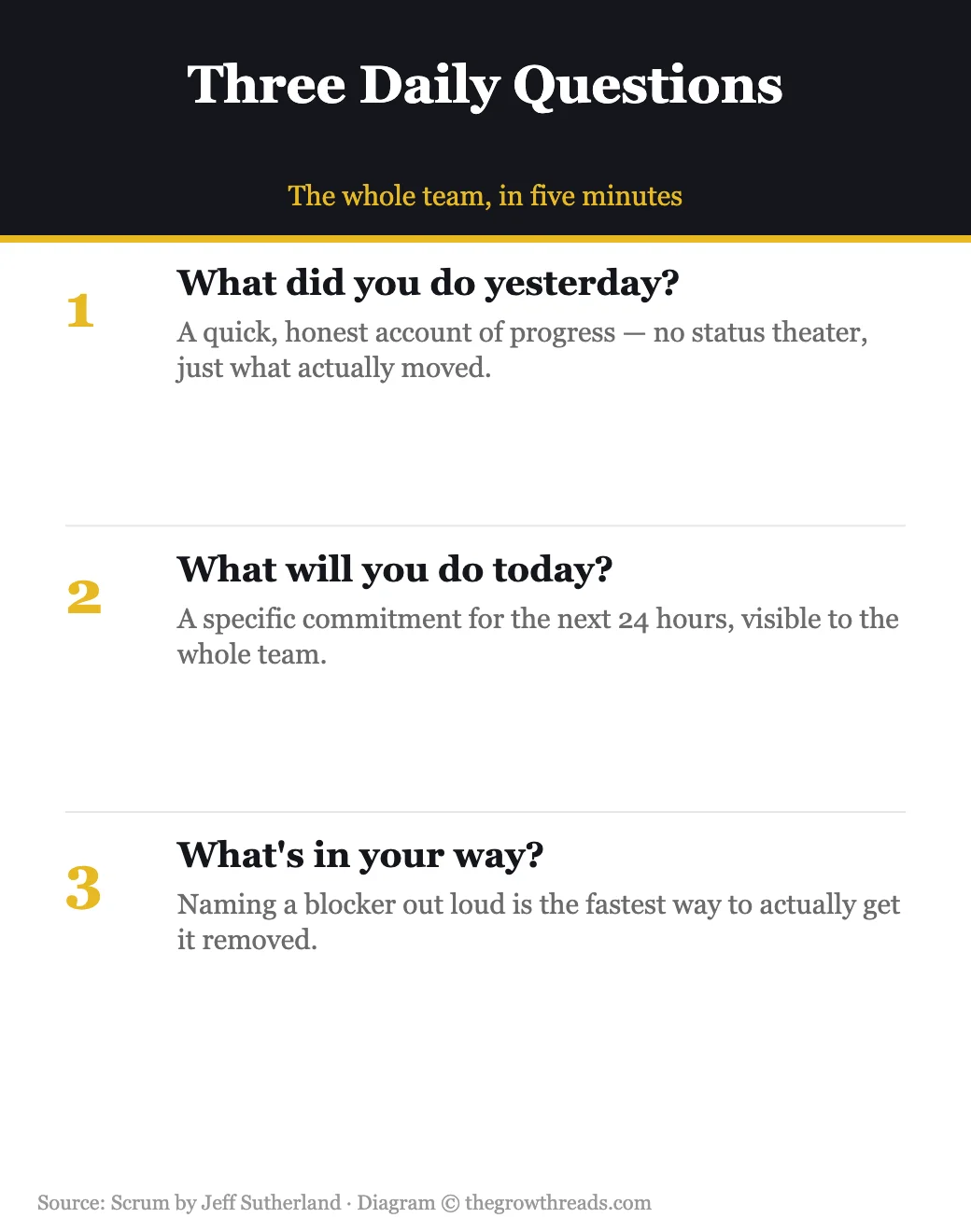
Inside every sprint sits the Daily Scrum, a fifteen-minute stand-up meeting built around three simple questions: what did I do yesterday to help the team finish the sprint, what will I do today, and what is standing in my way. Sutherland is blunt that this is not a status report for a manager — it is the team synchronizing with itself. The value, he argues, is less in the answers than in the habit of surfacing blockers daily instead of letting them fester silently until they become a crisis near the deadline.
Part 4: Inspect and adapt — review, retrospective, and results
Every sprint ends with two distinct meetings that Sutherland treats as non-negotiable. The Sprint Review is a working demonstration of what the team actually built, shown to stakeholders and, where possible, real users — not a slide deck describing progress, but the thing itself, running. Sutherland argues that showing real, working output invites sharper and more honest feedback than any status report, because people react differently to something they can see and touch than to something they are told about. The Sprint Retrospective follows, turned inward: the team alone, asking what went well, what didn’t, and what one or two changes to try in the next sprint. Small, repeated adjustments compound, Sutherland argues, in the same way that reducing waste at each step compounds across a factory floor.
As a case study, the book describes the FBI’s Sentinel case-management system, a project that had reportedly struggled for years under a traditional, heavily planned approach before being restructured around Scrum. According to the book, the switch coincided with the project finishing its remaining work faster and at a fraction of its earlier pace of spending — though the specific figures cited vary somewhat between retellings of the story elsewhere, so they are worth treating as illustrative of the framework’s potential rather than as independently verified statistics. The broader point Sutherland draws from it holds regardless of the exact numbers: even large, bureaucratic, high-stakes projects can benefit from shorter cycles and more frequent course correction.
TGR Note: The retrospective’s insistence on turning improvement into a fixed, recurring appointment rather than a one-off resolution mirrors the discipline Dan Charnas describes in Work Clean — borrowing a professional kitchen’s habit of a nightly reset so that small problems get fixed constantly instead of accumulating into a crisis.
Who is Scrum best for — and who should read something else first?
Scrum speaks most directly to anyone who leads or works on a team whose projects keep sliding past their deadlines despite careful upfront planning — team leads, product managers, and founders trying to bring order to a group’s work without adding bureaucracy. It is equally useful outside software: the book’s examples span construction, government, and even personal projects like planning a wedding.
If your challenge is less about coordinating a team and more about your own individual focus and habits, The Distracted Mind is a better starting point — it digs into why any one person’s attention fractures in the first place. If you are looking for a framework to rank your own priorities rather than a team’s, The 5 Choices covers similar ground at the individual level. And if your team’s problem is less about process and more about a culture of chronic overwork, Time Off tackles the rest side of the equation that Scrum’s sprint cadence assumes but does not fully address.
Questions to reflect on
- Where in your current work are you relying on a long-range plan that has not been checked against reality in weeks?
- If your team held a 15-minute daily check-in built around three questions, what blocker would finally get said out loud?
- What would you need to see — not hear about — to trust that a project is actually on track?
- When did your team last deliberately pause to ask what to change about how it works, rather than just what to build next?
- Is there one piece of work you could shrink into a two-week sprint this month, just to test the rhythm?
🔥 Ready to work in sprints instead of guesses?
Get Scrum and start running your first two-week cycle this month.
How to apply Scrum (7-day plan)
- Day 1 — Write your backlog: List every piece of work your team or project could plausibly take on, in one place, and rank it top to bottom by what actually matters most.
- Day 2 — Pick your sprint length: Choose one to two weeks for your first sprint — short enough to finish, long enough to get something real done.
- Day 3 — Define “done”: Agree as a team on what “finished” means for the work you are about to commit to, so there is no ambiguity at the end.
- Day 4 — Commit to a sprint goal: Pull the top items off the backlog until the team agrees it has a realistic, achievable slice of work for the sprint.
- Day 5 — Run your first Daily Scrum: Hold a 15-minute stand-up: what did you do, what will you do, what is in your way. Keep it to fifteen minutes, no exceptions.
- Day 6 — Protect the sprint boundary: When new requests arrive mid-sprint, write them on the backlog for next time instead of interrupting the current commitment.
- Day 7 — Hold a review and a retrospective: Show whatever you finished, even if it is small, then ask as a team what to change before starting sprint two.
Frequently asked questions
What is the main idea of Scrum?
Scrum argues that most projects fail not from poor effort but from planning too far ahead in conditions that are inherently uncertain. Its solution is to work in short, fixed cycles called sprints, with a daily check-in, a working demonstration at the end of each cycle, and a recurring pause to ask how the team could work better. The goal is constant, honest course correction rather than one long guess.
How is Scrum different from traditional project management?
Traditional, “waterfall” project management plans a project in detail from start to finish before work begins, then executes that plan in sequence. Scrum instead plans one short sprint at a time, checks the results, and re-plans the next sprint with better information. The difference is not more or less planning overall — it is planning in short, correctable increments instead of one long, fragile one.
What are the three Scrum roles?
The Product Owner owns and prioritizes the backlog of work. The Scrum Master protects the team’s process and removes obstacles, acting as a coach rather than a boss. The Team is small, cross-functional, and self-organizing, deciding for itself how best to complete the work it has committed to for the sprint.
How long should a sprint be?
Sutherland recommends somewhere between one and four weeks, with two weeks as a common starting point for many teams. The right length balances two needs: it should be short enough that the team can accurately predict what it can finish, and long enough to actually produce something meaningful to show at the end.
What happens if a team doesn’t finish everything in a sprint?
The unfinished work goes back onto the Product Backlog to be re-prioritized for a future sprint — it is not treated as a failure to be punished. Sutherland frames this as useful data: a team that consistently doesn’t finish its commitments learns to commit to less, which over time makes its forecasts more accurate rather than more optimistic.
Is Scrum only for software teams?
No — the book applies it well beyond software, including a chapter on the FBI’s Sentinel case-management system, a long-troubled government project the book describes as turning around after adopting Scrum. Specific figures describing that turnaround vary somewhat between different retellings of the story, so they are best read as illustrative rather than precise, but the underlying claim — that large, bureaucratic projects can benefit from shorter cycles — is the book’s central argument applied at scale.
What is the “cargo cult Scrum” criticism?
Some practitioners and critics use the term “cargo cult Scrum” to describe teams that adopt the visible rituals — a daily stand-up, a sprint board, two-week cycles — without embracing the underlying shift toward honest, empirical course correction, and see little benefit as a result. This is less a critique of the framework’s ideas than a caution about implementation: the mechanics of Scrum are simple to copy, but the mindset behind them takes real, sustained buy-in from the whole team.
Related summaries
- The 5 Choices — a framework for ranking priorities at the individual level.
- Work Clean — borrowing a professional kitchen’s discipline for daily resets.
- Your Brain at Work — why the brain struggles with long, complex plans.
- Time Off — building a sustainable rest ethic alongside a hard-working one.
For more, browse our full guide to the best productivity books.
How we analyze books: We read the original text, cross-check factual claims where possible, and focus on practical application rather than critique. Read our full methodology.