

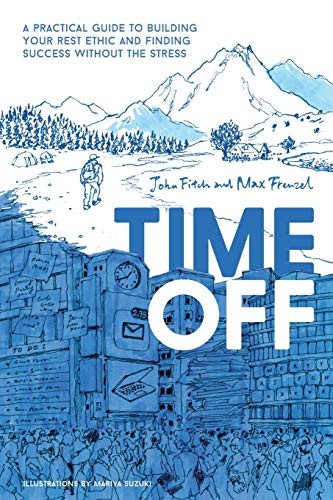
★★★★☆ 4.5/5 — A warm, illustrated case for treating rest as a deliberate skill, not a reward you’ve earned only after the work is done.
Best for: Anyone in hustle-driven work culture who equates busyness with worth.
Reading time: ~5 hrs to read, 20-25 min for this guide.
Difficulty to apply: Easy — the ideas are simple, though changing an identity built on busyness takes longer than changing a habit.
Time Off in one minute
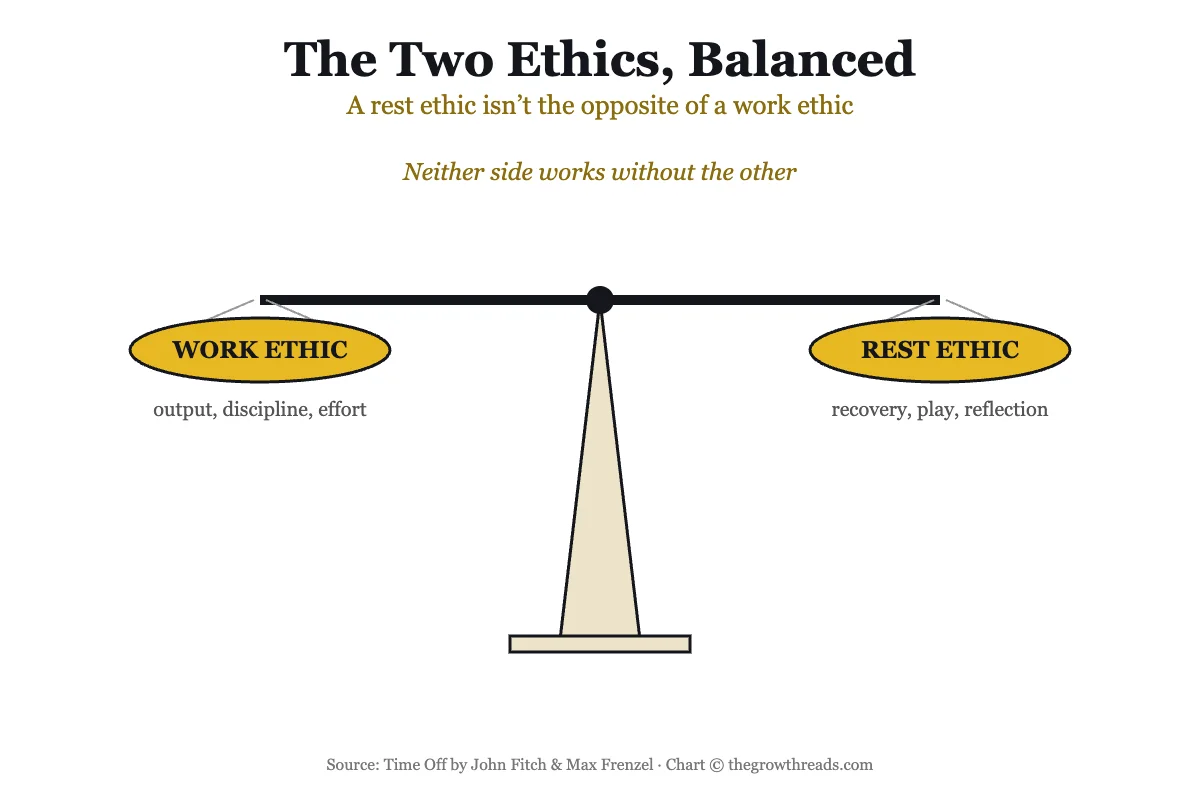
A “rest ethic” isn’t the opposite of a work ethic — it’s the half that makes a work ethic sustainable. John Fitch and Max Frenzel argue that modern work culture inherited a one-sided obsession with hustle and busyness, without the equally deliberate discipline around rest that once accompanied it. Deliberate rest, in their framing, is an active, learnable skill — not passive downtime you fall into once the to-do list is empty. Drawing on concepts like Aristotle’s “noble leisure” and a “mental crop rotation” between different kinds of activity, the book makes the case that treating recovery as seriously as output is, counterintuitively, what actually produces better work.
Key takeaways
- Rest is a skill, not an accident: deliberate rest has to be practiced and planned, the same way work skills do.
- A rest ethic complements a work ethic: the two aren’t in competition — one enables the other to be sustainable.
- Busyness isn’t the same as value: being constantly occupied is not the same as doing meaningful or high-quality work.
- Noble leisure has real content: restorative activity is meaningful in its own right, not just “not working.”
- Mental crop rotation: rotating between different types of activity lets one mental “field” recover while another stays active.
- Unstructured time matters: genuine slack, with no task attached, supports the kind of idea incubation a packed schedule can’t.
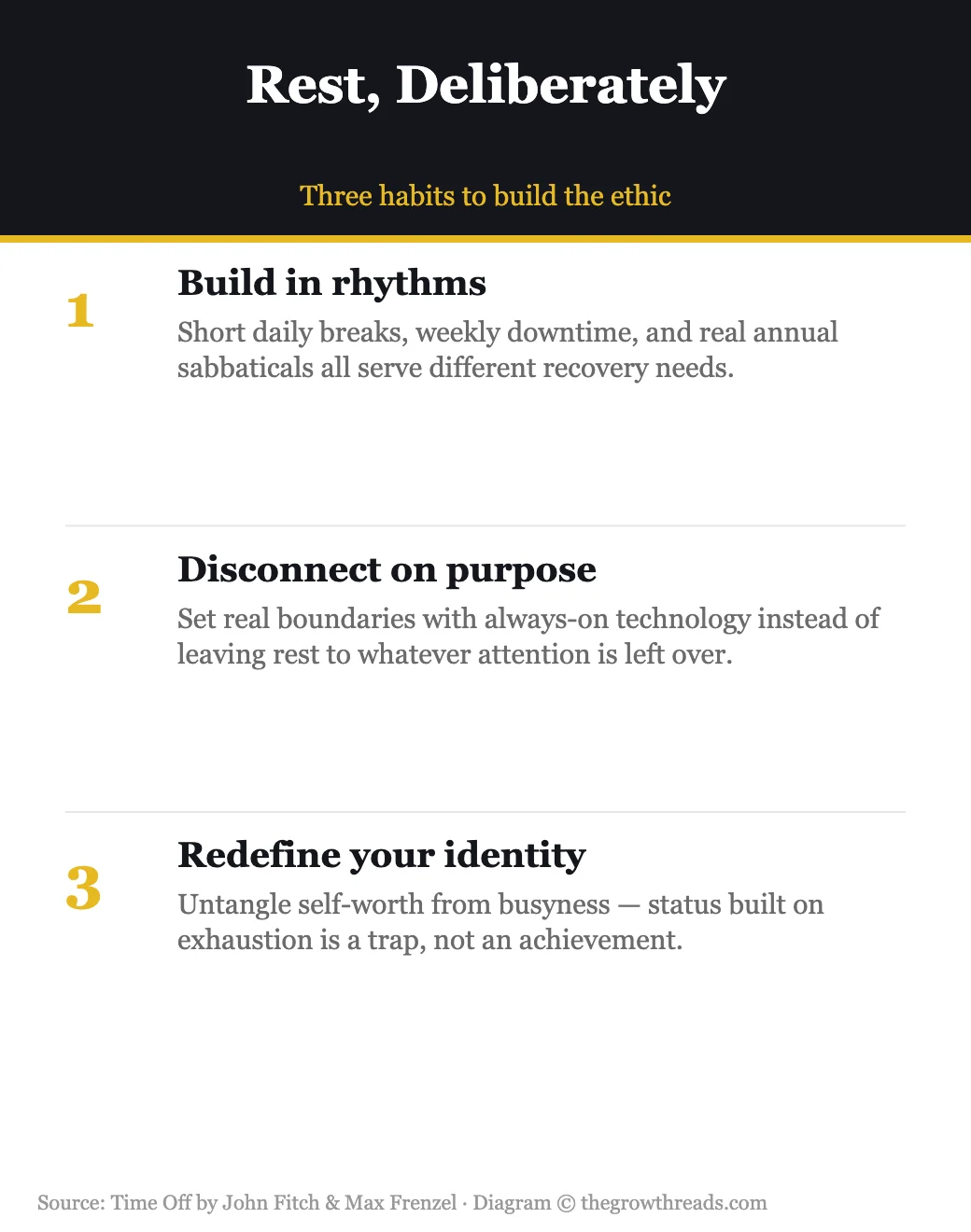
- Rest at multiple scales: daily breaks, weekly downtime, and real sabbaticals each serve different recovery needs.
- Boundaries with technology: deliberate disconnection protects rest the way an office door once protected focus.
- Identity matters too: untangling self-worth from busyness is as important as any single technique.
What is Time Off about?
Time Off argues that deliberate rest is an active, learnable skill and a necessary complement to a work ethic, not its opposite — and makes the case that treating recovery, leisure, and disconnection with the same seriousness as output leads to better, more sustainable work.
About the authors
John Fitch is an entrepreneur who has spoken about hitting a burnout point in his earlier career, which led him to study rest, recovery, and sabbaticals more seriously. Max Frenzel holds a Ph.D. in quantum physics and has worked as an AI researcher based in Tokyo, alongside a parallel career as a musician and visual artist exploring computational creativity. Both authors describe arriving at the book’s central idea — a “rest ethic” — after their own experiences with overwork in fast-paced, always-on professional culture, which gives the book’s argument a lived, first-person credibility rather than a purely academic one.
That combination of backgrounds — an entrepreneur who lived the burnout firsthand and a physicist-turned-AI-researcher who studies systems and creativity professionally — gives the book two complementary angles on the same problem, one more practical and personal, the other more conceptual, which shows up in how the book alternates between concrete technique and broader framing throughout.
Key concepts at a glance
| Concept | What it means | Use it when |
|---|---|---|
| Rest ethic | A deliberate, skill-based approach to rest that complements — rather than competes with — a work ethic. | You notice rest only happens by accident, if at all. |
| Noble leisure | Meaningful, restorative activity with real content, not just the absence of work. | Your “downtime” mostly means passive scrolling. |
| Mental crop rotation | Rotating between different kinds of activity so one area recovers while another stays active. | One project or task type has burned you out. |
| Unstructured slack | Genuinely open time with no task attached, needed for idea incubation. | Your calendar has no white space left at all. |
| Rest at multiple scales | Daily breaks, weekly downtime, and sabbaticals each serve a different recovery function. | You’re planning recovery for the year, not just the day. |
| Busyness identity | Treating constant occupation as a marker of status or worth. | You feel guilty or anxious when your schedule is empty. |
Part 1: Why work culture needs a rest ethic
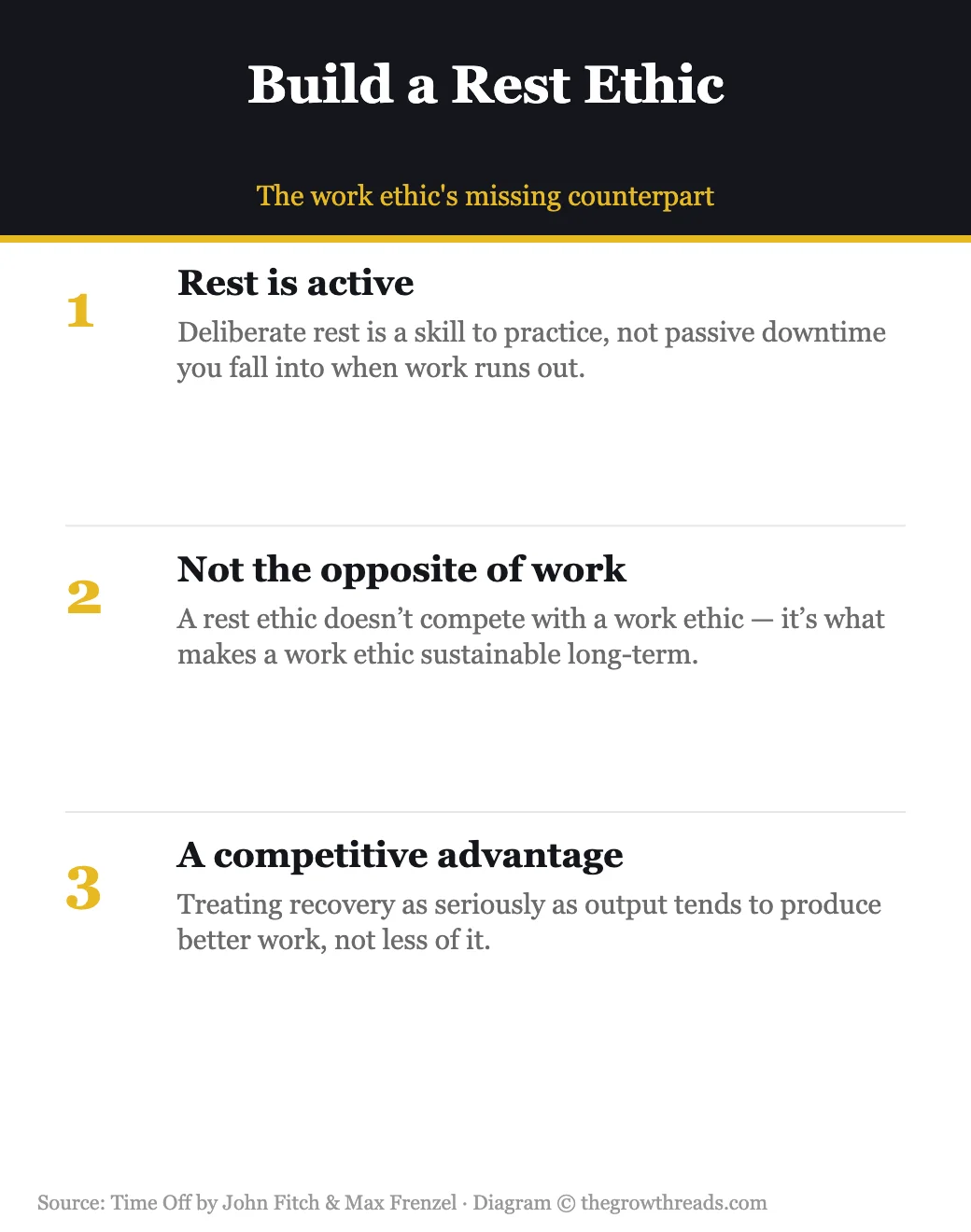
Fitch and Frenzel open by naming the imbalance directly: modern professional culture inherited an intense work ethic — discipline, effort, delayed gratification — without an equally developed counterpart for rest. The result is a culture that treats busyness itself as a signal of worth, independent of whether the busy work is actually valuable. The book’s core reframe is that this isn’t a call to work less out of self-indulgence; it’s an argument that a work ethic without a rest ethic eventually breaks down, producing burnout, diminishing returns, and worse output over time rather than more of it.
The authors present deliberate rest as a “competitive advantage” — not because rest itself produces results, but because sustained high performance requires recovery the same way physical training does. A schedule with no recovery built in doesn’t produce more total output over a year; it produces a shorter runway before quality and consistency both decline.
The authors draw an explicit parallel to athletic training here: elite athletes don’t treat rest as time stolen from training, they treat it as a scheduled, non-negotiable part of the training program itself, because performance gains happen during recovery as much as during effort. The book’s argument is that knowledge work has largely skipped this lesson, treating recovery as optional in a way no serious athletic program ever would.
TGR Note: This framing pairs naturally with the limited-resource model in our Your Brain at Work summary — both books treat mental energy as something that has to be replenished on a schedule, not just spent until it runs out.
Part 2: Noble leisure and mental crop rotation
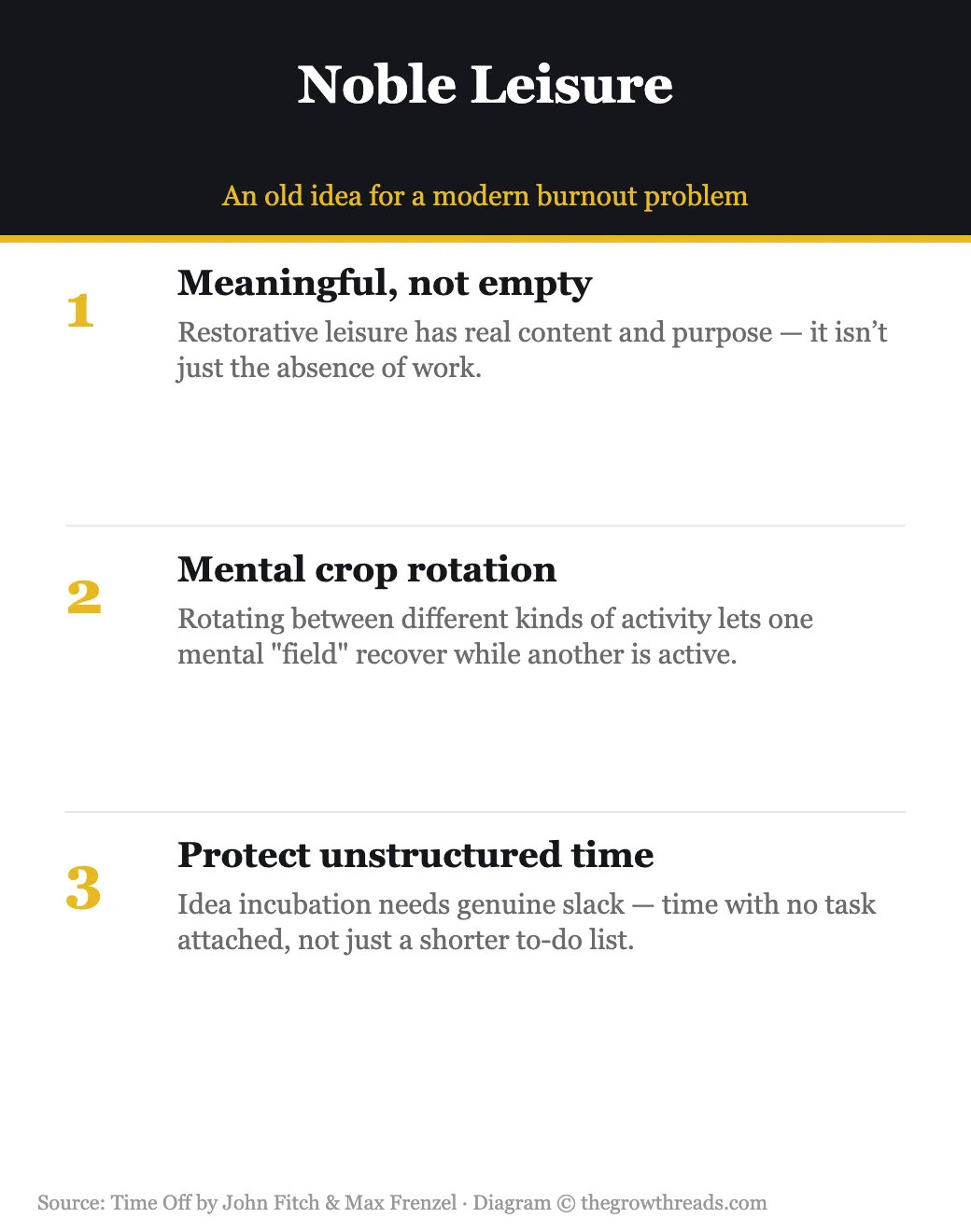
The book borrows the idea of “noble leisure” from Aristotle to argue that meaningful rest has real content of its own — it isn’t defined negatively as “not working,” it’s a category of activity with its own value. This distinction matters practically: passive scrolling and genuinely restorative leisure both count as “not working” on a calendar, but the book argues they don’t produce remotely the same recovery.
“Mental crop rotation” extends this into a practical technique: rotating between different types of activity — analytical work, creative work, physical activity, social time — lets one area of mental effort recover while another is engaged, rather than treating all “rest” as a single undifferentiated category. The metaphor borrows from agriculture: a field left fallow recovers fertility; a mind given genuinely different kinds of engagement recovers focus and creativity in a similar way.
In practice, this might mean following a demanding analytical work block with something physical, like a walk, rather than with a different piece of analytical work that draws on the same depleted mental resources. The rotation itself is the recovery mechanism — not a reward tacked onto the end of a task, but a structural feature of how the day is built.
TGR Note: The crop-rotation idea complements the single-tasking advice in our Work Clean summary — one is about protecting focus within a task, the other about protecting recovery across a whole week.
Part 3: Protecting unstructured time and disconnecting on purpose
The book makes a pointed case for unstructured “slack” — time with genuinely no task attached, not just a lighter to-do list. This kind of open time is where idea incubation happens, the authors argue: insight often arrives away from the desk, precisely because the mind isn’t being directed toward a specific problem. A schedule optimized entirely for efficiency, with every hour accounted for, eliminates the exact conditions that make breakthrough thinking possible. This is a genuinely uncomfortable idea for readers who measure a day’s success by how full the calendar was — a fully booked schedule can look productive while quietly eliminating the conditions that produce the best ideas.
Alongside unstructured time, the book argues for deliberate boundaries with always-on technology. Notifications and constant connectivity don’t just interrupt specific tasks — they eliminate the possibility of genuine disconnection, since even “downtime” spent half-attentive to a phone doesn’t produce real recovery.
This distinction matters because it’s easy to mistake screen time for rest simply because no active task is attached to it. Scrolling during a break can feel restful in the moment while still leaving the same underlying attention systems engaged, which is part of why a break spent this way often doesn’t leave someone feeling any more recovered than before it started.
The authors frame disconnection not as a nostalgic return to a pre-digital world, but as a practical skill: choosing when to be reachable, rather than defaulting to reachable at all times.
TGR Note: The disconnection advice here echoes the environment-first strategies in our The Distracted Mind summary — both books land on removing the trigger rather than trying to resist it once it’s in front of you.
Part 4: Rest at every scale, and rebuilding identity around it
The book distinguishes between rest at different timescales — brief daily breaks, weekly downtime, and longer sabbaticals — arguing each serves a different recovery function and that relying on only one scale (say, a single annual vacation) leaves the others neglected. Daily and weekly rhythms prevent the kind of accumulated fatigue that a single yearly break can’t fully repair, while longer sabbaticals allow for the kind of deep recovery and perspective-shift that short breaks can’t provide.
The book treats these scales as complementary rather than substitutable: a strong daily rhythm doesn’t eliminate the need for an occasional longer break, and a single annual vacation doesn’t compensate for a week-to-week pattern of overwork. Building recovery at all three levels — day, week, and year — is presented as more durable than relying heavily on any one of them alone.
The book’s final and arguably hardest argument is about identity: many readers’ resistance to rest isn’t really about time management, it’s about self-worth built on visible busyness. Redefining that identity — treating rest as a legitimate part of a serious professional’s life rather than something to apologize for — is presented as the deeper, slower work underneath all the book’s more concrete techniques.
Readers coming from more traditional productivity or hustle-culture backgrounds may find some of the book’s framing more aspirational than immediately actionable, since changing an identity built around busyness takes longer than adopting a new daily habit — a fair critique the book itself largely acknowledges rather than glosses over.
The book’s response to this critique is essentially that identity change and habit change reinforce each other over time — small, repeated acts of deliberate rest gradually make the identity shift feel less like a leap and more like a natural conclusion, rather than expecting readers to feel differently about busyness before they’ve tested a single new habit.
TGR Note: For more on separating self-worth from constant output, our Laziness Does Not Exist summary covers closely related ground from a more self-compassion-focused angle.
Who is Time Off best for — and who should read something else first?
This book is best for readers in hustle-driven or always-on work cultures who intellectually know they should rest more but haven’t built the habits or the permission structure to actually do it. If you want a more tactical, technique-first approach to organizing your actual workday, pair this with our Work Clean summary. If your core issue is more about digital distraction than rest specifically, start with our The Distracted Mind summary instead.
Questions to reflect on
- When was the last time you rested without also feeling guilty about it?
- What would a genuine “mental crop rotation” look like across your typical week?
- How much of your calendar right now is truly unstructured, with no task attached at all?
- Where does your sense of self-worth lean on being visibly busy?
- What’s one boundary with technology you could set this week to protect real disconnection?
🔥 Ready to build your own rest ethic?
Get the full framework and every technique from the book.
How to apply Time Off (7-day plan)
- Day 1 — Notice your busyness identity: pay attention to how often you mention how busy you are today, and why.
- Day 2 — Try one crop rotation: deliberately switch to a genuinely different kind of activity when you feel one area of focus starting to fade.
- Day 3 — Protect one hour of slack: block an hour with no task attached at all, and resist filling it.
- Day 4 — Take a real break: use a short daily break for something restorative, not just checking a different screen.
- Day 5 — Disconnect on purpose: choose a window today to be genuinely unreachable, and notice how it feels.
- Day 6 — Plan a weekly rhythm: pick one recurring weekly block dedicated to noble leisure, not errands or catch-up work.
- Day 7 — Review and rebuild: pick the one practice — crop rotation, protected slack, or disconnection — that felt most valuable, and schedule it again next week.
Frequently asked questions
What is a “rest ethic”?
A rest ethic is a deliberate, skill-based approach to rest — treating recovery, leisure, and disconnection as seriously as work itself. The book argues it isn’t the opposite of a work ethic but its necessary complement, since sustained high performance depends on genuine recovery.
What is “noble leisure”?
Noble leisure is a concept the book borrows from Aristotle describing meaningful, restorative activity that has real content and value of its own — distinct from simply not working, and distinct from passive activities like idle scrolling that don’t actually produce recovery.
What is “mental crop rotation”?
It’s an agricultural metaphor for rotating between different types of activity — analytical, creative, physical, social — so that one area of mental effort can recover while another stays engaged, rather than treating all forms of rest as interchangeable.
Who are John Fitch and Max Frenzel?
John Fitch is an entrepreneur who has spoken publicly about hitting a burnout point earlier in his career, which led him to study rest and recovery. Max Frenzel holds a Ph.D. in quantum physics and has worked as an AI researcher and musician based in Tokyo. Both describe the book as growing out of their own experiences with overwork.
Is this book only relevant to knowledge workers?
The book’s examples and framing lean toward knowledge work and creative/entrepreneurial careers, and some readers have noted it offers less direct guidance for hourly or shift-based work where schedule flexibility is more limited. The underlying principles — rotating activity types, protecting unstructured time — can still apply, but the specific techniques translate less directly.
How is this different from other books on rest or burnout?
Rather than focusing primarily on burnout recovery after the fact, Time Off frames rest as a proactive, ongoing skill to build alongside a work ethic — positioning it as a performance advantage rather than only a wellness concern. The book is also illustrated throughout, giving it a more visual, accessible format than many books in this space.
What’s the easiest place to start with this book’s ideas?
Protecting a small block of genuinely unstructured time — even just an hour with nothing scheduled — is one of the most immediately testable ideas, since it requires no new system, just a willingness to leave the block empty and resist filling it.
Related summaries
If this topic resonated, continue with our Work Clean summary, Your Brain at Work summary, Laziness Does Not Exist summary, and The Distracted Mind summary — or browse the full best productivity books collection.
How we analyze books: we read the full text, cross-check key claims and studies against primary sources, and build original diagrams and application plans rather than reproducing the book’s content. Read our full methodology.