

★★★★★ 4.6/5 — A clear, workshop-tested framework of five daily decision points, built on FranklinCovey’s decades of corporate time-management research.
Best for: Managers and professionals who want a structured, repeatable system rather than isolated tips.
Reading time: ~6 hrs to read, 20-25 min for this guide.
Difficulty to apply: Easy to understand, ongoing to practice — each choice is simple, but making it a habit takes repetition.
The 5 Choices in one minute
Extraordinary productivity isn’t a personality trait — it’s five choices you face repeatedly, every single day. Written by three FranklinCovey consultants and based on the company’s corporate training program of the same name, The 5 Choices frames productivity as a series of decision points: what to act on, what to aim for, what to schedule, how to handle technology, and how to manage your own energy. The book leans directly on Stephen Covey’s classic Urgent/Important matrix from First Things First, updating it for a workplace now dominated by notifications and constant demands on attention, while adding a fifth choice — energy management — that most classic time-management frameworks leave out entirely.
Key takeaways
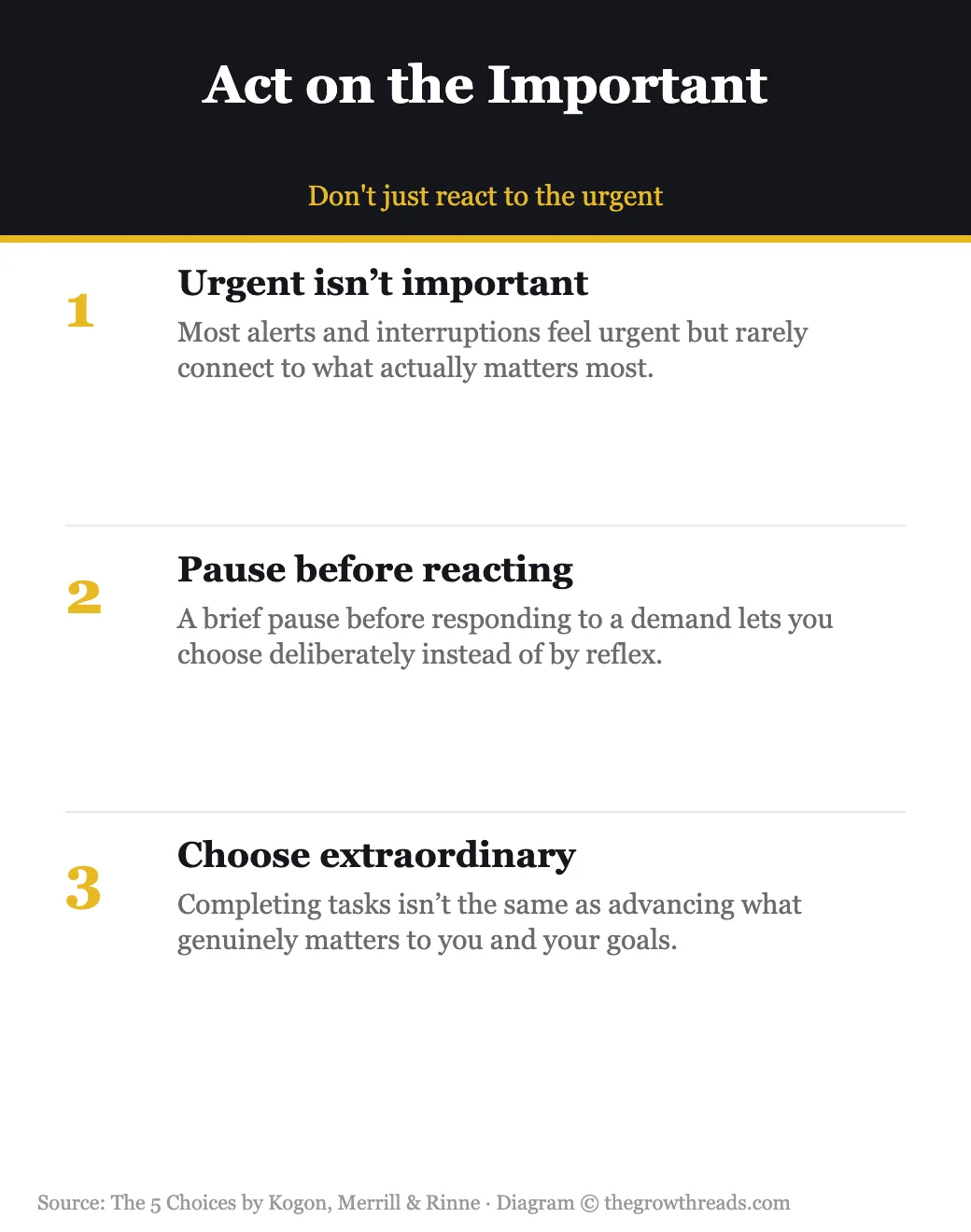
- Choice 1 — Act on the Important, Don’t React to the Urgent: most interruptions feel urgent but rarely connect to what actually matters.
- Choice 2 — Go for Extraordinary, Don’t Settle for Ordinary: completing tasks isn’t the same as advancing what genuinely matters to your goals and roles.
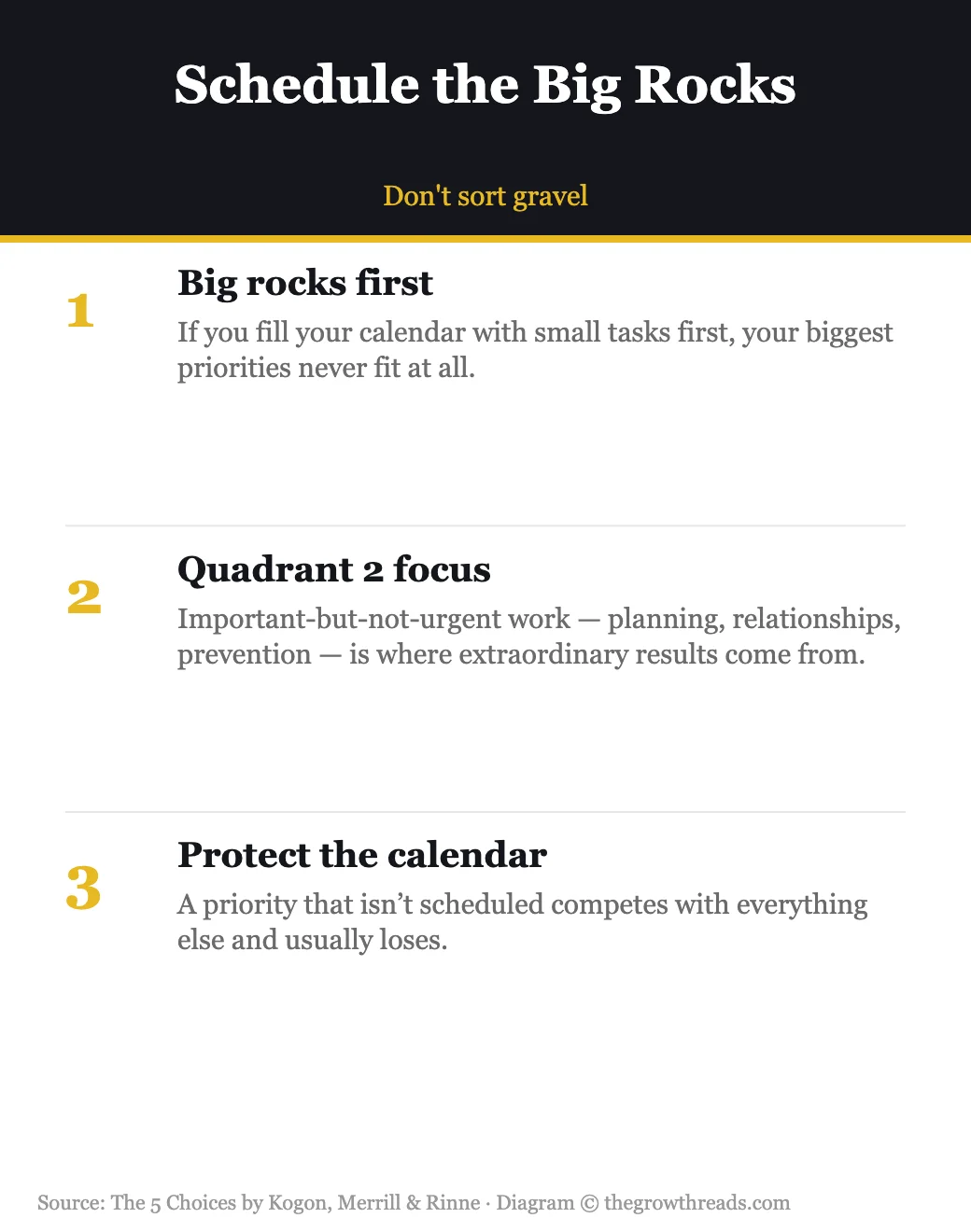
- Choice 3 — Schedule the Big Rocks, Don’t Sort Gravel: priorities that aren’t scheduled get crowded out by everything else.
- Choice 4 — Rule Your Technology, Don’t Let It Rule You: set the terms for when you engage with notifications, rather than reacting to every one.
- Choice 5 — Fuel Your Fire, Don’t Burn Out: physical, emotional, mental, and spiritual energy all need active renewal.
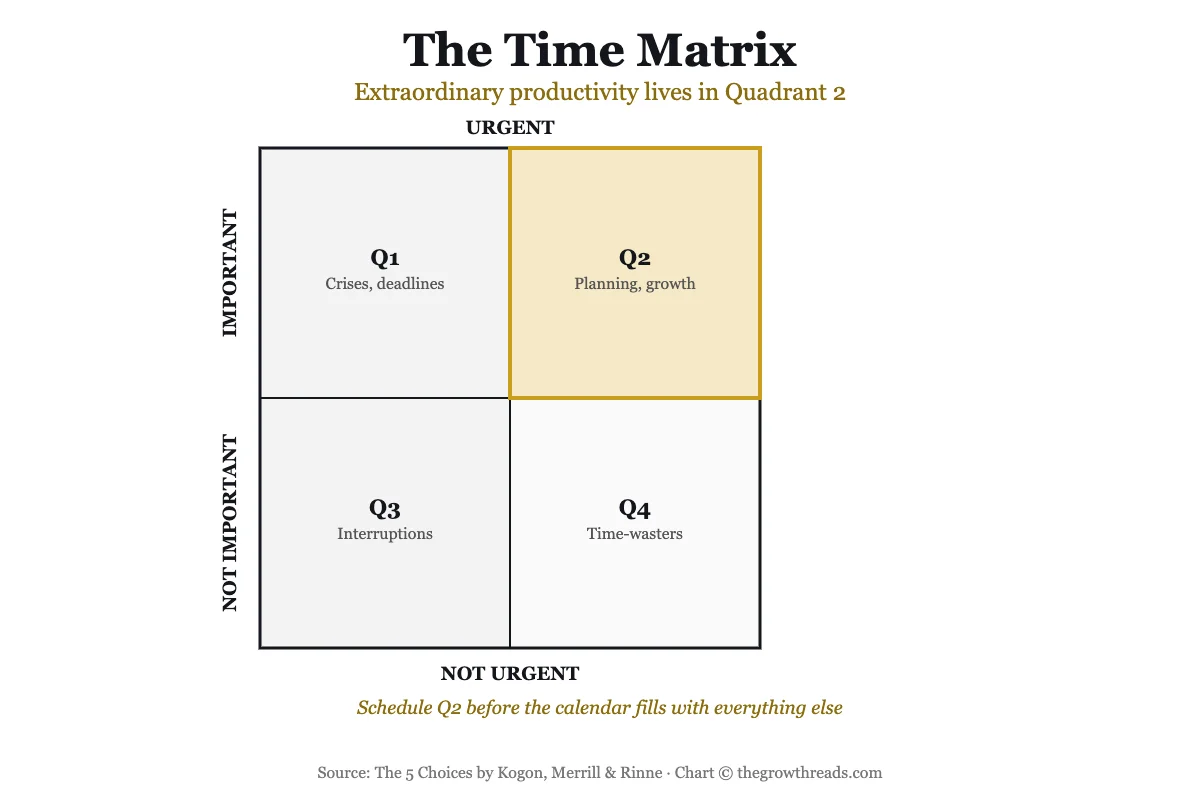
- The Time Matrix: a four-quadrant model splitting tasks by urgency and importance — most extraordinary work happens in Quadrant 2.
- Quadrant 2 is the target: important-but-not-urgent work like planning and relationship-building rarely feels pressing but drives the best outcomes.
- The Big Rocks metaphor: if you fill your schedule with small tasks first, your biggest priorities never fit.
- A six-year FranklinCovey study surveying over 350,000 respondents found more than 40% of people’s time was spent on activities not important to them or their organization.
What is The 5 Choices about?
The 5 Choices frames extraordinary productivity as five repeatable daily decisions — acting on what’s important rather than merely urgent, aiming higher than ordinary task completion, scheduling top priorities before the calendar fills, managing technology deliberately, and renewing personal energy across four dimensions.
About the authors
Kory Kogon, Adam Merrill, and Leena Rinne are all FranklinCovey consultants and executives. Kogon serves as FranklinCovey’s Global Practice Leader for Productivity; Merrill is Vice President of Innovation and previously contributed research to Stephen Covey’s First Things First, giving him a direct line from Covey’s original time-management work to this book; Rinne is a longtime Senior Consultant with roughly a decade at the company. The book is the print companion to FranklinCovey’s corporate training program of the same name, part of a curriculum lineage that includes The 7 Habits of Highly Effective People — giving The 5 Choices an unusually well-tested, workshop-refined foundation compared to books built from a single author’s personal experience.
Key concepts at a glance
| Concept | What it means | Use it when |
|---|---|---|
| Time Matrix | A four-quadrant model splitting tasks by urgency and importance, adapted from Covey’s classic framework. | You’re deciding what actually deserves your attention today. |
| Quadrant 2 | Important-but-not-urgent work — planning, relationships, prevention — where extraordinary results come from. | Your week is full of Q1 crises and Q3 interruptions with no Q2 time left. |
| Big Rocks | Your biggest priorities, which must be scheduled first or they get crowded out by smaller tasks. | You’re planning your week or your calendar for tomorrow. |
| Pause-Clarify-Decide | A brief pause before reacting to a demand, to clarify what’s actually being asked before deciding how to respond. | An interruption arrives and you feel the urge to react immediately. |
| Four energy dimensions | Physical, emotional, mental, and spiritual energy, each needing active renewal. | You’re productive in bursts but can’t sustain it. |
Part 1: Act on the important, don’t react to the urgent
The book’s first choice targets the single most common productivity failure: mistaking urgency for importance. Notifications, interruptions, and other people’s requests almost always feel urgent in the moment, but the authors argue that urgency is a property of timing, not value — a demand can be extremely urgent and almost completely unimportant at the same time. The fix isn’t ignoring urgent things outright; it’s building a brief pause before reacting, long enough to clarify what’s actually being asked and whether it deserves an immediate response.
The book calls this three-step move Pause, Clarify, Decide: pause before the automatic reaction, clarify what’s genuinely being requested and by when, then decide deliberately whether it belongs in your day at all. This small habit is presented as the practical entry point for the whole framework — everything else in the book assumes you can create at least a few seconds of space between a demand arriving and your response to it.
This choice sets up the book’s central tool, the Time Matrix, borrowed directly from Stephen Covey’s Urgent/Important grid in First Things First. Tasks fall into four quadrants: Q1 (urgent and important — genuine crises), Q2 (not urgent but important — planning and prevention), Q3 (urgent but not important — most interruptions), and Q4 (neither — pure time-wasters). The book’s core argument is that most people spend far too much time in Q1 and Q3, reacting to what’s loud, and far too little in Q2, where the highest-value work actually lives.
The distinction between Q1 and Q3 is worth dwelling on, since both feel identically urgent in the moment. Q1 work is genuinely important — a real deadline, a real crisis — while Q3 work only feels that way because someone else made it urgent, often for their own priorities rather than yours. Learning to tell the two apart in real time, rather than treating all urgency as equally deserving of an immediate response, is one of the book’s more subtle but consequential skills.
TGR Note: The Time Matrix pairs naturally with the “orphaned tasks” discipline in our Work Clean summary — both are ultimately about deciding what deserves your attention before it demands it.
Part 2: Schedule the big rocks, don’t sort gravel
The third choice gives the Time Matrix’s Quadrant 2 focus a concrete mechanism: schedule your biggest priorities — the “big rocks” — before anything else fills the calendar. The metaphor, well-known from Covey and FranklinCovey material more broadly, illustrates that a jar filled with sand and gravel first has no room left for big rocks, but a jar with big rocks placed first can still fit the gravel and sand around them. Applied to a calendar, this means blocking time for your most important work at the start of the week, not squeezing it in around whatever smaller tasks have already claimed the good hours.
The authors are specific about why order matters here: a calendar filled first with small, easy tasks creates a false sense of productivity — items get checked off quickly — while the genuinely important work keeps sliding to “tomorrow” indefinitely. Placing the big rocks first isn’t about working more hours; it’s about making sure the hours that exist get spent on what actually moves the needle before anything smaller has the chance to claim them.
The authors back this with a striking internal statistic: a six-year FranklinCovey study surveying more than 350,000 respondents found that over 40% of people’s time was spent on activities that weren’t important to themselves or their organization — a concrete measure of exactly how much Quadrant 2 time gets displaced by Q3 interruptions and Q4 busywork in practice.
TGR Note: The big-rocks-first approach echoes the “planning is prime” principle in our Work Clean summary — both books agree that what happens before you start working matters as much as the work itself.
Part 3: Rule your technology, don’t let it rule you
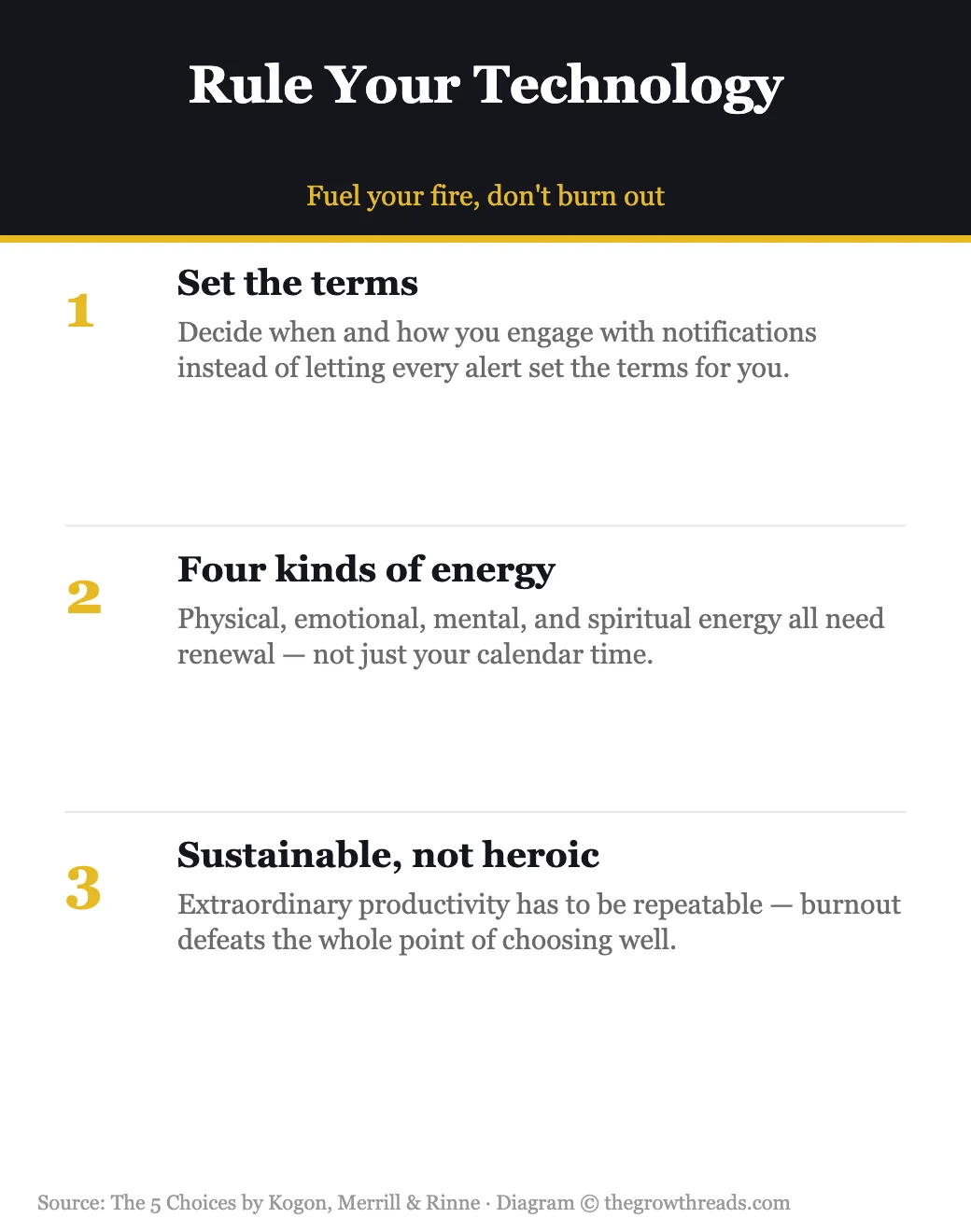
The fourth choice tackles the modern addition to classic time-management advice: an environment of constant notifications that Covey’s original framework, developed before smartphones, never had to address. The authors argue that most people let technology set the terms of their attention by default — responding to every alert as it arrives — rather than deciding deliberately when and how to engage with it. Ruling your technology means setting specific windows for checking messages, turning off non-essential notifications, and treating your attention as something worth actively defending rather than leaving open to whoever or whatever pings you next.
This choice connects directly back to the Time Matrix: unmanaged technology use is one of the primary ways Q3 (urgent-but-unimportant) work crowds out Q2 time, since most notifications are engineered to feel urgent regardless of their actual importance.
The book doesn’t argue for eliminating technology or treating every notification as an enemy — plenty of alerts genuinely matter. The point is that the default should be a deliberate choice about when to be reachable, rather than an assumption that every buzz deserves an immediate response simply because it arrived.
Part 4: Fuel your fire, don’t burn out
The fifth and final choice is the book’s most distinctive contribution relative to older time-management frameworks: energy management as a genuine complement to time management. The authors argue that managing time alone isn’t enough if the person doing the managing is running on empty — productivity depends on renewable energy across four dimensions: physical (sleep, movement, nutrition), emotional (relationships, positive affect), mental (focus, learning), and spiritual (meaning, values alignment). Neglecting any one dimension eventually undermines the others, regardless of how well-scheduled a person’s calendar looks on paper.
This choice is explicitly framed as protection against the trap the other four choices could otherwise create: someone who masters Quadrants and big rocks and technology boundaries but treats their own energy as infinite will burn out anyway, undoing the sustainability the whole system is meant to provide.
Notably, the authors treat all four energy dimensions as equally load-bearing rather than ranking physical energy above the rest, as many popular wellness frameworks implicitly do. A person can sleep well and exercise regularly while still running on empty emotionally or spiritually, and the book argues that gap will eventually show up in the quality of their decisions regardless of how well-rested they otherwise appear.
TGR Note: The four-dimensional energy model pairs directly with the case for deliberate recovery in our Time Off summary — both books treat energy, not just time, as the resource that actually needs managing.
Because the book is a direct adaptation of a corporate training curriculum, its framework overlaps substantially with Covey’s earlier First Things First and 7 Habits material — the Time Matrix and Big Rocks metaphor are essentially Covey concepts repackaged and refreshed for a technology-saturated workplace, which is unsurprising given Merrill’s direct authorship link to First Things First. Some readers find the trademarked, workshop-ready phrasing of each Choice (“Rule Your Technology, Don’t Let It Rule You”) formulaic compared to more literary productivity books, and parts of the book — self-assessments, team-application sections — are most useful in an organizational training context rather than for a solo reader working through the book alone.
Who is The 5 Choices best for — and who should read something else first?
This book is best for managers and professionals who want a structured, repeatable system rather than a loose collection of tips — the five-choice framework is easy to teach to a team, not just apply individually. If you’ve already read Covey’s First Things First or 7 Habits, expect meaningful overlap; you may get more new material from our Work Clean summary or Time Off summary instead. If energy management specifically is your main interest, jump directly to Choice 5’s territory via the Time Off summary.
Questions to reflect on
- What’s currently eating your Quadrant 2 time — too much Q1 crisis-fighting, or too much Q3 interruption?
- What’s the one “big rock” you keep failing to schedule before your week fills up?
- Where does your technology currently set the terms of your attention, rather than the other way around?
- Which of the four energy dimensions — physical, emotional, mental, spiritual — is most neglected in your current routine?
- What would “extraordinary,” not just “ordinary,” look like for one task on your plate this week?
🔥 Ready to make the five choices your own?
Get the full FranklinCovey framework and every technique from the book.
How to apply The 5 Choices (7-day plan)
- Day 1 — Map your quadrants: track where your time actually went today across Q1, Q2, Q3, and Q4.
- Day 2 — Schedule one big rock: block calendar time tomorrow for your single most important priority, before anything else claims it.
- Day 3 — Practice the pause: before reacting to one urgent demand, pause long enough to clarify whether it’s actually important.
- Day 4 — Set a technology boundary: pick one specific window for checking messages instead of responding to every notification as it arrives.
- Day 5 — Audit your energy: rate your physical, emotional, mental, and spiritual energy today, and notice which is lowest.
- Day 6 — Protect Quadrant 2: block time for one important-but-not-urgent task you’ve been putting off.
- Day 7 — Review and rebuild: pick the one choice — pausing, scheduling big rocks, or managing energy — that made the biggest difference, and repeat it next week.
Frequently asked questions
What are the five choices in the book?
The five choices are: Act on the Important, Don’t React to the Urgent; Go for Extraordinary, Don’t Settle for Ordinary; Schedule the Big Rocks, Don’t Sort Gravel; Rule Your Technology, Don’t Let It Rule You; and Fuel Your Fire, Don’t Burn Out. Each is a repeatable decision point people face throughout a normal workday.
What is the Time Matrix?
The Time Matrix is a four-quadrant model, adapted from Stephen Covey’s classic Urgent/Important grid, that sorts tasks by urgency and importance. The book argues extraordinary productivity comes from spending more time in Quadrant 2 — important but not urgent work like planning and relationship-building — rather than reacting to Quadrant 1 crises or Quadrant 3 interruptions.
Is this book similar to Stephen Covey’s other books?
Yes, significantly — the Time Matrix and Big Rocks metaphor both originate in Covey’s First Things First and 7 Habits of Highly Effective People. Co-author Adam Merrill directly contributed research to First Things First, so the overlap is by design rather than coincidence. Readers already familiar with Covey’s work will recognize much of the foundation.
Who are the authors and what is FranklinCovey?
Kory Kogon, Adam Merrill, and Leena Rinne are all consultants and executives at FranklinCovey, the training and consulting company built around Stephen Covey’s work. The book is a print companion to FranklinCovey’s corporate training program of the same name, giving it an unusually workshop-tested foundation.
What makes this book different from other time-management books?
Its fifth choice — energy management across physical, emotional, mental, and spiritual dimensions — is a notable addition most classic time-management frameworks don’t include. Combining a proven prioritization system with explicit attention to personal energy is the book’s most distinctive contribution.
Is this book more useful for teams or individuals?
Both, though its corporate-training origin means some sections — self-assessments, team-application exercises — are especially useful in an organizational context. Individual readers can still apply all five choices on their own, but the book’s structure shows its workshop roots throughout.
What’s the easiest choice to start applying today?
Scheduling one “big rock” — a single top priority blocked on the calendar before anything else fills the day — is one of the most immediately testable ideas, since it requires no new system, just a five-minute planning decision made the night before or first thing in the morning.
Related summaries
If this topic resonated, continue with our Work Clean summary, Time Off summary, Your Brain at Work summary, and The Distracted Mind summary — or browse the full best productivity books collection.
How we analyze books: we read the full text, cross-check key claims and studies against primary sources, and build original diagrams and application plans rather than reproducing the book’s content. Read our full methodology.