

★★★★☆ 4.4/5 — A rigorous, science-first look at why your brain struggles with modern technology, from two of the neuroscientists who study it.
Best for: Anyone who wants the research behind digital distraction, not just another list of productivity hacks.
Reading time: ~7.5 hrs to read, 25-30 min for this guide.
Difficulty to apply: Moderate — the diagnosis is detailed; the interventions are simple once you understand why they work.
The Distracted Mind in one minute
Your brain was built for a world with one thing happening at a time — and it never got the memo that the world changed. Neuroscientist Adam Gazzaley and psychologist Larry D. Rosen team up to explain, in plain terms backed by lab research, why smartphones, notifications, and multitasking feel so hard to resist. The core idea is “interference”: your goals get derailed either by things outside you (distraction) or by urges inside you (interruption), and both exploit ancient brain circuitry that evolved long before screens existed. The authors don’t just diagnose the problem — they walk through what actually works to strengthen focus, from meditation and exercise to deliberately designed tech breaks, while being honest about what doesn’t (spoiler: willpower alone rarely wins).
Key takeaways
- Interference has two sources: distraction comes from outside you, interruption comes from inside you — and they need different fixes.
- Your brain evolved for single-tasking: what feels like multitasking is really rapid task-switching, and each switch has a cost.
- Cognitive control has three parts: attention, working memory, and goal management all work together — and all degrade under constant interruption.
- The urge to check is self-generated: much of your distraction doesn’t come from a notification — it comes from your own mind looking for a reason to switch.
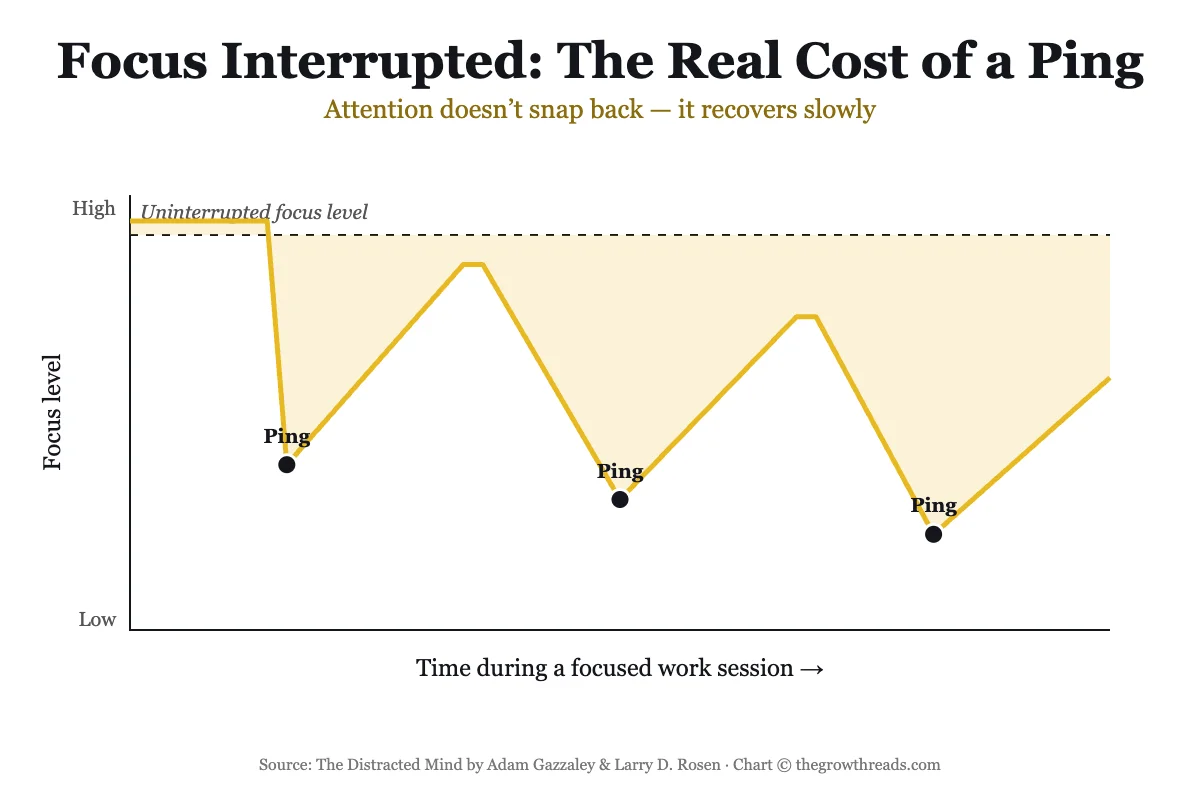
- Switching has a real cost: refocusing after an interruption takes measurable time and mental energy, not an instant snap-back.
- Age changes the picture: cognitive control tends to weaken with age, which is part of why older adults can show larger multitasking costs — and, per the authors’ own research, can also show real gains from targeted training.
- Environment beats willpower: removing a temptation from view works far more reliably than trying to resist it once it’s in front of you.
- Movement and stillness both help: physical exercise and short mindfulness practice each measurably support the same attention circuits.
- Awareness is a skill: metacognition — noticing when your attention has drifted — is trainable, and it’s the first step to steering it back.
What is The Distracted Mind about?
The Distracted Mind explains why focus feels so hard in a tech-saturated world: our brains evolved cognitive control systems built for a simpler environment, and modern information technology relentlessly exploits the gap between what we can handle and what we’re asked to handle, via both external distraction and self-generated interruption.
About the authors
Adam Gazzaley is a neuroscientist and professor at the University of California, San Francisco, where he directs a lab studying attention and cognitive control using tools like EEG and brain imaging. He is best known for leading the NeuroRacer research, published in Nature, on video-game-based training and cognitive control in older adults. Larry D. Rosen is a psychologist and professor emeritus at California State University, Dominguez Hills, who has spent decades researching the psychological impact of technology on daily life, from smartphone habits to generational differences in tech use. Together they bring a rare combination — hard neuroscience paired with real-world behavioral psychology — to a topic usually covered by pop-science generalists.
Key concepts at a glance
| Concept | What it means | Use it when |
|---|---|---|
| Distraction | An external interruption to your goal — a notification, noise, a person walking by. | You need to control your environment before a focus session. |
| Interruption | A self-generated urge to switch tasks, often unrelated to anything actually happening around you. | You notice you want to check something for no clear reason. |
| Cognitive control | The brain’s ability to pursue goals amid competing information — made of attention, working memory, and goal management. | You’re evaluating why a task suddenly feels harder to sustain. |
| Task-switching cost | The time and mental energy lost every time you shift between tasks, even briefly. | You’re deciding whether “quick multitasking” is really saving time. |
| Metacognition | Awareness of your own mental state — including noticing when your attention has drifted. | You want to catch a distraction before it derails a whole session. |
| Technology interference | The specific ways modern devices are designed to trigger both distraction and interruption. | You’re setting up device rules for focused work. |
| Cognitive control training | Structured practices — from targeted games to meditation and exercise — that can strengthen attention circuits. | You want a long-term plan, not just a one-day fix. |
Part 1: Two kinds of interference
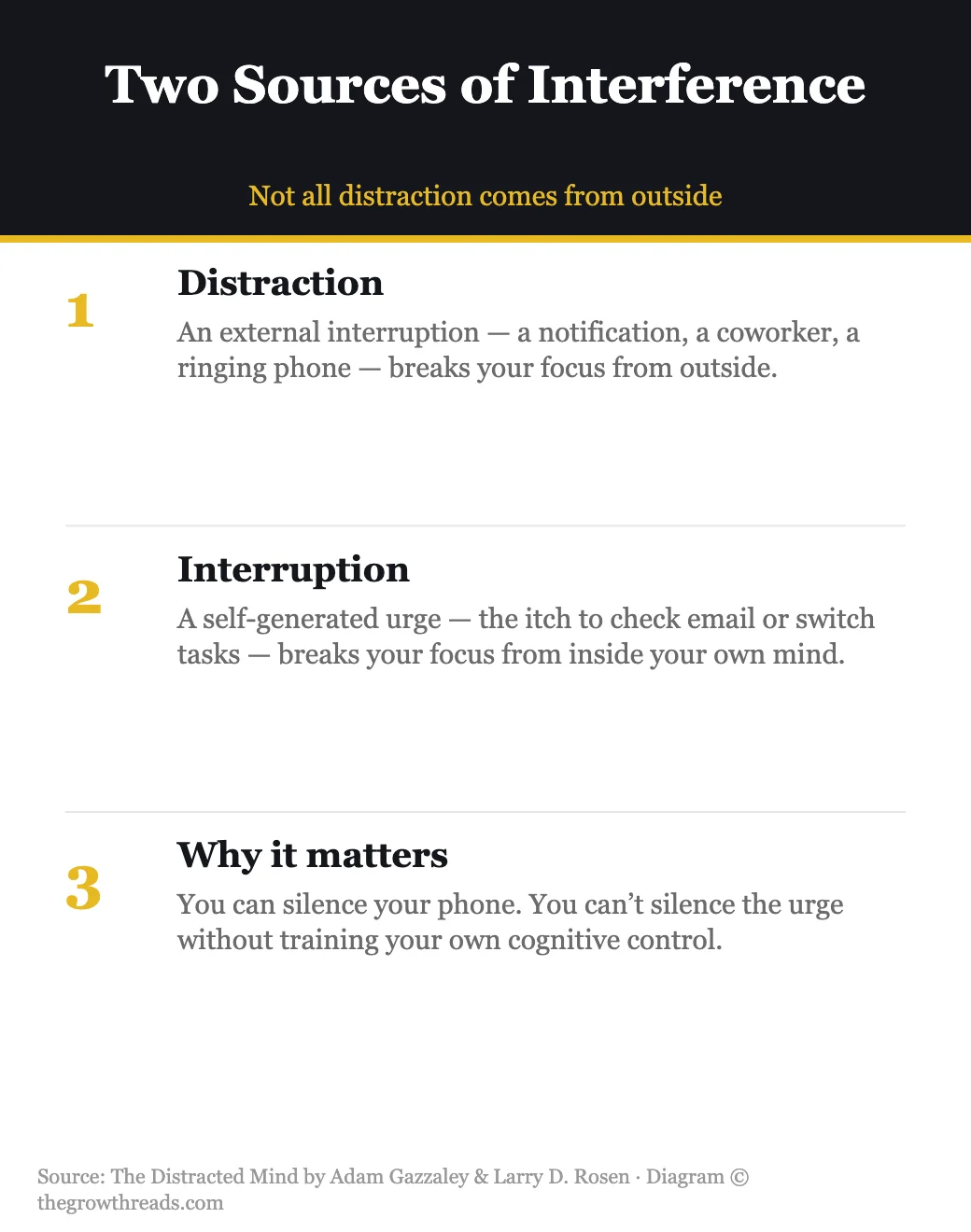
Gazzaley and Rosen open by drawing a distinction most productivity advice glosses over: not all lost focus comes from the same place. Distraction is external — a phone buzzing, a colleague stopping by your desk, background noise. Interruption is internal — the urge that rises up from inside your own mind to check something, switch tasks, or seek novelty, often with no external trigger at all. This matters because the fixes are different. You can silence a phone or close a door to handle distraction. Interruption is harder, because the impulse originates in you — which is why simply removing devices doesn’t fully solve the problem; it also takes training your own capacity to notice and resist the internal pull.
The authors trace this back to evolutionary mismatch: human cognitive control systems developed over a very long timescale, in an environment with far fewer competing demands for attention than a modern smartphone presents. That mismatch, more than any personal failing, is why focus feels like such a constant uphill effort today.
This plays out constantly in ordinary work: a single open email inbox, a chat app, and a phone on the desk can each independently pull at cognitive control throughout the day, long before any single one of them fully derails a task. The authors’ point isn’t that any one trigger is dangerous on its own — it’s that the cumulative, near-constant availability of triggers is what’s genuinely new, and genuinely hard for a brain that never had to filter this much at once.
TGR Note: This distraction-versus-interruption split pairs well with Gloria Mark’s research in our Attention Span summary, which digs deeper into how long attention actually takes to recover once it’s broken.
Part 2: Cognitive control’s Big Three
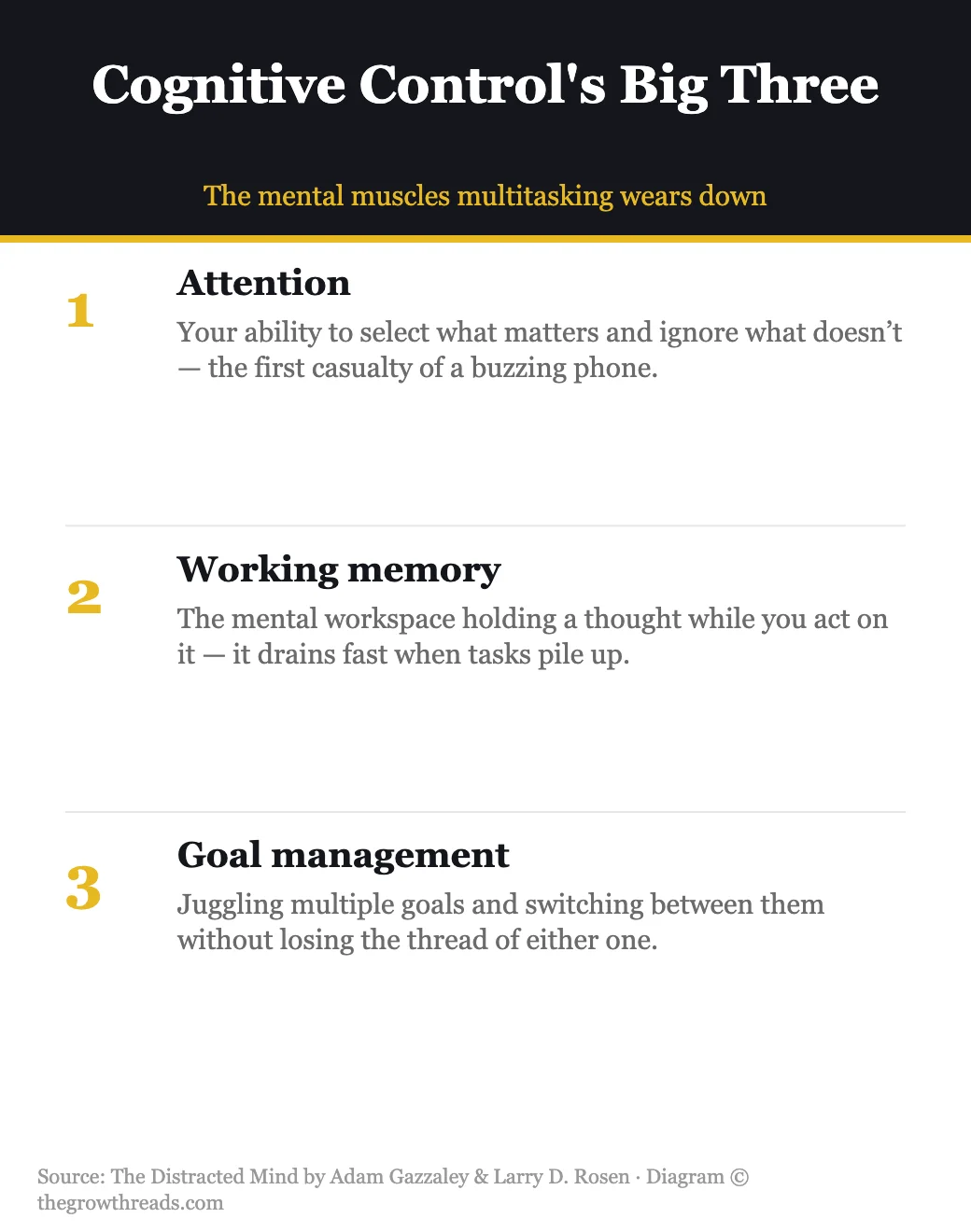
The book’s core neuroscience concept is “cognitive control” — the brain’s capacity to pursue a goal in the face of competing information. Gazzaley and Rosen break it into three interacting components: attention (selecting what matters and filtering what doesn’t), working memory (holding information active while you use it), and goal management (juggling and switching between objectives without losing track of either). All three draw on overlapping neural resources, particularly in the prefrontal cortex, and all three degrade under sustained interference.
This is also where the authors describe their own NeuroRacer research: a custom-built video game requiring simultaneous tasks, used to study multitasking costs across the lifespan. Older adults performed markedly worse at the dual-task version than younger adults — but after weeks of training on the game, older participants’ cognitive control scores improved, alongside measurable changes in brain activity. It’s a genuinely striking result, though it’s worth noting the wider scientific conversation about “brain training” is more mixed: whether gains from a specific game reliably transfer to everyday multitasking and attention outside the lab is still debated among researchers, and this book presents the finding as promising rather than as a settled, universal fix.
Working memory in particular gets a close look, since it’s the resource most visibly strained by interruption. Classic cognitive-science research has long suggested human working memory can hold only a handful of items actively at once — the exact number is debated and varies by task, but the general limit is well established. Every unrelated ping that forces its way into that small workspace pushes something else out, which is part of why returning to a complex task after even a short interruption can feel like starting over rather than simply resuming.
TGR Note: If the working-memory piece resonates, our Peak Mind summary covers Amishi Jha’s parallel research on how attention can be trained like a muscle, with a more meditation-first approach.
Part 3: Why “just multitasking” doesn’t work
Multitasking, as the authors describe it, is a bit of a misnomer — the brain doesn’t truly run two effortful tasks in parallel; it switches rapidly between them, and every switch carries a cost in time and accuracy. The book walks through the mechanics: when you shift from writing an email to checking a text and back, your brain has to disengage from one goal, reconfigure for the new one, then reconfigure again to return. Each of those transitions taxes working memory and goal management, which is why “quick” multitasking often takes noticeably longer, in total, than doing the same tasks one after another.
Gazzaley and Rosen also connect this to a real-world safety issue: texting while driving. They cite the sharply elevated crash risk associated with texting behind the wheel, drawing on transportation-safety research. Exact crash-risk multipliers vary somewhat between studies and data sources, so readers should treat any single specific number with some caution — but the directional finding, that texting while driving meaningfully increases crash risk, is well supported and consistent across the research the authors cite.
The authors also introduce a foraging-style explanation for why we compulsively check devices: much like an animal deciding whether to keep foraging in one patch or move to a potentially richer one, our brains weigh the perceived value of staying on task against the perceived value of switching to check something new — and notification-driven apps are engineered to make “checking” look like the richer patch, even when it usually isn’t.
Rosen’s own research background, much of it focused on how technology use differs across generations, also surfaces here. The book notes that younger people who have grown up with constant connectivity aren’t necessarily less capable of focus than older generations — but they have had far more practice normalizing frequent switching, which the authors suggest may shape default habits and expectations around attention rather than any fixed difference in underlying brain capacity.
TGR Note: The foraging-for-novelty framing echoes what we cover in our Dopamine Detox summary — both books land on the same practical advice: make the “rich patch” harder to reach.
Part 4: What actually helps
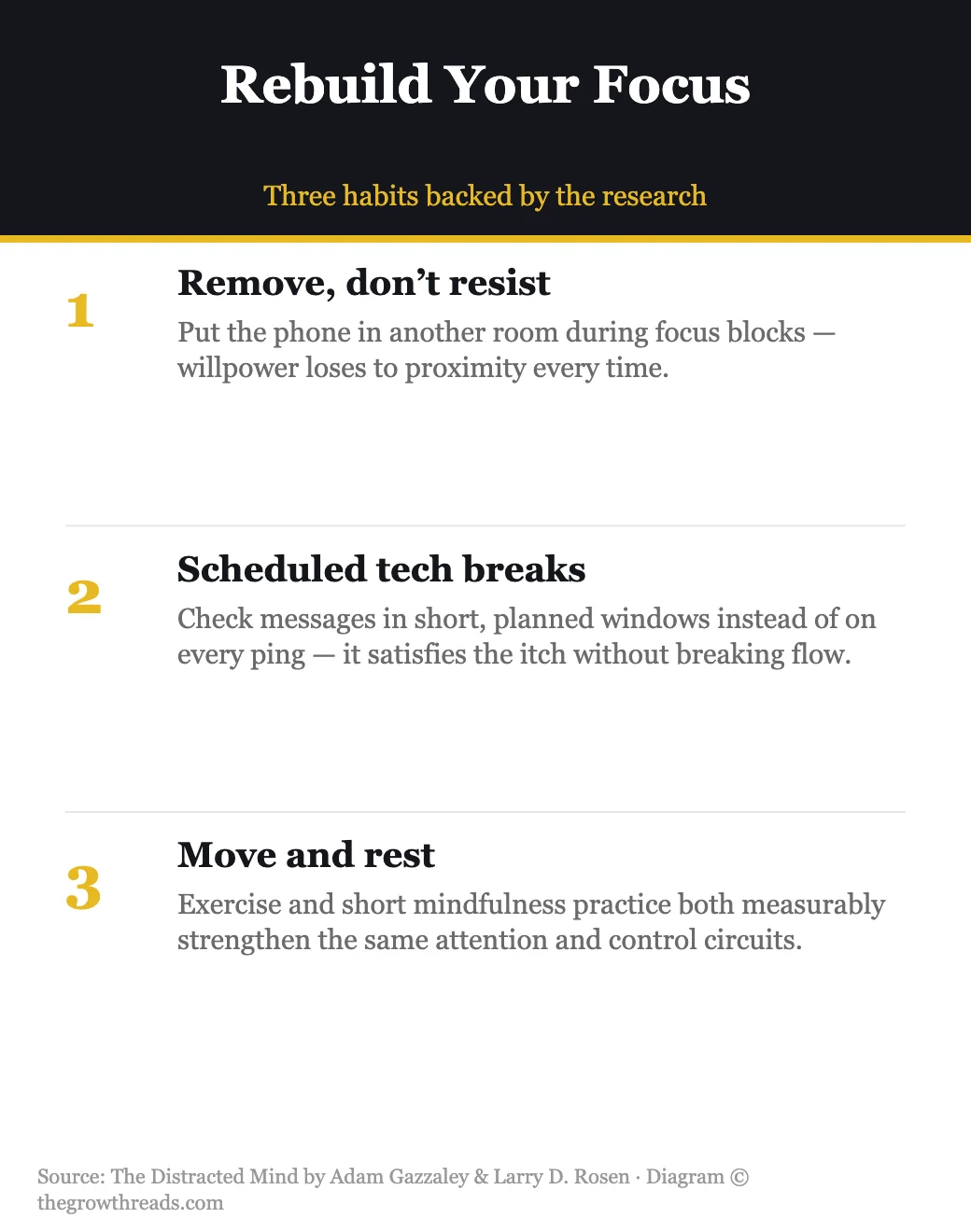
The book’s strongest practical chapters focus on evidence-backed interventions rather than willpower alone. Removing devices from the physical environment during focus blocks — not just silencing them, but putting them out of sight — reliably outperforms trying to resist an ever-present temptation. Scheduling specific windows to check messages, rather than responding to every notification as it arrives, lets you satisfy the urge to check on your own terms instead of the device’s. And two lifestyle factors show up repeatedly in the underlying research: regular physical exercise and short mindfulness or meditation practice both appear to support the same attention and cognitive-control circuits the book spends its first half describing.
Compared to most productivity books, The Distracted Mind spends more of its page count on diagnosis — the neuroscience of why focus breaks down — than on solutions. That’s arguably its biggest strength (few books in this space ground their advice this deeply in lab research) and also its main limitation for readers who want a longer menu of tactics; the practical chapters, while solid, are noticeably thinner than the explanatory ones. Some reviewers, including a critique published in Times Higher Education by academic Shane O’Mara, have also pushed back on the book’s evolutionary-mismatch framing itself, questioning how cleanly modern distraction maps onto ancient brain circuitry — worth keeping in mind as one perspective among several on a genuinely still-debated question in cognitive science.
It’s also worth noting the book operates on two levels that don’t always get equal airtime elsewhere: individual habits (what one person can change about their own environment and routine) and technology design (how devices and apps could be built differently to reduce interference in the first place). The authors are clear that individual strategies are what a reader can act on today, while the design-level changes are more of a longer-term, industry-wide hope — a useful distinction for setting realistic expectations about what a single reader’s habits alone can and can’t fix.
TGR Note: For a gentler, less device-focused route into the same territory, our How to Do Nothing summary makes a complementary case for protecting attention as a resource worth defending.
Who is The Distracted Mind best for — and who should read something else first?
This book is best for readers who want to understand the actual neuroscience behind digital distraction, not just a list of hacks — think knowledge workers, parents worried about screen habits, or anyone who’s tried a dozen productivity apps without addressing the underlying attention problem. If you already want the science and are looking for a lighter, more narrative read on the same subject, start with our Attention Span summary instead. If you want a faster, more tactical entry point with fewer research citations, our Dopamine Detox summary is a quicker on-ramp.
Questions to reflect on
- When you reach for your phone during focused work, is it usually triggered by something external (a buzz) or something internal (an urge)?
- What’s one task today where “multitasking” actually made things take longer, not shorter?
- Which is easier for you to control right now: your environment, or your response to an urge?
- Where in your day could a scheduled “check window” replace constant on-demand checking?
- Do you currently build any exercise or mindfulness practice into your week — and could it double as attention training?
🔥 Ready to understand your own distracted mind?
Get the full research behind the framework — and the complete set of strategies.
How to apply The Distracted Mind (7-day plan)
- Day 1 — Notice the difference: for one day, mentally tag every focus break as “distraction” (external) or “interruption” (internal) as it happens.
- Day 2 — Remove, don’t resist: pick one work block and physically move your phone to another room before you start.
- Day 3 — Set a check window: choose two fixed times to check messages instead of responding as they arrive.
- Day 4 — Track a switch cost: next time you multitask, note how long it actually takes to get back to full speed on the original task.
- Day 5 — Add movement: take one exercise break — even a 15-minute walk — and notice how your focus feels afterward.
- Day 6 — Try five minutes of stillness: sit for a short mindfulness practice before your hardest task of the day.
- Day 7 — Review and rebuild: look back at the week and pick the one change — environment, check windows, movement, or stillness — that made the biggest difference, then keep it.
Frequently asked questions
What is the main idea of The Distracted Mind?
The book argues that human brains evolved cognitive control systems suited to a much simpler environment, and that modern technology exploits the resulting mismatch through two mechanisms: external distraction and internally generated interruption. Understanding which one is at play in a given moment points to different, more effective fixes than generic willpower advice.
Is multitasking really impossible?
Not impossible, but far less efficient than it feels. The authors explain that what we call multitasking is usually rapid switching between tasks rather than true simultaneous processing, and each switch carries a measurable cost in time, accuracy, and mental effort — costs that add up quickly across a busy day.
What is the NeuroRacer study, and how strong is the evidence?
NeuroRacer is a custom video game Adam Gazzaley’s lab used to study multitasking and cognitive control across age groups, with results published in the journal Nature. Older adults showed real, measurable improvement in cognitive control after training. It’s a well-regarded study, though like most “brain training” research, how far its gains transfer to everyday, real-world multitasking is still an active and somewhat unsettled question among scientists.
Does the book blame technology entirely for distraction?
No — one of its more nuanced points is that a meaningful share of distraction is self-generated, arising from internal urges rather than external triggers like notifications. Technology is designed to amplify that internal pull, but the authors are careful to distinguish the two sources rather than placing all the blame on devices.
What practical strategies does the book recommend?
The most emphasized strategies are environmental: physically removing devices during focus time rather than relying on willpower, and scheduling specific windows for checking messages instead of responding on demand. The authors also point to regular exercise and short mindfulness practice as habits that measurably support the same attention circuits involved in resisting distraction.
How is this book different from other books on focus and attention?
Its authors are working neuroscientists and psychologists, and the book leans more heavily on original lab research — including the authors’ own studies — than most popular books on distraction and productivity. That makes the diagnosis chapters especially detailed, though it also means the solutions section is comparatively shorter than in more tactics-focused books.
Is The Distracted Mind worth reading if I’ve already read other focus books?
Yes, particularly for the underlying “why.” Many popular focus books borrow findings from cognitive science without much explanation of the mechanisms; this book supplies that missing layer, written by two of the researchers actually doing the work, which can make advice from other books click into place more clearly.
Related summaries
If this topic resonated, continue with our Attention Span summary, Dopamine Detox summary, Peak Mind summary, and How to Do Nothing summary — or browse the full best productivity books collection.
How we analyze books: we read the full text, cross-check key claims and studies against primary sources, and build original diagrams and application plans rather than reproducing the book’s content. Read our full methodology.