

★★★★☆ 4.5/5 — A vivid, kitchen-tested system for organizing any kind of work, built from real professional-chef discipline rather than generic productivity advice.
Best for: Anyone who feels chronically behind, disorganized, or reactive during a busy workday.
Reading time: ~6.5 hrs to read, 25-30 min for this guide.
Difficulty to apply: Easy to start, ongoing to master — the habits are simple but meant to become second nature over time.
Work Clean in one minute
Professional kitchens run on a discipline most offices never learned: mise-en-place, “everything in its place.” Journalist and NYU professor Dan Charnas spent years interviewing chefs to understand how kitchens stay organized and calm under the kind of pressure that would overwhelm most workplaces — then built a ten-principle system for translating that discipline into any kind of work. The book argues that unlike business schools, culinary and military training uniquely combine skill instruction with workflow discipline, which is exactly the gap most knowledge workers are missing. The result is less a list of productivity hacks and more a full mindset: preparation, process, and presence, applied consistently until organization becomes automatic.
Key takeaways
- Mise-en-place isn’t just for kitchens: “everything in its place” is a general discipline for organizing any kind of work, physical or digital.
- Planning is prime: the preparation you do before starting determines how well the actual work goes.
- Arrange your space deliberately: a well-organized workspace eliminates wasted motion and wasted attention.
- Clean as you go: continuous small tidying beats letting mess and half-finished tasks accumulate.
- Finish what you start: an “orphaned” half-done task quietly drains focus long after you’ve moved on.
- Slow down to speed up: deliberate, unhurried pacing prevents the costly mistakes that come from rushing.
- The Daily Meeze: a short daily planning ritual — borrowed directly from kitchen prep — resets your focus before the day gets away from you.
- Know your Meeze Point: everyone has a task load where performance peaks — learn yours and notice when you’re about to cross it.
- Total utilization: use your time, space, and resources fully rather than letting anything go to waste.
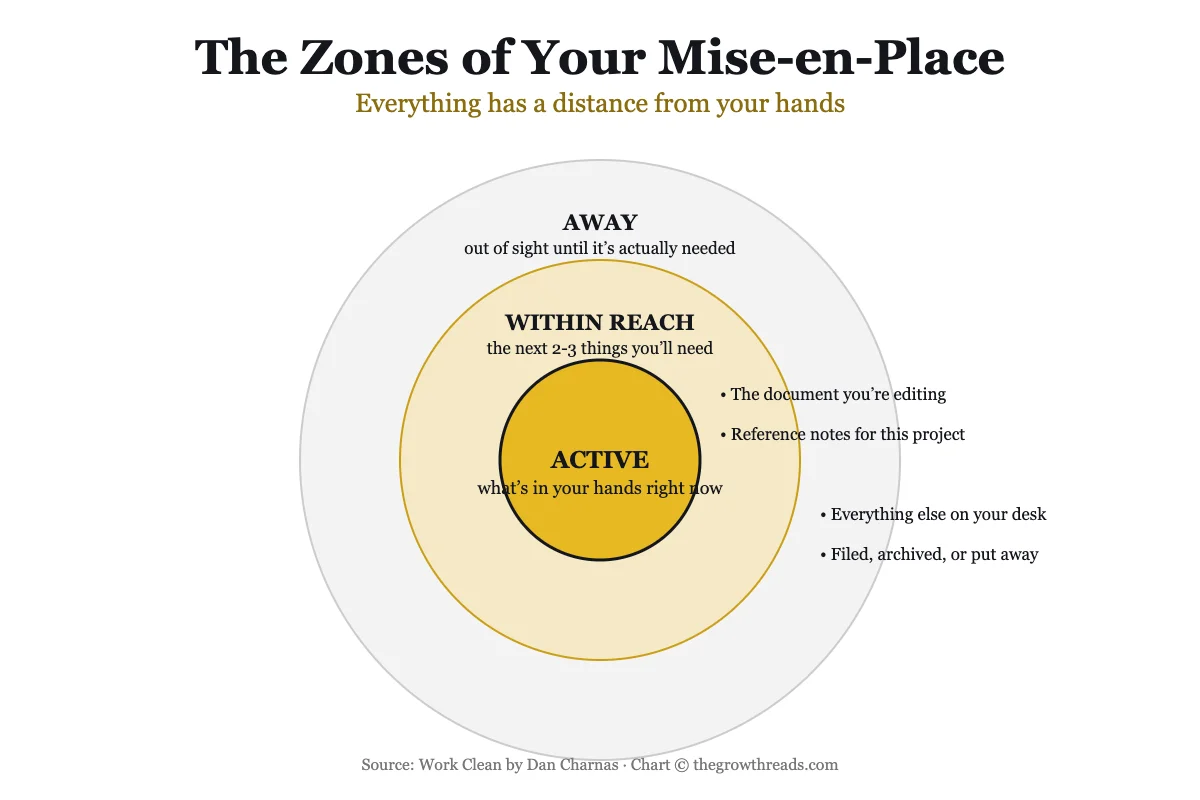
What is Work Clean about?
Work Clean adapts mise-en-place — the professional kitchen’s discipline of preparing and arranging everything before service begins — into a ten-principle system for organizing any kind of work, arguing that preparation, process, and presence are learnable habits, not just personality traits some people happen to have.
About the author
Dan Charnas is a journalist, author, and professor at NYU’s Clive Davis Institute of Recorded Music, best known before this book for his hip-hop industry history The Big Payback. He is not a professional chef — Work Clean grew directly out of his own struggles managing chaotic, multi-track creative and business work, which led him to spend years interviewing more than 100 culinary professionals to reverse-engineer how kitchens function under intense time pressure. That reporting process itself models one of the book’s own principles — thorough preparation before producing the finished work — a self-consistency that gives the resulting framework unusual credibility for a genre often built on secondhand research. That outsider’s curiosity is part of what makes the book work: Charnas approaches kitchen discipline as a journalist translating an unfamiliar expert culture for the rest of us, rather than a chef preaching to non-chefs. Explore all Dan Charnas book summaries →
That journalist’s lens shows up throughout the book in the form of specific, named professional kitchens and cooks whose habits Charnas studied directly, which gives the ten principles a grounded, reported feel rather than reading like abstracted business-book advice.
Key concepts at a glance
| Concept | What it means | Use it when |
|---|---|---|
| Mise-en-place | “Everything in its place” — the kitchen discipline of full preparation before work begins. | You’re about to start any task, project, or workday. |
| Planning is prime | Preparation determines performance — the unseen work before the work. | You keep feeling behind before you’ve even started. |
| Clean as you go | Continuous small tidying instead of end-of-task cleanup. | Mess and loose ends keep piling up during the day. |
| Finishing actions | Fully completing one task before starting the next. | You notice several tasks are “almost done” but not quite. |
| Daily Meeze | A short daily ritual for planning and resetting, borrowed from kitchen pre-shift prep. | You want one habit to anchor your whole day. |
| Meeze Point | The task load at which your performance is at its best. | You’re deciding whether to take on one more thing. |
| Total utilization | Using your time, space, and resources fully, without waste. | You’re reviewing how efficiently a project actually ran. |
Part 1: Preparation — planning, arranging, and the first move
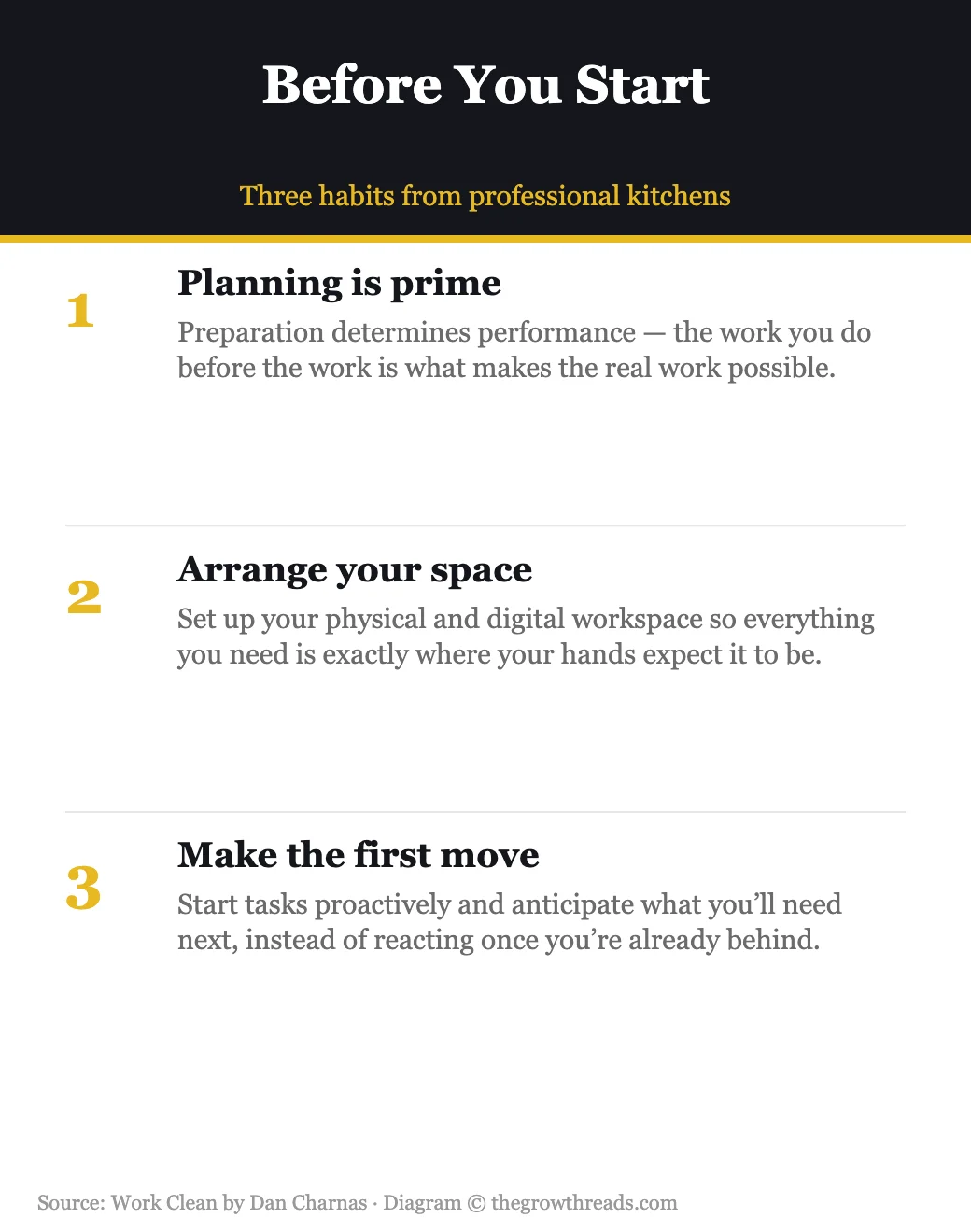
The book opens with the principles that happen before work starts. “Planning is prime” is Charnas’s foundational claim: professional kitchens don’t start cooking until every ingredient is prepped, measured, and within reach, because improvising mid-service is how mistakes happen. He extends this directly to office and creative work — the time spent planning a day, a project, or even a single task is not overhead, it’s what makes the actual execution smooth.
Charnas is careful to distinguish real planning from the kind of endless list-making that becomes its own form of procrastination. Kitchen prep has a hard deadline — service starts at a fixed time whether you’re ready or not — and he argues the same constraint discipline helps office planning stay useful rather than open-ended: plan with a clear stopping point, then start.
“Arranging spaces and perfecting movements” follows naturally: a well-run kitchen station is laid out so a chef’s hands never have to search for anything, and Charnas argues the same principle applies to a desk, an inbox, or a set of digital files. “Making first moves” rounds out this opening cluster — anticipating what you’ll need before you need it, rather than discovering mid-task that you’re missing something essential.
Charnas ties these three principles together with a simple test: could someone else walk up to your station and immediately understand what’s going on and what happens next? In a well-run kitchen, the answer is always yes — every ingredient labeled, every tool in its expected spot, every step legible at a glance. That standard of legibility, applied to a desk or a project file, is a surprisingly demanding bar most workspaces never actually meet.
TGR Note: The “arrange your space” principle pairs well with the environment-first advice in our The Distracted Mind summary — both books land on the same idea: your surroundings do a lot of the self-control work for you, if you set them up right.
Part 2: Process — staying clean and finishing what you start
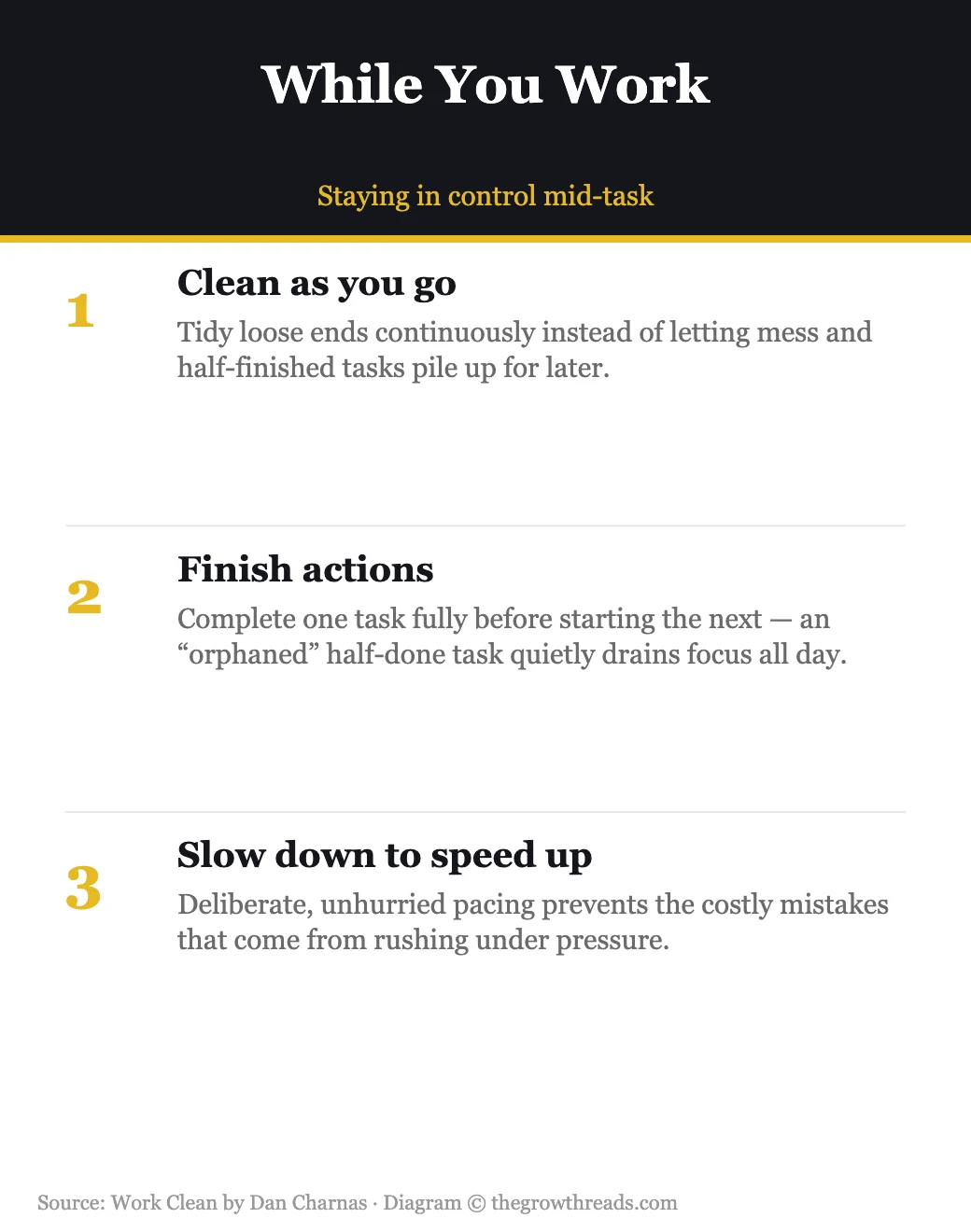
The middle of the book turns to habits maintained during the work itself. “Cleaning as you go” is one of the book’s most repeated principles: in a professional kitchen, a station left messy for even a few minutes compounds into chaos by the dinner rush, so cooks wipe down, put things back, and clear scraps continuously rather than in one big effort later. Charnas argues office work has an equivalent — an inbox, a desktop, or a project folder that isn’t tended continuously becomes its own kind of mess that eventually costs real time to untangle.
“Finishing actions” addresses a subtler problem: tasks that are 90% done but never quite closed out. Charnas calls these “orphaned” tasks, and argues they carry a hidden cost — each one occupies a small amount of ongoing attention, even when you’re not consciously thinking about it, simply because it’s unresolved. He suggests keeping a short, visible list of orphaned tasks specifically so they can be closed deliberately, rather than trusting memory to eventually resolve them on its own. “Slowing down to speed up” closes this cluster: kitchens that move fastest under pressure are the ones with the calmest, most deliberate cooks, not the most frantic ones — rushing reliably produces more errors and, paradoxically, more lost time overall.
This lands differently than most “hustle harder” productivity advice: Charnas’s kitchens aren’t calm because the pace is slow — dinner service is genuinely relentless — they’re calm because the cooks have removed everything that would force them to rush unnecessarily. Speed, in his framing, is a byproduct of good preparation and steady process, not a virtue to chase directly by simply moving faster through disorganized work.
TGR Note: The “orphaned tasks” idea echoes the working-memory research in our Your Brain at Work summary — an unfinished task really does seem to occupy real mental capacity, not just guilt.
Part 3: The Daily Meeze and finding your Meeze Point
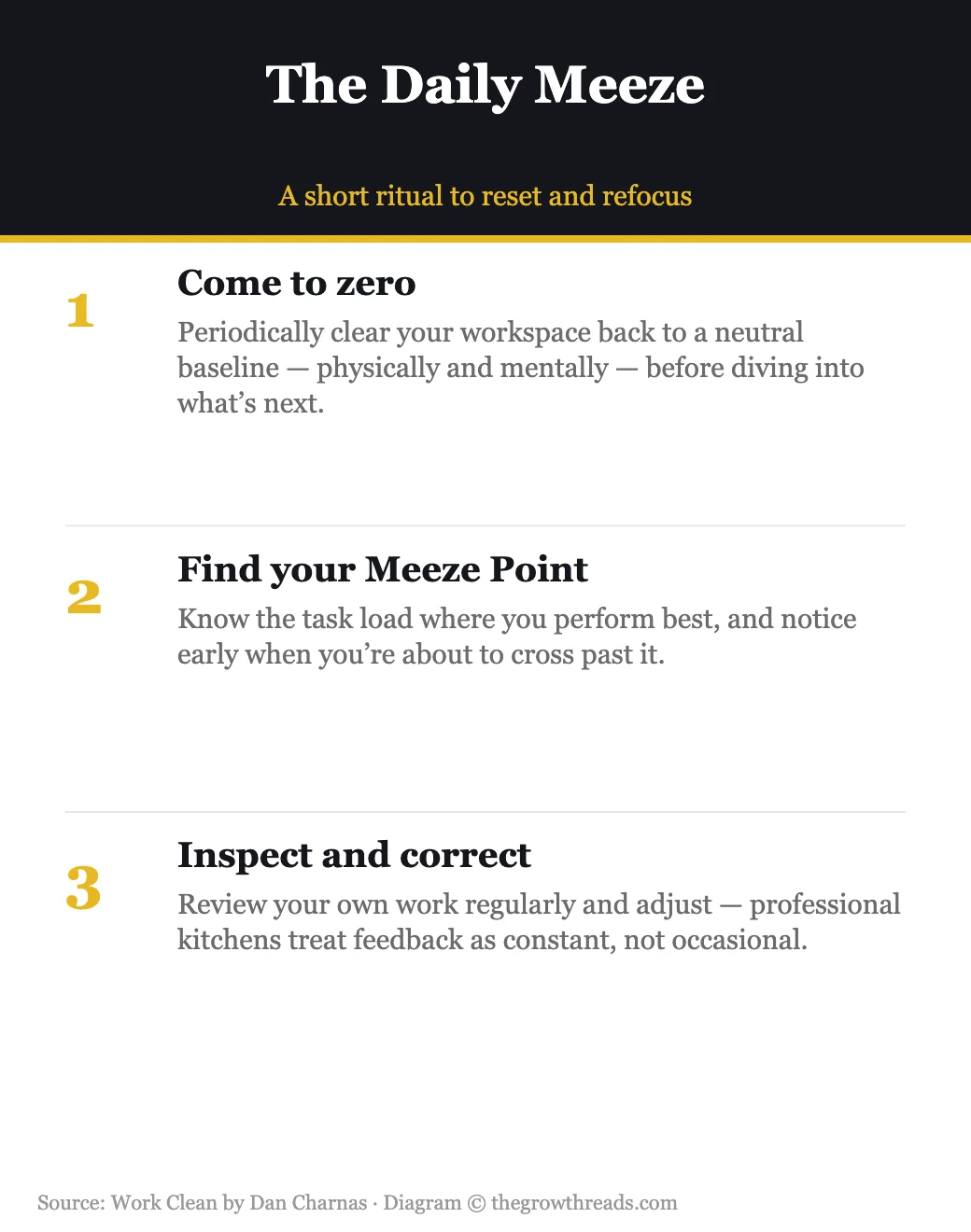
Charnas packages several of the book’s ideas into a single practical ritual he calls the “Daily Meeze” — a short daily session, borrowed from the pre-shift prep chefs do before service, for reviewing what’s ahead and organizing your resources before diving in. It’s meant to be brief, consistent, and protective: a fixed moment where you “come to zero,” clearing your workspace and your mental queue back to a neutral baseline before the day’s demands start pulling you in different directions.
Alongside this, Charnas introduces the “Meeze Point” — the specific task load at which a given person performs at their best. Past that point, adding more doesn’t increase output, it degrades it, the same way a kitchen station overloaded with orders starts producing worse food more slowly rather than more food faster. The book’s advice is to learn your own Meeze Point through observation rather than guesswork, and to treat “no” or “not right now” as a legitimate response once you’re near it.
This is one of the more counterintuitive parts of the book for ambitious readers: Charnas argues that pushing past your Meeze Point doesn’t just feel worse, it measurably produces worse output, the same way an overloaded kitchen station starts sending out dishes that are late, wrong, or both. Knowing your own limit, in this framing, isn’t a concession — it’s the same kind of professional discipline that lets a kitchen protect its standards during the busiest possible shift.
TGR Note: The Meeze Point concept is a close cousin of the cognitive-load ideas in our The Distracted Mind summary — both point toward the same practical lesson: know your capacity before you exceed it, not after.
Part 4: Total utilization and applying it beyond the kitchen
The book’s final principles round out the system: “calling it out” (the verbal confirmation and checklist culture common in professional kitchens, adapted to office communication and status updates), “open ears and eyes” (staying aware of your surrounding environment even while task-focused), “inspecting and correcting” (treating feedback and self-review as constant rather than occasional), and “total utilization” (using time, space, and resources fully rather than letting anything go to waste).
Charnas is explicit that the goal isn’t to turn an office into a kitchen — it’s to borrow the underlying discipline. He extends the framework well beyond desks, applying it to email management, creative projects, and even home organization, framing mise-en-place less as an efficiency hack and more as what he calls an “ethics of excellence”: a standard you hold yourself to consistently, not just when it’s convenient.
The book leans heavily on restaurant anecdotes and named chefs to make its case, which gives the writing genuine texture and credibility — Charnas interviewed over 100 culinary professionals to build the framework — though some readers looking for a purely tactical, no-narrative guide may find the kitchen stories run longer than strictly necessary to make each point.
That trade-off is worth naming directly: readers who want a quick checklist may find the restaurant anecdotes add length without always adding new instruction, since several chapters return to the same underlying idea from a slightly different kitchen scene. But for readers who respond to narrative and concrete example over abstract principle, that same repetition is likely what makes the ten principles stick well after the book is finished.
TGR Note: If total utilization and physical organization resonate, our Decluttering at the Speed of Life summary covers a complementary, home-focused approach to the same “everything in its place” philosophy.
Who is Work Clean best for — and who should read something else first?
This book is best for anyone who feels chronically reactive or disorganized during a busy workday — freelancers, creatives, managers, and anyone juggling multiple projects at once will find the kitchen metaphor unusually concrete and actionable. If you want the neuroscience behind why disorganization is so mentally costly, pair this with our Your Brain at Work summary. If your disorganization is more about physical clutter than workflow, start with our Decluttering at the Speed of Life summary instead.
Questions to reflect on
- What does your version of a “Daily Meeze” look like, and could you protect five minutes for it tomorrow?
- Which of your current tasks are “orphaned” — 90% done but never quite closed out?
- Where in your workspace do your hands have to search for something that should already be within reach?
- What’s your Meeze Point — the task load where your work actually gets worse, not better?
- Where could “slowing down” this week actually save you time later?
🔥 Ready to bring kitchen discipline to your own work?
Get the full ten-principle system and every technique from the book.
How to apply Work Clean (7-day plan)
- Day 1 — Try a 5-minute Daily Meeze: before starting work, spend five minutes reviewing what’s ahead and clearing your immediate workspace.
- Day 2 — Arrange one space: reorganize a single desk, drawer, or digital folder so everything in it is exactly where your hands expect it.
- Day 3 — Finish one orphaned task: find a task that’s 90% done and actually close it out today.
- Day 4 — Clean as you go: for one full day, tidy immediately after each task instead of saving it for later.
- Day 5 — Slow down on purpose: pick one task you’d normally rush and do it deliberately slower — notice the difference in errors.
- Day 6 — Track your Meeze Point: notice the moment today when adding one more task started making everything worse, not better.
- Day 7 — Review and rebuild: pick the one principle — planning, arranging, finishing, or slowing down — that made the biggest difference, and keep it as a permanent habit.
Frequently asked questions
What is mise-en-place?
Mise-en-place is a French culinary term meaning “everything in its place” — the professional kitchen discipline of preparing, measuring, and arranging every ingredient and tool before cooking begins. Work Clean adapts this discipline into a general system for organizing any kind of work, not just cooking.
Is Dan Charnas a professional chef?
No — Charnas is a journalist and NYU professor. Work Clean grew out of his own struggles managing chaotic creative and business work, which led him to interview more than 100 culinary professionals to understand how kitchens function under pressure, then translate that discipline for office and creative workers.
What are the book’s core principles?
The book organizes mise-en-place into ten principles built on three underlying values — preparation, process, and presence. They include planning is prime, arranging spaces, cleaning as you go, finishing actions, making first moves, slowing down to speed up, calling it out, open ears and eyes, inspecting and correcting, and total utilization.
What is the “Daily Meeze”?
The Daily Meeze is a short daily ritual, borrowed from the pre-shift preparation professional cooks do before service, for planning ahead and resetting your workspace and mental queue before diving into the day’s tasks. Charnas presents it as the book’s most practical entry point for readers who want to start with one habit.
Does this system only work for physical, hands-on jobs?
No — the book explicitly extends mise-en-place to knowledge work, creative projects, email management, and even home life, treating it as a mindset rather than a set of physical-only habits. That said, some readers find the kitchen-to-office analogy works more cleanly for certain kinds of tasks than others.
How is this different from other organization or productivity books?
Most productivity books draw on business or psychology research. Work Clean instead draws on a real, tested professional discipline — the way kitchens function under extreme time pressure — which gives it a vivid, concrete texture and a genuinely different set of source material than typical productivity advice.
What’s the easiest principle to start with?
Many readers start with “clean as you go,” since it requires no new planning system — just tidying continuously rather than saving it for later. It’s also the principle most people can test in a single afternoon without committing to the whole system, which makes it a low-risk way to see whether the broader framework is worth adopting. The Daily Meeze is a close second, since it’s a single short ritual rather than a full mindset shift.
Related summaries
If this topic resonated, continue with our Your Brain at Work summary, Decluttering at the Speed of Life summary, The Distracted Mind summary, and It Doesn’t Have to Be Crazy at Work summary — or browse the full best productivity books collection.
How we analyze books: we read the full text, cross-check key claims and studies against primary sources, and build original diagrams and application plans rather than reproducing the book’s content. Read our full methodology.