

⭐⭐⭐⭐ 4.4 / 5 — A sweeping, provocative history of humankind that fundamentally changes how you see civilization, progress, and yourself.
Best for: Curious thinkers, history enthusiasts, and anyone who wants to understand the big-picture forces — cognitive, agricultural, scientific — that shaped the modern world.
Reading time: ~15 hours (498 pages)
Difficulty to apply: Low — this is a perspective-shifting book rather than a how-to guide. The insights reshape how you interpret current events, institutions, and human behavior.
Sapiens in one minute
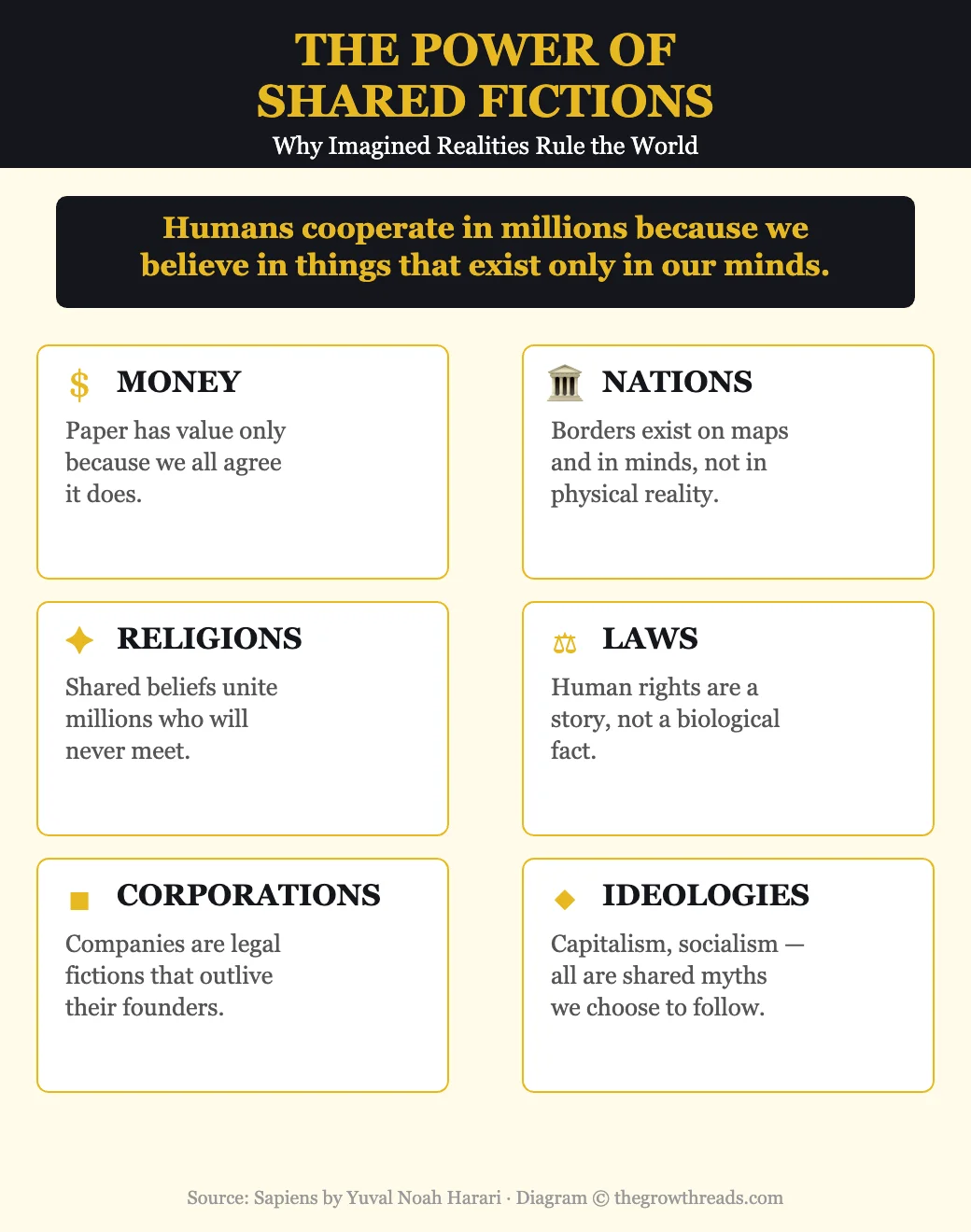
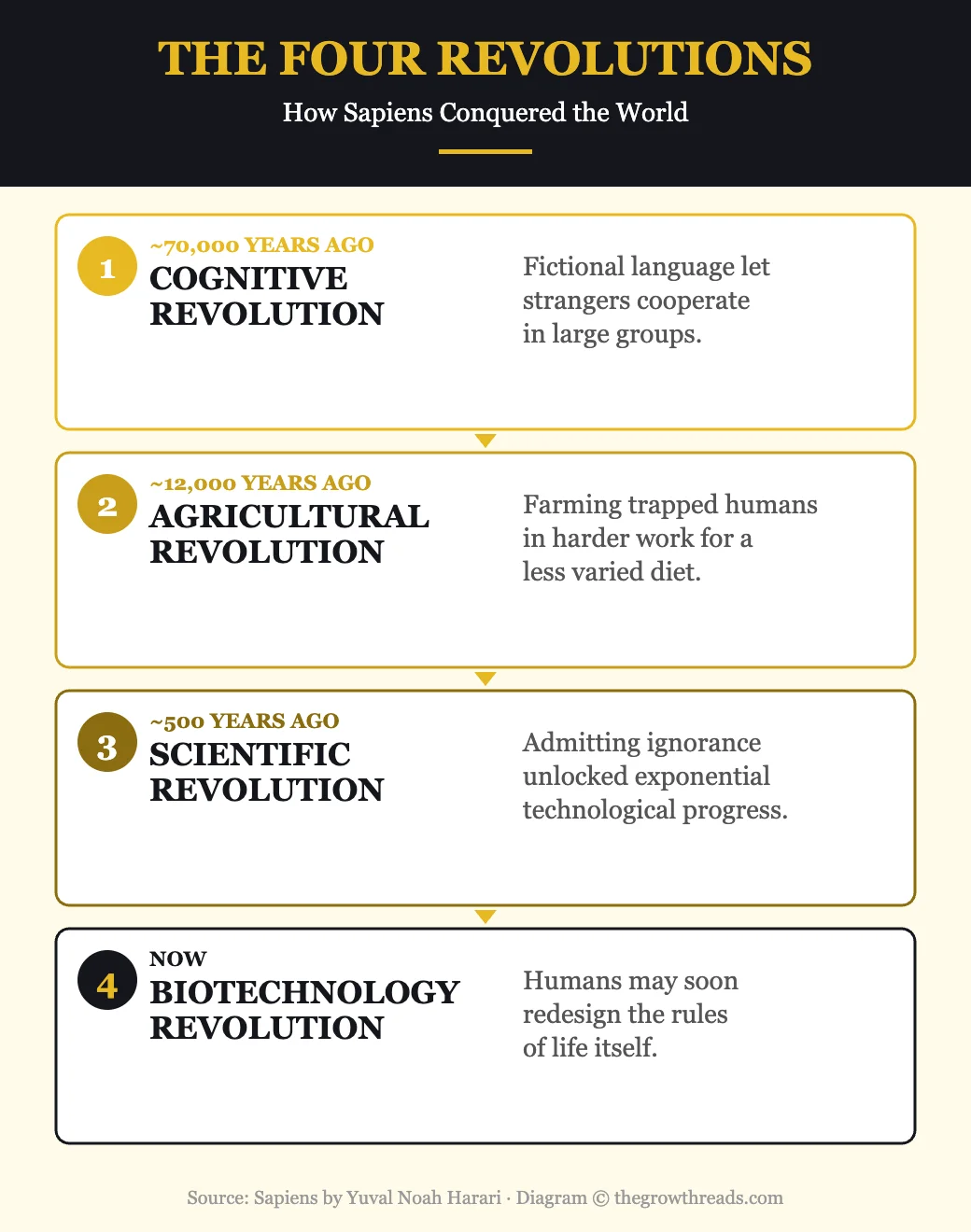
Seventy thousand years ago, Homo sapiens was an insignificant animal living in a corner of Africa — today, we are the most dominant force on Earth, and the key to that transformation was not our muscles, tools, or brains, but our unique ability to believe in shared fictions. Yuval Noah Harari traces the entire arc of human history through four transformative revolutions: the Cognitive Revolution (which gave us language and imagination), the Agricultural Revolution (which he controversially calls “history’s biggest fraud”), the Scientific Revolution (which married ignorance with power), and the unfolding biotechnological revolution (which may allow us to redesign life itself). The book’s central argument is that everything that enables mass human cooperation — money, nations, religions, laws, corporations — exists only in our collective imagination. Understanding this changes how you see every institution you participate in.
Key takeaways
- Shared fictions are humanity’s superpower: The ability to create and believe in imagined realities — gods, nations, money, human rights — is what allows millions of strangers to cooperate. No other animal can do this.
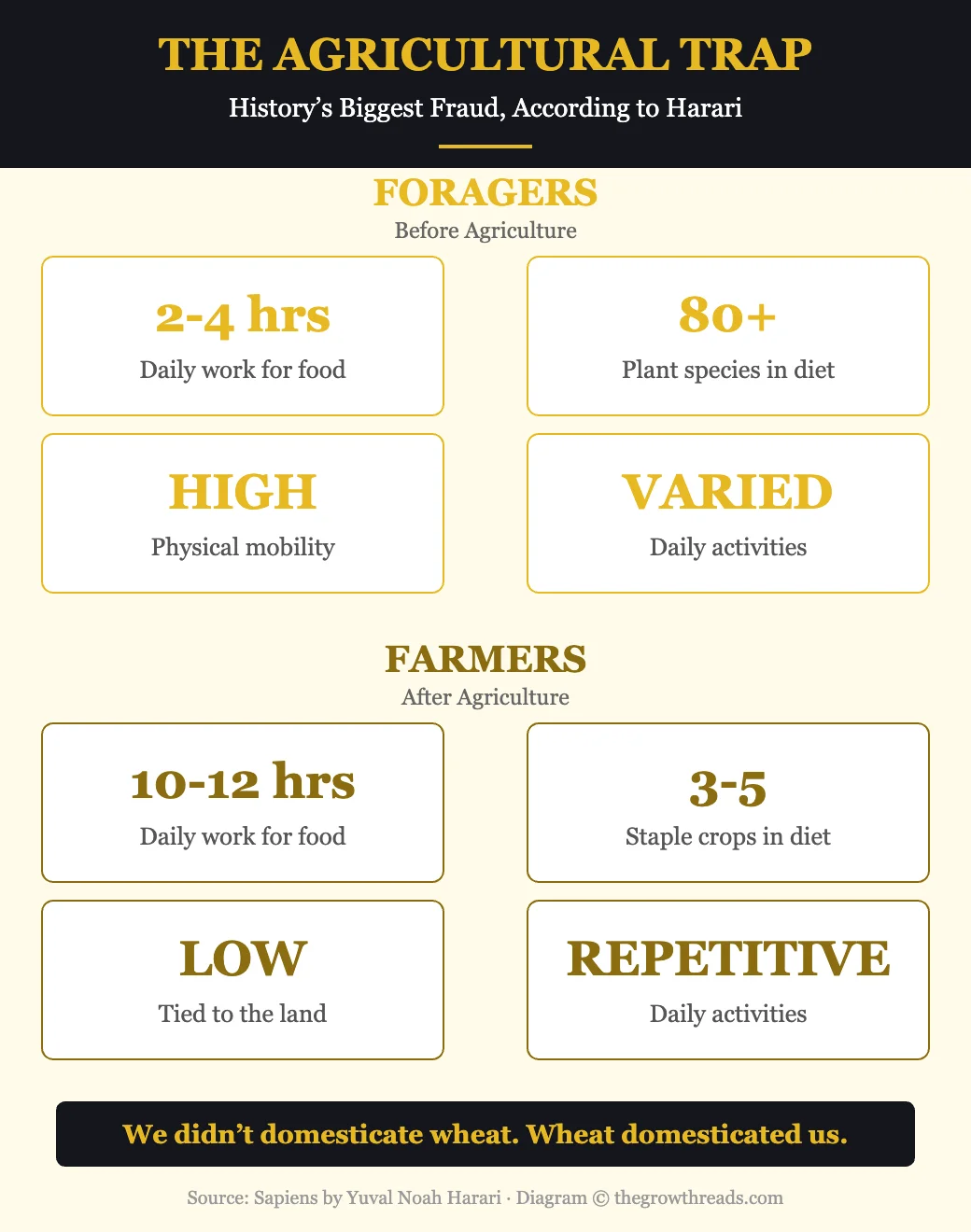
- The Agricultural Revolution was a trap: Farming made societies more productive in aggregate but made individual lives worse — longer hours, poorer diets, more disease, and less freedom than hunter-gatherers enjoyed.
- Biology enables, culture directs: Our biology has not changed significantly in 70,000 years. Everything that separates us from our forager ancestors — cities, empires, smartphones — is the product of cultural evolution, not biological evolution.
- History is not inevitable: There was nothing predetermined about the rise of Christianity, capitalism, or Western dominance. These outcomes resulted from contingent events and human choices, not destiny.
- Money is the most universal fiction: Money is the most successful shared belief system ever created — it is the only trust system that can bridge almost any cultural gap.
- Empire and religion spread culture: Large-scale human unification has historically been driven by empires (political), religions (ideological), and money (economic) — often working together.
- Science married ignorance to power: The Scientific Revolution began when humans admitted they did not know everything, then discovered that new knowledge could be converted into military and economic power.
- Capitalism is a belief system: The modern economy runs on the collective faith that the future will be more productive than the present — a faith that creates the credit that funds growth.
- Happiness has not kept pace with progress: Despite enormous gains in wealth, technology, and comfort, there is little evidence that modern humans are happier than their forager ancestors.
- We are becoming gods without knowing what we want: Humanity has acquired extraordinary powers over nature and biology but has no clear vision of what to do with them — making us more dangerous than ever.
What is Sapiens about?
Sapiens traces the entire history of humankind from the emergence of Homo sapiens in Africa 300,000 years ago to the present day, arguing that our species conquered the world not through physical superiority but through our unique ability to create and believe in shared fictions — from religions and nations to money and human rights.
About the author
Yuval Noah Harari is an Israeli historian and professor at the Hebrew University of Jerusalem, specializing in world history, medieval history, and military history. Born in 1976, he studied at the Hebrew University and completed his Ph.D. at the University of Oxford. Sapiens, originally published in Hebrew in 2011, became a global phenomenon after its English translation in 2014, selling over 25 million copies in 65 languages. Harari has since written Homo Deus (exploring the future of humanity) and 21 Lessons for the 21st Century. His work is distinguished by its ability to synthesize vast amounts of historical, scientific, and philosophical knowledge into accessible narratives that challenge conventional assumptions about progress and civilization. Explore all Yuval Noah Harari book summaries →
Key concepts at a glance
| Concept | What it means | Use it when |
|---|---|---|
| Imagined Realities | Shared fictions (money, nations, laws) that exist only in collective belief | You want to understand why institutions have power |
| Cognitive Revolution | The emergence of fictional language ~70,000 years ago | Understanding what makes humans unique among species |
| Agricultural Trap | Farming made societies richer but individuals worse off | Questioning whether “progress” always improves lives |
| Unification of Humankind | Money, empire, and religion as forces merging separate cultures | Seeing the deep structures behind globalization |
| Scientific Revolution | Admitting ignorance + linking knowledge to power | Understanding why science and capitalism grew together |
| Credit and Capitalism | The modern economy runs on faith in future growth | Understanding how economic systems are belief systems |
| The Happiness Question | Material progress has not demonstrably increased human happiness | Evaluating what “progress” really means for well-being |
| Homo Deus Problem | Humans gaining godlike powers without godlike wisdom | Thinking about the ethical implications of technology |
Part 1: The Cognitive Revolution — how fiction conquered biology
Harari begins with a startling premise: for most of our 300,000-year history, Homo sapiens was unremarkable. We shared the planet with at least five other human species — Neanderthals, Denisovans, Homo erectus, Homo floresiensis, and Homo soloensis. Physically, we were middle-of-the-pack. Our brains were large but expensive to run, consuming roughly 25% of our energy at rest. We had no claws, no venom, no particularly impressive speed. What happened around 70,000 years ago to change everything?
The answer, Harari argues, was the Cognitive Revolution — a transformation in the way Sapiens’ brains processed and communicated information. Other animals can communicate about concrete realities: “Careful! A lion!” But only Sapiens developed the ability to talk about things that do not exist — gods, spirits, nations, corporations. This capacity for fictional language unlocked something no other species had achieved: the ability to cooperate flexibly in very large numbers.
A chimpanzee troop maxes out at about 50 individuals because cooperation depends on personal relationships. Beyond that limit, the social bonds break down. Humans face the same biological constraint — Dunbar’s number suggests we can maintain meaningful relationships with about 150 people. But fictional language breaks through this ceiling entirely. Two million Catholics can cooperate during a crusade not because they know each other, but because they all believe in the same God, the same heaven, the same Pope. A modern corporation functions because employees share belief in the same legal entity, the same brand, the same stock options.
Part 2: The Agricultural Revolution — history’s biggest fraud
Harari’s most controversial claim lands in his account of the Agricultural Revolution. Conventional wisdom treats the shift from foraging to farming, which began around 12,000 years ago, as one of humanity’s greatest achievements. Harari calls it “history’s biggest fraud.”
His argument runs on a paradox. Farming made human societies more productive and populous — but it made individual lives measurably worse. Hunter-gatherers worked an estimated two to four hours per day to secure food, ate a diverse diet of dozens of plant and animal species, moved frequently (which kept them fit), and suffered relatively few epidemic diseases. Early farmers worked sunup to sundown, ate a monotonous diet dominated by one or two grain crops, lived in fixed settlements where disease spread easily, and developed the skeletal deformities associated with repetitive agricultural labor.
The trap was gradual and irreversible. Each small step toward agriculture made sense at the individual level — planting a few extra wheat seeds near camp, weeding out competing plants, staying a little longer near the field. But collectively, these incremental changes locked entire populations into a lifestyle they could not escape. Once a village depended on wheat, population grew to match the food supply. Going back to foraging was no longer an option — there were too many mouths to feed. Harari’s memorable formulation: “We did not domesticate wheat. Wheat domesticated us.”
The Agricultural Revolution also created something new: hierarchies. Forager bands were relatively egalitarian because there was no surplus to hoard. Farming created surplus, and surplus created the need for someone to control it. Kings, priests, taxes, armies, bureaucracies — all are products of the agricultural world. And these hierarchies were legitimized, inevitably, by imagined orders: divine right, caste systems, natural law.
Part 3: The unification of humankind — money, empire, and religion
The third section traces how thousands of separate human cultures gradually merged into the global civilization we inhabit today. Harari identifies three forces that drove this unification: money, empire, and religion.
Money is, in Harari’s framing, the most universally accepted shared fiction ever invented. Two strangers who share no language, no religion, and no cultural values can still conduct a transaction because they both believe in the value of the same pieces of paper (or digital numbers). Money converts almost anything into almost anything else — a farmer’s labor into a soldier’s weapons, a musician’s talent into a merchant’s goods. This universality makes money the most effective system of mutual trust ever devised.
Empire provided the political framework for large-scale unification. Harari is careful to separate the ethical judgment of empire (often brutal) from the historical analysis (undeniably powerful at merging cultures). Most of today’s cultures are products of imperial fusion — language, religion, legal systems, art, and cuisine in most countries bear the stamp of at least one historical empire.
Religion provided the ideological glue. Universal religions — those that claim truth for all humans, not just a local tribe — were essential for the functioning of empires. They gave diverse populations a shared moral framework, shared rituals, and shared identity. Harari traces the evolution from animism (local spirits) through polytheism (many gods) to monotheism (one God) to modern secular ideologies (liberalism, communism, capitalism), which he argues function as religions in all but name.
The interplay of these three forces — commercial, political, ideological — explains why the world has moved relentlessly toward greater unification despite countless local variations. Today, virtually every human on Earth participates in the same global economic system, recognizes the same nation-state framework, and shares many of the same basic assumptions about science, human rights, and individual freedom — all imagined realities that would have been incomprehensible to a forager 70,000 years ago.
Part 4: The Scientific Revolution — and the question of happiness
The final section covers the last 500 years — the period Harari considers the most revolutionary in human history. The Scientific Revolution, which began in Europe around 1500, was not primarily a discovery of new facts. It was a revolution in epistemology — a fundamental shift in how humans related to their own ignorance.
Pre-scientific cultures assumed that everything worth knowing was already known — in sacred texts, oral traditions, or ancient wisdom. The Scientific Revolution’s breakthrough was the admission: “We don’t know.” This sounds modest, but its consequences were staggering. If important knowledge is still undiscovered, then research becomes valuable. If research can produce new technologies, then whoever funds research gains power. This insight created the feedback loop between science, empire, and capital that drives the modern world.
Harari then pivots to the book’s most philosophical question: has all this progress made us happier? The evidence is ambiguous at best. Subjective well-being surveys suggest that people in wealthy nations are only marginally happier than those in developing countries. A French peasant in 1300 and a Wall Street banker in 2024 report surprisingly similar levels of life satisfaction. Harari draws on Buddhist philosophy and modern neuroscience to suggest that happiness may have more to do with brain chemistry and internal states than with external circumstances — an insight that challenges the entire narrative of progress.
The book concludes with a sobering meditation on humanity’s future. With biotechnology, artificial intelligence, and genetic engineering, we are approaching the ability to redesign life itself — including our own species. Harari’s final warning: “We are more powerful than ever before, but have very little idea what to do with all that power. Worse still, humans seem to be more irresponsible than ever.” We are, in his phrase, “self-made gods” who are “uncomfortable in our role.”
Who is Sapiens best for — and who should read something else first?
Sapiens is ideal for intellectually curious readers who want a grand, accessible overview of human history that challenges conventional assumptions. If you enjoy having your worldview productively disrupted, this book delivers on nearly every page. It is equally valuable for business leaders, policymakers, and technologists who want to understand the deep structures — fictions, incentives, power dynamics — that underlie modern institutions.
If you are looking for a more focused exploration of decision-making and cognitive biases, Thinking, Fast and Slow by Daniel Kahneman is the better starting point. If you want to understand specifically how social dynamics and persuasion work, Influence by Robert Cialdini is more practical. And if Harari’s philosophical questions about happiness resonate, Man’s Search for Meaning by Viktor Frankl offers a deeply personal answer to the question of what makes life worth living.
Questions to reflect on
- Which “imagined realities” do you participate in daily — money, nationality, your company, your professional credentials — and how would your life change if others stopped believing in them?
- Think about your daily routine: how much of it would be recognizable to a hunter-gatherer, and how much is a product of the Agricultural Revolution’s traps (fixed schedules, repetitive labor, sedentary lifestyle)?
- Harari argues that progress has not made humans happier. Looking at your own life, which improvements in comfort and technology have genuinely increased your well-being, and which have simply raised your expectations?
- What “shared fiction” do you think is most important for the functioning of your community or workplace — and what would happen if people stopped believing in it?
- If you could send one piece of advice back to a forager on the brink of the Agricultural Revolution, what would you say — and what does that reveal about your own relationship to progress?
🔥 Ready to see human history through completely new eyes?
Get Harari’s global bestseller and discover the shared fictions that built civilization.
How to apply Sapiens (7-day plan)
- Day 1 — Map your imagined realities: List every institution you interacted with today (employer, bank, government, social media platform). For each one, identify the “shared fiction” that gives it power. Notice how much of your day depends on collective belief.
- Day 2 — Audit your agricultural traps: Track how you spend your time for a full day. Identify the activities that feel like modern versions of the agricultural trap — things you do not because they make you happy, but because the system demands them.
- Day 3 — Read the news through Harari’s lens: Read today’s headlines and identify the imagined realities at play in each story — national identity, economic growth, human rights, political ideology. Notice how different the news looks when you see these as fictions rather than facts of nature.
- Day 4 — Examine your money story: Reflect on your relationship with money. What does money represent to you beyond its exchange value? How does the “fiction” of money shape your daily decisions, anxiety, and aspirations?
- Day 5 — Consider your forager heritage: Spend 30 minutes doing something your forager ancestors would recognize — walking in nature, eating a varied meal of whole foods, having an unhurried face-to-face conversation. Notice how your body and mood respond.
- Day 6 — Question progress: Make a list of the five greatest “improvements” in your life compared to your grandparents’ lives. For each one, honestly assess: has this made you happier, or has it simply shifted your expectations?
- Day 7 — Write your species-level perspective: Write a short paragraph describing what you think humanity should do with its unprecedented power. What would a “wise” species do differently from what we are doing? Let Harari’s question sit with you.
Frequently asked questions
What is the main argument of Sapiens?
Harari argues that Homo sapiens came to dominate the world not through physical strength or intelligence alone, but through our unique ability to create and believe in shared fictions — imagined realities like money, nations, religions, and human rights that enable millions of strangers to cooperate. These fictions are the foundation of every large-scale human institution, from ancient empires to modern corporations.
Why does Harari call the Agricultural Revolution a fraud?
Harari argues that while agriculture made societies more productive overall, it made individual human lives worse. Foragers worked fewer hours, ate more varied diets, had better health, and enjoyed more leisure. Farming trapped people in harder work, monotonous diets, and fixed settlements where disease spread easily. The trap was gradual and irreversible — once populations grew to depend on farming, there was no going back.
What are imagined realities in Sapiens?
Imagined realities are things that exist only because large numbers of humans collectively believe in them. Money, nations, corporations, human rights, and religions are all imagined realities. They are not lies — they are powerful shared beliefs that enable cooperation at a scale no other species has achieved. A dollar bill has value not because of the paper, but because billions of people agree it does.
Is Sapiens worth reading?
Yes, particularly if you enjoy having your assumptions challenged. Sapiens is one of those rare books that permanently changes how you see the world. It makes connections between biology, history, economics, and philosophy that most books keep in separate silos. The writing is clear, the arguments are provocative, and the scope is breathtaking. Even readers who disagree with some claims will find the exercise of engaging with them genuinely valuable.
Does Harari think progress has made us happier?
Harari presents evidence suggesting that material progress has not demonstrably increased human happiness. Subjective well-being surveys show only modest differences between wealthy and poor nations. He draws on neuroscience research suggesting that happiness is largely determined by brain chemistry and internal expectations rather than external circumstances, and on Buddhist philosophy’s argument that suffering comes from craving, not from lack of possessions.
What is the Cognitive Revolution in Sapiens?
The Cognitive Revolution refers to a transformation in Homo sapiens’ cognitive abilities around 70,000 years ago, possibly triggered by a genetic mutation affecting brain wiring. It gave Sapiens the ability to think and communicate about things that do not physically exist — to gossip, to tell stories, to create myths. This fictional language enabled cooperation among large groups of strangers, which is the foundation of every complex human society.
Should I read Sapiens or Homo Deus first?
Start with Sapiens. It covers the full arc of human history from prehistory to the present and establishes the conceptual framework — especially the idea of imagined realities — that Homo Deus builds on. Homo Deus picks up where Sapiens leaves off, focusing on humanity’s future and the implications of technologies like AI, genetic engineering, and brain-computer interfaces. Reading them in order gives you the full picture.
Related summaries
- Thinking, Fast and Slow by Daniel Kahneman — The cognitive science behind how humans actually think and decide, complementing Harari’s big-picture history with individual-level psychology.
- Influence by Robert Cialdini — How shared beliefs and social proof shape behavior at the interpersonal level, a micro view of Harari’s macro argument.
- Man’s Search for Meaning by Viktor Frankl — A deeply personal answer to Harari’s question about whether progress has made us happier.
- The Laws of Human Nature by Robert Greene — A complementary lens on the psychological patterns that drive human behavior across history.
Explore more psychology books: This summary is part of our Best Psychology Books collection. Browse the full list for more evidence-based guides to understanding the human mind.