

★★★★☆ 4.0 / 5 — The definitive case that emotional intelligence is the core competency of great leadership.
Best for: Managers and executives who want to understand why some leaders energise teams while others drain them.
Reading time: ~7 hours (306 pages)
Difficulty to apply: Medium-to-high. The concepts are clear, but developing genuine emotional intelligence requires sustained practice and honest feedback.
Primal Leadership in one minute
The most fundamental job of a leader is not strategy — it is managing the emotional climate of the group. Daniel Goleman, Richard Boyatzis, and Annie McKee argue that a leader’s emotional state is literally contagious: emotions ripple outward through “open-loop” limbic systems, affecting mood, motivation, and ultimately performance across the entire organisation. Leaders who master four domains of emotional intelligence — self-awareness, self-management, social awareness, and relationship management — create what the authors call “resonance,” a state of energised, aligned teamwork. Leaders who lack these skills create “dissonance,” draining the energy of everyone around them. The book provides a five-step self-directed learning process for building EI, plus six leadership styles that leaders can deploy situationally.
Key takeaways
- Leadership is fundamentally emotional: Throughout human history, leaders have served as the group’s emotional guide. Neuroscience confirms it: people look to leaders to define emotional reality, especially in uncertain situations.
- Emotions are contagious through open-loop systems: Unlike closed-loop systems (your heart rate, your digestion), your limbic system relies on external sources — especially authority figures — to regulate itself. A leader’s mood literally changes the brain chemistry of team members.
- Resonance amplifies performance: When a leader creates a positive emotional climate, cognitive function improves, creativity increases, and people make better decisions. This is a measurable, neurological effect, not just a feel-good platitude.
- Dissonance destroys it: Chronically angry, anxious, or disconnected leaders produce “dissonant” environments that trigger stress hormones, narrow thinking, and kill discretionary effort.
- Four domains of emotional intelligence: Self-awareness (knowing your emotions), self-management (controlling them), social awareness (reading the room), and relationship management (influencing others effectively).
- Six leadership styles exist, and four create resonance: Visionary, coaching, affiliative, and democratic styles build positive climates. Pacesetting and commanding styles can work short-term but create dissonance when overused.
- The best leaders use multiple styles: Mastery means reading the situation and switching styles fluidly — coaching a developing employee, being visionary during transformation, democratic when building buy-in.
- EI can be developed at any age: Unlike IQ, emotional intelligence is learnable. The self-directed learning process provides a structured path through five discoveries that rewire emotional habits.
- Change requires the ideal self, not just gap analysis: Effective development starts with a compelling vision of who you want to become, not a depressing inventory of what you lack.
- Relationships sustain the change: EI development happens in relationship, not in isolation. You need honest feedback, trusted advisors, and a support network that reinforces new behaviours.
What is Primal Leadership about?
Primal Leadership argues that a leader’s most important job is managing the emotional tone of the group. Drawing on neuroscience, organisational research, and case studies, Goleman and his co-authors show that emotionally intelligent leaders create “resonance” — a state of energised alignment — while emotionally unskilled leaders create “dissonance” that undermines everything else.
About the author
Daniel Goleman is the psychologist and science journalist who popularised the concept of emotional intelligence with his 1995 bestseller of the same name. A former New York Times science reporter, Goleman holds a doctorate from Harvard and has won two Pulitzer Prize nominations. His co-authors, Richard Boyatzis (Case Western Reserve University) and Annie McKee (University of Pennsylvania), are leading researchers in leadership development and organisational behaviour. Together, the three have published over 200 academic papers on the intersection of emotional intelligence and leadership effectiveness. Explore all Daniel Goleman book summaries →
Key concepts at a glance
| Concept | What it means | Use it when |
|---|---|---|
| Primal leadership | A leader’s first task is emotional — setting the group’s emotional tone | You want to understand why mood matters more than memos |
| Resonance | A positive emotional climate that amplifies performance | You want to build a team that is energised and aligned |
| Dissonance | A negative emotional climate that drains energy and cognition | You notice a team is underperforming despite having the right strategy |
| Open-loop limbic system | The neurological mechanism through which emotions spread between people | You want the scientific basis for “mood is contagious” |
| Six leadership styles | Visionary, coaching, affiliative, democratic, pacesetting, commanding | You need to choose the right leadership approach for the situation |
| Self-directed learning | A five-step process for developing emotional intelligence | You want a structured development plan for yourself or your team |
| Ideal self vs. real self | Starting development from aspiration rather than deficit | You are creating a leadership development programme |
Part 1: The neuroscience of resonant leadership
Goleman opens with the neuroscience that makes the book’s title literal. The human limbic system — the brain’s emotional centre — is an “open loop,” meaning it depends on external inputs to regulate itself. When you sit in a room with another person, your limbic systems are in constant dialogue, synchronising heart rates, breathing patterns, and hormone levels. This happens below conscious awareness.
In any group, the person with the most power has the most limbic influence. A leader’s emotional state radiates outward, setting the tone for the entire team. Studies show that leaders who express positive emotions produce teams with better coordination, less conflict, and higher performance — not because the work changes, but because the emotional environment changes how brains process information.
Conversely, leaders who express chronic negativity — irritability, anxiety, coldness — trigger cortisol release in their teams, narrowing attention and reducing creative problem-solving. The authors cite research showing that the emotional climate created by a leader accounts for 20–30% of business performance outcomes, a figure that surprised even the researchers who found it.
Part 2: The four domains of emotional intelligence
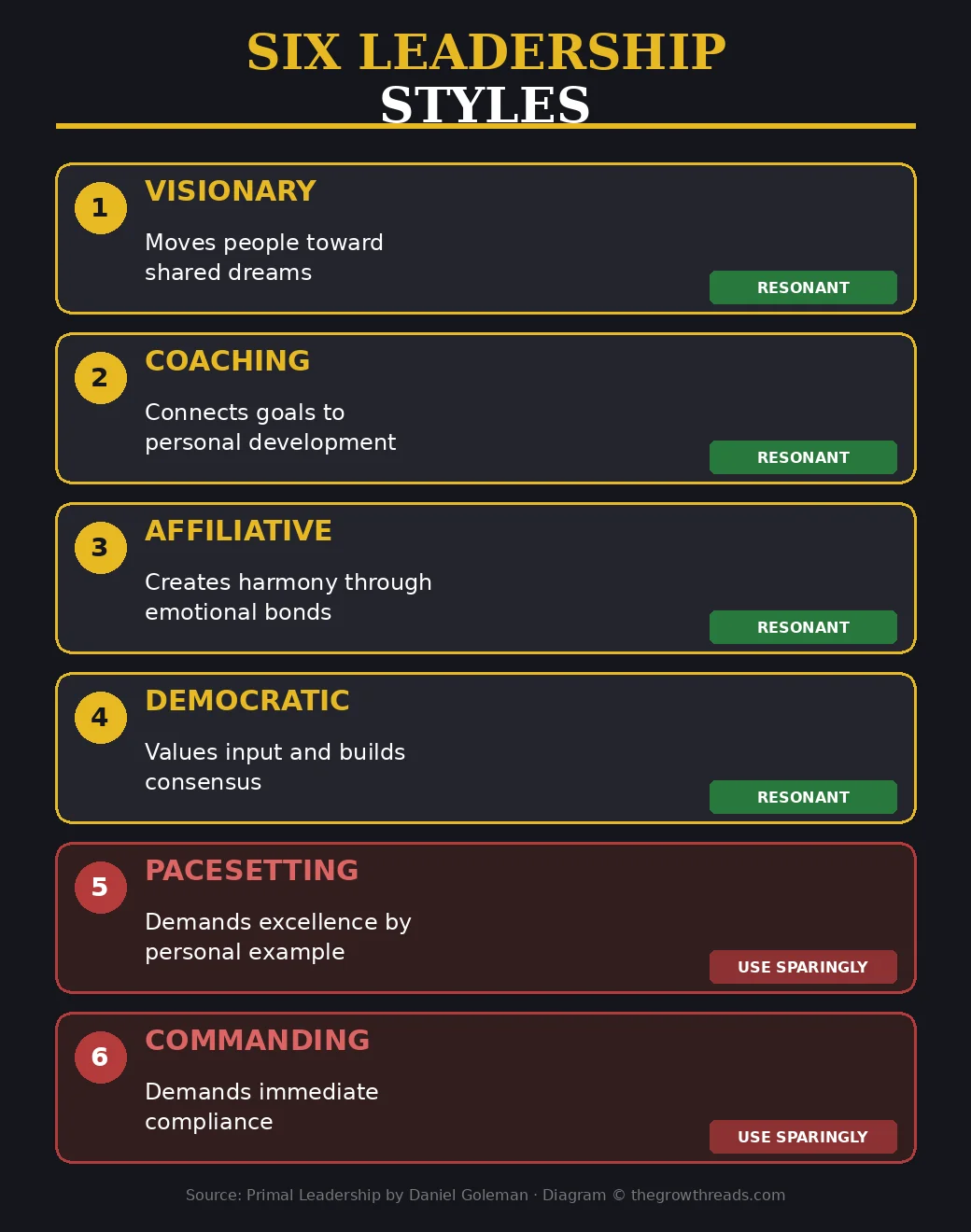
The authors organise emotional intelligence into four domains, each containing a cluster of specific competencies. The first two are personal (how you manage yourself); the second two are social (how you manage relationships).
Self-awareness is the foundation. It includes emotional self-awareness (knowing what you feel and why), accurate self-assessment (understanding your strengths and limits), and self-confidence (a grounded sense of your own worth). Leaders without self-awareness are blind to their effect on others and cannot develop the other domains.
Self-management builds on awareness. It includes emotional self-control (not letting destructive emotions drive decisions), transparency (acting with integrity), adaptability (flexibility under change), achievement orientation (striving to improve), initiative (readiness to act), and optimism (seeing opportunity in setbacks).
Social awareness turns the lens outward. It includes empathy (sensing others’ emotions), organisational awareness (reading political currents and group dynamics), and service orientation (anticipating and meeting the needs of stakeholders).
Relationship management is the culmination. It includes inspirational leadership (guiding with a compelling vision), influence (persuading effectively), developing others (cultivating people’s abilities), change catalyst (initiating and managing change), conflict management (resolving disagreements), and teamwork and collaboration (building cooperative relationships).
Part 3: Six styles, one leader
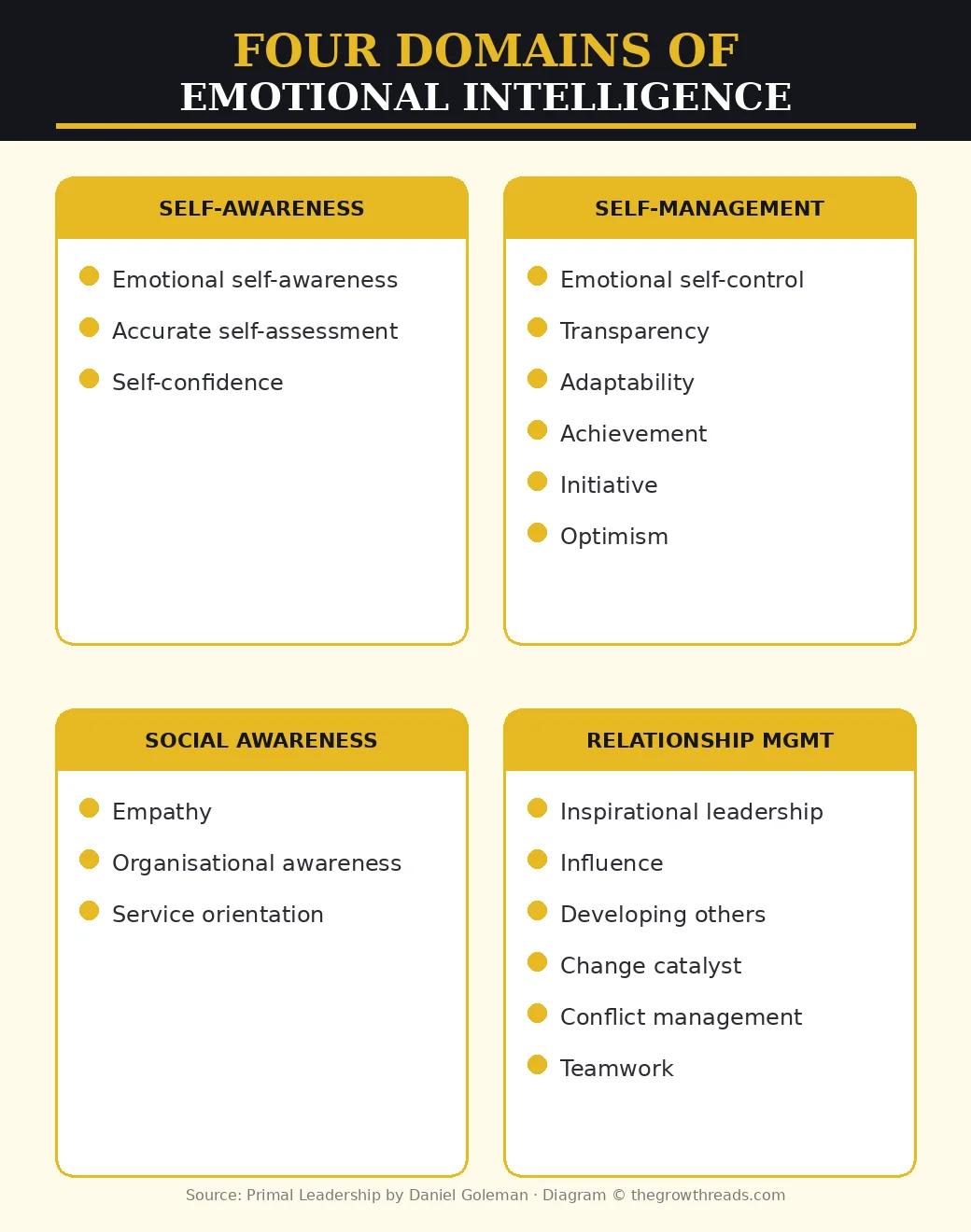
The six leadership styles are not personality types — they are approaches any leader can learn to deploy. The four resonant styles each create positive emotional climates in different ways. Visionary leaders articulate a compelling direction and give people freedom to figure out how to get there — best during times of change. Coaching leaders connect individual development goals to organisational needs — best for developing high-potential talent. Affiliative leaders prioritise harmony and emotional bonds — best for healing rifts or building trust. Democratic leaders seek input and build consensus — best when the leader needs buy-in or fresh ideas.
The two dissonant styles have their uses but carry risk. Pacesetting leaders set extremely high standards and model them personally — effective with highly motivated experts but corrosive when overused because it communicates that nothing is ever good enough. Commanding leaders demand immediate compliance — appropriate in genuine emergencies but destructive as a default because it eliminates autonomy and crushes initiative.
The most effective leaders use at least four styles and switch between them depending on the situation. Goleman cites research showing that leaders who rely on a single style — even a resonant one — underperform leaders who can adapt their approach to the context.
Part 4: Developing emotional intelligence — the five discoveries
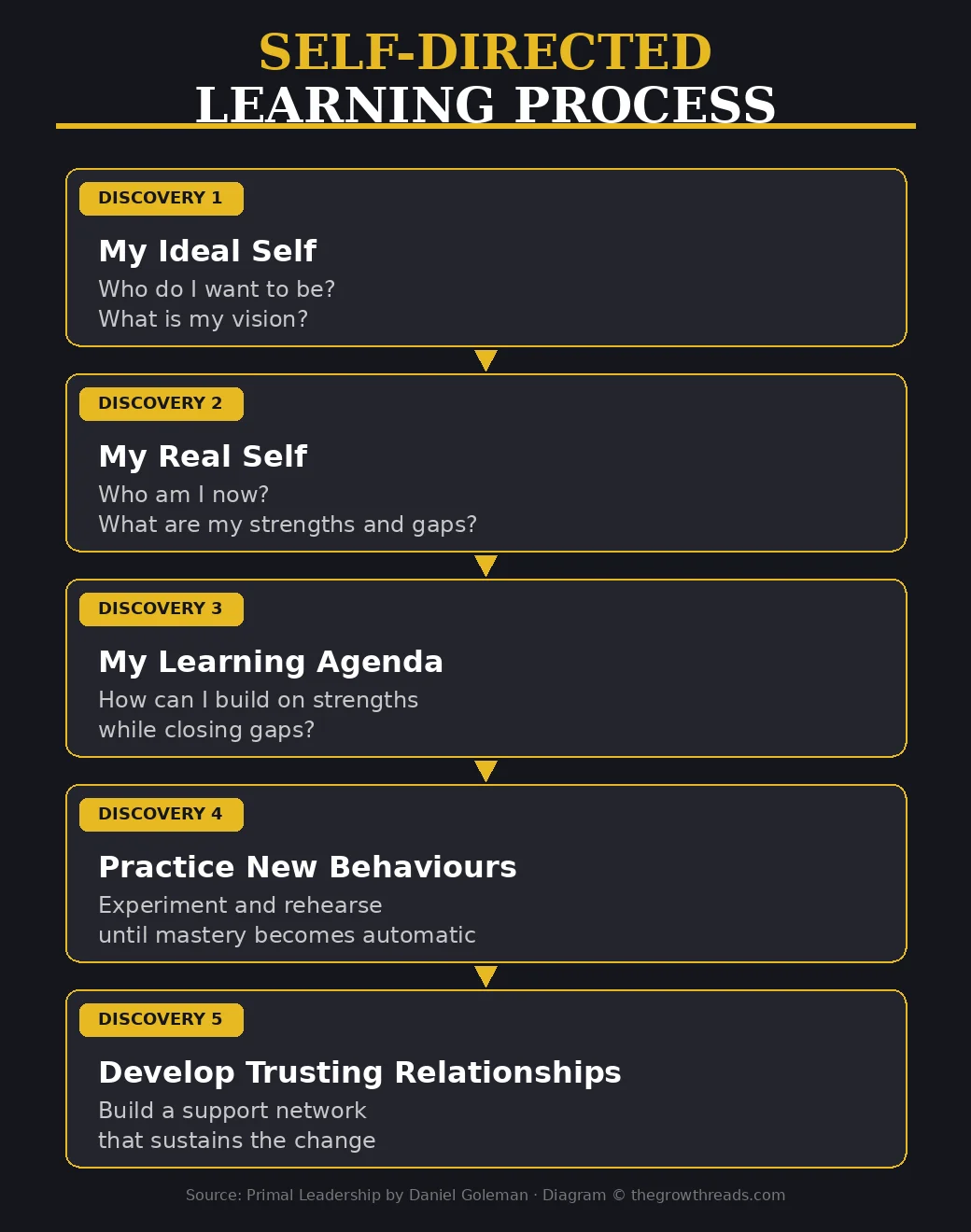
The final section presents Boyatzis’s self-directed learning model, a five-step process for developing emotional intelligence at any age. The steps are sequential but cyclical — you revisit them throughout your career.
Discovery 1: The ideal self. Start with vision, not deficits. Ask: who do I want to be? What kind of leader do I aspire to become? Research shows that development programmes anchored in aspiration produce more lasting change than those anchored in weakness.
Discovery 2: The real self. Get honest feedback about who you are now. Use 360-degree assessments, trusted advisors, and self-reflection. The gap between ideal and real is your learning agenda — but the key is to also identify strengths, because building on them is more energising and effective than fixing weaknesses alone.
Discovery 3: The learning agenda. Design a plan that builds on strengths while addressing critical gaps. Make it concrete: specific situations where you will practise new behaviours, measurable outcomes, and a timeline.
Discovery 4: Practise. New emotional habits require repetition. The authors emphasise that you are literally rewiring neural pathways — old habits are deeply grooved, and new ones need deliberate practice in safe-to-fail environments before they become automatic.
Discovery 5: Developing trusting relationships. Sustainable change happens in community. You need people who will give you honest feedback, hold you accountable, and support you through the inevitable setbacks.
Who is Primal Leadership best for — and who should read something else first?
This book is ideal for mid-career managers and executives who have the technical skills but sense that something softer — and harder to name — separates good leaders from great ones. It is also a strong pick for HR leaders and coaches designing leadership development programmes. The neuroscience and research base make it especially useful for sceptics who need evidence before they will invest in “soft skills.”
If you are new to the concept of emotional intelligence, start with Goleman’s earlier Emotional Intelligence for the foundations. If you want a more personal, vulnerability-focused approach to leadership, Dare to Lead is more intimate. If you prefer a military-style operational framework, Extreme Ownership covers some of the same ground with a different energy.
Questions to reflect on
- When you walk into a room, what emotional wake do you leave behind? Ask three trusted colleagues for honest feedback this week.
- Which of the six leadership styles do you default to — and which situations call for a style you rarely use?
- Of the four EI domains, where is your biggest gap between your ideal self and your real self?
- When was the last time a leader’s mood noticeably affected your own performance — positively or negatively?
- Who in your professional life can give you honest, caring feedback about your emotional impact?
🔥 Ready to lead with emotional intelligence?
Learn the six styles, four domains, and five discoveries that separate resonant leaders from the rest.
How to apply Primal Leadership (7-day plan)
- Day 1 — Self-awareness audit: Throughout the day, set three phone alarms. At each alarm, pause and label your current emotion in one word. Note whether the people around you mirror that emotion.
- Day 2 — Identify your default style: Review the six styles. Identify which one you use most often. Ask a colleague to confirm or challenge your self-assessment.
- Day 3 — Map your ideal self: Write a one-page vision of the leader you want to be in three years. Focus on how people feel working with you, not just what you accomplish.
- Day 4 — Get 360-degree feedback: Ask three people (a peer, a report, and a supervisor) one question: “What is it like to be on the other side of me in a meeting?” Write down their answers without defending.
- Day 5 — Practise a non-default style: Choose a style you rarely use (e.g., coaching if you default to pacesetting). Use it deliberately in at least one interaction today. Note what shifts.
- Day 6 — Create a resonance moment: Before your next team meeting, consciously set a positive emotional tone — arrive early, greet people warmly, open with genuine appreciation. Observe the energy in the room.
- Day 7 — Build a learning relationship: Identify one person who can be your honest-feedback partner for leadership development. Schedule a recurring monthly conversation.
Frequently asked questions
What is the main idea of Primal Leadership?
A leader’s most important job is managing the emotional climate of the group. Through open-loop limbic systems, a leader’s emotions are literally contagious — spreading through the team and either energising performance (resonance) or draining it (dissonance). Leaders who develop emotional intelligence across four domains create better business outcomes, not despite focusing on emotions, but because of it.
What are the six leadership styles in Primal Leadership?
Visionary (inspires with a shared dream), coaching (develops people by linking goals to growth), affiliative (builds harmony through emotional bonds), democratic (values input and consensus), pacesetting (demands excellence by personal example), and commanding (demands immediate compliance). The first four create resonance; the last two are useful situationally but create dissonance when overused.
Can emotional intelligence be learned?
Yes, and this is one of the book’s central claims. Unlike IQ, which is relatively fixed, emotional intelligence is learnable at any age. The self-directed learning process — five discoveries starting with the ideal self — provides a structured path. The key requirement is motivation: you need to genuinely want to change, not just check a box on a development plan.
What is resonance in leadership?
Resonance is a positive emotional climate in which team members feel energised, aligned, and psychologically safe. It occurs when a leader tunes into people’s feelings, articulates shared values, and sets a positive emotional tone. Research shows that resonant teams outperform dissonant ones by significant margins — not because the strategy is different, but because the emotional environment allows brains to function at their best.
How does Primal Leadership compare to Dare to Lead?
Both books argue that emotional skills are central to great leadership, but they approach the topic differently. Primal Leadership is more research-driven and structural — four EI domains, six styles, five discoveries, backed by neuroscience. Dare to Lead is more personal and narrative-driven, centring vulnerability and courage. Goleman gives you the framework; Brown gives you the heart. Leaders benefit from reading both.
What is the open-loop limbic system?
It is a neurological mechanism in which your emotional brain relies on external signals — especially from people in authority — to regulate itself. Unlike closed-loop systems like your cardiovascular system, the limbic system is “open” to outside influence. This is why a leader’s mood spreads to the team: people’s brains are literally co-regulating with the leader’s emotional state.
Is Primal Leadership worth reading in 2026?
Yes. The neuroscience of emotional contagion and the research on leadership styles have held up well. The book’s central thesis — that emotional intelligence drives leadership effectiveness — has been reinforced by two decades of subsequent research. The six styles framework remains one of the most practical tools available for leadership development. The writing is occasionally academic, but the ideas are evergreen.
Related summaries
- Emotional Intelligence Summary — Goleman’s foundational work on why EQ matters as much as IQ.
- Dare to Lead Summary — Brené Brown on leading with vulnerability and courage.
- Extreme Ownership Summary — Jocko Willink on leading through radical accountability.
- The Culture Code Summary — Daniel Coyle on building teams through belonging, vulnerability, and purpose.
- See all leadership book summaries on our Best Leadership Books pillar page.