

★★★★★ 4.6/5 — A brisk, sports-psychology-flavored case for planning tomorrow the night before.
Best for: Anyone who starts each day reacting to whatever lands first, instead of working from a plan.
Reading time: ~4 hours to read the book, about 20 minutes to read this guide.
Difficulty to apply: Easy — the core habit takes minutes each evening and pays off the next morning.
Organize Tomorrow Today in one minute
The single best time to plan your day is the night before it starts, not the morning it begins. That is the central habit at the heart of Organize Tomorrow Today, by sports psychologist Jason Selk and former basketball coach turned financial-advisor coach Tom Bartow. By the time most people open their inbox in the morning, the day has already started making decisions for them — the first urgent email, the first ping, the first meeting request sets the agenda instead of the person living it. Selk and Bartow argue that a few minutes of deliberate planning the evening before changes that dynamic entirely: instead of discovering your priorities as the day unfolds, you walk in already knowing exactly what has to happen first.
The book’s approach draws on Selk’s background training elite athletes — he spent years as Director of Mental Training for the St. Louis Cardinals — and Bartow’s decades coaching college basketball before becoming a top-producing financial advisor. Their shared premise is that businesspeople can borrow the same mental preparation routines that professional athletes use before a game: a small, repeatable pre-performance ritual, a short and specific priority list, and a structured way to recover focus after a setback. The result is less a productivity system than a nightly habit — organize tomorrow, today — designed to be simple enough to actually stick.
Key takeaways
- Plan tonight, not this morning: Deciding tomorrow’s priorities the evening before means you start the day already knowing what matters, instead of discovering it as things arrive.
- Pick one must-do task: Every day should have exactly one task that gets done no matter what else happens — everything else is secondary.
- Limit yourself to about three priorities: Trying to juggle a long list dilutes focus — a short, specific list of top tasks is easier to actually finish.
- Do the must-do task first: Starting with the most important task, before email or meetings, protects it from getting crowded out later in the day.
- Prepare mentally before you start: A brief, repeatable routine before beginning a task — similar to an athlete’s pre-performance ritual — helps you show up focused rather than scattered.
- Name setbacks quickly: When frustration or a distraction pulls your focus, noticing it immediately is the first step to getting back on track.
- Use a short reset routine: A brief pause — a few deliberate breaths — after a setback helps you return to the task at hand instead of spiraling.
- Review one win and one lesson daily: A quick nightly review of what went well and what to adjust turns each day into useful data for the next one.
- Borrow habits from high performers: Selk and Bartow argue that the routines separating elite athletes and top performers from everyone else are learnable habits, not innate talent.
- Consistency beats intensity: A small planning habit repeated every night compounds further than an occasional burst of intense organizing.
What is Organize Tomorrow Today about?
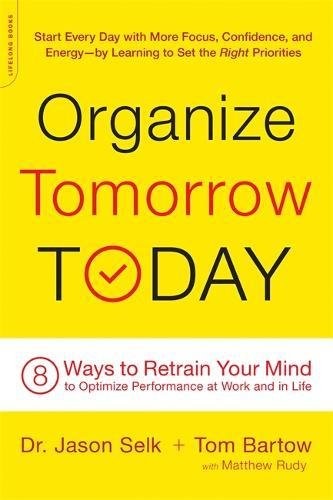
Organize Tomorrow Today is Jason Selk and Tom Bartow’s case for planning each day the night before it starts. Drawing on techniques borrowed from elite sports psychology, the book lays out a small set of habits — a nightly priority list, a single non-negotiable must-do task, and a short mental routine for regaining focus after setbacks — meant to help anyone perform with more focus and consistency, at work and beyond.
About the authors
Jason Selk holds a doctorate in sport psychology and served as Director of Mental Training for the St. Louis Cardinals during a period that included multiple World Series titles for the organization. He has worked with athletes and coaches across several professional sports leagues and writes for outlets including Forbes, bringing a background in elite performance psychology to the book’s exercises. Tom Bartow spent years as a college basketball coach before moving into financial services, where he became a top-producing advisor and later a coach to other advisors. His chapters draw on that dual background — the discipline of competitive coaching combined with the day-to-day realities of a demanding sales career — to translate Selk’s mental-training principles into a business context. A longtime sportswriter, Matthew Rudy, collaborated with the authors on the book’s writing.
Key concepts at a glance
| Concept | What it means | Use it when |
|---|---|---|
| Organize tomorrow today | Planning the next day’s priorities the evening before, instead of the morning of | You want to start each day already knowing what matters most |
| The must-do task | The single task that gets done each day, no matter what else happens | You need one clear, protected priority instead of a scattered list |
| Top 3 priorities | A short, specific list of the day’s most important tasks | Your to-do list is long enough that nothing on it feels urgent |
| Pre-performance routine | A brief, repeatable mental-preparation ritual before starting demanding work | You want to start focused instead of scattered |
| Setback reset | A short pause used to regain focus after frustration or distraction | Something has knocked you off track and you need to recover quickly |
| Nightly review | A quick end-of-day check-in on one win and one lesson | You want each day to inform the next instead of blurring together |
Part 1: Why tonight beats tomorrow morning
Selk and Bartow open with a simple observation: most people let the day decide their priorities for them. The first email, the first phone call, the first fire that needs putting out — whatever shows up first ends up setting the agenda, often at the expense of the work that actually matters most. By the time there is a free moment to think about priorities, half the day’s energy is already spent reacting to other people’s requests.
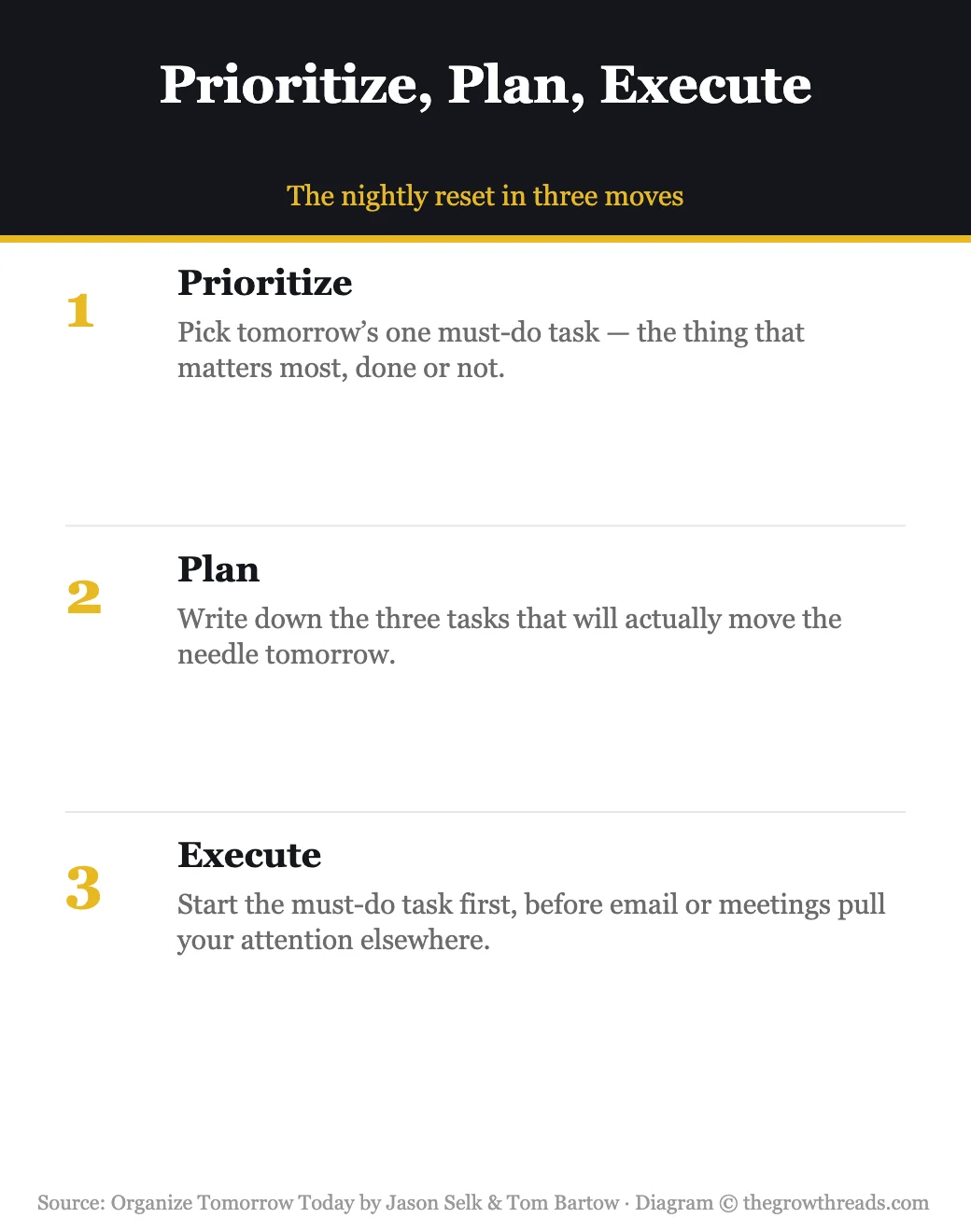
Their fix is to move the planning moment earlier — to the previous evening, when the day’s demands have quieted down and there is enough calm to think clearly about what tomorrow should actually accomplish. Deciding the next day’s must-do task and top priorities before leaving work, they argue, means walking in already equipped with a plan instead of building one under pressure. The habit is small, but the shift in when it happens — the night before instead of the morning of — is, in their telling, most of what makes it work.
TGR Note: This idea that a calmer moment produces better decisions than a rushed one echoes David Rock’s argument in Your Brain at Work that the brain’s capacity for careful decision-making is a limited resource that depletes over the course of a demanding day — planning before that depletion sets in is a way of working with the brain’s limits rather than against them.
Part 2: The must-do task and the top three
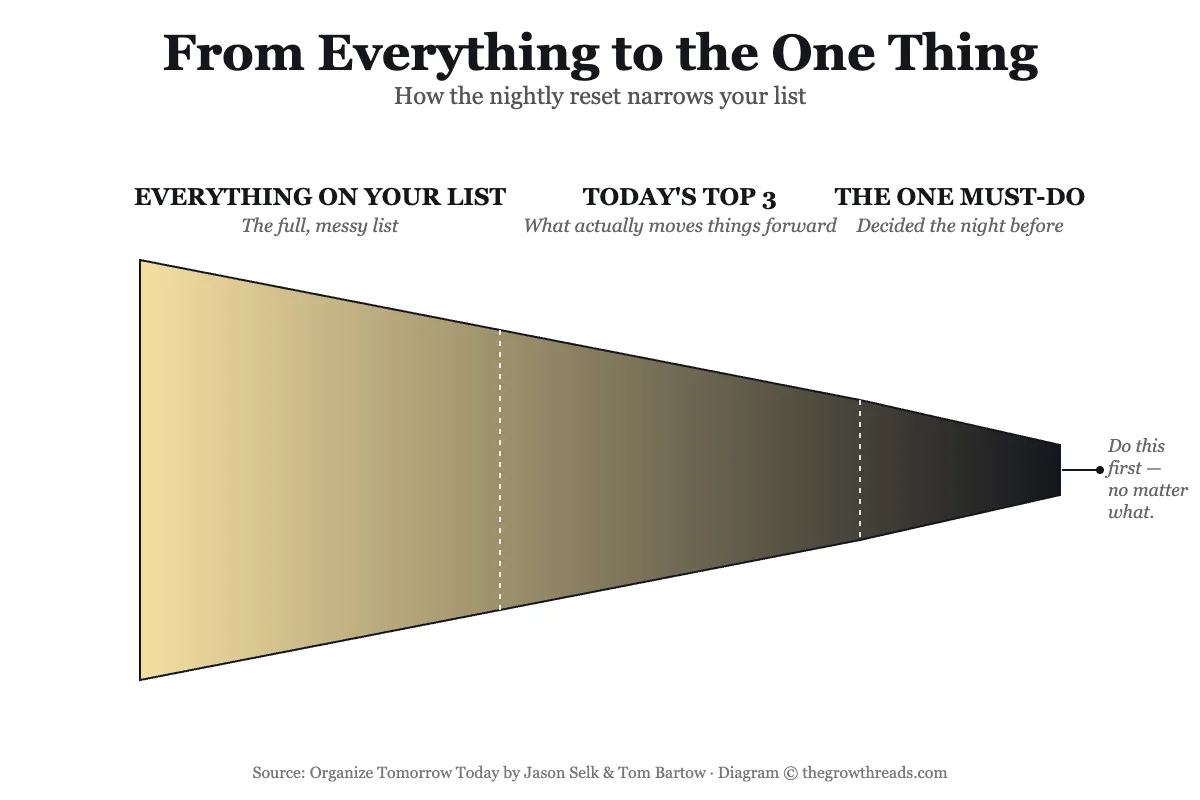
At the center of the system is a single question, asked every evening: what is the one task that must get done tomorrow, regardless of anything else that comes up? Selk and Bartow are strict that this should be exactly one task, not a handful — a genuine must-do, not just a nice-to-do. Around it sit two or three additional priorities, forming a short, specific list rather than an open-ended one. The authors argue that most to-do lists fail not because people lack discipline, but because the lists themselves are too long to signal what actually matters.
The must-do task is meant to be tackled first, before email, before meetings, before anything else has a chance to consume the morning’s attention. Selk and Bartow’s sports-psychology framing treats this as analogous to an athlete’s pre-game focus — you don’t warm up by checking notifications, you warm up by rehearsing exactly what you’re about to do.
TGR Note: The discipline of narrowing a long list down to one non-negotiable priority is the same instinct behind Kory Kogon, Adam Merrill, and Leena Rinne’s The 5 Choices, which makes a similar case that most productivity problems come from a failure to rank, not a shortage of time.
Part 3: Mental preparation and recovering from setbacks
Drawing directly on Selk’s work with professional athletes, the book recommends a brief pre-performance routine before starting demanding work — a short, repeatable ritual that signals to your mind it’s time to focus, the same way an athlete’s warm-up routine does before competition. The specifics matter less than the consistency: a few slow breaths, a quick mental rehearsal of the task ahead, a moment of quiet before diving in.
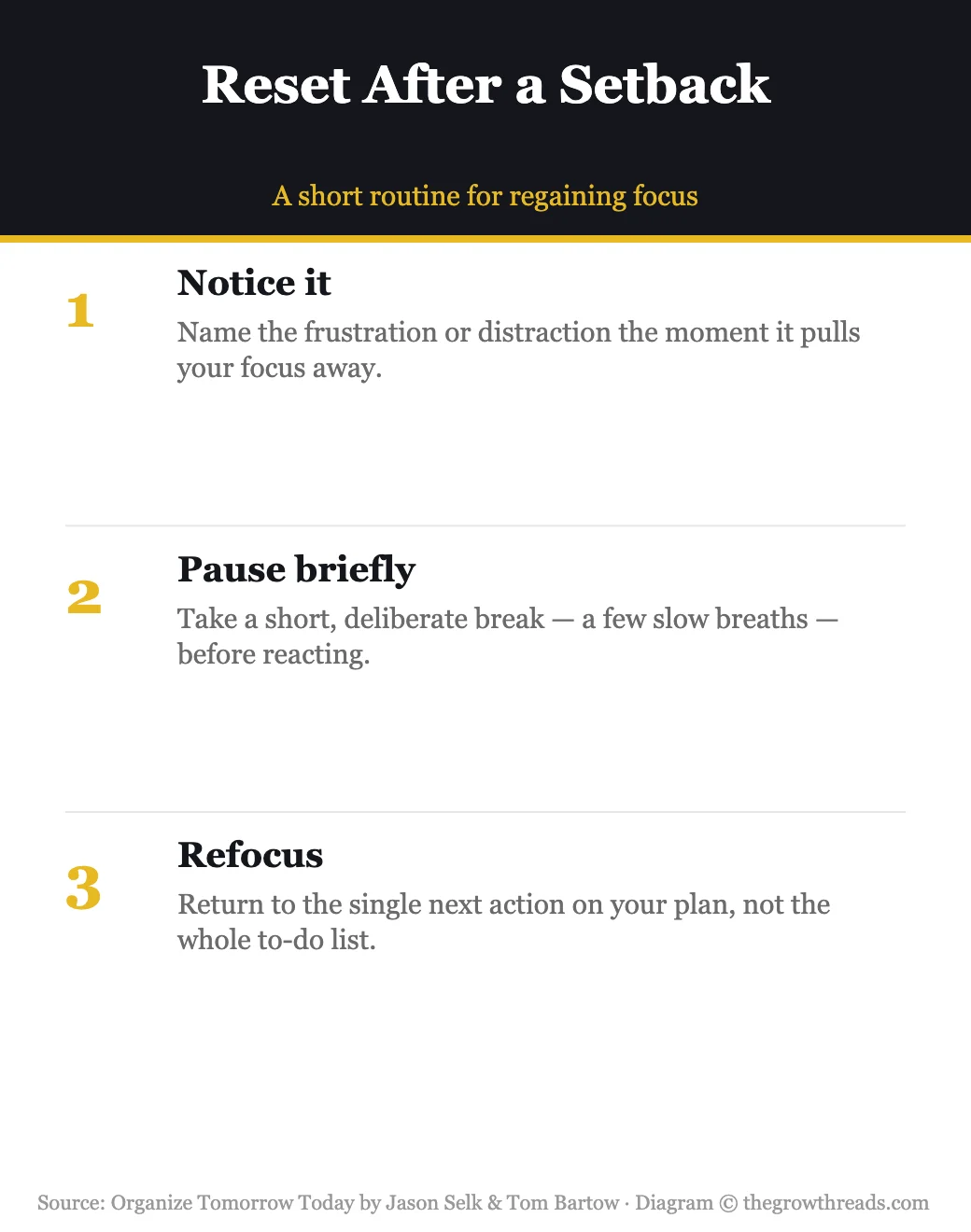
Just as important is what happens when things go wrong. Selk and Bartow describe a short reset routine for regaining focus after a setback — a missed deadline, a frustrating call, an unexpected interruption — built around noticing the disruption immediately, pausing briefly rather than reacting, and then deliberately returning to the next concrete action rather than the whole sprawling to-do list. The goal isn’t to avoid setbacks, which are inevitable, but to shrink the time spent recovering from them.
Part 4: Reviewing the day and building the habit
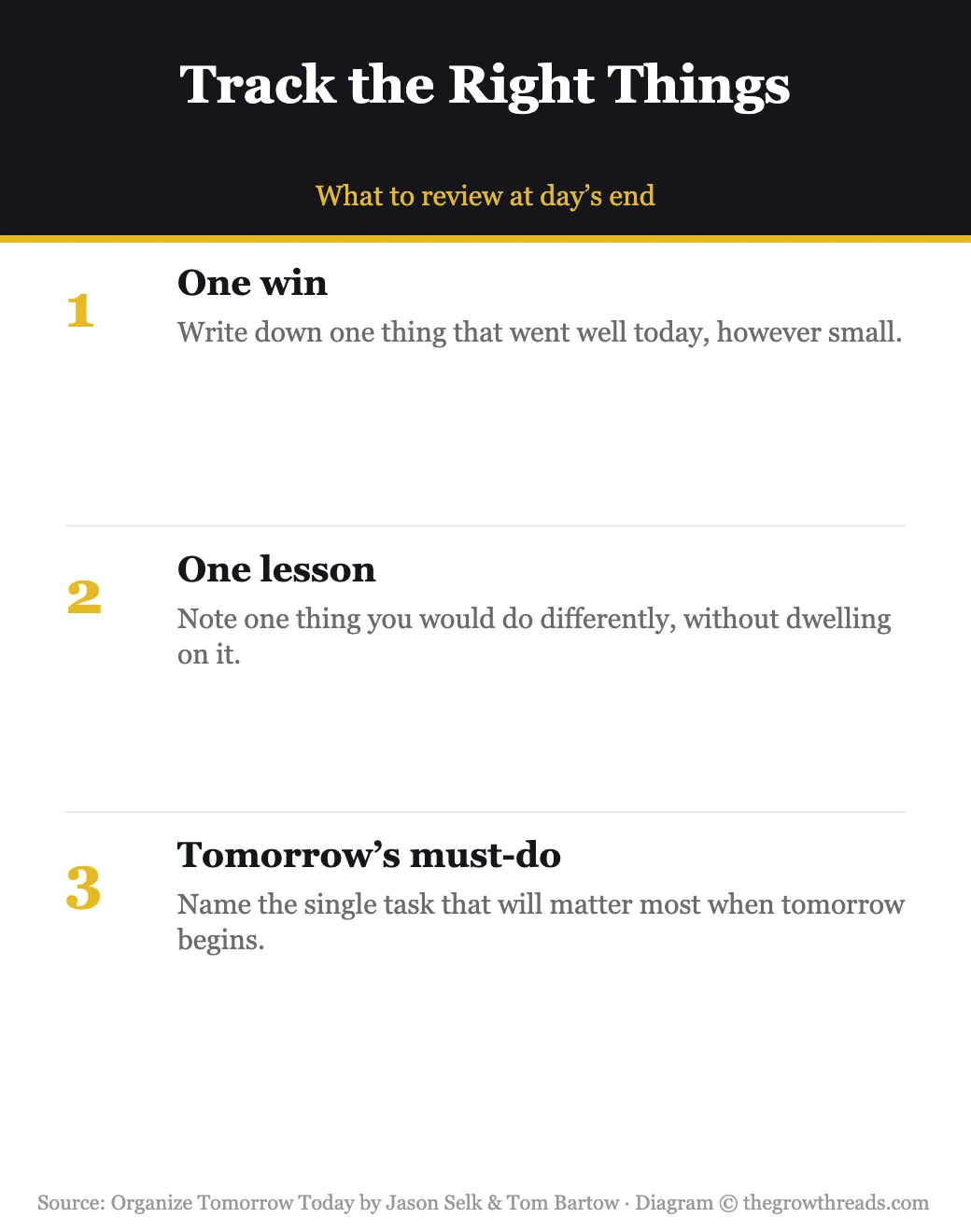
The system closes its loop with a short nightly review: one thing that went well, one thing to adjust, and — most importantly — tomorrow’s must-do task, decided while the day’s lessons are still fresh. Selk and Bartow frame this less as journaling and more as data collection: a habit that, repeated night after night, quietly reveals patterns in what actually moves your work forward versus what merely feels busy.
The authors are candid that none of these individual habits is complicated — that’s deliberate. Their argument, drawn from Selk’s work with high performers across several professional sports leagues, is that the routines separating consistently excellent performers from everyone else tend to be small, learnable, and unglamorous, repeated with a discipline that outlasts motivation. The book is less interested in a single dramatic overhaul than in a nightly ritual simple enough to survive a bad week.
TGR Note: This preference for small, repeatable rituals over one-time overhauls is the same discipline Dan Charnas describes borrowing from professional kitchens in Work Clean — a nightly reset that keeps small problems from piling into a crisis.
Who is Organize Tomorrow Today best for — and who should read something else first?
This book speaks most directly to people whose days feel reactive — where the inbox, not a plan, decides what gets attention first. It’s a natural fit for salespeople, advisors, and anyone in a role where Bartow’s own background applies directly, but the nightly-planning habit translates cleanly to almost any job.
If you want a deeper framework for ranking competing priorities rather than a nightly habit, The 5 Choices covers similar ground in more structural depth. If your team’s coordination problem is bigger than one person’s daily habits, Scrum tackles the same short-cycle philosophy at a team level. And if the deeper issue is chronic overwork rather than disorganization, Time Off addresses the rest side of the equation this book doesn’t fully cover.
Questions to reflect on
- What usually decides your priorities each morning — a plan you made, or whatever arrives first?
- If you had to name exactly one must-do task for tomorrow tonight, what would it be?
- What does your current to-do list cost you by being too long to signal what matters most?
- What is your version of a pre-performance routine before starting demanding work — do you have one at all?
- How long does it usually take you to recover focus after a frustrating setback, and what would a shorter reset look like?
🔥 Ready to plan tonight instead of scrambling tomorrow?
Get Organize Tomorrow Today and start your first nightly reset.
How to apply Organize Tomorrow Today (7-day plan)
- Day 1 — Choose tonight’s must-do: Before you finish work today, decide the one task tomorrow absolutely must include, no matter what else happens.
- Day 2 — Add two more priorities: Write your must-do task plus two supporting priorities — three items total, nothing more.
- Day 3 — Start with the must-do task: Before opening email, do the must-do task first, even if it feels uncomfortable to skip your inbox.
- Day 4 — Build a short pre-work ritual: Try a brief, repeatable routine — a few slow breaths, a moment of quiet — before starting your most demanding task.
- Day 5 — Practice the setback reset: The next time something knocks you off track, name it immediately, pause briefly, then return to one concrete next step.
- Day 6 — Run your nightly review: Write down one win and one lesson from today before deciding tomorrow’s must-do task.
- Day 7 — Look back at the week: Review your seven nightly plans — what patterns show up in what you chose as your must-do task, and what does that reveal about what actually matters?
Frequently asked questions
What is the main idea of Organize Tomorrow Today?
The book argues that planning tomorrow’s priorities the night before, rather than the morning of, produces sharper focus and less reactive days. Its core habit centers on choosing a single non-negotiable must-do task plus two or three supporting priorities, then starting the next day with that task before anything else competes for attention.
Who are Jason Selk and Tom Bartow?
Jason Selk is a sport psychologist who served as Director of Mental Training for the St. Louis Cardinals and has worked with athletes across several professional leagues. Tom Bartow is a former college basketball coach who became a top-producing financial advisor and later a coach to other advisors, bringing both a competitive-sports and a sales-floor perspective to the book.
What is the “must-do” task?
The must-do task is the single task chosen each evening that has to get done the following day, regardless of anything else that comes up. The authors are strict that it should be exactly one task — a genuine priority, not a wish list — and recommend tackling it first thing, before email or meetings can crowd it out.
Why plan the night before instead of the morning of?
Selk and Bartow argue that by the time most people sit down to plan in the morning, the day has often already started making decisions for them — an early email or a first request sets the agenda. Planning the evening before, when things have quieted down, lets you decide priorities calmly instead of reactively.
Is this book only useful for salespeople or athletes?
No — while Selk’s background is in sports psychology and Bartow’s includes financial sales, the habits themselves (a nightly must-do task, a short pre-work routine, a setback reset) are general enough to apply to almost any job that involves competing priorities and daily interruptions.
How is this different from a regular to-do list?
A regular to-do list often grows long enough that nothing on it signals what matters most. This system deliberately narrows that list to one must-do task plus two or three supporting priorities, decided the night before, so the next day starts with clarity rather than a wall of undifferentiated tasks.
What do critics say about the book?
Reviews of the book are generally positive, praising it as a practical, chapter-by-chapter guide with actionable exercises. Some reviewers have noted that its heavy reliance on sports analogies and its overall approach can feel familiar to readers of other business-productivity books, and recommend applying one chapter at a time rather than trying to absorb the whole system at once.
Related summaries
- The 5 Choices — a framework for ranking priorities at the individual level.
- Scrum — the same short-cycle philosophy applied to teams.
- Work Clean — borrowing a professional kitchen’s discipline for daily resets.
- Your Brain at Work — why the brain struggles with decisions late in a demanding day.
For more, browse our full guide to the best productivity books.
How we analyze books: We read the original text, cross-check factual claims where possible, and focus on practical application rather than critique. Read our full methodology.