

⭐⭐⭐⭐ 4.0 / 5
A foundational guide to how small environmental changes can dramatically improve the decisions people make.
Best for: Policy makers, managers, product designers, and anyone curious about why people make irrational choices.
Reading time: ~7 hours (312 pages)
Difficulty to apply: Moderate — the concepts are intuitive but applying them systematically requires thoughtful design.
Nudge in one minute
People are not rational — and that is not their fault. Richard Thaler and Cass Sunstein argue that humans rely on mental shortcuts, are swayed by defaults, and routinely make choices that undermine their own well-being. But instead of lecturing people into better behavior, we can redesign the environments in which choices are made. A “nudge” is any aspect of the choice architecture that alters people’s behavior in a predictable way without forbidding any options or significantly changing their economic incentives. Putting fruit at eye level in a cafeteria is a nudge. Banning junk food is not. The book lays out a philosophy called “libertarian paternalism” — helping people make better choices while preserving their freedom to choose — and applies it to savings, healthcare, organ donation, environmental policy, and everyday decisions.
Key takeaways
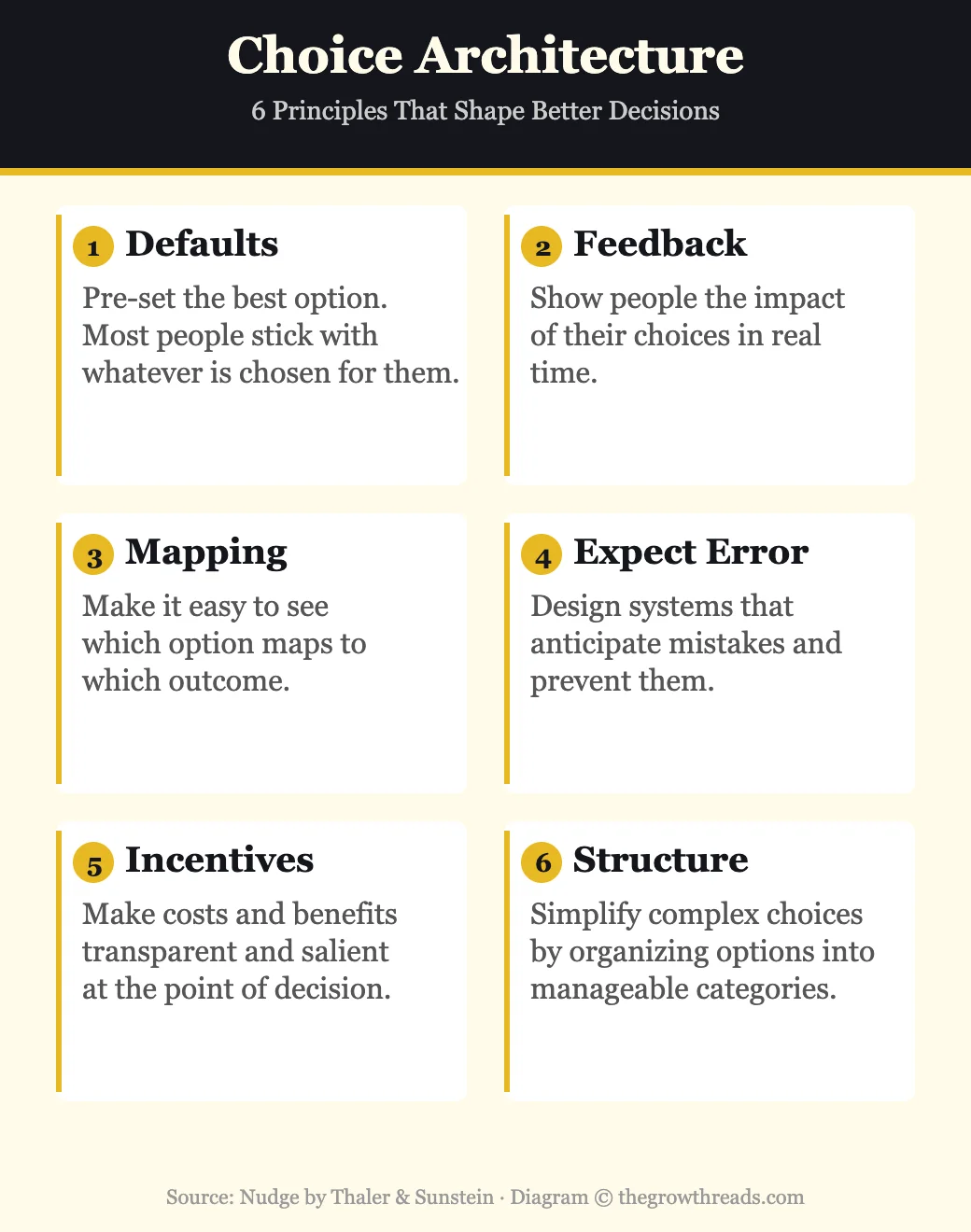
- Choice architecture matters: The way options are presented — their order, defaults, and framing — profoundly influences what people choose.
- Defaults are powerful: Most people stick with the pre-selected option. Setting smart defaults (like auto-enrolling employees in retirement plans) can dramatically improve outcomes.
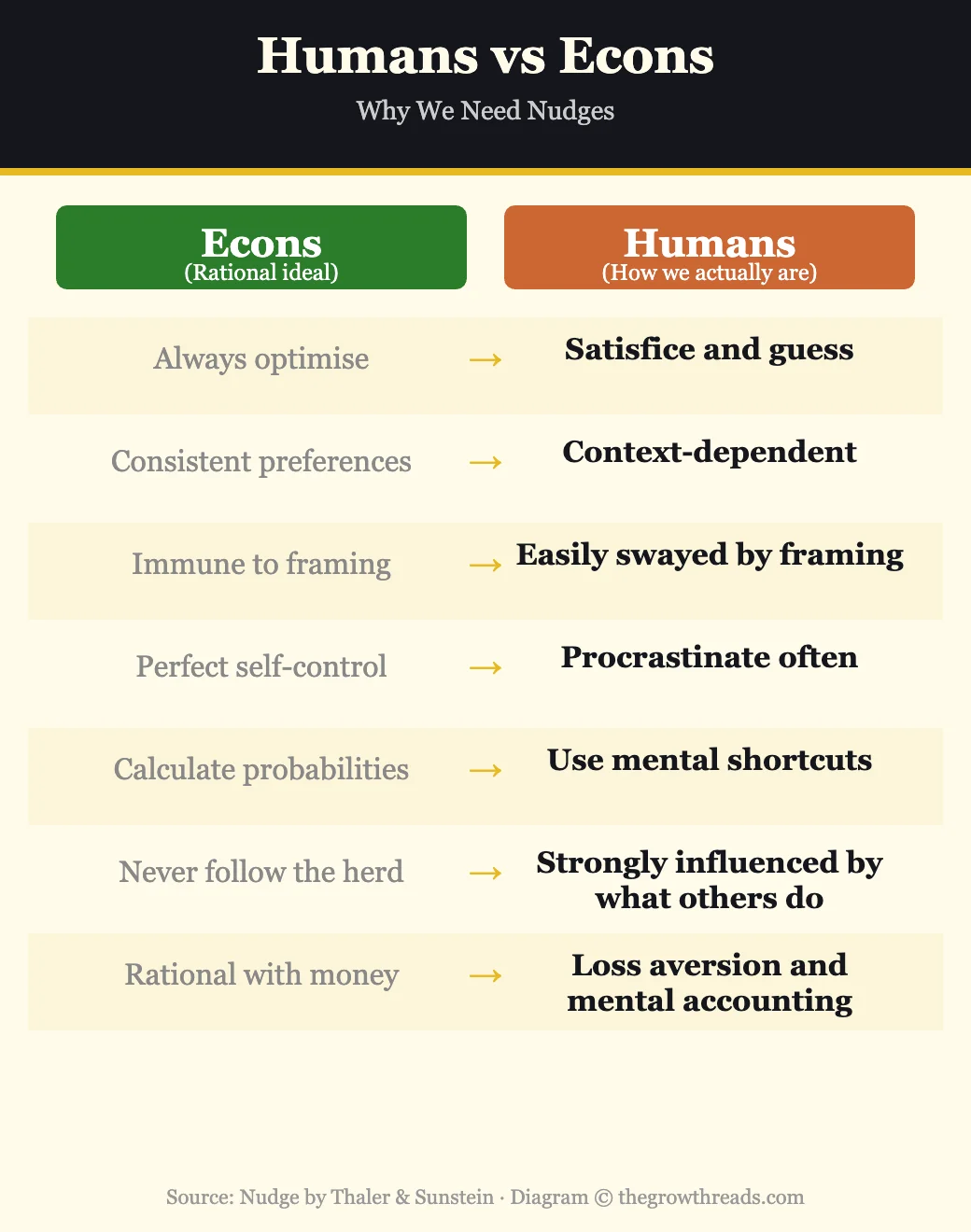
- Humans are not Econs: Economic models assume rational actors (“Econs”), but real humans use heuristics, are loss-averse, and follow the crowd.
- Libertarian paternalism: You can guide people toward better decisions without restricting their freedom — by making the beneficial choice the easy choice.
- Expect error: Good systems are designed for the mistakes people actually make, not the perfect behavior they should exhibit.
- Feedback loops improve decisions: Showing people the consequences of their choices in real time (energy meters, calorie counts) helps them self-correct.
- Social norms are nudges: Telling people what their neighbors do (energy use, tax compliance) is one of the most effective behavioral interventions.
- Complex choices need structure: When options are overwhelming, simplify and categorize. People make better choices when complexity is reduced.
- Mapping helps: People struggle when they cannot connect a choice to an outcome. Good choice architecture makes the link obvious.
- Nudges are everywhere: GPS navigation, alarm clocks, and automatic bill-pay are all nudges we already accept and rely on daily.
What is Nudge about?
Nudge is a behavioral science book that shows how redesigning choice environments — through smarter defaults, better feedback, and simpler options — can help people make decisions that improve their health, wealth, and happiness, all without taking away their freedom to choose.
About the author
Richard H. Thaler is the Charles R. Walgreen Distinguished Service Professor of Behavioral Science and Economics at the University of Chicago Booth School of Business. He won the Nobel Prize in Economics in 2017 for his contributions to behavioral economics and is considered one of the founding figures of the field. Cass R. Sunstein is the Robert Walmsley University Professor at Harvard Law School and served as Administrator of the White House Office of Information and Regulatory Affairs under President Obama, where he applied nudge principles to federal policy. Together, their work has influenced government policy in over 20 countries through the establishment of “nudge units” — dedicated behavioral insights teams. Explore all Cass R. Sunstein book summaries →
Key concepts at a glance
| Concept | What it means | Use it when |
|---|---|---|
| Choice architecture | The design of environments in which people make decisions | You are designing a form, menu, process, or policy |
| Libertarian paternalism | Guiding better choices while preserving full freedom to choose | You want to improve outcomes without mandates |
| Status quo bias | People disproportionately stick with the default option | You are setting up enrollment, subscriptions, or settings |
| Anchoring | The first number people see influences subsequent judgments | You are presenting prices, targets, or donation amounts |
| Social proof | People follow what others do, especially in uncertainty | You want to encourage a behavior by showing peer data |
| Loss aversion | Losses feel roughly twice as painful as equivalent gains feel good | You are framing benefits or consequences of a choice |
| Feedback | Real-time information about consequences of choices | You want people to self-correct without intervention |
| RECAP | Record, Evaluate, and Compare Alternative Prices — mandatory disclosure format | Markets are complex and consumers cannot compare options easily |
Part 1 — Humans and Econs: why we need nudges
Thaler and Sunstein open with the central insight of behavioral economics: people are not the rational agents that classical economic theory assumes. Traditional economics models “Econs” — beings who always calculate the optimal choice, never procrastinate, and are immune to framing effects. Real humans, by contrast, rely on mental shortcuts (heuristics) that work well in many situations but lead to systematic, predictable errors in others.
Three heuristics get detailed treatment. The anchoring effect shows how an arbitrary number (the last two digits of your social security number, the asking price of a house) can dramatically shift what people are willing to pay. Availability bias means people judge risks based on how easily examples come to mind — which is why people fear plane crashes more than car accidents despite the statistics strongly favoring air travel. And representativeness leads people to see patterns where none exist, misjudging probabilities based on how closely something matches a stereotype.
The practical implication is that these biases are not random noise — they are predictable. And because they are predictable, environments can be designed to account for them. A choice architect is anyone who designs the context in which people decide: a doctor presenting treatment options, a website designer laying out a checkout flow, a government official structuring a pension plan. Whether or not they intend it, they are already nudging. The question is whether they are nudging well.
Part 2 — Money: saving, investing, and borrowing
The most impactful real-world application of nudge theory has been in retirement savings. Thaler describes the “Save More Tomorrow” (SMarT) program he designed with Shlomo Benartzi. The insight was simple: people intend to save more but never get around to it because the immediate cost (smaller paycheck) feels larger than the distant benefit (comfortable retirement). SMarT solves this by asking employees to commit to increasing their savings rate with each future raise — so the increase never feels like a loss. In the first company to implement it, savings rates rose from 3.5% to 13.6% within 40 months.
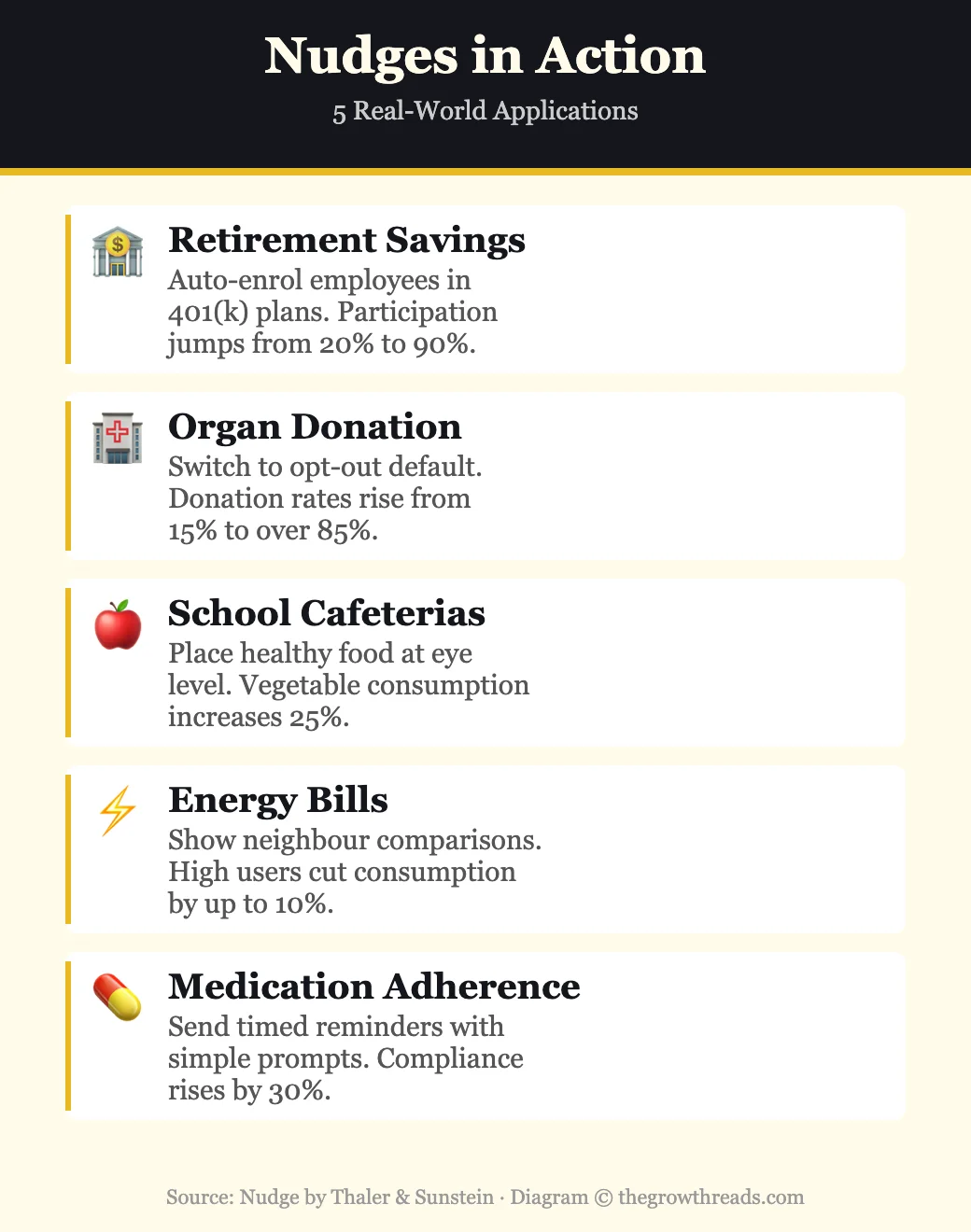
The power of defaults is the star of this section. When companies switch from opt-in to opt-out enrollment in retirement plans, participation rates jump from roughly 20% to over 90%. The same paycheck, the same plan, the same freedom to change — but a different default. This single design change has led to billions of dollars in additional retirement savings worldwide.
The authors also tackle the complexity of financial products. Mortgages, credit cards, and student loans are often deliberately confusing, making it nearly impossible for ordinary consumers to compare options. Their proposed solution is the RECAP framework — requiring companies to disclose terms in a standardized, machine-readable format so comparison tools can do the work that human cognition cannot.
Part 3 — Health, environment, and society
Beyond money, Thaler and Sunstein apply nudge principles to healthcare, organ donation, environmental policy, and education. The organ donation chapter is one of the most striking. Countries with opt-out organ donation systems (where you are presumed a donor unless you actively opt out) have donation consent rates above 85%, compared to roughly 15% in opt-in countries. The difference is not cultural — it is architectural. The same person who would willingly donate organs simply never gets around to filling out the form in an opt-in system.
In healthcare, the authors advocate for better information presentation. Medicare Part D, the prescription drug benefit, offers seniors a choice among dozens of plans with different premiums, copays, formularies, and coverage gaps. Studies showed that many seniors chose plans that cost them hundreds of dollars more per year than the best available option — not because they preferred those plans, but because the comparison was impossibly complex. Simplifying the choice set and highlighting key differences can save real money.
Environmental nudges get their own treatment. The Opower program (now Oracle Utilities) sends homeowners energy reports comparing their usage to similar neighbors. This social-norm nudge — showing you that your neighbors use less energy — reduces consumption by 1 to 3 percent across millions of households. It works because people are motivated by social comparison even when the financial savings are modest.
The Final Edition adds a chapter on “sludge” — bureaucratic friction that discourages people from claiming benefits they are entitled to. Complex application forms, unnecessary waiting periods, and confusing eligibility rules are anti-nudges that disproportionately harm the most vulnerable populations.
Part 4 — Objections, extensions, and the nudge toolkit
The final section addresses the most common criticisms. The slippery slope objection — “if the government can nudge, what stops it from manipulating?” — gets a principled response: nudges preserve choice. Auto-enrollment in a savings plan is transparent, easily reversible, and benefits the individual. It is categorically different from deception or coercion. The authors argue that choice architecture is unavoidable — there is no neutral way to present options — so the question is not whether to nudge but whether to nudge well.
They also tackle the “who decides what is good?” objection. Their answer is pragmatic: nudge in the direction people themselves say they want to go. When 70% of non-savers say they wish they saved more, auto-enrollment is not paternalistic overreach — it is helping people achieve their stated goals.
The Final Edition extends the framework with a taxonomy of nudges, distinguishing between “nudges that educate” (calorie labels, energy reports) and “nudges that simplify” (automatic enrollment, default settings). It also reflects on ten years of real-world implementation, including the UK’s Behavioural Insights Team and dozens of similar units worldwide, and honestly addresses which nudges worked and which fell short.
Who is Nudge best for — and who should read something else first?
Nudge is ideal for policy makers, UX designers, product managers, HR professionals, and anyone who designs systems that other people interact with. If you are responsible for how choices are presented — on a website, in a benefits package, or in a public policy — this book will change how you think about your work.
If you want the underlying cognitive science in more depth before the applications, start with Thinking, Fast and Slow. If you are more interested in personal habit design than institutional policy, Atomic Habits applies similar principles at the individual level.
Questions to reflect on
- What defaults are currently shaping your daily behavior — your phone settings, your subscription renewals, your workplace benefits — and are they serving you well?
- If you manage a team or product, where are the choice points where a different default could produce better outcomes for everyone?
- Which of your own recurring mistakes (overspending, poor eating, skipping exercise) could be addressed by changing the environment rather than relying on willpower?
- Where in your organization is “sludge” — unnecessary friction — preventing people from taking actions that would benefit them?
- How would you feel about being nudged versus being mandated? Where do you draw the line between helpful design and manipulation?
🔥 Ready to design better choices?
Nudge will transform how you think about defaults, design, and the hidden forces that shape every decision you make.
How to apply Nudge (7-day plan)
- Day 1 — Audit your defaults: List five defaults that currently shape your life (phone notifications, streaming autoplay, subscription renewals). Decide which ones serve you and change the ones that do not.
- Day 2 — Redesign one environment: Pick a physical space (kitchen, desk, pantry) and rearrange it so the healthiest or most productive option is the most visible and accessible.
- Day 3 — Automate a good decision: Set up one automatic action you have been meaning to do — auto-transfer to savings, auto-pay a bill, or auto-schedule a workout.
- Day 4 — Add a feedback loop: Start tracking one behavior you want to change (spending, screen time, calories) using an app that gives you real-time data.
- Day 5 — Use social proof: Share a goal publicly or join a group where the behavior you want is the norm — a running club, a book group, a savings challenge.
- Day 6 — Remove sludge: Identify one process in your work or life that is unnecessarily complicated. Simplify it by reducing steps, pre-filling forms, or eliminating approvals.
- Day 7 — Design a nudge for others: If you manage people or products, identify one choice point where a better default, clearer feedback, or simpler options could improve outcomes.
Frequently asked questions
What is the difference between a nudge and manipulation?
A nudge is transparent, easy to opt out of, and benefits the person being nudged. Manipulation is hidden, difficult to resist, and serves the manipulator. Auto-enrolling employees in a retirement plan with the option to opt out at any time is a nudge. Burying cancellation options in a maze of phone menus is sludge — the opposite of a nudge. The key test: does the intervention respect freedom of choice?
Is Nudge a political book?
Nudge deliberately avoids partisan framing. Thaler identifies as a libertarian paternalist — a position designed to appeal across the political spectrum. The philosophy preserves individual choice (libertarian) while improving outcomes through design (paternalism). Nudge units have been established by both conservative and progressive governments worldwide, and the book’s examples span healthcare, finance, and environmental policy without pushing a party agenda.
What is the Final Edition and how does it differ from the original?
The Final Edition, published in 2021, is a substantial revision — not just a new foreword. It adds chapters on sludge (bureaucratic friction), updates examples with a decade of real-world evidence from nudge units, and reflects honestly on which interventions worked and which did not. About a third of the content is new. If you are buying the book today, the Final Edition is the one to get.
Can I use nudges in my personal life?
Absolutely. Putting your phone in another room while working is a nudge. Setting your savings to auto-transfer on payday is a nudge. Keeping fruit on the counter and cookies in a hard-to-reach cabinet is a nudge. The book focuses on institutional design, but every principle applies to self-nudging. The key insight is the same: change the environment instead of relying on willpower.
How is Nudge different from Thinking, Fast and Slow?
Thinking, Fast and Slow is the science — a comprehensive map of cognitive biases and how they work. Nudge is the application — a practical guide to designing environments that account for those biases. Kahneman diagnosed the problem; Thaler and Sunstein offer the prescription. Reading both gives you the full picture: understanding why humans make errors and knowing how to build systems that help rather than exploit.
Do nudges actually work long-term?
The evidence is mixed but mostly positive. Auto-enrollment in retirement plans shows durable effects — people stay enrolled for years and accumulate significantly more savings. Energy-usage social comparisons show some fade-out when the reports stop but lasting effects when maintained. The Final Edition addresses this honestly: nudges work best when they are ongoing features of the environment, not one-time interventions.
Is Nudge still relevant in 2026?
More than ever. Digital product design has made choice architecture a daily reality — every app, website, and subscription service is nudging you constantly. Understanding how these nudges work is now a basic form of digital literacy. Governments in over 20 countries run nudge units, and the techniques are standard practice in UX design, public health, and behavioral finance.
Related summaries
- Thinking, Fast and Slow Summary — Daniel Kahneman’s foundational work on cognitive biases and dual-process thinking.
- Predictably Irrational Summary — Dan Ariely on the hidden forces that shape our decisions.
- Influence Summary — Robert Cialdini’s six principles of persuasion.
- Atomic Habits Summary — James Clear on using environment design for personal habit change.
📚 Explore the full Psychology collection
This summary is part of our best psychology books series — 39 in-depth reviews to help you understand human behavior and think more clearly.