

★★★★☆ 4.4/5 — A clear, wide-ranging tour of economics that explains everything from grocery-store price signals to why some nations grow rich and others stay poor.
Best for: readers who want a genuinely comprehensive, textbook-free introduction to how economics actually works · Reading time: ~8 hrs (this guide: ~12 min) · Difficulty to apply: Low — the ideas are explained plainly and connect directly to news and everyday decisions
Naked Economics in one minute
No single person plans a city’s food supply, yet fresh groceries reliably show up on shelves every day — and Charles Wheelan uses that puzzle to launch a wide-ranging, jargon-free tour of how economics actually explains the modern world. Wheelan walks through the power of markets and the “invisible hand,” why markets sometimes fail and require a government role (externalities, public goods, monopoly), how incentives shape behavior more reliably than moral appeals, the basics of financial markets, comparative advantage and the case for trade, and the deeper question of why some nations grow rich while others stay poor. First published in 2002 and revised multiple times since — most recently in 2019 with updated material on automation, inequality, and debt — the book is designed as a genuinely comprehensive introduction, closer to a well-written textbook’s worth of ideas delivered in plain, story-driven language.
Key takeaways
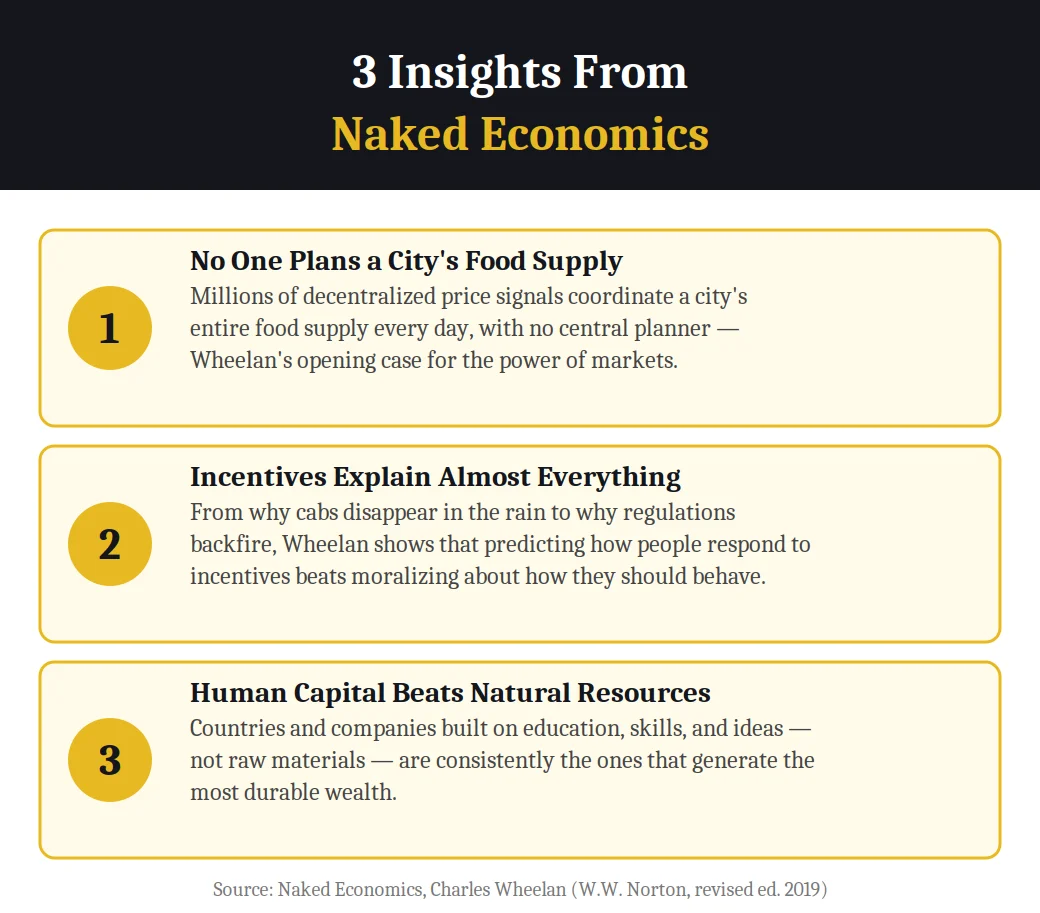
- No one plans a city’s food supply, and that’s the point: millions of decentralized price signals coordinate an enormously complex system every day without any central planner — Wheelan’s opening case for the power of markets.
- Incentives explain more than good intentions do: from why cabs vanish in the rain to why well-meaning regulations backfire, predicting how people respond to incentives beats moralizing about how they should behave.
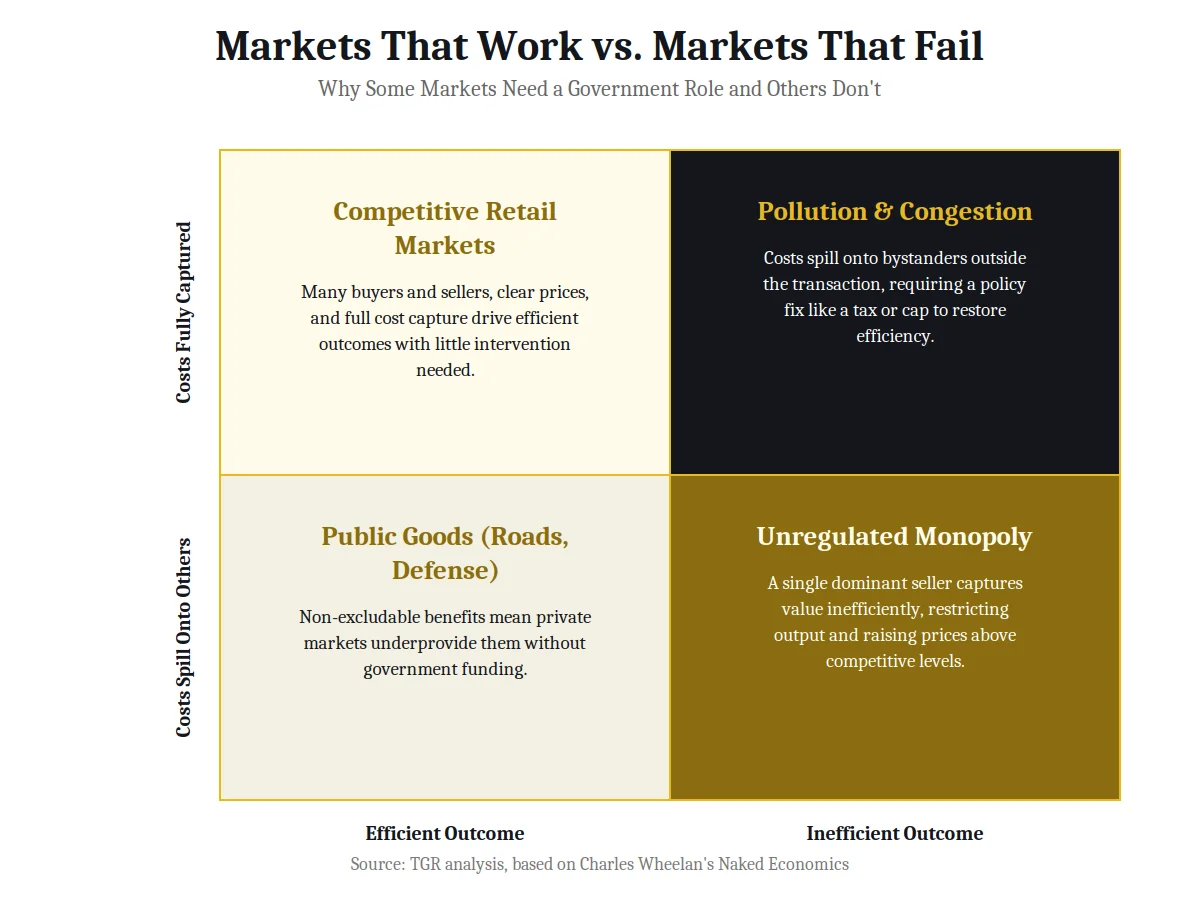
- Markets fail in specific, definable ways: externalities, public goods, and monopoly power are the main reasons unregulated markets don’t always produce efficient outcomes on their own.
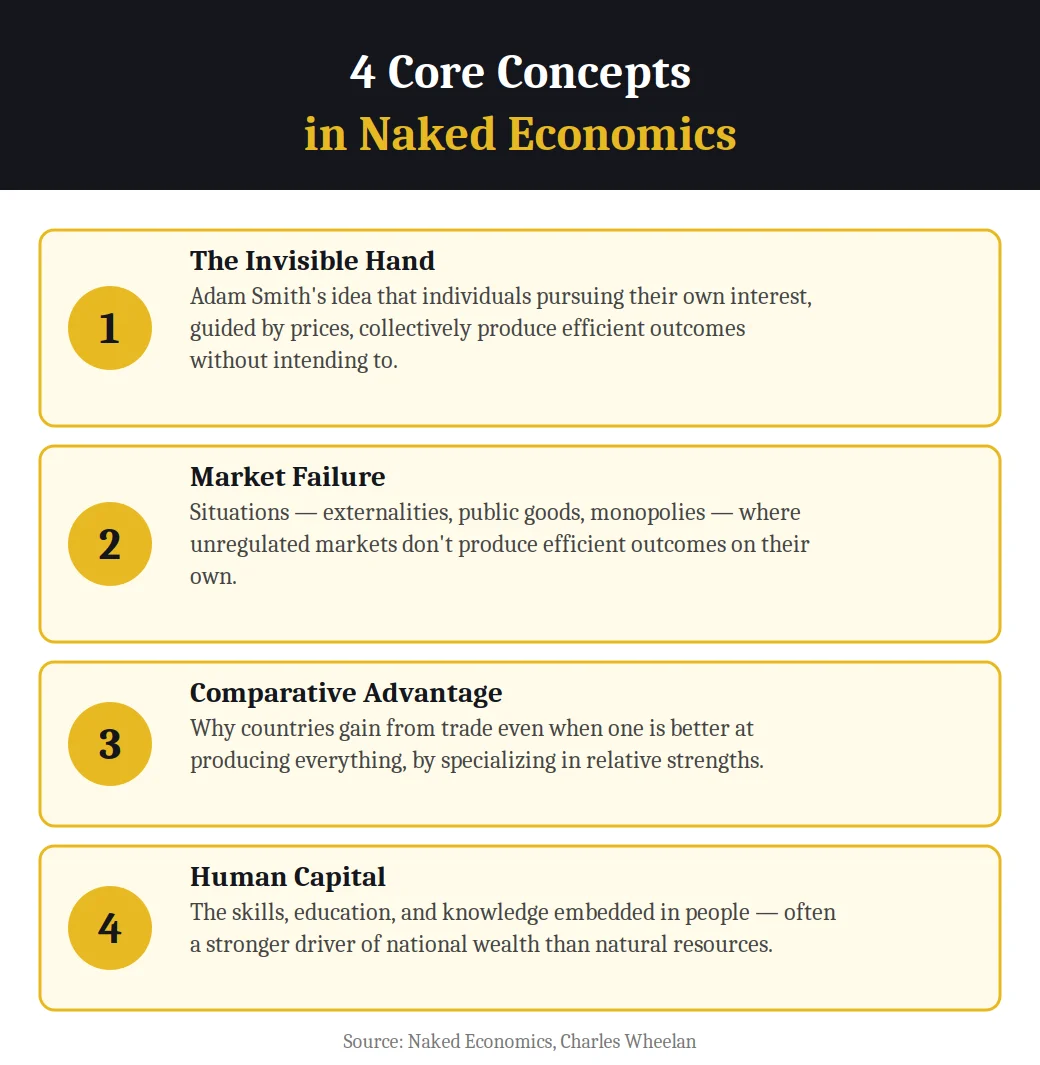
- The invisible hand works without anyone intending it to: Adam Smith’s insight is that individuals pursuing their own interest, guided by prices, collectively produce efficient outcomes as a byproduct, not a goal.
- Comparative advantage makes trade a win for both sides: countries gain from trade even when one is better at producing everything, simply by specializing in their relative strengths.
- Human capital beats natural resources over the long run: countries and companies built on education, skills, and ideas consistently generate more durable wealth than those built on raw materials alone.
- GDP and other economic measures are useful but imperfect: Wheelan’s “Keeping Score” chapter explains what GDP actually captures and where it falls short as a measure of well-being.
- The Federal Reserve’s tools shape the whole economy: monetary policy — interest rates, money supply — has outsized effects on inflation, employment, and growth that are worth understanding even for non-specialists.
- Institutions and openness determine national prosperity: secure property rights, human capital investment, and trade openness explain far more of the gap between rich and poor nations than luck or resources.
What is Naked Economics about?
Naked Economics is Charles Wheelan’s accessible, comprehensive introduction to how economics explains everyday life, from the price of groceries to why some nations grow rich while others stay poor. Opening with the puzzle of how a city’s food supply gets coordinated without any central planner, Wheelan walks readers through the power of markets, why markets sometimes fail, the role of incentives, financial markets, trade and globalization, and development economics, all in plain, jargon-free language. First published in 2002 and revised several times since — most recently in 2019 with new material on automation, inequality, and debt — the book has become one of the most widely assigned introductions to economics for general readers, closer in scope to a well-written textbook than a single-argument popular economics title.
About the author
Charles Wheelan is an American economist, journalist, and public policy professor best known for making economics accessible to a general audience. He spent years as a correspondent for The Economist and has taught public policy at the University of Chicago and Dartmouth College. Wheelan is the author of the bestselling Naked Economics, as well as Naked Statistics and Naked Money, part of a series that applies the same accessible, jargon-free approach to different quantitative subjects. He has also worked in policy and briefly ran for the U.S. Congress in Illinois as an independent candidate, experience that informs the book’s balanced treatment of the government’s role in markets. Explore all Charles Wheelan book summaries →
Key concepts at a glance
| Concept | What it means | Use it when |
|---|---|---|
| The Invisible Hand | Individuals pursuing self-interest, guided by prices, collectively produce efficient outcomes | You’re trying to understand how a decentralized system produces order without a planner |
| Market Failure | Externalities, public goods, and monopoly power that keep unregulated markets from being efficient | You’re evaluating whether a market needs a policy fix or can be left alone |
| Comparative Advantage | Why countries gain from trade even when one is better at producing everything | You’re thinking through the case for or against trade and specialization |
| Human Capital | The skills, education, and knowledge embedded in people | You’re assessing what actually drives long-term economic growth |
| GDP & Economic Measurement | What GDP captures about an economy, and what it leaves out | You’re reading economic news and want to interpret the numbers correctly |
Part 1: The power of markets and why they sometimes fail
Wheelan opens with a deceptively simple question: who feeds a city like New York or Paris? No single person or agency plans it — millions of decentralized price signals coordinate farmers, distributors, grocers, and restaurants into a system that reliably delivers food every day, an everyday miracle Adam Smith’s “invisible hand” explains without requiring anyone to intend the outcome. But Wheelan is careful not to oversell markets: he devotes real attention to the specific, definable ways they fail — externalities like pollution that impose costs on bystanders, public goods like national defense that private markets underprovide, and monopoly power that lets a single dominant seller restrict output and raise prices. Incentives run through all of it — Wheelan’s recurring point is that predicting how people actually respond to incentives explains far more than assuming they’ll behave as intended or as policy designers hoped.
TGR Note: Wheelan’s “who feeds Paris?” framing pairs naturally with The Undercover Economist‘s coffee-shop rent example — both books use an everyday purchase to reveal the hidden market machinery behind it.
Part 2: Trade, growth, and financial markets
Wheelan makes the case for trade through comparative advantage: countries benefit from trading even when one is better at producing literally everything, because specializing in relative strengths lets both sides come out ahead — a counterintuitive result that Wheelan works hard to make intuitive through concrete examples. He extends the same growth logic to human capital, arguing that the skills, education, and knowledge embedded in a country’s workforce are usually a stronger and more durable driver of prosperity than natural resource wealth, since human capital compounds while raw materials deplete. His chapters on financial markets and the Federal Reserve round out the practical toolkit, explaining how interest rates and monetary policy ripple through the entire economy, and why efficient markets make it so hard for individual investors to reliably beat a broad index.
TGR Note: The efficient-markets material here complements Winning the Loser’s Game‘s case for low-cost indexing — both books arrive at similar investing conclusions from different starting points.
Part 3: Why nations grow rich or stay poor
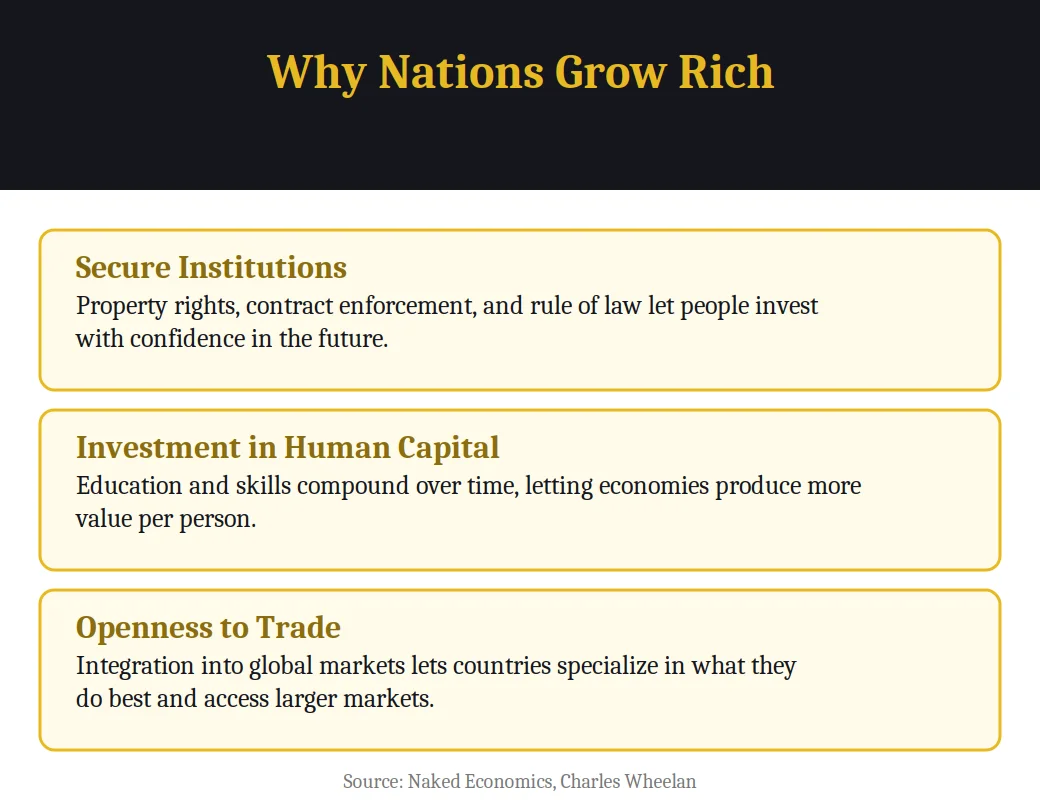
The book’s development economics chapters ask why some countries have grown dramatically wealthier over the past century while others have barely moved. Wheelan’s answer centers on institutions and openness: secure property rights and reliable contract enforcement let people invest with confidence in the future, investment in human capital compounds economic output over generations, and openness to trade lets countries specialize and access markets far larger than their own borders. Countries that get these three things right, Wheelan argues, tend to grow rich regardless of their starting endowment of natural resources — while countries that get them wrong tend to stay poor even when resources are abundant, a pattern he connects back to the incentive and institutional themes running through the rest of the book.
Who is Naked Economics best for — and who should read something else first?
This book is best for readers who want a genuinely comprehensive introduction to economics — students, career-changers, and curious generalists who want the equivalent of an intro econ course without the technical jargon. Its breadth makes it a stronger reference than a quick read, useful for readers who want the full landscape rather than a single sharp argument.
If you’d rather start with a narrower set of surprising, story-driven puzzles instead of a full survey, The Undercover Economist or Freakonomics make gentler, more focused entry points.
Questions to reflect on
- Where in your own city or industry can you spot an “invisible hand” coordinating something complex without anyone actually planning it?
- Can you identify a market failure — an externality, a public good, a monopoly — in something you interact with regularly?
- Where have you seen incentives predict behavior better than an appeal to good intentions or moral persuasion?
- How would you explain comparative advantage to someone skeptical of free trade?
- What’s one piece of economic news you’ve read recently that you could now interpret more precisely using GDP, monetary policy, or market failure concepts?
🔥 Ready for a complete, jargon-free tour of how economics actually works?
This guide covers the core framework — the book gives you Wheelan’s full examples, from trade to the Federal Reserve to development economics.
How to apply Naked Economics (7-day plan)
- Day 1: Trace the “invisible hand” behind one everyday purchase — how many decentralized decisions made it possible?
- Day 2: Identify one market failure (an externality, a public good, or monopoly power) you personally encounter.
- Day 3: Reframe a frustrating behavior — yours or someone else’s — in terms of the incentives driving it, not moral judgment.
- Day 4: Explain comparative advantage to a friend or family member using an example from your own work or hobbies.
- Day 5: Read one piece of economic news and identify whether it’s really about GDP, monetary policy, trade, or market failure.
- Day 6: Consider one investment in your own “human capital” — a skill or piece of knowledge — you could make this month.
- Day 7: Write down one policy debate you’ll now approach differently after understanding the economics underneath it.
Frequently asked questions
What is the “invisible hand” in the book?
Adam Smith’s idea that individuals pursuing their own interest, guided by prices, collectively produce efficient outcomes without intending to.
What are the main causes of market failure discussed?
Externalities, public goods, and monopoly power — the three main reasons unregulated markets don’t always produce efficient outcomes.
What is comparative advantage?
The reason countries gain from trade even when one is better at producing everything, by specializing in relative strengths.
Why does the book emphasize human capital?
Because skills, education, and ideas tend to compound and drive more durable national wealth than natural resources alone.
Is Naked Economics up to date?
Yes — the most recent revised edition, from 2019, adds material on automation, inequality, and debt following the 2008 financial crisis.
Does the book require an economics background?
No — it’s written for general readers, closer to an accessible textbook than a technical text.
How is this different from The Undercover Economist or Freakonomics?
Naked Economics is broader and more comprehensive, closer to a full course; the other two focus on narrower sets of surprising case studies.
Related summaries
If Naked Economics resonated, these dig further into related territory: The Undercover Economist on everyday market puzzles, Freakonomics on hidden incentives, and other titles in our best money and economics books pillar page.
How we analyze books: We work from the full book — reconstructing its core arguments in our own words, adding commentary that connects it to related research and other books in our library, and pressure-testing the advice in a practical 7-day plan. Ratings weigh usefulness, readability, and evidence quality. Read our full methodology.