

★★★★☆ 4.4/5 — A data-driven case that economics is really the study of incentives and hidden causality, applied to schoolteachers, sumo wrestlers, and crack dealers instead of markets.
Best for: readers who enjoy having conventional wisdom overturned by data, not personal-finance advice · Reading time: ~7 hrs (this guide: ~12 min) · Difficulty to apply: Low to apply as a thinking tool, harder to replicate the rigor without real data access
Freakonomics in one minute
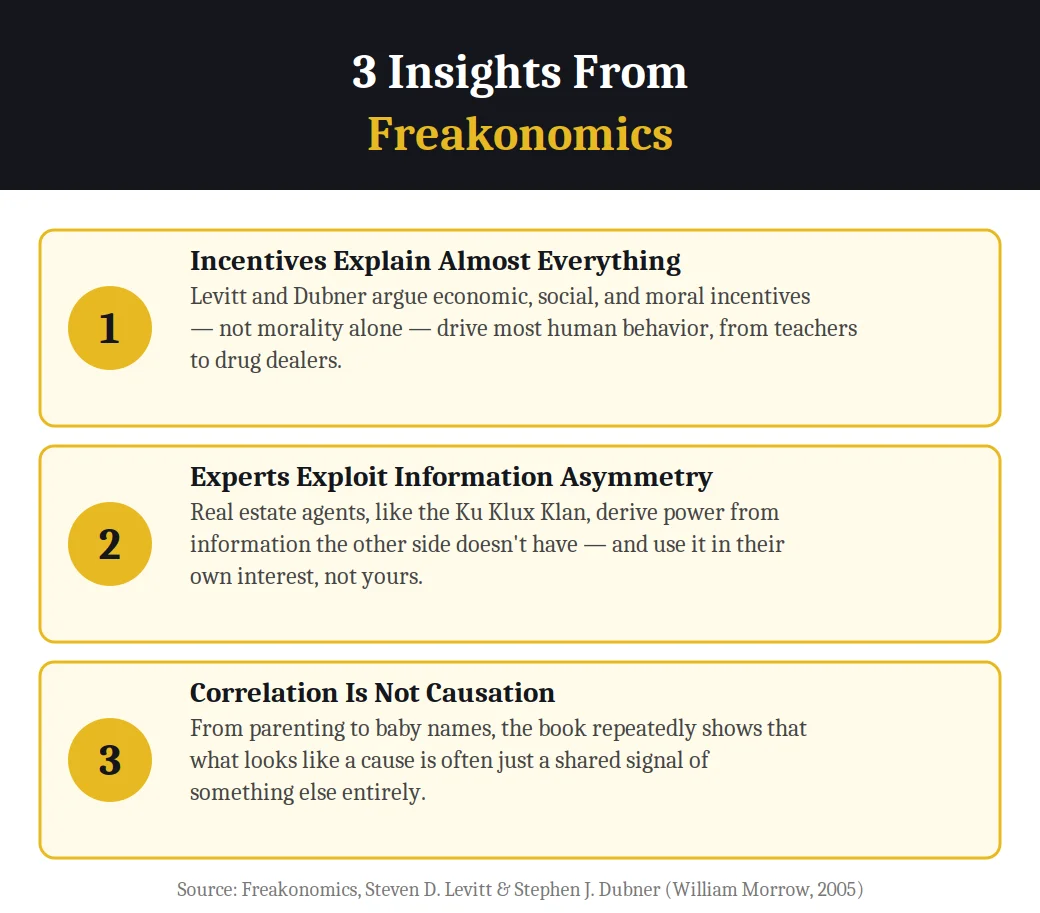
Freakonomics isn’t really a book about money — it’s a book about incentives, and how rarely they match conventional wisdom. University of Chicago economist Steven D. Levitt, joined by journalist Stephen J. Dubner (who profiled Levitt for The New York Times Magazine in 2003, leading directly to this book), applies rigorous data analysis to unconventional everyday questions: what Chicago public school teachers and sumo wrestlers have in common (both cheat, and data can catch it), how real estate agents resemble the Ku Klux Klan (both derive power from controlling information), why most crack dealers still live with their moms (gang finances mirror a corporate pyramid), and whether legalized abortion contributed to the 1990s crime drop. Published in 2005 and revised in 2006, the book’s real argument is methodological: incentives — economic, social, and moral — drive behavior more reliably than morality or intuition, and correlation is very often mistaken for causation.
Key takeaways
- Economics is the study of incentives, not money: Levitt and Dubner treat economics as a toolkit for uncovering what actually drives behavior, applied far beyond markets and personal finance.
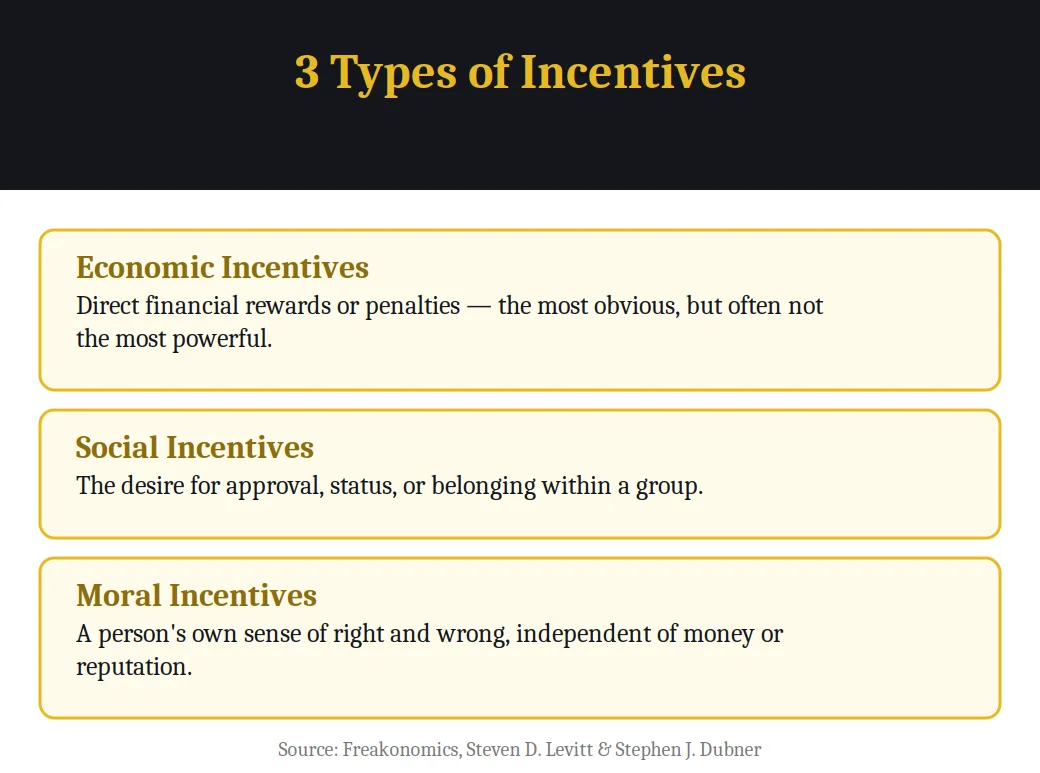
- There are three basic types of incentive: economic, social, and moral — and the most powerful one in a given situation is often not the financial one.
- Data can catch cheating hiding in plain sight: statistical analysis of Chicago Public Schools test answer sheets and sumo wrestling win-loss records both revealed patterns of collusion and fraud invisible to casual observation.
- Experts exploit information asymmetry: real estate agents keep their own homes on the market longer and sell them for more than their clients’ homes, because their commission incentive doesn’t align with getting clients the best price.
- Gang finances mirror a corporate pyramid: research with a Chicago crack-dealing gang found street-level dealers earning near minimum wage despite mortal risk, while only leaders at the top got rich — explaining why most dealers still live with their mothers.
- Correlation is not causation, again and again: having many books in the house correlates with higher-achieving kids, but doesn’t cause it — it’s a proxy for parental education and income, not a lever parents can pull directly.
- What parents are matters more than what parents do: the book’s parenting chapters argue that fixed characteristics (income, education) predict child outcomes better than specific parenting behaviors.
- Names function as signals, not causes: baby names track socioeconomic trends and often trickle down from higher-status groups over time, rather than determining a child’s life outcomes.
- The abortion-crime chapter is the book’s most contested claim: Levitt and co-author John Donohue’s original research linking Roe v. Wade to the 1990s crime decline faced a substantive methodological challenge from economists Christopher Foote and Christopher Goetz in 2008, which weakened the effect after a coding correction — a useful reminder that even careful data analysis can be wrong.
What is Freakonomics about?
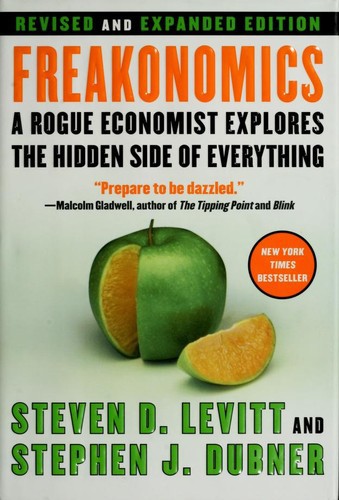
Freakonomics is Steven D. Levitt and Stephen J. Dubner’s argument that economics is best understood as the study of incentives and hidden causality, not a subject confined to markets or personal finance. The book applies rigorous data analysis to a loosely connected set of unconventional questions — cheating among teachers and sumo wrestlers, the finances of a crack-dealing gang, whether legalized abortion affected crime rates, and what actually shapes parenting outcomes and baby names — to strip away conventional wisdom and expose what the data actually shows. First published in 2005 and revised in 2006, it spawned a media franchise including several sequel books and the long-running Freakonomics Radio podcast.
About the author
Steven D. Levitt is the William B. Ogden Distinguished Service Professor of Economics at the University of Chicago and winner of the John Bates Clark Medal, awarded to the top American economist under 40. His research applies rigorous data analysis to unconventional questions in crime, cheating, and everyday incentives. Stephen J. Dubner is a journalist and author who profiled Levitt for The New York Times Magazine in 2003, an article that led directly to Freakonomics. Together they wrote several sequels, including SuperFreakonomics, Think Like a Freak, and When to Rob a Bank, and co-host the long-running Freakonomics Radio podcast. Explore all Steven D. Levitt & Stephen J. Dubner book summaries →
Key concepts at a glance
| Concept | What it means | Use it when |
|---|---|---|
| Three Types of Incentive | Economic, social, and moral incentives all shape behavior, often more powerfully than money alone | You’re trying to understand why someone isn’t responding to a financial incentive |
| Information Asymmetry | One party in a transaction has more information than the other, and often uses it in their own interest | You’re relying on an expert (agent, advisor) whose incentives may not match yours |
| Correlation vs. Causation | Two things moving together doesn’t mean one causes the other — both may share a third, hidden cause | You’re tempted to draw a causal conclusion from a pattern in data |
| Data-Detectable Cheating | Statistical pattern analysis can reveal fraud or collusion invisible to casual observation | You suspect a system is being gamed but have no direct evidence |
| Signals vs. Levers | Some factors (like baby names) predict outcomes without causing them, and aren’t things you can directly change to get a different result | You’re deciding whether something is worth intervening on, or is just a symptom |
Part 1: Incentives explain more than morality does
The book’s opening argument is that incentives, not moral character, are the most reliable predictor of behavior — and that they come in three flavors: economic, social, and moral. This framework does real analytical work across the book’s case studies. Chicago Public Schools teachers facing high-stakes accountability pressure had a economic and professional incentive to inflate scores, and statistical analysis of answer-sheet patterns caught the ones who did. Sumo wrestlers on the bubble for a winning record had a social and economic incentive to collude with opponents in final-day matches — and match-record data exposed the pattern. As Levitt and Dubner put it, “morality represents how we would like the world to work,” while economics describes how it actually does.
TGR Note: This attention to how systems, not just individual character, produce behavior echoes The Tipping Point‘s argument that small contextual and social factors — not individual willpower alone — determine whether ideas and behaviors spread.
Part 2: Information asymmetry and hidden costs
The comparison that gives the book’s second chapter its title — the Ku Klux Klan and real estate agents — sounds like a stretch until Levitt and Dubner make their point: both derive power from controlling information the other side doesn’t have. The Klan’s influence eroded once whistleblowers began publicizing its secret rituals; real estate agents’ influence rests on clients not fully understanding the market, which is why agents keep their own homes on the market roughly 10 days longer and sell them for about 3% more than they get for clients’ homes — since their small personal cut misaligns their incentive with getting sellers the best possible price.
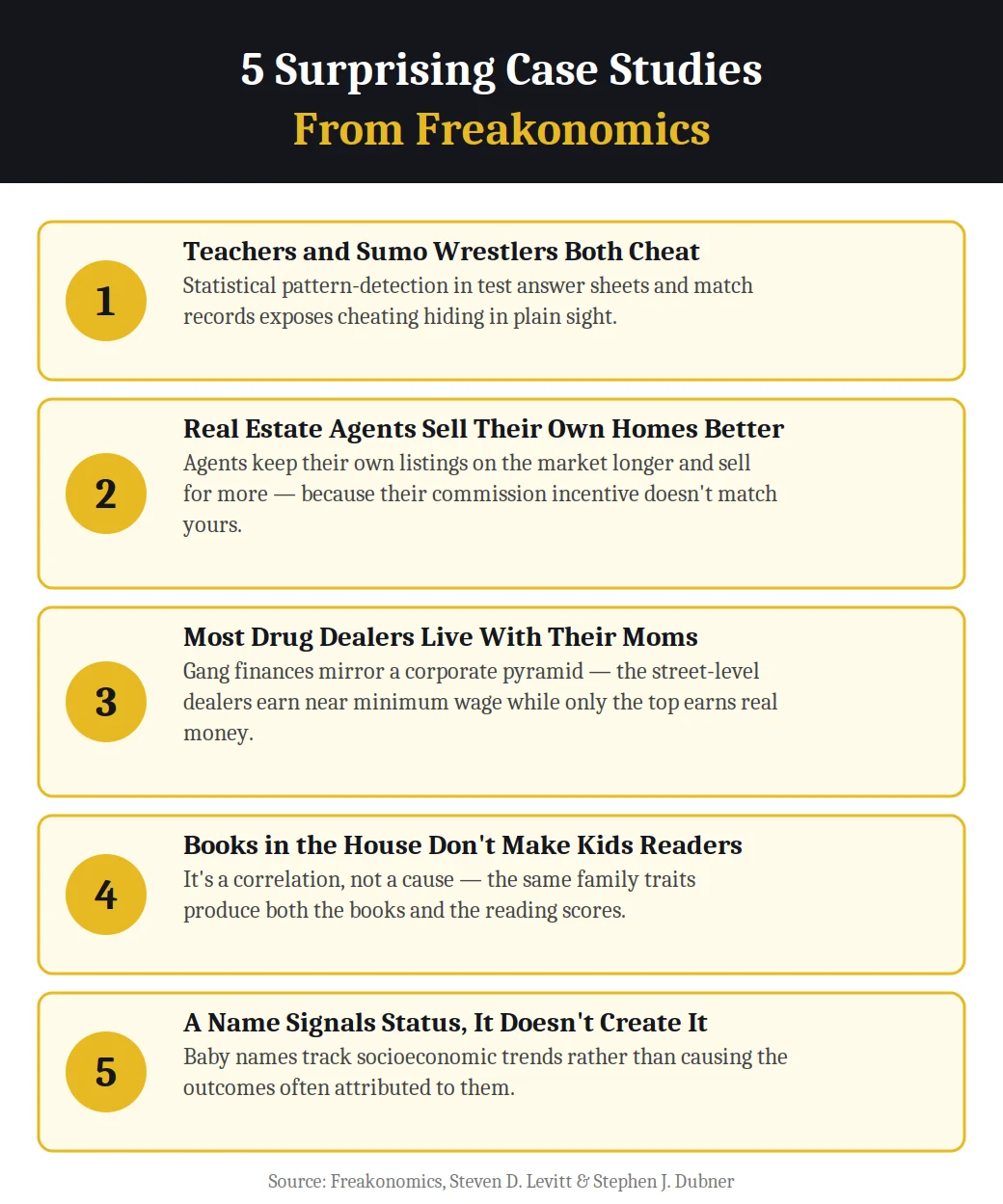
The gang-finance chapter, drawn from Sudhir Venkatesh’s fieldwork inside a Chicago crack-selling gang, extends the same logic: foot-soldier dealers earned close to minimum wage despite real mortal risk, while only members at the top of the hierarchy made real money — a tournament-style pay structure closer to a fast-food franchise than to popular imagination about drug-dealing wealth.
Part 3: The correlation-causation trap
The book’s later chapters turn to parenting and names, using large datasets to repeatedly demonstrate that a strong correlation doesn’t prove a cause. Having many books in the house correlates with higher-achieving kids, but the actual driver is more likely parental education and income — the books are a symptom of the same underlying cause, not the cause itself. The lesson generalizes: what parents are (their education, income, circumstances) predicts outcomes more reliably than specific things parents do. Baby names get the same treatment — they track socioeconomic trends and often trickle down from higher-status groups over time, functioning as signals of the family’s circumstances rather than as levers that shape a child’s future.
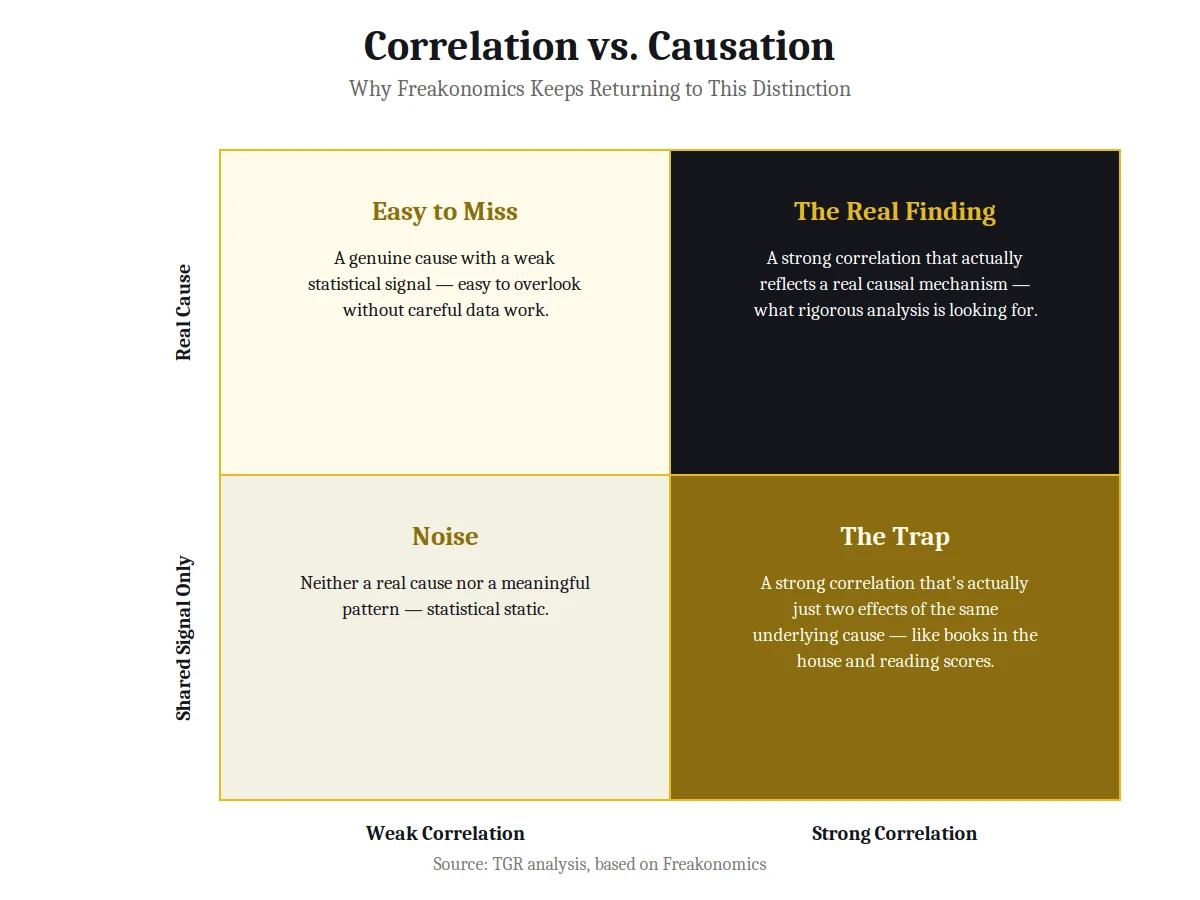
This same discipline is what makes the book’s most famous and most contested claim — that legalized abortion contributed meaningfully to the 1990s crime decline — worth reading critically rather than uncritically. Levitt and co-author John Donohue’s original analysis faced a substantive methodological challenge in 2008, when economists Christopher Foote and Christopher Goetz identified a coding issue that weakened the statistical effect once corrected. It’s a useful reminder, in a book all about catching other people’s flawed reasoning, that the same rigor has to apply to the authors’ own claims.
Who is Freakonomics best for — and who should read something else first?
This book is best for readers who enjoy having conventional wisdom overturned by data and are comfortable with a loosely connected anthology of case studies rather than one sustained argument. It’s not a personal-finance book, so readers looking for practical money advice should look elsewhere in this category.
If you want a more unified philosophical framework around uncertainty and prediction, The Black Swan builds a single sustained argument rather than a collection of case studies. If you’re drawn to the “surprising social science” style of storytelling, The Tipping Point offers a close cousin in tone, applied to how ideas and trends spread.
Questions to reflect on
- Where in your own life or work might an economic, social, or moral incentive be driving behavior you’ve been attributing to character instead?
- Is there an “expert” relationship in your life — a realtor, advisor, contractor — where your incentives and theirs might not actually be aligned?
- What’s a correlation you’ve been treating as a cause, without ever checking whether a third factor might explain both?
- Where might data reveal a pattern in your own work or team that intuition alone would miss?
- When you encounter a surprising, well-argued claim, do you actually check whether it’s held up to later scrutiny?
🔥 Ready to see the hidden incentives behind everyday life?
This guide covers the core case studies — the book gives you Levitt and Dubner’s full data, methodology, and storytelling.
How to apply Freakonomics (7-day plan)
- Day 1: Identify one behavior at work or home you’ve assumed is about character, and ask what incentive might actually be driving it.
- Day 2: List the “experts” you rely on regularly, and check whether their incentive genuinely matches your own interest.
- Day 3: Find one correlation you’ve been treating as causal in your own thinking, and identify a plausible third factor behind it.
- Day 4: Look for a pattern hiding in data you already have access to — attendance, sales, engagement — that intuition alone would miss.
- Day 5: Notice one place where “what people are” (circumstances) might predict an outcome better than “what people do.”
- Day 6: Practice explaining a surprising finding to someone else, focusing on the incentive or hidden variable behind it, not just the headline.
- Day 7: Pick one confident claim you’ve made recently and check whether it would hold up to the same scrutiny you’d apply to someone else’s argument.
Frequently asked questions
What is Freakonomics actually about, if not money?
It’s about incentives and hidden causality — using economic thinking and data analysis to explain surprising real-world behavior, from cheating to parenting to crime.
What are the three types of incentives in the book?
Economic, social, and moral incentives — all of which shape behavior, often more powerfully than financial reward alone.
Why do real estate agents get compared to the Ku Klux Klan?
Both derive power from controlling information the other side lacks, and both lose influence when that information becomes public.
Is the abortion-crime chapter’s claim considered valid today?
It remains contested — a 2008 study identified a coding error in the original analysis that weakened the statistical effect after correction, though Levitt and his co-author defended a revised version of the finding.
Why do most drug dealers still live with their moms?
Gang finances mirror a corporate pyramid — street-level dealers earn close to minimum wage despite real risk, while only top-level leaders earn substantial money.
Does having books in the house make kids better readers?
Not directly — it’s a correlation, not a cause. Books in the house are a proxy for parental education and income, which are the actual predictors.
Is there a sequel to Freakonomics?
Yes, SuperFreakonomics (2009), followed by Think Like a Freak (2014) and When to Rob a Bank (2015), plus the ongoing Freakonomics Radio podcast.
Related summaries
If Freakonomics resonated, these dig further into related territory: The Tipping Point on how ideas and behaviors spread, and other titles in our best money and economics books pillar page.
How we analyze books: We work from the full book — reconstructing its core arguments in our own words, adding commentary that connects it to related research and other books in our library, and pressure-testing the advice in a practical 7-day plan. Ratings weigh usefulness, readability, and evidence quality. Read our full methodology.