

★★★★☆ 4.4/5 — A witty, accessible tour showing that basic economic tools — scarcity, price signals, market power — explain far more of everyday life than most people realize.
Best for: readers who want a friendly, story-driven introduction to how markets actually work, from coffee shops to entire economies · Reading time: ~7 hrs (this guide: ~12 min) · Difficulty to apply: Low — the ideas are approachable and immediately visible in daily purchases
The Undercover Economist in one minute
Ordinary economic tools — scarcity, price signals, and market power — explain far more of everyday life than most people ever notice, and Tim Harford spends the book teaching readers to spot them. He opens with a simple puzzle: why does a cup of coffee at a train station cost so much more than the beans are worth? The answer isn’t the coffee — it’s rent, in the classical economic sense, captured by whoever controls the scarce, well-located land the shop sits on. From there, Harford walks through price discrimination (why loyalty cards and “fair trade” labels let sellers charge each customer close to their maximum willingness to pay), asymmetric information (George Akerlof’s “market for lemons” and why used cars are so often disappointing), externalities like traffic congestion, and — in the book’s most ambitious chapters — why some countries stay poor while others grow rich. First published in 2005 and revised in 2012 with new material on the financial crisis, the book remains one of the most approachable introductions to how real markets actually behave, and how often they diverge from the textbook ideal.
Key takeaways
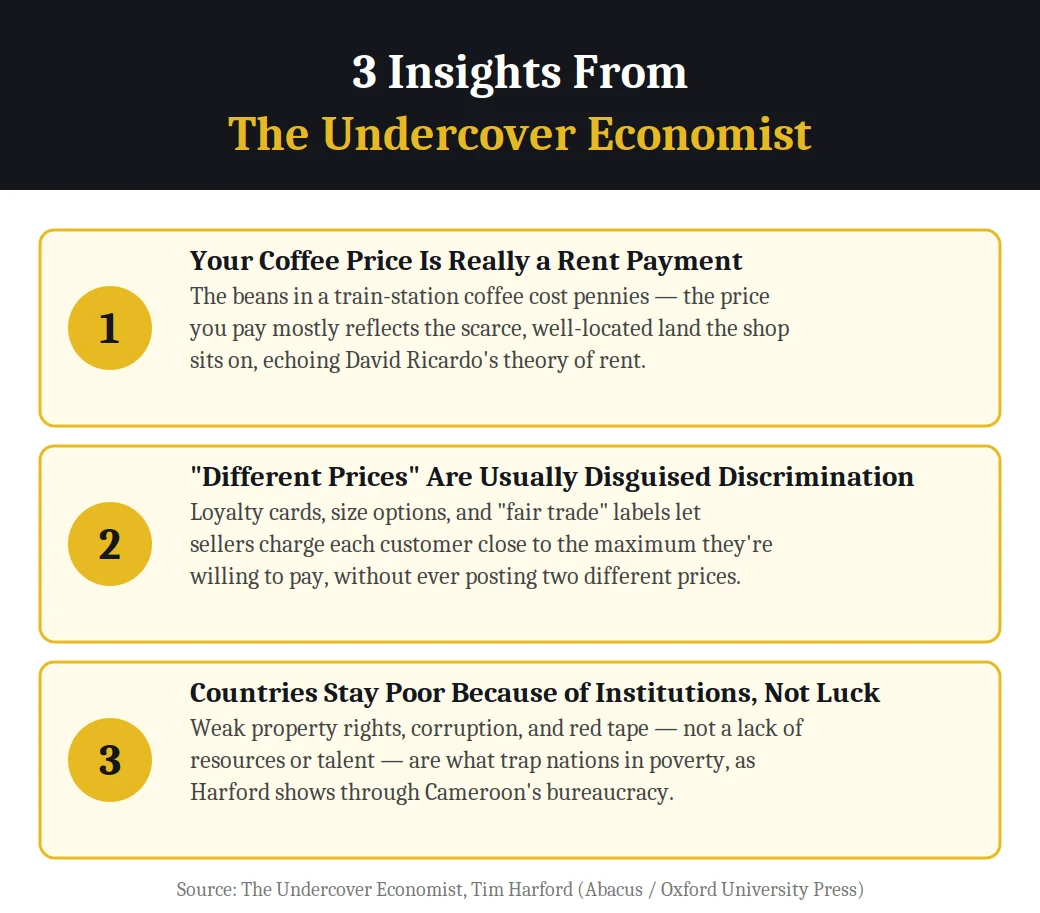
- Your coffee price is mostly a rent payment: the beans cost pennies — what you’re really paying for is the scarce, well-located real estate the shop occupies, a modern echo of David Ricardo’s theory of rent.
- “Different prices” are usually disguised price discrimination: loyalty cards, size options, and premium labels let sellers charge each customer close to the maximum they’re willing to pay, without ever posting two different prices for the same thing.
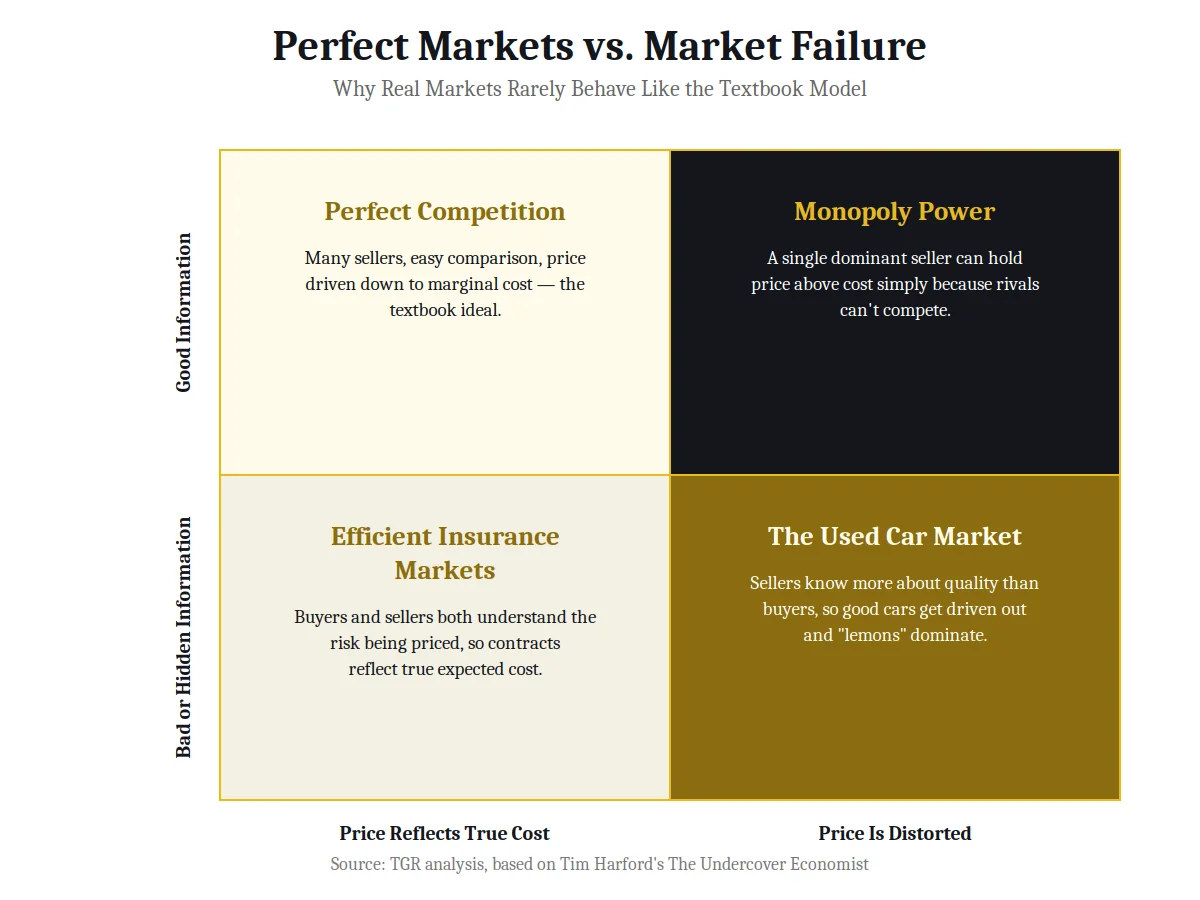
- Perfect competition is a useful ideal, not a description of reality: real markets deviate from the textbook model through monopoly power, externalities, and incomplete information.
- Externalities distort decisions when costs land on bystanders: traffic congestion and pollution impose real costs on people outside the transaction — Harford makes the case for congestion pricing as a fix.
- Asymmetric information can collapse entire markets: George Akerlof’s “market for lemons” shows how sellers knowing more than buyers drives good used cars out of the market, leaving mostly “lemons” behind.
- Well-designed auctions extract true value: the UK’s 3G spectrum auction, which Harford helped advise on, shows how careful market design can force bidders to reveal what something is genuinely worth to them.
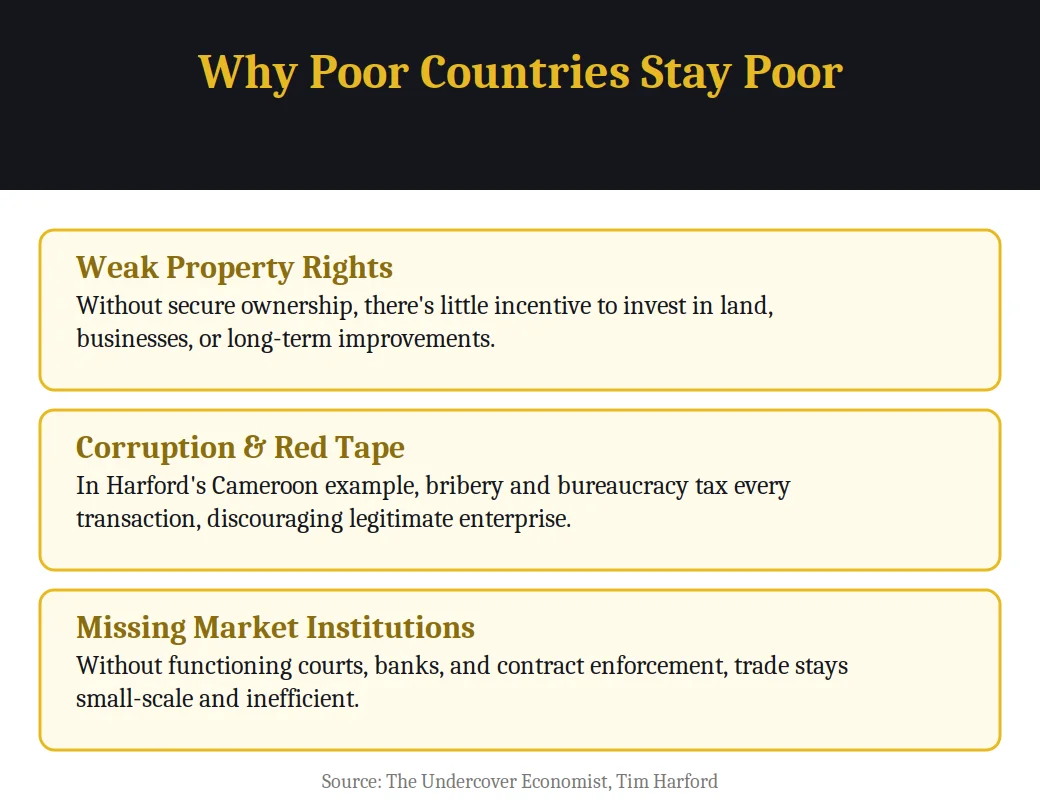
- Poor countries usually stay poor because of weak institutions, not bad luck: insecure property rights, corruption, and red tape — illustrated through Cameroon’s bureaucracy — trap nations in poverty regardless of natural resources.
- Globalization and trade have driven real prosperity: Harford’s China chapter argues that integration into world markets, not isolation, is what has lifted hundreds of millions of people out of poverty.
- Thinking like an economist is a transferable skill: once you learn to spot scarcity, incentives, and information gaps, you start seeing them everywhere — not just in markets, but in daily decisions.
What is The Undercover Economist about?
The Undercover Economist is Tim Harford’s accessible tour of how basic economic principles — scarcity, price signals, market power, and information — explain everyday phenomena, from an overpriced cup of train-station coffee to why entire nations stay poor. Structured as a series of real-world puzzles, the book walks readers through price discrimination, market failure, externalities, and game theory before widening its lens to development economics and globalization, using Cameroon and China as contrasting case studies in what makes economies grow or stagnate. First published in 2005 and revised in 2012 with new material addressing the financial crisis, the book helped launch Harford’s career as one of the most widely read popular economics writers, known for his Financial Times column of the same name and the BBC’s More or Less.
About the author
Tim Harford is a British economist, journalist, and broadcaster best known for the Financial Times column “The Undercover Economist” and the BBC radio series More or Less, which examines the numbers behind the news. He holds degrees from Oxford University and worked briefly at the World Bank before turning to economics writing and journalism full-time. Harford’s books, including The Undercover Economist, The Logic of Life, Adapt, Messy, and How to Make the World Add Up, are known for translating rigorous economic ideas into accessible, story-driven explanations of everyday life, and he has advised on real-world market design, including work related to the UK’s 3G spectrum auction discussed in this very book. Explore all Tim Harford book summaries →
Key concepts at a glance
| Concept | What it means | Use it when |
|---|---|---|
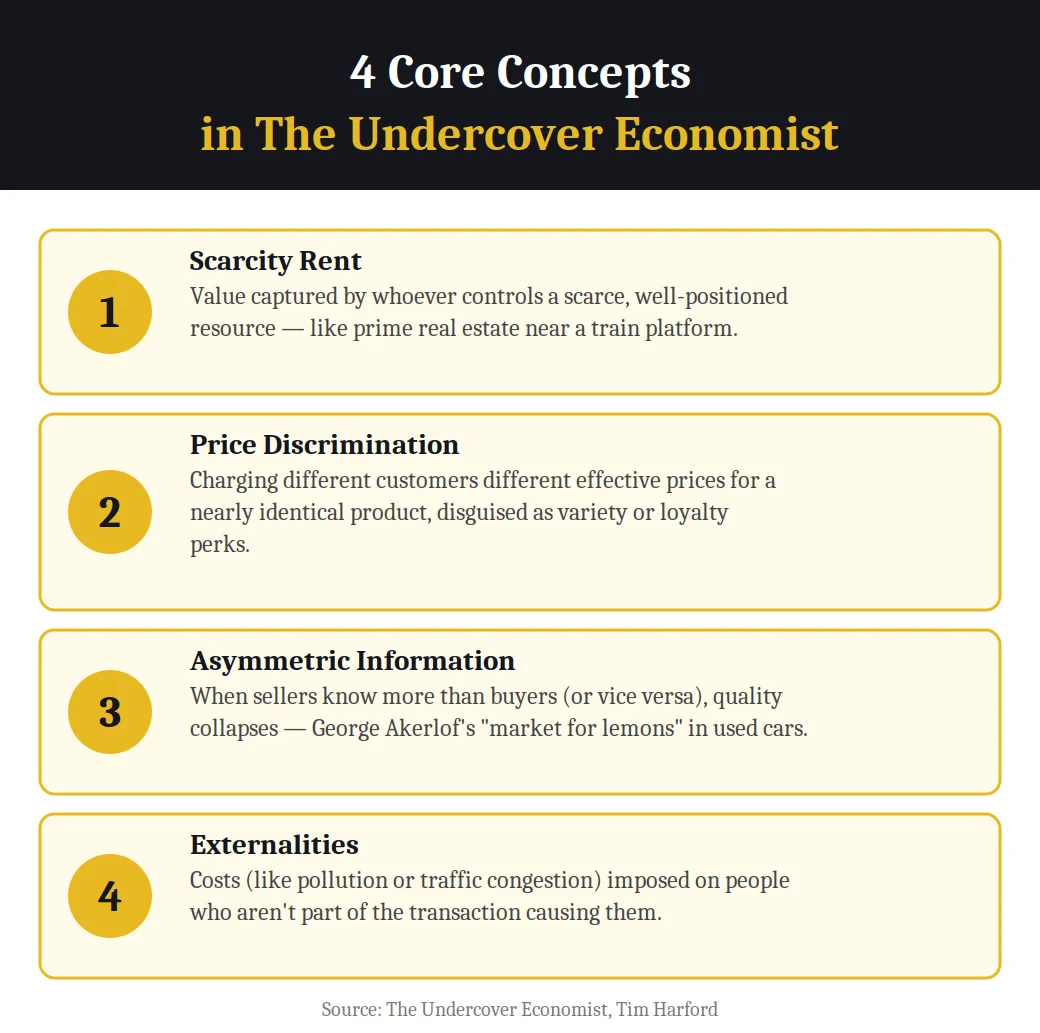
| Scarcity Rent | Value captured by whoever controls a scarce, well-positioned resource | You’re wondering why a location-dependent product costs so much more than its raw materials |
| Price Discrimination | Charging different customers different effective prices for a nearly identical product | You notice loyalty cards, bundles, or “premium” labels on an otherwise similar product |
| Asymmetric Information | When sellers know more than buyers (or vice versa), quality collapses | You’re buying something (a used car, insurance) where the seller has more information than you |
| Externalities | Costs imposed on people who aren’t part of the transaction causing them | You’re evaluating a policy like congestion pricing or pollution taxes |
| Institutions & Property Rights | The rules, courts, and enforcement that let markets and investment actually function | You’re trying to understand why a country’s economy isn’t growing despite having resources |
Part 1: Why your coffee costs what it costs
Harford opens with a deceptively simple question: why does a cup of coffee at a train station cost so much more than the few pennies of beans inside it? The answer, he argues, has almost nothing to do with the coffee itself — it’s rent, in the classical economic sense used by David Ricardo, captured by whoever controls the scarce, well-located land the shop occupies. From there, Harford unpacks price discrimination: coffee chains, supermarkets, and airlines routinely charge different customers different effective prices for nearly identical products, disguising the practice as size options, loyalty cards, or “fair trade” labeling, so that price-sensitive and price-insensitive customers each pay close to what they’re individually willing to spend, without the seller ever posting two different price tags.
TGR Note: Harford’s price discrimination examples pair naturally with Freakonomics‘s knack for finding hidden incentives behind ordinary-looking prices and behaviors — both books train readers to ask “what’s really being priced here?”
Part 2: When markets fail — information, externalities, and auctions
Real markets, Harford shows, routinely deviate from the textbook ideal of perfect competition. George Akerlof’s “market for lemons” explains why used-car markets are so often disappointing: sellers know more about a car’s true condition than buyers do, so good cars get priced out and low-quality “lemons” come to dominate the listings. Externalities create a different kind of distortion — traffic congestion and pollution impose real costs on people who aren’t part of the transaction causing them, which is why Harford makes the case for congestion pricing as a practical fix. On the more optimistic side, he walks through the UK’s 3G spectrum auction, a market Harford helped advise on, as an example of how careful auction design can force bidders to reveal the true value of a scarce resource rather than letting it be captured or under-priced.
TGR Note: The book’s used-car “lemons” problem is a specific case of the same accountability gap explored in Skin in the Game — sellers who don’t share the buyer’s risk have weaker incentive to be honest about quality.
Part 3: Why some countries stay poor
The book’s most ambitious chapters widen the lens from individual markets to entire economies. Using Cameroon as a case study, Harford shows how weak property rights, pervasive corruption, and suffocating bureaucratic red tape can trap a country in poverty regardless of its natural resources or the talent of its people — every transaction taxed by bribery discourages the kind of legitimate, large-scale enterprise that builds lasting prosperity. He contrasts this with China’s rapid growth, arguing that integration into global trade and markets, not isolation, is what has lifted hundreds of millions of people out of poverty over the past several decades — a case for globalization built on the same core economic tools used throughout the book.
Who is The Undercover Economist best for — and who should read something else first?
This book is best for readers who want a friendly, story-driven introduction to how markets actually work — students, curious professionals, and anyone who wants to understand pricing, trade, and development without wading through a textbook. Its light, conversational tone makes it one of the more approachable entry points into popular economics.
If you enjoyed the price-discrimination and hidden-incentive puzzles here, Freakonomics covers similar territory with an even wider range of quirky case studies, and Winning the Loser’s Game applies related market-efficiency thinking specifically to investing.
Questions to reflect on
- Where have you paid more for “location” or convenience without realizing you were really paying rent for scarce, well-placed real estate?
- Can you spot a price-discrimination scheme — a loyalty card, a size option, a “premium” label — the next time you shop?
- Is there a purchase you’ve made where the seller likely knew more than you did about the product’s true quality?
- What externality — a cost imposed on someone outside the transaction — do you encounter regularly without thinking about who’s really paying for it?
- What weak institution or piece of red tape, in your own experience, has made a legitimate transaction harder than it should be?
🔥 Ready to start seeing the hidden economics in everyday life?
This guide covers the core framework — the book gives you Harford’s full case studies, from spectrum auctions to the rise of China.
How to apply The Undercover Economist (7-day plan)
- Day 1: Identify one purchase where you’re likely paying for scarce location or convenience rather than the product itself.
- Day 2: Spot a price-discrimination scheme in a store, app, or subscription service you use regularly.
- Day 3: Notice one purchase where the seller probably knows more about quality than you do, and consider how that shapes your decision.
- Day 4: Identify an externality in your daily commute or routine, and think about who actually bears its cost.
- Day 5: Read one news story about trade or development through the lens of institutions and property rights rather than luck or resources.
- Day 6: Practice explaining one everyday price to a friend using scarcity or rent instead of “that’s just what it costs.”
- Day 7: Write down one decision — personal or professional — where thinking in incentives, not intentions, changes your read of the situation.
Frequently asked questions
Why does train-station coffee cost so much in the book’s example?
Mostly because of rent captured by the scarce, well-located land the shop sits on, not the cost of the beans themselves.
What is price discrimination in the book?
Charging different customers different effective prices for a nearly identical product, disguised as variety, size, or loyalty perks.
What is the “market for lemons”?
George Akerlof’s theory explaining how asymmetric information between buyers and sellers drives good used cars out of the market, leaving mostly low-quality ones.
Why does the book discuss Cameroon and China?
As contrasting case studies in how institutions, property rights, and trade openness determine whether a country grows rich or stays poor.
Does the book require an economics background?
No — it’s written for a general audience, using everyday examples like coffee and used cars rather than technical jargon.
What is an externality?
A cost or benefit imposed on someone who isn’t part of the transaction causing it, such as traffic congestion or pollution.
How is this different from Freakonomics?
The Undercover Economist builds a structured tour of core economic tools; Freakonomics is a looser anthology of surprising, incentive-driven case studies.
Related summaries
If The Undercover Economist resonated, these dig further into related territory: Freakonomics on hidden incentives, Winning the Loser’s Game on market efficiency in investing, and other titles in our best money and economics books pillar page.
How we analyze books: We work from the full book — reconstructing its core arguments in our own words, adding commentary that connects it to related research and other books in our library, and pressure-testing the advice in a practical 7-day plan. Ratings weigh usefulness, readability, and evidence quality. Read our full methodology.