

⭐⭐⭐⭐ 4.2 / 5 — The relationship classic that reframed how millions of couples understand their communication differences.
Best for: Couples who argue about “nothing” and individuals who want to understand why their partner communicates so differently.
Reading time: ~7 hours (this guide: 14 min)
Difficulty to apply: Medium — understanding the concepts is easy, but breaking ingrained communication patterns takes consistent effort.
Men Are from Mars, Women Are from Venus in one minute
Most relationship conflicts aren’t about the issue — they’re about two people speaking entirely different emotional languages. John Gray’s groundbreaking book uses the metaphor of men and women coming from different planets to explain why partners so often misunderstand each other. Men tend to withdraw into their “cave” when stressed, while women need to talk through their feelings. Men instinctively offer solutions when women want empathy. Women try to “improve” men who just want acceptance. Gray maps these patterns through concepts like the Rubber Band (his natural intimacy cycle), the Wave (her emotional cycle), the Love Letter technique, and the scoring system that explains why small gestures matter more than grand ones. The book’s core insight: understanding these differences doesn’t mean one gender is right — it means both can stop taking natural differences personally.
Key takeaways
- Men and women process stress differently: Men withdraw to their mental “cave” to solve problems internally; women need to talk through feelings to process them. Neither approach is wrong — they’re just different.
- Don’t offer solutions when empathy is needed: When a woman shares a problem, she usually wants understanding first, not a fix. Listening without trying to solve is one of the most powerful relationship skills a man can develop.
- Don’t try to change your partner: Unsolicited advice feels like criticism. Men need acceptance and trust; women need caring and understanding. Trying to “improve” your partner communicates that they’re not good enough as they are.
- The Rubber Band effect is natural: Men naturally cycle between closeness and distance. When a man pulls away, it’s not rejection — it’s a need for autonomy that, when respected, leads him to spring back with even more love.
- The Wave is natural too: Women’s emotions naturally rise and fall in cycles. When she crashes, she needs support, not solutions. The wave always rises again.
- Small things score big: In the relationship “point system,” every loving act scores one point — regardless of size. Twenty small gestures outweigh one grand romantic gesture.
- Learn to ask for what you need: Partners are not mind readers. Learning to ask without demanding, and to receive without criticizing, transforms relationships.
- Love Letters heal resentment: Gray’s four-layer letter technique (anger → sadness → fear → love) helps process difficult emotions and communicate them constructively.
- Men are motivated by being needed: When a woman shows trust in his abilities and appreciation for his efforts, a man is naturally motivated to give more.
- Women are motivated by being cherished: When a man shows consistent caring, understanding, and respect, a woman feels safe enough to be her most loving self.
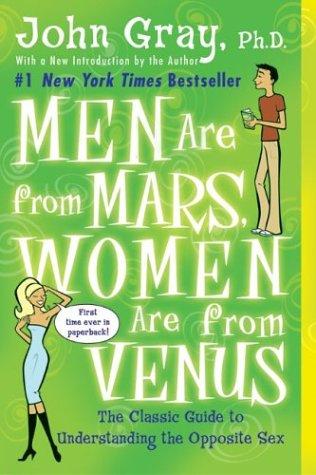
What is Men Are from Mars, Women Are from Venus about?
Men Are from Mars, Women Are from Venus is a relationship guide that explains the fundamental differences in how men and women communicate, process emotions, handle stress, and express love. John Gray uses the metaphor of two different planets to help couples understand and appreciate these differences rather than fight about them.
About the author
John Gray is an American relationship counselor and author who has written over twenty books on communication, relationships, and personal growth. He earned his doctorate in psychology and human sexuality from Columbia Pacific University and spent nine years as a monk studying meditation with Maharishi Mahesh Yogi before turning to relationship counseling. Men Are from Mars, Women Are from Venus, published in 1992, became one of the best-selling nonfiction books of the 1990s, spending over 120 weeks on the bestseller list and selling over 50 million copies worldwide in 40 languages. Gray has appeared on Oprah, The Today Show, and hundreds of other media outlets, and continues to run relationship workshops and seminars internationally. Explore all John Gray book summaries →
Key concepts at a glance
| Concept | What it means | Use it when |
|---|---|---|
| The Cave | Men’s need to withdraw and process problems alone before re-engaging | Your partner goes quiet after a stressful day |
| The Rubber Band | Men naturally cycle between closeness and distance in relationships | He pulls away and you feel rejected |
| The Wave | Women’s emotional cycles of rising confidence and crashing vulnerability | She suddenly feels down for “no reason” |
| The Point System | Every loving act scores equally — small gestures matter as much as big ones | You want to show love more effectively daily |
| Love Letters | Four-layer writing technique: anger → sadness → fear → love | You need to process and communicate difficult feelings |
| Primary Love Needs | His: trust, acceptance, appreciation · Hers: caring, understanding, respect | You want to love your partner in the way they actually receive it |
| The Well | A woman’s deep emotional reservoir that needs filling through love and attention | She feels empty despite having a “good” life on paper |
Part 1: Speaking different languages — why he offers solutions, why she wants empathy
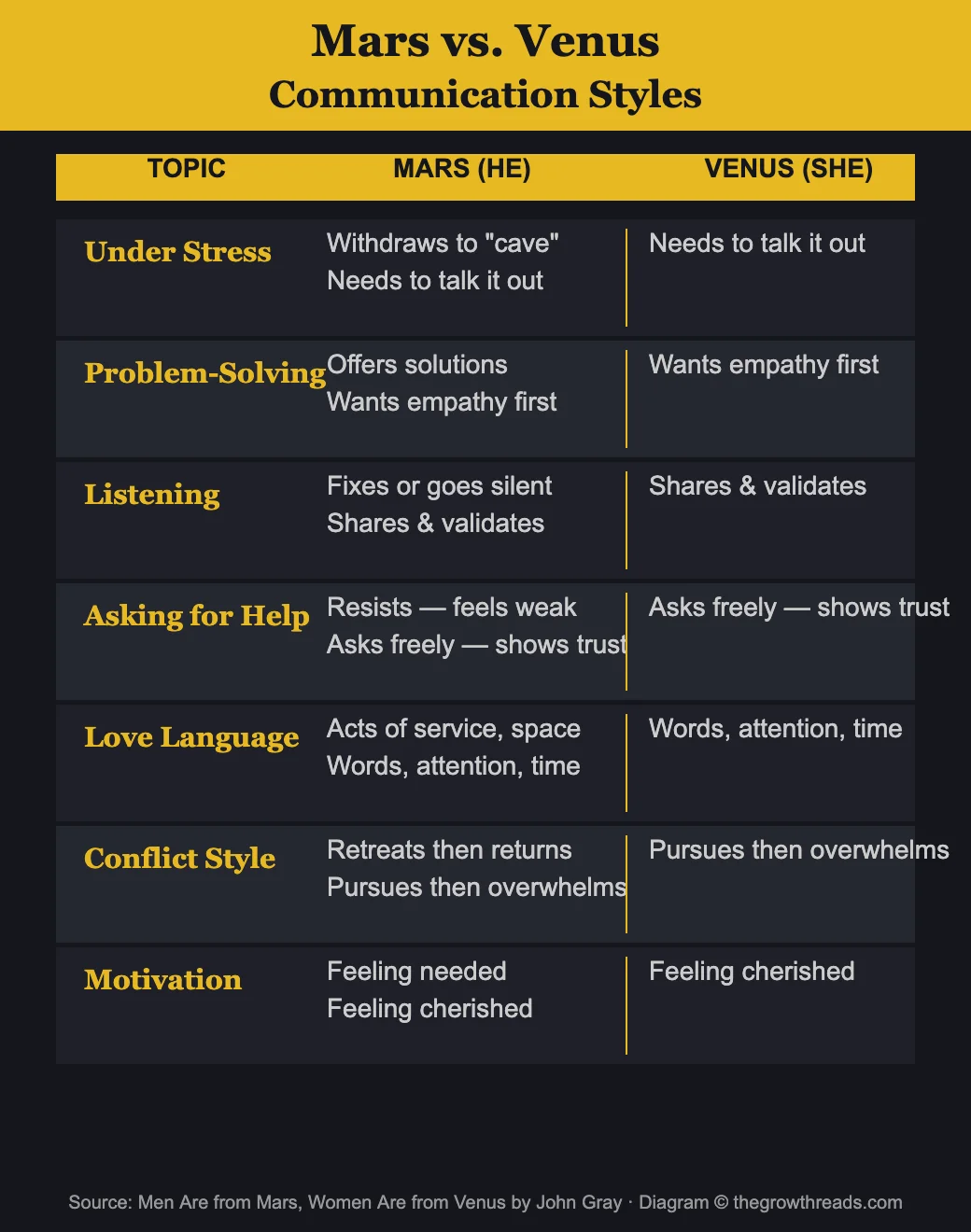
Gray opens with the core metaphor: imagine that men really did come from Mars and women from Venus. On Mars, competence, efficiency, and achievement were the highest values. When a Martian had a problem, he went to his cave to solve it alone — asking for help was a sign of weakness. On Venus, communication, beauty, and relationships were paramount. When a Venusian had a problem, she talked about it with others — sharing was a sign of trust, not weakness.
When these two groups came to Earth and fell in love, they forgot they were from different planets. They began expecting their partners to think, feel, and communicate just like they did — and when the inevitable differences appeared, they interpreted them as flaws rather than features.
The most common example is what Gray calls the “home improvement” dynamic. When a woman shares a problem, a man instinctively offers a solution — because on Mars, that’s how you show you care. But she doesn’t want a solution; she wants to feel heard. His solution-giving makes her feel dismissed. Meanwhile, when she tries to help him by offering unsolicited suggestions about how he could handle something differently, he feels she doesn’t trust his competence. Both partners are trying to love each other — but in their own language, not their partner’s.
Part 2: The cave and the wave — understanding emotional cycles
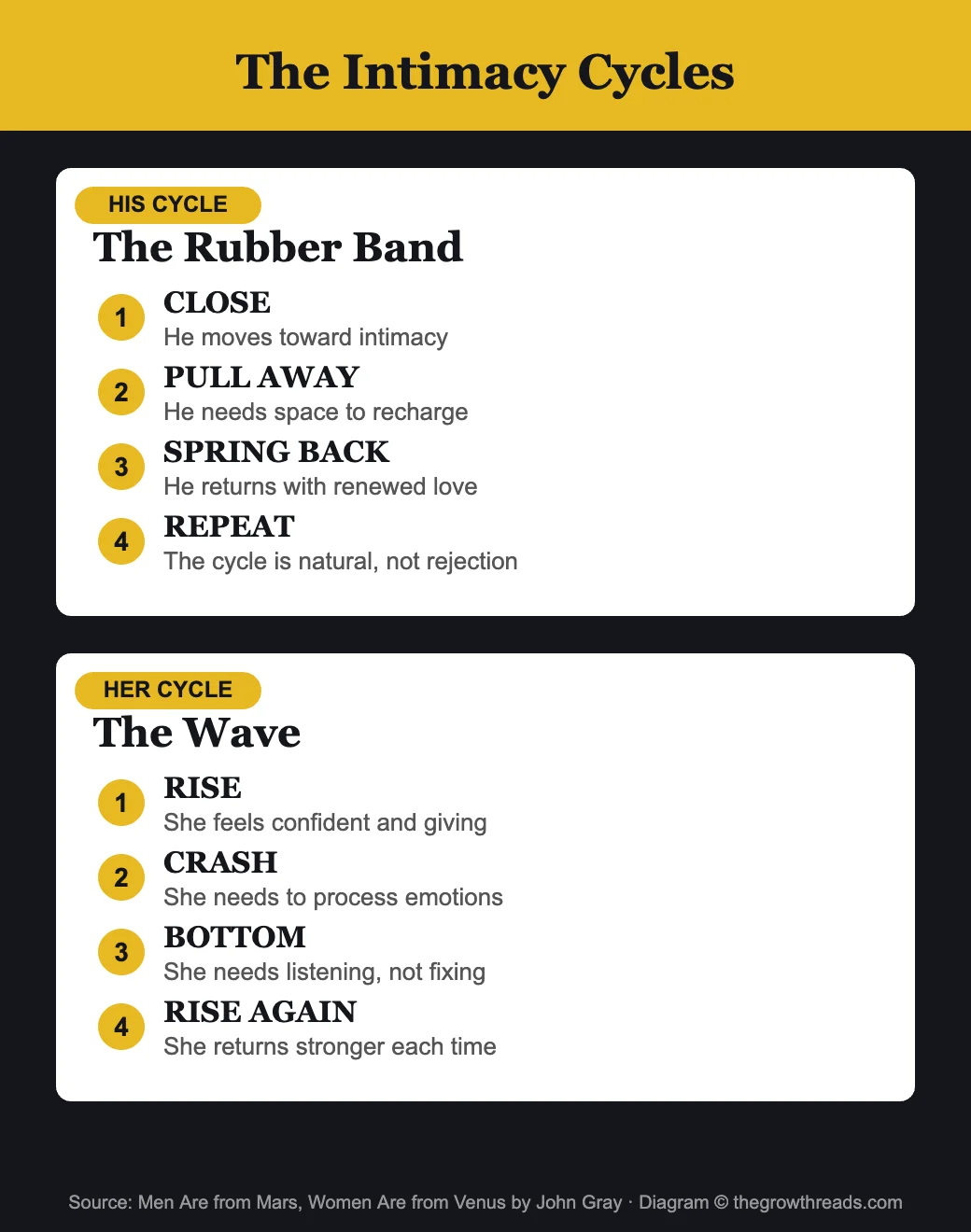
Gray introduces two powerful metaphors for understanding the natural emotional rhythms in relationships. The Rubber Band describes a man’s intimacy cycle: he gets close, then naturally pulls away to regain his sense of autonomy and self, then springs back with renewed desire for connection. This isn’t rejection — it’s a biological and psychological need for independence that, when satisfied, fuels even deeper intimacy.
The critical mistake women make during this cycle is chasing. When he pulls away, her instinct is to pursue — asking what’s wrong, trying to get closer, wondering what she did. This pursuit prevents the rubber band from stretching, which prevents the natural spring-back. The counterintuitive solution: give him space, and he’ll return on his own.
The Wave describes a woman’s emotional cycle. Her well of self-esteem and emotional resilience naturally fills and empties. When the wave rises, she’s confident, generous, and happy. When it crashes, she may feel overwhelmed, unappreciated, or sad — often without a specific trigger. This isn’t irrational; it’s how she processes accumulated emotional experiences.
The critical mistake men make during the wave’s crash is trying to fix it. Offering solutions (“Why don’t you just…”) or dismissing feelings (“It’s not that bad”) makes her feel unheard. What she needs at the bottom of the wave is someone who simply listens, validates, and stays present without trying to fix anything. The wave always rises again — and it rises faster when she feels supported through the dip.
Part 3: The point system and how to love your partner effectively
One of the book’s most practical insights is the scoring system. Gray argues that men and women keep score differently in relationships — and misunderstanding this system is one of the biggest sources of resentment. In a woman’s scoring system, every act of love counts as one point, regardless of size. Bringing home flowers: one point. Buying a car: one point. Listening to her for fifteen minutes after work: one point. Complimenting her outfit: one point.
This means that a man who does one grand romantic gesture per month (one point) will score lower than a man who does twenty small daily kindnesses (twenty points). The implications are transformative: instead of saving up for big gestures, men should focus on consistent small actions — opening doors, calling during the day, asking about her feelings, remembering details she mentioned.
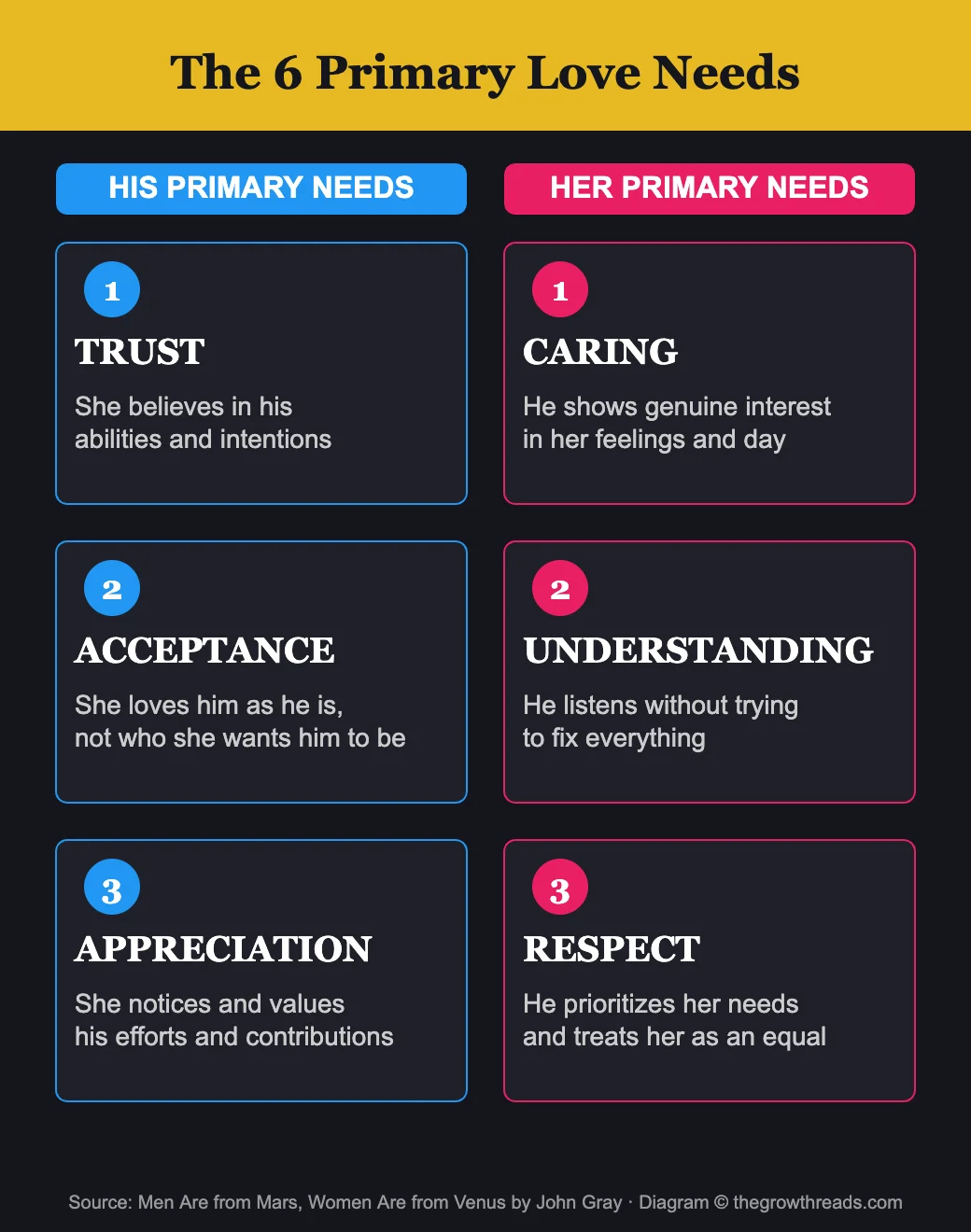
Gray also addresses the six primary love needs that differ by gender. Men primarily need trust (she believes in him), acceptance (she doesn’t try to change him), and appreciation (she values his efforts). Women primarily need caring (he shows genuine interest), understanding (he listens without judging), and respect (he treats her as a priority). When these needs go unmet, the “love tank” empties — and an empty love tank is the root cause of most relationship dissatisfaction.
Part 4: Asking for love, writing love letters, and keeping the magic alive
The final section focuses on practical tools for improving communication. Gray introduces the Love Letter technique, a structured writing exercise for processing and communicating difficult emotions. The letter moves through four layers: anger (“I’m angry that…”), sadness (“I’m sad that…”), fear (“I’m afraid that…”), and finally love (“I love you because…”). By moving through all four layers, you process the full spectrum of emotion rather than getting stuck in anger or resentment.
Gray also teaches the art of asking for what you need without demanding or nagging. The key principles: ask at the right time (not when he’s in the cave or she’s at the bottom of a wave), be direct (hints don’t work across planets), be brief (don’t over-explain), and always leave room for him to say no gracefully. When a man can choose to give rather than being forced to, the giving fills his love tank too.
The concept of “seasonal” relationships adds a final layer of understanding. Gray describes four seasons that relationships cycle through: Spring (easy love), Summer (deeper intimacy), Fall (challenges and growth), and Winter (emotional distance and renewal). Understanding that winter is a natural part of the cycle — not the death of the relationship — gives couples the patience to weather difficult periods and trust that spring will come again.
Who is Men Are from Mars, Women Are from Venus best for — and who should read something else first?
This book is ideal for couples experiencing communication frustrations — especially those who love each other but can’t seem to stop arguing about the same things. It’s also valuable for singles who want to understand relationship dynamics before entering one, and for anyone in a heterosexual relationship who feels like their partner is speaking a foreign language.
If your relationship challenges go deeper than communication — involving trust violations, control patterns, or emotional abuse — this book won’t be sufficient. Start with The Body Keeps the Score for understanding trauma’s role in relationships. For a more attachment-science-based approach, Attached addresses why some people pursue while others withdraw. For universal love language insights beyond gender, The 5 Love Languages is the natural companion read.
Questions to reflect on
- When your partner withdraws or goes quiet, do you pursue or give space — and how does that choice usually play out?
- When you share a problem, are you looking for solutions or empathy — and does your partner give you the one you actually need?
- What are the small, daily gestures that would fill your partner’s love tank — and are you doing them consistently?
- Do you try to change or “improve” your partner, and how might they experience those attempts?
- Which of the six primary love needs feels most unmet in your relationship right now — and have you communicated that directly?
🔥 Ready to understand your partner’s planet?
Learn why you keep misunderstanding each other — and how to bridge the gap for good.
How to apply Men Are from Mars, Women Are from Venus (7-day plan)
- Day 1 — Identify your pattern. Notice how you and your partner respond to stress today. Does one withdraw? Does one pursue? Write down what you observe without judgment.
- Day 2 — Listen without solving. When your partner shares a problem today, resist the urge to offer solutions. Instead, say “That sounds really frustrating” or “Tell me more.” Notice how they respond to being heard.
- Day 3 — Score twenty small points. Do twenty small acts of love today: a text, a compliment, making coffee, asking about their day, a touch on the shoulder. Track them and notice the cumulative effect.
- Day 4 — Respect the cave (or the wave). If your partner withdraws, practice giving space without pursuing. If your partner crashes emotionally, practice listening without fixing.
- Day 5 — Write a Love Letter. Pick a recent conflict and write through all four layers: anger, sadness, fear, and love. You don’t have to share it — the processing itself is valuable.
- Day 6 — Ask for what you need. Identify one unmet need and ask for it directly: “It would mean a lot to me if you…” Keep it specific, brief, and non-blaming.
- Day 7 — Discuss the book together. Share the most useful insight from this week with your partner. Ask which concept resonated most with them. Listen to understand, not to debate.
Frequently asked questions
Is Men Are from Mars, Women Are from Venus still relevant today?
The core insights about communication differences remain widely applicable, even as our understanding of gender has evolved. The specific patterns Gray describes — one partner withdrawing under stress, the other pursuing connection, different definitions of “support” — play out in millions of relationships regardless of how we label them. Modern readers may find some of the gender framing oversimplified, but the practical communication tools (Love Letters, the point system, listening without solving) are timeless and work for any couple.
Does this book apply to same-sex relationships?
While Gray wrote the book using heterosexual relationship dynamics, the underlying patterns — withdrawing vs. pursuing, solution-giving vs. empathizing, different primary love needs — appear in relationships of all kinds. Many readers in same-sex relationships report finding the Mars/Venus archetypes useful as personality descriptions rather than strict gender categories. The practical tools (Love Letters, communication techniques, the point system) work regardless of gender configuration.
What is the Rubber Band theory in Men Are from Mars?
The Rubber Band theory describes a man’s natural intimacy cycle. Like a rubber band, a man stretches away from intimacy to fulfill his need for autonomy and independence, then springs back with renewed desire for closeness. Gray argues this cycle is natural and healthy — not a sign of lost interest. The key for partners is to avoid chasing during the pullback phase, which prevents the natural spring-back and can push him further away.
What are Love Letters in the book?
Love Letters are a structured writing technique for processing difficult emotions. You write through four layers in order: anger (“I’m frustrated that…”), sadness (“I feel hurt that…”), fear (“I’m afraid that…”), and love (“I appreciate that… I want…”). By moving through all four layers, you process the full emotional spectrum rather than getting stuck in anger. You can share the letter with your partner or keep it private — the writing itself is therapeutic.
What is the main criticism of Men Are from Mars?
The most common criticism is that the book oversimplifies gender differences and reinforces stereotypes. Research in psychology suggests that individual personality variation is much larger than average gender differences — meaning many men communicate like “Venus” and many women like “Mars.” That said, the patterns Gray identifies are recognizable to millions of readers, and the practical tools work whether you map them to gender or simply see them as different communication styles that any two partners might have.
How many copies has Men Are from Mars sold?
Men Are from Mars, Women Are from Venus has sold over 50 million copies worldwide and has been translated into approximately 40 languages. It spent over 120 weeks on bestseller lists in the 1990s and remains one of the best-selling relationship books of all time. The book spawned a franchise of sequels, workbooks, and even a one-man Broadway show. Its cultural impact is so significant that “Men are from Mars” has entered common language as shorthand for gender communication differences.
How long does it take to read Men Are from Mars?
The book is approximately 286 pages and takes about 7 hours to read at an average pace. Gray writes in an accessible, conversational style with plenty of relatable examples and dialogues that make it feel more like a counseling session than an academic text. The audiobook runs about 7.5 hours. Many couples find it valuable to read together, discussing each chapter as they go.
Related summaries
If you enjoyed this summary, explore more from our best relationship books collection:
- The 5 Love Languages Summary — discover how you and your partner give and receive love differently.
- Attached Summary — the science behind why some people pursue and others withdraw.
- Nonviolent Communication Summary — express feelings and needs without blame or judgment.
- Crucial Conversations Summary — tools for high-stakes dialogue when emotions run strong.