

★★★★☆ 4.5 / 5
One-liner: A deceptively simple fable that exposes the hidden pattern of self-deception sabotaging every relationship and team you touch.
Best for: Managers, team leads, and anyone who keeps encountering the same interpersonal friction despite “doing everything right.”
Reading time: ~4 hours (228 pages)
Difficulty to apply: High — the concepts are easy to grasp but require deep honesty about your own blind spots.
Leadership and Self-Deception in one minute
The biggest obstacle to effective leadership is not a lack of skill — it is a way of being. The Arbinger Institute uses a compelling business fable to reveal that most interpersonal and organisational problems share a single root cause: self-deception. When we betray our own instincts to help others, we enter a psychological “box” where we stop seeing people as people and start treating them as objects — obstacles, vehicles, or irrelevancies. From inside the box, every management technique fails because the underlying mindset poisons execution. Getting out of the box does not require new skills; it requires seeing others as human beings with needs and challenges as real as your own. This shift transforms conflict into collaboration, blame into accountability, and dysfunction into results.
Key takeaways
- Self-deception is the default: We systematically blind ourselves to our real motivations, then wonder why our relationships and results suffer.
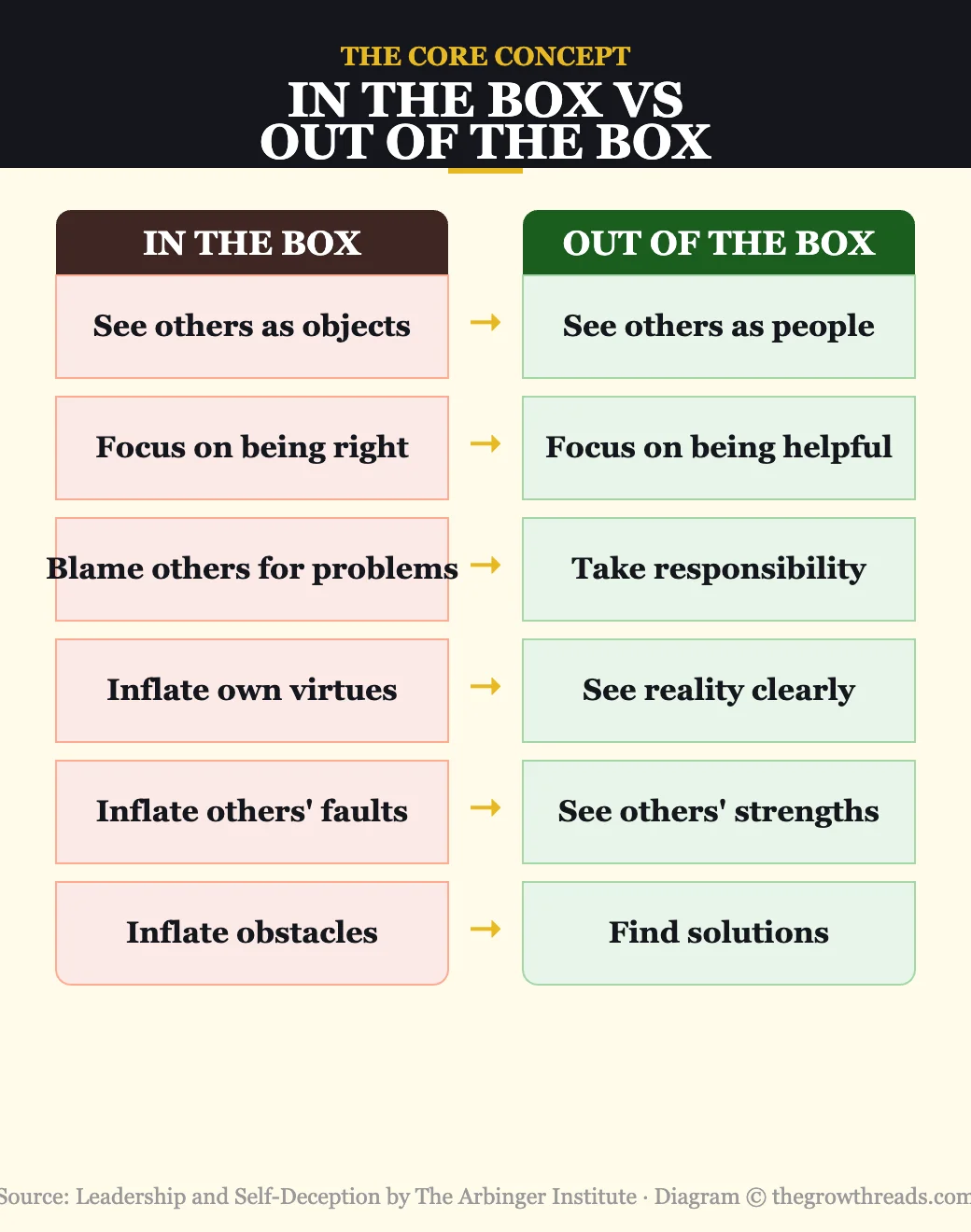
- The “box” is a mindset: When you are “in the box,” you see others as objects — obstacles to manage, vehicles to use, or irrelevancies to ignore — rather than as people.
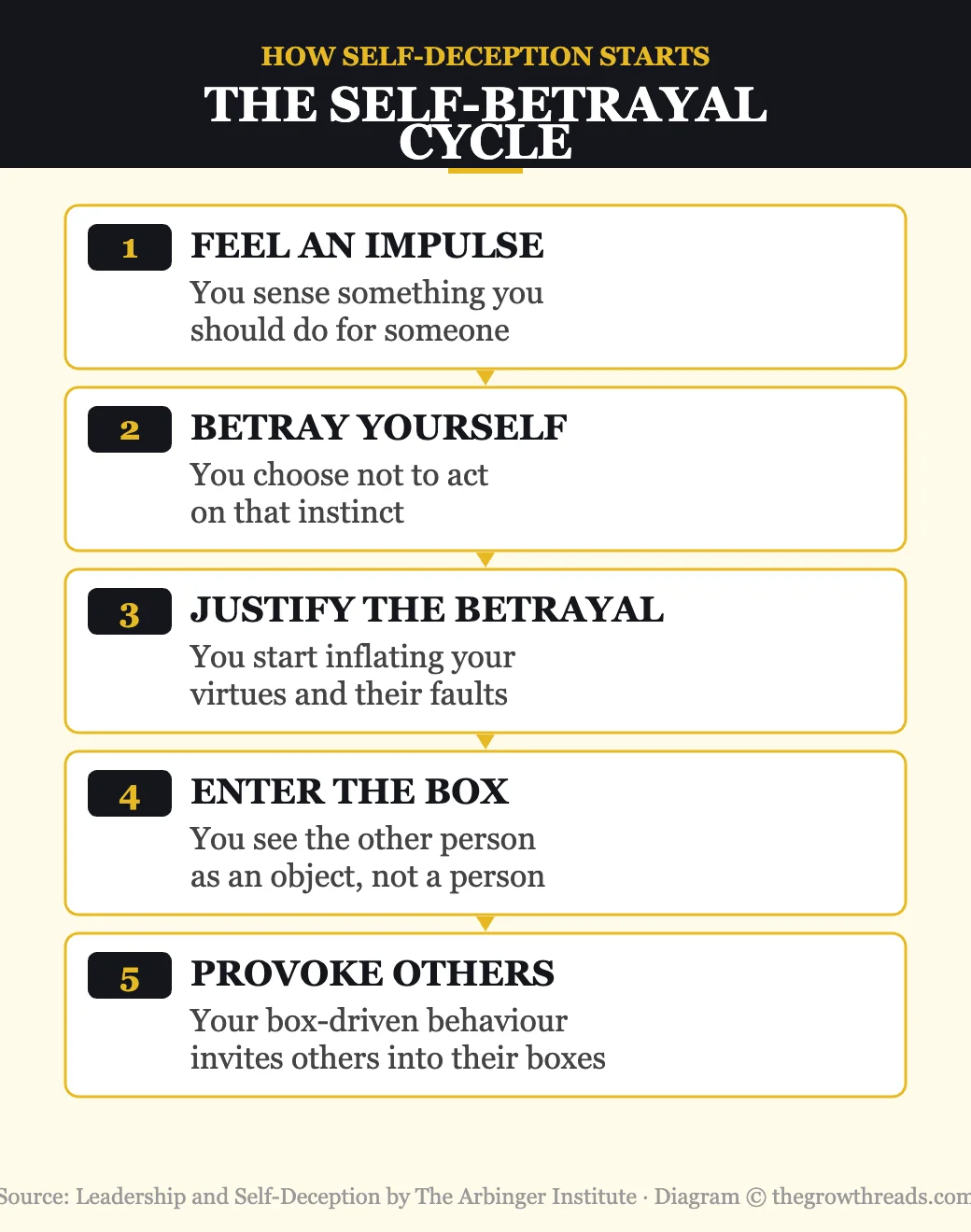
- Self-betrayal is the trigger: The box forms the moment you feel an impulse to help someone and choose not to act on it. That single act of self-betrayal launches a cascade of self-justification.
- Justification inflates everything: Once in the box, you inflate your own virtues, inflate others’ faults, and inflate the value of things that justify your self-betrayal.
- Boxes are contagious: Your in-the-box behaviour provokes others into their own boxes, creating a collusion pattern where both sides feel justified and neither side can see clearly.
- Techniques fail inside the box: Communication skills, feedback frameworks, and management tools backfire when delivered from inside the box because people sense the underlying contempt.
- You cannot force yourself out: Trying to change behaviour while staying in the box just produces better-disguised manipulation. The shift must happen at the level of how you see others.
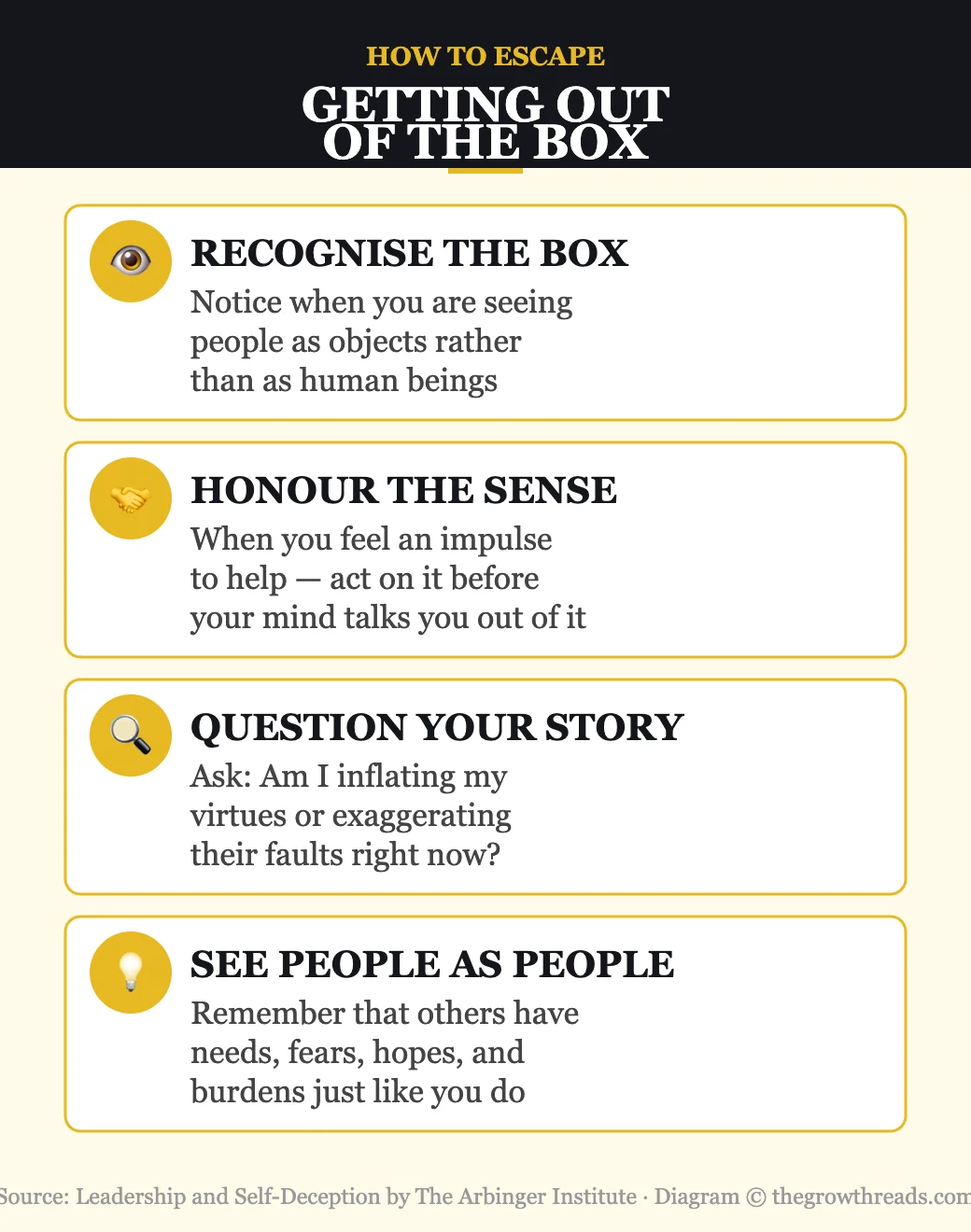
- Getting out is instantaneous: The moment you see another person as a person — with needs, fears, and hopes as legitimate as yours — you are already out of the box.
- Staying out requires practice: While getting out is a moment, staying out is a discipline. Self-betrayal opportunities arise constantly, and each one is a chance to re-enter the box.
- Organisational culture is shaped by boxes: Dysfunctional teams are collections of people in boxes blaming each other. Healthy cultures are built by leaders who model out-of-the-box being.
What is Leadership and Self-Deception about?
Leadership and Self-Deception is about the hidden pattern of self-deception that undermines leadership, teamwork, and personal relationships. Through a business fable, The Arbinger Institute shows how “being in the box” — seeing others as objects rather than people — is the root cause of most interpersonal dysfunction, and how getting out of the box transforms results without learning new techniques.
About the author
The Arbinger Institute is a management consulting and training firm founded in 1979, built on the philosophical work of C. Terry Warner at Brigham Young University. Warner’s research into self-deception and human interaction forms the intellectual backbone of the book. The Institute works with organisations ranging from small businesses to Fortune 500 companies, government agencies, and military units. Their methodology has been adopted by companies including Apple, Google, and Boeing. The book, first published in 2000, has sold over three million copies worldwide and has been updated through four editions to reflect evolving applications of the framework. Explore all The Arbinger Institute book summaries →
Key concepts at a glance
| Concept | What it means | Use it when |
|---|---|---|
| The Box | A self-deceived mindset where you see others as objects | You notice interpersonal friction that logic cannot explain |
| Self-Betrayal | Choosing not to act on an impulse to help someone | You catch yourself rationalising inaction toward a colleague |
| Collusion | Two people in boxes reinforcing each other’s justifications | A conflict keeps escalating despite both sides “being reasonable” |
| Inflation | Magnifying your virtues and others’ faults to justify the box | You hear yourself building a case for why someone else is the problem |
| Carrying Boxes | Bringing box-mindsets from one relationship into others | You notice the same conflict pattern repeating with different people |
| Outward Mindset | Seeing others as people with legitimate needs and goals | You want to shift a conversation from blame to collaboration |
Part 1 — The problem beneath the problem
The book opens with Tom Callum, a new senior leader at the fictional Zagrum Company, arriving for a one-day meeting with the executive vice president, Bud Jefferson. Tom expects the usual onboarding orientation. Instead, Bud tells him that Zagrum has identified a single factor that determines whether any leader succeeds or fails at the company: whether they are operating from inside or outside the “box.”
Bud explains that most management problems — missed deadlines, political infighting, poor morale, high turnover — are symptoms, not causes. The cause is a particular kind of self-deception. When a leader is in the box, they cannot see their own contribution to the very problems they are complaining about. They work harder, implement new processes, give more feedback — and nothing changes, because the problem is not what they are doing but how they are being.
The first illustration is disarmingly simple. Bud asks Tom to recall a time when he knew he should do something for another person — hold a door, help a struggling colleague, acknowledge a family member — and chose not to. That moment of choosing against your own sense of what was right is what Arbinger calls self-betrayal, and it is the gateway into the box.
Part 2 — How the box works: Self-betrayal and inflation
The centre of the book maps the mechanics of self-deception with precision. Once you commit an act of self-betrayal — choosing not to follow your instinct to help — a cascade of psychological distortions follows automatically. You begin to inflate three things: your own qualities (to prove you are justified), the other person’s faults (to prove they deserved your inaction), and the obstacles in your way (to prove the situation was impossible).
Bud walks Tom through a memorable example. A husband lies awake at night with a crying baby in the next room. He feels the impulse to get up so his wife can sleep. He does not. Immediately, his mind begins constructing justifications: “I have an important meeting tomorrow,” “She does not have to wake up early,” “I got up last time.” Within minutes, he has built an entire case — and he now sees his wife not as a tired partner but as a lazy, inconsiderate obstacle to his sleep. The box has formed.
The power of this illustration is its universality. Everyone has done this. The book shows that the same mechanism operates in boardrooms, on project teams, between departments, and in families. A manager who feels they should mentor a struggling report but does not will begin to see that report as lazy, entitled, or simply not talented enough to bother with — all to avoid the discomfort of their own self-betrayal.
Part 3 — Collusion: How boxes multiply
The most provocative section of the book introduces collusion — what happens when two people in boxes interact. When you treat someone as an object (from inside your box), they feel it. They may not be able to articulate what is wrong, but they sense the contempt, indifference, or instrumentalism behind your words. That feeling invites them into their own box, where they begin to see you as the problem.
Now both parties are in boxes, each one justified in their own view, each one provoking the other. The manager thinks, “This employee just does not care.” The employee thinks, “This manager just does not listen.” Both are partly right about the other’s behaviour — but both are blind to their own contribution to the dynamic. This is collusion: a self-reinforcing cycle where each person’s box feeds the other’s.
Arbinger argues that most organisational dysfunction — silos, blame cultures, passive-aggressive communication, political manoeuvring — is collusion at scale. Departments in boxes blame other departments. Leaders in boxes implement policies that treat employees as objects. Employees in boxes respond with disengagement, which confirms the leaders’ view that employees cannot be trusted. Everyone is right about everyone else’s behaviour, and no one can see their own.
Part 4 — Getting out: Seeing people as people
The resolution of the book is counterintuitively simple: you get out of the box by seeing others as people. Not by learning new communication techniques, not by implementing better processes, not by “trying harder” — but by genuinely recognising that the person in front of you has needs, fears, hopes, and burdens as real and legitimate as your own.
Arbinger is careful to distinguish this from mere behaviour change. You can smile at someone, use their name, give them feedback using the latest framework — and still be in the box. People sense the difference between a technique and genuine regard. The shift has to happen at the level of being, not doing. When you are genuinely out of the box, the right behaviours tend to follow naturally.
The book also addresses a common objection: “But what if the other person really is the problem?” Arbinger’s answer is that someone else’s poor behaviour does not force you into the box. You can see someone clearly — including their faults — while still seeing them as a person. Being out of the box does not mean being naive or avoiding accountability. It means holding people accountable while seeing them as human, which turns out to produce far better results than accountability delivered from contempt.
Who is Leadership and Self-Deception best for — and who should read something else first?
This book is essential for managers and team leads who keep running into the same interpersonal problems despite having “good intentions,” couples and families caught in cycles of blame, and anyone who suspects they might be contributing to the conflicts they keep experiencing. It is also one of the most effective books to read as a leadership team — the shared vocabulary of “the box” transforms how groups discuss friction.
If you are looking for a more tactical leadership playbook with specific tools and frameworks, start with The Culture Code by Daniel Coyle. If you prefer research-heavy psychology over fable-format storytelling, The Righteous Mind by Jonathan Haidt covers similar terrain about moral self-deception with more academic rigour.
Questions to reflect on
- Think of a person you currently find difficult — what story have you built about them, and what might their story about you be?
- When was the last time you felt an impulse to help someone and talked yourself out of it? What justification did you use?
- In your most important relationship (work or personal), where might you be in a collusion pattern without realising it?
- If you dropped every justification for a current conflict and asked “How am I contributing to this?” — what would you see?
- What would change in your team if you spent one week genuinely seeing every person as a person with needs as real as your own?
🔥 Ready to get out of the box?
Discover the hidden pattern of self-deception that sabotages leadership, relationships, and results.
How to apply Leadership and Self-Deception (7-day plan)
- Day 1 — Map your boxes: Identify three people in your life where you feel persistent friction. For each one, write down the “case” you have built against them — their faults, your justifications.
- Day 2 — Spot self-betrayal: Throughout the day, notice every moment you feel an impulse to help or acknowledge someone and choose not to. Jot them down without judgment.
- Day 3 — Humanise one person: Pick the person you are most “in the box” toward. Spend ten minutes genuinely considering their needs, pressures, fears, and hopes. Write a paragraph about their life from their perspective.
- Day 4 — Test a behaviour shift: Approach that person with something genuinely helpful — not as a technique, but because you now see their situation differently. Notice how the interaction changes.
- Day 5 — Check for collusion: In one ongoing conflict, ask yourself: “What am I doing that might be provoking the behaviour I am complaining about?” Write down at least two honest answers.
- Day 6 — Extend to your team: Before your next meeting, spend 60 seconds per attendee considering them as people with full lives and legitimate pressures. Notice how the meeting feels different.
- Day 7 — Establish a box check: Create a daily 2-minute reflection habit: “Was I in the box with anyone today? Who? What triggered it?” This builds the self-awareness muscle that prevents re-entry.
Frequently asked questions
What does “being in the box” mean in Leadership and Self-Deception?
Being “in the box” is the book’s metaphor for a state of self-deception where you see other people as objects rather than as human beings. When you are in the box, you view others as obstacles to your goals, vehicles for your purposes, or irrelevancies to ignore. This distorted perception drives destructive behaviours — blame, defensiveness, passive-aggression — while making you blind to your own contribution to the problem. The box forms through self-betrayal: the moment you feel an impulse to help someone and choose not to act on it.
What is self-betrayal in this context?
Self-betrayal is the act of going against your own sense of what you should do for another person. You feel an impulse — to help a colleague, to listen to your partner, to acknowledge a team member — and you choose not to act on it. This single moment triggers a cascade of self-justification: you begin inflating your own virtues, exaggerating the other person’s faults, and building a case for why your inaction was reasonable. Self-betrayal is the entry point into the box, and it happens dozens of times a day in most people’s lives.
How do you get out of the box?
You get out of the box by genuinely seeing another person as a person — someone with needs, fears, hopes, and challenges as real as your own. This is not a technique or a behaviour to perform; it is a shift in perception. You cannot force it by “trying harder” or learning new communication skills, because techniques delivered from inside the box still feel manipulative to others. The shift happens when you stop justifying your distorted view and allow yourself to see reality clearly. Once you are out, appropriate behaviours tend to follow naturally.
Is Leadership and Self-Deception relevant outside of work?
Absolutely. While the book uses a workplace setting, the framework applies to every human relationship. The Arbinger Institute’s research shows that the box operates identically in marriages, parenting, friendships, and community interactions. Many readers report that the book’s biggest impact was on their personal relationships rather than their professional ones. The in-the-box dynamic of seeing others as objects, inflating their faults, and justifying your own behaviour is universal to human psychology, not specific to management.
What is collusion in Leadership and Self-Deception?
Collusion is the pattern that emerges when two people are simultaneously in their boxes toward each other. Person A treats Person B as an object; Person B senses this and enters their own box, treating Person A as an object in return. Now both sides feel justified — and both are provoking the exact behaviour they complain about. Collusion is self-reinforcing: each person’s in-the-box behaviour confirms the other’s distorted view. Most chronic conflicts — between spouses, between departments, between nations — are collusion patterns.
Does being out of the box mean you cannot hold people accountable?
No — and this is one of the book’s most important points. Being out of the box does not mean being soft, naive, or avoiding difficult conversations. You can see someone’s poor performance clearly and hold them accountable while still seeing them as a person. The difference is that accountability delivered from outside the box feels fundamentally different to the recipient: it communicates “I see you and I want you to succeed” rather than “I have built a case against you.” Out-of-the-box accountability is actually more effective because it does not trigger defensiveness.
How is the fourth edition different from earlier editions?
The fourth edition (2024) updates the story with new characters and scenarios that reflect modern workplace challenges, including remote work dynamics and cross-functional team conflicts. The core framework — self-betrayal, the box, collusion, and getting out — remains unchanged. The new edition also includes a group discussion guide and additional resources for teams who want to apply the concepts together. If you have read an earlier edition, the fundamental ideas are the same, but the contemporary examples make the book feel more immediately relevant.
Related summaries
- The Culture Code by Daniel Coyle — The practical playbook for building the trust and belonging that emerge when leaders get out of the box.
- The Five Dysfunctions of a Team by Patrick Lencioni — Another leadership fable that diagnoses team dysfunction through a different lens.
- Radical Acceptance by Tara Brach — The internal practice of seeing yourself and others without judgment — the mindfulness companion to Arbinger’s framework.
- Extreme Ownership by Jocko Willink — The military leadership perspective on taking responsibility — the action-oriented counterpart to getting out of the box.
📚 Explore more: Best Leadership Books