

★★★★☆ 4.5/5 — A former McKinsey partner translates behavioral science and neuroscience into moment-by-moment tactics for navigating an actual workday, not just its big decisions.
Best for: Readers who want research-backed, granular tactics for specific hard moments — a tense meeting, a bad morning, a difficult colleague — rather than a single big system.
Reading time: ~7 hrs to read the book itself · ~9 minutes for this summary
Difficulty to apply: Moderate — the book covers a lot of ground, so most readers benefit from picking a few techniques rather than trying all of them at once.
How to Have a Good Day in one minute
Most bad days aren’t caused by one big thing — they’re built from dozens of small moments that could have gone either way. Caroline Webb, a former McKinsey partner turned executive coach, spent years translating behavioral economics and neuroscience findings into practical guidance for exactly those moments: the tone of the first email you read, how you walk into a tense meeting, what you tell yourself when a plan falls apart by 11am. The book’s central claim is that you have far more influence over how your day unfolds than it feels like in the moment — if you know which small levers to pull.
Key takeaways
- Two mental gears run your day: a slow, effortful “deliberate” system and a fast, automatic one — and both shape your decisions constantly.
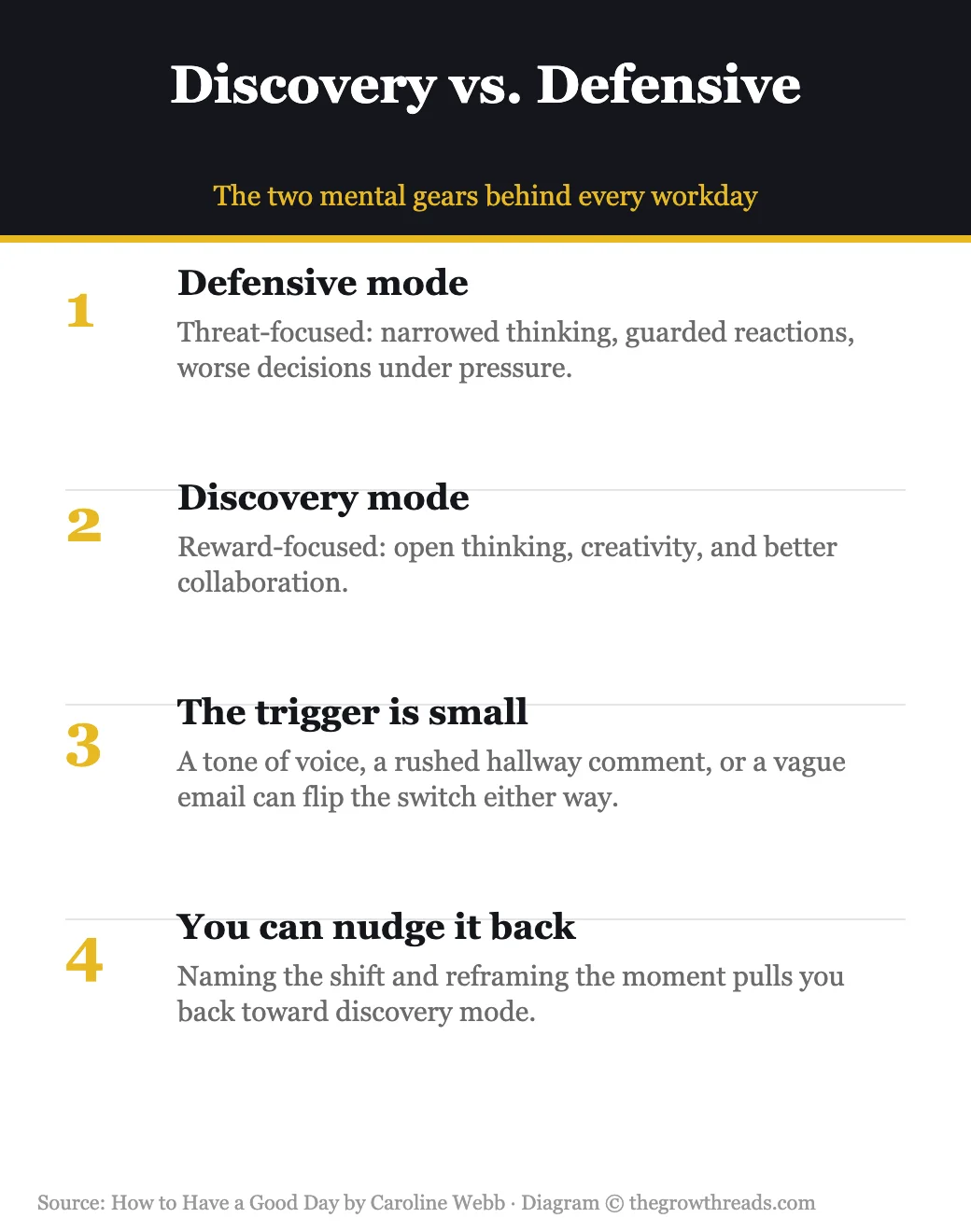
- You oscillate between defensive and discovery mode — threat-focused and narrow, or reward-focused and open — often without noticing the shift.
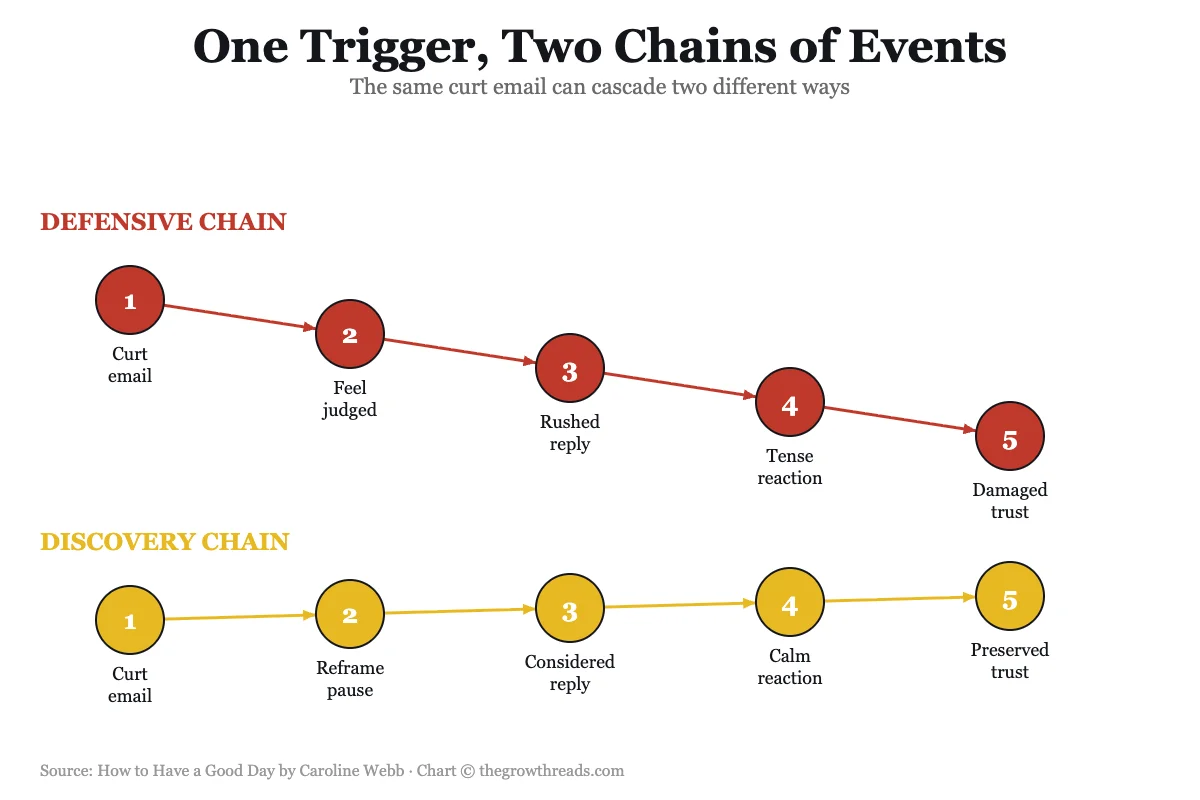
- Small triggers flip the switch: a curt email or rushed comment can tip you into defensive mode for the rest of a conversation.
- Mental contrasting beats pure positive thinking: picture the goal, then honestly name the obstacle most likely to derail it.
- “When-then” plans remove in-the-moment decisions: pre-deciding your response to a known obstacle makes it easier to follow through.
- Frame goals as approach, not avoidance: aiming toward what you want outperforms just trying to dodge what you fear.
- Deliberate effort is a limited daily resource — batch decisions and build routines to conserve it for what actually matters.
- Priming your mindset before a big moment — a meeting, a hard conversation — measurably changes how it goes.
- Single-task where it counts: switching costs are real, even when multitasking feels productive.
- A bad moment doesn’t have to become a bad day — the reset is often just noticing which mode you’re in and choosing to shift it.
What is How to Have a Good Day about?
It’s a behavioral-science field guide to the small moments that make up a workday. Caroline Webb translates findings from psychology, neuroscience, and behavioral economics into specific tactics for priorities, meetings, difficult colleagues, setbacks, and energy — helping readers notice when they’ve slipped into a defensive mindset and deliberately shift back toward a more open, productive one.
About the author
Caroline Webb spent over a decade as a partner at McKinsey & Company before training in behavioral economics and coaching, and later serving as an economist advising the UK Treasury and Bank of England on policy. That combination — management consulting rigor plus formal behavioral-science training — shapes the book’s approach: it doesn’t propose a single new theory, but synthesizes a wide range of established research into concrete, everyday tactics. That synthesis-first approach is also why the book reads more like a well-organized reference than a single-thesis manifesto — it draws on dozens of distinct research threads rather than building everything around one central metaphor. She has continued to work as an executive coach and speaker, applying the same behavioral-science lens to leadership and organizational culture beyond the book itself. Explore all Caroline Webb book summaries →
Key concepts at a glance
| Concept | What it means | Use it when |
| Deliberate vs. automatic system | Slow, effortful reasoning vs. fast, habitual processing — both run your decisions | Understanding why willpower fades over the day |
| Discovery vs. defensive mode | Open, reward-focused thinking vs. narrow, threat-focused reacting | Noticing why a conversation suddenly feels tense |
| Mental contrasting | Pairing a vivid goal with an honest obstacle before acting | Planning for something you’re likely to procrastinate on |
| When-then plans | Pre-deciding your response to a known obstacle | Situations where you tend to freeze or improvise poorly |
| Approach framing | Aiming toward a positive outcome instead of away from a feared one | Setting goals or giving yourself instructions under pressure |
| Priming | Deliberately setting your mindset before a high-stakes moment | Before a big meeting, negotiation, or difficult conversation |
Part 1: Two systems, one brain
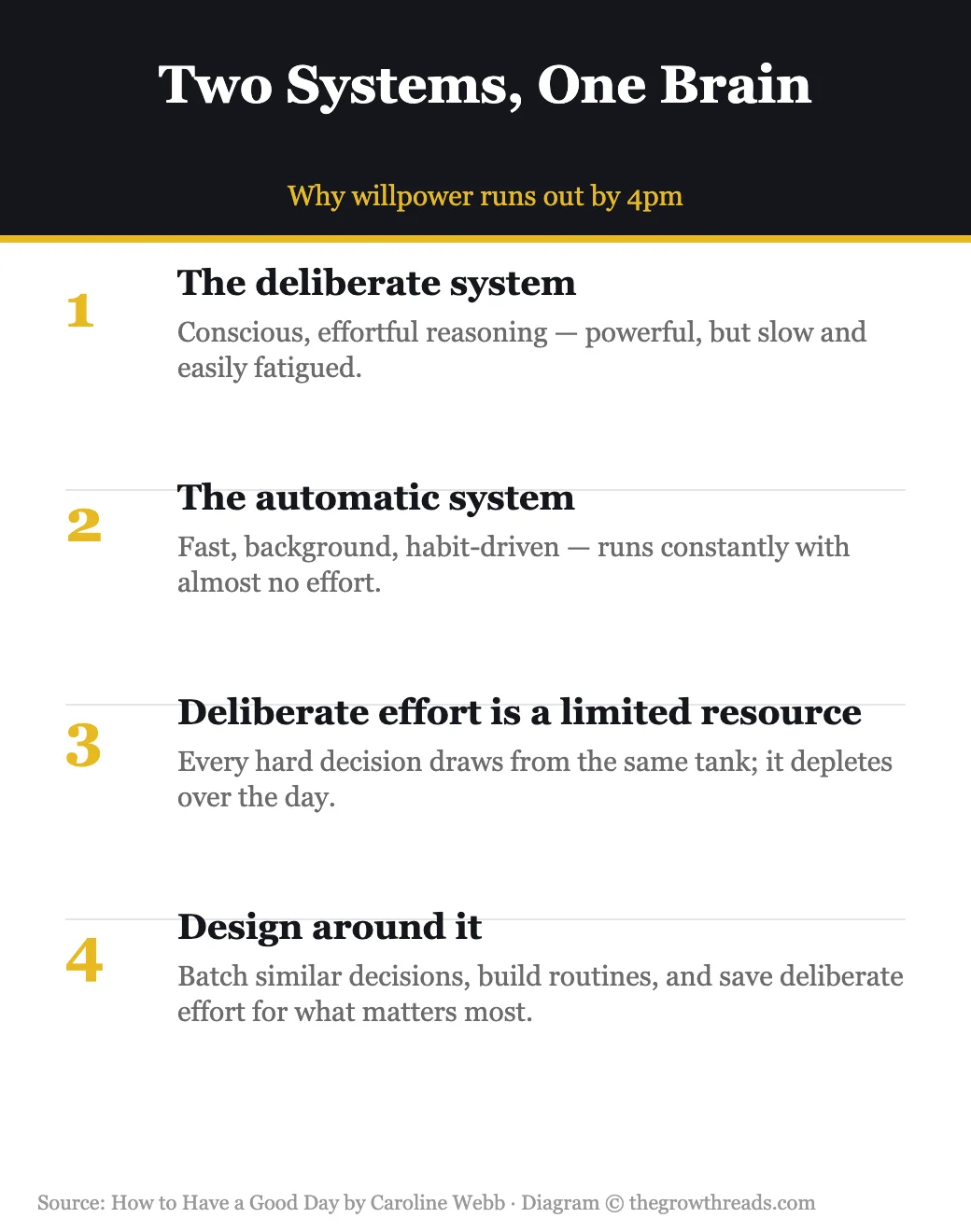
Webb builds the book on a dual-process model of the mind: a “deliberate” system that handles conscious reasoning, self-control, and complex judgment, and an “automatic” system that runs fast, constant, background processing — habits, snap judgments, gut reactions. The deliberate system is powerful but limited and slow to engage; the automatic system is effortless but can misfire, especially under stress or fatigue.
The practical implication is that willpower and careful judgment are finite resources that get spent down over a day, not constant capacities you can rely on equally at 9am and 5pm. Recognizing this, Webb argues, changes how you should sequence a day: put the decisions that genuinely need deliberate thought earlier, and lean on routines and defaults later, rather than assuming you’ll have the same clarity for a hard call at the end of a long day that you had at the start.
Webb points out this isn’t a character flaw to overcome through sheer discipline — it’s a structural feature of how the brain allocates effort, and fighting it head-on tends to fail. A more reliable approach is to design the day around it: front-load anything that needs careful judgment, and protect the tail end of the day for lower-stakes, more routine work where the automatic system can comfortably take over. This is one reason the same hard conversation can go noticeably differently depending on whether it happens first thing in the morning or as the last item on a packed afternoon — the deliberate system simply has less left to give by then, regardless of how important the topic is.
TGR Note: This finite-effort framing lines up with the “deliberate effort as a limited resource” idea behind the batching habits in Manage Your Day-to-Day — both books treat willpower as a budget to spend deliberately, not a constant you can assume.
Part 2: Discovery mode and defensive mode
Layered on top of the two-system model is a second axis: whether you’re currently in “discovery” mode (open, reward-focused, creative) or “defensive” mode (threat-focused, narrow, guarded). These aren’t personality traits — they’re states that shift, often within minutes, triggered by things as small as a curt email, a rushed hallway comment, or an ambiguous tone in a meeting.
The stakes are real: decisions made in defensive mode tend to be more guarded, less creative, and more likely to damage a relationship, while the same situation approached from discovery mode tends to produce better outcomes on every axis. This matters most in exactly the moments where the stakes feel highest — a performance review, a tense negotiation, a disagreement with a manager — because those are precisely the situations most likely to trigger a defensive response in the first place, right when a clear, open-minded reaction would serve you best. Webb’s practical advice is to build the habit of noticing which mode you’re in — a kind of running self-check — and to deliberately reframe a triggering moment (a pause, a reframe, a reminder of the bigger picture) before reacting, rather than letting the automatic system’s first response run the show.
Webb suggests this self-check doesn’t need to be elaborate — noticing physical cues (a tightened jaw, a faster pulse, a defensive tone creeping into your own voice) is often enough of a signal to prompt the reframe. The goal isn’t to suppress the automatic reaction entirely, which rarely works, but to insert a brief pause between the trigger and the response, long enough for the deliberate system to weigh in before a defensive reaction takes over the conversation.
TGR Note: The idea that a small trigger can flip your entire mode for a conversation echoes the “library rules” thinking in It Doesn’t Have to Be Crazy at Work — protecting the environment around a moment often matters as much as anything you consciously decide in it.
Part 3: Planning that actually survives contact with the day
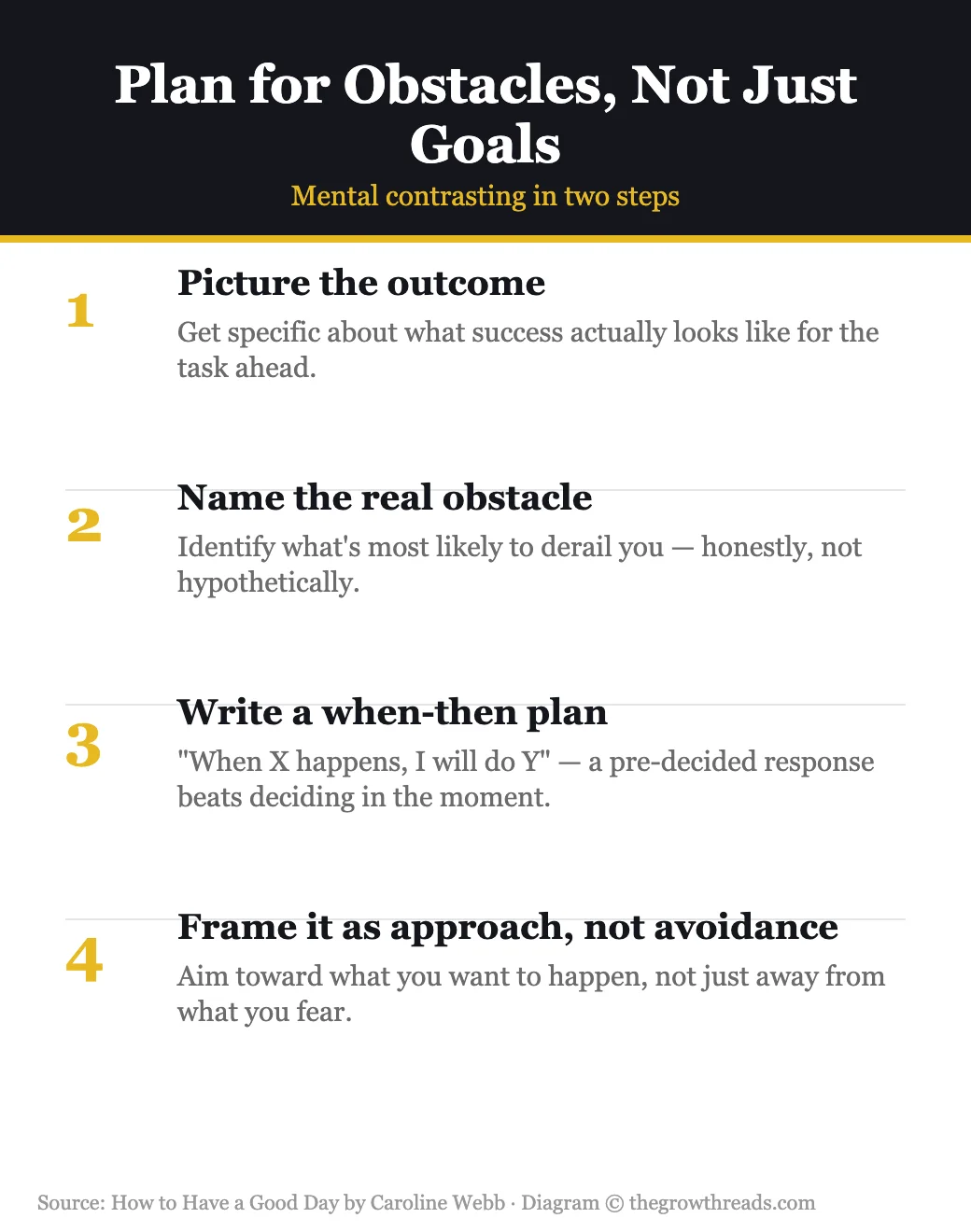
Webb draws on research showing that pure positive visualization — just picturing success — is a weaker predictor of follow-through than “mental contrasting”: pairing a vivid picture of the goal with an honest, specific look at the obstacle most likely to get in the way. Once that obstacle is named, a “when-then” plan converts it into a pre-decided response: “when my inbox is full at 9am, then I check priorities before opening it,” rather than deciding in the moment, when the automatic system is more likely to take over. The specificity matters — a vague intention like “I’ll try to stay focused” gives the automatic system nothing concrete to execute on, while a precise trigger-and-response pair can run almost on autopilot once the trigger occurs.
She pairs this with a preference for framing goals around approach rather than avoidance — aiming toward “give clear, calm feedback” rather than just “don’t lose my temper in this meeting.” The approach framing gives the deliberate system something concrete to aim for, rather than just something to suppress, which tends to hold up better under the exact pressure it was meant to prepare for.
Webb also flags a common planning mistake: treating the obstacle-naming step as pessimism to avoid, when it’s actually the part that makes the plan realistic. A goal without an honest obstacle attached tends to survive contact with the first busy morning; a goal paired with a specific, pre-decided response to its most likely obstacle is far more likely to still be standing by the afternoon.
TGR Note: This obstacle-first planning pairs naturally with the goal-cascade discipline in Extreme Productivity — knowing your target only helps if you’ve also planned for what’s likely to knock you off it.
Part 4: Recovering from a bad moment
The book treats a rough patch — a tense meeting, a harsh email, a missed deadline — as recoverable by design, not as evidence the whole day is lost. Because mode shifts happen quickly in both directions, a deliberate reset (a short pause, a walk, a reframe of what just happened) can pull you back toward discovery mode almost as fast as the original trigger pulled you into defensive mode. Webb frames this as one of the more practically useful findings in the book: the difference between a bad moment and a bad day is often just whether you notice the shift and choose to interrupt it.
This same logic extends to how she suggests closing out a workday — a brief, deliberate reflection on what went well and what to carry into tomorrow, rather than letting a rough afternoon color your read on the entire day, or worse, bleed into the evening at home.
Webb ties this back to the discovery/defensive framing directly: ending the day still in defensive mode — replaying a bad meeting, rehearsing a comeback you didn’t say — tends to carry that state into the next morning, compounding rather than resetting. A short, deliberate close-out ritual functions as its own kind of when-then plan: when the workday ends, then you take two minutes to name what went well before switching contexts entirely.
None of this requires the day to have gone perfectly. Webb is explicit that the goal isn’t an error-free workday — that’s not realistic for anyone — but a day where setbacks get processed and released rather than accumulated and carried forward, so that a rough Tuesday doesn’t quietly become a rough week.
Who is How to Have a Good Day best for — and who should read something else first?
This book is best for readers who want granular, research-backed tactics for specific hard moments — a difficult colleague, a tense meeting, a rough morning — rather than one big overarching system. Because it covers a lot of ground across a full workday, it rewards picking a few techniques to try rather than attempting all of them at once. Readers who try to adopt everything in the book at once often report it feels overwhelming — the better approach, echoed by several reviewers, is to treat it as a reference to dip into for a specific challenge rather than a linear program to complete cover to cover. If you want a tighter, single-framework approach to daily planning, Extreme Productivity is more streamlined. If your main issue is company-wide culture rather than personal moment-to-moment tactics, It Doesn’t Have to Be Crazy at Work addresses that at the organizational level instead.
Questions to reflect on
- Think of a recent moment that flipped you into defensive mode — what was the actual trigger, and how small was it?
- What’s one goal you’re currently framing as avoidance (“don’t mess this up”) that could be reframed as approach (“aim for this”)?
- What obstacle do you consistently underestimate when planning your day, and what would a when-then plan for it look like?
- Which of your daily decisions could be batched or turned into a routine to save deliberate effort for what matters more?
- The next time a moment goes badly, what’s your fastest reliable way back to discovery mode?
🔥 Ready to have a genuinely better workday?
Get How to Have a Good Day and try one behavioral-science tactic tomorrow.
How to apply How to Have a Good Day (7-day plan)
- Day 1: Notice one moment today when you shifted into defensive mode. Name the trigger after the fact.
- Day 2: Pick tomorrow’s hardest task and do mental contrasting: picture the goal, then honestly name the obstacle.
- Day 3: Write a when-then plan for that obstacle: “when X happens, then I will Y.”
- Day 4: Reframe one avoidance goal (“don’t be late”) as an approach goal (“arrive with five minutes to spare”).
- Day 5: Before your next important meeting, spend two minutes deliberately priming your mindset toward discovery mode.
- Day 6: Batch one category of small decisions (what to eat, what to wear, routine replies) to save deliberate effort for later.
- Day 7: If today includes a rough moment, practice the reset: pause, reframe, and consciously choose not to let it define the whole day.
Frequently asked questions
What is the main idea of How to Have a Good Day?
The main idea is that a good or bad day is built from many small moments, and behavioral science offers concrete, practical tactics for navigating those moments better — from the first email you read to a difficult conversation to how you recover from a setback. Caroline Webb translates research from psychology, neuroscience, and behavioral economics into everyday workplace guidance rather than proposing one new theory.
What are discovery mode and defensive mode?
They’re two mental states people shift between, often quickly and without noticing. Discovery mode is open, reward-focused, and creative; defensive mode is threat-focused, narrow, and guarded. Small triggers — a curt email, a rushed comment — can flip you into defensive mode, and the book argues you can deliberately notice and reverse that shift.
What is mental contrasting and how is it different from positive thinking?
Mental contrasting pairs a vivid picture of your goal with an honest, specific look at the obstacle most likely to derail it — as opposed to pure positive visualization, which research suggests is a weaker predictor of actually following through. Once the obstacle is named, a “when-then” plan gives you a pre-decided response instead of having to improvise when the obstacle actually shows up.
What’s the difference between the deliberate and automatic systems?
The deliberate system handles conscious reasoning, self-control, and complex judgment — it’s powerful but slow and limited. The automatic system runs fast, constant background processing like habits and snap reactions — effortless, but prone to misfiring under stress or fatigue. Both influence your decisions throughout the day, and deliberate effort specifically gets depleted as the day goes on.
Is this book more about mindset or about concrete tactics?
Both — it grounds each tactic in specific research findings, but the emphasis throughout is practical: what to actually do before a hard meeting, how to plan around a known obstacle, how to reset after a bad moment. Readers looking purely for a mindset shift without concrete steps, or purely a to-do-list system without the underlying reasoning, may find it covers more ground than they need.
Do I need to read the whole book, or can I use it as a reference?
Several reviewers note the book is comprehensive enough that it works well as a reference to dip into for a specific challenge — a tough meeting, a difficult colleague — rather than requiring a cover-to-cover read. Its chapter structure by topic (priorities, relationships, setbacks, energy) supports that kind of selective use.
How is this book different from other productivity books that cite behavioral science?
Its author’s background — a McKinsey partner turned behavioral-economics-trained coach and former economic policy advisor — gives it a synthesis-heavy approach, translating a wide range of established research into workday tactics rather than centering on one big idea or framework the way some productivity books do. That breadth is also its main trade-off: readers get comprehensive coverage at the cost of a single unifying hook.
Related summaries
- Extreme Productivity
- It Doesn’t Have to Be Crazy at Work
- Manage Your Day-to-Day
- Procrastinate on Purpose
- Best Productivity Books
How we analyze books: we read the source material, cross-check named frameworks and factual claims against independent sources, and build original diagrams, application plans, and reflection questions rather than reproducing the text. Read our full methodology.